History of Statistical Physics
By
Aqeel A. Al-Taie
May, 2016
Outline:
• Introduction
• Historical development:
• - Kinetic theory of gases
• - Caloric theory
• - Statistical mechanics
• Conclusions
Introduction
Statistical Physics: Unfinished & High
active part of physics.
We do not have the theoretical framework
to describe highly irreversible processes
such as fracture.
Properties of nonlinear systems that lead to
complicated pattern formation processes
is beyond our study of statisical physics.
Historical Development
In 17th century, the gas laws was formulated
when the physical nature of the air surrounding
the earth established .
The invention of the mercuri barometer by
Evangelista Torricelli (1608–47) and the fact
that Robert Boyle (1627–91) introduced the
pressure P as a new physical variable where
important steps. Then Boyle–Mariotte’s law PV
= const. for constant temperature, where V is
the volume, was formulated.
Kinetic Theory of Gases
The Swiss physicist and mathematician
Daniel Bernoulli published in 1738, the
Hydrodynamics which laid the basis for
the kinetic theory of gases. In this work,
Bernoulli posited the argument, still used
to this day, that gases consist of great
numbers of molecules moving in all Daniel Bernoulli
directions, that their impact on a (1700-82)
surface causes the gas pressure that
we feel, and that what we experience
as heat is simply the kinetic energy of
their motion.
Caloric Theoty
Bernoulli’s kinetic theory received so little
attention because most of scientists at that
time believed in the so–called caloric theory
of heat.
In this theory heat was a substance called
”caloric”. Caloric was considered to
be a fluid composed of particles which repel
each other.Each matter particle was thought to
be surrounded by an atmosphere of caloric
whose density increases with temperature.the
attractive forces between matter particles are of
gravitational origin just as the forces
between the sun and the planets.
At a certain distance between matter particles
there would be equilibrium between the caloric
repulsion and the gravitational attraction.
Reputed scientists as Pierre Simon de Laplace
(1749–1827) gave a very sophisticated
derivation of the gas laws within the caloric
theory.
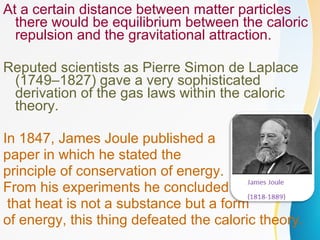
In 1847, James Joule published a
paper in which he stated the
principle of conservation of energy.
From his experiments he concluded
that heat is not a substance but a form
of energy, this thing defeated the caloric theory.
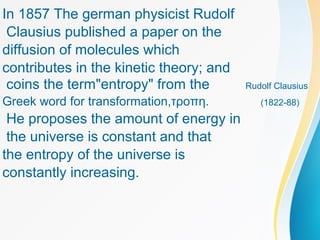
In 1857 The german physicist Rudolf
Clausius published a paper on the
diffusion of molecules which
contributes in the kinetic theory; and
coins the term"entropy" from the Rudolf Clausius
Greek word for transformation,τροπη. (1822-88)
He proposes the amount of energy in
the universe is constant and that
the entropy of the universe is
constantly increasing.
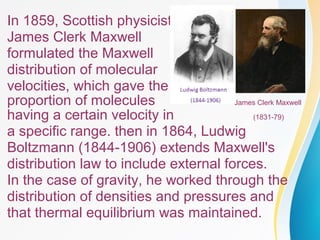
In 1859, Scottish physicist
James Clerk Maxwell
formulated the Maxwell
distribution of molecular
velocities, which gave the
proportion of molecules James Clerk Maxwell
having a certain velocity in (1831-79)
a specific range. then in 1864, Ludwig
Boltzmann (1844-1906) extends Maxwell's
distribution law to include external forces.
In the case of gravity, he worked through the
distribution of densities and pressures and
that thermal equilibrium was maintained.
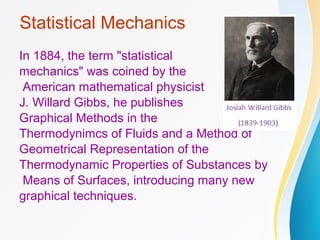
In 1884, the term "statistical
mechanics" was coined by the
American mathematical physicist
J. Willard Gibbs, he publishes
Graphical Methods in the
Thermodynimcs of Fluids and a Method of
Geometrical Representation of the
Thermodynamic Properties of Substances by
Means of Surfaces, introducing many new
graphical techniques.
Statistical Mechanics
In this century, Lars Onsager (1903–1976)
made several outstanding contributions. By
his exact solution of the Ising model, in two-
spatial dimensions, he proved that the
framework of statistical physics could
indeed tackle the problem of phase
transitions.
Conclusions
The motivation for studying the statistical
physics because the properties of non-
linear system granular media, earthquakes,
friction and many systems underlying to the
scope of statistical physics.
The field of statistical physics is in a phase of
rapid change. New ideas and concepts
permit a fresh approach to old problems.

History of statistical physics

  • 1.
    History of StatisticalPhysics By Aqeel A. Al-Taie May, 2016
  • 2.
    Outline: • Introduction • Historicaldevelopment: • - Kinetic theory of gases • - Caloric theory • - Statistical mechanics • Conclusions
  • 3.
    Introduction Statistical Physics: Unfinished& High active part of physics. We do not have the theoretical framework to describe highly irreversible processes such as fracture. Properties of nonlinear systems that lead to complicated pattern formation processes is beyond our study of statisical physics.
  • 4.
    Historical Development In 17thcentury, the gas laws was formulated when the physical nature of the air surrounding the earth established . The invention of the mercuri barometer by Evangelista Torricelli (1608–47) and the fact that Robert Boyle (1627–91) introduced the pressure P as a new physical variable where important steps. Then Boyle–Mariotte’s law PV = const. for constant temperature, where V is the volume, was formulated.
  • 5.
    Kinetic Theory ofGases The Swiss physicist and mathematician Daniel Bernoulli published in 1738, the Hydrodynamics which laid the basis for the kinetic theory of gases. In this work, Bernoulli posited the argument, still used to this day, that gases consist of great numbers of molecules moving in all Daniel Bernoulli directions, that their impact on a (1700-82) surface causes the gas pressure that we feel, and that what we experience as heat is simply the kinetic energy of their motion.
  • 6.
    Caloric Theoty Bernoulli’s kinetictheory received so little attention because most of scientists at that time believed in the so–called caloric theory of heat. In this theory heat was a substance called ”caloric”. Caloric was considered to be a fluid composed of particles which repel each other.Each matter particle was thought to be surrounded by an atmosphere of caloric whose density increases with temperature.the attractive forces between matter particles are of gravitational origin just as the forces between the sun and the planets.
  • 7.
    At a certaindistance between matter particles there would be equilibrium between the caloric repulsion and the gravitational attraction. Reputed scientists as Pierre Simon de Laplace (1749–1827) gave a very sophisticated derivation of the gas laws within the caloric theory. In 1847, James Joule published a paper in which he stated the principle of conservation of energy. From his experiments he concluded that heat is not a substance but a form of energy, this thing defeated the caloric theory.
  • 8.
    In 1857 Thegerman physicist Rudolf Clausius published a paper on the diffusion of molecules which contributes in the kinetic theory; and coins the term"entropy" from the Rudolf Clausius Greek word for transformation,τροπη. (1822-88) He proposes the amount of energy in the universe is constant and that the entropy of the universe is constantly increasing.
  • 9.
    In 1859, Scottishphysicist James Clerk Maxwell formulated the Maxwell distribution of molecular velocities, which gave the proportion of molecules James Clerk Maxwell having a certain velocity in (1831-79) a specific range. then in 1864, Ludwig Boltzmann (1844-1906) extends Maxwell's distribution law to include external forces. In the case of gravity, he worked through the distribution of densities and pressures and that thermal equilibrium was maintained.
  • 10.
    In 1884, theterm "statistical mechanics" was coined by the American mathematical physicist J. Willard Gibbs, he publishes Graphical Methods in the Thermodynimcs of Fluids and a Method of Geometrical Representation of the Thermodynamic Properties of Substances by Means of Surfaces, introducing many new graphical techniques. Statistical Mechanics
  • 11.
    In this century,Lars Onsager (1903–1976) made several outstanding contributions. By his exact solution of the Ising model, in two- spatial dimensions, he proved that the framework of statistical physics could indeed tackle the problem of phase transitions.
  • 12.
    Conclusions The motivation forstudying the statistical physics because the properties of non- linear system granular media, earthquakes, friction and many systems underlying to the scope of statistical physics. The field of statistical physics is in a phase of rapid change. New ideas and concepts permit a fresh approach to old problems.