History of
Mathematics
Library Resources
Jane Wu
Class Objectives
• Understand how to effectively search online databases
• Understand Boolean Logic search strategies
• Understand differences between keyword and subject
• Understand the differences between primary vs.
secondary sources
• Know major sources that can be used for the class
Class Guide
• Getting Started
• http://otterbein.libguides.com/mathhis
• Exploring your topics
• Finding Aids
• Research databases
• Books
• Journal Articles
• Internet Sources
• Citing the Sources
• Using MLA, APA styles correctly
• RefWorks
• Research Consultation
Finding Books
• Otterbein’s Catalog
• Subject Vs Keyword
• OPAL Catalog (20 libraries)
• OhioLINK Catalog (84 libraries)
• Delivery within 4 days
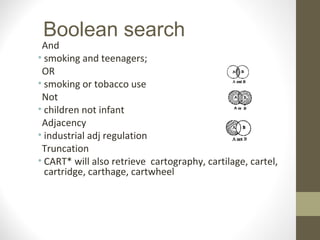
Boolean search
And
• smoking and teenagers;
OR
• smoking or tobacco use
Not
• children not infant
Adjacency
• industrial adj regulation
Truncation
• CART* will also retrieve cartography, cartilage, cartel,
cartridge, carthage, cartwheel
Databases
• Academic Search Premier
• Journals from many disciplines, but good mathematical journals
also.
• ERIC (EBSCO)
• The Education Database.
• MathSciNet
• ISI Web of Science
• Science Citation Index Expanded
• Scopus
• The most comprehensive database of peer-reviewed research
Science Citation Index
• access to current bibliographic information and cited
references from more than 7100 of the world's leading
professional scientific research journals covering more
than 150 disciplines.
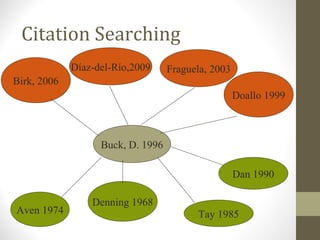
• Researchers can search the citation data (the footnotes
of each article), taking a known, relevant paper and
finding other, more recent papers that cite it.
Citation Searching
Buck, D. 1996
Fraguela, 2003
Doallo 1999
Aven 1974
Denning 1968
Tay 1985
Dan 1990
Díaz-del-Río,2009
Birk, 2006
MathSciNet Facts and Figures:
• American Mathematical Society database of more than a
million reviews and abstracts of math publications
• Bibliographic data and reviews of mathematical research
literature contained in the Mathematical Reviews and
Current Mathematical Publications since 1940.
• MathSciNet, the Mathematical Reviews Database,
Mathematical Reviews, and Current Mathematical
Publications are all produced by the American
Mathematical Society.
• Most of the items are classified according to the
Mathematics Subject Classification
Search fields
• Author: any author in the Mathematical Reviews database
• Author/Related: an author, an editor of a book or journal issue,
• Title: any word or phrase in the title of a work
• Institution Code: the code Mathematical Reviews uses to identify the
institutional affiliation of an author.
• Series: any words that could appear in the title of a series
• MSC Primary/Secondary: All items in the Mathematical Reviews
database receive a classification code using the Mathematical
Subjects classification scheme. These are either 2 digit (ex: 65 for
Numerical analysis), 3 digit (ex: 65D for Numerical approximation and
computational geometry (primarily algorithms)) or 5 digit (ex: 65D05
for Interpolation). All items have a least one MSC number, the
primary number; some have more than one, a secondary number.
• MR Numbers: numbers assigned to every item with a review. They
are connected to the year and month of publication and to the MSC
code. Example: MR2639867
• Anywhere: allows searching of all other search fields simultaneously
Search criteria and others
• The wildcard character is the asterisk (*) and
may be used in all fields except MR Number and
Mathematics Subject Classifications
• To search for mathematical symbols omit the
initial  from the Tex code. For example, to
search for {rm P}spinfty, enter p sp infty.
• References, Reference Citations, Review
Citations
SCOPUS
• The largest abstract and citation database containing
both peer-reviewed research literature and quality web
sources
• 50 million records. 21,000 titles. 5,000 publishers, of
which 20,000 are peer-reviewed journals
• Quick, easy and comprehensive resource covers
scientific, technical, medical and social sciences fields
and the arts and humanities fields.
Need More Help
• Call us at 614 823-1984 during the library hours
• E-mail us too! Library@otterbein.edu
• Chat with a Librarian on line.
• IM User Name: otterbeinlibrary (AIM, MSN, Yahoo, Google Talk)
• Schedule a Research Consultation Session

Math history r

  • 1.
  • 2.
    Class Objectives • Understandhow to effectively search online databases • Understand Boolean Logic search strategies • Understand differences between keyword and subject • Understand the differences between primary vs. secondary sources • Know major sources that can be used for the class
  • 3.
    Class Guide • GettingStarted • http://otterbein.libguides.com/mathhis • Exploring your topics • Finding Aids • Research databases • Books • Journal Articles • Internet Sources • Citing the Sources • Using MLA, APA styles correctly • RefWorks • Research Consultation
  • 4.
    Finding Books • Otterbein’sCatalog • Subject Vs Keyword • OPAL Catalog (20 libraries) • OhioLINK Catalog (84 libraries) • Delivery within 4 days
  • 5.
    Boolean search And • smokingand teenagers; OR • smoking or tobacco use Not • children not infant Adjacency • industrial adj regulation Truncation • CART* will also retrieve cartography, cartilage, cartel, cartridge, carthage, cartwheel
  • 6.
    Databases • Academic SearchPremier • Journals from many disciplines, but good mathematical journals also. • ERIC (EBSCO) • The Education Database. • MathSciNet • ISI Web of Science • Science Citation Index Expanded • Scopus • The most comprehensive database of peer-reviewed research
  • 7.
    Science Citation Index •access to current bibliographic information and cited references from more than 7100 of the world's leading professional scientific research journals covering more than 150 disciplines. • Researchers can search the citation data (the footnotes of each article), taking a known, relevant paper and finding other, more recent papers that cite it.
  • 8.
    Citation Searching Buck, D.1996 Fraguela, 2003 Doallo 1999 Aven 1974 Denning 1968 Tay 1985 Dan 1990 Díaz-del-Río,2009 Birk, 2006
  • 9.
    MathSciNet Facts andFigures: • American Mathematical Society database of more than a million reviews and abstracts of math publications • Bibliographic data and reviews of mathematical research literature contained in the Mathematical Reviews and Current Mathematical Publications since 1940. • MathSciNet, the Mathematical Reviews Database, Mathematical Reviews, and Current Mathematical Publications are all produced by the American Mathematical Society. • Most of the items are classified according to the Mathematics Subject Classification
  • 10.
    Search fields • Author:any author in the Mathematical Reviews database • Author/Related: an author, an editor of a book or journal issue, • Title: any word or phrase in the title of a work • Institution Code: the code Mathematical Reviews uses to identify the institutional affiliation of an author. • Series: any words that could appear in the title of a series • MSC Primary/Secondary: All items in the Mathematical Reviews database receive a classification code using the Mathematical Subjects classification scheme. These are either 2 digit (ex: 65 for Numerical analysis), 3 digit (ex: 65D for Numerical approximation and computational geometry (primarily algorithms)) or 5 digit (ex: 65D05 for Interpolation). All items have a least one MSC number, the primary number; some have more than one, a secondary number. • MR Numbers: numbers assigned to every item with a review. They are connected to the year and month of publication and to the MSC code. Example: MR2639867 • Anywhere: allows searching of all other search fields simultaneously
  • 11.
    Search criteria andothers • The wildcard character is the asterisk (*) and may be used in all fields except MR Number and Mathematics Subject Classifications • To search for mathematical symbols omit the initial from the Tex code. For example, to search for {rm P}spinfty, enter p sp infty. • References, Reference Citations, Review Citations
  • 12.
    SCOPUS • The largestabstract and citation database containing both peer-reviewed research literature and quality web sources • 50 million records. 21,000 titles. 5,000 publishers, of which 20,000 are peer-reviewed journals • Quick, easy and comprehensive resource covers scientific, technical, medical and social sciences fields and the arts and humanities fields.
  • 13.
    Need More Help •Call us at 614 823-1984 during the library hours • E-mail us too! Library@otterbein.edu • Chat with a Librarian on line. • IM User Name: otterbeinlibrary (AIM, MSN, Yahoo, Google Talk) • Schedule a Research Consultation Session