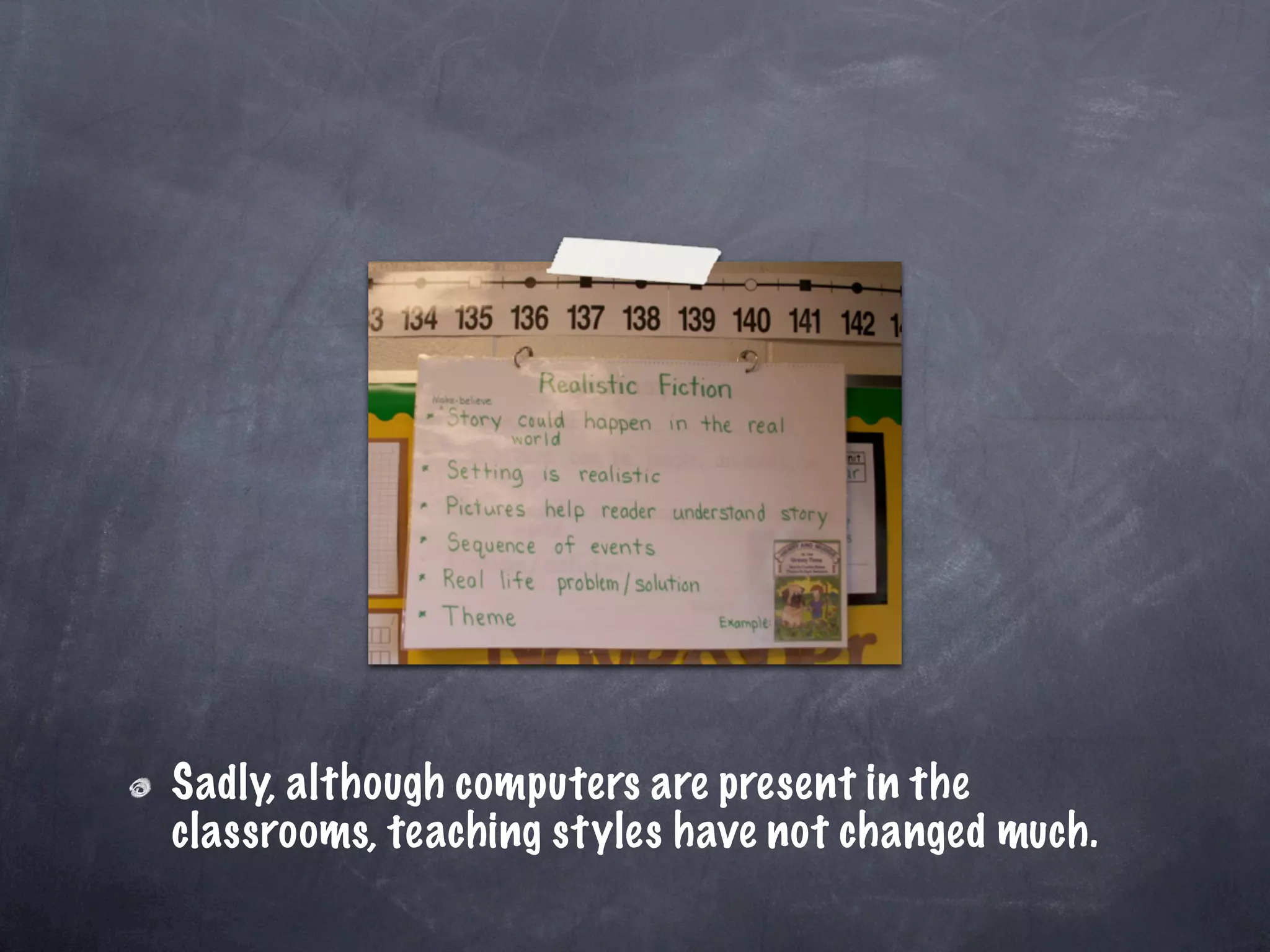
Computers were first introduced into schools in the 1960s and were primarily used for administrative purposes and computer-assisted instruction to help students practice skills. In the 1980s, teachers were wary of computers replacing them or malfunctioning in the classroom. By the 1990s, many schools had outdated computers that could not run the latest software, and relied on gopher servers for online information. While computers became more common in classrooms over time, teaching styles did not significantly change and technology integration faced roadblocks around lack of funding and mindsets.
History of Computersin
Education
Jolina Shue
EDUC 515 - Educational Technology & Learning
San Diego Regional Center
Master’s Digital Teaching & Learning
Professor: Jeff McKendricks
Summer 2009
2.
A brief history
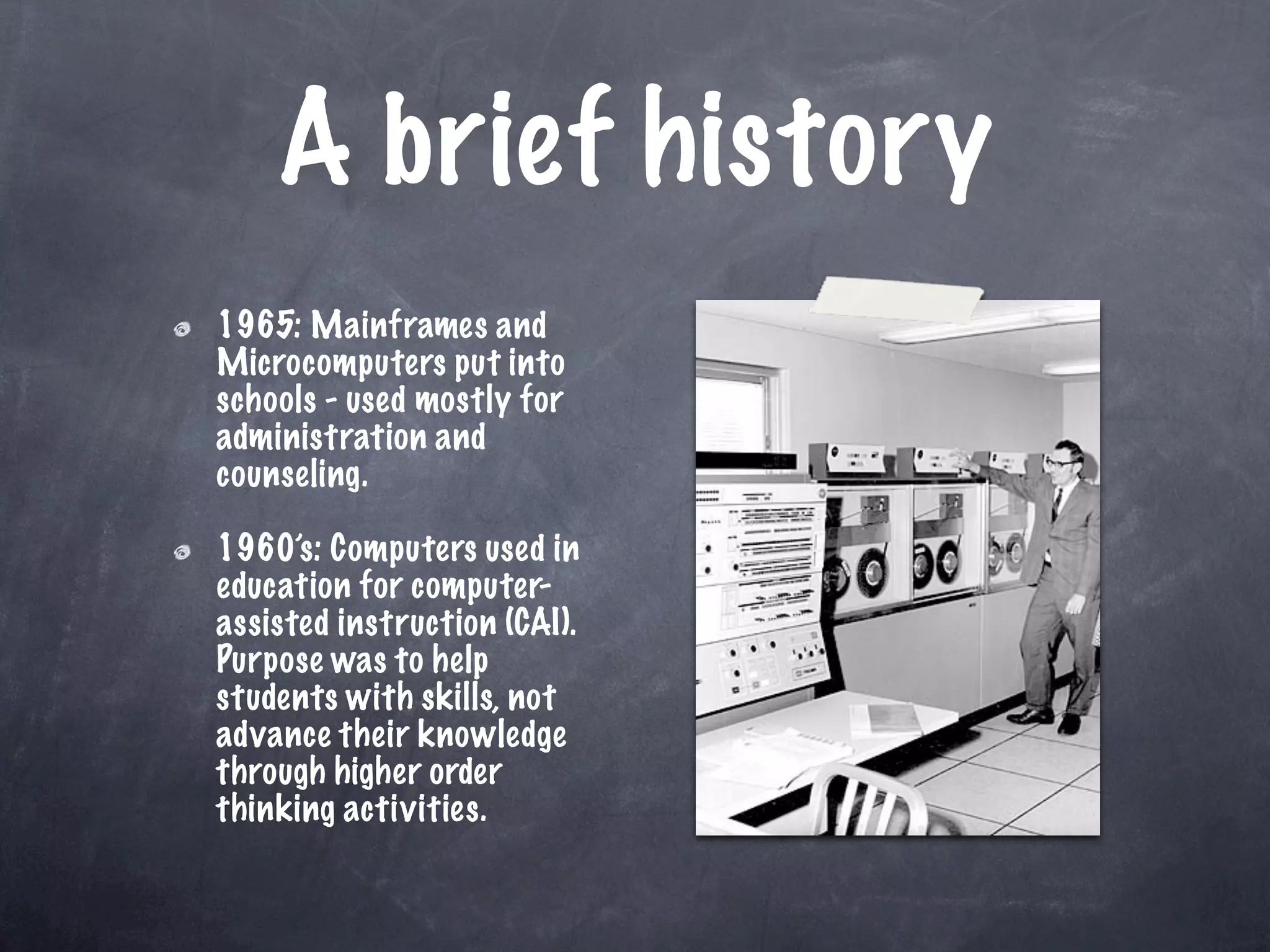
1965:Mainframes and
Microcomputers put into
schools - used mostly for
administration and
counseling.
1960’s: Computers used in
education for computer-
assisted instruction (CAI).
Purpose was to help
students with skills, not
advance their knowledge
through higher order
thinking activities.
3.
1975: Apple IComputers donated to schools.
1980’s: Teachers afraid they would be replaced by
computers & fearful of computer malfunctions.
Overall, the 80’s had little in the way of
educational soft ware. Teacher’s were asking, “how
do I use a computer in my classroom?”
Educational philosophy at the time - students
needed to know how the computer worked
(programing language).
4.
Students sent toa computer lab
to learn by a computer teacher.
1983: Belief surfacing that
computers can be used to support
teaching.
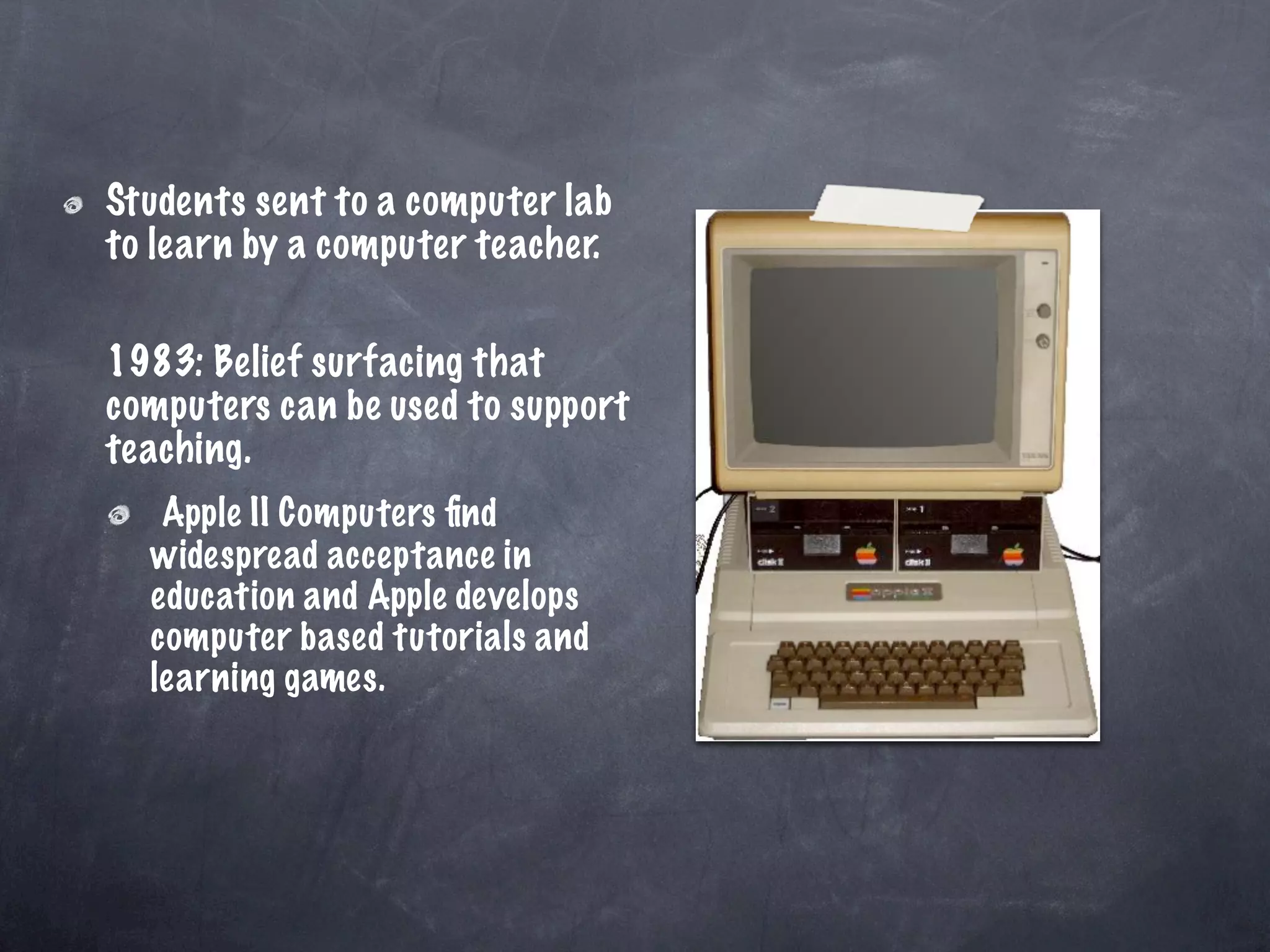
Apple II Computers find
widespread acceptance in
education and Apple develops
computer based tutorials and
learning games.
5.
With the developmentof AppleWorks, school
computers had word processing, spreadsheet,
database, paint and draw application. This caused a
move away from teaching programming.
1992: Many
computers in
schools, but they
could not manage
the latest
soft ware available
and were using
gopher ser vers to
provide students
with online
information.
6.
Computing power wassurpassing the capacity and
budgets of schools and they were left with outdates
computers.
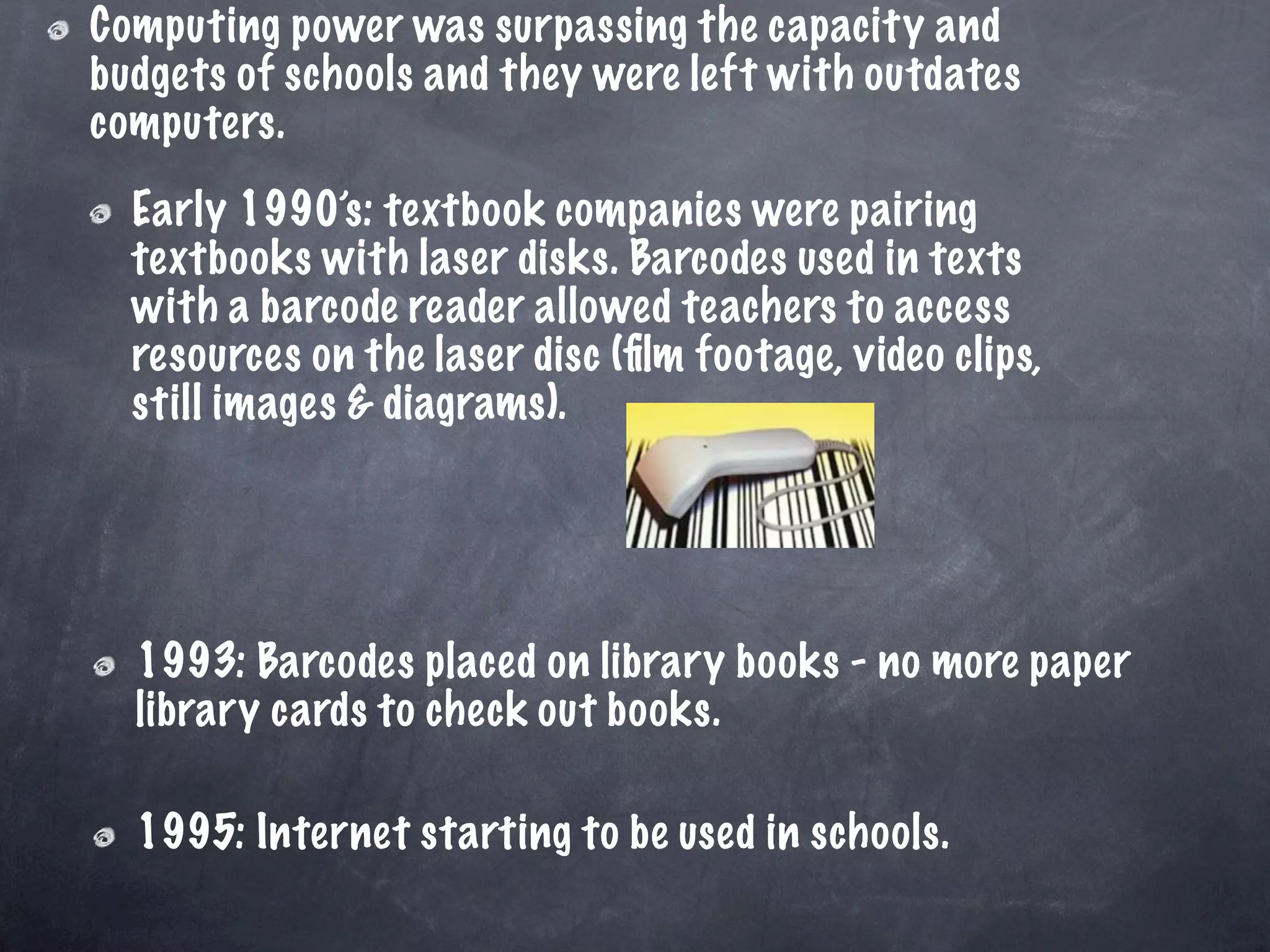
Early 1990’s: textbook companies were pairing
textbooks with laser disks. Barcodes used in texts
with a barcode reader allowed teachers to access
resources on the laser disc (film footage, video clips,
still images & diagrams).
1993: Barcodes placed on library books - no more paper
library cards to check out books.
1995: Internet starting to be used in schools.
7.
1996: New graphicsad multimedia tools are
developed for delivery of information and
instruction using the internet. Schools start re-
wiring for internet access.
1997-present: Schools continually attempt to
integrate computers into direct instruction, but
lack of money and unchanging mindsets place
roadblocks on technology integration.
References
California State LongBeach University. History, the history
of computers,and the history of computers in education.
<http://www.csulb.edu/~murdock/histofcs.html>. Retrieved
June 25, 2009.
IGI Global. A brief history of computers, computing in
education. <https:/ /igi-pub.com/downloads/excerpts/
SchifterExc.pdf>. Retrieved June 25, 2009.
Google Images