A BRIEF HISTROY OF AR
POONTAMILSELVAN P
22CDR068
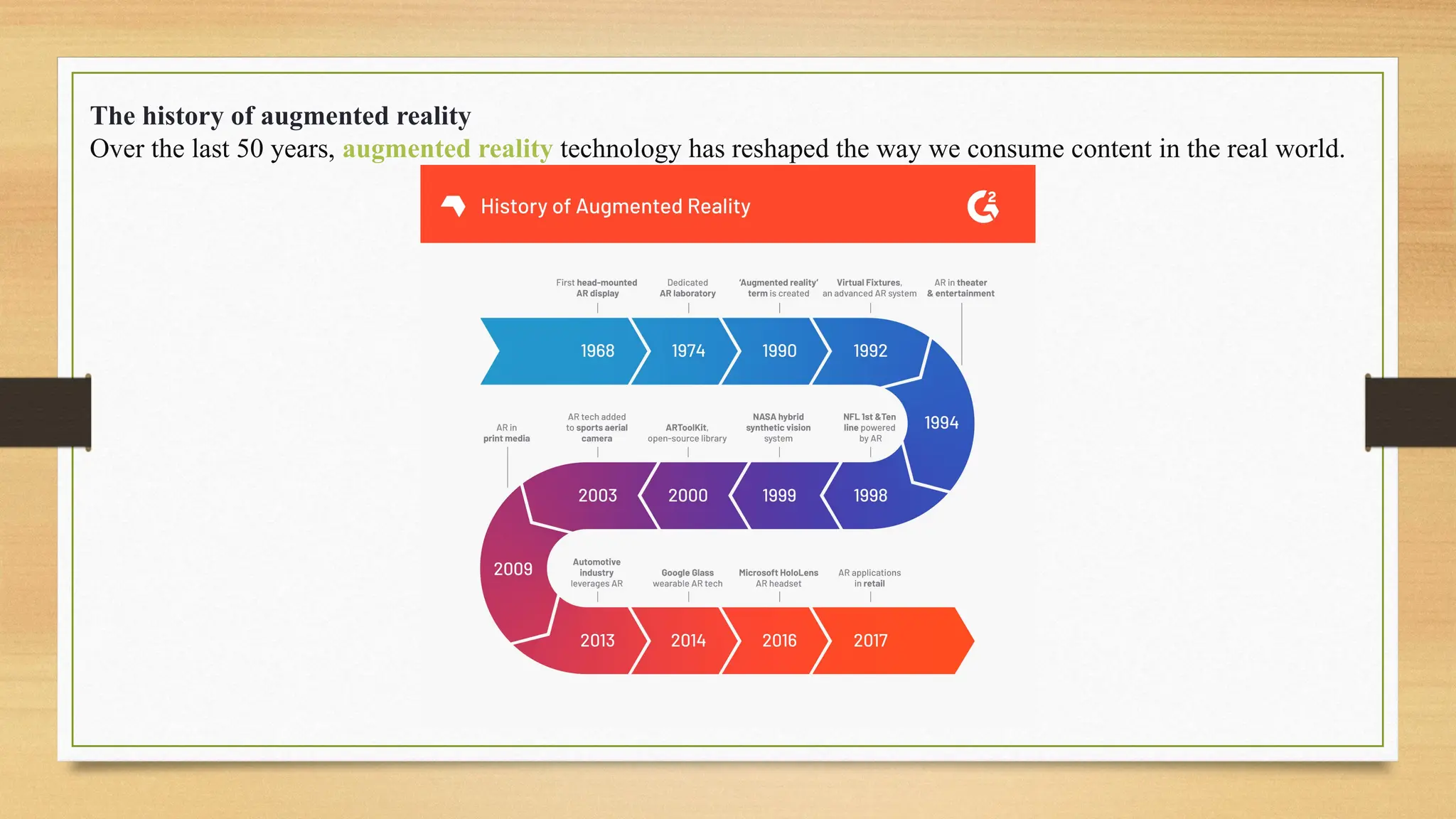
The history of augmented reality
Over the last 50 years, augmented reality technology has reshaped the way we consume content in the real world.
Augmented reality in the 60s & 70s
Let's take a look back to see how AR technology was created in the first place.
• 1968: Ivan Sutherland, a Harvard professor and computer scientist, created the first head-mounted display called
‘The Sword of Damocles’.
• The user experienced computer-generated graphics that enhanced their sensory perception of the world.
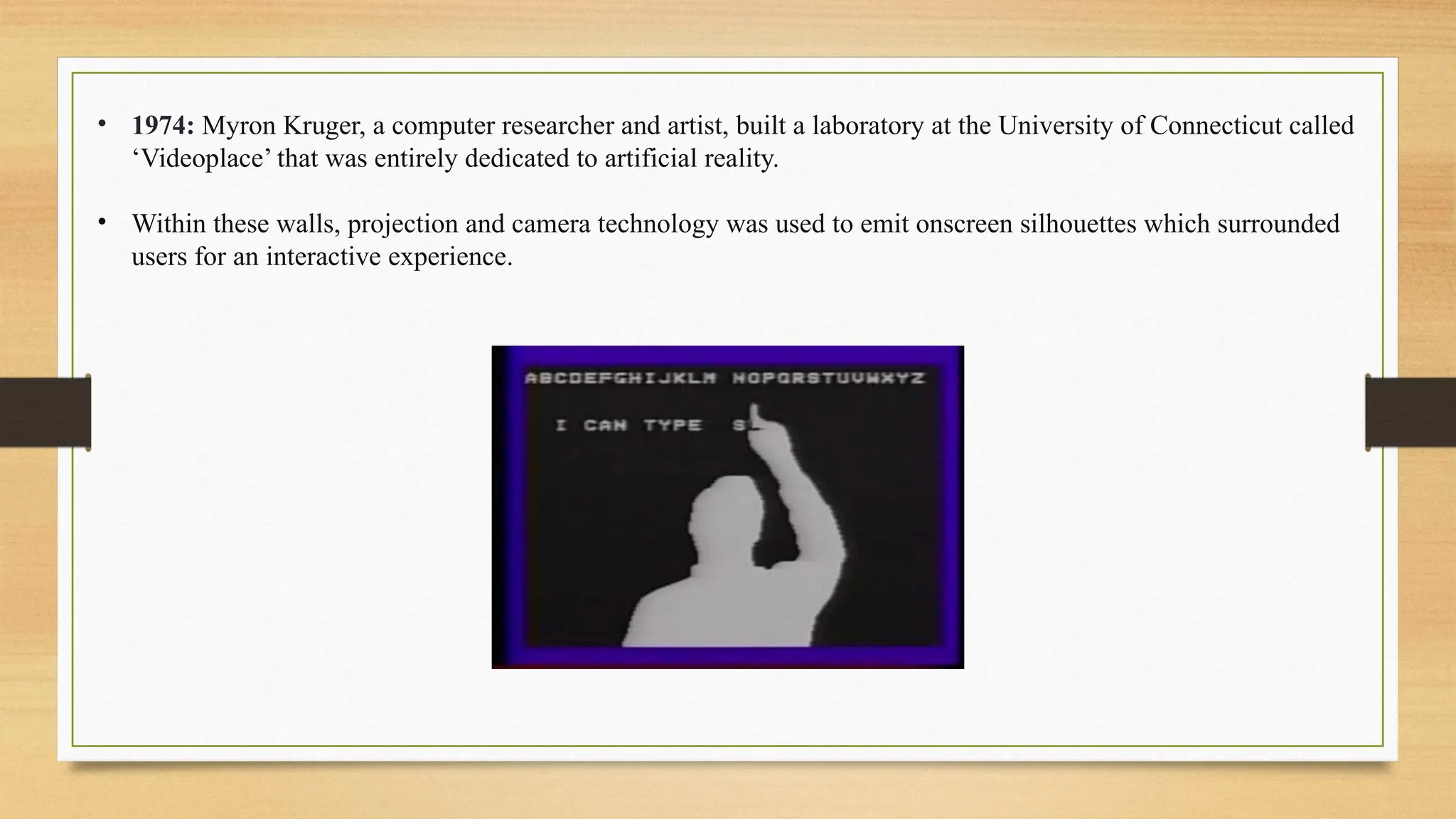
• 1974: Myron Kruger, a computer researcher and artist, built a laboratory at the University of Connecticut called
‘Videoplace’ that was entirely dedicated to artificial reality.
• Within these walls, projection and camera technology was used to emit onscreen silhouettes which surrounded
users for an interactive experience.
Augmented reality in the 80s & 90s
Now, let's learn how AR transitioned out of the lab and into various industries and business applications.
• 1990: Tom Caudell, a Boeing researcher, coined the term ‘augmented reality’.
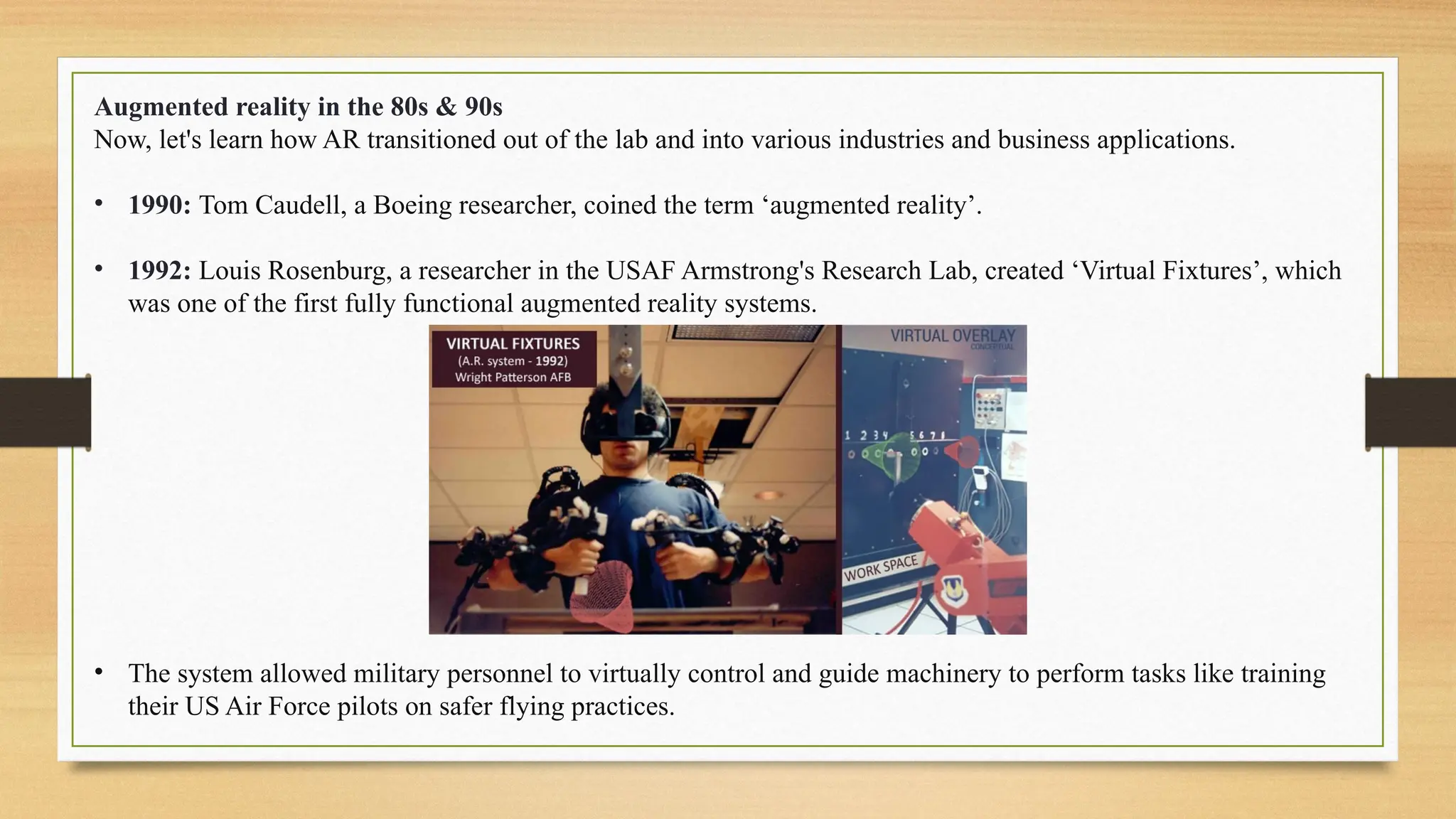
• 1992: Louis Rosenburg, a researcher in the USAF Armstrong's Research Lab, created ‘Virtual Fixtures’, which
was one of the first fully functional augmented reality systems.
• The system allowed military personnel to virtually control and guide machinery to perform tasks like training
their US Air Force pilots on safer flying practices.
• 1994: Julie Martin, a writer and producer, brought augmented reality to the entertainment industry for the first
time with the theater production titled Dancing in Cyberspace.
• The show featured acrobats dancing alongside projected virtual objects on the physical stage.
• 1998: Sportsvision broadcasts the first live NFL game with the virtual 1st & Ten graphic system – aka the yellow
yard marker. The technology displays a yellow line overlayed on top of the feed to that views can quickly see
where the team just advance to get a first down.
• This system is still used today, although admittedly more advanced than it was in the late ‘90s. Viewers have
become accustomed to the yellow line marker and other additional graphics – most don’t even know that this is a
form of AR technology.
• 1999: NASA created a hybrid synthetic vision system of their X-38 spacecraft. The system leveraged AR
technology to assist in providing better navigation during their test flights.
• The augmented reality component displayed map data right on the pilot’s screen.
Augmented reality in the 2000s & today
By now, AR has a foothold in the fast-paced tech landscape. Let's see how its eventually rolled out to everyday
consumers.
• 2000: Hirokazu Kato developed an open-source software library called the ARToolKit. This package helps other
developers build augmented reality software programs. The library uses video tracking to overlay virtual
graphics on top of the real world.
• 2003: Sportvision enhanced the 1st & Ten graphic to include the feature on the new Skycam system – providing
viewers with an aerial shot of the field with graphics overlaid on top of it.
• 2009: Esquire Magazine used augmented reality in print media for the first time in an attempt to make the pages
come alive.
• When readers scanned the cover, the augmented reality equipped magazine featured Robert Downey Jr. speaking
to readers.
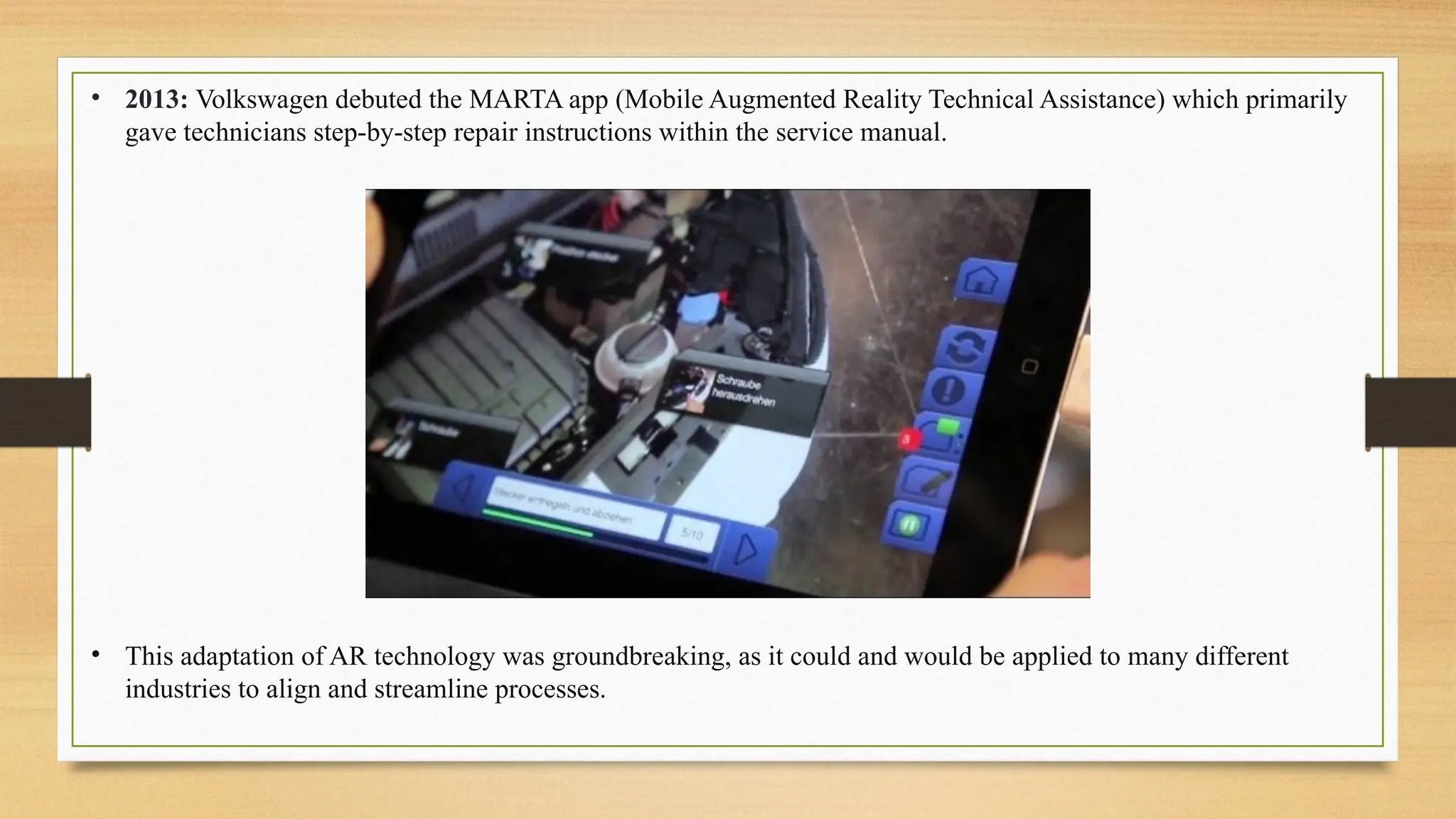
• 2013: Volkswagen debuted the MARTA app (Mobile Augmented Reality Technical Assistance) which primarily
gave technicians step-by-step repair instructions within the service manual.
• This adaptation of AR technology was groundbreaking, as it could and would be applied to many different
industries to align and streamline processes.
• 2014: Google unveiled its Google Glass devices, a pair of augmented reality glasses that users could wear for
immersive experiences.
• Users wore the AR tech and communicated with the Internet via natural language processing commands. With
this device, users could access a variety of applications like Google Maps, Google+, Gmail, and more.
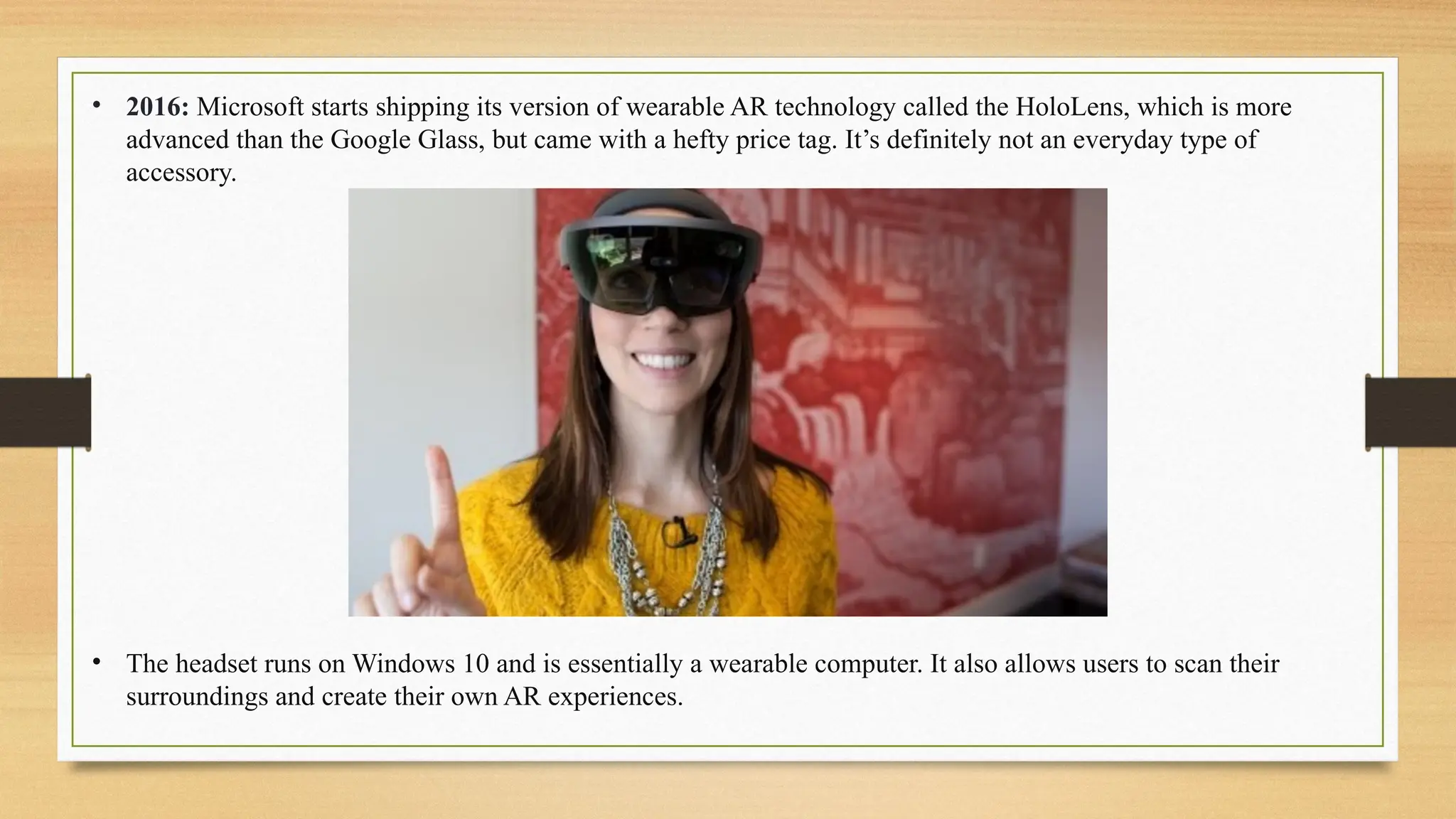
• 2016: Microsoft starts shipping its version of wearable AR technology called the HoloLens, which is more
advanced than the Google Glass, but came with a hefty price tag. It’s definitely not an everyday type of
accessory.
• The headset runs on Windows 10 and is essentially a wearable computer. It also allows users to scan their
surroundings and create their own AR experiences.
• 2017: IKEA released its augmented reality app called IKEA Place that changed the retail industry forever.
• The app allows customers to virtually preview their home decor options before actually making a purchase.
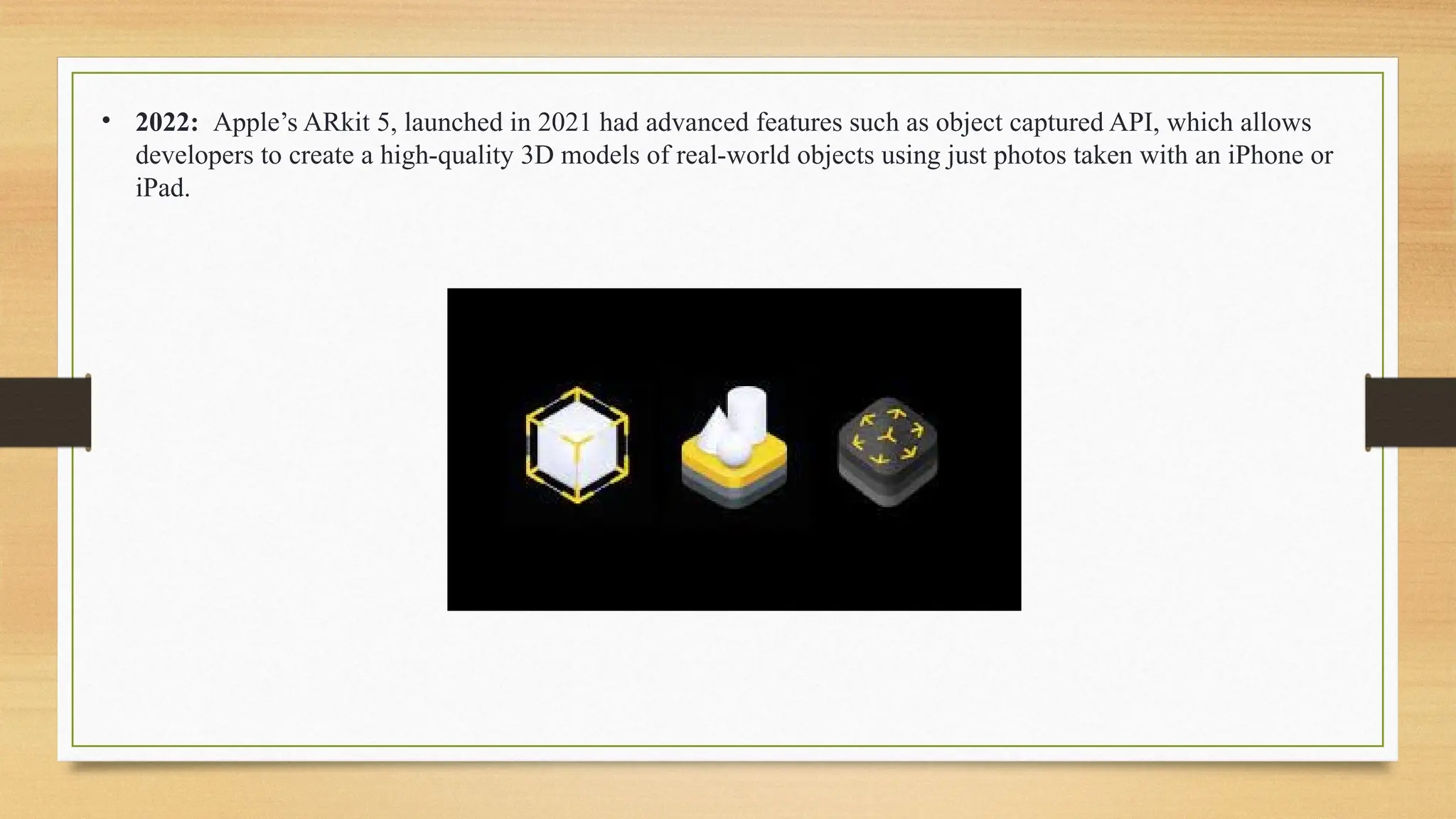
• 2022: Apple’s ARkit 5, launched in 2021 had advanced features such as object captured API, which allows
developers to create a high-quality 3D models of real-world objects using just photos taken with an iPhone or
iPad.

History of Augmented Reality and Virtual reality

  • 1.
    A BRIEF HISTROYOF AR POONTAMILSELVAN P 22CDR068
  • 2.
    The history ofaugmented reality Over the last 50 years, augmented reality technology has reshaped the way we consume content in the real world.
  • 3.
    Augmented reality inthe 60s & 70s Let's take a look back to see how AR technology was created in the first place. • 1968: Ivan Sutherland, a Harvard professor and computer scientist, created the first head-mounted display called ‘The Sword of Damocles’. • The user experienced computer-generated graphics that enhanced their sensory perception of the world.
  • 4.
    • 1974: MyronKruger, a computer researcher and artist, built a laboratory at the University of Connecticut called ‘Videoplace’ that was entirely dedicated to artificial reality. • Within these walls, projection and camera technology was used to emit onscreen silhouettes which surrounded users for an interactive experience.
  • 5.
    Augmented reality inthe 80s & 90s Now, let's learn how AR transitioned out of the lab and into various industries and business applications. • 1990: Tom Caudell, a Boeing researcher, coined the term ‘augmented reality’. • 1992: Louis Rosenburg, a researcher in the USAF Armstrong's Research Lab, created ‘Virtual Fixtures’, which was one of the first fully functional augmented reality systems. • The system allowed military personnel to virtually control and guide machinery to perform tasks like training their US Air Force pilots on safer flying practices.
  • 6.
    • 1994: JulieMartin, a writer and producer, brought augmented reality to the entertainment industry for the first time with the theater production titled Dancing in Cyberspace. • The show featured acrobats dancing alongside projected virtual objects on the physical stage.
  • 7.
    • 1998: Sportsvisionbroadcasts the first live NFL game with the virtual 1st & Ten graphic system – aka the yellow yard marker. The technology displays a yellow line overlayed on top of the feed to that views can quickly see where the team just advance to get a first down. • This system is still used today, although admittedly more advanced than it was in the late ‘90s. Viewers have become accustomed to the yellow line marker and other additional graphics – most don’t even know that this is a form of AR technology.
  • 8.
    • 1999: NASAcreated a hybrid synthetic vision system of their X-38 spacecraft. The system leveraged AR technology to assist in providing better navigation during their test flights. • The augmented reality component displayed map data right on the pilot’s screen.
  • 9.
    Augmented reality inthe 2000s & today By now, AR has a foothold in the fast-paced tech landscape. Let's see how its eventually rolled out to everyday consumers. • 2000: Hirokazu Kato developed an open-source software library called the ARToolKit. This package helps other developers build augmented reality software programs. The library uses video tracking to overlay virtual graphics on top of the real world. • 2003: Sportvision enhanced the 1st & Ten graphic to include the feature on the new Skycam system – providing viewers with an aerial shot of the field with graphics overlaid on top of it. • 2009: Esquire Magazine used augmented reality in print media for the first time in an attempt to make the pages come alive. • When readers scanned the cover, the augmented reality equipped magazine featured Robert Downey Jr. speaking to readers.
  • 11.
    • 2013: Volkswagendebuted the MARTA app (Mobile Augmented Reality Technical Assistance) which primarily gave technicians step-by-step repair instructions within the service manual. • This adaptation of AR technology was groundbreaking, as it could and would be applied to many different industries to align and streamline processes.
  • 12.
    • 2014: Googleunveiled its Google Glass devices, a pair of augmented reality glasses that users could wear for immersive experiences. • Users wore the AR tech and communicated with the Internet via natural language processing commands. With this device, users could access a variety of applications like Google Maps, Google+, Gmail, and more.
  • 13.
    • 2016: Microsoftstarts shipping its version of wearable AR technology called the HoloLens, which is more advanced than the Google Glass, but came with a hefty price tag. It’s definitely not an everyday type of accessory. • The headset runs on Windows 10 and is essentially a wearable computer. It also allows users to scan their surroundings and create their own AR experiences.
  • 14.
    • 2017: IKEAreleased its augmented reality app called IKEA Place that changed the retail industry forever. • The app allows customers to virtually preview their home decor options before actually making a purchase.
  • 15.
    • 2022: Apple’sARkit 5, launched in 2021 had advanced features such as object captured API, which allows developers to create a high-quality 3D models of real-world objects using just photos taken with an iPhone or iPad.