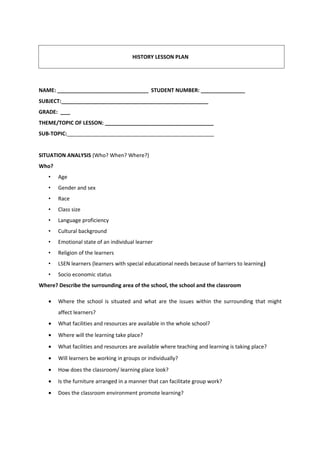
HISTORY LESSON PLAN
NAME: _______________________________ STUDENT NUMBER: _______________
SUBJECT:__________________________________________________
GRADE: ___
THEME/TOPIC OF LESSON: _____________________________________
SUB-TOPIC:__________________________________________________
SITUATION ANALYSIS (Who? When? Where?)
Who?
• Age
• Gender and sex
• Race
• Class size
• Language proficiency
• Cultural background
• Emotional state of an individual learner
• Religion of the learners
• LSEN learners (learners with special educational needs because of barriers to learning)
• Socio economic status
Where? Describe the surrounding area of the school, the school and the classroom
• Where the school is situated and what are the issues within the surrounding that might
affect learners?
• What facilities and resources are available in the whole school?
• Where will the learning take place?
• What facilities and resources are available where teaching and learning is taking place?
• Will learners be working in groups or individually?
• How does the classroom/ learning place look?
• Is the furniture arranged in a manner that can facilitate group work?
• Does the classroom environment promote learning?
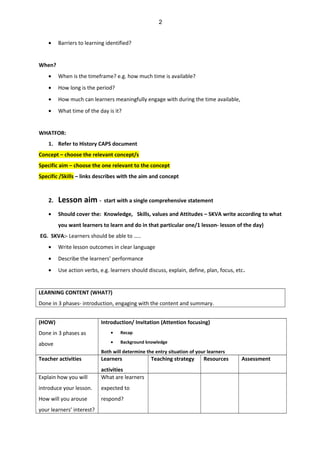
• Barriers to learning identified?
When?
• When is the timeframe? e.g. how much time is available?
• How long is the period?
• How much can learners meaningfully engage with during the time available,
• What time of the day is it?
WHATFOR:
1. Refer to History CAPS document
Concept – choose the relevant concept/s
Specific aim – choose the one relevant to the concept
Specific /Skills – links describes with the aim and concept
2. Lesson aim - start with a single comprehensive statement
• Should cover the: Knowledge, Skills, values and Attitudes – SKVA write according to what
you want learners to learn and do in that particular one/1 lesson- lesson of the day)
EG. SKVA:- Learners should be able to …..
• Write lesson outcomes in clear language
• Describe the learners’ performance
• Use action verbs, e.g. learners should discuss, explain, define, plan, focus, etc.
LEARNING CONTENT (WHAT?)
Done in 3 phases- introduction, engaging with the content and summary.
(HOW)
Done in 3 phases as
above
Introduction/ Invitation (Attention focusing)
• Recap
• Background knowledge
Both will determine the entry situation of your learners
Teacher activities Learners
activities
Teaching strategy Resources Assessment
Explain how you will
introduce your lesson.
How will you arouse
your learners’ interest?
What are learners
expected to
respond?
2
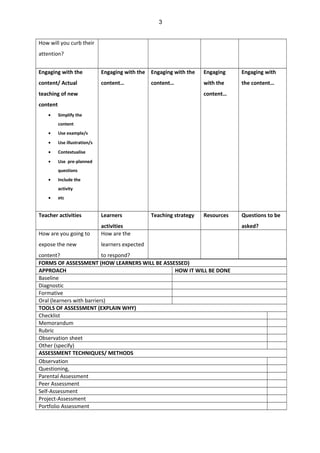
How will you curb their
attention?
Engaging with the
content/ Actual
teaching of new
content
• Simplify the
content
• Use example/s
• Use illustration/s
• Contextualise
• Use pre-planned
questions
• Include the
activity
• etc
Engaging with the
content…
Engaging with the
content…
Engaging
with the
content…
Engaging with
the content…
Teacher activities Learners
activities
Teaching strategy Resources Questions to be
asked?
How are you going to
expose the new
content?
How are the
learners expected
to respond?
FORMS OF ASSESSMENT (HOW LEARNERS WILL BE ASSESSED)
APPROACH HOW IT WILL BE DONE
Baseline
Diagnostic
Formative
Oral (learners with barriers)
TOOLS OF ASSESSMENT (EXPLAIN WHY)
Checklist
Memorandum
Rubric
Observation sheet
Other (specify)
ASSESSMENT TECHNIQUES/ METHODS
Observation
Questioning,
Parental Assessment
Peer Assessment
Self-Assessment
Project-Assessment
Portfolio Assessment
3
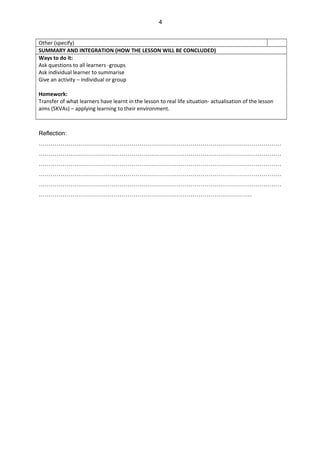
Other (specify)
SUMMARY AND INTEGRATION (HOW THE LESSON WILL BE CONCLUDED)
Ways to do it:
Ask questions to all learners -groups
Ask individual learner to summarise
Give an activity – individual or group
Homework:
Transfer of what learners have learnt in the lesson to real life situation- actualisation of the lesson
aims (SKVAs) – applying learning to their environment.
Reflection:
……………………………………………………………………………………………………………
……………………………………………………………………………………………………………
……………………………………………………………………………………………………………
……………………………………………………………………………………………………………
……………………………………………………………………………………………………………
………………………………………………………………………………………………
4

History lesson plan template

  • 1.
    HISTORY LESSON PLAN NAME:_______________________________ STUDENT NUMBER: _______________ SUBJECT:__________________________________________________ GRADE: ___ THEME/TOPIC OF LESSON: _____________________________________ SUB-TOPIC:__________________________________________________ SITUATION ANALYSIS (Who? When? Where?) Who? • Age • Gender and sex • Race • Class size • Language proficiency • Cultural background • Emotional state of an individual learner • Religion of the learners • LSEN learners (learners with special educational needs because of barriers to learning) • Socio economic status Where? Describe the surrounding area of the school, the school and the classroom • Where the school is situated and what are the issues within the surrounding that might affect learners? • What facilities and resources are available in the whole school? • Where will the learning take place? • What facilities and resources are available where teaching and learning is taking place? • Will learners be working in groups or individually? • How does the classroom/ learning place look? • Is the furniture arranged in a manner that can facilitate group work? • Does the classroom environment promote learning?
  • 2.
    • Barriers tolearning identified? When? • When is the timeframe? e.g. how much time is available? • How long is the period? • How much can learners meaningfully engage with during the time available, • What time of the day is it? WHATFOR: 1. Refer to History CAPS document Concept – choose the relevant concept/s Specific aim – choose the one relevant to the concept Specific /Skills – links describes with the aim and concept 2. Lesson aim - start with a single comprehensive statement • Should cover the: Knowledge, Skills, values and Attitudes – SKVA write according to what you want learners to learn and do in that particular one/1 lesson- lesson of the day) EG. SKVA:- Learners should be able to ….. • Write lesson outcomes in clear language • Describe the learners’ performance • Use action verbs, e.g. learners should discuss, explain, define, plan, focus, etc. LEARNING CONTENT (WHAT?) Done in 3 phases- introduction, engaging with the content and summary. (HOW) Done in 3 phases as above Introduction/ Invitation (Attention focusing) • Recap • Background knowledge Both will determine the entry situation of your learners Teacher activities Learners activities Teaching strategy Resources Assessment Explain how you will introduce your lesson. How will you arouse your learners’ interest? What are learners expected to respond? 2
  • 3.
    How will youcurb their attention? Engaging with the content/ Actual teaching of new content • Simplify the content • Use example/s • Use illustration/s • Contextualise • Use pre-planned questions • Include the activity • etc Engaging with the content… Engaging with the content… Engaging with the content… Engaging with the content… Teacher activities Learners activities Teaching strategy Resources Questions to be asked? How are you going to expose the new content? How are the learners expected to respond? FORMS OF ASSESSMENT (HOW LEARNERS WILL BE ASSESSED) APPROACH HOW IT WILL BE DONE Baseline Diagnostic Formative Oral (learners with barriers) TOOLS OF ASSESSMENT (EXPLAIN WHY) Checklist Memorandum Rubric Observation sheet Other (specify) ASSESSMENT TECHNIQUES/ METHODS Observation Questioning, Parental Assessment Peer Assessment Self-Assessment Project-Assessment Portfolio Assessment 3
  • 4.
    Other (specify) SUMMARY ANDINTEGRATION (HOW THE LESSON WILL BE CONCLUDED) Ways to do it: Ask questions to all learners -groups Ask individual learner to summarise Give an activity – individual or group Homework: Transfer of what learners have learnt in the lesson to real life situation- actualisation of the lesson aims (SKVAs) – applying learning to their environment. Reflection: …………………………………………………………………………………………………………… …………………………………………………………………………………………………………… …………………………………………………………………………………………………………… …………………………………………………………………………………………………………… …………………………………………………………………………………………………………… ……………………………………………………………………………………………… 4