
Creating and Proving
          Historical Themes
                   A filmstrip by:
                   Lisa M Lane


>>   0    >>   1     >>     2        >>   3   >>   4   >>
...This war was the result of
                    conflicting priorities, skillful use
                    of propaganda, and hatred toward
         Historians, as we know, rely on facts, but only to prove ideas, known as historical theses. A historical thesis is
                    the Martianthen proven in the body paragraphs with evidence.
                      like a thesis for a paper, which is lifestyle.


     Historians, as we know, rely on facts, but only to prove
     ideas, known as historical theses. A historical thesis is like a
     thesis for a paper, which is then proven in the body
     paragraphs with primary source evidence.A historical thesis is like a thesis
     for a paper, which is then proven in the body paragraphs with evidence.


>>         0           >>             1           >>             2             >>         3           >>            4         >>
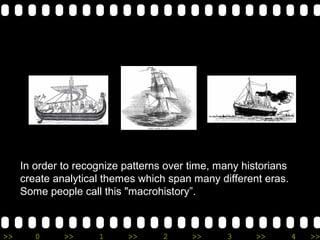
In order to recognize patterns over time, many
        historians create analytical themes which span many
        different eras. Some people call this "macrohistory”.


     In order to recognize patterns over time, many historians
     create analytical themes which span many different eras.
     Some people call this "macrohistory”.


>>      0     >>     1     >>      2     >>     3      >>        4   >>
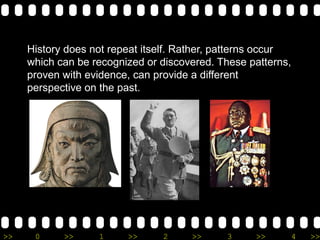
History does not repeat itself. Rather, patterns occur
     which can be recognized or discovered. These patterns,
     proven with evidence, can provide a different
     perspective on the past.


>>    0     >>     1     >>     2     >>     3     >>         4   >>
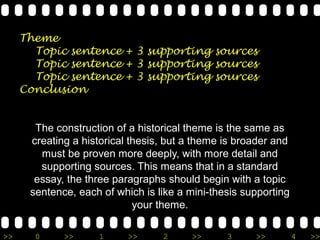
Theme
     I. Topic sentence + 3 supporting sources
        Topic sentence + 3 supporting sources
        Topic sentence + 3 supporting sources
     Conclusion


       The construction of a historical theme is the same as
      creating a historical thesis, but a theme is broader and
        must be proven more deeply, with more detail and
        supporting sources. This means that in a standard
       essay, the three paragraphs should begin with a topic
      sentence, each of which is like a mini-thesis supporting
                             your theme.

>>     0     >>     1      >>     2     >>      3     >>         4   >>
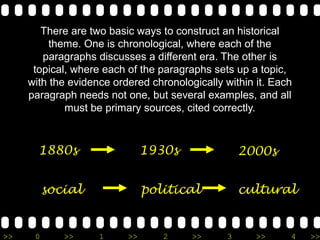
There are two basic ways to construct an historical
          theme. One is chronological, where each of the
        paragraphs discusses a different era. The other is
      topical, where each of the paragraphs sets up a topic,
     with the evidence ordered chronologically within it. Each
     paragraph needs not one, but several examples, and all
             must be primary sources, cited correctly.


       1880s                   1930s                2000s


          social               political            cultural


>>    0      >>     1     >>      2     >>      3     >>     4   >>
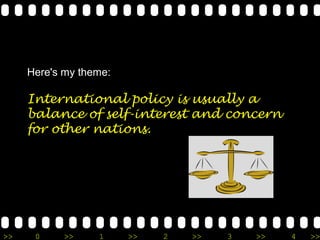
Here's my theme:

     International policy is usually a
     balance of self-interest and concern
     for other nations.


>>    0     >>    1     >>   2   >>   3   >>   4   >>
I can then prove this in two ways. Here's the outline for
                    a chronological answer:

     I. During the expansion of the British into
        India, one imperialist goal was ending
        violence between the Indian principalities.

     I. During the Spanish-American War, the United
        States had a goal of saving countries from
        Spanish domination.

     I.    Japanese policy during the Pacific expansion
          of the 1930s was partly designed to spread a
          superior culture.


>>    0      >>     1     >>      2     >>      3     >>         4   >>
Here's the outline for a topical answer.


     I. Concern for other nations can take a
        religious focus.

     I. Sometimes the goal is to expand the
        local economy as well as international
        trade.

     I. The liberation of a nation from its
        enemies can also provide opportunity.


>>   0    >>      1     >>      2     >>      3     >>   4   >>
Each topic sentence is proven using evidence,
      especially primary sources, and connected back to the
                           main theme.


     Concern for other nations can take a
     religious focus. According to Mark Twain’s
     letter from the “Sandwich Isles” (Hawai’i)
     in 1866, “The missionary ship arrived in safety
     shortly afterward, timed by providential
     exactness to meet the emergency, and the gospel
     was planted as in a virgin soil. “ (
     http://www.twainquotes.com/18660922u.html)
     Although his own view was sarcastic, Twain is
     noting the goal of the U.S. missionaries...

>>     0    >>     1     >>      2     >>     3     >>        4   >>
And each paragraph needs more than one source to
                       prove its point.

     Britain had similar goals. According to a letter
     published by missionaries to justify annexing the
     New Hebrides in 1883, “150 native evangelists and
     teachers are employed” in Christianizing the local
     people for the good of the British empire (John G.
     Patton, Urging the Annexation of The South Sea
     Islands, 1883,
     http://www.fordham.edu/halsall/mod/1883hebrides.
     html).


      Always be sure to cite the source!


>>    0     >>      1     >>     2     >>   3   >>        4   >>
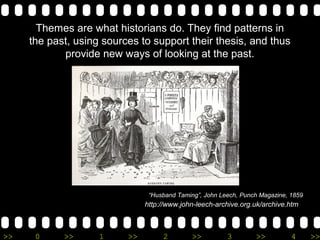
Themes are what historians do. They find patterns in
     the past, using sources to support their thesis, and thus
            provide new ways of looking at the past.


                                “Husband Taming”, John Leech, Punch Magazine, 1859
                               http://www.john-leech-archive.org.uk/archive.htm


>>    0     >>      1     >>        2         >>         3        >>          4      >>
Thanks for listening!


>>   0   >>   1      >>      2     >>     3   >>   4   >>

Historical Themes Tutorial

  • 1.
    Creating and Proving Historical Themes A filmstrip by: Lisa M Lane >> 0 >> 1 >> 2 >> 3 >> 4 >>
  • 2.
    ...This war wasthe result of conflicting priorities, skillful use of propaganda, and hatred toward Historians, as we know, rely on facts, but only to prove ideas, known as historical theses. A historical thesis is the Martianthen proven in the body paragraphs with evidence. like a thesis for a paper, which is lifestyle. Historians, as we know, rely on facts, but only to prove ideas, known as historical theses. A historical thesis is like a thesis for a paper, which is then proven in the body paragraphs with primary source evidence.A historical thesis is like a thesis for a paper, which is then proven in the body paragraphs with evidence. >> 0 >> 1 >> 2 >> 3 >> 4 >>
  • 3.
    In order torecognize patterns over time, many historians create analytical themes which span many different eras. Some people call this "macrohistory”. In order to recognize patterns over time, many historians create analytical themes which span many different eras. Some people call this "macrohistory”. >> 0 >> 1 >> 2 >> 3 >> 4 >>
  • 4.
    History does notrepeat itself. Rather, patterns occur which can be recognized or discovered. These patterns, proven with evidence, can provide a different perspective on the past. >> 0 >> 1 >> 2 >> 3 >> 4 >>
  • 5.
    Theme I. Topic sentence + 3 supporting sources Topic sentence + 3 supporting sources Topic sentence + 3 supporting sources Conclusion The construction of a historical theme is the same as creating a historical thesis, but a theme is broader and must be proven more deeply, with more detail and supporting sources. This means that in a standard essay, the three paragraphs should begin with a topic sentence, each of which is like a mini-thesis supporting your theme. >> 0 >> 1 >> 2 >> 3 >> 4 >>
  • 6.
    There are twobasic ways to construct an historical theme. One is chronological, where each of the paragraphs discusses a different era. The other is topical, where each of the paragraphs sets up a topic, with the evidence ordered chronologically within it. Each paragraph needs not one, but several examples, and all must be primary sources, cited correctly. 1880s 1930s 2000s social political cultural >> 0 >> 1 >> 2 >> 3 >> 4 >>
  • 7.
    Here's my theme: International policy is usually a balance of self-interest and concern for other nations. >> 0 >> 1 >> 2 >> 3 >> 4 >>
  • 8.
    I can thenprove this in two ways. Here's the outline for a chronological answer: I. During the expansion of the British into India, one imperialist goal was ending violence between the Indian principalities. I. During the Spanish-American War, the United States had a goal of saving countries from Spanish domination. I. Japanese policy during the Pacific expansion of the 1930s was partly designed to spread a superior culture. >> 0 >> 1 >> 2 >> 3 >> 4 >>
  • 9.
    Here's the outlinefor a topical answer. I. Concern for other nations can take a religious focus. I. Sometimes the goal is to expand the local economy as well as international trade. I. The liberation of a nation from its enemies can also provide opportunity. >> 0 >> 1 >> 2 >> 3 >> 4 >>
  • 10.
    Each topic sentenceis proven using evidence, especially primary sources, and connected back to the main theme. Concern for other nations can take a religious focus. According to Mark Twain’s letter from the “Sandwich Isles” (Hawai’i) in 1866, “The missionary ship arrived in safety shortly afterward, timed by providential exactness to meet the emergency, and the gospel was planted as in a virgin soil. “ ( http://www.twainquotes.com/18660922u.html) Although his own view was sarcastic, Twain is noting the goal of the U.S. missionaries... >> 0 >> 1 >> 2 >> 3 >> 4 >>
  • 11.
    And each paragraphneeds more than one source to prove its point. Britain had similar goals. According to a letter published by missionaries to justify annexing the New Hebrides in 1883, “150 native evangelists and teachers are employed” in Christianizing the local people for the good of the British empire (John G. Patton, Urging the Annexation of The South Sea Islands, 1883, http://www.fordham.edu/halsall/mod/1883hebrides. html). Always be sure to cite the source! >> 0 >> 1 >> 2 >> 3 >> 4 >>
  • 12.
    Themes are whathistorians do. They find patterns in the past, using sources to support their thesis, and thus provide new ways of looking at the past. “Husband Taming”, John Leech, Punch Magazine, 1859 http://www.john-leech-archive.org.uk/archive.htm >> 0 >> 1 >> 2 >> 3 >> 4 >>
  • 13.
    Thanks for listening! >> 0 >> 1 >> 2 >> 3 >> 4 >>