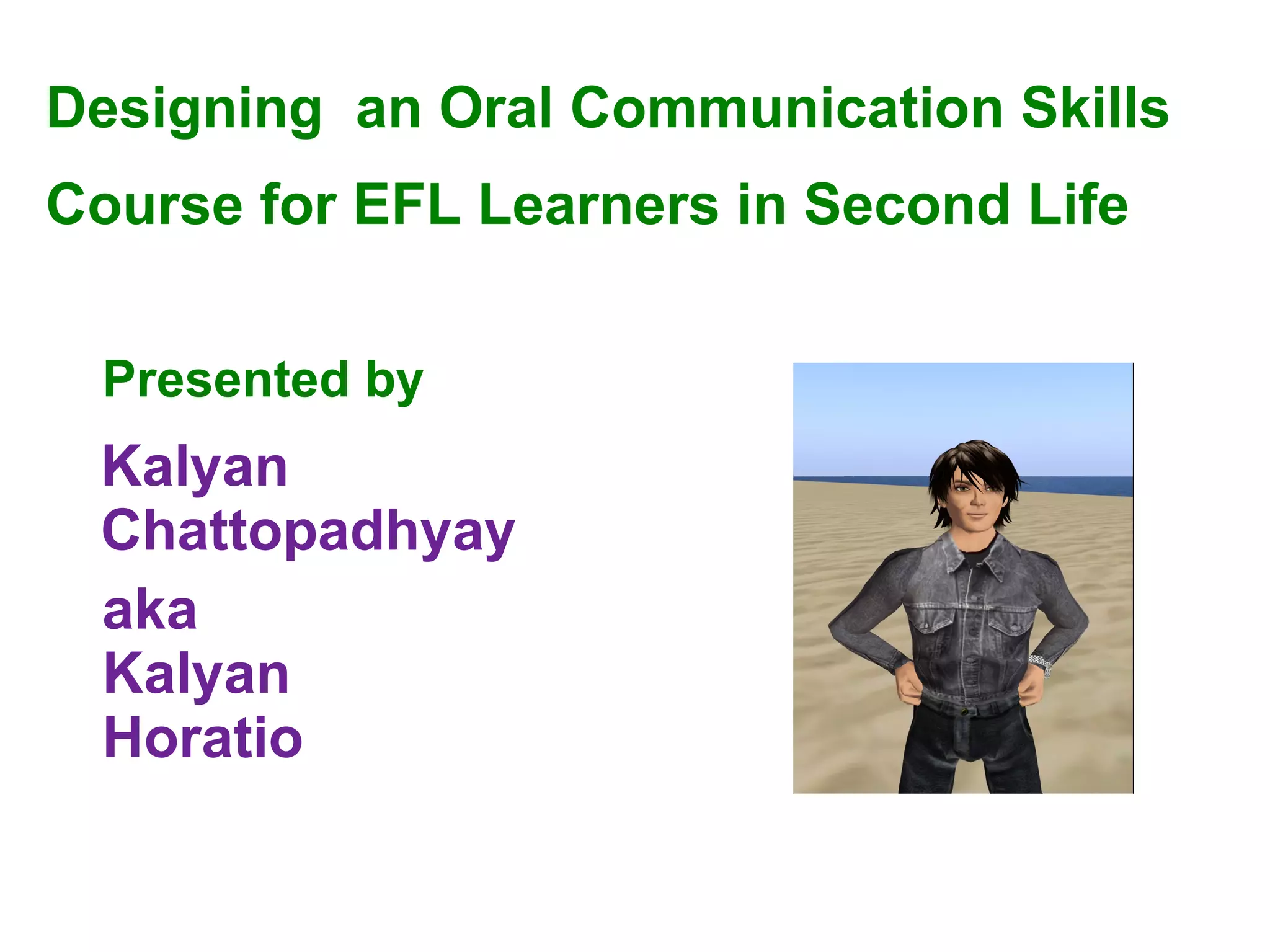
Designing  an Oral Communication Skills  Course  for EFL Learners in Second Life Presented by   aka Kalyan Horatio Kalyan Chattopadhyay
Outline of this presentation Second Life Environment Language learning in Second Life: affordances Learners' needs, wants and lacks, and contexts Determining goals and objectives Conceptualising content Course Outline
Identifying needs Models used: Salmon et.al (2010) five-stage model of teaching and learning in SL Kolb's notion of experiential learning cycle
Course aim On completion of the these tasks the learners will f learners to listen to varied workplace content, accents, dialects, speech styles used in them for  comprehension, and allow them to receive  suggestions for improvement through local and voiced chat within the group with tutor, and peers
Course content Pre-listening :  Knowing the workplace Students respond to questions :  What do you know about....... ? Students see pictures, and read description of different jobs in Second Life in  notecards.  They are asked to search and find resources such as audio, images, and videos that are from Second life context and paste those links in the local chat .
While-listening Use of knowledge sources:  They are given some listening inputs and asked to identify their contextual use in workplace, such as meeting, job interviews, customer service enquiry etc. Students listen to them and identify the context in the form of a Quiz.  Deriving meaning Students listen to predict text in recordings Students take an information-gap exercise Students compare recordings with transcript
Adding to the meaning Students listen again to derive meaning, and answer detailed questions about recordings. Students review and evaluate the content of recordings and post their comment in Forum. Selecting and integrating information Students listen to a recording and notice grammar. Students listen to audio files  and transcribe what they hear. Students listen to one speaker in a conversation and play the part of the other speaker. Students watch a silent video, predict the text, and then listen carefully to compare their versions with the original.
Post-listening Students listen to debate on a topic and  join the voiced chat  to express their views Students listen to a recording twice and demonstrate their understanding of it by writing its gist in a notecard and droping it to the tutor.


Iste sl kalyan_2010

  • 1.
    Designing anOral Communication Skills Course for EFL Learners in Second Life Presented by aka Kalyan Horatio Kalyan Chattopadhyay
  • 2.
    Outline of thispresentation Second Life Environment Language learning in Second Life: affordances Learners' needs, wants and lacks, and contexts Determining goals and objectives Conceptualising content Course Outline
  • 3.
    Identifying needs Modelsused: Salmon et.al (2010) five-stage model of teaching and learning in SL Kolb's notion of experiential learning cycle
  • 4.
    Course aim Oncompletion of the these tasks the learners will f learners to listen to varied workplace content, accents, dialects, speech styles used in them for comprehension, and allow them to receive suggestions for improvement through local and voiced chat within the group with tutor, and peers
  • 5.
    Course content Pre-listening: Knowing the workplace Students respond to questions : What do you know about....... ? Students see pictures, and read description of different jobs in Second Life in notecards. They are asked to search and find resources such as audio, images, and videos that are from Second life context and paste those links in the local chat .
  • 6.
    While-listening Use ofknowledge sources: They are given some listening inputs and asked to identify their contextual use in workplace, such as meeting, job interviews, customer service enquiry etc. Students listen to them and identify the context in the form of a Quiz. Deriving meaning Students listen to predict text in recordings Students take an information-gap exercise Students compare recordings with transcript
  • 7.
    Adding to themeaning Students listen again to derive meaning, and answer detailed questions about recordings. Students review and evaluate the content of recordings and post their comment in Forum. Selecting and integrating information Students listen to a recording and notice grammar. Students listen to audio files and transcribe what they hear. Students listen to one speaker in a conversation and play the part of the other speaker. Students watch a silent video, predict the text, and then listen carefully to compare their versions with the original.
  • 8.
    Post-listening Students listento debate on a topic and join the voiced chat to express their views Students listen to a recording twice and demonstrate their understanding of it by writing its gist in a notecard and droping it to the tutor.
  • 9.
  • 10.
  • 11.