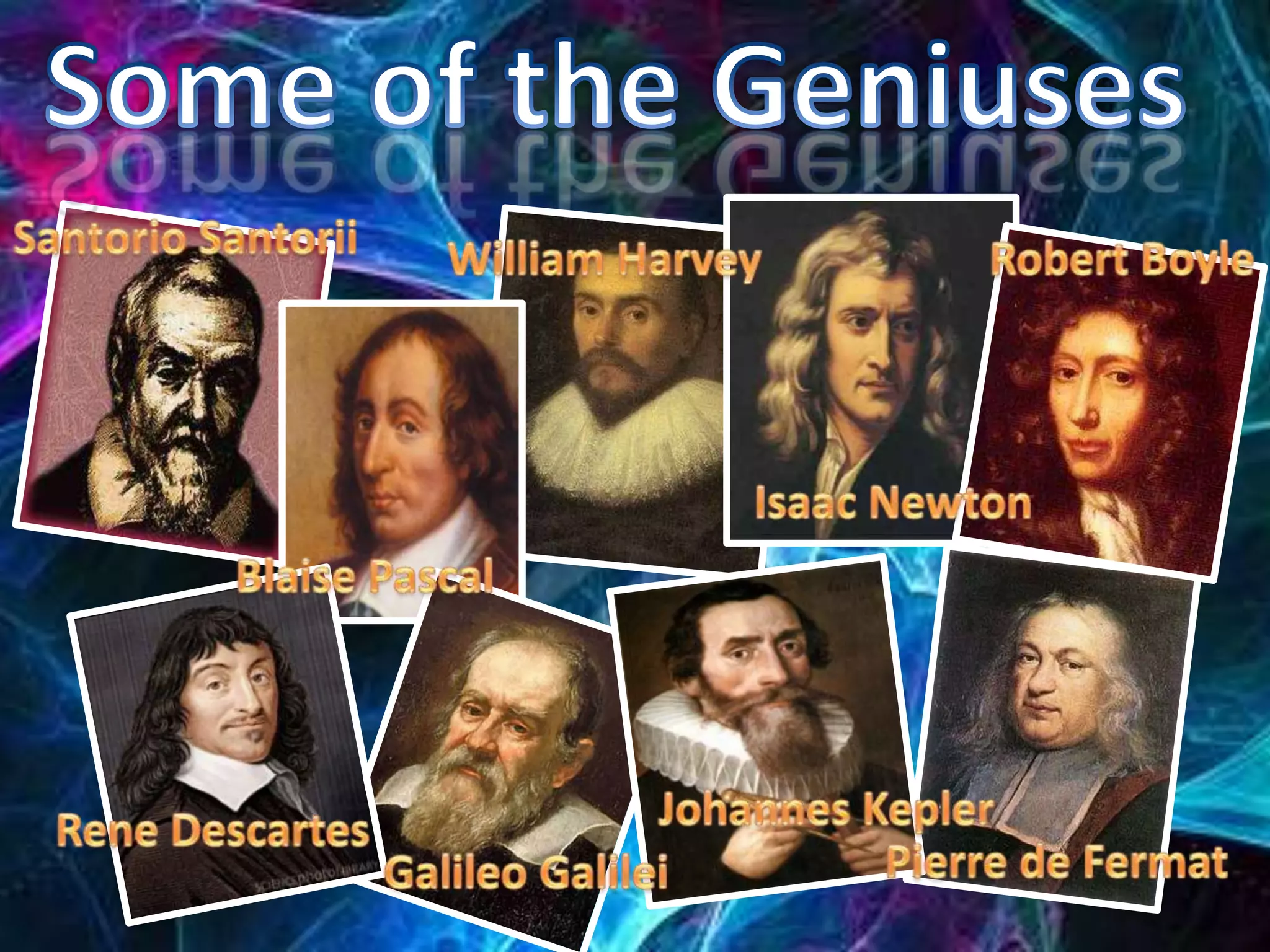
Historical Development of
   Science and Technology
               •Century of the Genius
                •Industrial Revolution
               •18th and 19th Century
                    •Modern Era


Prepared by:
Maria Niña C. Leonoras
•Emerged most fully during the
Eighteenth-century or
Enlightenment Period.
•Age of Enlightenment is also known
as Age of Reason.
•Science during the 18th century falls
into two categories:
      •Baroque Period
      •Classical Period
Started in the 17th century and
lasted to the early 18th century;


lasted into the early 19th century.
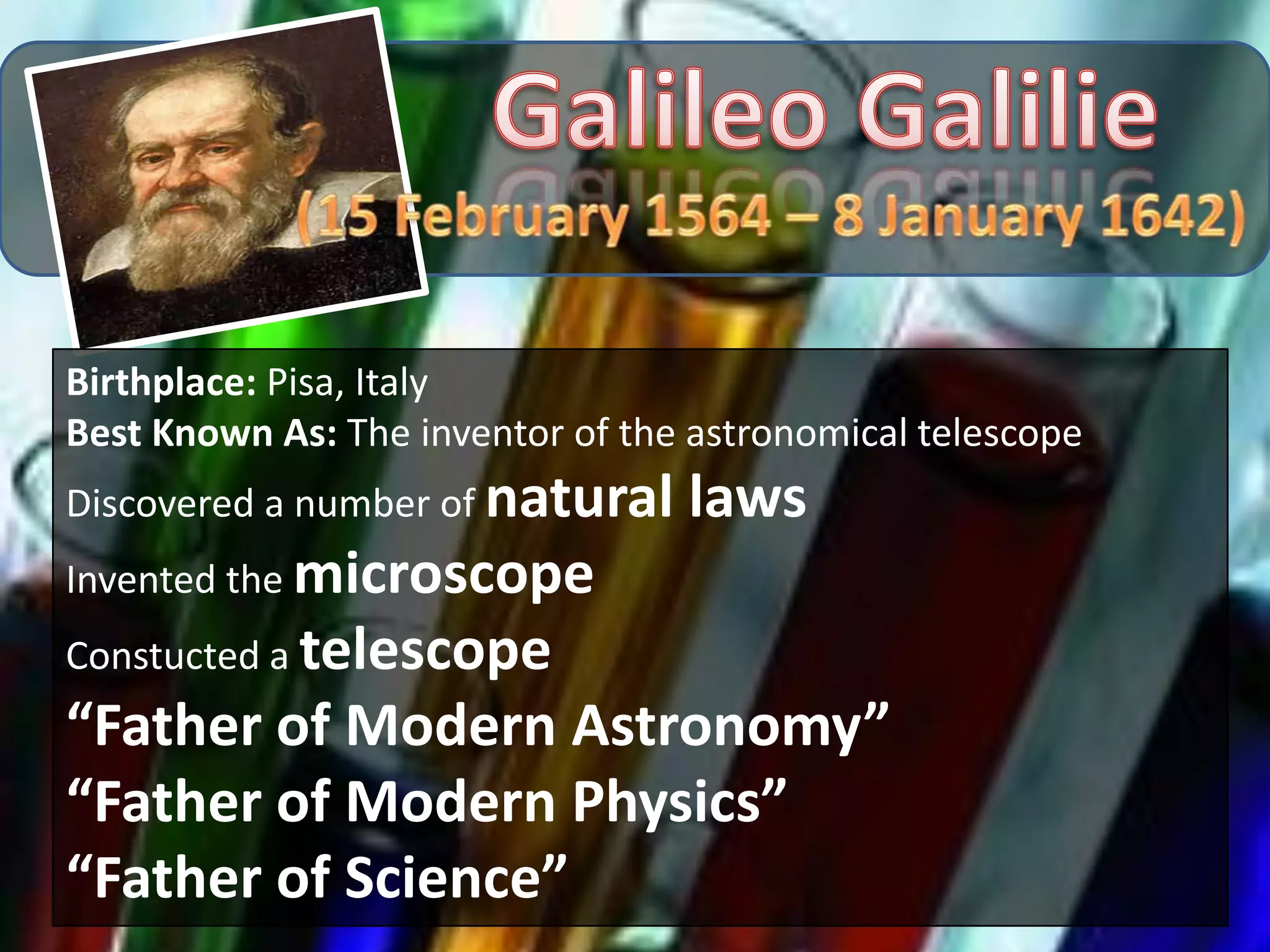
Birthplace: Pisa, Italy
Best Known As: The inventor of the astronomical telescope
Discovered a number of natural    laws
Invented the microscope
Constucted a telescope
“Father of Modern Astronomy”
“Father of Modern Physics”
“Father of Science”
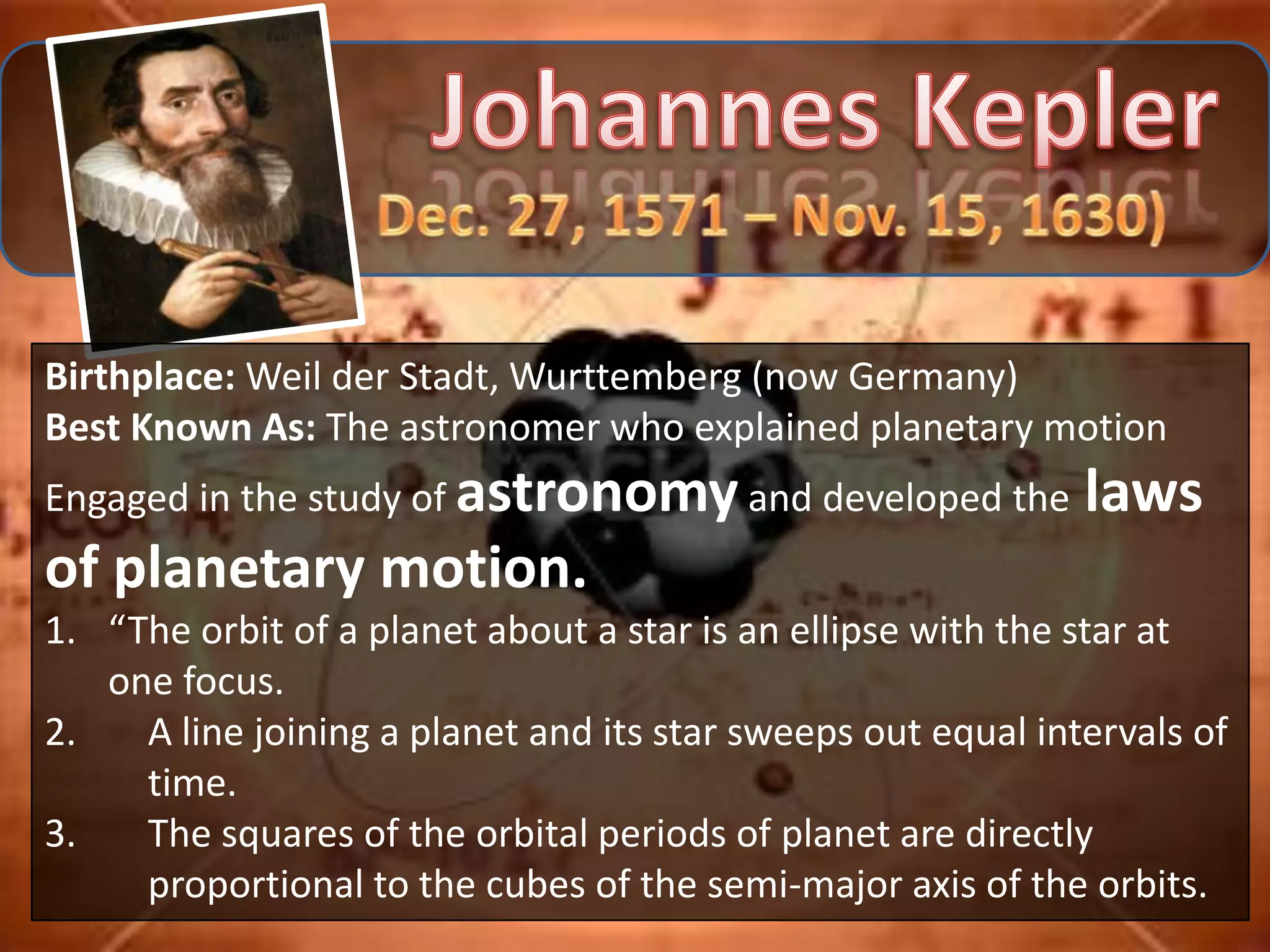
Birthplace: Weil der Stadt, Wurttemberg (now Germany)
Best Known As: The astronomer who explained planetary motion
Engaged in the study of astronomy and developed the           laws
of planetary motion.
1. “The orbit of a planet about a star is an ellipse with the star at
   one focus.
2.   A line joining a planet and its star sweeps out equal intervals of
     time.
3.   The squares of the orbital periods of planet are directly
     proportional to the cubes of the semi-major axis of the orbits.
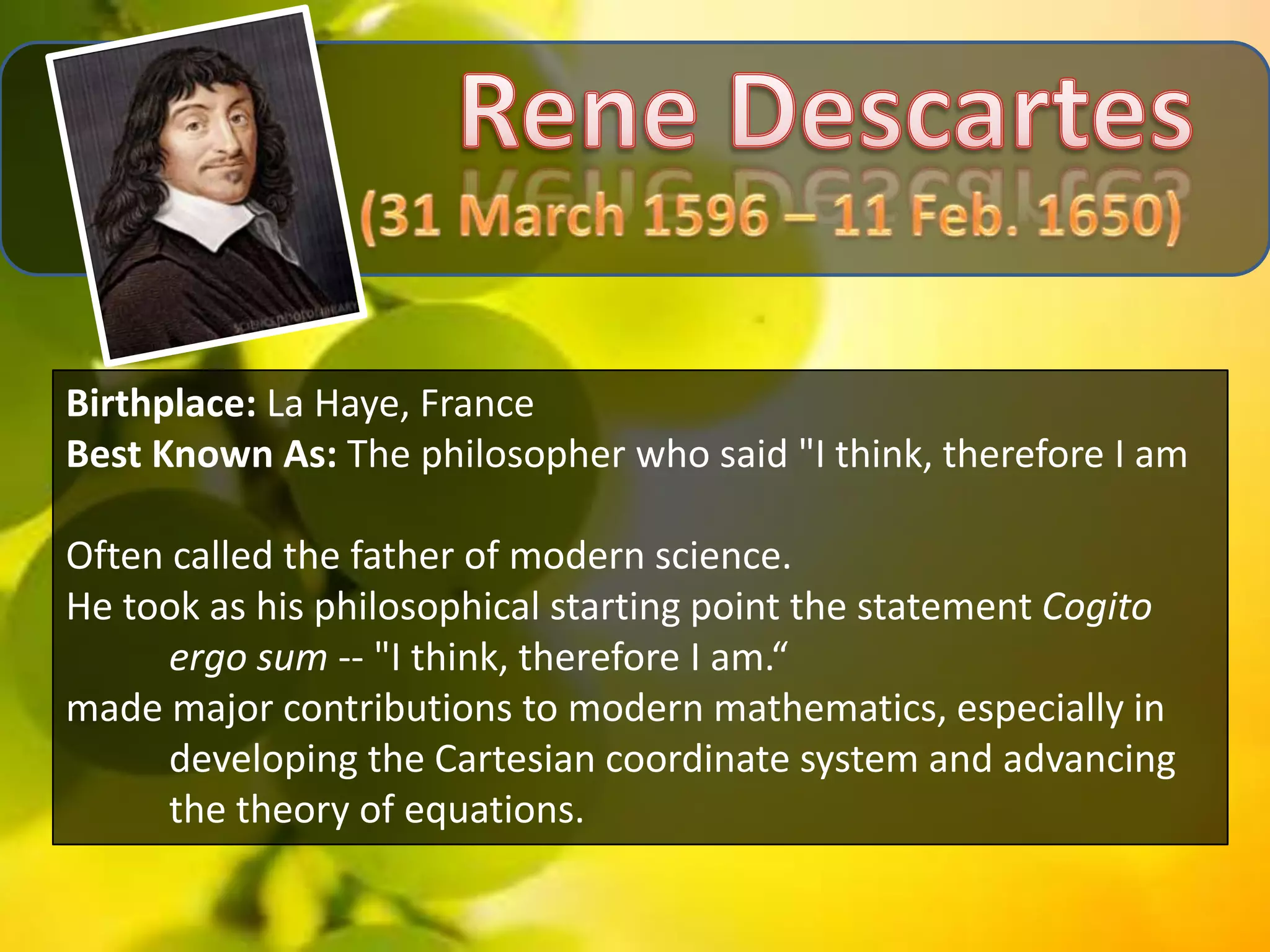
Birthplace: La Haye, France
Best Known As: The philosopher who said "I think, therefore I am

Often called the father of modern science.
He took as his philosophical starting point the statement Cogito
      ergo sum -- "I think, therefore I am.“
made major contributions to modern mathematics, especially in
      developing the Cartesian coordinate system and advancing
      the theory of equations.
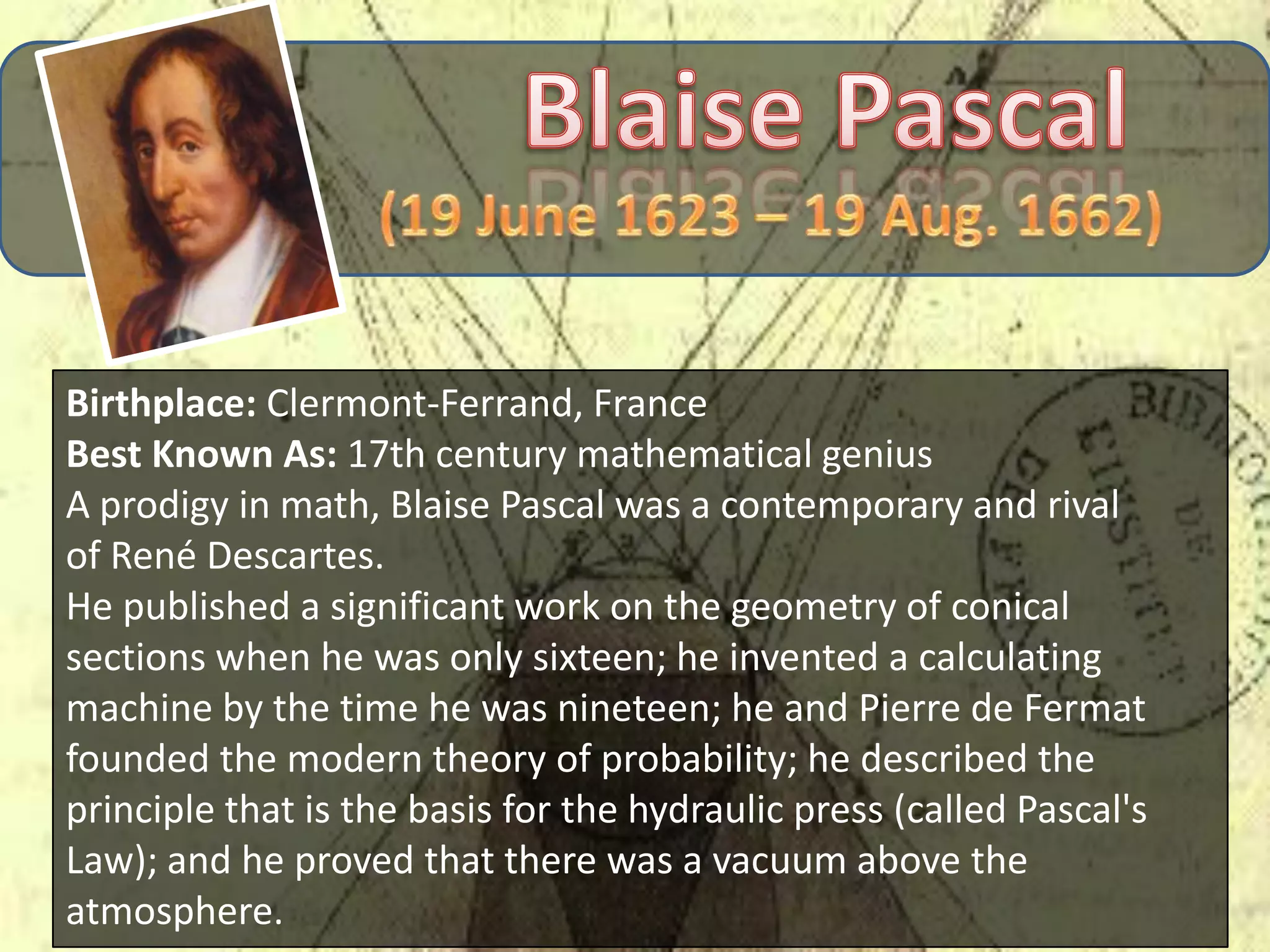
Birthplace: Clermont-Ferrand, France
Best Known As: 17th century mathematical genius
A prodigy in math, Blaise Pascal was a contemporary and rival
of René Descartes.
He published a significant work on the geometry of conical
sections when he was only sixteen; he invented a calculating
machine by the time he was nineteen; he and Pierre de Fermat
founded the modern theory of probability; he described the
principle that is the basis for the hydraulic press (called Pascal's
Law); and he proved that there was a vacuum above the
atmosphere.
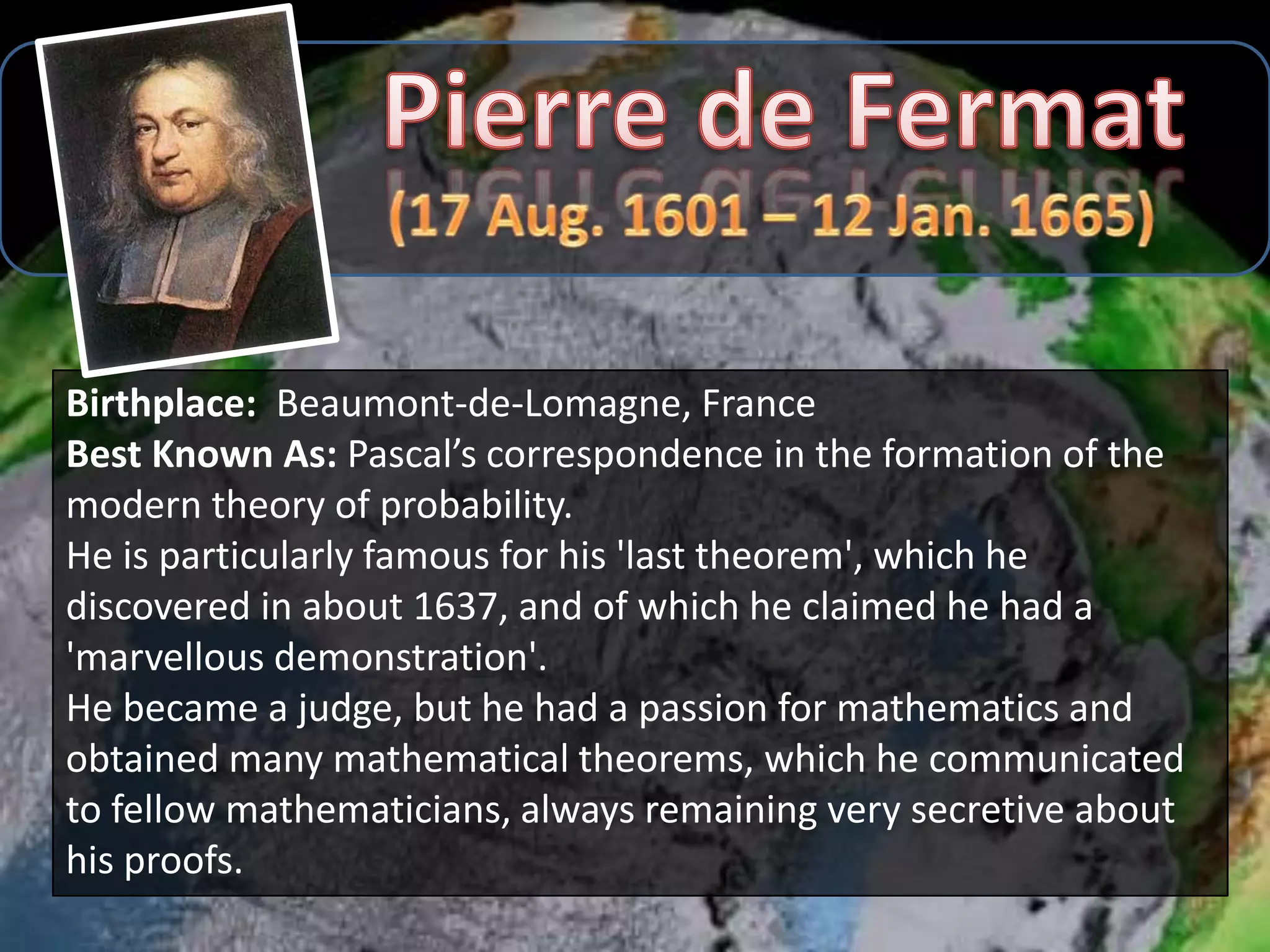
Birthplace: Beaumont-de-Lomagne, France
Best Known As: Pascal’s correspondence in the formation of the
modern theory of probability.
He is particularly famous for his 'last theorem', which he
discovered in about 1637, and of which he claimed he had a
'marvellous demonstration'.
He became a judge, but he had a passion for mathematics and
obtained many mathematical theorems, which he communicated
to fellow mathematicians, always remaining very secretive about
his proofs.
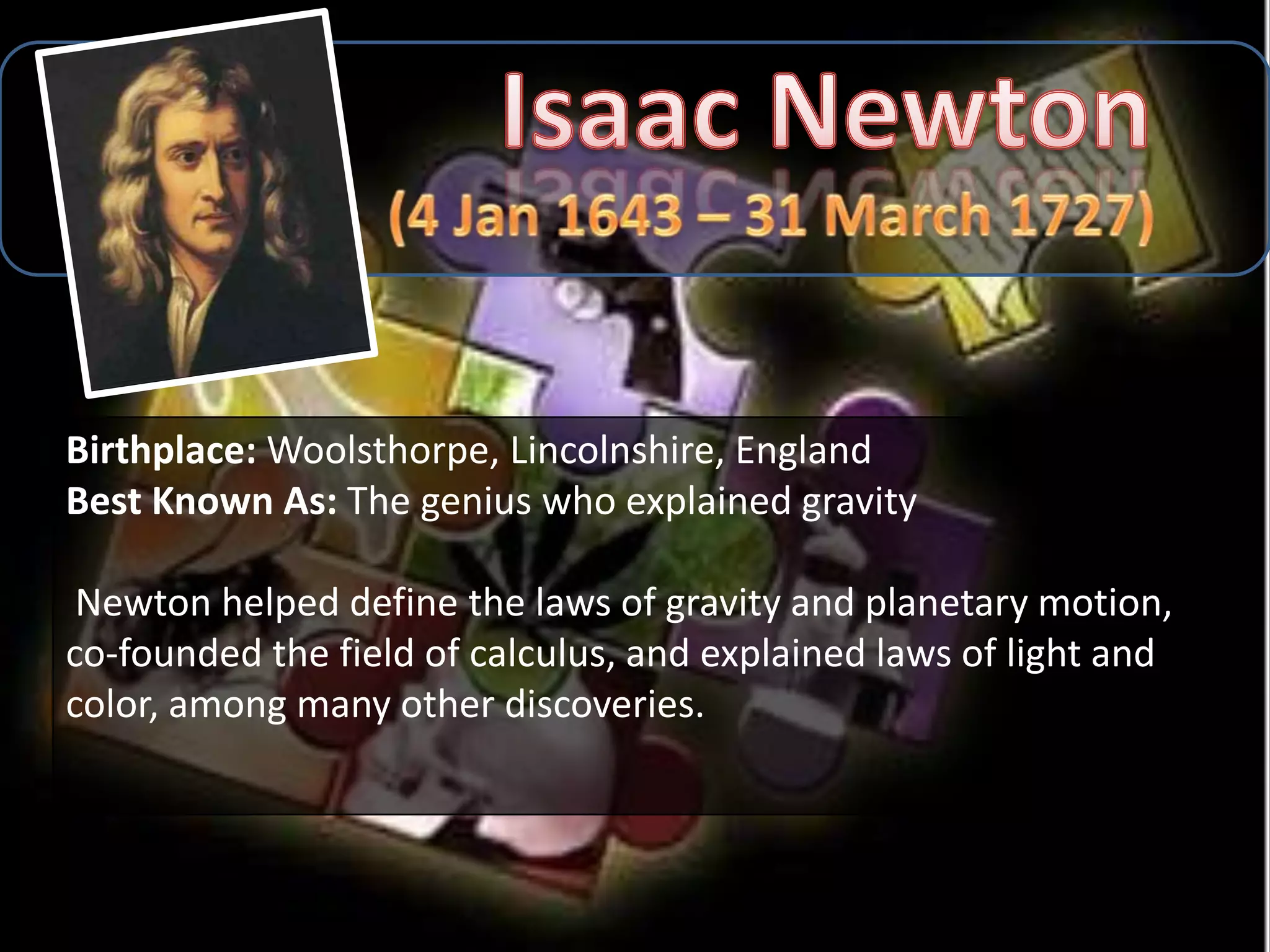
Birthplace: Woolsthorpe, Lincolnshire, England
Best Known As: The genius who explained gravity

 Newton helped define the laws of gravity and planetary motion,
co-founded the field of calculus, and explained laws of light and
color, among many other discoveries.
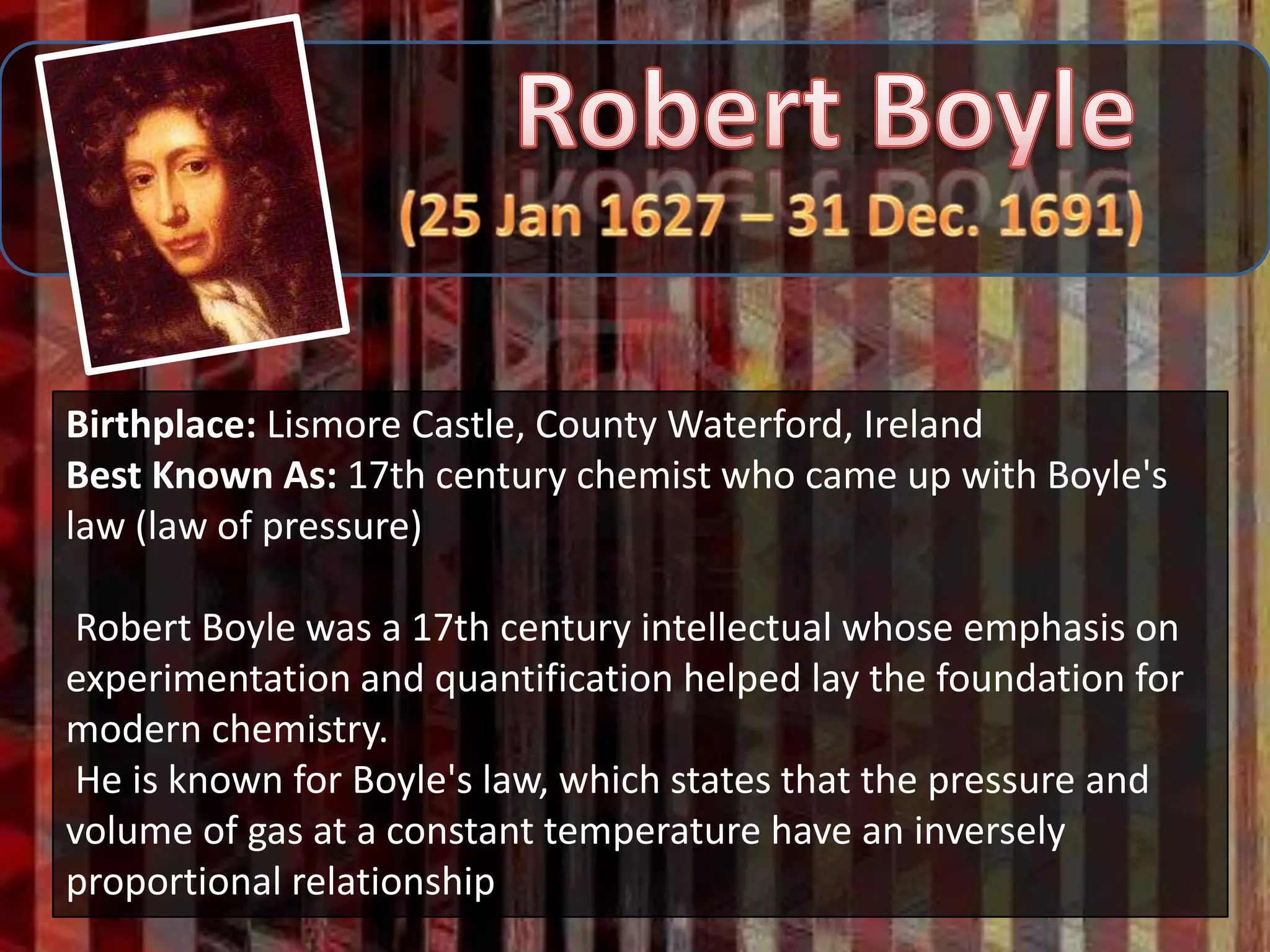
Birthplace: Lismore Castle, County Waterford, Ireland
Best Known As: 17th century chemist who came up with Boyle's
law (law of pressure)

Robert Boyle was a 17th century intellectual whose emphasis on
experimentation and quantification helped lay the foundation for
modern chemistry.
He is known for Boyle's law, which states that the pressure and
volume of gas at a constant temperature have an inversely
proportional relationship
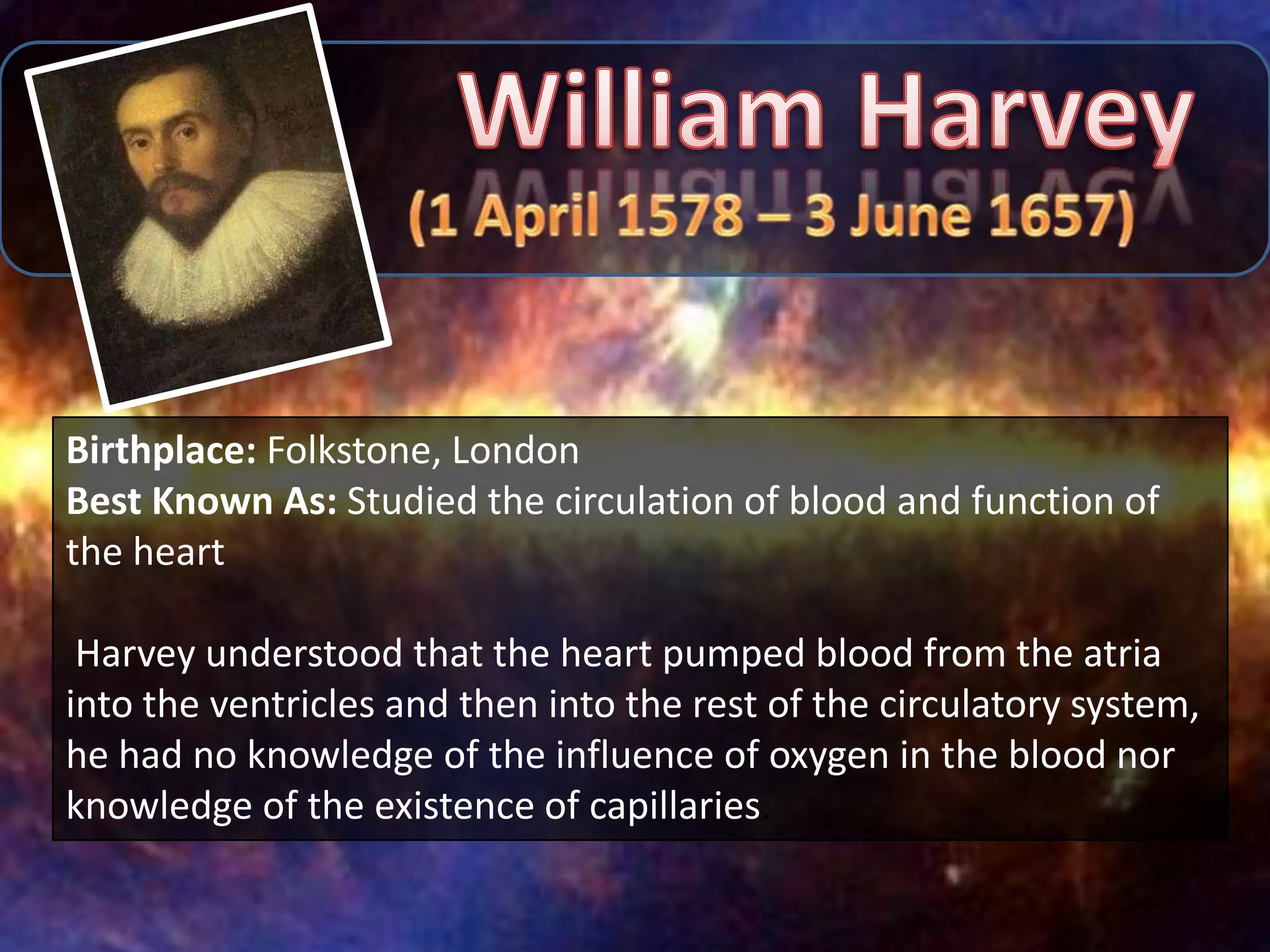
Birthplace: Folkstone, London
Best Known As: Studied the circulation of blood and function of
the heart

 Harvey understood that the heart pumped blood from the atria
into the ventricles and then into the rest of the circulatory system,
he had no knowledge of the influence of oxygen in the blood nor
knowledge of the existence of capillaries.
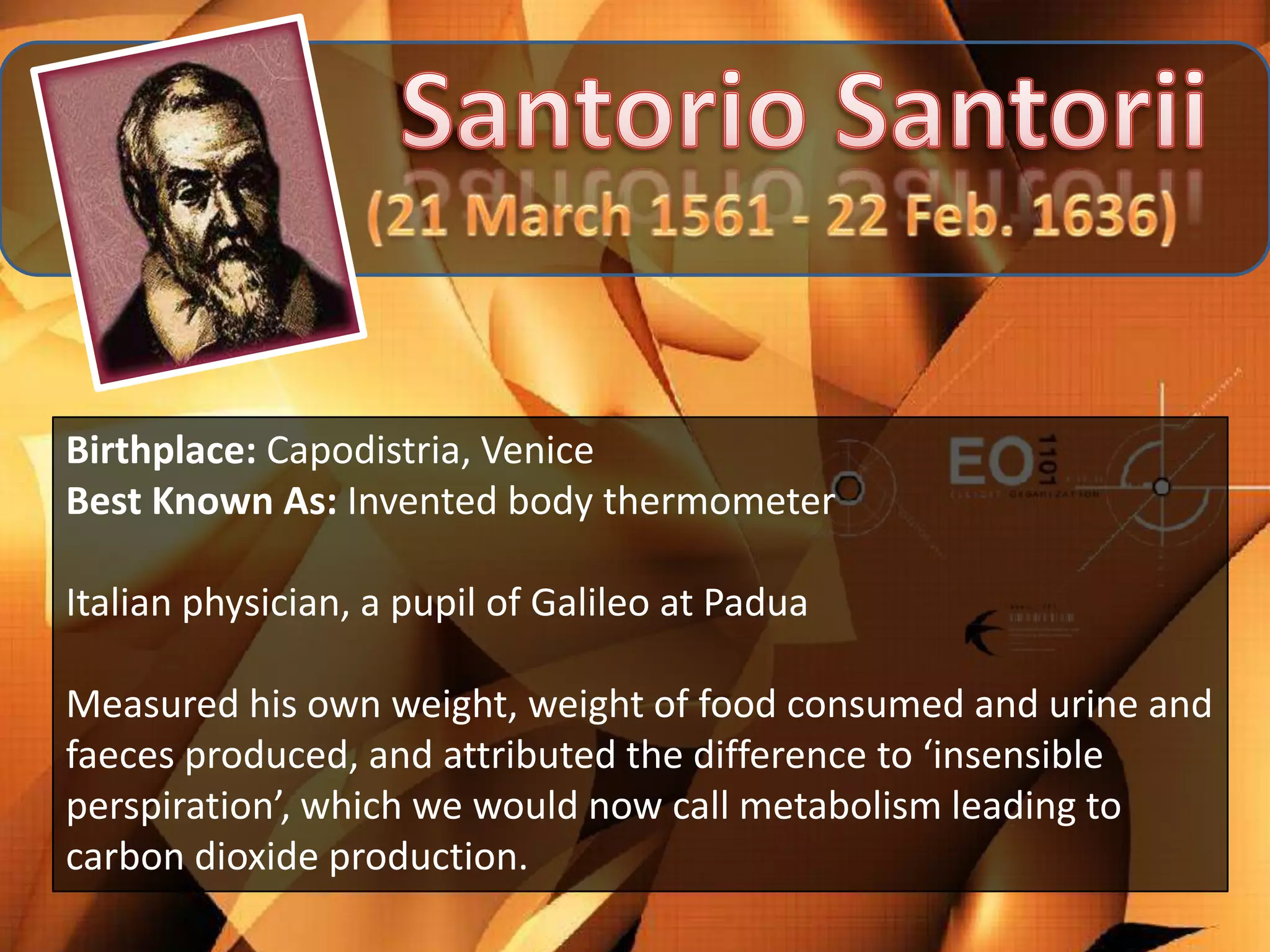
Birthplace: Capodistria, Venice
Best Known As: Invented body thermometer

Italian physician, a pupil of Galileo at Padua

Measured his own weight, weight of food consumed and urine and
faeces produced, and attributed the difference to ‘insensible
perspiration’, which we would now call metabolism leading to
carbon dioxide production.
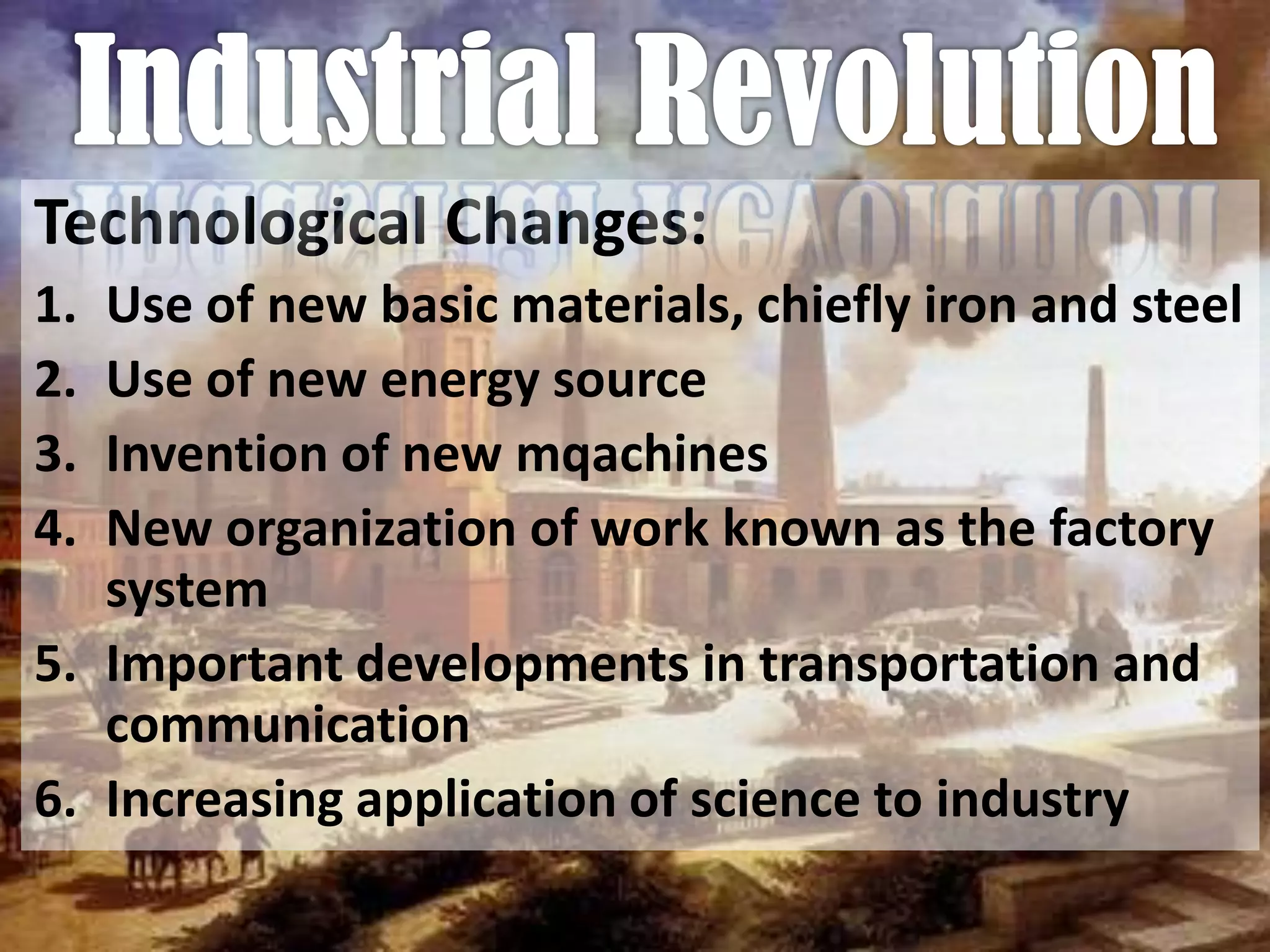
• Process of change from an agrarian,
  handicraft economy to one dominated
  by industry and machine manufacture.
• Process began in England in the 18th
  century and from there spread to the
  rest of the world.
Technological Changes:
1. Use of new basic materials, chiefly iron and steel
2. Use of new energy source
3. Invention of new mqachines
4. New organization of work known as the factory
   system
5. Important developments in transportation and
   communication
6. Increasing application of science to industry
• By definition, it lasted from 1801-1900
  according to the Gregorian Calendar.
• Lead to the second Industrial Revolution
  through the invention of useable electricity,
  steel and petroleum products.
• Age of machine tools (tools that made
  tools)
• Assembly line speed up factory production
• Gave birth to professional scientist
• Science through the 20th century
• Inventions have progressed at an
  accelerated rate
• Began the infancy of airplanes,
  automobiles, spaceships, computers,
  cell phones and wireless internet.
• Science of microengineering.
  (deals with particle manipulation if
  those particles are smaller than 100
  nanometers.
• Essential core is atomic and
  molecular manipulation.
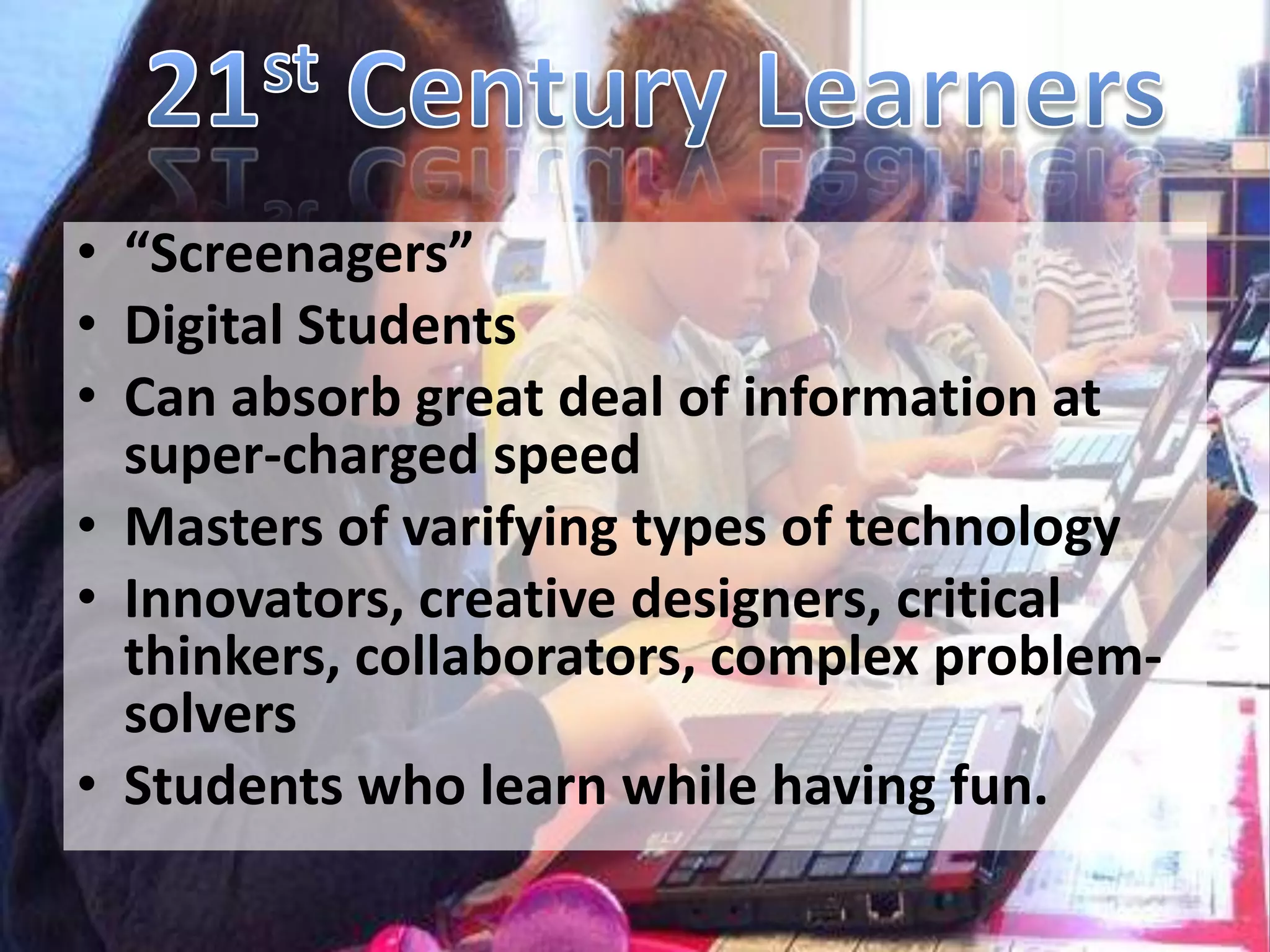
• “Screenagers”
• Digital Students
• Can absorb great deal of information at
  super-charged speed
• Masters of varifying types of technology
• Innovators, creative designers, critical
  thinkers, collaborators, complex problem-
  solvers
• Students who learn while having fun.

Historical development of science and technology

  • 1.
    Historical Development of Science and Technology •Century of the Genius •Industrial Revolution •18th and 19th Century •Modern Era Prepared by: Maria Niña C. Leonoras
  • 3.
    •Emerged most fullyduring the Eighteenth-century or Enlightenment Period. •Age of Enlightenment is also known as Age of Reason. •Science during the 18th century falls into two categories: •Baroque Period •Classical Period
  • 4.
    Started in the17th century and lasted to the early 18th century; lasted into the early 19th century.
  • 6.
    Birthplace: Pisa, Italy BestKnown As: The inventor of the astronomical telescope Discovered a number of natural laws Invented the microscope Constucted a telescope “Father of Modern Astronomy” “Father of Modern Physics” “Father of Science”
  • 7.
    Birthplace: Weil derStadt, Wurttemberg (now Germany) Best Known As: The astronomer who explained planetary motion Engaged in the study of astronomy and developed the laws of planetary motion. 1. “The orbit of a planet about a star is an ellipse with the star at one focus. 2. A line joining a planet and its star sweeps out equal intervals of time. 3. The squares of the orbital periods of planet are directly proportional to the cubes of the semi-major axis of the orbits.
  • 8.
    Birthplace: La Haye,France Best Known As: The philosopher who said "I think, therefore I am Often called the father of modern science. He took as his philosophical starting point the statement Cogito ergo sum -- "I think, therefore I am.“ made major contributions to modern mathematics, especially in developing the Cartesian coordinate system and advancing the theory of equations.
  • 9.
    Birthplace: Clermont-Ferrand, France BestKnown As: 17th century mathematical genius A prodigy in math, Blaise Pascal was a contemporary and rival of René Descartes. He published a significant work on the geometry of conical sections when he was only sixteen; he invented a calculating machine by the time he was nineteen; he and Pierre de Fermat founded the modern theory of probability; he described the principle that is the basis for the hydraulic press (called Pascal's Law); and he proved that there was a vacuum above the atmosphere.
  • 10.
    Birthplace: Beaumont-de-Lomagne, France BestKnown As: Pascal’s correspondence in the formation of the modern theory of probability. He is particularly famous for his 'last theorem', which he discovered in about 1637, and of which he claimed he had a 'marvellous demonstration'. He became a judge, but he had a passion for mathematics and obtained many mathematical theorems, which he communicated to fellow mathematicians, always remaining very secretive about his proofs.
  • 11.
    Birthplace: Woolsthorpe, Lincolnshire,England Best Known As: The genius who explained gravity Newton helped define the laws of gravity and planetary motion, co-founded the field of calculus, and explained laws of light and color, among many other discoveries.
  • 12.
    Birthplace: Lismore Castle,County Waterford, Ireland Best Known As: 17th century chemist who came up with Boyle's law (law of pressure) Robert Boyle was a 17th century intellectual whose emphasis on experimentation and quantification helped lay the foundation for modern chemistry. He is known for Boyle's law, which states that the pressure and volume of gas at a constant temperature have an inversely proportional relationship
  • 13.
    Birthplace: Folkstone, London BestKnown As: Studied the circulation of blood and function of the heart Harvey understood that the heart pumped blood from the atria into the ventricles and then into the rest of the circulatory system, he had no knowledge of the influence of oxygen in the blood nor knowledge of the existence of capillaries.
  • 14.
    Birthplace: Capodistria, Venice BestKnown As: Invented body thermometer Italian physician, a pupil of Galileo at Padua Measured his own weight, weight of food consumed and urine and faeces produced, and attributed the difference to ‘insensible perspiration’, which we would now call metabolism leading to carbon dioxide production.
  • 16.
    • Process ofchange from an agrarian, handicraft economy to one dominated by industry and machine manufacture. • Process began in England in the 18th century and from there spread to the rest of the world.
  • 17.
    Technological Changes: 1. Useof new basic materials, chiefly iron and steel 2. Use of new energy source 3. Invention of new mqachines 4. New organization of work known as the factory system 5. Important developments in transportation and communication 6. Increasing application of science to industry
  • 19.
    • By definition,it lasted from 1801-1900 according to the Gregorian Calendar. • Lead to the second Industrial Revolution through the invention of useable electricity, steel and petroleum products. • Age of machine tools (tools that made tools) • Assembly line speed up factory production • Gave birth to professional scientist
  • 21.
    • Science throughthe 20th century • Inventions have progressed at an accelerated rate • Began the infancy of airplanes, automobiles, spaceships, computers, cell phones and wireless internet.
  • 22.
    • Science ofmicroengineering. (deals with particle manipulation if those particles are smaller than 100 nanometers. • Essential core is atomic and molecular manipulation.
  • 23.
    • “Screenagers” • DigitalStudents • Can absorb great deal of information at super-charged speed • Masters of varifying types of technology • Innovators, creative designers, critical thinkers, collaborators, complex problem- solvers • Students who learn while having fun.