HISTORICAL DEVELOPMENT OFCOMPUTERS
PRE-COMPUTING TO 19TH
CENTURY COMPUTING DEVICES
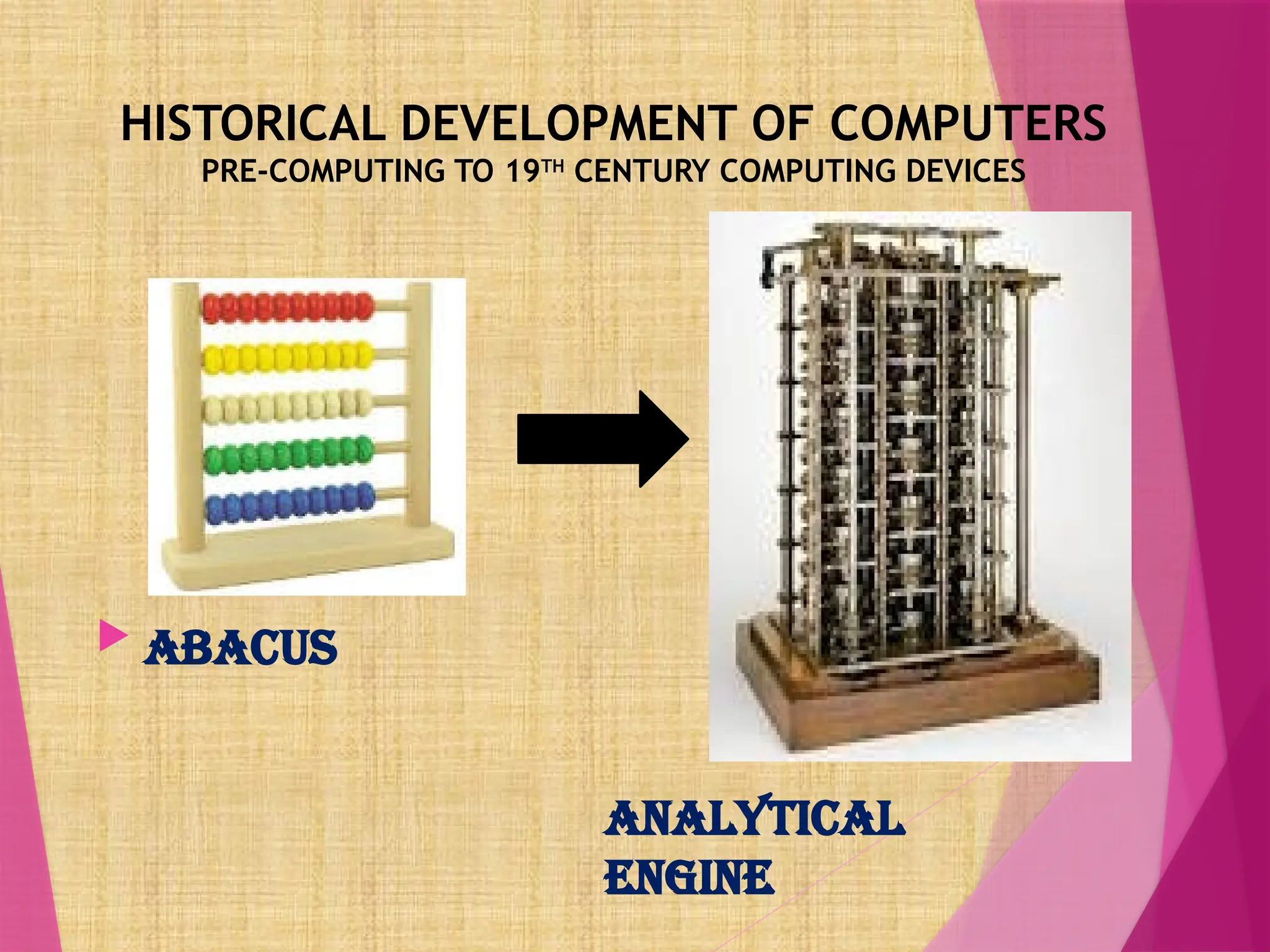
ABACUS
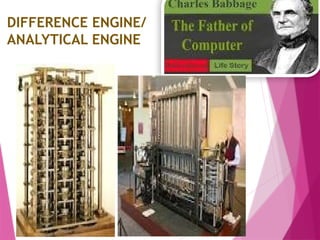
ANALYTICAL
ENGINE
2.
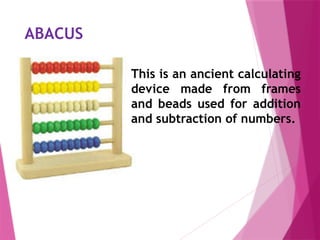
ABACUS
This is anancient calculating
device made from frames
and beads used for addition
and subtraction of numbers.
3.
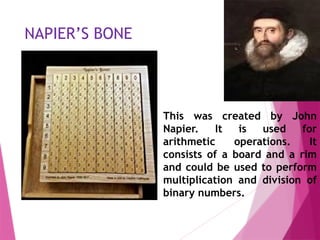
NAPIER’S BONE
This wascreated by John
Napier. It is used for
arithmetic operations. It
consists of a board and a rim
and could be used to perform
multiplication and division of
binary numbers.
4.
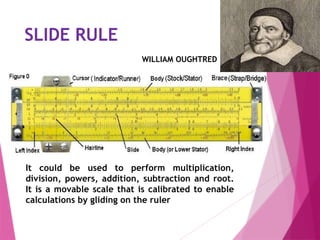
SLIDE RULE
WILLIAM OUGHTRED
Itcould be used to perform multiplication,
division, powers, addition, subtraction and root.
It is a movable scale that is calibrated to enable
calculations by gliding on the ruler
5.
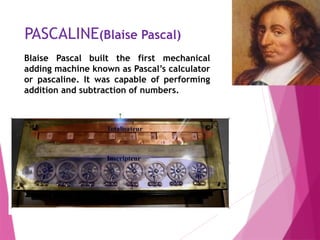
PASCALINE(Blaise Pascal)
Blaise Pascalbuilt the first mechanical
adding machine known as Pascal’s calculator
or pascaline. It was capable of performing
addition and subtraction of numbers.
6.
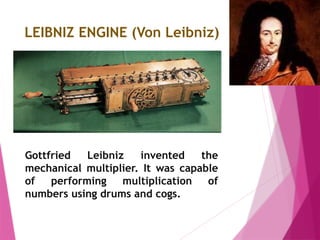
LEIBNIZ ENGINE (VonLeibniz)
Gottfried Leibniz invented the
mechanical multiplier. It was capable
of performing multiplication of
numbers using drums and cogs.