How do representations of
Britishness compare to previous
time periods?
HMK: 500 words on this question
How do representations of
Britishness compare to previous
time periods?
Point: British women are portrayed as more powerful in
contemporary cinema than previous decades.
Evidence: In Fish Tank (2009) directed by Andrea Arnold, Mia
(Katie Jarvis) is a strong independent woman signified by the
close up of her headbutting her best friend which connotes
she’s taking control of her situation.
Explain: This links to David Gauntlett’s theory of decline in
tradition. Mia is standing up for herself which in films in the
past for example The 39 Steps (1935) directed by Alfred
Hitchcock the female character on the train was shown being
dominated by the lead character who forcefully kissed her
and she let him. This represents her character as a traditional
30s woman.
Charlie’s example
• The portrayal of British men has changed within films.
• In My Name is Joe (1998) directed by Ken Loach, Joe is
unemployed signing on. There is a low angle shot
showing Joe painting connoting he looks for odd jobs
to earn an untaxable income.
• This supports David Gauntlett’s theory of masculinity in
crisis because men are supposed to be the
breadwinner. An opposing example to this is Ben
Sergeant (played by Dominic Cooper) in Tamara Drewe
(2010) is a commercially successful popstar. This is
represented by the young girl stealing his t shirt which
connotes he is a desirable icon unlike Joe.
Compare Alfie (1966) Gilbert and 39
steps (1935) Hitchcock• Rep of Britishness through gender/class
• Are stereotypes reinforced or challenged?
• 30s – ‘Many full-length films were produced during the decade of the 1930s. The
1930s were a decade of political turmoil and economic problems; the great
depression had affected the entire world, and Europe was dealing with both the
fallout of World War I and the economic hardships of the time, both of which
resulted in the rise of fascist (intolerant/domineering/authoritarian) political
movements. The uncertainty of the era resulted in widespread popularity of
fantastical, escapist fare.’
• ‘mainstream critics said that the films, whether big or low budget, failed to reflect
social reality, depict ordinary British life or venture beyond the confines of a
studio.’
• 60s – ‘By the middle of the decade, the focus was back on London, newly
confident as the home of a thriving music and fashion scene that was envied
worldwide. The 'swinging London' phenomenon spawned a coterie (exclusive
group) of films’
• Alfie – Paramount – budget $800,000 – took $18 million
• 39 Steps – Gaumont British (independent) / no box office figures
39 steps
• China tea set – wealth
• Suits, diegetic dialogue, unity, groomed, overcoat
• Police are good/trusted
• Train – exciting/wealth/adventures/escapism
• Challenged – on side of villain
• Woman allowed him to kiss/handed him over to police
– traditional values
• Male lead
Alfie
• Cockney accent – well dressed, nice car – reinforcing
London in the 60s
• Breaking the fourth wall – piece to camera – breaking
traditional filmmaking rules
• Checkered suit – against tradition/cleavage – sexual
liberation/reinforcing
• Institution of marriage challenged – positive affair
• Diegetic dialogue: ‘it’ll go home happy’ Objectifying
women – challenging 60s stereotypes
• Married woman trapped, boring, sad – plain looking, no
makeup
• Dog – balance negative associations
Key texts to compare – female leads
• Fish Tank (2009) Andrea Arnold
• production company: BBC films, UK film
council, Limelight Communication, distributed by IFC
• Tamara Drewe (2010) Stephen Frears
• Production company: BBC films, UK film council, Ruby
films, distributed by Momentum, Sony US
• Bridget Jones Edge of Reason (2004) Beeban Kidron
• Production: Working Title distributed by Universal
• Educating Rita(1983) Lewis Gilbert
• Acorn pictures distributed by Columbia
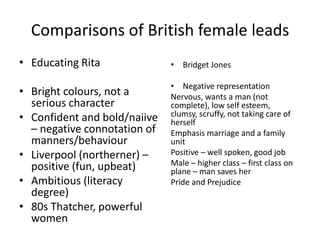
Comparisons of British female leads
• Educating Rita
• Bright colours, not a
serious character
• Confident and bold/naiive
– negative connotation of
manners/behaviour
• Liverpool (northerner) –
positive (fun, upbeat)
• Ambitious (literacy
degree)
• 80s Thatcher, powerful
women
• Bridget Jones
• Negative representation
Nervous, wants a man (not
complete), low self esteem,
clumsy, scruffy, not taking care of
herself
Emphasis marriage and a family
unit
Positive – well spoken, good job
Male – higher class – first class on
plane – man saves her
Pride and Prejudice
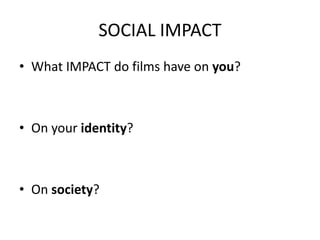
SOCIAL IMPACT
• What IMPACT do films have on you?
• On your identity?
• On society?
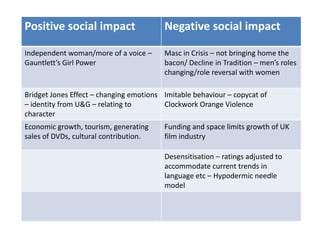
Positive social impact Negative social impact
Independent woman/more of a voice –
Gauntlett’s Girl Power
Masc in Crisis – not bringing home the
bacon/ Decline in Tradition – men’s roles
changing/role reversal with women
Bridget Jones Effect – changing emotions
– identity from U&G – relating to
character
Imitable behaviour – copycat of
Clockwork Orange Violence
Economic growth, tourism, generating
sales of DVDs, cultural contribution.
Funding and space limits growth of UK
film industry
Desensitisation – ratings adjusted to
accommodate current trends in
language etc – Hypodermic needle
model
Positive social impact Negative social impact
Independent woman/more of a voice –
Gauntlett’s Girl Power
Masc in Crisis – not bringing home the
bacon/ Decline in Tradition – men’s roles
changing/role reversal with women
Bridget Jones Effect – changing emotions
– identity from U&G – relating to
character
Imitable behaviour – copycat of
Clockwork Orange Violence
Economic growth, tourism, generating
sales of DVDs, cultural contribution.
Funding and space limits growth of UK
film industry
Desensitisation – ratings adjusted to
accommodate current trends in
language etc – Hypodermic needle
model
SOCIAL IMPACT
• What IMPACT do films have on you?
• Change opinions/beliefs/relate/empathise with the
characters – shape who you want to be/think
differently/ enjoyment/entertainment/utopian feel
• On your identity?
• Aspirational needs/behaviour changes/career path….
• On society? change views
• Educates/inform – world events/culture/issues/politics
• Passive audience – Stuart Hall’s preferred
response/Hypodermic needle model
• Uses and Gratifications Theory
SOCIAL IMPACT
• What IMPACT do films have on you?
• Escapism, entertainment, knowledge, social interaction…uses and
gratifications
• On your identity? (active/passive)/hypodermic needle/U&G
• Reinforcing/challenging stereotypes – consider your
appearance/behaviour/beliefs/opinions
• On society? (major or independent/niche vs mainstream audiences)
• Prejudice, think differently, live differently – The Bridget Jones
effect/generation…ideology/hegemony(dominant ideologies –
breakdown of family/single girls settling down)
Which film will have the most social
impact?
• Fish Tank (2009) Andrea Arnold
• production company: BBC films, UK film
council, Limelight Communication, distributed by IFC
• Tamara Drewe (2010) Stephen Frears
• Production company: BBC films, UK film council, Ruby
films, distributed by Momentum, Sony US
• Bridget Jones Edge of Reason (2004) Beeban Kidron
• Production: Working Title distributed by Universal
• Educating Rita(1983) Lewis Gilbert
• Acorn pictures distributed by Columbia
Social impact
• Fish Tank
• Single Mum struggling – social worker –
asynchronous sound – ‘hard being on your
own’
• Mia’s limited opportunities/neglected alcohol
abuse
• Masc in crisis/decline in tradition – Conor has
a more feminine role – nurturing her
• Objectification of him undressing/voyeuristic
Social impact
• Tamara Drewe
• More in control of relationship – he’s chasing her
– masc in crisis
• Teens – fantasising, troublesome, reinforces
typical teen stereotypes (passive audience)
• Beth as a motherly figure –
insignificant, belittles, ignores – he’s the
important figure – sexist traditional roles –
subverts masc in crisis
• Andy vs Ben – roles changing over time –
juxtaposition/binary opposites – stark contrast of
modern vs traditional man
Which film has the most social impact?
• Educating Rita (1983)
• Bridget Jones Edge of Reason (2004)
• Fish Tank (2009)
• Tamara Drewe (2010)
The Bridget Jones Effect
• Read the articles
• In what ways can a film affect society?
TASK 30 mins: apply today’s targets
What are the social implications of
different representations of
Britishness?
500 words on this question.
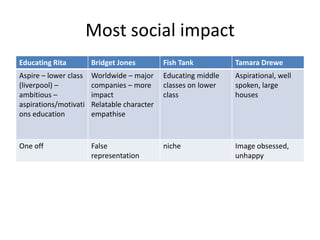
Most social impact
Educating Rita Bridget Jones Fish Tank Tamara Drewe
Aspire – lower class
(liverpool) –
ambitious –
aspirations/motivati
ons education
Worldwide – major
companies – more
impact
Relatable character
empathise
Educating middle
classes on lower
class
Aspirational, well
spoken, large
houses
One off False
representation
niche Image obsessed,
unhappy

Historical and Social Impact

  • 1.
    How do representationsof Britishness compare to previous time periods? HMK: 500 words on this question
  • 2.
    How do representationsof Britishness compare to previous time periods? Point: British women are portrayed as more powerful in contemporary cinema than previous decades. Evidence: In Fish Tank (2009) directed by Andrea Arnold, Mia (Katie Jarvis) is a strong independent woman signified by the close up of her headbutting her best friend which connotes she’s taking control of her situation. Explain: This links to David Gauntlett’s theory of decline in tradition. Mia is standing up for herself which in films in the past for example The 39 Steps (1935) directed by Alfred Hitchcock the female character on the train was shown being dominated by the lead character who forcefully kissed her and she let him. This represents her character as a traditional 30s woman.
  • 3.
    Charlie’s example • Theportrayal of British men has changed within films. • In My Name is Joe (1998) directed by Ken Loach, Joe is unemployed signing on. There is a low angle shot showing Joe painting connoting he looks for odd jobs to earn an untaxable income. • This supports David Gauntlett’s theory of masculinity in crisis because men are supposed to be the breadwinner. An opposing example to this is Ben Sergeant (played by Dominic Cooper) in Tamara Drewe (2010) is a commercially successful popstar. This is represented by the young girl stealing his t shirt which connotes he is a desirable icon unlike Joe.
  • 4.
    Compare Alfie (1966)Gilbert and 39 steps (1935) Hitchcock• Rep of Britishness through gender/class • Are stereotypes reinforced or challenged? • 30s – ‘Many full-length films were produced during the decade of the 1930s. The 1930s were a decade of political turmoil and economic problems; the great depression had affected the entire world, and Europe was dealing with both the fallout of World War I and the economic hardships of the time, both of which resulted in the rise of fascist (intolerant/domineering/authoritarian) political movements. The uncertainty of the era resulted in widespread popularity of fantastical, escapist fare.’ • ‘mainstream critics said that the films, whether big or low budget, failed to reflect social reality, depict ordinary British life or venture beyond the confines of a studio.’ • 60s – ‘By the middle of the decade, the focus was back on London, newly confident as the home of a thriving music and fashion scene that was envied worldwide. The 'swinging London' phenomenon spawned a coterie (exclusive group) of films’ • Alfie – Paramount – budget $800,000 – took $18 million • 39 Steps – Gaumont British (independent) / no box office figures
  • 5.
    39 steps • Chinatea set – wealth • Suits, diegetic dialogue, unity, groomed, overcoat • Police are good/trusted • Train – exciting/wealth/adventures/escapism • Challenged – on side of villain • Woman allowed him to kiss/handed him over to police – traditional values • Male lead
  • 6.
    Alfie • Cockney accent– well dressed, nice car – reinforcing London in the 60s • Breaking the fourth wall – piece to camera – breaking traditional filmmaking rules • Checkered suit – against tradition/cleavage – sexual liberation/reinforcing • Institution of marriage challenged – positive affair • Diegetic dialogue: ‘it’ll go home happy’ Objectifying women – challenging 60s stereotypes • Married woman trapped, boring, sad – plain looking, no makeup • Dog – balance negative associations
  • 7.
    Key texts tocompare – female leads • Fish Tank (2009) Andrea Arnold • production company: BBC films, UK film council, Limelight Communication, distributed by IFC • Tamara Drewe (2010) Stephen Frears • Production company: BBC films, UK film council, Ruby films, distributed by Momentum, Sony US • Bridget Jones Edge of Reason (2004) Beeban Kidron • Production: Working Title distributed by Universal • Educating Rita(1983) Lewis Gilbert • Acorn pictures distributed by Columbia
  • 8.
    Comparisons of Britishfemale leads • Educating Rita • Bright colours, not a serious character • Confident and bold/naiive – negative connotation of manners/behaviour • Liverpool (northerner) – positive (fun, upbeat) • Ambitious (literacy degree) • 80s Thatcher, powerful women • Bridget Jones • Negative representation Nervous, wants a man (not complete), low self esteem, clumsy, scruffy, not taking care of herself Emphasis marriage and a family unit Positive – well spoken, good job Male – higher class – first class on plane – man saves her Pride and Prejudice
  • 9.
    SOCIAL IMPACT • WhatIMPACT do films have on you? • On your identity? • On society?
  • 10.
    Positive social impactNegative social impact Independent woman/more of a voice – Gauntlett’s Girl Power Masc in Crisis – not bringing home the bacon/ Decline in Tradition – men’s roles changing/role reversal with women Bridget Jones Effect – changing emotions – identity from U&G – relating to character Imitable behaviour – copycat of Clockwork Orange Violence Economic growth, tourism, generating sales of DVDs, cultural contribution. Funding and space limits growth of UK film industry Desensitisation – ratings adjusted to accommodate current trends in language etc – Hypodermic needle model
  • 11.
    Positive social impactNegative social impact Independent woman/more of a voice – Gauntlett’s Girl Power Masc in Crisis – not bringing home the bacon/ Decline in Tradition – men’s roles changing/role reversal with women Bridget Jones Effect – changing emotions – identity from U&G – relating to character Imitable behaviour – copycat of Clockwork Orange Violence Economic growth, tourism, generating sales of DVDs, cultural contribution. Funding and space limits growth of UK film industry Desensitisation – ratings adjusted to accommodate current trends in language etc – Hypodermic needle model
  • 12.
    SOCIAL IMPACT • WhatIMPACT do films have on you? • Change opinions/beliefs/relate/empathise with the characters – shape who you want to be/think differently/ enjoyment/entertainment/utopian feel • On your identity? • Aspirational needs/behaviour changes/career path…. • On society? change views • Educates/inform – world events/culture/issues/politics • Passive audience – Stuart Hall’s preferred response/Hypodermic needle model • Uses and Gratifications Theory
  • 13.
    SOCIAL IMPACT • WhatIMPACT do films have on you? • Escapism, entertainment, knowledge, social interaction…uses and gratifications • On your identity? (active/passive)/hypodermic needle/U&G • Reinforcing/challenging stereotypes – consider your appearance/behaviour/beliefs/opinions • On society? (major or independent/niche vs mainstream audiences) • Prejudice, think differently, live differently – The Bridget Jones effect/generation…ideology/hegemony(dominant ideologies – breakdown of family/single girls settling down)
  • 14.
    Which film willhave the most social impact? • Fish Tank (2009) Andrea Arnold • production company: BBC films, UK film council, Limelight Communication, distributed by IFC • Tamara Drewe (2010) Stephen Frears • Production company: BBC films, UK film council, Ruby films, distributed by Momentum, Sony US • Bridget Jones Edge of Reason (2004) Beeban Kidron • Production: Working Title distributed by Universal • Educating Rita(1983) Lewis Gilbert • Acorn pictures distributed by Columbia
  • 15.
    Social impact • FishTank • Single Mum struggling – social worker – asynchronous sound – ‘hard being on your own’ • Mia’s limited opportunities/neglected alcohol abuse • Masc in crisis/decline in tradition – Conor has a more feminine role – nurturing her • Objectification of him undressing/voyeuristic
  • 16.
    Social impact • TamaraDrewe • More in control of relationship – he’s chasing her – masc in crisis • Teens – fantasising, troublesome, reinforces typical teen stereotypes (passive audience) • Beth as a motherly figure – insignificant, belittles, ignores – he’s the important figure – sexist traditional roles – subverts masc in crisis • Andy vs Ben – roles changing over time – juxtaposition/binary opposites – stark contrast of modern vs traditional man
  • 17.
    Which film hasthe most social impact? • Educating Rita (1983) • Bridget Jones Edge of Reason (2004) • Fish Tank (2009) • Tamara Drewe (2010)
  • 18.
    The Bridget JonesEffect • Read the articles • In what ways can a film affect society?
  • 19.
    TASK 30 mins:apply today’s targets What are the social implications of different representations of Britishness? 500 words on this question.
  • 20.
    Most social impact EducatingRita Bridget Jones Fish Tank Tamara Drewe Aspire – lower class (liverpool) – ambitious – aspirations/motivati ons education Worldwide – major companies – more impact Relatable character empathise Educating middle classes on lower class Aspirational, well spoken, large houses One off False representation niche Image obsessed, unhappy