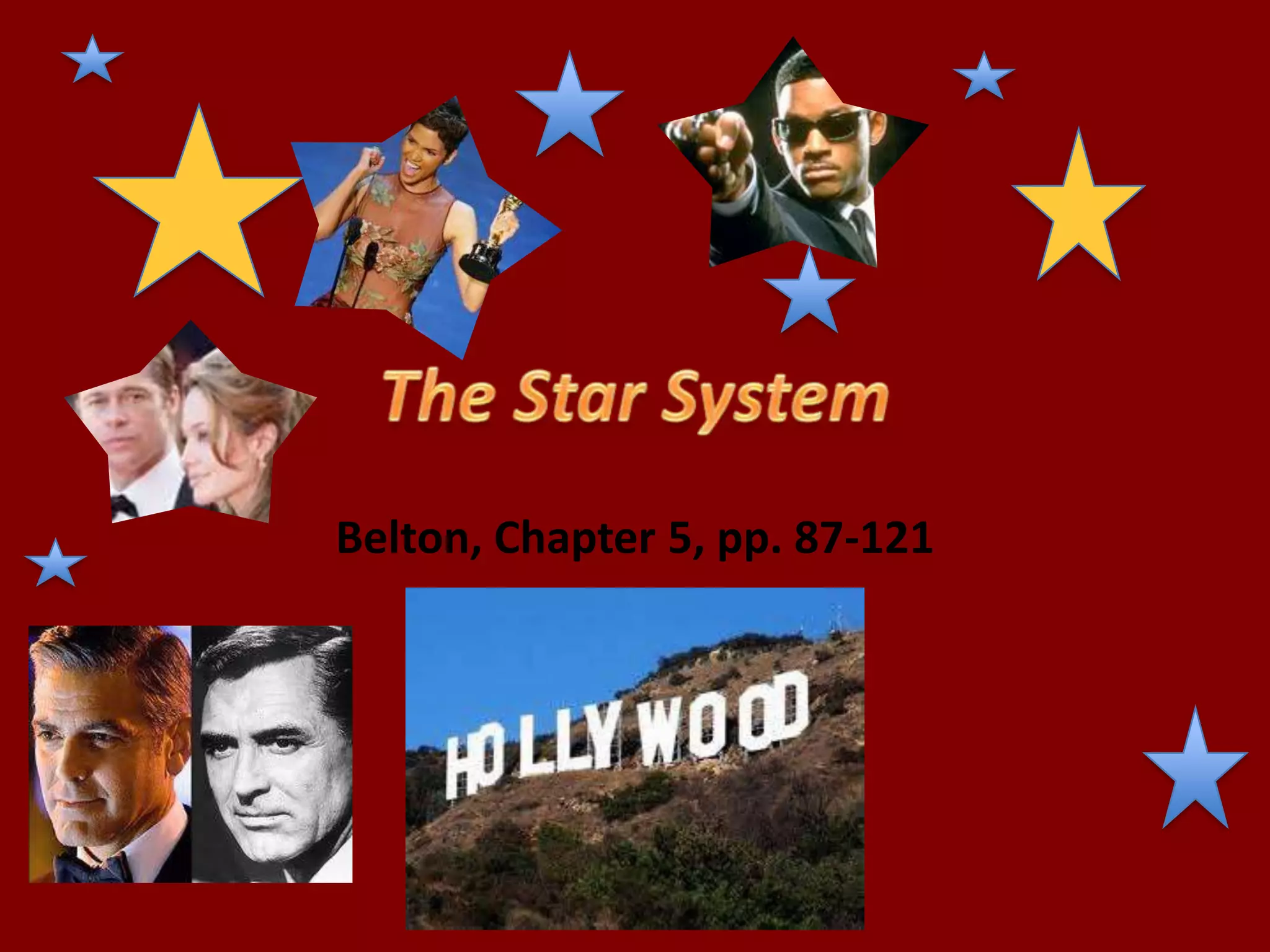
Belton, Chapter 5, pp. 87-121
Making Stars

 Exposed Artifice: Singin’ in the Rain
    Early film viewer idolized actors and actresses of the silent film
     industry
    Advent of sound exposed imperfections of talkies, artifice that
     had once been easily concealed
 Stars, Fans, and Profits
    “The industry that makes motion pictures also manufactures
     movie stars, with the aid of the press and other media—movie
     stars who have played and continue to play a crucial economic
     role…” (89).
    provide studios with a tangible attraction, a marketable image
Star Power

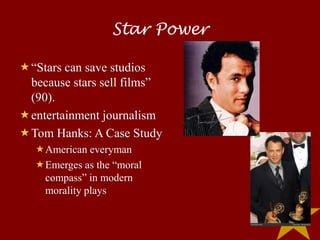
“Stars can save studios
 because stars sell films”
 (90).
entertainment journalism
Tom Hanks: A Case Study
  American everyman
  Emerges as the “moral
   compass” in modern
   morality plays
Persona: A Variety of Masks
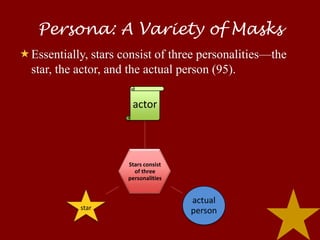
Essentially, stars consist of three personalities—the
 star, the actor, and the actual person (95).

                       actor


                      Stars consist
                        of three
                      personalities


                                      actual
            star                      person
Stardom and Mass Culture:
        From Persona to Star
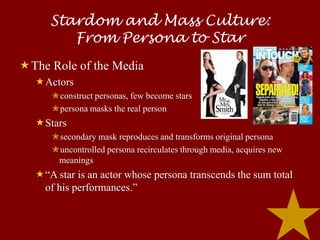
The Role of the Media
  Actors
     ✮construct personas, few become stars
     ✮persona masks the real person
  Stars
     ✮secondary mask reproduces and transforms original persona
     ✮uncontrolled persona recirculates through media, acquires new
      meanings
  “A star is an actor whose persona transcends the sum total
   of his performances.”
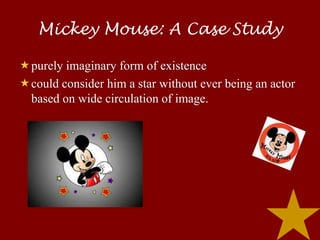
Mickey Mouse: A Case Study

purely imaginary form of existence
could consider him a star without ever being an actor
 based on wide circulation of image.
Stars, the System, and the Public

 Marilyn Monroe: A Case Study
    “Only the public can make a star…It’s the studios who try to
     make a system out of it.”
    Marilyn Monroe’s account of stardom, challenged studio
     attempts to manufacture a replacement (she was known to push
     the limits, defiance, resisted strict demands imposed by studios-
     arrived late, walked off set in mid-production)
 Stardom and Public Acceptance
    Stars function as “sociocultural barometers, giving expression
     to and providing symbolic solutions for specific
     fears, desires, anxieties, and/or dreams that haunt popular
     consciousness”
    Fans as intelligent agents! Fans are aware of the fantasy involved
     in stardom; public has the power to “break stars” when they
     violate social norms (100).
The Early Years
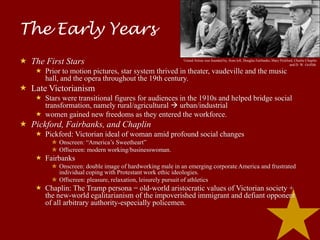
 The First Stars                                         United Artists was founded by, from left, Douglas Fairbanks, Mary Pickford, Charlie Chaplin
                                                                                                                                  and D. W. Griffith.

     Prior to motion pictures, star system thrived in theater, vaudeville and the music
      hall, and the opera throughout the 19th century.
 Late Victorianism
     Stars were transitional figures for audiences in the 1910s and helped bridge social
      transformation, namely rural/agricultural  urban/industrial
     women gained new freedoms as they entered the workforce.
 Pickford, Fairbanks, and Chaplin
     Pickford: Victorian ideal of woman amid profound social changes
         ✮ Onscreen: “America’s Sweetheart”
         ✮ Offscreen: modern working/businesswoman.
     Fairbanks
         ✮ Onscreen: double image of hardworking male in an emerging corporate America and frustrated
           individual coping with Protestant work ethic ideologies.
         ✮ Offscreen: pleasure, relaxation, leisurely pursuit of athletics
     Chaplin: The Tramp persona = old-world aristocratic values of Victorian society +
      the new-world egalitarianism of the impoverished immigrant and defiant opponent
      of all arbitrary authority-especially policemen.
Exoticism, Eroticism, and Modern
    Morality: Stars of the 1920s
 The Jazz Age
     Atmosphere of Sexual Liberation: SEX sells; sex plays a major role in the
      construction of stardom
     New World innocence of Valentino and Garbo
     Women’s movements: suffrage/voting rights in 1920, temperance impact on
      institution of Prohibition in 1919
         ✮ Roaring Twenties: “flappers” and “jazz babies” expressed sexual liberation and defended their
           actions in terms of a modern morality (104).
         ✮ Victorian Puritanism replaced by explicitly confronting female desire and behavior;
           however, endings often returned to traditional virtues, sexual fidelity, marriage, and family.
 Having “It”: Clara Bow and Rudolph Valentino
     “It” = having beauty, being desirable: pretty/handsome, sexy, fun-
      loving, impudent, worldly-wise.
     Valentino: “foreign-born screen idol” appealed to American women, cast in roles
      ranging from misogynist, brutal romantic, passionate bullfighter, Latino lover
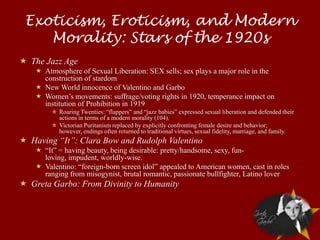
 Greta Garbo: From Divinity to Humanity
Depression/Repression: The 1930s

 New Realities, New Images
    The transition to sound ushered in a new breed of movie star
     made up of actors and actresses from the theater, vaudeville, the
     recording studio, and radio.
    Working class stars of the 1930s
 All-American Kids: Shirley Temple, Mickey Rooney, and
  Judy Garland
    Hollywood’s response to audience demands/interest in less
     fantasy, more realistic stars; more human/accessible stars
 Clark Gable: Populist Hero
    The most representative star of the 1930s
    the all-American guy, projected a no-nonsense honesty
Sex, Censorship, and Star Images

 “Sex continued to play a major role in the construction of
  stardom in the 1930s” (110).
 The Production Code of 1934
    resulted from protest by civic organizations (mostly religious
    prohibited depictions of crime, violence, and sexual themes such
     as adultery; scenes of passion, seduction, or rape; sexual
     perversion, and miscegenation
    sex films  screwball comedy
 Sexual self-censorship made actors more desirable, drove
  sex underground-repression during war years led to
  explosive resexualization of Hollywood in postwar years
  (e.g. sexually explicit themes, film noir).
World War II and Its Aftermath

 A New Generation
    Postwar transformation of stardom
    performers pushed the limits of classical social, sexual and
     psychological behavior.
 Transformations
    stardom changed during and after the war; performers pushed the
     limits of “classical social, sexual, and psychological behavior”
    Rebellious/revolutionary nature of American female sexuality
     revealed briefly empowering women who embraced it (111).
 The Darker Side: Psychology and “the Method”
    Postwar realism—emphasis on imperfections, focus on flaws;
     training method based on personal experiences/emotional
     histories (e.g. Marilyn Monroe).
Stars and Anti-Stars
 Resisting Tradition: Nicholas, Eastwood, and Their Peers
    by-product of 1960s counterculture
    Resistance, reluctance, refusal to cooperate with the
     press, publicity avoidance
 Anti-stars: Television as Training Ground
    Since the breakup of the studio system, contemporary stars have
     entered Hollywood from a variety of other media, developing
     star status outside of motion pictures that they translate into
     stardom in Hollywood.
 Stars’ Children: Déjà Vu
    Emergence of 2nd generation stardom
    “contemporary stars enable us to see the ghost of Hollywood
     past in the faces of Hollywood present” (116).
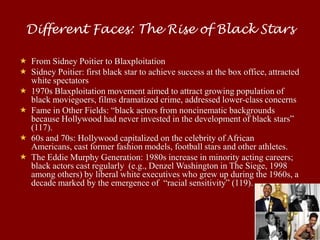
Different Faces: The Rise of Black Stars

 From Sidney Poitier to Blaxploitation
 Sidney Poitier: first black star to achieve success at the box office, attracted
  white spectators
 1970s Blaxploitation movement aimed to attract growing population of
  black moviegoers, films dramatized crime, addressed lower-class concerns
 Fame in Other Fields: “black actors from noncinematic backgrounds
  because Hollywood had never invested in the development of black stars”
  (117).
 60s and 70s: Hollywood capitalized on the celebrity of African
  Americans, cast former fashion models, football stars and other athletes.
 The Eddie Murphy Generation: 1980s increase in minority acting careers;
  black actors cast regularly (e.g., Denzel Washington in The Siege, 1998
  among others) by liberal white executives who grew up during the 1960s, a
  decade marked by the emergence of “racial sensitivity” (119).
Economics and Contemporary
              Stardom
 Essential artifice emerges in the economic context of film
  industry where images are worth money: “Stars are and always
  have been commodities…not born, but made with a purpose—
  to sell films” (119).
 Phenomenon of stardom is essential to the reproduction of
  Hollywood motion picture production; presence of stars
  equates profit; stars play a role in stabilizing an otherwise
  unstable industry
 Stars provide unique pleasure to audiences who appreciate
  stars as performers; we derive appreciation from the interplay
  between star and character.
 Ever been disappointed or shocked by a particular star’s
  behavior or appearance in public? What might your response
  to negative publicity suggest about prevailing ideologies?

Belton Chapter 5: The Star System

  • 1.
  • 3.
    Making Stars  ExposedArtifice: Singin’ in the Rain  Early film viewer idolized actors and actresses of the silent film industry  Advent of sound exposed imperfections of talkies, artifice that had once been easily concealed  Stars, Fans, and Profits  “The industry that makes motion pictures also manufactures movie stars, with the aid of the press and other media—movie stars who have played and continue to play a crucial economic role…” (89).  provide studios with a tangible attraction, a marketable image
  • 4.
    Star Power “Stars cansave studios because stars sell films” (90). entertainment journalism Tom Hanks: A Case Study American everyman Emerges as the “moral compass” in modern morality plays
  • 5.
    Persona: A Varietyof Masks Essentially, stars consist of three personalities—the star, the actor, and the actual person (95). actor Stars consist of three personalities actual star person
  • 6.
    Stardom and MassCulture: From Persona to Star The Role of the Media Actors ✮construct personas, few become stars ✮persona masks the real person Stars ✮secondary mask reproduces and transforms original persona ✮uncontrolled persona recirculates through media, acquires new meanings “A star is an actor whose persona transcends the sum total of his performances.”
  • 7.
    Mickey Mouse: ACase Study purely imaginary form of existence could consider him a star without ever being an actor based on wide circulation of image.
  • 8.
    Stars, the System,and the Public  Marilyn Monroe: A Case Study  “Only the public can make a star…It’s the studios who try to make a system out of it.”  Marilyn Monroe’s account of stardom, challenged studio attempts to manufacture a replacement (she was known to push the limits, defiance, resisted strict demands imposed by studios- arrived late, walked off set in mid-production)  Stardom and Public Acceptance  Stars function as “sociocultural barometers, giving expression to and providing symbolic solutions for specific fears, desires, anxieties, and/or dreams that haunt popular consciousness”  Fans as intelligent agents! Fans are aware of the fantasy involved in stardom; public has the power to “break stars” when they violate social norms (100).
  • 10.
    The Early Years The First Stars United Artists was founded by, from left, Douglas Fairbanks, Mary Pickford, Charlie Chaplin and D. W. Griffith.  Prior to motion pictures, star system thrived in theater, vaudeville and the music hall, and the opera throughout the 19th century.  Late Victorianism  Stars were transitional figures for audiences in the 1910s and helped bridge social transformation, namely rural/agricultural  urban/industrial  women gained new freedoms as they entered the workforce.  Pickford, Fairbanks, and Chaplin  Pickford: Victorian ideal of woman amid profound social changes ✮ Onscreen: “America’s Sweetheart” ✮ Offscreen: modern working/businesswoman.  Fairbanks ✮ Onscreen: double image of hardworking male in an emerging corporate America and frustrated individual coping with Protestant work ethic ideologies. ✮ Offscreen: pleasure, relaxation, leisurely pursuit of athletics  Chaplin: The Tramp persona = old-world aristocratic values of Victorian society + the new-world egalitarianism of the impoverished immigrant and defiant opponent of all arbitrary authority-especially policemen.
  • 11.
    Exoticism, Eroticism, andModern Morality: Stars of the 1920s  The Jazz Age  Atmosphere of Sexual Liberation: SEX sells; sex plays a major role in the construction of stardom  New World innocence of Valentino and Garbo  Women’s movements: suffrage/voting rights in 1920, temperance impact on institution of Prohibition in 1919 ✮ Roaring Twenties: “flappers” and “jazz babies” expressed sexual liberation and defended their actions in terms of a modern morality (104). ✮ Victorian Puritanism replaced by explicitly confronting female desire and behavior; however, endings often returned to traditional virtues, sexual fidelity, marriage, and family.  Having “It”: Clara Bow and Rudolph Valentino  “It” = having beauty, being desirable: pretty/handsome, sexy, fun- loving, impudent, worldly-wise.  Valentino: “foreign-born screen idol” appealed to American women, cast in roles ranging from misogynist, brutal romantic, passionate bullfighter, Latino lover  Greta Garbo: From Divinity to Humanity
  • 12.
    Depression/Repression: The 1930s New Realities, New Images  The transition to sound ushered in a new breed of movie star made up of actors and actresses from the theater, vaudeville, the recording studio, and radio.  Working class stars of the 1930s  All-American Kids: Shirley Temple, Mickey Rooney, and Judy Garland  Hollywood’s response to audience demands/interest in less fantasy, more realistic stars; more human/accessible stars  Clark Gable: Populist Hero  The most representative star of the 1930s  the all-American guy, projected a no-nonsense honesty
  • 13.
    Sex, Censorship, andStar Images  “Sex continued to play a major role in the construction of stardom in the 1930s” (110).  The Production Code of 1934  resulted from protest by civic organizations (mostly religious  prohibited depictions of crime, violence, and sexual themes such as adultery; scenes of passion, seduction, or rape; sexual perversion, and miscegenation  sex films  screwball comedy  Sexual self-censorship made actors more desirable, drove sex underground-repression during war years led to explosive resexualization of Hollywood in postwar years (e.g. sexually explicit themes, film noir).
  • 14.
    World War IIand Its Aftermath  A New Generation  Postwar transformation of stardom  performers pushed the limits of classical social, sexual and psychological behavior.  Transformations  stardom changed during and after the war; performers pushed the limits of “classical social, sexual, and psychological behavior”  Rebellious/revolutionary nature of American female sexuality revealed briefly empowering women who embraced it (111).  The Darker Side: Psychology and “the Method”  Postwar realism—emphasis on imperfections, focus on flaws; training method based on personal experiences/emotional histories (e.g. Marilyn Monroe).
  • 15.
    Stars and Anti-Stars Resisting Tradition: Nicholas, Eastwood, and Their Peers  by-product of 1960s counterculture  Resistance, reluctance, refusal to cooperate with the press, publicity avoidance  Anti-stars: Television as Training Ground  Since the breakup of the studio system, contemporary stars have entered Hollywood from a variety of other media, developing star status outside of motion pictures that they translate into stardom in Hollywood.  Stars’ Children: Déjà Vu  Emergence of 2nd generation stardom  “contemporary stars enable us to see the ghost of Hollywood past in the faces of Hollywood present” (116).
  • 16.
    Different Faces: TheRise of Black Stars  From Sidney Poitier to Blaxploitation  Sidney Poitier: first black star to achieve success at the box office, attracted white spectators  1970s Blaxploitation movement aimed to attract growing population of black moviegoers, films dramatized crime, addressed lower-class concerns  Fame in Other Fields: “black actors from noncinematic backgrounds because Hollywood had never invested in the development of black stars” (117).  60s and 70s: Hollywood capitalized on the celebrity of African Americans, cast former fashion models, football stars and other athletes.  The Eddie Murphy Generation: 1980s increase in minority acting careers; black actors cast regularly (e.g., Denzel Washington in The Siege, 1998 among others) by liberal white executives who grew up during the 1960s, a decade marked by the emergence of “racial sensitivity” (119).
  • 17.
    Economics and Contemporary Stardom  Essential artifice emerges in the economic context of film industry where images are worth money: “Stars are and always have been commodities…not born, but made with a purpose— to sell films” (119).  Phenomenon of stardom is essential to the reproduction of Hollywood motion picture production; presence of stars equates profit; stars play a role in stabilizing an otherwise unstable industry  Stars provide unique pleasure to audiences who appreciate stars as performers; we derive appreciation from the interplay between star and character.  Ever been disappointed or shocked by a particular star’s behavior or appearance in public? What might your response to negative publicity suggest about prevailing ideologies?