Understanding HIPAA Presented by: Officer Frank Webb Mental Health Unit Houston Police Department
Disclaimer The information provided in this presentation does not constitute legal advice and is intended to be used for guidance only.
HIPAA? Helping Impede Police Action & Authority or Health Insurance Portability & Accountability Act
HIPAA Also known as the Kennedy-Kassenbaum Act Grew out of the Clinton Health Care Administration
HIPAA Goals Insure the confidentiality of patients’ health care information Simplify the prosecution of health care fraud and abuse Make changing jobs easier, while providing better access to health care insurance
Examples Chief over ISD Collecting data within an agency HNT  Call-Takers not being able to ask about MI
Examples Sharing data between police departments Premise histories Your examples?
Definitions PHI (Protected Health Information) - All Individually Identifiable Health Information and other information on treatment and care that is transmitted or maintained in any form or medium Use - The sharing, employment, application, utilization, examination, or analysis of such information within an entity that maintains such information
Definitions Disclosure - Release or divulgence of information by an entity to persons or organizations outside of that entity Authorization - The mechanism for obtaining consent from a patient for the use and disclosure of health information for a purpose that is not treatment, payment, or health care operations or not for other permitted disclosures
Definitions Minimum Necessary - When using PHI, a covered entity must make all reasonable efforts to limit itself to the “minimum necessary to accomplish the intended purpose of the use, disclosure, or request” Health Plan - An individual or group plan that provides, or pays the cost of, medical care
Definitions Health Care Provider - Any person or organization that furnishes, bills, or is paid for health care services or supplies (such as EMS, Mental Health, Health Departments, etc.)
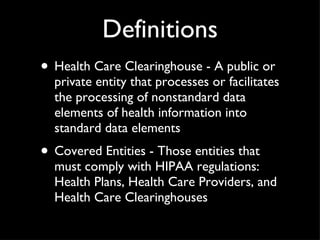
Definitions Health Care Clearinghouse - A public or private entity that processes or facilitates the processing of nonstandard data elements of health information into standard data elements Covered Entities - Those entities that must comply with HIPAA regulations: Health Plans, Health Care Providers, and Health Care Clearinghouses
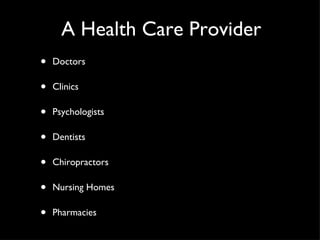
A Health Care Provider Doctors Clinics Psychologists Dentists Chiropractors Nursing Homes Pharmacies
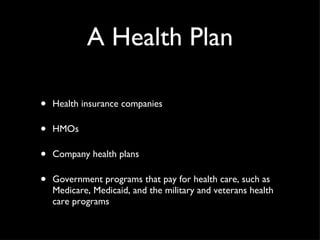
A Health Plan Health insurance companies HMOs Company health plans Government programs that pay for health care, such as Medicare, Medicaid, and the military and veterans health care programs
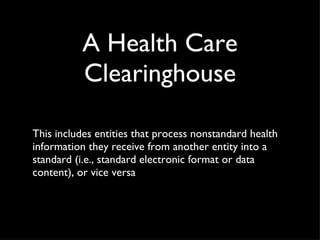
A Health Care Clearinghouse This includes entities that process nonstandard health information they receive from another entity into a standard (i.e., standard electronic format or data content), or vice versa
Covered Entities The Privacy and Security Rules apply only to covered entities. If an entity is not a covered entity, it does not have to comply. -  U.S. Department of Health & Human Services
The Problem The potential for HIPAA problems arises when dealing with agencies that do have to comply with it. Obtaining patient health information  Being asked to release patient health information by the press, public or other interested parties
Permitted Law Enforcement Disclosures As required by law (court orders, court-ordered warrants, subpoenas) and administrative requests To identify or locate a suspect, fugitive, material witness, or missing person In response to a law enforcement official’s request for information about a victim or suspected victim of a crime
Permitted Law Enforcement Disclosures To alert law enforcement of a person’s death, if the covered entity suspects that criminal activity caused the death When a covered entity believes that protected health information is evidence of a crime that occurred on its premises
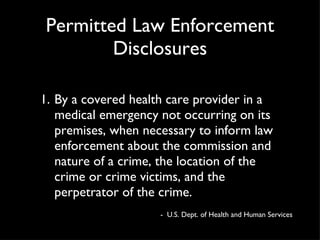
Permitted Law Enforcement Disclosures By a covered health care provider in a medical emergency not occurring on its premises, when necessary to inform law enforcement about the commission and nature of a crime, the location of the crime or crime victims, and the perpetrator of the crime. -  U.S. Dept. of Health and Human Services
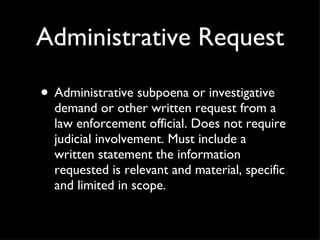
Administrative Request Administrative subpoena or investigative demand or other written request from a law enforcement official. Does not require judicial involvement. Must include a written statement the information requested is relevant and material, specific and limited in scope.
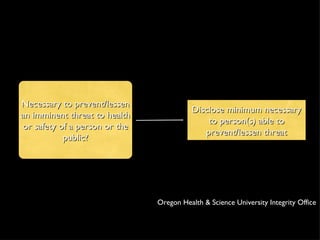
Necessary to prevent/lessen an imminent threat to health or safety of a person or the public? Disclose minimum necessary to person(s) able to prevent/lessen threat Oregon Health & Science University Integrity Office
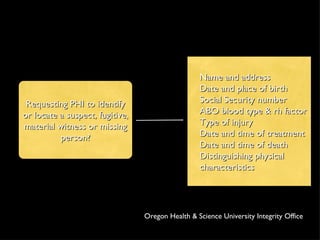
Requesting PHI to identify or locate a suspect, fugitive, material witness or missing person? Name and address Date and place of birth Social Security number ABO blood type & rh factor Type of injury Date and time of treatment Date and time of death Distinguishing physical characteristics Oregon Health & Science University Integrity Office
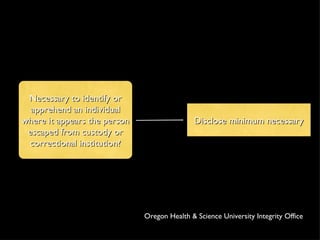
Necessary to identify or apprehend an individual where it appears the person escaped from custody or correctional institution? Disclose minimum necessary Oregon Health & Science University Integrity Office
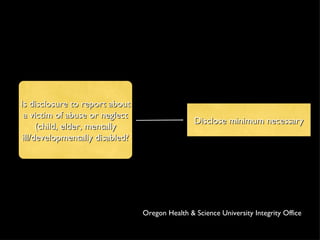
Is disclosure to report about a victim of abuse or neglect (child, elder, mentally ill/developmentally disabled? Disclose minimum necessary Oregon Health & Science University Integrity Office

HIPAA Laws

  • 1.
    Understanding HIPAA Presentedby: Officer Frank Webb Mental Health Unit Houston Police Department
  • 2.
    Disclaimer The informationprovided in this presentation does not constitute legal advice and is intended to be used for guidance only.
  • 3.
    HIPAA? Helping ImpedePolice Action & Authority or Health Insurance Portability & Accountability Act
  • 4.
    HIPAA Also knownas the Kennedy-Kassenbaum Act Grew out of the Clinton Health Care Administration
  • 5.
    HIPAA Goals Insurethe confidentiality of patients’ health care information Simplify the prosecution of health care fraud and abuse Make changing jobs easier, while providing better access to health care insurance
  • 6.
    Examples Chief overISD Collecting data within an agency HNT Call-Takers not being able to ask about MI
  • 7.
    Examples Sharing databetween police departments Premise histories Your examples?
  • 8.
    Definitions PHI (ProtectedHealth Information) - All Individually Identifiable Health Information and other information on treatment and care that is transmitted or maintained in any form or medium Use - The sharing, employment, application, utilization, examination, or analysis of such information within an entity that maintains such information
  • 9.
    Definitions Disclosure -Release or divulgence of information by an entity to persons or organizations outside of that entity Authorization - The mechanism for obtaining consent from a patient for the use and disclosure of health information for a purpose that is not treatment, payment, or health care operations or not for other permitted disclosures
  • 10.
    Definitions Minimum Necessary- When using PHI, a covered entity must make all reasonable efforts to limit itself to the “minimum necessary to accomplish the intended purpose of the use, disclosure, or request” Health Plan - An individual or group plan that provides, or pays the cost of, medical care
  • 11.
    Definitions Health CareProvider - Any person or organization that furnishes, bills, or is paid for health care services or supplies (such as EMS, Mental Health, Health Departments, etc.)
  • 12.
    Definitions Health CareClearinghouse - A public or private entity that processes or facilitates the processing of nonstandard data elements of health information into standard data elements Covered Entities - Those entities that must comply with HIPAA regulations: Health Plans, Health Care Providers, and Health Care Clearinghouses
  • 13.
    A Health CareProvider Doctors Clinics Psychologists Dentists Chiropractors Nursing Homes Pharmacies
  • 14.
    A Health PlanHealth insurance companies HMOs Company health plans Government programs that pay for health care, such as Medicare, Medicaid, and the military and veterans health care programs
  • 15.
    A Health CareClearinghouse This includes entities that process nonstandard health information they receive from another entity into a standard (i.e., standard electronic format or data content), or vice versa
  • 16.
    Covered Entities ThePrivacy and Security Rules apply only to covered entities. If an entity is not a covered entity, it does not have to comply. - U.S. Department of Health & Human Services
  • 17.
    The Problem Thepotential for HIPAA problems arises when dealing with agencies that do have to comply with it. Obtaining patient health information Being asked to release patient health information by the press, public or other interested parties
  • 18.
    Permitted Law EnforcementDisclosures As required by law (court orders, court-ordered warrants, subpoenas) and administrative requests To identify or locate a suspect, fugitive, material witness, or missing person In response to a law enforcement official’s request for information about a victim or suspected victim of a crime
  • 19.
    Permitted Law EnforcementDisclosures To alert law enforcement of a person’s death, if the covered entity suspects that criminal activity caused the death When a covered entity believes that protected health information is evidence of a crime that occurred on its premises
  • 20.
    Permitted Law EnforcementDisclosures By a covered health care provider in a medical emergency not occurring on its premises, when necessary to inform law enforcement about the commission and nature of a crime, the location of the crime or crime victims, and the perpetrator of the crime. - U.S. Dept. of Health and Human Services
  • 21.
    Administrative Request Administrativesubpoena or investigative demand or other written request from a law enforcement official. Does not require judicial involvement. Must include a written statement the information requested is relevant and material, specific and limited in scope.
  • 22.
    Necessary to prevent/lessenan imminent threat to health or safety of a person or the public? Disclose minimum necessary to person(s) able to prevent/lessen threat Oregon Health & Science University Integrity Office
  • 23.
    Requesting PHI toidentify or locate a suspect, fugitive, material witness or missing person? Name and address Date and place of birth Social Security number ABO blood type & rh factor Type of injury Date and time of treatment Date and time of death Distinguishing physical characteristics Oregon Health & Science University Integrity Office
  • 24.
    Necessary to identifyor apprehend an individual where it appears the person escaped from custody or correctional institution? Disclose minimum necessary Oregon Health & Science University Integrity Office
  • 25.
    Is disclosure toreport about a victim of abuse or neglect (child, elder, mentally ill/developmentally disabled? Disclose minimum necessary Oregon Health & Science University Integrity Office