HEALTH INSURANCE
PORTABILITY AND
ACCOUNTABILITY ACT
PAUL D. FRIEDMAN, M.A., J.D.
300 W. Clarendon, Ste. 400
Phoenix, Arizona 85013
(602) 252-8888
bioethics@cox.net
HIPAA
(not HIPPO)
©Copyright 2005
Paul D. Friedman, M.A., J.D.
WHY DID THE HIPPO CROSS THE
ROAD?
©Copyright 2005
Paul D. Friedman, M.A., J.D.
BECAUSE HE HEARD THERE WAS
GOING TO BE A PRESENTATION ON
HIPAA ON HIS SIDE OF THE ROAD.
Is it too late
to leave?
THE PURPOSE OF THE HEALTH
INSURANCE PORTABILITY AND
ACCOUNTABILITY ACT OF 1996
HIPAA amended the Employee
Retirement Income Security Act
(ERISA), to provide new rights and
protections for participants and
beneficiaries in group health plans..
©Copyright 2005
Paul D. Friedman, M.A., J.D.
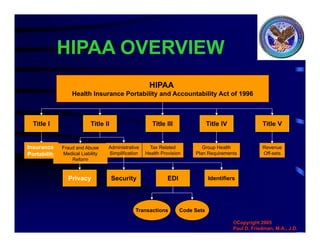
HIPAA OVERVIEW
HIPAA
Health Insurance Portability and Accountability Act of 1996
Transactions Code Sets
Insurance
Portability
Administrative
Simplification
Fraud and Abuse
Medical Liability
Reform
Title I Title II Title III Title IV Title V
Privacy Security EDI
Tax Related
Health Provision
Group Health
Plan Requirements
Revenue
Off-sets
Identifiers
©Copyright 2005
Paul D. Friedman, M.A., J.D.
HIPAA
PORTABILITY
• Limits Exclusions For Pre-Existing
Conditions
• Prohibits Discrimination Against
employees And Dependents Based
Upon Health Status
©Copyright 2005
Paul D. Friedman, M.A., J.D.
HIPAA
PORTABILITY
Health Insurance Must Include
Coverage For Pre-Existing
Conditions As Long As There Has
Not Been A Break In Coverage For
63 Days Or More
©Copyright 2005
Paul D. Friedman, M.A., J.D.
Administrative
Simplification
[Accountability]
Insurance
Reform
[Portability]
Health Insurance
Portability and Accountability Act
(HIPAA)
HIPAA - 2003
Transactions,
Code Sets, &
Identifiers
PRIVACY
Compliance
Date:
4/14/2003
Security
©Copyright 2005
Paul D. Friedman, M.A., J.D.
PURPOSE OF THE
HIPAA PRIVACY RULE
Protect And Enhance The Rights Of Consumers By:
Providing Access To Their Health Information
Controlling Inappropriate Use Of That Information
Improve Quality of Health Care
Improve Efficiency And Effectiveness Of Health Care
Delivery By Providing A National Framework For
Privacy Protection
©Copyright 2005
Paul D. Friedman, M.A., J.D.
PRIVACY
How Protected Information in Either
Written Or Verbal Form Is:
Stored
Transmitted
Shared
Discarded
Disclosed
©Copyright 2005
Paul D. Friedman, M.A., J.D.
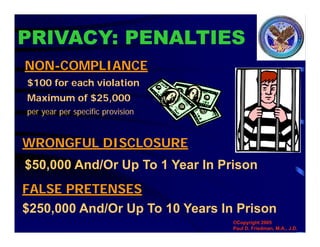
PRIVACY: PENALTIES
$100 for each violation
Maximum of $25,000
per year per specific provision
NON-COMPLIANCE
WRONGFUL DISCLOSURE
FALSE PRETENSES
©Copyright 2005
Paul D. Friedman, M.A., J.D.
$50,000 And/Or Up To 1 Year In Prison
$250,000 And/Or Up To 10 Years In Prison
Notify Patient Of Their Privacy Rights
Patient Access To Their Medical Records
Patient Consent Before Releasing
Information
INTRODUCTON TO PRIVACY
The Privacy Rule Provides:
©Copyright 2005
Paul D. Friedman, M.A., J.D.
COMPLIANCE TO PRIVACY
Provide patients with a written explanation
of how the organization may use and
disclose their health information
Provide patients with the ability to get
copies of their medical information and
request amendments
Obtain patient consent before sharing
medical information
Compliance Involves:
©Copyright 2005
Paul D. Friedman, M.A., J.D.
PERMISSION
HIPAA Allows For But Does Not Mandate
Consent For Disclosure of Personal Health
Information For Treatment, Payment And
Health Care Operations
CONSENT
AUTHORIZATION
Written Authorization Is Mandated Unless
There Is A Specific Exclusion
©Copyright 2005
Paul D. Friedman, M.A., J.D.
AUTHORIZATION EXCEPTIONS
 Treatment, Payment or Health Care Operations
 Directories At Facilities
 Family And Friends
 Marketing
 Fundraising
 Averting a Serious Threat To Health Or Safety
 Health Oversight Activities
 Judicial And Administrative Proceedings
 Law Enforcement
 Public Health Activities
 Required By Law
 Research
 Victims of Abuse, Neglect Or Domestic Violence
Authorizations Are Mandated Except:
©Copyright 2005
Paul D. Friedman, M.A., J.D.
AUTHORIZATION ELEMENTS
 Identity Of The Party Authorizing The Disclosure
 Signature Of The Party Authorizing The Disclosure
 Agent May Sign If The Designation Is Present
 Parents Generally Can Sign On Behalf Of Minors Unless
 The Minor Consents And Parental Consent Is Not Mandated Under
State Law
 The Court Appoints A Guardian Or Allows Assent
 Parent Agrees That It The Child Has A Confidential Relationship
 Identity Of The Party Receiving The Disclosure
 Identity Of The Party Providing The Disclosure
The Core Elements Of A Valid Authorization:
©Copyright 2005
Paul D. Friedman, M.A., J.D.
AUTHORIZATION ELEMENTS
 Description Of Information To Be Disclosed
 Purpose For Disclosure
 Expiration Date Or Event
 Required Statements
 Right To Revoke The Authorization
 Treatment Not Conditioned On Signature
 Redisclosure May Occur
 Plain Language
 Copy Of Signed Authorization Provided To Individual
Core Elements Of A Valid Authorization (cont):
©Copyright 2005
Paul D. Friedman, M.A., J.D.
AUTHORIZATION ELEMENTS
 Copy Is Valid As An Original
 May Be Prepared By A Third Party
 No Required Format
 HIPAA Federally Preempts State Laws Unless
 State Law Prevents Fraud And Abuse
 Ensures Appropriate State Insurance Regulation
 Necessary For State To Report Health Care Delivery Costs
 Compelling Need Related To Public Health, Safety Or Welfare
 Regulation Of Controlled Substances
 State Law Is More Stringent Than HIPAA
 Reporting of Disease, Injury, Child Abuse, Birth Or Death
 Health Plan Management Audits
Other Considerations For Authorizations:
©Copyright 2005
Paul D. Friedman, M.A., J.D.
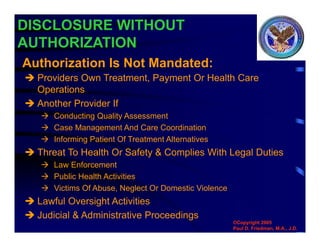
DISCLOSURE WITHOUT
AUTHORIZATION
 Providers Own Treatment, Payment Or Health Care
Operations
 Another Provider If
 Conducting Quality Assessment
 Case Management And Care Coordination
 Informing Patient Of Treatment Alternatives
 Threat To Health Or Safety & Complies With Legal Duties
 Law Enforcement
 Public Health Activities
 Victims Of Abuse, Neglect Or Domestic Violence
 Lawful Oversight Activities
 Judicial & Administrative Proceedings
Authorization Is Not Mandated:
©Copyright 2005
Paul D. Friedman, M.A., J.D.
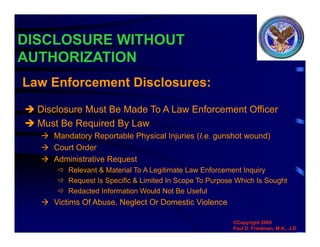
DISCLOSURE WITHOUT
AUTHORIZATION
 Disclosure Must Be Made To A Law Enforcement Officer
 Must Be Required By Law
 Mandatory Reportable Physical Injuries (I.e. gunshot wound)
 Court Order
 Administrative Request
 Relevant & Material To A Legitimate Law Enforcement Inquiry
 Request Is Specific & Limited In Scope To Purpose Which Is Sought
 Redacted Information Would Not Be Useful
 Victims Of Abuse, Neglect Or Domestic Violence
Law Enforcement Disclosures:
©Copyright 2005
Paul D. Friedman, M.A., J.D.
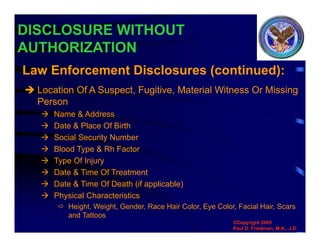
DISCLOSURE WITHOUT
AUTHORIZATION
 Location Of A Suspect, Fugitive, Material Witness Or Missing
Person
 Name & Address
 Date & Place Of Birth
 Social Security Number
 Blood Type & Rh Factor
 Type Of Injury
 Date & Time Of Treatment
 Date & Time Of Death (if applicable)
 Physical Characteristics
 Height, Weight, Gender, Race Hair Color, Eye Color, Facial Hair, Scars
and Tattoos
Law Enforcement Disclosures (continued):
©Copyright 2005
Paul D. Friedman, M.A., J.D.
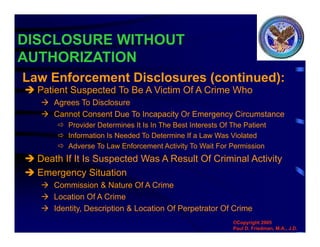
DISCLOSURE WITHOUT
AUTHORIZATION
 Patient Suspected To Be A Victim Of A Crime Who
 Agrees To Disclosure
 Cannot Consent Due To Incapacity Or Emergency Circumstance
 Provider Determines It Is In The Best Interests Of The Patient
 Information Is Needed To Determine If a Law Was Violated
 Adverse To Law Enforcement Activity To Wait For Permission
 Death If It Is Suspected Was A Result Of Criminal Activity
 Emergency Situation
 Commission & Nature Of A Crime
 Location Of A Crime
 Identity, Description & Location Of Perpetrator Of Crime
Law Enforcement Disclosures (continued):
©Copyright 2005
Paul D. Friedman, M.A., J.D.
DISCLOSURE WITHOUT
AUTHORIZATION
Patient Is Present And Agrees Or Objects
Patient Is Incapacitated
 Provider Determines That Patient Would Not Object To
Surrogate
Can Be For Limited Information
Can Be Retracted At Any Time
Friends & Relatives
©Copyright 2005
Paul D. Friedman, M.A., J.D.
HYPOTHETICAL NUMBER ONE
©Copyright 2005
Paul D. Friedman, M.A., J.D.
I Just Hate
Hippotheticals!
HYPOTHETICAL NUMBER ONE
You are taking care of a well-known
actress who is in intensive care after a
drug overdose. She is experiencing
severe renal failure.
A nurse on another floor asks you if you
are aware that this actress is on your
unit after the overdose.
What do you say?
©Copyright 2005
Paul D. Friedman, M.A., J.D.
HYPOTHETICAL NUMBER ONE
Ask yourself the following questions:
1) Does your friend need to know if the patient is being
treated in your facility?
2) Does your friend need to know if the patient is being
treated in intensive care?
3) Does your friend need to know if the patient
overdosed to do his [the nurse’s] job?
4) If you were the patient, would you want this person
[the inquiring nurse] to know about your treatment?
©Copyright 2005
Paul D. Friedman, M.A., J.D.
HYPOTHETICAL NUMBER ONE
HIPAA forbids you from sharing this
information unless it is necessary
for the treatment of this patient.
HIPAA forbids the other nurse from
accessing information unless it is
necessary for his treatment of the
patient.
©Copyright 2005
Paul D. Friedman, M.A., J.D.
HYPOTHETICAL NUMBER ONE
©Copyright 2005
Paul D. Friedman, M.A., J.D.
That Was Pretty
Easy. I Kind of
Like This Guy!
HYPOTHETICAL NUMBER TWO
©Copyright 2005
Paul D. Friedman, M.A., J.D.
I Spoke Too
Soon!
HYPOTHETICAL NUMBER TWO
©Copyright 2005
Paul D. Friedman, M.A., J.D.
A family member of you patient calls
your unit and asks you questions about
the status of the patient.
What do you say?
HYPOTHETICAL NUMBER TWO
©Copyright 2005
Paul D. Friedman, M.A., J.D.
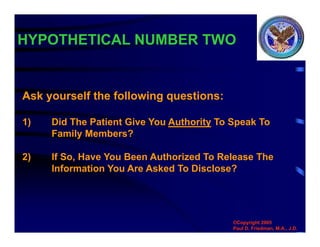
Ask yourself the following questions:
1) Did The Patient Give You Authority To Speak To
Family Members?
2) If So, Have You Been Authorized To Release The
Information You Are Asked To Disclose?
HIPAA RESOURCES
 http://www.aamc.org
 http://www.hhs.gov/topics/privacy.html
 http://www.hipaadvisory.com
 lhttp://www.cio.gov/documents/info_security
©Copyright 2005
Paul D. Friedman, M.A., J.D.
THE END OF HIPAA
©Copyright 2005
Paul D. Friedman, M.A., J.D.
Whew, Now I
can come back.
That Wasn’t So
Bad!

HIPAA

  • 1.
    HEALTH INSURANCE PORTABILITY AND ACCOUNTABILITYACT PAUL D. FRIEDMAN, M.A., J.D. 300 W. Clarendon, Ste. 400 Phoenix, Arizona 85013 (602) 252-8888 bioethics@cox.net HIPAA (not HIPPO) ©Copyright 2005 Paul D. Friedman, M.A., J.D.
  • 2.
    WHY DID THEHIPPO CROSS THE ROAD? ©Copyright 2005 Paul D. Friedman, M.A., J.D. BECAUSE HE HEARD THERE WAS GOING TO BE A PRESENTATION ON HIPAA ON HIS SIDE OF THE ROAD. Is it too late to leave?
  • 3.
    THE PURPOSE OFTHE HEALTH INSURANCE PORTABILITY AND ACCOUNTABILITY ACT OF 1996 HIPAA amended the Employee Retirement Income Security Act (ERISA), to provide new rights and protections for participants and beneficiaries in group health plans.. ©Copyright 2005 Paul D. Friedman, M.A., J.D.
  • 4.
    HIPAA OVERVIEW HIPAA Health InsurancePortability and Accountability Act of 1996 Transactions Code Sets Insurance Portability Administrative Simplification Fraud and Abuse Medical Liability Reform Title I Title II Title III Title IV Title V Privacy Security EDI Tax Related Health Provision Group Health Plan Requirements Revenue Off-sets Identifiers ©Copyright 2005 Paul D. Friedman, M.A., J.D.
  • 5.
    HIPAA PORTABILITY • Limits ExclusionsFor Pre-Existing Conditions • Prohibits Discrimination Against employees And Dependents Based Upon Health Status ©Copyright 2005 Paul D. Friedman, M.A., J.D.
  • 6.
    HIPAA PORTABILITY Health Insurance MustInclude Coverage For Pre-Existing Conditions As Long As There Has Not Been A Break In Coverage For 63 Days Or More ©Copyright 2005 Paul D. Friedman, M.A., J.D.
  • 7.
    Administrative Simplification [Accountability] Insurance Reform [Portability] Health Insurance Portability andAccountability Act (HIPAA) HIPAA - 2003 Transactions, Code Sets, & Identifiers PRIVACY Compliance Date: 4/14/2003 Security ©Copyright 2005 Paul D. Friedman, M.A., J.D.
  • 8.
    PURPOSE OF THE HIPAAPRIVACY RULE Protect And Enhance The Rights Of Consumers By: Providing Access To Their Health Information Controlling Inappropriate Use Of That Information Improve Quality of Health Care Improve Efficiency And Effectiveness Of Health Care Delivery By Providing A National Framework For Privacy Protection ©Copyright 2005 Paul D. Friedman, M.A., J.D.
  • 9.
    PRIVACY How Protected Informationin Either Written Or Verbal Form Is: Stored Transmitted Shared Discarded Disclosed ©Copyright 2005 Paul D. Friedman, M.A., J.D.
  • 10.
    PRIVACY: PENALTIES $100 foreach violation Maximum of $25,000 per year per specific provision NON-COMPLIANCE WRONGFUL DISCLOSURE FALSE PRETENSES ©Copyright 2005 Paul D. Friedman, M.A., J.D. $50,000 And/Or Up To 1 Year In Prison $250,000 And/Or Up To 10 Years In Prison
  • 11.
    Notify Patient OfTheir Privacy Rights Patient Access To Their Medical Records Patient Consent Before Releasing Information INTRODUCTON TO PRIVACY The Privacy Rule Provides: ©Copyright 2005 Paul D. Friedman, M.A., J.D.
  • 12.
    COMPLIANCE TO PRIVACY Providepatients with a written explanation of how the organization may use and disclose their health information Provide patients with the ability to get copies of their medical information and request amendments Obtain patient consent before sharing medical information Compliance Involves: ©Copyright 2005 Paul D. Friedman, M.A., J.D.
  • 13.
    PERMISSION HIPAA Allows ForBut Does Not Mandate Consent For Disclosure of Personal Health Information For Treatment, Payment And Health Care Operations CONSENT AUTHORIZATION Written Authorization Is Mandated Unless There Is A Specific Exclusion ©Copyright 2005 Paul D. Friedman, M.A., J.D.
  • 14.
    AUTHORIZATION EXCEPTIONS  Treatment,Payment or Health Care Operations  Directories At Facilities  Family And Friends  Marketing  Fundraising  Averting a Serious Threat To Health Or Safety  Health Oversight Activities  Judicial And Administrative Proceedings  Law Enforcement  Public Health Activities  Required By Law  Research  Victims of Abuse, Neglect Or Domestic Violence Authorizations Are Mandated Except: ©Copyright 2005 Paul D. Friedman, M.A., J.D.
  • 15.
    AUTHORIZATION ELEMENTS  IdentityOf The Party Authorizing The Disclosure  Signature Of The Party Authorizing The Disclosure  Agent May Sign If The Designation Is Present  Parents Generally Can Sign On Behalf Of Minors Unless  The Minor Consents And Parental Consent Is Not Mandated Under State Law  The Court Appoints A Guardian Or Allows Assent  Parent Agrees That It The Child Has A Confidential Relationship  Identity Of The Party Receiving The Disclosure  Identity Of The Party Providing The Disclosure The Core Elements Of A Valid Authorization: ©Copyright 2005 Paul D. Friedman, M.A., J.D.
  • 16.
    AUTHORIZATION ELEMENTS  DescriptionOf Information To Be Disclosed  Purpose For Disclosure  Expiration Date Or Event  Required Statements  Right To Revoke The Authorization  Treatment Not Conditioned On Signature  Redisclosure May Occur  Plain Language  Copy Of Signed Authorization Provided To Individual Core Elements Of A Valid Authorization (cont): ©Copyright 2005 Paul D. Friedman, M.A., J.D.
  • 17.
    AUTHORIZATION ELEMENTS  CopyIs Valid As An Original  May Be Prepared By A Third Party  No Required Format  HIPAA Federally Preempts State Laws Unless  State Law Prevents Fraud And Abuse  Ensures Appropriate State Insurance Regulation  Necessary For State To Report Health Care Delivery Costs  Compelling Need Related To Public Health, Safety Or Welfare  Regulation Of Controlled Substances  State Law Is More Stringent Than HIPAA  Reporting of Disease, Injury, Child Abuse, Birth Or Death  Health Plan Management Audits Other Considerations For Authorizations: ©Copyright 2005 Paul D. Friedman, M.A., J.D.
  • 18.
    DISCLOSURE WITHOUT AUTHORIZATION  ProvidersOwn Treatment, Payment Or Health Care Operations  Another Provider If  Conducting Quality Assessment  Case Management And Care Coordination  Informing Patient Of Treatment Alternatives  Threat To Health Or Safety & Complies With Legal Duties  Law Enforcement  Public Health Activities  Victims Of Abuse, Neglect Or Domestic Violence  Lawful Oversight Activities  Judicial & Administrative Proceedings Authorization Is Not Mandated: ©Copyright 2005 Paul D. Friedman, M.A., J.D.
  • 19.
    DISCLOSURE WITHOUT AUTHORIZATION  DisclosureMust Be Made To A Law Enforcement Officer  Must Be Required By Law  Mandatory Reportable Physical Injuries (I.e. gunshot wound)  Court Order  Administrative Request  Relevant & Material To A Legitimate Law Enforcement Inquiry  Request Is Specific & Limited In Scope To Purpose Which Is Sought  Redacted Information Would Not Be Useful  Victims Of Abuse, Neglect Or Domestic Violence Law Enforcement Disclosures: ©Copyright 2005 Paul D. Friedman, M.A., J.D.
  • 20.
    DISCLOSURE WITHOUT AUTHORIZATION  LocationOf A Suspect, Fugitive, Material Witness Or Missing Person  Name & Address  Date & Place Of Birth  Social Security Number  Blood Type & Rh Factor  Type Of Injury  Date & Time Of Treatment  Date & Time Of Death (if applicable)  Physical Characteristics  Height, Weight, Gender, Race Hair Color, Eye Color, Facial Hair, Scars and Tattoos Law Enforcement Disclosures (continued): ©Copyright 2005 Paul D. Friedman, M.A., J.D.
  • 21.
    DISCLOSURE WITHOUT AUTHORIZATION  PatientSuspected To Be A Victim Of A Crime Who  Agrees To Disclosure  Cannot Consent Due To Incapacity Or Emergency Circumstance  Provider Determines It Is In The Best Interests Of The Patient  Information Is Needed To Determine If a Law Was Violated  Adverse To Law Enforcement Activity To Wait For Permission  Death If It Is Suspected Was A Result Of Criminal Activity  Emergency Situation  Commission & Nature Of A Crime  Location Of A Crime  Identity, Description & Location Of Perpetrator Of Crime Law Enforcement Disclosures (continued): ©Copyright 2005 Paul D. Friedman, M.A., J.D.
  • 22.
    DISCLOSURE WITHOUT AUTHORIZATION Patient IsPresent And Agrees Or Objects Patient Is Incapacitated  Provider Determines That Patient Would Not Object To Surrogate Can Be For Limited Information Can Be Retracted At Any Time Friends & Relatives ©Copyright 2005 Paul D. Friedman, M.A., J.D.
  • 23.
    HYPOTHETICAL NUMBER ONE ©Copyright2005 Paul D. Friedman, M.A., J.D. I Just Hate Hippotheticals!
  • 24.
    HYPOTHETICAL NUMBER ONE Youare taking care of a well-known actress who is in intensive care after a drug overdose. She is experiencing severe renal failure. A nurse on another floor asks you if you are aware that this actress is on your unit after the overdose. What do you say? ©Copyright 2005 Paul D. Friedman, M.A., J.D.
  • 25.
    HYPOTHETICAL NUMBER ONE Askyourself the following questions: 1) Does your friend need to know if the patient is being treated in your facility? 2) Does your friend need to know if the patient is being treated in intensive care? 3) Does your friend need to know if the patient overdosed to do his [the nurse’s] job? 4) If you were the patient, would you want this person [the inquiring nurse] to know about your treatment? ©Copyright 2005 Paul D. Friedman, M.A., J.D.
  • 26.
    HYPOTHETICAL NUMBER ONE HIPAAforbids you from sharing this information unless it is necessary for the treatment of this patient. HIPAA forbids the other nurse from accessing information unless it is necessary for his treatment of the patient. ©Copyright 2005 Paul D. Friedman, M.A., J.D.
  • 27.
    HYPOTHETICAL NUMBER ONE ©Copyright2005 Paul D. Friedman, M.A., J.D. That Was Pretty Easy. I Kind of Like This Guy!
  • 28.
    HYPOTHETICAL NUMBER TWO ©Copyright2005 Paul D. Friedman, M.A., J.D. I Spoke Too Soon!
  • 29.
    HYPOTHETICAL NUMBER TWO ©Copyright2005 Paul D. Friedman, M.A., J.D. A family member of you patient calls your unit and asks you questions about the status of the patient. What do you say?
  • 30.
    HYPOTHETICAL NUMBER TWO ©Copyright2005 Paul D. Friedman, M.A., J.D. Ask yourself the following questions: 1) Did The Patient Give You Authority To Speak To Family Members? 2) If So, Have You Been Authorized To Release The Information You Are Asked To Disclose?
  • 31.
    HIPAA RESOURCES  http://www.aamc.org http://www.hhs.gov/topics/privacy.html  http://www.hipaadvisory.com  lhttp://www.cio.gov/documents/info_security ©Copyright 2005 Paul D. Friedman, M.A., J.D.
  • 32.
    THE END OFHIPAA ©Copyright 2005 Paul D. Friedman, M.A., J.D. Whew, Now I can come back. That Wasn’t So Bad!