18/10/19
Stav Debi, Dani Starodubsky, Shterna
Aharon
Hip
Fracture in
the
geriatric
patient
Introduction
As the population of older adults increases worldwide so too does the number of hip fractures. Older
adults have weaker bone and are more likely to fall due to diminished balance, medication side effects,
and difficulty maneuvering around environmental hazards. Clinicians in many fields are involved in
caring for patients with hip fractures and should be familiar with the basic types, assessment, and
management of these injuries.
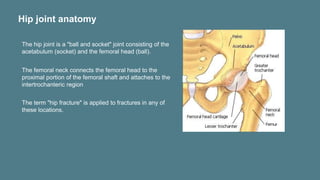
Hip joint anatomy
The hip joint is a "ball and socket" joint consisting of the
acetabulum (socket) and the femoral head (ball).
The femoral neck connects the femoral head to the
proximal portion of the femoral shaft and attaches to the
intertrochanteric region
The term "hip fracture" is applied to fractures in any of
these locations.
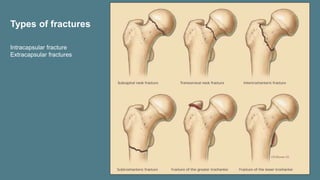
Types of fractures
Intracapsular fracture
Extracapsular fractures
Epidemiology
Worldwide, the total number of hip fractures is expected to surpass 6 million by the year 2050.
Age is the main risk factor for hip fractures. The incidence of hip fracture increases
exponentially with age in both genders.
The incidence rates vary from North to South Europe, with the highest being in
Sweden and Norway and the lowest in France and Switzerland.
Hip fractures are estimated to 72% of total fracture related health care costs.
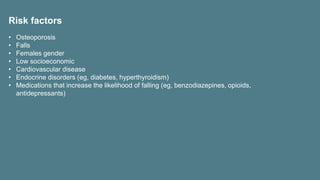
Risk factors
• Osteoporosis
• Falls
• Females gender
• Low socioeconomic
• Cardiovascular disease
• Endocrine disorders (eg, diabetes, hyperthyroidism)
• Medications that increase the likelihood of falling (eg, benzodiazepines, opioids,
antidepressants)
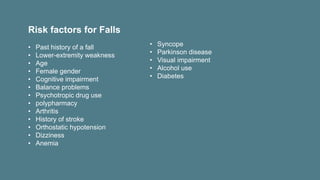
Risk factors for Falls
• Past history of a fall
• Lower-extremity weakness
• Age
• Female gender
• Cognitive impairment
• Balance problems
• Psychotropic drug use
• polypharmacy
• Arthritis
• History of stroke
• Orthostatic hypotension
• Dizziness
• Anemia
• Syncope
• Parkinson disease
• Visual impairment
• Alcohol use
• Diabetes
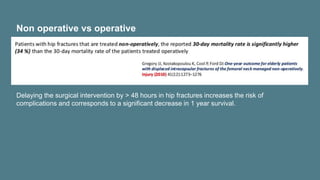
Non operative vs operative
Delaying the surgical intervention by > 48 hours in hip fractures increases the risk of
complications and corresponds to a significant decrease in 1 year survival.
Pre-operative considerations
• Patients with active comorbidities may require more extensive preoperative evaluation and
medical management of these conditions prior to repair of their fracture.
• Unless contraindicated, thromboembolic prophylaxis should be instituted in patients who are
awaiting surgery.
• Aggressive pressure ulcer prevention measures should be employed in patients in whom
surgery is delayed beyond 24 to 48 hours.
Medical management:
• Analgesia e.g lower doses of opioids
• Thromboembolic prophylaxis — Patients with hip fracture are at high risk of venous
thromboembolism.
• Infection prophylaxis — Antibiotic prophylaxis for surgical site infection is indicated for any
patient who undergoes surgery for hip fracture.
• Delirium — Delirium is a common complication in hospitalized older adults, and occurs in as
many as 61 percent of patients with hip fracture.
• Prevention of constipation — Attention should be paid to prevent constipation, especially in
patients who receive opioid analgesics.
• Prevention of pressure ulcers
• Bladder catheterization
• Blood transfusion
• Blood pressure control
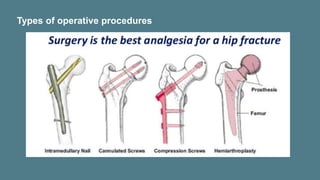
Types of operative procedures
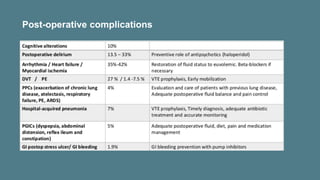
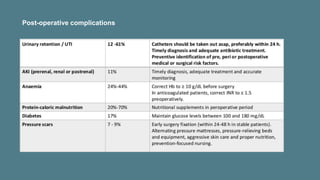
Post-operative complications
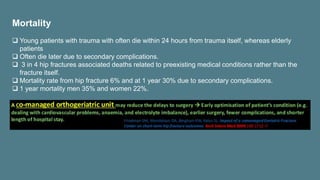
Mortality
 Young patients with trauma with often die within 24 hours from trauma itself, whereas elderly
patients
 Often die later due to secondary complications.
 3 in 4 hip fractures associated deaths related to preexisting medical conditions rather than the
fracture itself.
 Mortality rate from hip fracture 6% and at 1 year 30% due to secondary complications.
 1 year mortality men 35% and women 22%.
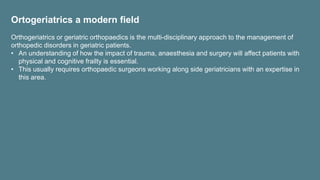
Ortogeriatrics a modern field
Orthogeriatrics or geriatric orthopaedics is the multi-disciplinary approach to the management of
orthopedic disorders in geriatric patients.
• An understanding of how the impact of trauma, anaesthesia and surgery will affect patients with
physical and cognitive frailty is essential.
• This usually requires orthopaedic surgeons working along side geriatricians with an expertise in
this area.
Referencess
https://www-uptodate-com.ezproxy.is.cuni.cz/contents/overview-of-
common-hip-fractures-in-
adults?search=hip%20fracture%20elderly&source=search_result&selected
Title=1~150&usage_type=default&display_rank=1
https://openorthopaedicsjournal.com/VOLUME/11/PAGE/1181/FULLTEXT/
#r11
https://www-uptodate-com.ezproxy.is.cuni.cz/contents/hip-fracture-in-
adults-epidemiology-and-medical-
management?search=hip%20fracture%20mortality&source=search_result
&selectedTitle=1~150&usage_type=default&display_rank=1
https://www-uptodate-com.ezproxy.is.cuni.cz/contents/overview-of-
geriatric-rehabilitation-patient-assessment-and-common-indications-for-
rehabilitation?search=hip%20fracture%20elderly&source=search_result&s
electedTitle=3~150&usage_type=default&display_rank=3

Hip fracture