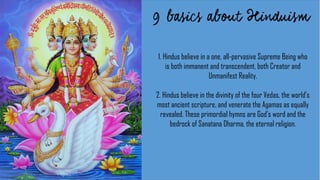
1. Hindus believe in a one, all-pervasive Supreme Being who
is both immanent and transcendent, both Creator and
Unmanifest Reality.
2. Hindus believe in the divinity of the four Vedas, the world's
most ancient scripture, and venerate the Agamas as equally
revealed. These primordial hymns are God's word and the
bedrock of Sanatana Dharma, the eternal religion.
3. Hindus believe that the universe undergoes
endless cycles of creation, preservation and
dissolution.
4. Hindus believe in karma, the law of cause and
effect by which each individual creates his own
destiny by his thoughts, words and deeds.
5. Hindus believe that the soul reincarnates,
evolving through many births until all karmas have
been resolved, and moksha, liberation from the
cycle of rebirth, is attained. Not a single soul will
be deprived of this destiny.
6. Hindus believe that divine beings exist in unseen
worlds and that temple worship, rituals,
sacraments and personal devotionals create a
communion with these devas and Gods.
7. Hindus believe that an enlightened
master, or satguru, is essential to know
the Transcendent Absolute, as are
personal discipline, good conduct,
purification, pilgrimage, self-inquiry,
meditation and surrender in God.
8. Hindus believe that all life is sacred, to
be loved and revered, and therefore
practice ahimsa, noninjury, in thought,
word and deed.
9. Hindus believe that no religion teaches
the only way to salvation above all
others, but that all genuine paths are
facets of God's Light, deserving
tolerance and understanding.”
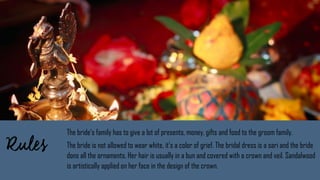
The bride’s family has to give a lot of presents, money, gifts and food to the groom family.
The bride is not allowed to wear white, it’s a color of grief. The bridal dress is a sari and the bride
dons all the ornaments. Her hair is usually in a bun and covered with a crown and veil. Sandalwood
is artistically applied on her face in the design of the crown.
• The groom will wear a Dhoti, which
is an unstitched garment, and a
shirt. On arrival at the bride’s
house he will change into another
similar outfit. He will cover himself
with a sheet and wear the topor
(paper mache headdress).
• The groom may wear a white silk
brocade suit, sword and turban as
his wedding outfit.
• Traditions changes from one
region to another but there are
some very important commons
points.
• The main point of a Hindu
wedding is to found a family and
create an alliance between the
bride’s and the groom’s families.
• The ceremony can last from one to twelve days.
• Hindu weddings are mostly arranged weddings.
•If the wedding is sumptuous it will take away the evil eye.
• Jaimala (Exchange of Garlands)
The couple exchanges garlands as a gesture of
acceptance of one another and a pledge to
respect one another as partners.
• Madhupak (Offering of Yogurt and Honey)
The bride’s father offers the groom yogurt and
honey as the expression of welcome and
respect.
• Kanyadan (Giving Away of the Bride)
The father of the bride places her hand in the
groom’s hand requesting him to accept her as
an equal partner. The concept behind Kanyadan
is that the bride is a form of the goddess Lamxi
and the groom is Lord Narayana. The parents
are facilitating their union.
• Havan (Lighting of the Sacred Fire)
The couple invokes Agni, the god of Fire, to witness
their commitment to each other. Crushed sandalwood,
herbs, sugar rice and oil are offered to the ceremonial
fire.
• Rajaham (Sacrifice to the Sacred Fire)
The bride places both her hands into the groom’s and
her brother then places rice into her hands. Together
the bride and groom offer the rice as a sacrifice into
the fire.
• Gath Bandhan (Tying of the Nuptial
Knot)
The scarves placed around the bride
and groom are tied together
symbolizing their eternal bond. This
signifies their pledge before God to
love each other and remain faithful.
• Mangalphera (Walk Around the Fire)
The couple makes four Mangalpheras
around the fire in a clockwise
direction representing four goals in
life: Dharma, religious and moral
duties; Artha, prosperity; Kama,
earthly pleasures; Moksha, spiritual
salvation and liberation. The bride
leads the Pheras first, signifying her
determination to stand first beside
her husband in all happiness and
sorrow.
Saptapardi (Seven Steps Together) The most important rite of a Hindu Wedding
The bride and groom walk seven steps togehr to signify the beginning of their journey through life together. Each step represents a marital vow:
First step: To respect and honor each other
Second step: To share each other’s joy and sorrow
Third step: To trust and be loyal to each other
Fourth step: To cultivate appreciation for knowledge, values, sacrifice and service
Fifth step: To reconfirm their vow of purity, love family duties and spiritual growth
Sixth step: To follow principles of Dharma (righteousness) Seventh step: To nurture an eternal bond of friendship and love
• Jalastnchana (Blessing of the Couple)
The parents of the bride and groom bless
the wedded couple by dipping a rose in
water and sprinking it over the couple.
• Sindhoor (Red Powder)
The groom applies a small dot of vermilion,
a powdered red lead, to the bride’s
forehead and welcomes her as his partner
for life. It is applied for the first time to a
woman during the marriage ceremony
when the bridegroom himself adorns her
with it.
…
• A love story between a
Muslim Prince and a Hindu
Princess, first forced to be
married to made an
alliance, they finally fall in
love with each other.
• A box office success in
India
• A pure product of the
Bollywood Industry
…
Organized a wedding for Hindu and Muslim
together is a very difficult task, and it can be
dangerous for the bride and the groom because it
is generally a source of conflict with the families.
There are so many customs and traditions in
those religions that marrying, Hindu and Muslim,
is a real challenge.
And there is a lot of family pressures for the both
sides of the couple.
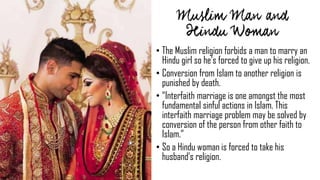
• The Muslim religion forbids a man to marry an
Hindu girl so he’s forced to give up his religion.
• Conversion from Islam to another religion is
punished by death.
• “Interfaith marriage is one amongst the most
fundamental sinful actions in Islam. This
interfaith marriage problem may be solved by
conversion of the person from other faith to
Islam.”
• So a Hindu woman is forced to take his
husband’s religion.
• The Hindu man has to
convert to Islam if he wants
to marry his bride.
• They can try to combine
both of their traditions but
it is really complicated and
they rarely have their
family support.
• A wedding who combines both of
the religion is practically
impossible to organize because we
are talking about two religions with
very strong traditions, customs
and beliefs.
• If a couple wants to marry each
other they have to convert to one
of the religions.
• If they are very open minded and
the families agreed (or not) they
can try to combine but it was not
possible to find an example.
https://www.himalayanacademy.com/readlearn/basics/nine-beliefs
http://en.wikipedia.org/wiki/Hindu_wedding
http://weddingdetails.com/lore-tradition/hindu/
http://www.hinduwedding.info/marriage-ceremony.html
http://www.islamicbulletin.org/newsletters/issue_24/beliefs.aspx
http://www.interfaithshaadi.org/index.php/hindu-muslim-marriage-2

Hindu weddings

  • 2.
    1. Hindus believein a one, all-pervasive Supreme Being who is both immanent and transcendent, both Creator and Unmanifest Reality. 2. Hindus believe in the divinity of the four Vedas, the world's most ancient scripture, and venerate the Agamas as equally revealed. These primordial hymns are God's word and the bedrock of Sanatana Dharma, the eternal religion.
  • 3.
    3. Hindus believethat the universe undergoes endless cycles of creation, preservation and dissolution. 4. Hindus believe in karma, the law of cause and effect by which each individual creates his own destiny by his thoughts, words and deeds. 5. Hindus believe that the soul reincarnates, evolving through many births until all karmas have been resolved, and moksha, liberation from the cycle of rebirth, is attained. Not a single soul will be deprived of this destiny. 6. Hindus believe that divine beings exist in unseen worlds and that temple worship, rituals, sacraments and personal devotionals create a communion with these devas and Gods.
  • 4.
    7. Hindus believethat an enlightened master, or satguru, is essential to know the Transcendent Absolute, as are personal discipline, good conduct, purification, pilgrimage, self-inquiry, meditation and surrender in God. 8. Hindus believe that all life is sacred, to be loved and revered, and therefore practice ahimsa, noninjury, in thought, word and deed. 9. Hindus believe that no religion teaches the only way to salvation above all others, but that all genuine paths are facets of God's Light, deserving tolerance and understanding.”
  • 5.
    The bride’s familyhas to give a lot of presents, money, gifts and food to the groom family. The bride is not allowed to wear white, it’s a color of grief. The bridal dress is a sari and the bride dons all the ornaments. Her hair is usually in a bun and covered with a crown and veil. Sandalwood is artistically applied on her face in the design of the crown.
  • 6.
    • The groomwill wear a Dhoti, which is an unstitched garment, and a shirt. On arrival at the bride’s house he will change into another similar outfit. He will cover himself with a sheet and wear the topor (paper mache headdress). • The groom may wear a white silk brocade suit, sword and turban as his wedding outfit.
  • 7.
    • Traditions changesfrom one region to another but there are some very important commons points. • The main point of a Hindu wedding is to found a family and create an alliance between the bride’s and the groom’s families.
  • 8.
    • The ceremonycan last from one to twelve days. • Hindu weddings are mostly arranged weddings. •If the wedding is sumptuous it will take away the evil eye.
  • 9.
    • Jaimala (Exchangeof Garlands) The couple exchanges garlands as a gesture of acceptance of one another and a pledge to respect one another as partners. • Madhupak (Offering of Yogurt and Honey) The bride’s father offers the groom yogurt and honey as the expression of welcome and respect. • Kanyadan (Giving Away of the Bride) The father of the bride places her hand in the groom’s hand requesting him to accept her as an equal partner. The concept behind Kanyadan is that the bride is a form of the goddess Lamxi and the groom is Lord Narayana. The parents are facilitating their union.
  • 10.
    • Havan (Lightingof the Sacred Fire) The couple invokes Agni, the god of Fire, to witness their commitment to each other. Crushed sandalwood, herbs, sugar rice and oil are offered to the ceremonial fire. • Rajaham (Sacrifice to the Sacred Fire) The bride places both her hands into the groom’s and her brother then places rice into her hands. Together the bride and groom offer the rice as a sacrifice into the fire.
  • 11.
    • Gath Bandhan(Tying of the Nuptial Knot) The scarves placed around the bride and groom are tied together symbolizing their eternal bond. This signifies their pledge before God to love each other and remain faithful. • Mangalphera (Walk Around the Fire) The couple makes four Mangalpheras around the fire in a clockwise direction representing four goals in life: Dharma, religious and moral duties; Artha, prosperity; Kama, earthly pleasures; Moksha, spiritual salvation and liberation. The bride leads the Pheras first, signifying her determination to stand first beside her husband in all happiness and sorrow.
  • 12.
    Saptapardi (Seven StepsTogether) The most important rite of a Hindu Wedding The bride and groom walk seven steps togehr to signify the beginning of their journey through life together. Each step represents a marital vow: First step: To respect and honor each other Second step: To share each other’s joy and sorrow Third step: To trust and be loyal to each other Fourth step: To cultivate appreciation for knowledge, values, sacrifice and service Fifth step: To reconfirm their vow of purity, love family duties and spiritual growth Sixth step: To follow principles of Dharma (righteousness) Seventh step: To nurture an eternal bond of friendship and love
  • 13.
    • Jalastnchana (Blessingof the Couple) The parents of the bride and groom bless the wedded couple by dipping a rose in water and sprinking it over the couple. • Sindhoor (Red Powder) The groom applies a small dot of vermilion, a powdered red lead, to the bride’s forehead and welcomes her as his partner for life. It is applied for the first time to a woman during the marriage ceremony when the bridegroom himself adorns her with it.
  • 15.
  • 16.
    • A lovestory between a Muslim Prince and a Hindu Princess, first forced to be married to made an alliance, they finally fall in love with each other. • A box office success in India • A pure product of the Bollywood Industry
  • 17.
  • 18.
    Organized a weddingfor Hindu and Muslim together is a very difficult task, and it can be dangerous for the bride and the groom because it is generally a source of conflict with the families. There are so many customs and traditions in those religions that marrying, Hindu and Muslim, is a real challenge. And there is a lot of family pressures for the both sides of the couple.
  • 19.
    • The Muslimreligion forbids a man to marry an Hindu girl so he’s forced to give up his religion. • Conversion from Islam to another religion is punished by death. • “Interfaith marriage is one amongst the most fundamental sinful actions in Islam. This interfaith marriage problem may be solved by conversion of the person from other faith to Islam.” • So a Hindu woman is forced to take his husband’s religion.
  • 20.
    • The Hinduman has to convert to Islam if he wants to marry his bride. • They can try to combine both of their traditions but it is really complicated and they rarely have their family support.
  • 21.
    • A weddingwho combines both of the religion is practically impossible to organize because we are talking about two religions with very strong traditions, customs and beliefs. • If a couple wants to marry each other they have to convert to one of the religions. • If they are very open minded and the families agreed (or not) they can try to combine but it was not possible to find an example.
  • 22.