SPEED MATTERS 
©6WIND 2014. All rights reserved. All brand names, trademarks and copyright information cited in this presentation shall remain the property of its registered owners.
Agenda 
 How DPDK can be used for your Application 
 Basic Architectures 
 IPsec 
 TCP Termination 
 Virtualization 
 DPDK Ecosystem boosting your Development 
 Extensions 
 Support 
 Packaging 
 Meet the Community Challenges 
 More Users 
 More NIC Vendors 
 More Developers 
 More Patches 
©6WIND 2014 2
Key numbers 
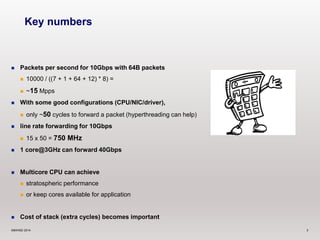
 Packets per second for 10Gbps with 64B packets 
 10000 / ((7 + 1 + 64 + 12) * 8) = 
 ~15 Mpps 
 With some good configurations (CPU/NIC/driver), 
 only ~50 cycles to forward a packet (hyperthreading can help) 
 line rate forwarding for 10Gbps 
 15 x 50 = 750 MHz 
 1 core@3GHz can forward 40Gbps 
 Multicore CPU can achieve 
 stratospheric performance 
 or keep cores available for application 
 Cost of stack (extra cycles) becomes important 
©6WIND 2014 3
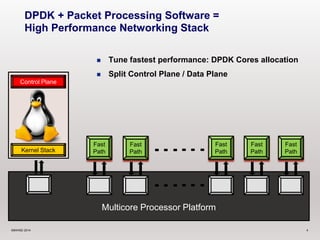
DPDK + Packet Processing Software = 
High Performance Networking Stack 
 Tune fastest performance: DPDK Cores allocation 
 Split Control Plane / Data Plane 
Fast 
Control Plane 
Kernel Stack Path 
Fast 
Path 
Fast 
Path 
Multicore Processor Platform 
Fast 
Path 
Fast 
Path 
©6WIND 2014 4
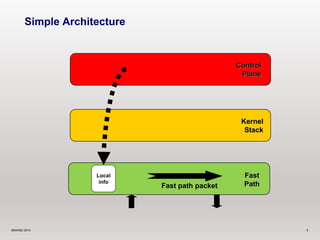
Control 
Plane 
Kernel 
Stack 
Fast 
Path 
Simple Architecture 
Local 
info 
Fast path packet 
©6WIND 2014 5
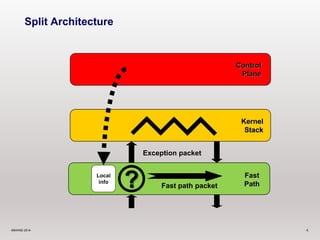
Control 
Plane 
Kernel 
Stack 
Fast 
Path 
Split Architecture 
Local 
info 
? Exception packet 
Fast path packet 
©6WIND 2014 6
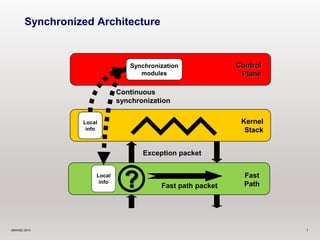
Control 
Plane 
Kernel 
Stack 
Fast 
Path 
Synchronized Architecture 
Local 
info 
Synchronization 
modules 
Continuous 
synchronization 
Local 
info 
? Exception packet 
Fast path packet 
©6WIND 2014 7
Use cases 
 Some applications use only DPDK to analyze raw packets 
 Firewall / not compatible with Linux 
 DPI 
 Some applications need complex networking stacks on top of DPDK 
 IPsec 
 TCP 
 BRAS 
 Small dedicated fast path stacks are better in their job than generic kernel ones 
©6WIND 2014 8
Parallel Processing 
 Standard applications use 
 1 TCP/UDP socket (single point of connection with stack/drivers) 
 Many threads (possibly dynamically allocated) 
 1 dispatching loop 
 DPDK applications leverage parallelization from the beginning 
 Multiqueue 
 Multicore 
 1 loop per core / run to completion 
 DPDK requires static initialization of cores and memory 
©6WIND 2014 9
Run to completion 
 Each cycle is important = no time for scheduling 
 Application is in the polling thread which receives packets 
 Application should never block a long time 
 Power management like sleeping 
 Poll mode can start on IRQ (NAPI style) 
©6WIND 2014 10
Efficient memory access 
 Dedicated memory allocator 
 DPDK functions 
 NUMA allocation (QPI must be avoided) 
 Hugepages = less TLB cache misses 
 Local memory objects for no locking 
 Spinlocks or atomic instructions 
 Small buffers (rte_mbuf <<< skbuff) = less cache misses 
 Big pool of buffers delays packet loss but has horrible properties because of L3 misses 
 Small memory usage allows efficient L3 caching 
©6WIND 2014 11
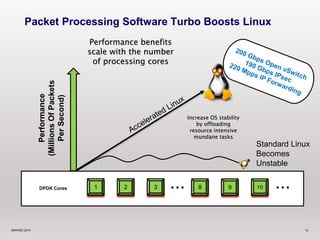
Packet Processing Software Turbo Boosts Linux 
Performance 
(Millions Of Packets 
Per Second) 
Performance benefits 
scale with the number 
of processing cores 
DPDK Cores ... ... 
Increase OS stability 
by offloading 
resource intensive 
mundane tasks 
Standard Linux 
Becomes 
Unstable 
1 2 3 8 9 10 ... 
©6WIND 2014 12
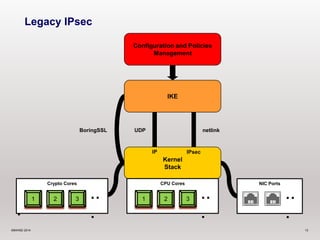
Legacy IPsec 
Configuration and Policies 
Management 
IKE 
BoringSSL UDP netlink 
IP IPsec 
Kernel 
Stack 
NIC Ports 
... 
.. 
. 
.. 
. 
Crypto Cores 
CPU Cores 
... 
... 
1 2 3 .. 
. 
.. 
. 
1 2 3 
©6WIND 2014 13
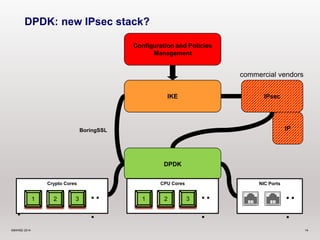
DPDK: new IPsec stack? 
Configuration and Policies 
Management 
IKE 
DPDK 
commercial vendors 
IPsec 
NIC Ports 
... 
IP 
.. 
. 
.. 
. 
Crypto Cores 
CPU Cores 
BoringSSL 
... 
... 
1 2 3 .. 
. 
.. 
. 
1 2 3 
©6WIND 2014 14
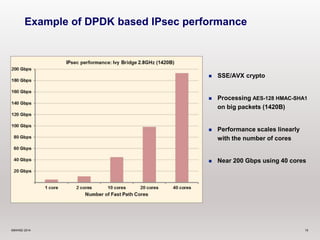
Example of DPDK based IPsec performance 
 SSE/AVX crypto 
 Processing AES-128 HMAC-SHA1 
on big packets (1420B) 
 Performance scales linearly 
with the number of cores 
 Near 200 Gbps using 40 cores 
©6WIND 2014 15
Parallelized TCP termination 
 RSS dispatching to multicore workers 
 Parallel workers are DPDK cores (not flying threads) 
 Workers have DPDK style main loop for polling (not event scheduling) 
 Remove single socket / locking bottleneck 
 Keeping packet ordering is difficult 
 True parallelized stack may require new parallelized socket API 
 rte_mbuf must be used to achieve zero-copy send/recv/fwd 
 Scalable timers 
©6WIND 2014 16
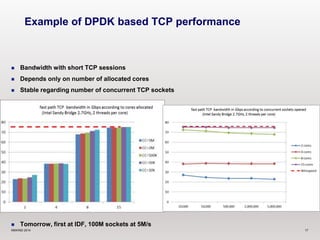
Example of DPDK based TCP performance 
 Bandwidth with short TCP sessions 
 Depends only on number of allocated cores 
 Stable regarding number of concurrent TCP sockets 
 Tomorrow, first at IDF, 100M sockets at 5M/s 
©6WIND 2014 17
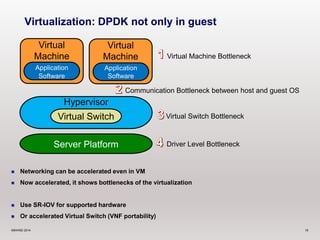
Virtualization: DPDK not only in guest 
Virtual 
Machine 
Application 
Software 
Virtual 
Machine 
Application 
Software 
Hypervisor 
Virtual Switch 
Virtual Machine Bottleneck 
Communication Bottleneck between host and guest OS 
Server Platform 
 Networking can be accelerated even in VM 
Virtual Switch Bottleneck 
Driver Level Bottleneck 
 Now accelerated, it shows bottlenecks of the virtualization 
 Use SR-IOV for supported hardware 
 Or accelerated Virtual Switch (VNF portability) 
©6WIND 2014 18
Virtual 
Network 
Function 
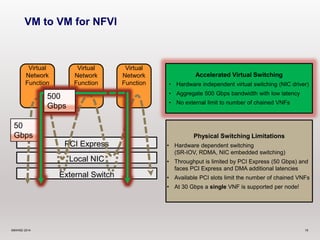
VM to VM for NFVI 
Virtual 
Network 
Function 
Virtual 
Network 
Function 
500 
Gbps 
PCI Express 
Local NIC 
External Switch 
Accelerated Virtual Switching 
• Hardware independent virtual switching (NIC driver) 
• Aggregate 500 Gbps bandwidth with low latency 
• No external limit to number of chained VNFs 
Physical Switching Limitations 
• Hardware dependent switching 
(SR-IOV, RDMA, NIC embedded switching) 
• Throughput is limited by PCI Express (50 Gbps) and 
faces PCI Express and DMA additional latencies 
• Available PCI slots limit the number of chained VNFs 
• At 30 Gbps a single VNF is supported per node! 
50 
Gbps 
©6WIND 2014 19
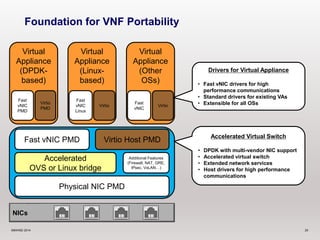
Foundation for VNF Portability 
Virtual 
Appliance 
(DPDK-based) 
Virtual 
Appliance 
(Linux-based) 
Fast 
vNIC 
Linux 
Fast 
vNIC 
PMD 
Virtio 
PMD 
Fast vNIC PMD 
NICs 
Accelerated 
Fast 
vNIC 
Virtio Virtio 
OVS or Linux bridge 
Virtio Host PMD 
Physical NIC PMD 
Virtual 
Appliance 
(Other 
OSs) 
Additional Features 
(Firewall, NAT, GRE, 
IPsec, VxLAN…) 
Drivers for Virtual Appliance 
• Fast vNIC drivers for high 
performance communications 
• Standard drivers for existing VAs 
• Extensible for all OSs 
Accelerated Virtual Switch 
• DPDK with multi-vendor NIC support 
• Accelerated virtual switch 
• Extended network services 
• Host drivers for high performance 
communications 
©6WIND 2014 20
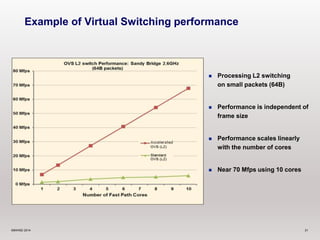
Example of Virtual Switching performance 
 Processing L2 switching 
on small packets (64B) 
 Performance is independent of 
frame size 
 Performance scales linearly 
with the number of cores 
 Near 70 Mfps using 10 cores 
©6WIND 2014 21
Current limitations of Openstack with DPDK 
 Nova: to do 
 No vhost-user 
 Pinning not well defined 
 No automation of policy scheduling (e.g. core sharing policy) 
 Libvirt: to do 
 No ivshmem 
 OVS: lot of work in progress 
 Drivers 
 No live migration with vhost-user 
 No dynamic PMD ports add/delete in DPDK without locking 
©6WIND 2014 22
Extensions 
 Can be transparently used with your application 
 Poll Mode Drivers for multi-vendor NICs 
 Mellanox ConnectX-3® EN Series 
 Emulex OCE14000 series 
 Cavium LiquidIO 
 Cisco (rumor) http://dpdk.org/ml/archives/dev/2014-May/002866.html 
 Netronome (rumor) http://www.netronome.com/network-functions-virtualization 
 Tilera (rumor) http://www.tilera.com/about_tilera/press-releases/tileras-tile-iq-technology-accelerates-applications-3-5x-reducing-power- 
 Performance acceleration for virtualized networking 
 Fast vNIC 
 Crypto acceleration modules that leverage 
 Cavium NITROX Crypto 
 Intel® Multi-Buffer Crypto 
 Intel® QuickAssist Crypto 
©6WIND 2014 23
Extending ecosystem 
 ISA independent on any CPU 
 DPDK is almost ISA neutral, but it has to be done properly 
 XLP rumor 
 http://nfvwiki.etsi.org/images/NFVPER%2814%29000007r2_NFV_ISG_PoC_Proposal_-_Virtual_Function_State_Migration_an.pdf 
 Integrated in OpenDataPlane (ODP) 
 Linux Foundation Open NFV initiatives 
©6WIND 2014 24
Support 
 Good documentation 
 Mailing list archive 
 http://dpdk.org/ml 
 Best effort by Open Source community 
 Commercial commitment by DPDK partners 
 http://dpdk.org/about 
 Compatibility? Performance first, speed matters 
©6WIND 2014 25
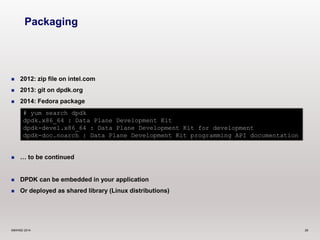
Packaging 
 2012: zip file on intel.com 
 2013: git on dpdk.org 
 2014: Fedora package 
# yum search dpdk 
dpdk.x86_64 : Data Plane Development Kit 
dpdk-devel.x86_64 : Data Plane Development Kit for development 
dpdk-doc.noarch : Data Plane Development Kit programming API documentation 
 … to be continued 
 DPDK can be embedded in your application 
 Or deployed as shared library (Linux distributions) 
©6WIND 2014 26
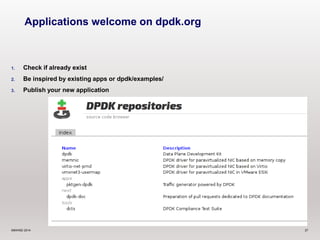
Applications welcome on dpdk.org 
1. Check if already exist 
2. Be inspired by existing apps or dpdk/examples/ 
3. Publish your new application 
©6WIND 2014 27
More Users 
 Make clean API to have a set of coherent libraries and drivers 
 Generic (support many CPUs/NICs) 
 Easy to use 
 Easy to understand 
 Well documented 
 Speed matters, SPEED MATTERS, SPEED MATTERS, SPEED MATTERS! 
 Configuration must be easier 
 Too many compile-time options 
 Must use some smart defaults at run-time 
 CPU / PCI mapping would be simpler if automatic 
©6WIND 2014 28
More NIC Vendors 
 All NIC vendors are welcome, choose your model: 
 Open Source contribution in dpdk.org tree 
 Binary extension as shared library 
 Hardware features are exposed to applications via the DPDK API 
 But NICs provide different features 
 Flexibility (in progress) by dynamically querying feature support 
 rte_mbuf API must be efficient for any NICs 
©6WIND 2014 29
More Developers 
 Nice code / More cleanup = More newcomers 
 More bug reports = More tasks dispatched 
 More reviewers = More developers enjoying to contribute 
 Open decisions = More involvement 
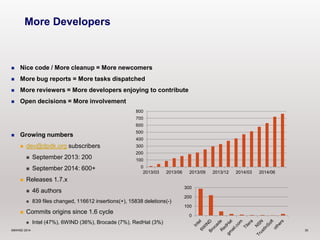
 Growing numbers 
 dev@dpdk.org subscribers 
 September 2013: 200 
 September 2014: 600+ 
 Releases 1.7.x 
 46 authors 
800 
700 
600 
500 
400 
300 
200 
100 
0 
2013/03 2013/06 2013/09 2013/12 2014/03 2014/06 
 839 files changed, 116612 insertions(+), 15838 deletions(-) 
 Commits origins since 1.6 cycle 
 Intel (47%), 6WIND (36%), Brocade (7%), RedHat (3%) 
300 
200 
100 
0 
©6WIND 2014 30
More discussions 
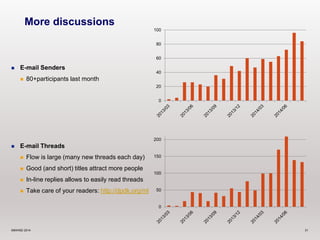
 E-mail Senders 
 80+participants last month 
 E-mail Threads 
 Flow is large (many new threads each day) 
 Good (and short) titles attract more people 
 In-line replies allows to easily read threads 
 Take care of your readers: http://dpdk.org/ml 
100 
80 
60 
40 
20 
0 
200 
150 
100 
50 
0 
©6WIND 2014 31
Large community… 
 POLICE 
 Housekeeping 
 No anarchy 
 Organization 
 Flexibility is possible 
to sustain innovation 
©6WIND 2014 32
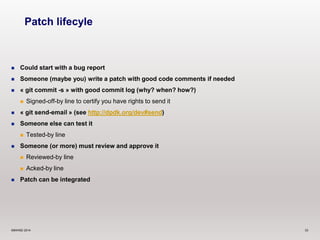
Patch lifecyle 
 Could start with a bug report 
 Someone (maybe you) write a patch with good code comments if needed 
 « git commit -s » with good commit log (why? when? how?) 
 Signed-off-by line to certify you have rights to send it 
 « git send-email » (see http://dpdk.org/dev#send) 
 Someone else can test it 
 Tested-by line 
 Someone (or more) must review and approve it 
 Reviewed-by line 
 Acked-by line 
 Patch can be integrated 
©6WIND 2014 33
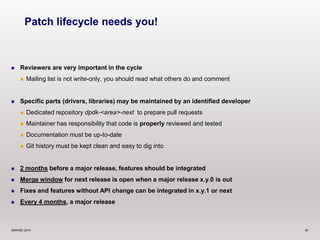
Patch lifecycle needs you! 
 Reviewers are very important in the cycle 
 Mailing list is not write-only, you should read what others do and comment 
 Specific parts (drivers, libraries) may be maintained by an identified developer 
 Dedicated repository dpdk-<area>-next to prepare pull requests 
 Maintainer has responsibility that code is properly reviewed and tested 
 Documentation must be up-to-date 
 Git history must be kept clean and easy to dig into 
 2 months before a major release, features should be integrated 
 Merge window for next release is open when a major release x.y.0 is out 
 Fixes and features without API change can be integrated in x.y.1 or next 
 Every 4 months, a major release 
©6WIND 2014 34
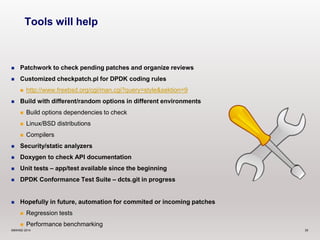
Tools will help 
 Patchwork to check pending patches and organize reviews 
 Customized checkpatch.pl for DPDK coding rules 
 http://www.freebsd.org/cgi/man.cgi?query=style&sektion=9 
 Build with different/random options in different environments 
 Build options dependencies to check 
 Linux/BSD distributions 
 Compilers 
 Security/static analyzers 
 Doxygen to check API documentation 
 Unit tests – app/test available since the beginning 
 DPDK Conformance Test Suite – dcts.git in progress 
 Hopefully in future, automation for commited or incoming patches 
 Regression tests 
 Performance benchmarking 
©6WIND 2014 35
Everybody is welcome 
 Open 24/7 
http://dpdk.org 
©6WIND 2014 36
Calling all Dataplaners… 
Starting on October 9th 6WIND will sponsor the 
Official DPDK Silicon Valley Meetup! 
When? 
Every 2nd Thursday of the month @ 4 
pm…starting in October! 
Why? 
To collaborate, discuss, and learn more 
about DPDK…we also race fast RCs (if 
you have one, bring it! If not, take one of 
ours for a spin!) SPEED MATTERS 
Where? 
6WIND Silicon Valley Office 
2975 Scott Boulevard, Suite 115 
Santa Clara, CA 95054 
www.6WIND.com @6WINDsoftware
©6WIND 2014 38

High Performance Networking Leveraging the DPDK and Growing Community

  • 1.
    SPEED MATTERS ©6WIND2014. All rights reserved. All brand names, trademarks and copyright information cited in this presentation shall remain the property of its registered owners.
  • 2.
    Agenda  HowDPDK can be used for your Application  Basic Architectures  IPsec  TCP Termination  Virtualization  DPDK Ecosystem boosting your Development  Extensions  Support  Packaging  Meet the Community Challenges  More Users  More NIC Vendors  More Developers  More Patches ©6WIND 2014 2
  • 3.
    Key numbers Packets per second for 10Gbps with 64B packets  10000 / ((7 + 1 + 64 + 12) * 8) =  ~15 Mpps  With some good configurations (CPU/NIC/driver),  only ~50 cycles to forward a packet (hyperthreading can help)  line rate forwarding for 10Gbps  15 x 50 = 750 MHz  1 core@3GHz can forward 40Gbps  Multicore CPU can achieve  stratospheric performance  or keep cores available for application  Cost of stack (extra cycles) becomes important ©6WIND 2014 3
  • 4.
    DPDK + PacketProcessing Software = High Performance Networking Stack  Tune fastest performance: DPDK Cores allocation  Split Control Plane / Data Plane Fast Control Plane Kernel Stack Path Fast Path Fast Path Multicore Processor Platform Fast Path Fast Path ©6WIND 2014 4
  • 5.
    Control Plane Kernel Stack Fast Path Simple Architecture Local info Fast path packet ©6WIND 2014 5
  • 6.
    Control Plane Kernel Stack Fast Path Split Architecture Local info ? Exception packet Fast path packet ©6WIND 2014 6
  • 7.
    Control Plane Kernel Stack Fast Path Synchronized Architecture Local info Synchronization modules Continuous synchronization Local info ? Exception packet Fast path packet ©6WIND 2014 7
  • 8.
    Use cases Some applications use only DPDK to analyze raw packets  Firewall / not compatible with Linux  DPI  Some applications need complex networking stacks on top of DPDK  IPsec  TCP  BRAS  Small dedicated fast path stacks are better in their job than generic kernel ones ©6WIND 2014 8
  • 9.
    Parallel Processing Standard applications use  1 TCP/UDP socket (single point of connection with stack/drivers)  Many threads (possibly dynamically allocated)  1 dispatching loop  DPDK applications leverage parallelization from the beginning  Multiqueue  Multicore  1 loop per core / run to completion  DPDK requires static initialization of cores and memory ©6WIND 2014 9
  • 10.
    Run to completion  Each cycle is important = no time for scheduling  Application is in the polling thread which receives packets  Application should never block a long time  Power management like sleeping  Poll mode can start on IRQ (NAPI style) ©6WIND 2014 10
  • 11.
    Efficient memory access  Dedicated memory allocator  DPDK functions  NUMA allocation (QPI must be avoided)  Hugepages = less TLB cache misses  Local memory objects for no locking  Spinlocks or atomic instructions  Small buffers (rte_mbuf <<< skbuff) = less cache misses  Big pool of buffers delays packet loss but has horrible properties because of L3 misses  Small memory usage allows efficient L3 caching ©6WIND 2014 11
  • 12.
    Packet Processing SoftwareTurbo Boosts Linux Performance (Millions Of Packets Per Second) Performance benefits scale with the number of processing cores DPDK Cores ... ... Increase OS stability by offloading resource intensive mundane tasks Standard Linux Becomes Unstable 1 2 3 8 9 10 ... ©6WIND 2014 12
  • 13.
    Legacy IPsec Configurationand Policies Management IKE BoringSSL UDP netlink IP IPsec Kernel Stack NIC Ports ... .. . .. . Crypto Cores CPU Cores ... ... 1 2 3 .. . .. . 1 2 3 ©6WIND 2014 13
  • 14.
    DPDK: new IPsecstack? Configuration and Policies Management IKE DPDK commercial vendors IPsec NIC Ports ... IP .. . .. . Crypto Cores CPU Cores BoringSSL ... ... 1 2 3 .. . .. . 1 2 3 ©6WIND 2014 14
  • 15.
    Example of DPDKbased IPsec performance  SSE/AVX crypto  Processing AES-128 HMAC-SHA1 on big packets (1420B)  Performance scales linearly with the number of cores  Near 200 Gbps using 40 cores ©6WIND 2014 15
  • 16.
    Parallelized TCP termination  RSS dispatching to multicore workers  Parallel workers are DPDK cores (not flying threads)  Workers have DPDK style main loop for polling (not event scheduling)  Remove single socket / locking bottleneck  Keeping packet ordering is difficult  True parallelized stack may require new parallelized socket API  rte_mbuf must be used to achieve zero-copy send/recv/fwd  Scalable timers ©6WIND 2014 16
  • 17.
    Example of DPDKbased TCP performance  Bandwidth with short TCP sessions  Depends only on number of allocated cores  Stable regarding number of concurrent TCP sockets  Tomorrow, first at IDF, 100M sockets at 5M/s ©6WIND 2014 17
  • 18.
    Virtualization: DPDK notonly in guest Virtual Machine Application Software Virtual Machine Application Software Hypervisor Virtual Switch Virtual Machine Bottleneck Communication Bottleneck between host and guest OS Server Platform  Networking can be accelerated even in VM Virtual Switch Bottleneck Driver Level Bottleneck  Now accelerated, it shows bottlenecks of the virtualization  Use SR-IOV for supported hardware  Or accelerated Virtual Switch (VNF portability) ©6WIND 2014 18
  • 19.
    Virtual Network Function VM to VM for NFVI Virtual Network Function Virtual Network Function 500 Gbps PCI Express Local NIC External Switch Accelerated Virtual Switching • Hardware independent virtual switching (NIC driver) • Aggregate 500 Gbps bandwidth with low latency • No external limit to number of chained VNFs Physical Switching Limitations • Hardware dependent switching (SR-IOV, RDMA, NIC embedded switching) • Throughput is limited by PCI Express (50 Gbps) and faces PCI Express and DMA additional latencies • Available PCI slots limit the number of chained VNFs • At 30 Gbps a single VNF is supported per node! 50 Gbps ©6WIND 2014 19
  • 20.
    Foundation for VNFPortability Virtual Appliance (DPDK-based) Virtual Appliance (Linux-based) Fast vNIC Linux Fast vNIC PMD Virtio PMD Fast vNIC PMD NICs Accelerated Fast vNIC Virtio Virtio OVS or Linux bridge Virtio Host PMD Physical NIC PMD Virtual Appliance (Other OSs) Additional Features (Firewall, NAT, GRE, IPsec, VxLAN…) Drivers for Virtual Appliance • Fast vNIC drivers for high performance communications • Standard drivers for existing VAs • Extensible for all OSs Accelerated Virtual Switch • DPDK with multi-vendor NIC support • Accelerated virtual switch • Extended network services • Host drivers for high performance communications ©6WIND 2014 20
  • 21.
    Example of VirtualSwitching performance  Processing L2 switching on small packets (64B)  Performance is independent of frame size  Performance scales linearly with the number of cores  Near 70 Mfps using 10 cores ©6WIND 2014 21
  • 22.
    Current limitations ofOpenstack with DPDK  Nova: to do  No vhost-user  Pinning not well defined  No automation of policy scheduling (e.g. core sharing policy)  Libvirt: to do  No ivshmem  OVS: lot of work in progress  Drivers  No live migration with vhost-user  No dynamic PMD ports add/delete in DPDK without locking ©6WIND 2014 22
  • 23.
    Extensions  Canbe transparently used with your application  Poll Mode Drivers for multi-vendor NICs  Mellanox ConnectX-3® EN Series  Emulex OCE14000 series  Cavium LiquidIO  Cisco (rumor) http://dpdk.org/ml/archives/dev/2014-May/002866.html  Netronome (rumor) http://www.netronome.com/network-functions-virtualization  Tilera (rumor) http://www.tilera.com/about_tilera/press-releases/tileras-tile-iq-technology-accelerates-applications-3-5x-reducing-power-  Performance acceleration for virtualized networking  Fast vNIC  Crypto acceleration modules that leverage  Cavium NITROX Crypto  Intel® Multi-Buffer Crypto  Intel® QuickAssist Crypto ©6WIND 2014 23
  • 24.
    Extending ecosystem ISA independent on any CPU  DPDK is almost ISA neutral, but it has to be done properly  XLP rumor  http://nfvwiki.etsi.org/images/NFVPER%2814%29000007r2_NFV_ISG_PoC_Proposal_-_Virtual_Function_State_Migration_an.pdf  Integrated in OpenDataPlane (ODP)  Linux Foundation Open NFV initiatives ©6WIND 2014 24
  • 25.
    Support  Gooddocumentation  Mailing list archive  http://dpdk.org/ml  Best effort by Open Source community  Commercial commitment by DPDK partners  http://dpdk.org/about  Compatibility? Performance first, speed matters ©6WIND 2014 25
  • 26.
    Packaging  2012:zip file on intel.com  2013: git on dpdk.org  2014: Fedora package # yum search dpdk dpdk.x86_64 : Data Plane Development Kit dpdk-devel.x86_64 : Data Plane Development Kit for development dpdk-doc.noarch : Data Plane Development Kit programming API documentation  … to be continued  DPDK can be embedded in your application  Or deployed as shared library (Linux distributions) ©6WIND 2014 26
  • 27.
    Applications welcome ondpdk.org 1. Check if already exist 2. Be inspired by existing apps or dpdk/examples/ 3. Publish your new application ©6WIND 2014 27
  • 28.
    More Users Make clean API to have a set of coherent libraries and drivers  Generic (support many CPUs/NICs)  Easy to use  Easy to understand  Well documented  Speed matters, SPEED MATTERS, SPEED MATTERS, SPEED MATTERS!  Configuration must be easier  Too many compile-time options  Must use some smart defaults at run-time  CPU / PCI mapping would be simpler if automatic ©6WIND 2014 28
  • 29.
    More NIC Vendors  All NIC vendors are welcome, choose your model:  Open Source contribution in dpdk.org tree  Binary extension as shared library  Hardware features are exposed to applications via the DPDK API  But NICs provide different features  Flexibility (in progress) by dynamically querying feature support  rte_mbuf API must be efficient for any NICs ©6WIND 2014 29
  • 30.
    More Developers Nice code / More cleanup = More newcomers  More bug reports = More tasks dispatched  More reviewers = More developers enjoying to contribute  Open decisions = More involvement  Growing numbers  dev@dpdk.org subscribers  September 2013: 200  September 2014: 600+  Releases 1.7.x  46 authors 800 700 600 500 400 300 200 100 0 2013/03 2013/06 2013/09 2013/12 2014/03 2014/06  839 files changed, 116612 insertions(+), 15838 deletions(-)  Commits origins since 1.6 cycle  Intel (47%), 6WIND (36%), Brocade (7%), RedHat (3%) 300 200 100 0 ©6WIND 2014 30
  • 31.
    More discussions E-mail Senders  80+participants last month  E-mail Threads  Flow is large (many new threads each day)  Good (and short) titles attract more people  In-line replies allows to easily read threads  Take care of your readers: http://dpdk.org/ml 100 80 60 40 20 0 200 150 100 50 0 ©6WIND 2014 31
  • 32.
    Large community… POLICE  Housekeeping  No anarchy  Organization  Flexibility is possible to sustain innovation ©6WIND 2014 32
  • 33.
    Patch lifecyle Could start with a bug report  Someone (maybe you) write a patch with good code comments if needed  « git commit -s » with good commit log (why? when? how?)  Signed-off-by line to certify you have rights to send it  « git send-email » (see http://dpdk.org/dev#send)  Someone else can test it  Tested-by line  Someone (or more) must review and approve it  Reviewed-by line  Acked-by line  Patch can be integrated ©6WIND 2014 33
  • 34.
    Patch lifecycle needsyou!  Reviewers are very important in the cycle  Mailing list is not write-only, you should read what others do and comment  Specific parts (drivers, libraries) may be maintained by an identified developer  Dedicated repository dpdk-<area>-next to prepare pull requests  Maintainer has responsibility that code is properly reviewed and tested  Documentation must be up-to-date  Git history must be kept clean and easy to dig into  2 months before a major release, features should be integrated  Merge window for next release is open when a major release x.y.0 is out  Fixes and features without API change can be integrated in x.y.1 or next  Every 4 months, a major release ©6WIND 2014 34
  • 35.
    Tools will help  Patchwork to check pending patches and organize reviews  Customized checkpatch.pl for DPDK coding rules  http://www.freebsd.org/cgi/man.cgi?query=style&sektion=9  Build with different/random options in different environments  Build options dependencies to check  Linux/BSD distributions  Compilers  Security/static analyzers  Doxygen to check API documentation  Unit tests – app/test available since the beginning  DPDK Conformance Test Suite – dcts.git in progress  Hopefully in future, automation for commited or incoming patches  Regression tests  Performance benchmarking ©6WIND 2014 35
  • 36.
    Everybody is welcome  Open 24/7 http://dpdk.org ©6WIND 2014 36
  • 37.
    Calling all Dataplaners… Starting on October 9th 6WIND will sponsor the Official DPDK Silicon Valley Meetup! When? Every 2nd Thursday of the month @ 4 pm…starting in October! Why? To collaborate, discuss, and learn more about DPDK…we also race fast RCs (if you have one, bring it! If not, take one of ours for a spin!) SPEED MATTERS Where? 6WIND Silicon Valley Office 2975 Scott Boulevard, Suite 115 Santa Clara, CA 95054 www.6WIND.com @6WINDsoftware
  • 38.