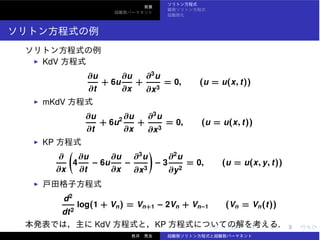
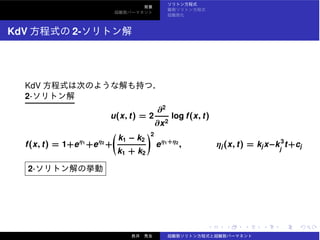
✓ ✏
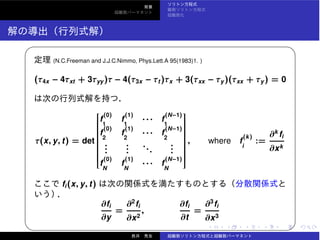
(N.C.Freeman andJ.J.C.Nimmo, Phys.Lett.A 95(1983)1. )
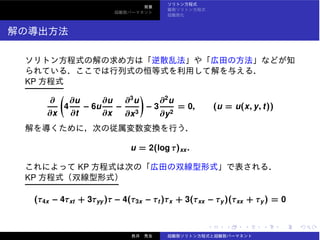
(τ4x − 4τxt + 3τyy)τ − 4(τ3x − τt )τx + 3(τxx − τy)(τxx + τy) = 0
τ(x, y, t) = det
⎡
⎢⎢⎢⎢⎢⎢⎢⎢⎢⎢⎢⎢⎢⎢⎢⎢⎢⎢⎢⎢⎢⎣
f
(0)
1
f
(1)
1
· · · f
(N−1)
1
f
(0)
2
f
(1)
2
· · · f
(N−1)
2
...
...
...
...
f
(0)
N
f
(1)
N
· · · f
(N−1)
N
⎤
⎥⎥⎥⎥⎥⎥⎥⎥⎥⎥⎥⎥⎥⎥⎥⎥⎥⎥⎥⎥⎥⎦
, where f
(k)
i
:=
∂k
fi
∂xk
fi(x, y, t)
∂fi
∂y
=
∂2
fi
∂x2
,
∂fi
∂t
=
∂3
fi
∂x3
✒ ✑
11.
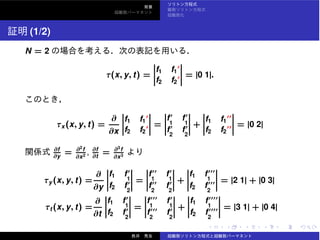
(1/2)
N = 2
τ(x,y, t) =
f1 f1
′
f2 f2
′ = |0 1|.
τx(x, y, t) =
∂
∂x
f1 f1
′
f2 f2
′ =
f′
1
f′
1
f′
2
f′
2
+
f1 f1
′′
f2 f2
′′ = |0 2|
∂f
∂y
= ∂2
f
∂x2 , ∂f
∂t
= ∂3
f
∂x3
τy(x, y, t) =
∂
∂y
f1 f′
1
f2 f′
2
=
f′′
1
f′
1
f′′
2
f′
2
+
f1 f′′′
1
f2 f′′′
2
= |2 1| + |0 3|
τt (x, y, t) =
∂
∂t
f1 f′
1
f2 f′
2
=
f′′′
1
f′
1
f′′′
2
f′
2
+
f1 f′′′′
1
f2 f′′′′
2
= |3 1| + |0 4|
KP
ex1) N =2
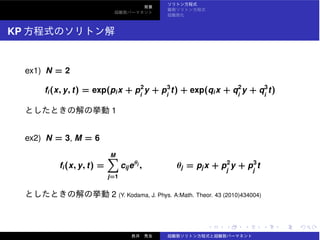
fi(x, y, t) = exp(pix + p2
i
y + p3
i
t) + exp(qix + q2
i
y + q3
i
t)
1
ex2) N = 3, M = 6
fi(x, y, t) =
M
j=1
cijeθj
, θj = pjx + p2
j
y + p3
j
t
2 (Y. Kodama, J. Phys. A:Math. Theor. 43 (2010)434004)
14.
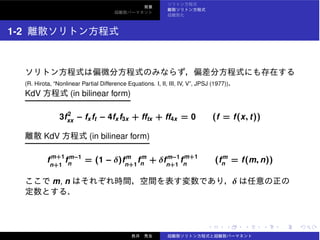
1-2
(R. Hirota, “NonlinearPartial Difference Equations. I, II, III, IV, V”, JPSJ (1977)).
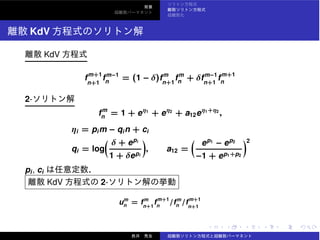
KdV (in bilinear form)
3f2
xx − fxft − 4fxf3x + fftx + ff4x = 0 (f = f(x, t))
KdV (in bilinear form)
fm+1
n+1
fm−1
n
= (1 − δ)fm
n+1
fm
n + δfm−1
n+1
fm+1
n
(fm
n = f(m, n))
m, n δ
15.
KdV
KdV
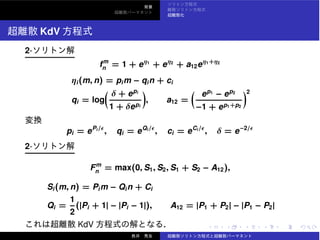
fm+1
n+1
fm−1
n
= (1 −δ)fm
n+1
fm
n + δfm−1
n+1
fm+1
n
2-
fm
n = 1 + eη1
+ eη2
+ a12eη1+η2
,
ηi = pim − qin + ci
qi = log
δ + epi
1 + δepi
, a12 =
ep1
− ep2
−1 + ep1+p2
2
pi, ci
KdV 2-
um
n = fm
n+1
fm+1
n
/fm
n /fm+1
n+1
16.
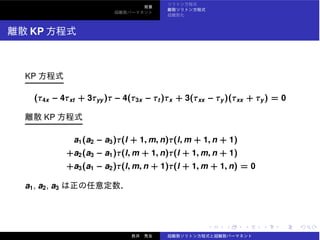
KP
KP
(τ4x − 4τxt+ 3τyy)τ − 4(τ3x − τt )τx + 3(τxx − τy)(τxx + τy) = 0
KP
a1(a2 − a3)τ(l + 1, m, n)τ(l, m + 1, n + 1)
+a2(a3 − a1)τ(l, m + 1, n)τ(l + 1, m, n + 1)
+a3(a1 − a2)τ(l, m, n + 1)τ(l + 1, m + 1, n) = 0
a1, a2, a3
17.
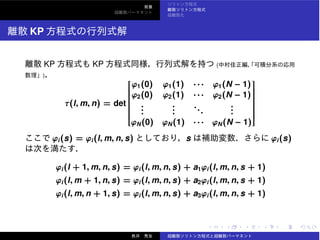
KP
KP KP (
)
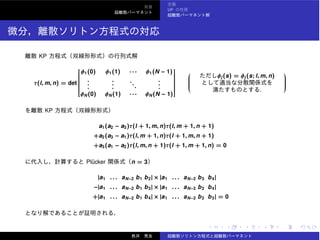
τ(l,m, n) = det
⎡
⎢⎢⎢⎢⎢⎢⎢⎢⎢⎢⎢⎢⎢⎢⎢⎢⎣
ϕ1(0) ϕ1(1) · · · ϕ1(N − 1)
ϕ2(0) ϕ2(1) · · · ϕ2(N − 1)
...
...
...
...
ϕN(0) ϕN(1) · · · ϕN(N − 1)
⎤
⎥⎥⎥⎥⎥⎥⎥⎥⎥⎥⎥⎥⎥⎥⎥⎥⎦
ϕi(s) = ϕi(l, m, n, s) s ϕi(s)
ϕi(l + 1, m, n, s) = ϕi(l, m, n, s) + a1ϕi(l, m, n, s + 1)
ϕi(l, m + 1, n, s) = ϕi(l, m, n, s) + a2ϕi(l, m, n, s + 1)
ϕi(l, m, n + 1, s) = ϕi(l, m, n, s) + a3ϕi(l, m, n, s + 1)
18.
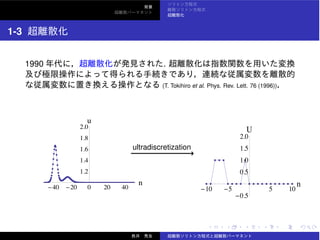
1-3
1990 .
(T. Tokihiroet al. Phys. Rev. Lett. 76 (1996))
40 20 0 20 40
n
1.2
1.4
1.6
1.8
2.0
u
ultradiscretization
−−−−−−−−−−−−−−−−→
10 5 5 10
n
0.5
0.5
1.0
1.5
2.0
U
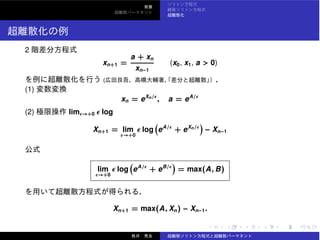
xn+1 =
a +xn
xn−1
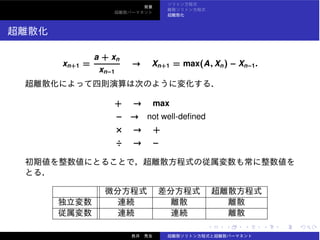
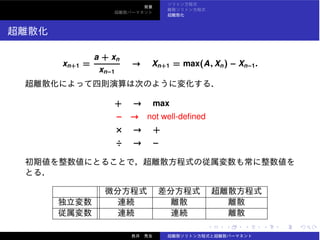
→ Xn+1 = max(A, Xn) − Xn−1.
+ → max
− → not well-defined
× → +
÷ → −
21.
xn+1 =
a +xn
xn−1
→ Xn+1 = max(A, Xn) − Xn−1.
+ → max
− → not well-defined
× → +
÷ → −
22.
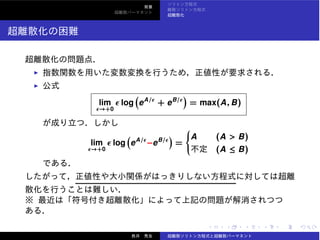
lim
ϵ→+0
ϵ log eA/ϵ
+eB/ϵ
= max(A, B)
lim
ϵ→+0
ϵ log eA/ϵ
−eB/ϵ
=
⎧
⎪⎪⎨
⎪⎪⎩
A (A > B)
(A ≤ B)
23.
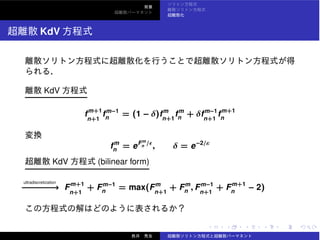
KdV
KdV
fm+1
n+1
fm−1
n
= (1 −δ)fm
n+1
fm
n + δfm−1
n+1
fm+1
n
fm
n = eFm
n
/ϵ
, δ = e−2/ε
KdV (bilinear form)
ultradiscretization
−−−−−−−−−→ Fm+1
n+1
+ Fm−1
n
= max(Fm
n+1
+ Fm
n , Fm−1
n+1
+ Fm+1
n
− 2)
UP
2.1.
✓ ✏
(UP)
N A= [aij]1≤i,j≤N A
(UP) . (D. Takahashi, R. Hirota, “Ultradiscrete Soliton Solution of
Permanent Type”, J. Phys. Soc. Japan, 76 (2007) 104007–104012)
up[A] ≡ max
π∈SN
1≤i≤N
aiπi
maxπ∈SN
N π = (π1, π2, . . . , πN)
.
✒ ✑
cf)
det[A] ≡
π∈SN 1≤i≤N
sgn(π)aiπi
perm[A] ≡
π∈SN 1≤i≤N
aiπi
31.
UP
UP
UP
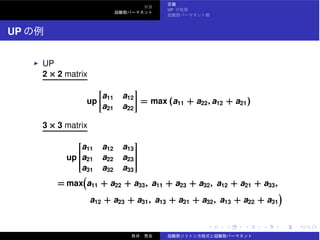
2 × 2matrix
up
a11 a12
a21 a22
= max (a11 + a22, a12 + a21)
3 × 3 matrix
up
⎡
⎢⎢⎢⎢⎢⎢⎢⎢⎣
a11 a12 a13
a21 a22 a23
a31 a32 a33
⎤
⎥⎥⎥⎥⎥⎥⎥⎥⎦
= max a11 + a22 + a33, a11 + a23 + a32, a12 + a21 + a33,
a12 + a23 + a31, a13 + a21 + a32, a13 + a22 + a31
32.
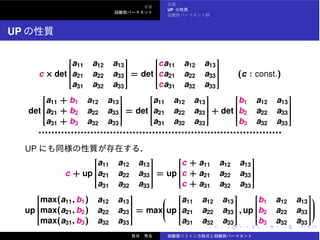
UP
UP
c × det
⎡
⎢⎢⎢⎢⎢⎢⎢⎢⎣
a11a12 a13
a21 a22 a33
a31 a32 a33
⎤
⎥⎥⎥⎥⎥⎥⎥⎥⎦
= det
⎡
⎢⎢⎢⎢⎢⎢⎢⎢⎣
ca11 a12 a13
ca21 a22 a33
ca31 a32 a33
⎤
⎥⎥⎥⎥⎥⎥⎥⎥⎦
(c : const.)
det
⎡
⎢⎢⎢⎢⎢⎢⎢⎢⎣
a11 + b1 a12 a13
a21 + b2 a22 a33
a31 + b3 a32 a33
⎤
⎥⎥⎥⎥⎥⎥⎥⎥⎦
= det
⎡
⎢⎢⎢⎢⎢⎢⎢⎢⎣
a11 a12 a13
a21 a22 a33
a31 a32 a33
⎤
⎥⎥⎥⎥⎥⎥⎥⎥⎦
+ det
⎡
⎢⎢⎢⎢⎢⎢⎢⎢⎣
b1 a12 a13
b2 a22 a33
b3 a32 a33
⎤
⎥⎥⎥⎥⎥⎥⎥⎥⎦
***************************************************************************
UP
c + up
⎡
⎢⎢⎢⎢⎢⎢⎢⎢⎣
a11 a12 a13
a21 a22 a33
a31 a32 a33
⎤
⎥⎥⎥⎥⎥⎥⎥⎥⎦
= up
⎡
⎢⎢⎢⎢⎢⎢⎢⎢⎣
c + a11 a12 a13
c + a21 a22 a33
c + a31 a32 a33
⎤
⎥⎥⎥⎥⎥⎥⎥⎥⎦
up
⎡
⎢⎢⎢⎢⎢⎢⎢⎢⎣
max(a11, b1) a12 a13
max(a21, b2) a22 a33
max(a31, b3) a32 a33
⎤
⎥⎥⎥⎥⎥⎥⎥⎥⎦
= max
⎛
⎜⎜⎜⎜⎜⎝up
⎡
⎢⎢⎢⎢⎢⎢⎢⎢⎣
a11 a12 a13
a21 a22 a33
a31 a32 a33
⎤
⎥⎥⎥⎥⎥⎥⎥⎥⎦
, up
⎡
⎢⎢⎢⎢⎢⎢⎢⎢⎣
b1 a12 a13
b2 a22 a33
b3 a32 a33
⎤
⎥⎥⎥⎥⎥⎥⎥⎥⎦
⎞
⎟⎟⎟⎟⎟⎠
33.
UP
UP det
det
a11 +a12 a12 + a13
a21 + a22 a22 + a23
= det
a11 a12
a21 a22
+ det
a11 a13
a21 a23
+ det
a12 a13
a22 a23
***************************************************************************
up
max(a11, a12) max(a12, a13)
max(a21, a22) max(a22, a23)
= max
⎛
⎜⎜⎜⎜⎜⎝up
a11 a12
a21 a22
, up
a11 a13
a21 a23
, up
a12 a12
a22 a22
, up
a12 a13
a22 a23
⎞
⎟⎟⎟⎟⎟⎠
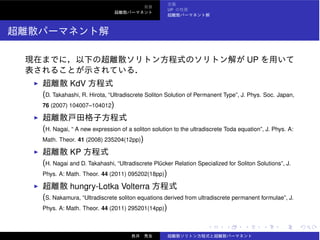
UP
34.
UP
UP
KdV
(D. Takahashi, R.Hirota, “Ultradiscrete Soliton Solution of Permanent Type”, J. Phys. Soc. Japan,
76 (2007) 104007–104012)
(H. Nagai, “ A new expression of a soliton solution to the ultradiscrete Toda equation”, J. Phys. A:
Math. Theor. 41 (2008) 235204(12pp))
KP
(H. Nagai and D. Takahashi, “Ultradiscrete Pl¨ucker Relation Specialized for Soliton Solutions”, J.
Phys. A: Math. Theor. 44 (2011) 095202(18pp))
hungry-Lotka Volterra
(S. Nakamura, “Ultradiscrete soliton equations derived from ultradiscrete permanent formulae”, J.
Phys. A: Math. Theor. 44 (2011) 295201(14pp))
35.
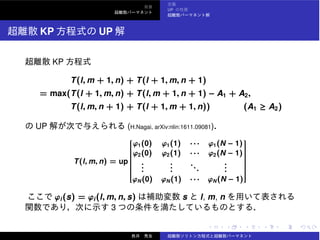
UP
KP UP
KP
T(l, m+ 1, n) + T(l + 1, m, n + 1)
= max(T(l + 1, m, n) + T(l, m + 1, n + 1) − A1 + A2,
T(l, m, n + 1) + T(l + 1, m + 1, n)) (A1 ≥ A2)
UP (H.Nagai, arXiv:nlin:1611.09081)
T(l, m, n) = up
⎡
⎢⎢⎢⎢⎢⎢⎢⎢⎢⎢⎢⎢⎢⎢⎢⎢⎢⎣
ϕ1(0) ϕ1(1) · · · ϕ1(N − 1)
ϕ2(0) ϕ2(1) · · · ϕ2(N − 1)
...
...
...
...
ϕN(0) ϕN(1) · · · ϕN(N − 1)
⎤
⎥⎥⎥⎥⎥⎥⎥⎥⎥⎥⎥⎥⎥⎥⎥⎥⎥⎦
ϕi(s) = ϕi(l, m, n, s) s l, m, n
3
36.
UP
UP ϕi(s)
1 A1≥ A2 ≥ A3
ϕi(l + 1, m, n; s) = max(ϕi(l, m, n; s), ϕi(l, m, n; s + 1) − A1)
ϕi(l, m + 1, n; s) = max(ϕi(l, m, n; s), ϕi(l, m, n; s + 1) − A2)
ϕi(l, m, n + 1; s) = max(ϕi(l, m, n; s), ϕi(l, m, n; s + 1) − A3)
2 j, i1, i2
ϕi1
(s + j) + ϕi2
(s + j)
≤ max ϕi1
(s + j − 1) + ϕi2
(s + j + 1), ϕi2
(s + j − 1) + ϕi1
(s + j + 1)
3 (ϕ1(s), ϕ2(s), . . . , ϕN(s))T
= Φ(s) ,
0 ≤ k1 < k2 < k3 ≤ N + 1
up[Φ(0) · · · Φ(k2) · · · Φ(N)] + up[Φ(0) · · · Φ(k1) · · · Φ(k3) · · · Φ(N + 1)]
= max up[Φ(0) · · · Φ(k3) · · · Φ(N)] + up[Φ(0) · · · Φ(k1) · · · Φ(k2) · · · Φ(N + 1)]
up[Φ(0) · · · Φ(k1) · · · Φ(N)] + up[Φ(0) · · · Φ(k2) · · · Φ(k3) · · · Φ(N + 1)]
UP
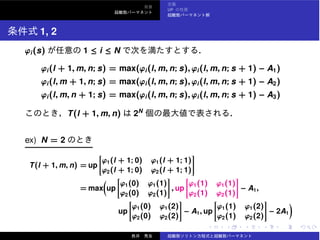
1, 2
ϕi(s) 1≤ i ≤ N
ϕi(l + 1, m, n; s) = max(ϕi(l, m, n; s), ϕi(l, m, n; s + 1) − A1)
ϕi(l, m + 1, n; s) = max(ϕi(l, m, n; s), ϕi(l, m, n; s + 1) − A2)
ϕi(l, m, n + 1; s) = max(ϕi(l, m, n; s), ϕi(l, m, n; s + 1) − A3)
T(l + 1, m, n) 2N
ex) N = 2
T(l + 1, m, n) = up
ϕ1(l + 1; 0) ϕ1(l + 1; 1)
ϕ2(l + 1; 0) ϕ2(l + 1; 1)
= max up
ϕ1(0) ϕ1(1)
ϕ2(0) ϕ2(1)
, up
ϕ1(1) ϕ1(1)
ϕ2(1) ϕ2(1)
− A1,
up
ϕ1(0) ϕ1(2)
ϕ2(0) ϕ2(2)
− A1, up
ϕ1(1) ϕ1(2)
ϕ2(1) ϕ2(2)
− 2A1
41.
UP
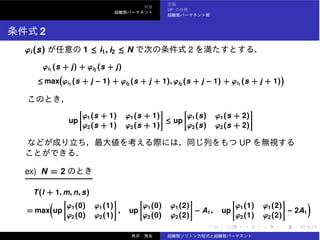
2
ϕi(s) 1 ≤i1, i2 ≤ N 2
ϕi1
(s + j) + ϕi2
(s + j)
≤ max ϕi1
(s + j − 1) + ϕi2
(s + j + 1), ϕi2
(s + j − 1) + ϕi1
(s + j + 1)
up
ϕ1(s + 1) ϕ1(s + 1)
ϕ2(s + 1) ϕ2(s + 1)
≤ up
ϕ1(s) ϕ1(s + 2)
ϕ2(s) ϕ2(s + 2)
UP
ex) N = 2
T(l + 1, m, n, s)
= max up
ϕ1(0) ϕ1(1)
ϕ2(0) ϕ2(1)
, up
ϕ1(0) ϕ1(2)
ϕ2(0) ϕ2(2)
− A1, up
ϕ1(1) ϕ1(2)
ϕ2(1) ϕ2(2)
− 2A1
42.
UP
UP ϕi(s)
1 A1≥ A2 ≥ A3
ϕi(l + 1, m, n; s) = max(ϕi(l, m, n; s), ϕi(l, m, n; s + 1) − A1)
ϕi(l, m + 1, n; s) = max(ϕi(l, m, n; s), ϕi(l, m, n; s + 1) − A2)
ϕi(l, m, n + 1; s) = max(ϕi(l, m, n; s), ϕi(l, m, n; s + 1) − A3)
2 j, i1, i2
ϕi1
(s + j) + ϕi2
(s + j)
≤ max ϕi1
(s + j − 1) + ϕi2
(s + j + 1), ϕi2
(s + j − 1) + ϕi1
(s + j + 1)
3 (ϕ1(s), ϕ2(s), . . . , ϕN(s))T
= Φ(s) ,
0 ≤ k1 < k2 < k3 ≤ N + 1
up[Φ(0) · · · Φ(k2) · · · Φ(N)] + up[Φ(0) · · · Φ(k1) · · · Φ(k3) · · · Φ(N + 1)]
= max up[Φ(0) · · · Φ(k3) · · · Φ(N)] + up[Φ(0) · · · Φ(k1) · · · Φ(k2) · · · Φ(N + 1)]
up[Φ(0) · · · Φ(k1) · · · Φ(N)] + up[Φ(0) · · · Φ(k2) · · · Φ(k3) · · · Φ(N + 1)]
43.
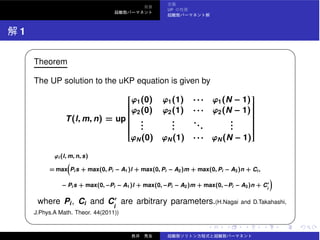
UP
1
✓ ✏
Theorem
The UPsolution to the uKP equation is given by
T(l, m, n) = up
⎡
⎢⎢⎢⎢⎢⎢⎢⎢⎢⎢⎢⎢⎢⎢⎢⎢⎣
ϕ1(0) ϕ1(1) · · · ϕ1(N − 1)
ϕ2(0) ϕ2(1) · · · ϕ2(N − 1)
...
...
...
...
ϕN(0) ϕN(1) · · · ϕN(N − 1)
⎤
⎥⎥⎥⎥⎥⎥⎥⎥⎥⎥⎥⎥⎥⎥⎥⎥⎦
ϕi (l, m, n, s)
= max Pi s + max(0, Pi − A1)l + max(0, Pi − A2)m + max(0, Pi − A3)n + Ci ,
− Pi s + max(0, −Pi − A1)l + max(0, −Pi − A2)m + max(0, −Pi − A3)n + C′
i
where Pi, Ci and C′
i
are arbitrary parameters.(H.Nagai and D.Takahashi,
J.Phys.A Math. Theor. 44(2011))
✒ ✑
44.
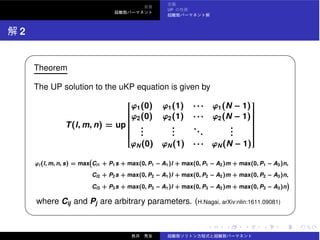
UP
2
✓ ✏
Theorem
The UPsolution to the uKP equation is given by
T(l, m, n) = up
⎡
⎢⎢⎢⎢⎢⎢⎢⎢⎢⎢⎢⎢⎢⎢⎢⎢⎣
ϕ1(0) ϕ1(1) · · · ϕ1(N − 1)
ϕ2(0) ϕ2(1) · · · ϕ2(N − 1)
...
...
...
...
ϕN(0) ϕN(1) · · · ϕN(N − 1)
⎤
⎥⎥⎥⎥⎥⎥⎥⎥⎥⎥⎥⎥⎥⎥⎥⎥⎦
ϕi (l, m, n, s) = max Ci1 + P1s + max(0, P1 − A1)l + max(0, P1 − A2)m + max(0, P1 − A3)n,
Ci2 + P2s + max(0, P2 − A1)l + max(0, P2 − A2)m + max(0, P2 − A3)n,
Ci3 + P3s + max(0, P3 − A1)l + max(0, P3 − A2)m + max(0, P3 − A3)n
where Cij and Pj are arbitrary parameters. (H.Nagai, arXiv:nlin:1611.09081)
✒ ✑



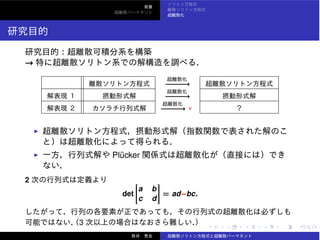
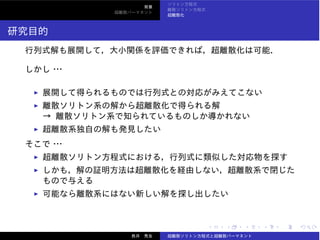
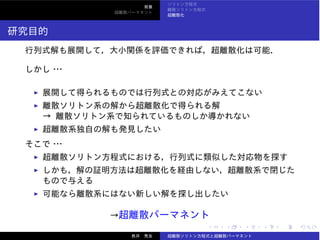
![UP
2.1.
✓ ✏
(UP)
N A = [aij]1≤i,j≤N A
(UP) . (D. Takahashi, R. Hirota, “Ultradiscrete Soliton Solution of
Permanent Type”, J. Phys. Soc. Japan, 76 (2007) 104007–104012)
up[A] ≡ max
π∈SN
1≤i≤N
aiπi
maxπ∈SN
N π = (π1, π2, . . . , πN)
.
✒ ✑
cf)
det[A] ≡
π∈SN 1≤i≤N
sgn(π)aiπi
perm[A] ≡
π∈SN 1≤i≤N
aiπi](https://image.slidesharecdn.com/hidetomonagai-171029045750/85/Hidetomo-Nagai-30-320.jpg)

![UP
UP ϕi(s)
1 A1 ≥ A2 ≥ A3
ϕi(l + 1, m, n; s) = max(ϕi(l, m, n; s), ϕi(l, m, n; s + 1) − A1)
ϕi(l, m + 1, n; s) = max(ϕi(l, m, n; s), ϕi(l, m, n; s + 1) − A2)
ϕi(l, m, n + 1; s) = max(ϕi(l, m, n; s), ϕi(l, m, n; s + 1) − A3)
2 j, i1, i2
ϕi1
(s + j) + ϕi2
(s + j)
≤ max ϕi1
(s + j − 1) + ϕi2
(s + j + 1), ϕi2
(s + j − 1) + ϕi1
(s + j + 1)
3 (ϕ1(s), ϕ2(s), . . . , ϕN(s))T
= Φ(s) ,
0 ≤ k1 < k2 < k3 ≤ N + 1
up[Φ(0) · · · Φ(k2) · · · Φ(N)] + up[Φ(0) · · · Φ(k1) · · · Φ(k3) · · · Φ(N + 1)]
= max up[Φ(0) · · · Φ(k3) · · · Φ(N)] + up[Φ(0) · · · Φ(k1) · · · Φ(k2) · · · Φ(N + 1)]
up[Φ(0) · · · Φ(k1) · · · Φ(N)] + up[Φ(0) · · · Φ(k2) · · · Φ(k3) · · · Φ(N + 1)]](https://image.slidesharecdn.com/hidetomonagai-171029045750/85/Hidetomo-Nagai-36-320.jpg)

![UP
KP
KP UP
T(l, m, n) = up
⎡
⎢⎢⎢⎢⎢⎢⎢⎢⎢⎢⎢⎢⎢⎣
φ1(0) φ1(1) · · · φ1(N − 1)
.
.
.
.
.
.
...
.
.
.
φN (0) φN (1) · · · φN (N − 1)
⎤
⎥⎥⎥⎥⎥⎥⎥⎥⎥⎥⎥⎥⎥⎦
KP
T(l, m + 1, n) + T(l + 1, m, n + 1)
= max T(l + 1, m, n) + T(l, m + 1, n + 1) − A1 + A2,
T(l, m, n + 1) + T(l + 1, m + 1, n) (A1 > A2)
3
up[Φ(0) · · · Φ(k2) · · · Φ(N)] + up[Φ(0) · · · Φ(k1) · · · Φ(k3) · · · Φ(N + 1)]
= max up[Φ(0) · · · Φ(k3) · · · Φ(N)] + up[Φ(0) · · · Φ(k1) · · · Φ(k2) · · · Φ(N + 1)]
up[Φ(0) · · · Φ(k1) · · · Φ(N)] + up[Φ(0) · · · Φ(k2) · · · Φ(k3) · · · Φ(N + 1)]](https://image.slidesharecdn.com/hidetomonagai-171029045750/85/Hidetomo-Nagai-39-320.jpg)
![UP
UP ϕi(s)
1 A1 ≥ A2 ≥ A3
ϕi(l + 1, m, n; s) = max(ϕi(l, m, n; s), ϕi(l, m, n; s + 1) − A1)
ϕi(l, m + 1, n; s) = max(ϕi(l, m, n; s), ϕi(l, m, n; s + 1) − A2)
ϕi(l, m, n + 1; s) = max(ϕi(l, m, n; s), ϕi(l, m, n; s + 1) − A3)
2 j, i1, i2
ϕi1
(s + j) + ϕi2
(s + j)
≤ max ϕi1
(s + j − 1) + ϕi2
(s + j + 1), ϕi2
(s + j − 1) + ϕi1
(s + j + 1)
3 (ϕ1(s), ϕ2(s), . . . , ϕN(s))T
= Φ(s) ,
0 ≤ k1 < k2 < k3 ≤ N + 1
up[Φ(0) · · · Φ(k2) · · · Φ(N)] + up[Φ(0) · · · Φ(k1) · · · Φ(k3) · · · Φ(N + 1)]
= max up[Φ(0) · · · Φ(k3) · · · Φ(N)] + up[Φ(0) · · · Φ(k1) · · · Φ(k2) · · · Φ(N + 1)]
up[Φ(0) · · · Φ(k1) · · · Φ(N)] + up[Φ(0) · · · Φ(k2) · · · Φ(k3) · · · Φ(N + 1)]](https://image.slidesharecdn.com/hidetomonagai-171029045750/85/Hidetomo-Nagai-42-320.jpg)


![Tuyển tập tích phân luyện thi đại học 2014 [đáp án chi tiết]](https://cdn.slidesharecdn.com/ss_thumbnails/tuyntptchphnluynthiihc2014pnchitit-151212160439-thumbnail.jpg?width=640&height=640&fit=bounds)


