RESULTS OF THE KOOBI FORA RESEARCH PROJECT
Koobi Fora Research Project (KFRP)  1968-today Exploration of the fossil exposures in the Omo-Turkana Basin, northern Kenya, for evidence that will disclose the course and context of human evolution
Australopithecus africanus  1925 Paranthropus robustus  1938 South Africa What was known from Africa in 1968
Paranthropus boisei 1959 East Africa
Homo habilis Homo erectus Olduvai Gorge 1960s
KNM-KP 271 Kanapoi  1965 Lothagam 1967 KNM-LT 329 What was known from Kenya? Late Miocene/early Pliocene
Baringo, Chemeron  Baringo, Kapthurin  Kanam  Late Pliocene /Pleistocene
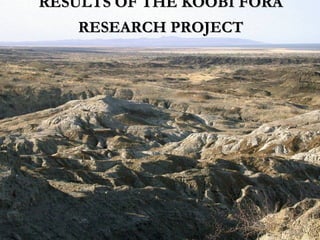
EAST TURKANA 1968
Field work 1969 Paranthropus boisei
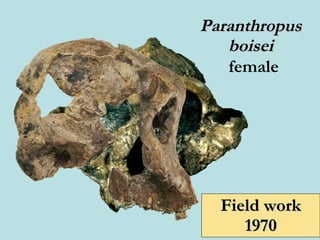
Paranthropus boisei female Field work 1970
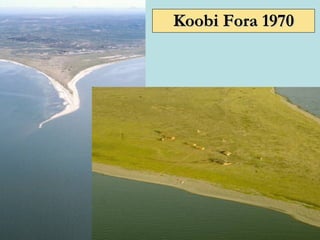
Koobi Fora 1970
 
KBS  SITE 1.8 million years Koobi Fora Research Project 1970s
1972 1974 Homo habilis Homo rudolphensis Early  Homo
Earliest known  Homo erectus  skull 1.89 myr 1975
1979 Frank Brown, with Thure Cerling, defined finger printing method of identifying tuffs (volcanic ashes)
Significance of finds in 70s Geological history of lake basin outlined Fossiliferous areas along Koobi Fora Ridge and Karari escarpment mapped Pliocene and Pleistocene faunas documented Rich hominid record disclosed  Environmental trends towards more open country habitats demonstrated Archaeological record established  Initial investigations of Holocene record
Koobi Fora Research Project 1980s Nachukui Formation, West Turkana
Nariokotome 1984
 
 
Turkana Boy  1.56 myr Only known  Homo erectus  skeleton KNM-ER 15000
Paranthropus  æ thiopicus  Earliest skull known of a robust australopithecine 2.6  myr   KNM-ER 17000 “ Black Skull”
Earliest fossil ape  Kamoyapithecus hamiltoni   Loperot and Lothodok Late Oligocene  23-25 myr
Kalodirr and Buluk 17-18 myr  Three new genera and species of fossil apes
Significance of finds in 80s Increased understanding of  Homo erectus  body plan, brain size and development Pliocene and Pleistocene faunal assemblages around the lake basin documented Earliest  Paranthropus  described  Earliest fossil ape from the late Oligocene Three new species of early Miocene apes discovered
Major Turkana Basin Discoveries 1968-1989
H. sapiens chimpanzee Capitates Koobi Fora ResearchProject 1990s A. afarensis chimpanzee South Turkwell chimpanzee South Turkwell  3.5 myr
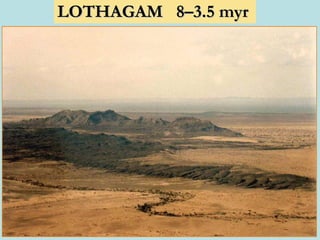
LOTHAGAM  8–3.5 myr
Lothagam Late Miocene hominins ~5.0 myr
Lothagam Late Miocene fauna ~7.0-5.0 myr
Type site for: 10 vertebrate genera (7 are mammals)  and  8 vertebrate species (21 are mammals) LOTHAGAM
Brachypotherium Stegotetrabelodon Tragoportax Palaeotragus
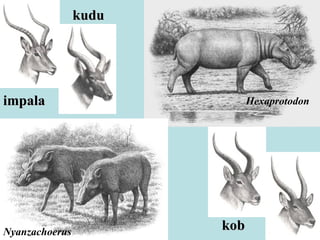
kob Hexaprotodon Nyanzachoerus kudu impala
Isotopes Radiation of C4 grasses: many herbivores change from C3 to C4 diets after 9 myr EQUIDAE PROBOSCIDEA 8myr 8-7myr
Allia Bay – Site 261-1  3.9 myr
Allia Bay  - 3.9 myr
KANAPOI  4.1 myr
Australopithecus anamensis 4.1 myr
 
Capitates A. afarensis chimpanzee A. anamensis South Turkwell Kanapoi A. afarensis
Australopithecus anamensis Fossil evidence: 47 specimens from Kanapoi 31 of specimens from Allia Bay TOTAL 78 Significance: earliest australopithecine secure evidence of bipedality wrist  primitive likely ancestor for  A. afarensis
Louise Leakey co-leader KFRP 1998-today
LOMEKWI  3.5-3.2 myr
3 Ma 6 Ma ? ? Australopithecus afarensis   the common ancestor?
Kenyanthropus platyops Holotype:   Cranium KNM-WT 40000 (3.5 Myr.) Etymology:   platus  (Gk), flat;  opsis (GK), face, appearance
?
Significance of finds in 90s First good East African late Miocene fauna described Many herbivores change to C4 dominated diet between 8-6 myr Australopithecus anamensis : Earliest australopithecine bipedal but with primitive wrist bone 4.1 myr  Kenyanthropus platyops:  diversity in the hominin lineage at 3.5 myr
EAST TURKANA 2000 Fossils collected in 70s 2.0 to 1.3 myr
Discovery of KNM-ER 42700 by Frederick Manthi in 2000
 
1.55 ± 0.05 myr Homo erectus
Smallest 691cc Largest 1067cc Sexual Dimorphism in  Homo erectus
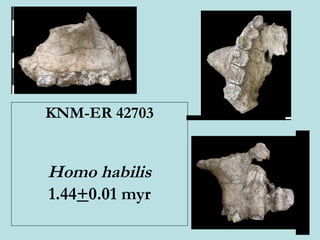
KNM-ER 42703 Homo habilis 1.44 + 0.01 myr
Homo erectus  highly sexually dimorphic, almost as dimorphic as modern gorillas Expect a significant degree of variation Homo habilis  lived alongside  Homo erectus  for >400,000 yrs (from 1.87 to 1.44 myr) Significance of finds in 2000
Current Research: GIS technology
GIS - Global information systems
 
2000-2007 1970-1980 East Turkana fossil collections- context for human ancestors
New primate species discovered by the KFRP 1968-2008 Hominids Homo ergaster Homo rudolphensis Kenyanthropus platyops Australopithecus anamensis Kamoyapithecus hamiltoni Turkanapithecus kalakolensis Afropithecus turkanensis Simiolus engiessi Cercopithecids Paracolobus mutiwa Paracolobus kerioensis  Rhinocolobus turkanensis Cercopithecoides kimeui Colobus freedmani Parapapio lothagamensis
Numbers of fossils and hominins collected 1968-2008 between 8-1.3 myr 384 16,315 Total 6 1,600 Lothagam 46 518 Kanapoi 61 4,310 West Turkana 271 9,887 East Turkana number of hominins number of fossils Late Miocene and Plio-Pleistocene
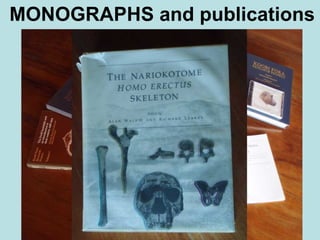
MONOGRAPHS and publications
Sibiloi National Park  gazetted in 1973
LLSB Memorial Building, completed 1977
Turkana Basin Institute
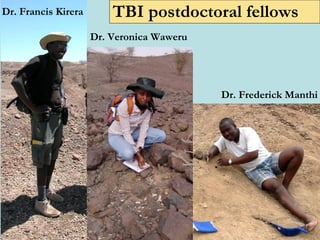
TBI postdoctoral fellows Dr. Francis Kirera Dr. Frederick Manthi Dr. Veronica Waweru
Koobi Fora Research Project Field Crew who find the fossils
If you want to know more www.turkanabasin.org www.kfrp.com Special thanks to the National Geographic Society   for their long term sponsorship

hew

Editor's Notes

  • #2 REL began exploration east of Lake Turkana, then Rudolph, in 1968. Huge area of fossiliferous sediments, numerous fossils including many monkeys