HEPARIN AND ENOXAPARIN
Dr. Arun George
PG Registrar
PICU
OUTLINE
Physiology
 Coagulation cascade
Classification
Individual drugs
 Heparin
 Enoxaparin
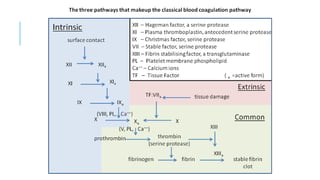
COAGULATION CASCADE
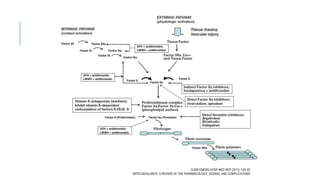
WHERE DOES THESE
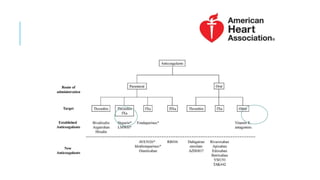
AGENTS ACT ?
Anticoagulants
CURR EMERG HOSP MED REP (2013) 1:83–97
ANTICOAGULANTS: A REVIEW OF THE PHARMACOLOGY, DOSING, AND COMPLICATIONS
INDICATIONS FOR
ANTICOAGULATION
Venous Thromboembolism (VTE)
Arterial Thromboembolism (ATE)
Conventional anticoagulants in pediatric
 unfractionated heparin (UFH)
 low molecular weight heparins (LMWHs, enoxaparin)
 vitamin K antagonists (warfarin)
UFH
UFH – INTRODUCTION
Heparin was discovered by a medical student
Heparin – High concentration in liver
Obtained from ox lung / pig intestine mucosa
Molecular weight ranging from 3000 to 30,000 kD
UFH
It accelerates the Anti thrombin 3 activity
Inhibits factors - 2, 10, 9,11,12 & 13
UFH + AT’s = inhibition of coagulation serine proteases increases
approximately 1000-fold
UFH increases the intravascular release of tissue factor pathway inhibitor (TFPI)
High dose – anti platelet action
INTERACTION OF HEPARIN-ATIII-CLOTTING
FACTORS
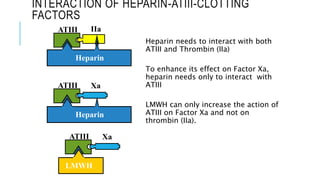
Heparin needs to interact with both
ATIII and Thrombin (IIa)
To enhance its effect on Factor Xa,
heparin needs only to interact with
ATIII
LMWH can only increase the action of
ATIII on Factor Xa and not on
thrombin (IIa).
Heparin
ATIII IIa
Heparin
ATIII Xa
LMWH
ATIII Xa
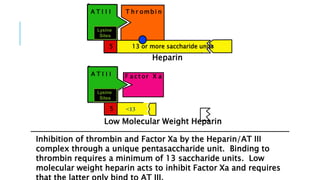
Inhibition of thrombin and Factor Xa by the Heparin/AT III
complex through a unique pentasaccharide unit. Binding to
thrombin requires a minimum of 13 saccharide units. Low
molecular weight heparin acts to inhibit Factor Xa and requires
A T I I I T h r ombi n
5 13 or more saccharide units
Heparin
Lysine
Sites
A T I I I F a c t or X a
5
Low Molecular Weight Heparin
Lysine
Sites
<13
ANTICOAGULANT THERAPY
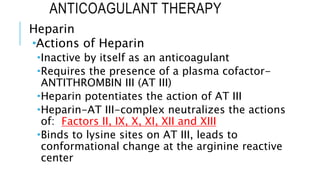
Heparin
Actions of Heparin
Inactive by itself as an anticoagulant
Requires the presence of a plasma cofactor-
ANTITHROMBIN III (AT III)
Heparin potentiates the action of AT III
Heparin-AT III-complex neutralizes the actions
of: Factors II, IX, X, XI, XII and XIII
Binds to lysine sites on AT III, leads to
conformational change at the arginine reactive
center
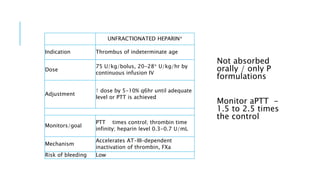
Not absorbed
orally / only P
formulations
Monitor aPTT -
1.5 to 2.5 times
the control
UNFRACTIONATED HEPARIN*
Indication Thrombus of indeterminate age
Dose
75 U/kg/bolus, 20-28* U/kg/hr by
continuous infusion IV
Adjustment
↑ dose by 5-10% q6hr until adequate
level or PTT is achieved
Monitors/goal
PTT times control; thrombin time
infinity; heparin level 0.3-0.7 U/mL
Mechanism
Accelerates AT-III–dependent
inactivation of thrombin, FXa
Risk of bleeding Low
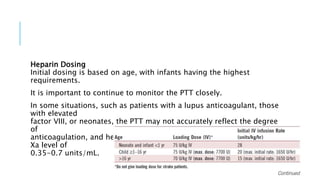
Heparin Dosing
Initial dosing is based on age, with infants having the highest
requirements.
It is important to continue to monitor the PTT closely.
In some situations, such as patients with a lupus anticoagulant, those
with elevated
factor VIII, or neonates, the PTT may not accurately reflect the degree
of
anticoagulation, and heparin can be monitored using a heparin anti-
Xa level of
0.35-0.7 units/mL.
ADVERSE EFFECTS
1. Bleeding
The true frequency of bleeding in pediatric patients receiving heparin
has not been well established and is reported as 1–24%. If the
anticoagulant effect of heparin must be reversed immediately,
protamine sulfate may be administered to neutralize the heparin.
2. Hypersensitive reactions
3. Osteoporosis
4. Reversible alopecia
5. Heparin-induced thrombocytopenia (HIT)
HIT is a prothrombotic, immune-mediated complication in which
antibodies develop to a complex of heparin and platelet factor 4.
These antibodies result in platelet activation, stimulation of
coagulation, thrombocytopenia, and in some cases, life-threatening
thrombosis.
If HIT is strongly suspected, heparin must be discontinued
immediately.
An alternative parenteral anticoagulant, such as argatroban or
bivalirudin, may be used in this situation.
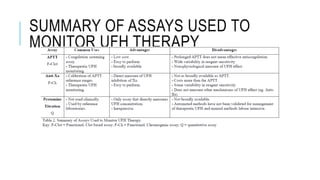
MONITORING
Narrow therapeutic window
Recommendations for UFH therapy from the American College of
Chest Physicians (ACCP) suggest target aPPT
APTT of 1.5 to 2.5 times normal values produced desirable UFH safety
and efficacy outcomes
SUMMARY OF ASSAYS USED TO
MONITOR UFH THERAPY
LMWH – ENOXAPARIN
LMWH - Prepared by altering UFH
The interaction of the smaller chains with AT III results primarily in
the
inhibition of factor Xa, with less of an effect on thrombin.
The several LMWHs available have variable inhibitory effects on
thrombin. For this reason, the PTT is not a reliable measure of the
anticoagulant effect of LMWH, and the anti–factor Xa activity is used
instead.
ADVANTAGES OF LMWH
No need for aPTT monitoring
Higher bioavailability
Longer duration of action
Lower side effects
BD/ OD doses
NOTE
longer half-life and reduced reversibility compared to UFH
used in patients with less acute risk of haemorrhage
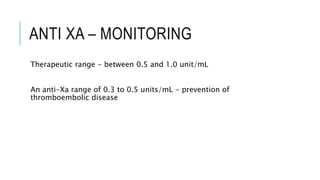
ANTI XA – MONITORING
Therapeutic range - between 0.5 and 1.0 unit/mL
An anti-Xa range of 0.3 to 0.5 units/mL - prevention of
thromboembolic disease
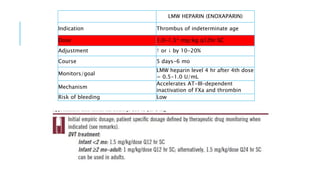
LMW HEPARIN (ENOXAPARIN)
Indication Thrombus of indeterminate age
Dose 1.0-1.5* mg/kg q12hr SC
Adjustment ↑ or ↓ by 10-20%
Course 5 days-6 mo
Monitors/goal
LMW heparin level 4 hr after 4th dose
= 0.5-1.0 U/mL
Mechanism
Accelerates AT-III–dependent
inactivation of FXa and thrombin
Risk of bleeding Low
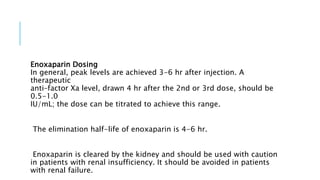
Enoxaparin Dosing
In general, peak levels are achieved 3-6 hr after injection. A
therapeutic
anti–factor Xa level, drawn 4 hr after the 2nd or 3rd dose, should be
0.5-1.0
IU/mL; the dose can be titrated to achieve this range.
The elimination half-life of enoxaparin is 4-6 hr.
Enoxaparin is cleared by the kidney and should be used with caution
in patients with renal insufficiency. It should be avoided in patients
with renal failure.
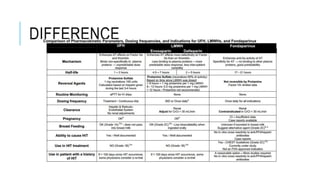
DIFFERENCE
References:
1. Nelson textbook of Paediatrics 21st edition
2. Harriet Lane
3. Anticoagulant therapy in Paediatrics – Journal of Basic and Clinical
Pharmacy 2015

Heparin and enoxaparin

  • 1.
    HEPARIN AND ENOXAPARIN Dr.Arun George PG Registrar PICU
  • 2.
  • 3.
  • 5.
    WHERE DOES THESE AGENTSACT ? Anticoagulants
  • 6.
    CURR EMERG HOSPMED REP (2013) 1:83–97 ANTICOAGULANTS: A REVIEW OF THE PHARMACOLOGY, DOSING, AND COMPLICATIONS
  • 8.
    INDICATIONS FOR ANTICOAGULATION Venous Thromboembolism(VTE) Arterial Thromboembolism (ATE) Conventional anticoagulants in pediatric  unfractionated heparin (UFH)  low molecular weight heparins (LMWHs, enoxaparin)  vitamin K antagonists (warfarin)
  • 9.
  • 10.
    UFH – INTRODUCTION Heparinwas discovered by a medical student Heparin – High concentration in liver Obtained from ox lung / pig intestine mucosa Molecular weight ranging from 3000 to 30,000 kD
  • 11.
    UFH It accelerates theAnti thrombin 3 activity Inhibits factors - 2, 10, 9,11,12 & 13 UFH + AT’s = inhibition of coagulation serine proteases increases approximately 1000-fold UFH increases the intravascular release of tissue factor pathway inhibitor (TFPI) High dose – anti platelet action
  • 12.
    INTERACTION OF HEPARIN-ATIII-CLOTTING FACTORS Heparinneeds to interact with both ATIII and Thrombin (IIa) To enhance its effect on Factor Xa, heparin needs only to interact with ATIII LMWH can only increase the action of ATIII on Factor Xa and not on thrombin (IIa). Heparin ATIII IIa Heparin ATIII Xa LMWH ATIII Xa
  • 13.
    Inhibition of thrombinand Factor Xa by the Heparin/AT III complex through a unique pentasaccharide unit. Binding to thrombin requires a minimum of 13 saccharide units. Low molecular weight heparin acts to inhibit Factor Xa and requires A T I I I T h r ombi n 5 13 or more saccharide units Heparin Lysine Sites A T I I I F a c t or X a 5 Low Molecular Weight Heparin Lysine Sites <13
  • 14.
    ANTICOAGULANT THERAPY Heparin Actions ofHeparin Inactive by itself as an anticoagulant Requires the presence of a plasma cofactor- ANTITHROMBIN III (AT III) Heparin potentiates the action of AT III Heparin-AT III-complex neutralizes the actions of: Factors II, IX, X, XI, XII and XIII Binds to lysine sites on AT III, leads to conformational change at the arginine reactive center
  • 15.
    Not absorbed orally /only P formulations Monitor aPTT - 1.5 to 2.5 times the control UNFRACTIONATED HEPARIN* Indication Thrombus of indeterminate age Dose 75 U/kg/bolus, 20-28* U/kg/hr by continuous infusion IV Adjustment ↑ dose by 5-10% q6hr until adequate level or PTT is achieved Monitors/goal PTT times control; thrombin time infinity; heparin level 0.3-0.7 U/mL Mechanism Accelerates AT-III–dependent inactivation of thrombin, FXa Risk of bleeding Low
  • 16.
    Heparin Dosing Initial dosingis based on age, with infants having the highest requirements. It is important to continue to monitor the PTT closely. In some situations, such as patients with a lupus anticoagulant, those with elevated factor VIII, or neonates, the PTT may not accurately reflect the degree of anticoagulation, and heparin can be monitored using a heparin anti- Xa level of 0.35-0.7 units/mL.
  • 17.
    ADVERSE EFFECTS 1. Bleeding Thetrue frequency of bleeding in pediatric patients receiving heparin has not been well established and is reported as 1–24%. If the anticoagulant effect of heparin must be reversed immediately, protamine sulfate may be administered to neutralize the heparin. 2. Hypersensitive reactions 3. Osteoporosis 4. Reversible alopecia
  • 18.
    5. Heparin-induced thrombocytopenia(HIT) HIT is a prothrombotic, immune-mediated complication in which antibodies develop to a complex of heparin and platelet factor 4. These antibodies result in platelet activation, stimulation of coagulation, thrombocytopenia, and in some cases, life-threatening thrombosis. If HIT is strongly suspected, heparin must be discontinued immediately. An alternative parenteral anticoagulant, such as argatroban or bivalirudin, may be used in this situation.
  • 19.
    MONITORING Narrow therapeutic window Recommendationsfor UFH therapy from the American College of Chest Physicians (ACCP) suggest target aPPT APTT of 1.5 to 2.5 times normal values produced desirable UFH safety and efficacy outcomes
  • 20.
    SUMMARY OF ASSAYSUSED TO MONITOR UFH THERAPY
  • 21.
    LMWH – ENOXAPARIN LMWH- Prepared by altering UFH The interaction of the smaller chains with AT III results primarily in the inhibition of factor Xa, with less of an effect on thrombin. The several LMWHs available have variable inhibitory effects on thrombin. For this reason, the PTT is not a reliable measure of the anticoagulant effect of LMWH, and the anti–factor Xa activity is used instead.
  • 22.
    ADVANTAGES OF LMWH Noneed for aPTT monitoring Higher bioavailability Longer duration of action Lower side effects BD/ OD doses
  • 23.
    NOTE longer half-life andreduced reversibility compared to UFH used in patients with less acute risk of haemorrhage
  • 24.
    ANTI XA –MONITORING Therapeutic range - between 0.5 and 1.0 unit/mL An anti-Xa range of 0.3 to 0.5 units/mL - prevention of thromboembolic disease
  • 25.
    LMW HEPARIN (ENOXAPARIN) IndicationThrombus of indeterminate age Dose 1.0-1.5* mg/kg q12hr SC Adjustment ↑ or ↓ by 10-20% Course 5 days-6 mo Monitors/goal LMW heparin level 4 hr after 4th dose = 0.5-1.0 U/mL Mechanism Accelerates AT-III–dependent inactivation of FXa and thrombin Risk of bleeding Low
  • 26.
    Enoxaparin Dosing In general,peak levels are achieved 3-6 hr after injection. A therapeutic anti–factor Xa level, drawn 4 hr after the 2nd or 3rd dose, should be 0.5-1.0 IU/mL; the dose can be titrated to achieve this range. The elimination half-life of enoxaparin is 4-6 hr. Enoxaparin is cleared by the kidney and should be used with caution in patients with renal insufficiency. It should be avoided in patients with renal failure.
  • 27.
  • 28.
    References: 1. Nelson textbookof Paediatrics 21st edition 2. Harriet Lane 3. Anticoagulant therapy in Paediatrics – Journal of Basic and Clinical Pharmacy 2015