Name: Shubham Khedekar
14 Principles of Management-Henri Fayol
ITC LIMITED
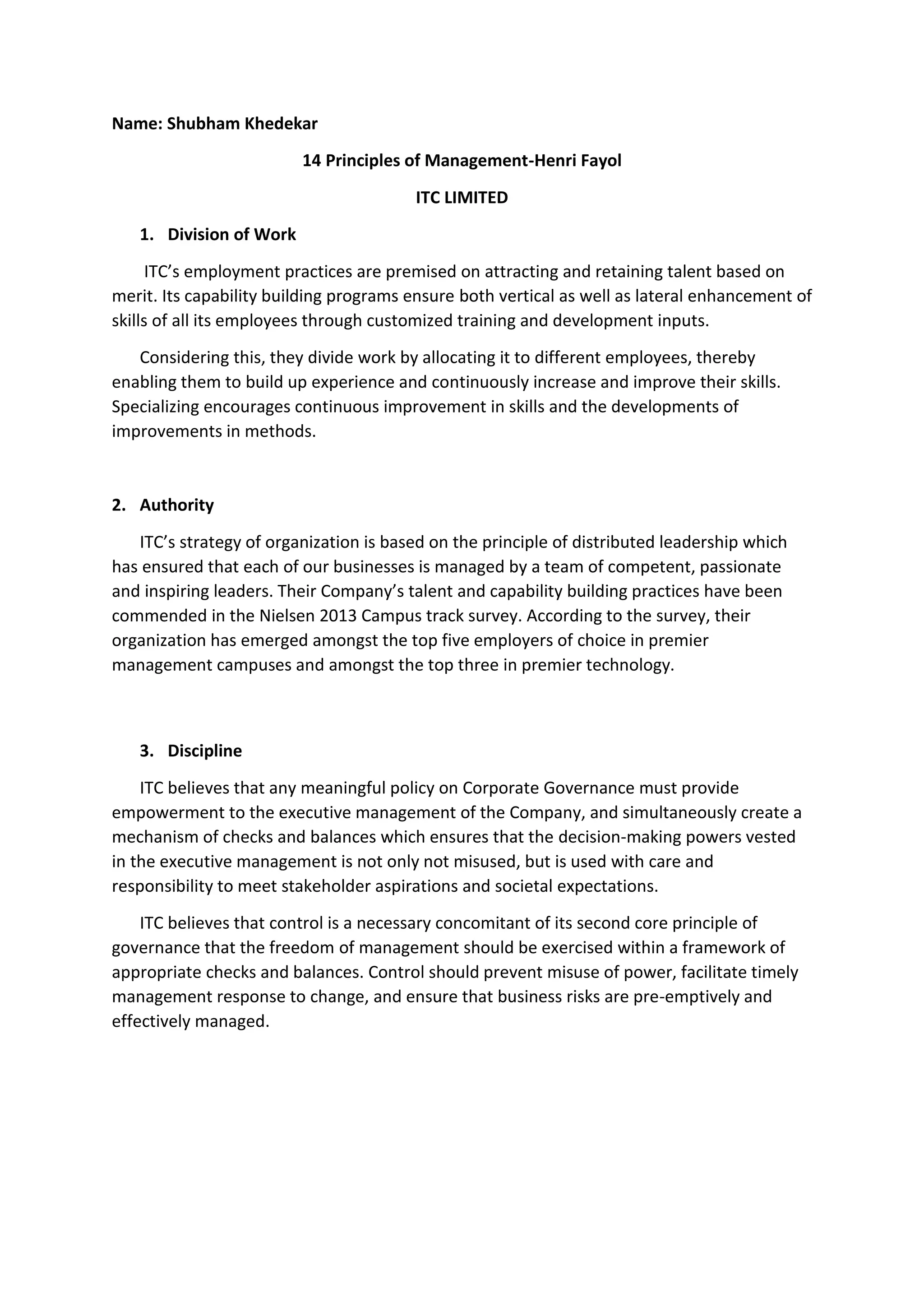
1. Division of Work
ITC’s employment practices are premised on attracting and retaining talent based on
merit. Its capability building programs ensure both vertical as well as lateral enhancement of
skills of all its employees through customized training and development inputs.
Considering this, they divide work by allocating it to different employees, thereby
enabling them to build up experience and continuously increase and improve their skills.
Specializing encourages continuous improvement in skills and the developments of
improvements in methods.
2. Authority
ITC’s strategy of organization is based on the principle of distributed leadership which
has ensured that each of our businesses is managed by a team of competent, passionate
and inspiring leaders. Their Company’s talent and capability building practices have been
commended in the Nielsen 2013 Campus track survey. According to the survey, their
organization has emerged amongst the top five employers of choice in premier
management campuses and amongst the top three in premier technology.
3. Discipline
ITC believes that any meaningful policy on Corporate Governance must provide
empowerment to the executive management of the Company, and simultaneously create a
mechanism of checks and balances which ensures that the decision-making powers vested
in the executive management is not only not misused, but is used with care and
responsibility to meet stakeholder aspirations and societal expectations.
ITC believes that control is a necessary concomitant of its second core principle of
governance that the freedom of management should be exercised within a framework of
appropriate checks and balances. Control should prevent misuse of power, facilitate timely
management response to change, and ensure that business risks are pre-emptively and
effectively managed.
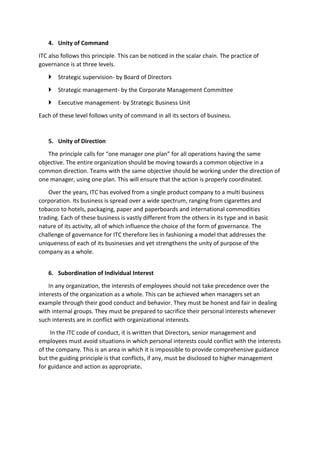
4. Unity of Command
ITC also follows this principle. This can be noticed in the scalar chain. The practice of
governance is at three levels.
 Strategic supervision- by Board of Directors
 Strategic management- by the Corporate Management Committee
 Executive management- by Strategic Business Unit
Each of these level follows unity of command in all its sectors of business.
5. Unity of Direction
The principle calls for “one manager one plan” for all operations having the same
objective. The entire organization should be moving towards a common objective in a
common direction. Teams with the same objective should be working under the direction of
one manager, using one plan. This will ensure that the action is properly coordinated.
Over the years, ITC has evolved from a single product company to a multi business
corporation. Its business is spread over a wide spectrum, ranging from cigarettes and
tobacco to hotels, packaging, paper and paperboards and international commodities
trading. Each of these business is vastly different from the others in its type and in basic
nature of its activity, all of which influence the choice of the form of governance. The
challenge of governance for ITC therefore lies in fashioning a model that addresses the
uniqueness of each of its businesses and yet strengthens the unity of purpose of the
company as a whole.
6. Subordination of Individual Interest
In any organization, the interests of employees should not take precedence over the
interests of the organization as a whole. This can be achieved when managers set an
example through their good conduct and behavior. They must be honest and fair in dealing
with internal groups. They must be prepared to sacrifice their personal interests whenever
such interests are in conflict with organizational interests.
In the ITC code of conduct, it is written that Directors, senior management and
employees must avoid situations in which personal interests could conflict with the interests
of the company. This is an area in which it is impossible to provide comprehensive guidance
but the guiding principle is that conflicts, if any, must be disclosed to higher management
for guidance and action as appropriate.
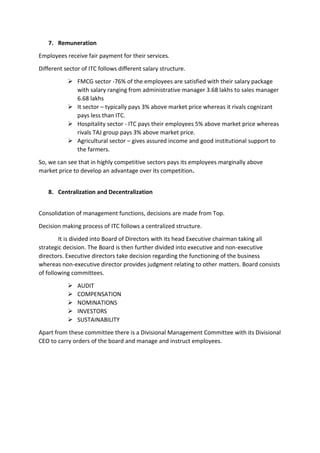
7. Remuneration
Employees receive fair payment for their services.
Different sector of ITC follows different salary structure.
 FMCG sector -76% of the employees are satisfied with their salary package
with salary ranging from administrative manager 3.68 lakhs to sales manager
6.68 lakhs
 It sector – typically pays 3% above market price whereas it rivals cognizant
pays less than ITC.
 Hospitality sector - ITC pays their employees 5% above market price whereas
rivals TAJ group pays 3% above market price.
 Agricultural sector – gives assured income and good institutional support to
the farmers.
So, we can see that in highly competitive sectors pays its employees marginally above
market price to develop an advantage over its competition.
8. Centralization and Decentralization
Consolidation of management functions, decisions are made from Top.
Decision making process of ITC follows a centralized structure.
It is divided into Board of Directors with its head Executive chairman taking all
strategic decision. The Board is then further divided into executive and non-executive
directors. Executive directors take decision regarding the functioning of the business
whereas non-executive director provides judgment relating to other matters. Board consists
of following committees.
 AUDIT
 COMPENSATION
 NOMINATIONS
 INVESTORS
 SUSTAINABILITY
Apart from these committee there is a Divisional Management Committee with its Divisional
CEO to carry orders of the board and manage and instruct employees.
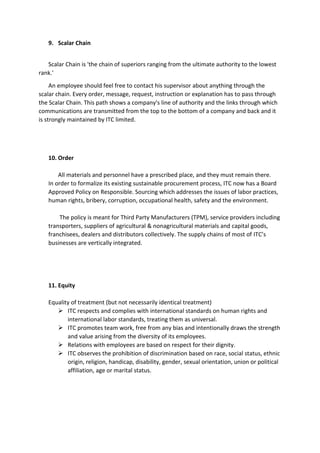
9. Scalar Chain
Scalar Chain is 'the chain of superiors ranging from the ultimate authority to the lowest
rank.'
An employee should feel free to contact his supervisor about anything through the
scalar chain. Every order, message, request, instruction or explanation has to pass through
the Scalar Chain. This path shows a company's line of authority and the links through which
communications are transmitted from the top to the bottom of a company and back and it
is strongly maintained by ITC limited.
10. Order
All materials and personnel have a prescribed place, and they must remain there.
In order to formalize its existing sustainable procurement process, ITC now has a Board
Approved Policy on Responsible. Sourcing which addresses the issues of labor practices,
human rights, bribery, corruption, occupational health, safety and the environment.
The policy is meant for Third Party Manufacturers (TPM), service providers including
transporters, suppliers of agricultural & nonagricultural materials and capital goods,
franchisees, dealers and distributors collectively. The supply chains of most of ITC’s
businesses are vertically integrated.
11. Equity
Equality of treatment (but not necessarily identical treatment)
 ITC respects and complies with international standards on human rights and
international labor standards, treating them as universal.
 ITC promotes team work, free from any bias and intentionally draws the strength
and value arising from the diversity of its employees.
 Relations with employees are based on respect for their dignity.
 ITC observes the prohibition of discrimination based on race, social status, ethnic
origin, religion, handicap, disability, gender, sexual orientation, union or political
affiliation, age or marital status.
12. Stability of Tenure of Personnel
Limited turnover of personnel.
Lifetime employment for good workers.
ITC provides a stable job, and honestly inform employees about employment prospects.
ITC supports staff in raising the skills and supports their career within the company.
Pay system rules are designed to reflect the individual contribution of every employee.
Honesty is a prerequisite for achieving stability and success of ITC.
Half of ITC's 7,000-odd managers have been with the tobacco, hotels and consumer
products enterprise for more than a quarter of century. Attrition at senior management
levels - from chief executive officer to business heads - has been zero for at least 15
years now.
13. Initiative
Thinking out a plan and do what it takes to make it happen.
ITC believes that business exists to sub serve larger societal goals. Therefore, the company
not only embarks to create a good health in terms of its profit and loss statements, its
contribution can be measured for the value it creates for society at large.
14. Espirit De Corps
Harmony, cohesion among personnel.
ITC is a super company which is famed to emphasize and nurture team spirit. They believe
that union is strength and which aptly reflects in the company projections where during the
major shift form one production line to another, the company remained solidly unified at all
levels.
Conclusion
The 14 principles of management are basically used to manage organizations and is a useful
tool for forecasting, planning, process management, organization management, decision-
making, coordination and control.
The success of ITC can be materialized by a few number crunching which establishes that
the cigarettes to hospitality giant has indeed made inroads to an intensely competitive
market often marked by pressured margins.
In just two years, ITC's personal care business has notched up market share of about 5 per
cent (volume) in soaps, and around 3.4 per cent in shampoos. Brands Vivel and Superia are
each estimated to be more than Rs 200 crore (Rs 2 billion) per annum in consumer spend.

Henry Fayol Principles for ITC Limited

  • 1.
    Name: Shubham Khedekar 14Principles of Management-Henri Fayol ITC LIMITED 1. Division of Work ITC’s employment practices are premised on attracting and retaining talent based on merit. Its capability building programs ensure both vertical as well as lateral enhancement of skills of all its employees through customized training and development inputs. Considering this, they divide work by allocating it to different employees, thereby enabling them to build up experience and continuously increase and improve their skills. Specializing encourages continuous improvement in skills and the developments of improvements in methods. 2. Authority ITC’s strategy of organization is based on the principle of distributed leadership which has ensured that each of our businesses is managed by a team of competent, passionate and inspiring leaders. Their Company’s talent and capability building practices have been commended in the Nielsen 2013 Campus track survey. According to the survey, their organization has emerged amongst the top five employers of choice in premier management campuses and amongst the top three in premier technology. 3. Discipline ITC believes that any meaningful policy on Corporate Governance must provide empowerment to the executive management of the Company, and simultaneously create a mechanism of checks and balances which ensures that the decision-making powers vested in the executive management is not only not misused, but is used with care and responsibility to meet stakeholder aspirations and societal expectations. ITC believes that control is a necessary concomitant of its second core principle of governance that the freedom of management should be exercised within a framework of appropriate checks and balances. Control should prevent misuse of power, facilitate timely management response to change, and ensure that business risks are pre-emptively and effectively managed.
  • 2.
    4. Unity ofCommand ITC also follows this principle. This can be noticed in the scalar chain. The practice of governance is at three levels.  Strategic supervision- by Board of Directors  Strategic management- by the Corporate Management Committee  Executive management- by Strategic Business Unit Each of these level follows unity of command in all its sectors of business. 5. Unity of Direction The principle calls for “one manager one plan” for all operations having the same objective. The entire organization should be moving towards a common objective in a common direction. Teams with the same objective should be working under the direction of one manager, using one plan. This will ensure that the action is properly coordinated. Over the years, ITC has evolved from a single product company to a multi business corporation. Its business is spread over a wide spectrum, ranging from cigarettes and tobacco to hotels, packaging, paper and paperboards and international commodities trading. Each of these business is vastly different from the others in its type and in basic nature of its activity, all of which influence the choice of the form of governance. The challenge of governance for ITC therefore lies in fashioning a model that addresses the uniqueness of each of its businesses and yet strengthens the unity of purpose of the company as a whole. 6. Subordination of Individual Interest In any organization, the interests of employees should not take precedence over the interests of the organization as a whole. This can be achieved when managers set an example through their good conduct and behavior. They must be honest and fair in dealing with internal groups. They must be prepared to sacrifice their personal interests whenever such interests are in conflict with organizational interests. In the ITC code of conduct, it is written that Directors, senior management and employees must avoid situations in which personal interests could conflict with the interests of the company. This is an area in which it is impossible to provide comprehensive guidance but the guiding principle is that conflicts, if any, must be disclosed to higher management for guidance and action as appropriate.
  • 3.
    7. Remuneration Employees receivefair payment for their services. Different sector of ITC follows different salary structure.  FMCG sector -76% of the employees are satisfied with their salary package with salary ranging from administrative manager 3.68 lakhs to sales manager 6.68 lakhs  It sector – typically pays 3% above market price whereas it rivals cognizant pays less than ITC.  Hospitality sector - ITC pays their employees 5% above market price whereas rivals TAJ group pays 3% above market price.  Agricultural sector – gives assured income and good institutional support to the farmers. So, we can see that in highly competitive sectors pays its employees marginally above market price to develop an advantage over its competition. 8. Centralization and Decentralization Consolidation of management functions, decisions are made from Top. Decision making process of ITC follows a centralized structure. It is divided into Board of Directors with its head Executive chairman taking all strategic decision. The Board is then further divided into executive and non-executive directors. Executive directors take decision regarding the functioning of the business whereas non-executive director provides judgment relating to other matters. Board consists of following committees.  AUDIT  COMPENSATION  NOMINATIONS  INVESTORS  SUSTAINABILITY Apart from these committee there is a Divisional Management Committee with its Divisional CEO to carry orders of the board and manage and instruct employees.
  • 4.
    9. Scalar Chain ScalarChain is 'the chain of superiors ranging from the ultimate authority to the lowest rank.' An employee should feel free to contact his supervisor about anything through the scalar chain. Every order, message, request, instruction or explanation has to pass through the Scalar Chain. This path shows a company's line of authority and the links through which communications are transmitted from the top to the bottom of a company and back and it is strongly maintained by ITC limited. 10. Order All materials and personnel have a prescribed place, and they must remain there. In order to formalize its existing sustainable procurement process, ITC now has a Board Approved Policy on Responsible. Sourcing which addresses the issues of labor practices, human rights, bribery, corruption, occupational health, safety and the environment. The policy is meant for Third Party Manufacturers (TPM), service providers including transporters, suppliers of agricultural & nonagricultural materials and capital goods, franchisees, dealers and distributors collectively. The supply chains of most of ITC’s businesses are vertically integrated. 11. Equity Equality of treatment (but not necessarily identical treatment)  ITC respects and complies with international standards on human rights and international labor standards, treating them as universal.  ITC promotes team work, free from any bias and intentionally draws the strength and value arising from the diversity of its employees.  Relations with employees are based on respect for their dignity.  ITC observes the prohibition of discrimination based on race, social status, ethnic origin, religion, handicap, disability, gender, sexual orientation, union or political affiliation, age or marital status.
  • 5.
    12. Stability ofTenure of Personnel Limited turnover of personnel. Lifetime employment for good workers. ITC provides a stable job, and honestly inform employees about employment prospects. ITC supports staff in raising the skills and supports their career within the company. Pay system rules are designed to reflect the individual contribution of every employee. Honesty is a prerequisite for achieving stability and success of ITC. Half of ITC's 7,000-odd managers have been with the tobacco, hotels and consumer products enterprise for more than a quarter of century. Attrition at senior management levels - from chief executive officer to business heads - has been zero for at least 15 years now. 13. Initiative Thinking out a plan and do what it takes to make it happen. ITC believes that business exists to sub serve larger societal goals. Therefore, the company not only embarks to create a good health in terms of its profit and loss statements, its contribution can be measured for the value it creates for society at large. 14. Espirit De Corps Harmony, cohesion among personnel. ITC is a super company which is famed to emphasize and nurture team spirit. They believe that union is strength and which aptly reflects in the company projections where during the major shift form one production line to another, the company remained solidly unified at all levels.
  • 6.
    Conclusion The 14 principlesof management are basically used to manage organizations and is a useful tool for forecasting, planning, process management, organization management, decision- making, coordination and control. The success of ITC can be materialized by a few number crunching which establishes that the cigarettes to hospitality giant has indeed made inroads to an intensely competitive market often marked by pressured margins. In just two years, ITC's personal care business has notched up market share of about 5 per cent (volume) in soaps, and around 3.4 per cent in shampoos. Brands Vivel and Superia are each estimated to be more than Rs 200 crore (Rs 2 billion) per annum in consumer spend.