Introduction
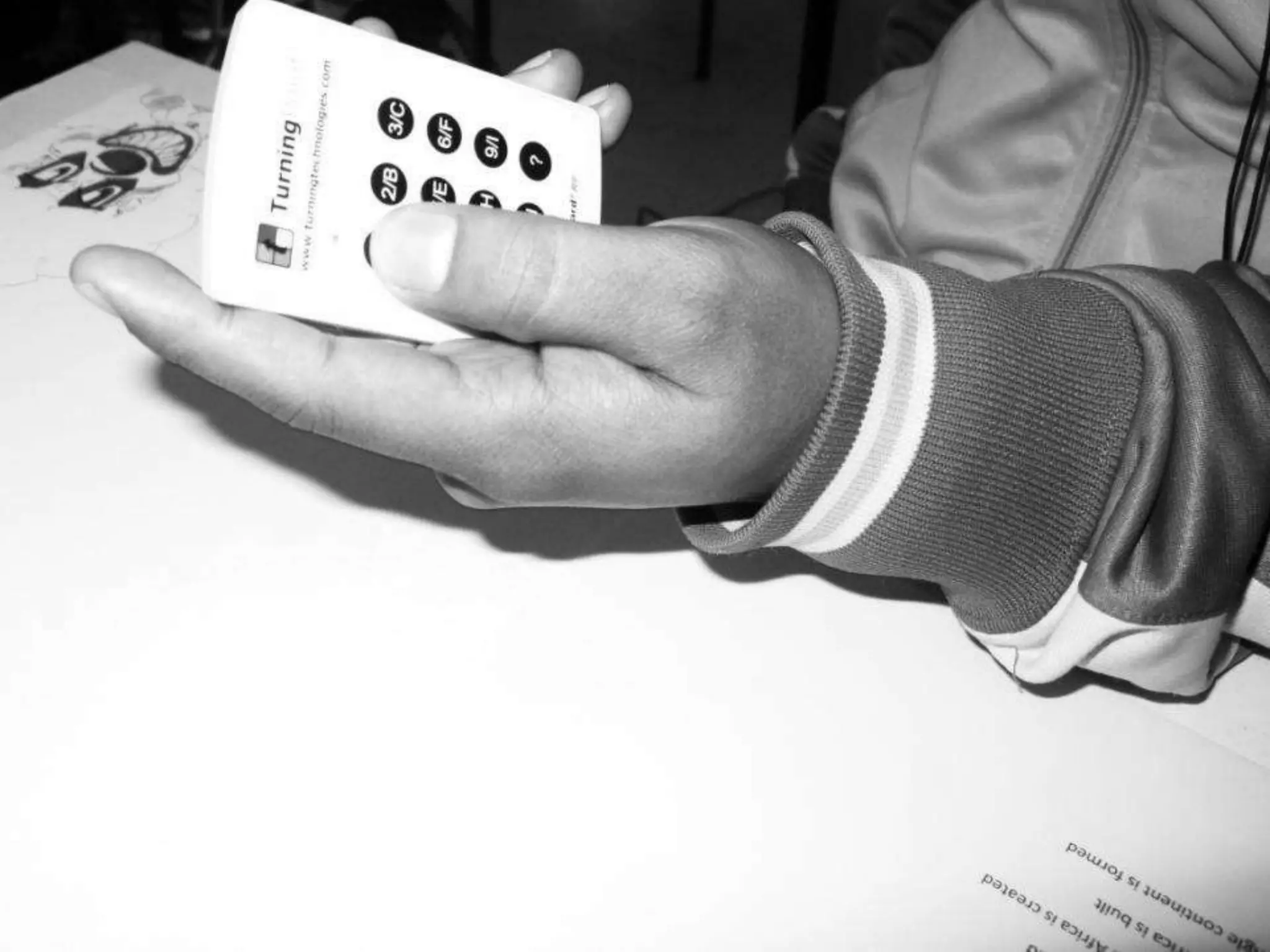
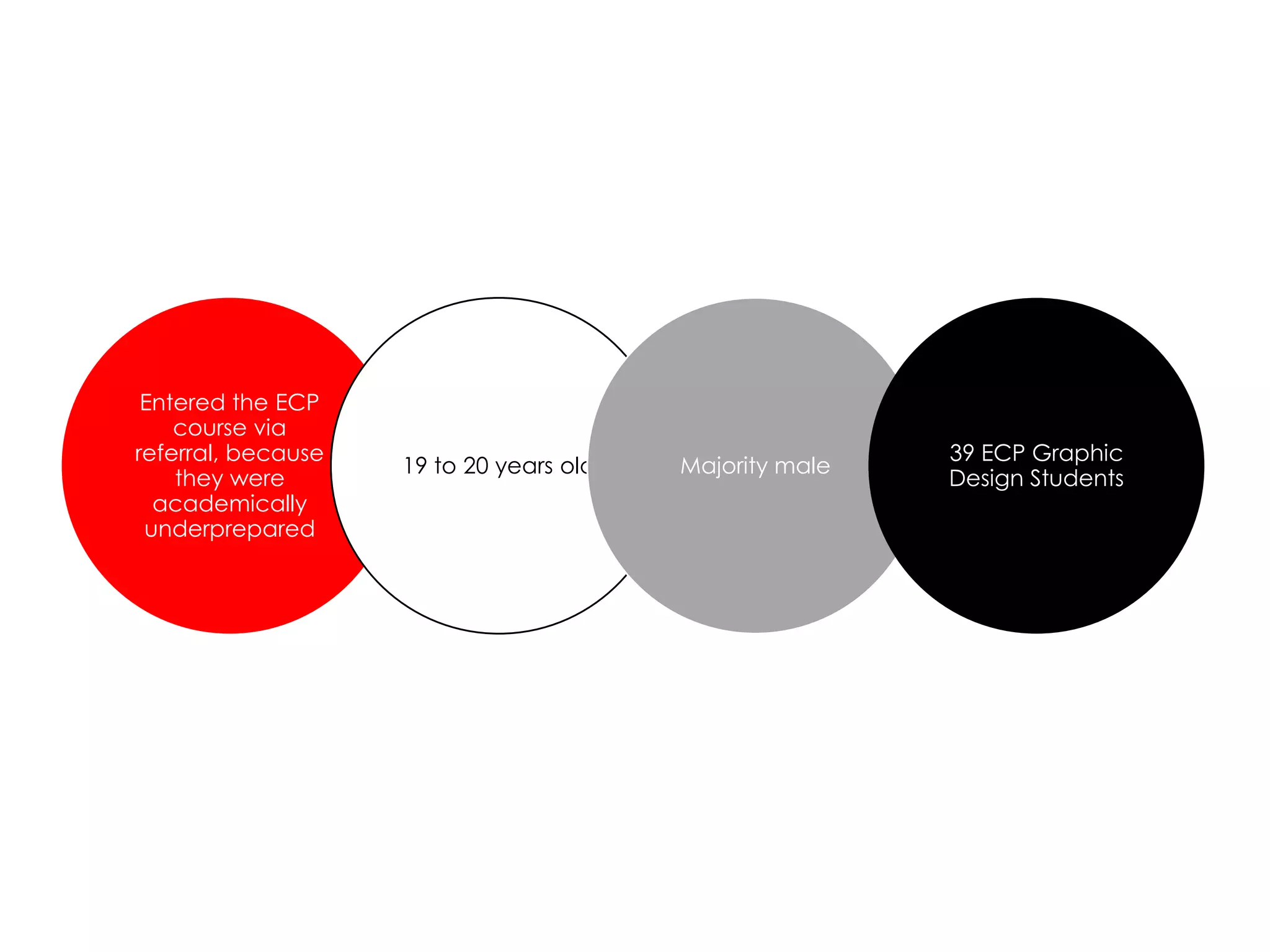
CPUT invested in 100 clickers at the end of 2009 for use in the Extended Curriculum Programme (ECP).ECP allows lecturers more time to develop interactive approaches to teaching and learning
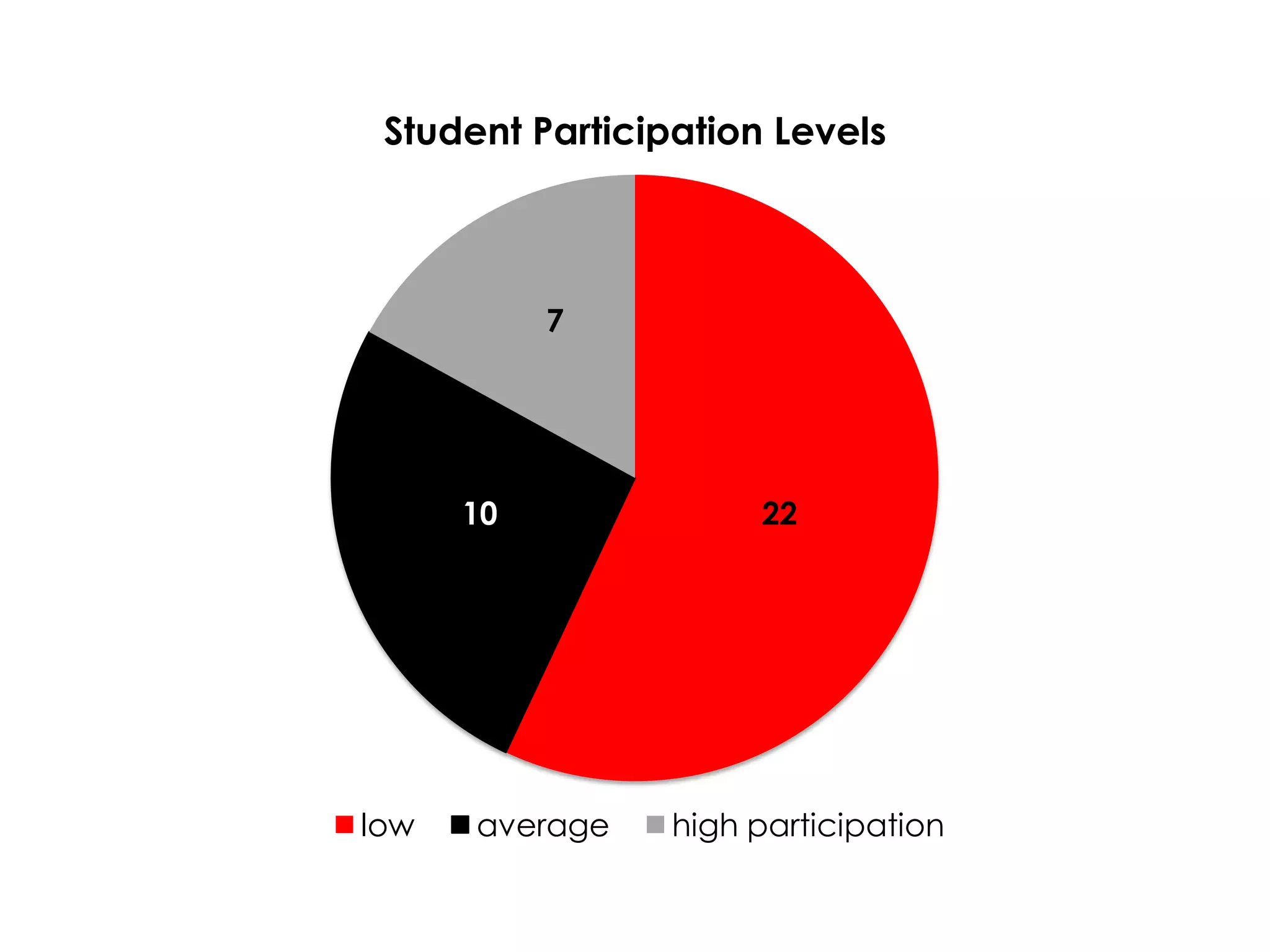
A main challenge in the ECP Graphic Design course is the lack of student participation & engagement in class discussions
71022
Student engagement is the single best predictor of a student’s learning and personal development (Kuh, 2009)
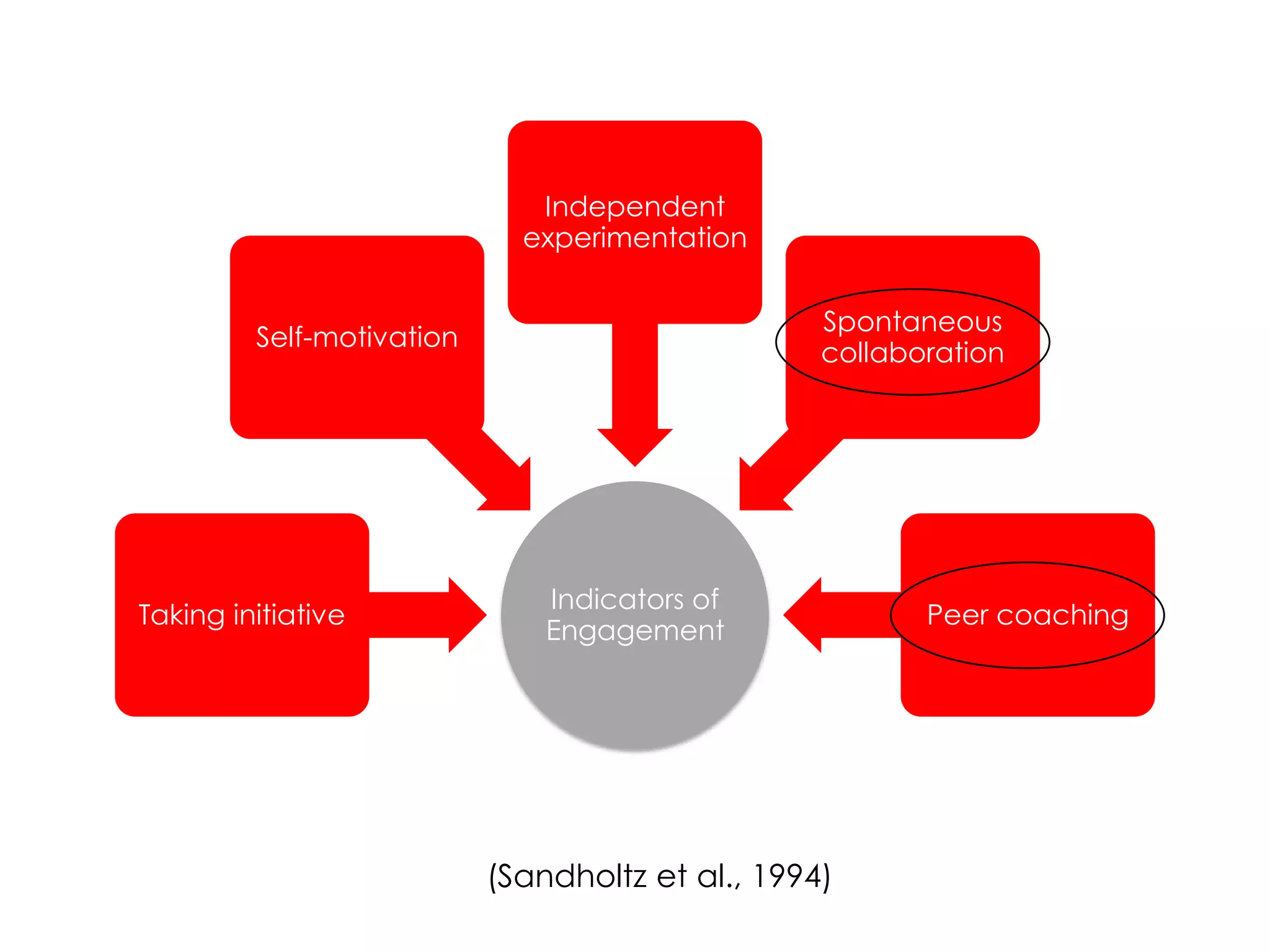
(Sandholtz et al., 1994)
Literature
Clickers & EngagementStudies link student engagement,improved attention and focus to clickers. Improved attendance, enjoyment and fun experienced inlectures are also attributed to clickers(Addison, Wright, & Milner, 2009; Preszler et al., 2007;Stagg & Lane, 2010; Trees & Jackson, 2007)
Clickers & ParticipationThey offer students an opportunity to participate in class without “fear of ridicule, should they volunteer an incorrect response” (Banks, 2006)
Clickers & ParticipationSecond language learners often struggle to participate in class because of cultural factors inhibiting active participation, such as lack of competency in the language of instruction (Stagg & Lane, 2010)
Small Classes“very little attention has been paid to the impact of clickers in small classes”(Walker & Barwell, 2009:3)
Clickers & EngagementIn smaller classes, clickers’ main benefit lies in “collaborative learning [amongst students] rather than the knowledge transfer from teacher to learner(Walker & Barwell, 2009)
Clickers & Peer LearningMazur (1997) is one of the main proponents of using clickers for peer learning, which can help normally struggling students to improve in examinations.
Context
During 2010 three clicker interventionswere designed and implementedThe interventions encouraged discussion through non factual questions and peer voting
Data Collection
Findings
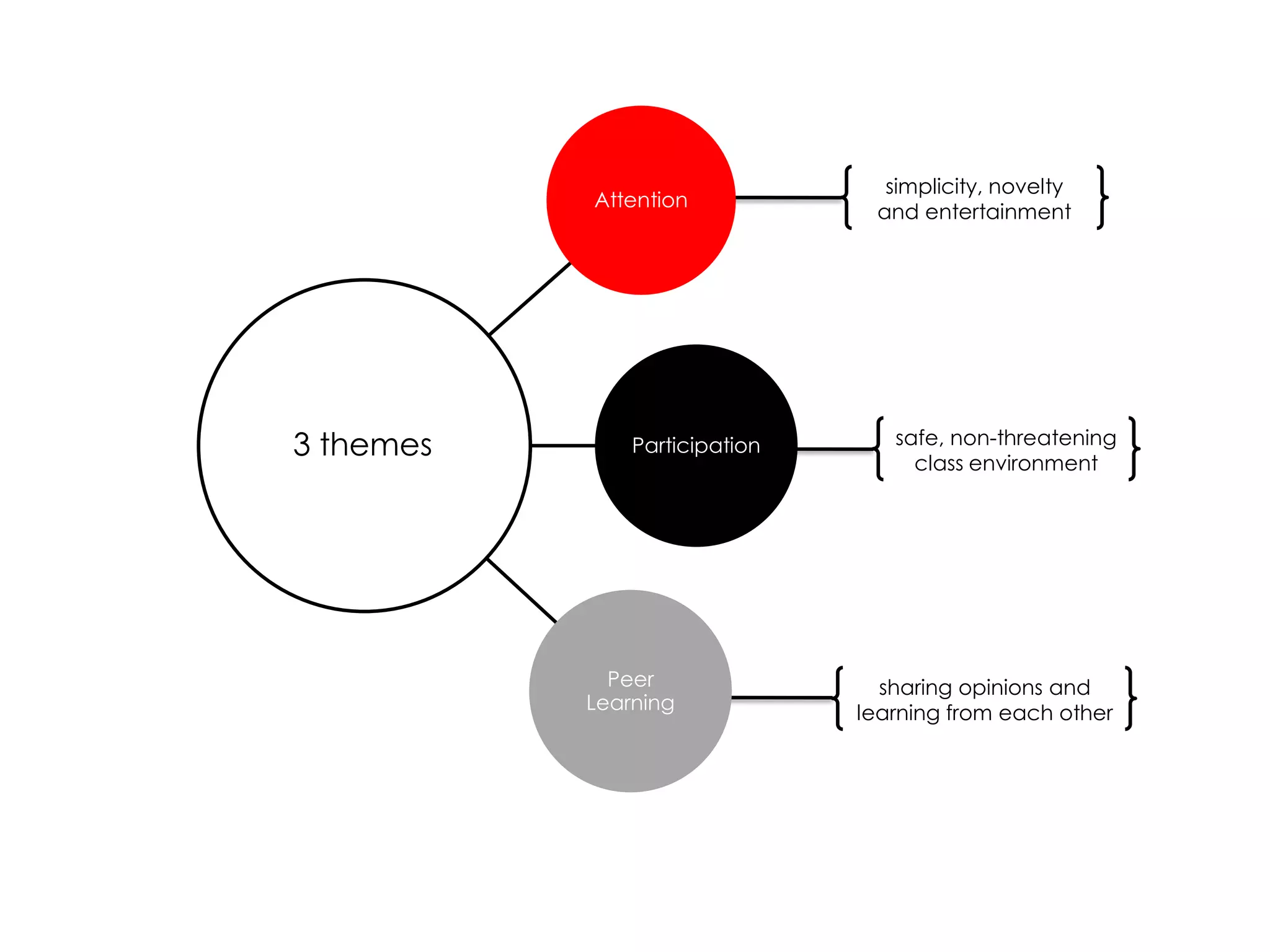
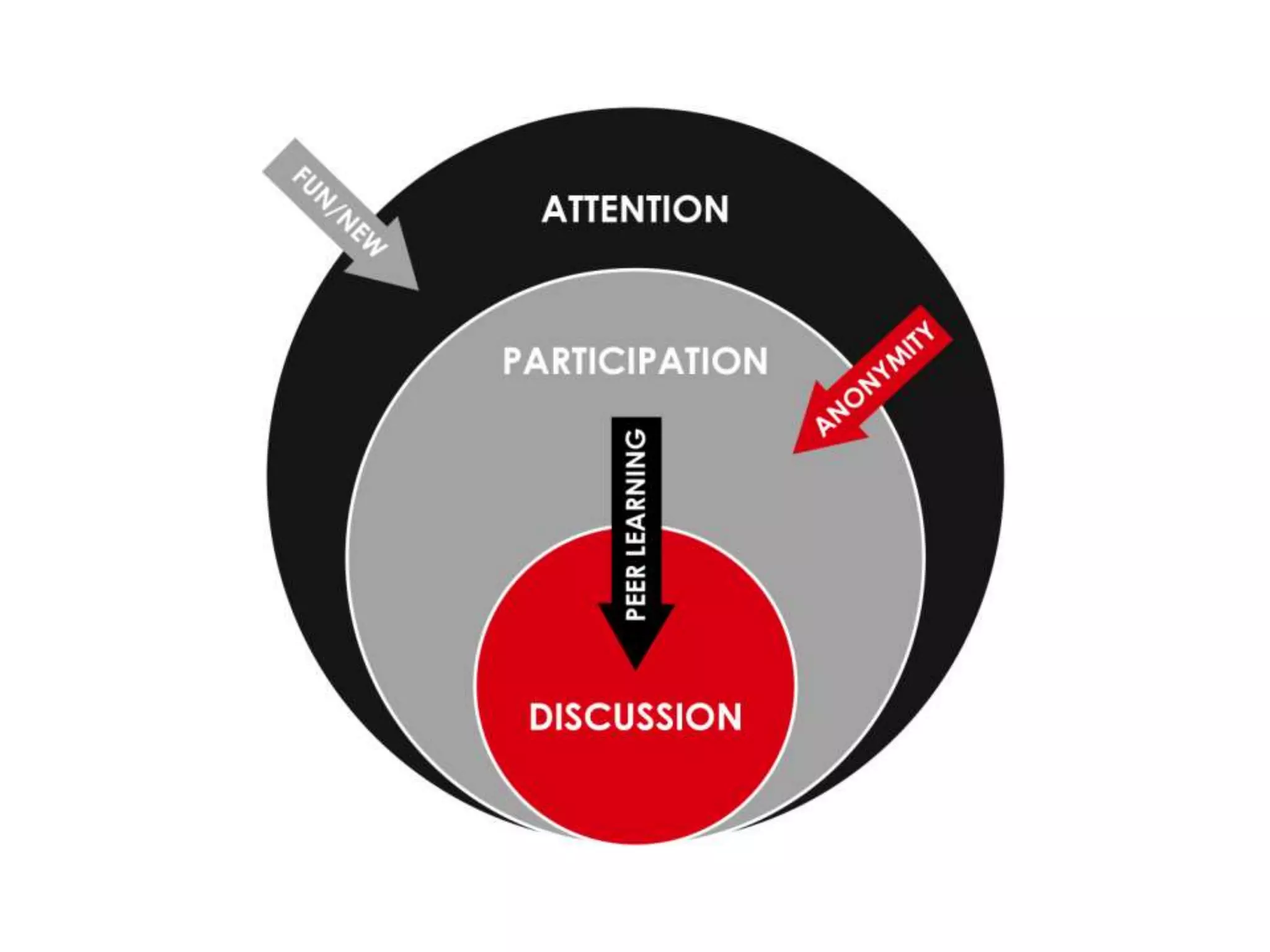
simplicity, novelty and entertainment 3 themessafe, non-threatening class environment sharing opinions and learning from each other
Attention
I enjoyed myself during the clicker class.People get kind of involved in the process.No one left the class bored or tired [but] happy and comfortable.After the questions were all done, I wanted more!Simplicity, novelty and entertainment (Kay & Lesage, 2009)
I find it to be very innovative,exciting and it grabs my attentionYou have to refresh your mind and think about what you are going to answer ... it keeps our minds think[ing] all the time.
Participation
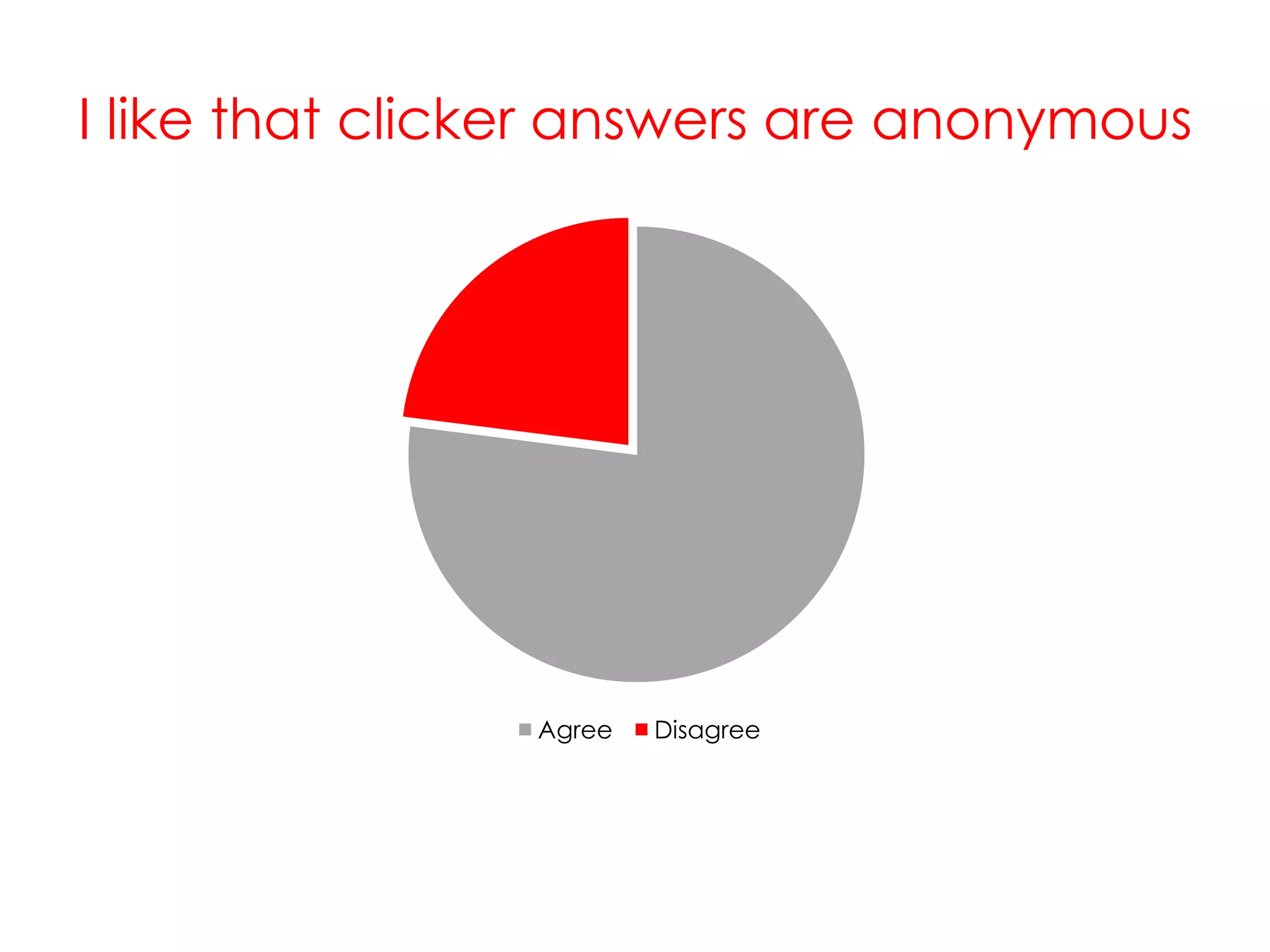
Staying anonymous [is good]: people are unsure of their answers or they’re too embarrassed to say their answers or they’re scared that some people might think of them differently, if they say something wrong.Corresponding to other findings in the literature (Simpson & Oliver, 2007) the anonymity that clickers offer decreased fear
…feel free to talk with your own language ... then you can have a reason. Because you’re not that perfect in English. That’s why you feel so scared. But I have a reason in isiXhosa, but I don’t know how to say it in English. Stagg and Lane (2010)
I like that clicker answers are anonymous
Peer Learning
You hear other people’s opinions and then you can weigh it up with your own ... and with that you can formulate a better answer.You hear different explanations from other people about the things that you don’t even know about.
The more people speak out their ideas, the more I think on adding to what they have said.It helps widening the thinking and helps the flow of thinking juice.
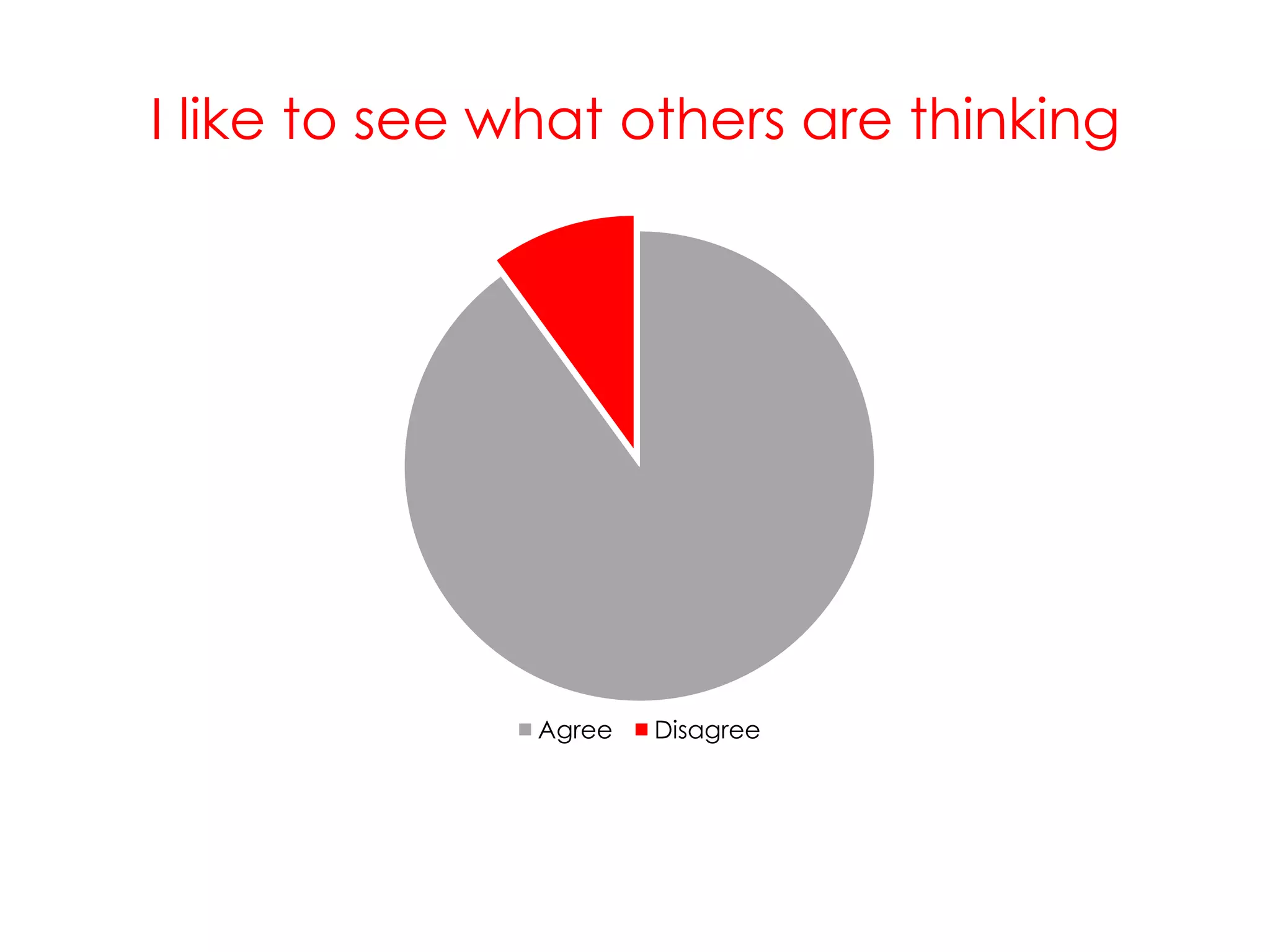
I like to see what others are thinking
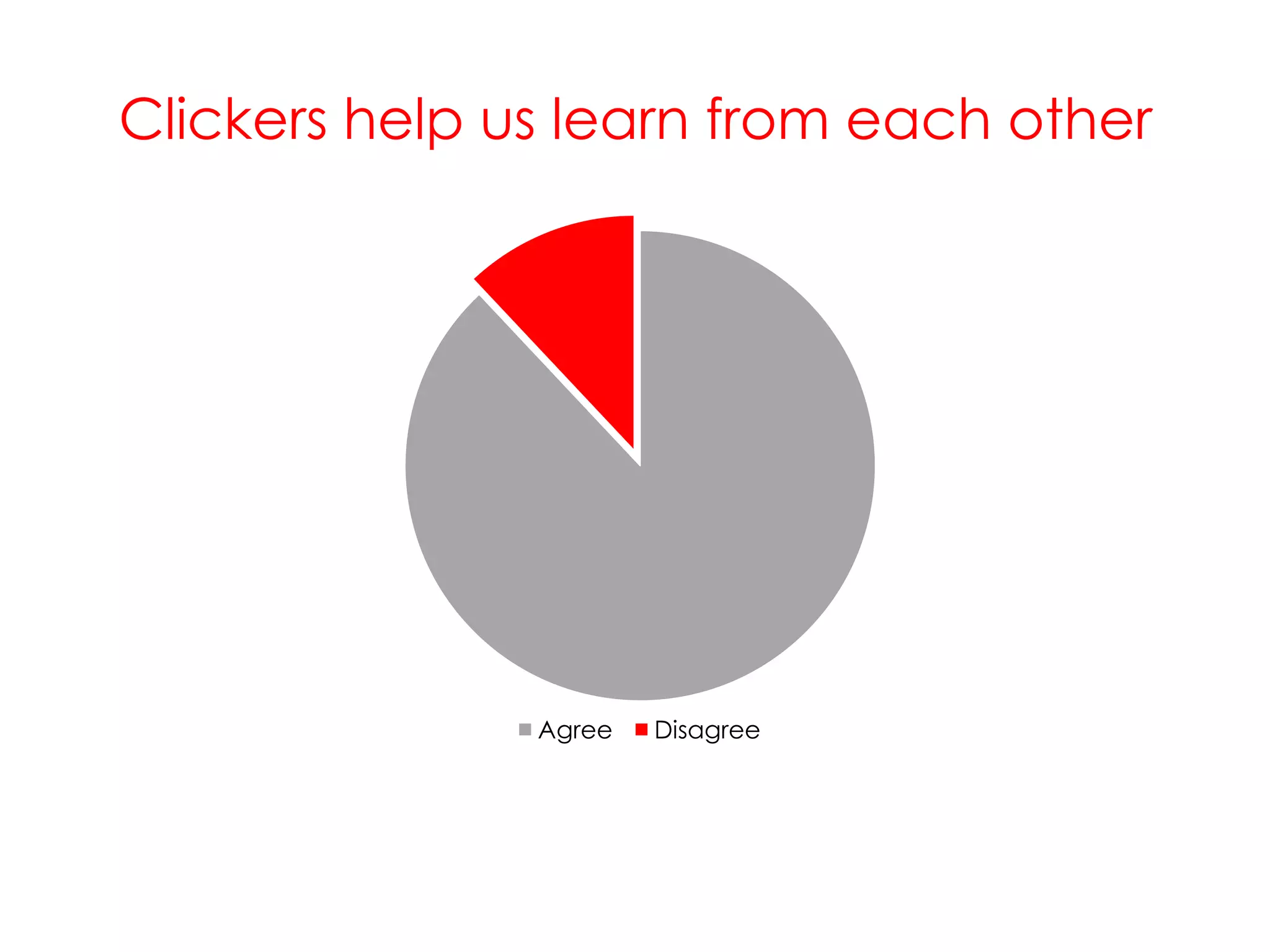
Clickers help us learn from each other
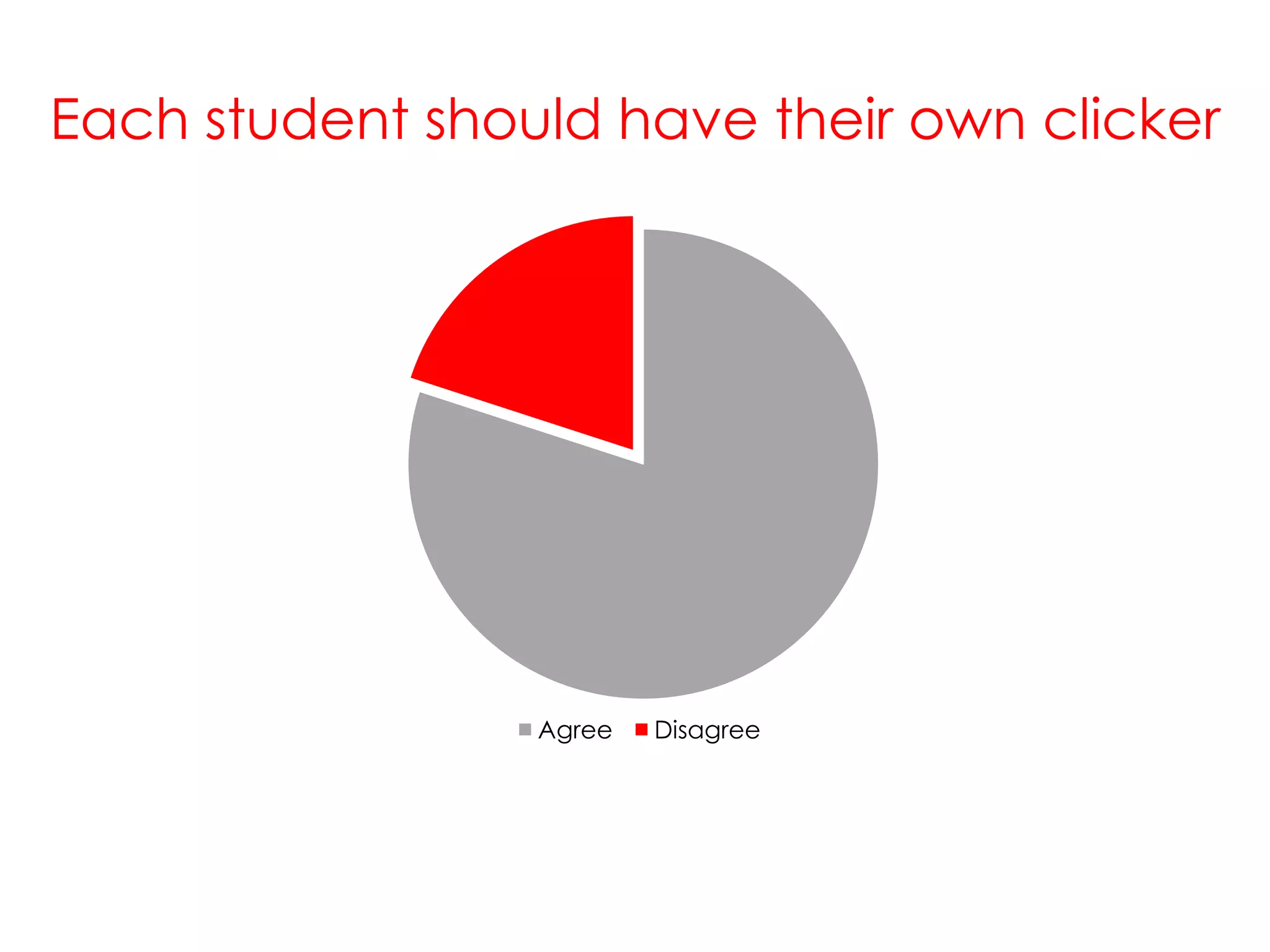
Each student should have their own clicker
Conclusion
Even if the process of collaborative decision-making necessitated through peer-voting is not always a comfortable experience for students, the development of this skill is crucial for future graphic designers.
The findings strengthen our view, that collaborative learning, rather than knowledge transfer from teacher to learner, should be emphasised in small clicker classes.
Question
Thank You
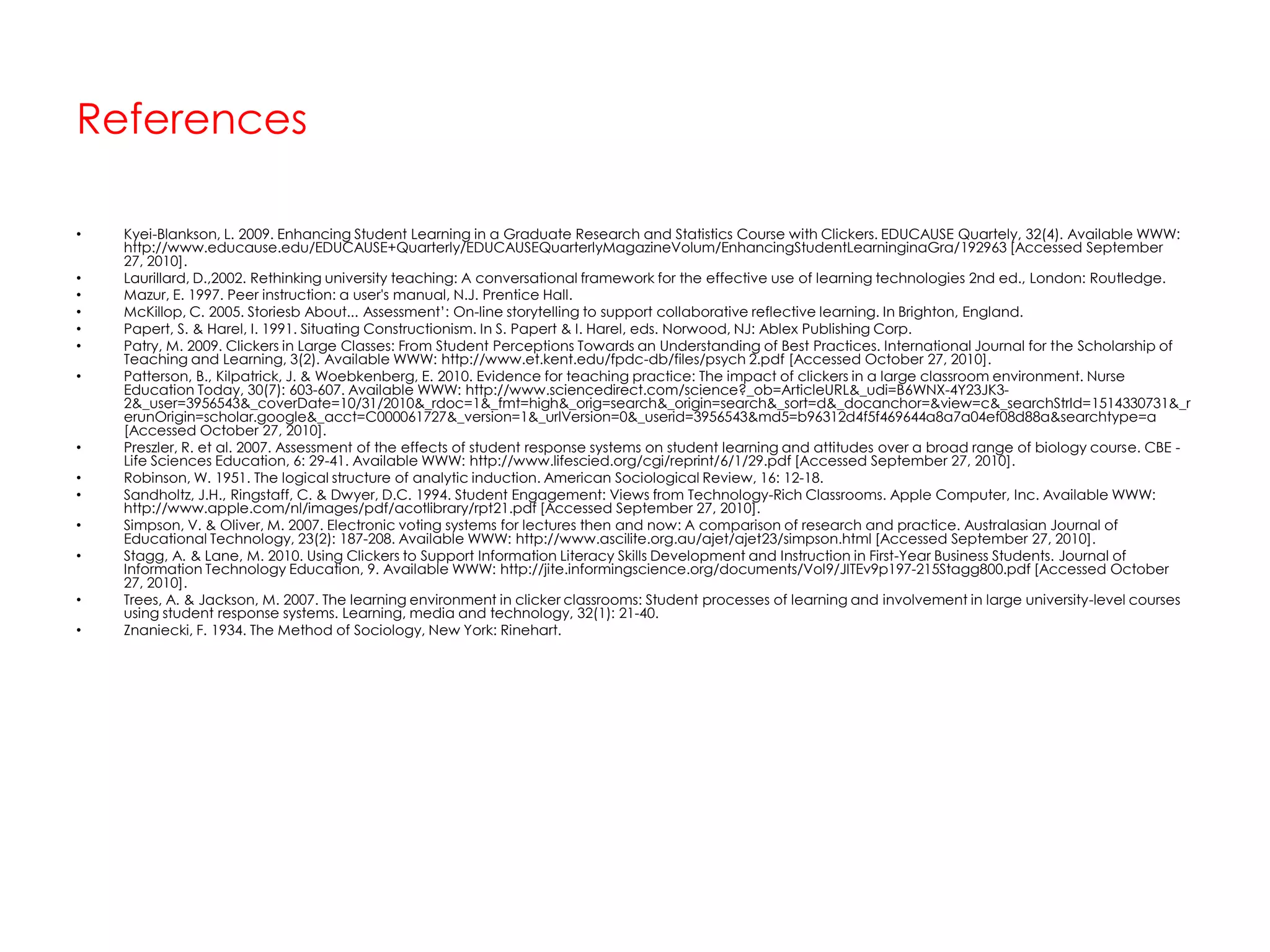
ReferencesAddison, S., Wright, A. & Milner, R. 2009. Using clickers to improve student engagement and performance in an introductory biochemistry class. Biochemistry and Molecular Biology Education, 37(2): 84–91. Available WWW: http://onlinelibrary.wiley.com/doi/10.1002/bmb.20264/full [Accessed April 15, 2011].
Astin, A. 1987. Achieving educational excellence. San Francisco: Jossey-Bass.
Astin, A. 1984. Student involvement: A development theory for higher education. Journal of College Student Personnel, 25: 297-308.

Helping the flow of the thinking juice - student engagement in a Graphic Design clicker class

  • 3.
  • 4.
    CPUT invested in100 clickers at the end of 2009 for use in the Extended Curriculum Programme (ECP).ECP allows lecturers more time to develop interactive approaches to teaching and learning
  • 6.
    A main challengein the ECP Graphic Design course is the lack of student participation & engagement in class discussions
  • 7.
  • 8.
    Student engagement isthe single best predictor of a student’s learning and personal development (Kuh, 2009)
  • 9.
  • 10.
  • 11.
    Clickers & EngagementStudieslink student engagement,improved attention and focus to clickers. Improved attendance, enjoyment and fun experienced inlectures are also attributed to clickers(Addison, Wright, & Milner, 2009; Preszler et al., 2007;Stagg & Lane, 2010; Trees & Jackson, 2007)
  • 12.
    Clickers & ParticipationTheyoffer students an opportunity to participate in class without “fear of ridicule, should they volunteer an incorrect response” (Banks, 2006)
  • 13.
    Clickers & ParticipationSecondlanguage learners often struggle to participate in class because of cultural factors inhibiting active participation, such as lack of competency in the language of instruction (Stagg & Lane, 2010)
  • 14.
    Small Classes“very littleattention has been paid to the impact of clickers in small classes”(Walker & Barwell, 2009:3)
  • 15.
    Clickers & EngagementInsmaller classes, clickers’ main benefit lies in “collaborative learning [amongst students] rather than the knowledge transfer from teacher to learner(Walker & Barwell, 2009)
  • 16.
    Clickers & PeerLearningMazur (1997) is one of the main proponents of using clickers for peer learning, which can help normally struggling students to improve in examinations.
  • 17.
  • 19.
    During 2010 threeclicker interventionswere designed and implementedThe interventions encouraged discussion through non factual questions and peer voting
  • 20.
  • 22.
  • 23.
    simplicity, novelty andentertainment 3 themessafe, non-threatening class environment sharing opinions and learning from each other
  • 24.
  • 25.
    I enjoyed myselfduring the clicker class.People get kind of involved in the process.No one left the class bored or tired [but] happy and comfortable.After the questions were all done, I wanted more!Simplicity, novelty and entertainment (Kay & Lesage, 2009)
  • 26.
    I find itto be very innovative,exciting and it grabs my attentionYou have to refresh your mind and think about what you are going to answer ... it keeps our minds think[ing] all the time.
  • 27.
  • 28.
    Staying anonymous [isgood]: people are unsure of their answers or they’re too embarrassed to say their answers or they’re scared that some people might think of them differently, if they say something wrong.Corresponding to other findings in the literature (Simpson & Oliver, 2007) the anonymity that clickers offer decreased fear
  • 29.
    …feel free totalk with your own language ... then you can have a reason. Because you’re not that perfect in English. That’s why you feel so scared. But I have a reason in isiXhosa, but I don’t know how to say it in English. Stagg and Lane (2010)
  • 30.
    I like thatclicker answers are anonymous
  • 31.
  • 32.
    You hear otherpeople’s opinions and then you can weigh it up with your own ... and with that you can formulate a better answer.You hear different explanations from other people about the things that you don’t even know about.
  • 33.
    The more peoplespeak out their ideas, the more I think on adding to what they have said.It helps widening the thinking and helps the flow of thinking juice.
  • 34.
    I like tosee what others are thinking
  • 35.
    Clickers help uslearn from each other
  • 36.
    Each student shouldhave their own clicker
  • 37.
  • 39.
    Even if theprocess of collaborative decision-making necessitated through peer-voting is not always a comfortable experience for students, the development of this skill is crucial for future graphic designers.
  • 40.
    The findings strengthenour view, that collaborative learning, rather than knowledge transfer from teacher to learner, should be emphasised in small clicker classes.
  • 41.
  • 42.
  • 43.
    ReferencesAddison, S., Wright,A. & Milner, R. 2009. Using clickers to improve student engagement and performance in an introductory biochemistry class. Biochemistry and Molecular Biology Education, 37(2): 84–91. Available WWW: http://onlinelibrary.wiley.com/doi/10.1002/bmb.20264/full [Accessed April 15, 2011].
  • 44.
    Astin, A. 1987.Achieving educational excellence. San Francisco: Jossey-Bass.
  • 45.
    Astin, A. 1984.Student involvement: A development theory for higher education. Journal of College Student Personnel, 25: 297-308.
  • 46.
    Astin, A. 1999.Student involvement: A developmental theory for higher education. Journal of College Student Development, 40(5), pp.518-529. Available WWW: http://www.middlesex.mass.edu/TutoringServices/AstinInvolvement.pdf [Accessed September 27, 2010].
  • 47.
    Banks, D.A. 2006.Preface. In D. A. Banks, ed. Hershey PA: Idea Group Inc: vii-xv.
  • 48.
    Caldwell, J.E. 2007.Clickers in the large classroom: Current research and best-practice tips. CBE -Life Sciences Education, 6(1): 9-20. Available WWW: http://www.lifescied.org/cgi/content/abstract/6/1/9 [Accessed September 27, 2010].
  • 49.
    Crouch, C.H. &Mazur, E. 2001. Peer instruction: ten years of experience and results. American Journal of Physics, 69: 970-977.
  • 50.
    D'Inverno, R., Davis,H. & White, S. 2003. Using a personal response system for promoting student interaction. Teaching Mathematics and its Applications, 22(4): 163-169. Available WWW: http://teamat.oupjournals.org/cgi/doi/10.1093/teamat/22.4.163. [Accessed October 6, 2010].
  • 51.
    Davies, C. 1996.Assessment and transferable skills in art and design. Assessment and transferable skills in art and design, 3: 327-331.
  • 52.
    Draper, S. &Brown, M.I. 2004. Increasing interactivity in lectures using an electronic voting system. Journal of Computer Assisted Learning, 20(2): 81-94. Available WWW: http://onlinelibrary.wiley.com/doi/10.1111/j.1365-2729.2004.00074.x/pdf [Accessed October 6, 2010].
  • 53.
    Draper, S., Cargill,J. & Cutts, Q. 2002. Electronically enhanced classroom interaction. Australasian Journal of Educational Technology, 18(1): 13-23. Available WWW: http://www.dcs.gla.ac.uk/~quintin/papers/AJET2002.pdf [Accessed September 27, 2010].
  • 54.
    Fies, C. &Marshall, J. 2006. Classroom response systems: a review of the literature. Journal of Science Education and Technology, 15(1): 101-109.
  • 55.
    Graham, C.R. etal. 2007. Empowering or compelling reluctant participators using audience response systems. Active Learning in Higher Education, 8: 233-258. Available WWW: http://alh.sagepub.com/content/8/3/233.abstract [Accessed September 27, 2010].
  • 56.
    Hu, J. etal. 2006. Wireless Interactive Teaching. In D. A. Banks, ed. Hershey PA: Idea Group Inc, pp. 209-221.
  • 57.
    Hull, G.A. etal. 2006. Many versions of masculine, Available WWW: http://www.uclinks.org/reference/research/Hulletal.Masculinitypaper.pdf [Accessed January 21, 2011].
  • 58.
    Kay, R.H. &LeSage, A. 2009. Examining the benefits and challenges of using audience response systems: A review of the literature. Computers & Education, 53: 819-827.
  • 59.
    Kuh, G.D. 2009.The National Survey of Student Engagement: Conceptual and Empirical Foundations. New Directions for Institutional Research, (141). Available WWW: http://onlinelibrary.wiley.com/doi/10.1002/ir.283/pdf [Accessed September 27, 2009].ReferencesKyei-Blankson, L. 2009. Enhancing Student Learning in a Graduate Research and Statistics Course with Clickers. EDUCAUSE Quartely, 32(4). Available WWW: http://www.educause.edu/EDUCAUSE+Quarterly/EDUCAUSEQuarterlyMagazineVolum/EnhancingStudentLearninginaGra/192963 [Accessed September 27, 2010].
  • 60.
    Laurillard, D.,2002. Rethinkinguniversity teaching: A conversational framework for the effective use of learning technologies 2nd ed., London: Routledge.
  • 61.
    Mazur, E. 1997.Peer instruction: a user's manual, N.J. Prentice Hall.
  • 62.
    McKillop, C. 2005.Storiesb About... Assessment’: On-line storytelling to support collaborative reflective learning. In Brighton, England.
  • 63.
    Papert, S. &Harel, I. 1991. Situating Constructionism. In S. Papert & I. Harel, eds. Norwood, NJ: Ablex Publishing Corp.
  • 64.
    Patry, M. 2009.Clickers in Large Classes: From Student Perceptions Towards an Understanding of Best Practices. International Journal for the Scholarship of Teaching and Learning, 3(2). Available WWW: http://www.et.kent.edu/fpdc-db/files/psych 2.pdf [Accessed October 27, 2010].
  • 65.
    Patterson, B., Kilpatrick,J. & Woebkenberg, E. 2010. Evidence for teaching practice: The impact of clickers in a large classroom environment. Nurse Education Today, 30(7): 603-607. Available WWW: http://www.sciencedirect.com/science?_ob=ArticleURL&_udi=B6WNX-4Y23JK3-2&_user=3956543&_coverDate=10/31/2010&_rdoc=1&_fmt=high&_orig=search&_origin=search&_sort=d&_docanchor=&view=c&_searchStrId=1514330731&_rerunOrigin=scholar.google&_acct=C000061727&_version=1&_urlVersion=0&_userid=3956543&md5=b96312d4f5f469644a8a7a04ef08d88a&searchtype=a [Accessed October 27, 2010].
  • 66.
    Preszler, R. etal. 2007. Assessment of the effects of student response systems on student learning and attitudes over a broad range of biology course. CBE -Life Sciences Education, 6: 29-41. Available WWW: http://www.lifescied.org/cgi/reprint/6/1/29.pdf [Accessed September 27, 2010].
  • 67.
    Robinson, W. 1951.The logical structure of analytic induction. American Sociological Review, 16: 12-18.
  • 68.
    Sandholtz, J.H., Ringstaff,C. & Dwyer, D.C. 1994. Student Engagement: Views from Technology-Rich Classrooms. Apple Computer, Inc. Available WWW: http://www.apple.com/nl/images/pdf/acotlibrary/rpt21.pdf [Accessed September 27, 2010].
  • 69.
    Simpson, V. &Oliver, M. 2007. Electronic voting systems for lectures then and now: A comparison of research and practice. Australasian Journal of Educational Technology, 23(2): 187-208. Available WWW: http://www.ascilite.org.au/ajet/ajet23/simpson.html [Accessed September 27, 2010].
  • 70.
    Stagg, A. &Lane, M. 2010. Using Clickers to Support Information Literacy Skills Development and Instruction in First-Year Business Students. Journal of Information Technology Education, 9. Available WWW: http://jite.informingscience.org/documents/Vol9/JITEv9p197-215Stagg800.pdf [Accessed October 27, 2010].
  • 71.
    Trees, A. &Jackson, M. 2007. The learning environment in clicker classrooms: Student processes of learning and involvement in large university-level courses using student response systems. Learning, media and technology, 32(1): 21-40.
  • 72.
    Znaniecki, F. 1934.The Method of Sociology, New York: Rinehart.gachagod@cput.ac.zamorrisa@cput.ac.zasimone@cput.ac.za