LOVE
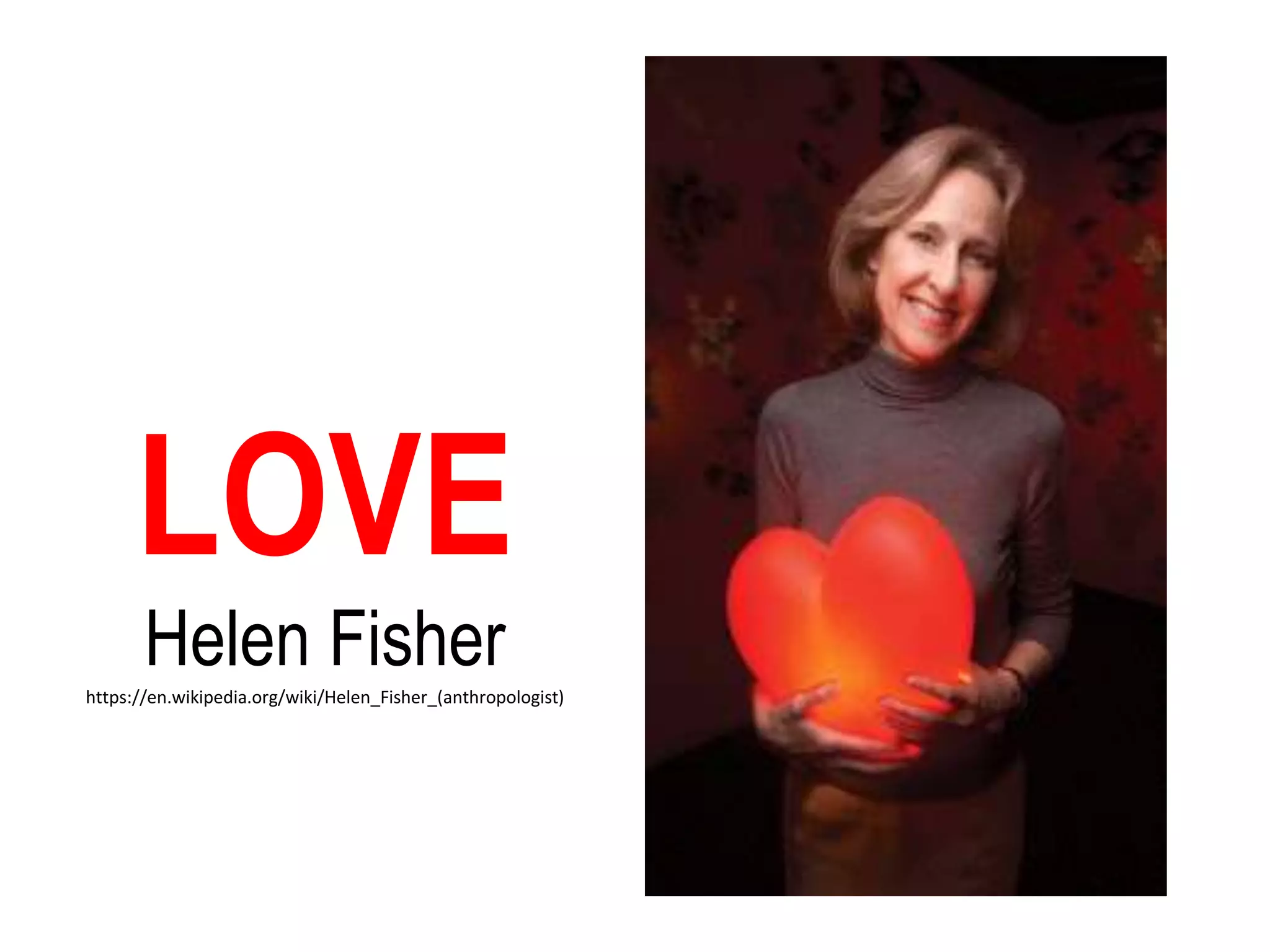
Helen Fisherhttps://en.wikipedia.org/wiki/Helen_Fisher_(anthropologist)
• Helen E. Fisher is an American anthropologist,
human behavior researcher, and self-help
author. She is a biological anthropologist, is a
Senior Research Fellow, at The Kinsey
Institute, Indiana University, and a Member of
the Center For Human Evolutionary Studies in
the Department of Anthropology at Rutgers
University.
In her book, Why We Love: The Nature and Chemistry of
Romantic Love, Fisher proposed that humanity has
evolved three core brain systems for mating and
reproduction:
lust – the sex drive or libido, also described as borogodó.
attraction – early stage intense romantic love.
attachment – deep feelings of union with a long term
partner.
Love can start with any of these three feelings, Fisher
maintains. Some people have sex with someone new and
then fall in love. Some fall in love first, then have sex.
Some feel a deep feeling of attachment to another, which
then turns into romance and the sex drive. But the sex
drive evolved to initiate mating with a range of partners;
romantic love evolved to focus one's mating energy on
one partner at a time; and attachment evolved to enable
us to form a pair bond and rear young together as a team.
Fisher discusses many of the feelings of intense
romantic love, saying it begins as the beloved
takes on "special meaning." Then you focus
intensely on him or her. People can list the things
they dislike about a sweetheart, but they sweep
these things aside and focus on what they adore.
Intense energy, elation, mood swings, emotional
dependence, separation anxiety, possessiveness,
physical reactions including a pounding heart and
shortness of breath, and craving, Fisher reports,
are all central to this feeling. But most important
is obsessive thinking. As Fisher says, "Someone is
camping in your head."
Fisher and her colleagues studied the brain
circuitry of romantic love by fMRI-scanning the
brains of forty-nine men and women: seventeen
who had just fallen madly in love, fifteen who
had just been dumped, and seventeen who
reported that they were still in love after an
average of twenty-one years of marriage. One of
her central ideas is that romantic love is a drive
that is stronger than the sex drive. As she has
said, "After all, if you casually ask someone to go
to bed with you and they refuse, you don't slip
into a depression, commit suicide or homicide --
but around the world people suffer terribly from
romantic rejection."
Fisher also maintains that taking certain antidepressants can potentially
dampen feelings of romantic love and attachment (as well as sex drive).
From the brain scans of people who had just fallen madly in love, Fisher's
2004 book discusses differences between male and female brains.On
average, men tended to show more activity in a brain region associated with
the integration of visual stimuli, while women showed more activity in
several brain regions linked with memory recall. Fisher hypothesizes that
these differences stem from differing evolutionary forces governing mate
choice. In prehistory (and today), a male was obliged to size up a potential
female partner visually to ensure that she is healthy and age-appropriate to
bear and rear their potential progeny. But a female could not know from a
male's appearance whether he would be a good husband and father; she
had to remember his past behaviors, achievements and misadventures--
memories which could help her select an effective husband and father for
her forthcoming young.
In 2006, her MRI research, which showed that the ventral tegmental
area and the caudate nucleus become active when people are in love, was
featured in the National Geographic cover-page article, "Love – the
Chemical Reaction".[11]
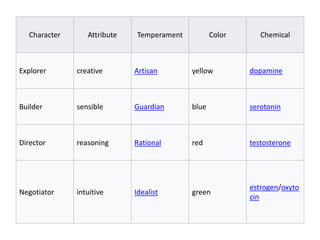
Fisher distinguishes between four broad biologically based styles of thinking
and behaving which she associates with four broad neurochemical systems.
Fisher emphasizes that these are not “types” and that we are all a unique
combination of all of them.
Character Attribute Temperament Color Chemical
Explorer creative Artisan yellow dopamine
Builder sensible Guardian blue serotonin
Director reasoning Rational red testosterone
Negotiator intuitive Idealist green
estrogen/oxyto
cin
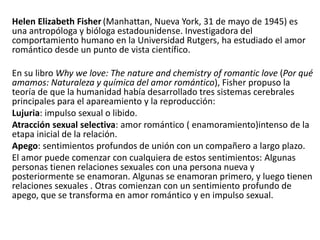
Helen Elizabeth Fisher (Manhattan, Nueva York, 31 de mayo de 1945) es
una antropóloga y bióloga estadounidense. Investigadora del
comportamiento humano en la Universidad Rutgers, ha estudiado el amor
romántico desde un punto de vista científico.
En su libro Why we love: The nature and chemistry of romantic love (Por qué
amamos: Naturaleza y química del amor romántico), Fisher propuso la
teoría de que la humanidad había desarrollado tres sistemas cerebrales
principales para el apareamiento y la reproducción:
Lujuria: impulso sexual o libido.
Atracción sexual selectiva: amor romántico ( enamoramiento)intenso de la
etapa inicial de la relación.
Apego: sentimientos profundos de unión con un compañero a largo plazo.
El amor puede comenzar con cualquiera de estos sentimientos: Algunas
personas tienen relaciones sexuales con una persona nueva y
posteriormente se enamoran. Algunas se enamoran primero, y luego tienen
relaciones sexuales . Otras comienzan con un sentimiento profundo de
apego, que se transforma en amor romántico y en impulso sexual.
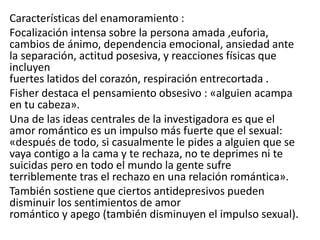
Características del enamoramiento :
Focalización intensa sobre la persona amada ,euforia,
cambios de ánimo, dependencia emocional, ansiedad ante
la separación, actitud posesiva, y reacciones físicas que
incluyen
fuertes latidos del corazón, respiración entrecortada .
Fisher destaca el pensamiento obsesivo : «alguien acampa
en tu cabeza».
Una de las ideas centrales de la investigadora es que el
amor romántico es un impulso más fuerte que el sexual:
«después de todo, si casualmente le pides a alguien que se
vaya contigo a la cama y te rechaza, no te deprimes ni te
suicidas pero en todo el mundo la gente sufre
terriblemente tras el rechazo en una relación romántica».
También sostiene que ciertos antidepresivos pueden
disminuir los sentimientos de amor
romántico y apego (también disminuyen el impulso sexual).
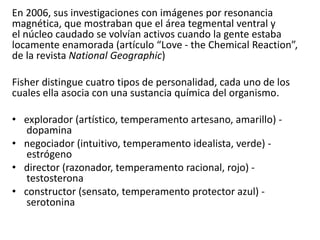
En 2006, sus investigaciones con imágenes por resonancia
magnética, que mostraban que el área tegmental ventral y
el núcleo caudado se volvían activos cuando la gente estaba
locamente enamorada (artículo “Love - the Chemical Reaction”,
de la revista National Geographic)
Fisher distingue cuatro tipos de personalidad, cada uno de los
cuales ella asocia con una sustancia química del organismo.
• explorador (artístico, temperamento artesano, amarillo) -
dopamina
• negociador (intuitivo, temperamento idealista, verde) -
estrógeno
• director (razonador, temperamento racional, rojo) -
testosterona
• constructor (sensato, temperamento protector azul) -
serotonina

Hellen fisher

  • 1.
  • 2.
    • Helen E.Fisher is an American anthropologist, human behavior researcher, and self-help author. She is a biological anthropologist, is a Senior Research Fellow, at The Kinsey Institute, Indiana University, and a Member of the Center For Human Evolutionary Studies in the Department of Anthropology at Rutgers University.
  • 3.
    In her book,Why We Love: The Nature and Chemistry of Romantic Love, Fisher proposed that humanity has evolved three core brain systems for mating and reproduction: lust – the sex drive or libido, also described as borogodó. attraction – early stage intense romantic love. attachment – deep feelings of union with a long term partner. Love can start with any of these three feelings, Fisher maintains. Some people have sex with someone new and then fall in love. Some fall in love first, then have sex. Some feel a deep feeling of attachment to another, which then turns into romance and the sex drive. But the sex drive evolved to initiate mating with a range of partners; romantic love evolved to focus one's mating energy on one partner at a time; and attachment evolved to enable us to form a pair bond and rear young together as a team.
  • 4.
    Fisher discusses manyof the feelings of intense romantic love, saying it begins as the beloved takes on "special meaning." Then you focus intensely on him or her. People can list the things they dislike about a sweetheart, but they sweep these things aside and focus on what they adore. Intense energy, elation, mood swings, emotional dependence, separation anxiety, possessiveness, physical reactions including a pounding heart and shortness of breath, and craving, Fisher reports, are all central to this feeling. But most important is obsessive thinking. As Fisher says, "Someone is camping in your head."
  • 5.
    Fisher and hercolleagues studied the brain circuitry of romantic love by fMRI-scanning the brains of forty-nine men and women: seventeen who had just fallen madly in love, fifteen who had just been dumped, and seventeen who reported that they were still in love after an average of twenty-one years of marriage. One of her central ideas is that romantic love is a drive that is stronger than the sex drive. As she has said, "After all, if you casually ask someone to go to bed with you and they refuse, you don't slip into a depression, commit suicide or homicide -- but around the world people suffer terribly from romantic rejection."
  • 6.
    Fisher also maintainsthat taking certain antidepressants can potentially dampen feelings of romantic love and attachment (as well as sex drive). From the brain scans of people who had just fallen madly in love, Fisher's 2004 book discusses differences between male and female brains.On average, men tended to show more activity in a brain region associated with the integration of visual stimuli, while women showed more activity in several brain regions linked with memory recall. Fisher hypothesizes that these differences stem from differing evolutionary forces governing mate choice. In prehistory (and today), a male was obliged to size up a potential female partner visually to ensure that she is healthy and age-appropriate to bear and rear their potential progeny. But a female could not know from a male's appearance whether he would be a good husband and father; she had to remember his past behaviors, achievements and misadventures-- memories which could help her select an effective husband and father for her forthcoming young. In 2006, her MRI research, which showed that the ventral tegmental area and the caudate nucleus become active when people are in love, was featured in the National Geographic cover-page article, "Love – the Chemical Reaction".[11] Fisher distinguishes between four broad biologically based styles of thinking and behaving which she associates with four broad neurochemical systems. Fisher emphasizes that these are not “types” and that we are all a unique combination of all of them.
  • 7.
    Character Attribute TemperamentColor Chemical Explorer creative Artisan yellow dopamine Builder sensible Guardian blue serotonin Director reasoning Rational red testosterone Negotiator intuitive Idealist green estrogen/oxyto cin
  • 8.
    Helen Elizabeth Fisher(Manhattan, Nueva York, 31 de mayo de 1945) es una antropóloga y bióloga estadounidense. Investigadora del comportamiento humano en la Universidad Rutgers, ha estudiado el amor romántico desde un punto de vista científico. En su libro Why we love: The nature and chemistry of romantic love (Por qué amamos: Naturaleza y química del amor romántico), Fisher propuso la teoría de que la humanidad había desarrollado tres sistemas cerebrales principales para el apareamiento y la reproducción: Lujuria: impulso sexual o libido. Atracción sexual selectiva: amor romántico ( enamoramiento)intenso de la etapa inicial de la relación. Apego: sentimientos profundos de unión con un compañero a largo plazo. El amor puede comenzar con cualquiera de estos sentimientos: Algunas personas tienen relaciones sexuales con una persona nueva y posteriormente se enamoran. Algunas se enamoran primero, y luego tienen relaciones sexuales . Otras comienzan con un sentimiento profundo de apego, que se transforma en amor romántico y en impulso sexual.
  • 9.
    Características del enamoramiento: Focalización intensa sobre la persona amada ,euforia, cambios de ánimo, dependencia emocional, ansiedad ante la separación, actitud posesiva, y reacciones físicas que incluyen fuertes latidos del corazón, respiración entrecortada . Fisher destaca el pensamiento obsesivo : «alguien acampa en tu cabeza». Una de las ideas centrales de la investigadora es que el amor romántico es un impulso más fuerte que el sexual: «después de todo, si casualmente le pides a alguien que se vaya contigo a la cama y te rechaza, no te deprimes ni te suicidas pero en todo el mundo la gente sufre terriblemente tras el rechazo en una relación romántica». También sostiene que ciertos antidepresivos pueden disminuir los sentimientos de amor romántico y apego (también disminuyen el impulso sexual).
  • 10.
    En 2006, susinvestigaciones con imágenes por resonancia magnética, que mostraban que el área tegmental ventral y el núcleo caudado se volvían activos cuando la gente estaba locamente enamorada (artículo “Love - the Chemical Reaction”, de la revista National Geographic) Fisher distingue cuatro tipos de personalidad, cada uno de los cuales ella asocia con una sustancia química del organismo. • explorador (artístico, temperamento artesano, amarillo) - dopamina • negociador (intuitivo, temperamento idealista, verde) - estrógeno • director (razonador, temperamento racional, rojo) - testosterona • constructor (sensato, temperamento protector azul) - serotonina