ninth edition
STEPHEN P. ROBBINS
PowerPoint Presentation by Charlie Cook
The University of West Alabama
MARY COULTER
© 2007 Prentice Hall, Inc.
All rights reserved.
Decision-Making:
The Essence of
the Manager’s Job
Chapter
6
© 2007 Prentice Hall, Inc. All rights reserved. 6–2
Types of Programmed Decisions
• Policy
A general guideline for making a decision about a
structured problem.
• Procedure
A series of interrelated steps that a manager can use
to respond (applying a policy) to a structured problem.
• Rule
An explicit statement that limits what a manager or
employee can or cannot do.
© 2007 Prentice Hall, Inc. All rights reserved. 6–3
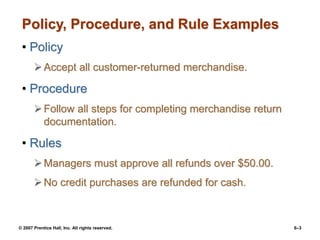
Policy, Procedure, and Rule Examples
• Policy
Accept all customer-returned merchandise.
• Procedure
Follow all steps for completing merchandise return
documentation.
• Rules
Managers must approve all refunds over $50.00.
No credit purchases are refunded for cash.
© 2007 Prentice Hall, Inc. All rights reserved. 6–4
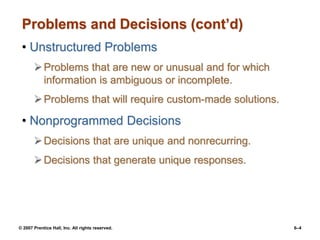
Problems and Decisions (cont’d)
• Unstructured Problems
Problems that are new or unusual and for which
information is ambiguous or incomplete.
Problems that will require custom-made solutions.
• Nonprogrammed Decisions
Decisions that are unique and nonrecurring.
Decisions that generate unique responses.
© 2007 Prentice Hall, Inc. All rights reserved. 6–5
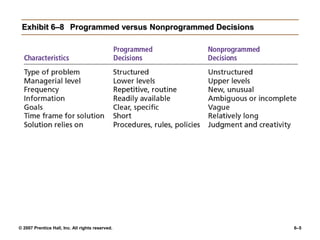
Exhibit 6–8 Programmed versus Nonprogrammed Decisions
© 2007 Prentice Hall, Inc. All rights reserved. 6–6
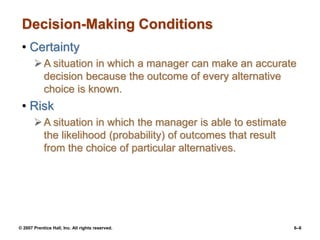
Decision-Making Conditions
• Certainty
A situation in which a manager can make an accurate
decision because the outcome of every alternative
choice is known.
• Risk
A situation in which the manager is able to estimate
the likelihood (probability) of outcomes that result
from the choice of particular alternatives.
© 2007 Prentice Hall, Inc. All rights reserved. 6–7
Exhibit 6–9 Expected Value for Revenues from
the Addition of One Ski Lift
Expected
Expected × Probability = Value of Each
Event Revenues Alternative
Heavy snowfall $850,000 0.3 = $255,000
Normal snowfall 725,000 0.5 = 362,500
Light snowfall 350,000 0.2 = 70,000
$687,500
© 2007 Prentice Hall, Inc. All rights reserved. 6–8
Decision-Making Conditions
• Uncertainty
Limited information prevents estimation of outcome
probabilities for alternatives associated with the
problem and may force managers to rely on intuition,
hunches, and “gut feelings”.
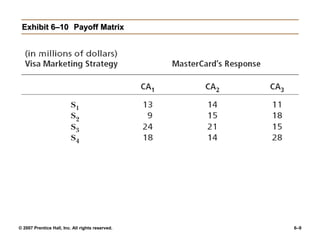
 Maximax: the optimistic manager’s choice to maximize the
maximum payoff
 Maximin: the pessimistic manager’s choice to maximize the
minimum payoff
 Minimax: the manager’s choice to minimize maximum regret.
© 2007 Prentice Hall, Inc. All rights reserved. 6–9
Exhibit 6–10 Payoff Matrix
© 2007 Prentice Hall, Inc. All rights reserved. 6–10
Exhibit 6–11 Regret Matrix
© 2007 Prentice Hall, Inc. All rights reserved. 6–11
Decision-Making Styles
• Dimensions of Decision-Making Styles
Ways of thinking
 Rational, orderly, and consistent
 Intuitive, creative, and unique
Tolerance for ambiguity
 Low tolerance: require consistency and order
 High tolerance: multiple thoughts simultaneously
© 2007 Prentice Hall, Inc. All rights reserved. 6–12
Decision-Making Styles (cont’d)
• Types of Decision Makers
Directive
 Use minimal information and consider few alternatives.
Analytic
 Make careful decisions in unique situations.
Conceptual
 Maintain a broad outlook and consider many alternatives in
making decisions.
Behavioral
 Avoid conflict by working well with others and being receptive
to suggestions.
© 2007 Prentice Hall, Inc. All rights reserved. 6–13
Exhibit 6–12 Decision-Making Matrix
© 2007 Prentice Hall, Inc. All rights reserved. 6–14
Exhibit 6–13 Common Decision-Making Errors and Biases
© 2007 Prentice Hall, Inc. All rights reserved. 6–15
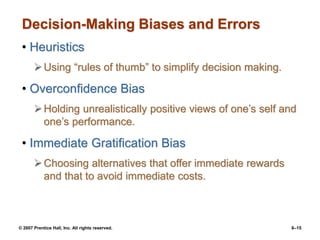
Decision-Making Biases and Errors
• Heuristics
Using “rules of thumb” to simplify decision making.
• Overconfidence Bias
Holding unrealistically positive views of one’s self and
one’s performance.
• Immediate Gratification Bias
Choosing alternatives that offer immediate rewards
and that to avoid immediate costs.
© 2007 Prentice Hall, Inc. All rights reserved. 6–16
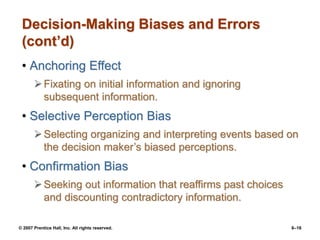
Decision-Making Biases and Errors
(cont’d)
• Anchoring Effect
Fixating on initial information and ignoring
subsequent information.
• Selective Perception Bias
Selecting organizing and interpreting events based on
the decision maker’s biased perceptions.
• Confirmation Bias
Seeking out information that reaffirms past choices
and discounting contradictory information.
© 2007 Prentice Hall, Inc. All rights reserved. 6–17
Decision-Making Biases and Errors
(cont’d)
• Framing Bias
Selecting and highlighting certain aspects of a
situation while ignoring other aspects.
• Availability Bias
Losing decision-making objectivity by focusing on the
most recent events.
• Representation Bias
Drawing analogies and seeing identical situations
when none exist.
• Randomness Bias
Creating unfounded meaning out of random events.
© 2007 Prentice Hall, Inc. All rights reserved. 6–18
Decision-Making Biases and Errors
(cont’d)
• Sunk Costs Errors
Forgetting that current actions cannot influence past
events and relate only to future consequences.
• Self-Serving Bias
Taking quick credit for successes and blaming outside
factors for failures.
• Hindsight Bias
Mistakenly believing that an event could have been
predicted once the actual outcome is known (after-
the-fact).
© 2007 Prentice Hall, Inc. All rights reserved. 6–19
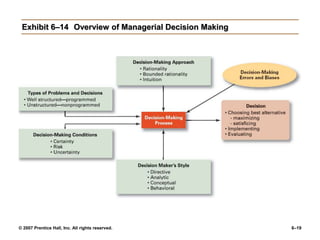
Exhibit 6–14 Overview of Managerial Decision Making
© 2007 Prentice Hall, Inc. All rights reserved. 6–20
Decision Making for Today’s World
• Guidelines for making effective decisions:
Understand cultural differences.
Know when it’s time to call it quits.
Use an effective decision-making process.
• Habits of highly reliable organizations (HROs)
Are not tricked by their success.
Defer to the experts on the front line.
Let unexpected circumstances provide the solution.
Embrace complexity.
Anticipate, but also anticipate their limits.
© 2007 Prentice Hall, Inc. All rights reserved. 6–21
Characteristics of an Effective Decision-
Making Process
• It focuses on what is important.
• It is logical and consistent.
• It acknowledges both subjective and objective thinking
and blends analytical with intuitive thinking.
• It requires only as much information and analysis as is
necessary to resolve a particular dilemma.
• It encourages and guides the gathering of relevant
information and informed opinion.
• It is straightforward, reliable, easy to use, and flexible.
© 2007 Prentice Hall, Inc. All rights reserved. 6–22
Terms to Know
• decision
• decision-making process
• problem
• decision criteria
• rational decision making
• bounded rationality
• satisficing
• escalation of commitment
• intuitive decision making
• structured problems
• programmed decision
• procedure
• rule
• policy
• unstructured problems
• nonprogrammed decisions
• certainty
• risk
• uncertainty
• directive style
• analytic style
• conceptual style
• behavioral style
• heuristics
• business performance
management (BPM) software

Chapter 6.ppt

  • 1.
    ninth edition STEPHEN P.ROBBINS PowerPoint Presentation by Charlie Cook The University of West Alabama MARY COULTER © 2007 Prentice Hall, Inc. All rights reserved. Decision-Making: The Essence of the Manager’s Job Chapter 6
  • 2.
    © 2007 PrenticeHall, Inc. All rights reserved. 6–2 Types of Programmed Decisions • Policy A general guideline for making a decision about a structured problem. • Procedure A series of interrelated steps that a manager can use to respond (applying a policy) to a structured problem. • Rule An explicit statement that limits what a manager or employee can or cannot do.
  • 3.
    © 2007 PrenticeHall, Inc. All rights reserved. 6–3 Policy, Procedure, and Rule Examples • Policy Accept all customer-returned merchandise. • Procedure Follow all steps for completing merchandise return documentation. • Rules Managers must approve all refunds over $50.00. No credit purchases are refunded for cash.
  • 4.
    © 2007 PrenticeHall, Inc. All rights reserved. 6–4 Problems and Decisions (cont’d) • Unstructured Problems Problems that are new or unusual and for which information is ambiguous or incomplete. Problems that will require custom-made solutions. • Nonprogrammed Decisions Decisions that are unique and nonrecurring. Decisions that generate unique responses.
  • 5.
    © 2007 PrenticeHall, Inc. All rights reserved. 6–5 Exhibit 6–8 Programmed versus Nonprogrammed Decisions
  • 6.
    © 2007 PrenticeHall, Inc. All rights reserved. 6–6 Decision-Making Conditions • Certainty A situation in which a manager can make an accurate decision because the outcome of every alternative choice is known. • Risk A situation in which the manager is able to estimate the likelihood (probability) of outcomes that result from the choice of particular alternatives.
  • 7.
    © 2007 PrenticeHall, Inc. All rights reserved. 6–7 Exhibit 6–9 Expected Value for Revenues from the Addition of One Ski Lift Expected Expected × Probability = Value of Each Event Revenues Alternative Heavy snowfall $850,000 0.3 = $255,000 Normal snowfall 725,000 0.5 = 362,500 Light snowfall 350,000 0.2 = 70,000 $687,500
  • 8.
    © 2007 PrenticeHall, Inc. All rights reserved. 6–8 Decision-Making Conditions • Uncertainty Limited information prevents estimation of outcome probabilities for alternatives associated with the problem and may force managers to rely on intuition, hunches, and “gut feelings”.  Maximax: the optimistic manager’s choice to maximize the maximum payoff  Maximin: the pessimistic manager’s choice to maximize the minimum payoff  Minimax: the manager’s choice to minimize maximum regret.
  • 9.
    © 2007 PrenticeHall, Inc. All rights reserved. 6–9 Exhibit 6–10 Payoff Matrix
  • 10.
    © 2007 PrenticeHall, Inc. All rights reserved. 6–10 Exhibit 6–11 Regret Matrix
  • 11.
    © 2007 PrenticeHall, Inc. All rights reserved. 6–11 Decision-Making Styles • Dimensions of Decision-Making Styles Ways of thinking  Rational, orderly, and consistent  Intuitive, creative, and unique Tolerance for ambiguity  Low tolerance: require consistency and order  High tolerance: multiple thoughts simultaneously
  • 12.
    © 2007 PrenticeHall, Inc. All rights reserved. 6–12 Decision-Making Styles (cont’d) • Types of Decision Makers Directive  Use minimal information and consider few alternatives. Analytic  Make careful decisions in unique situations. Conceptual  Maintain a broad outlook and consider many alternatives in making decisions. Behavioral  Avoid conflict by working well with others and being receptive to suggestions.
  • 13.
    © 2007 PrenticeHall, Inc. All rights reserved. 6–13 Exhibit 6–12 Decision-Making Matrix
  • 14.
    © 2007 PrenticeHall, Inc. All rights reserved. 6–14 Exhibit 6–13 Common Decision-Making Errors and Biases
  • 15.
    © 2007 PrenticeHall, Inc. All rights reserved. 6–15 Decision-Making Biases and Errors • Heuristics Using “rules of thumb” to simplify decision making. • Overconfidence Bias Holding unrealistically positive views of one’s self and one’s performance. • Immediate Gratification Bias Choosing alternatives that offer immediate rewards and that to avoid immediate costs.
  • 16.
    © 2007 PrenticeHall, Inc. All rights reserved. 6–16 Decision-Making Biases and Errors (cont’d) • Anchoring Effect Fixating on initial information and ignoring subsequent information. • Selective Perception Bias Selecting organizing and interpreting events based on the decision maker’s biased perceptions. • Confirmation Bias Seeking out information that reaffirms past choices and discounting contradictory information.
  • 17.
    © 2007 PrenticeHall, Inc. All rights reserved. 6–17 Decision-Making Biases and Errors (cont’d) • Framing Bias Selecting and highlighting certain aspects of a situation while ignoring other aspects. • Availability Bias Losing decision-making objectivity by focusing on the most recent events. • Representation Bias Drawing analogies and seeing identical situations when none exist. • Randomness Bias Creating unfounded meaning out of random events.
  • 18.
    © 2007 PrenticeHall, Inc. All rights reserved. 6–18 Decision-Making Biases and Errors (cont’d) • Sunk Costs Errors Forgetting that current actions cannot influence past events and relate only to future consequences. • Self-Serving Bias Taking quick credit for successes and blaming outside factors for failures. • Hindsight Bias Mistakenly believing that an event could have been predicted once the actual outcome is known (after- the-fact).
  • 19.
    © 2007 PrenticeHall, Inc. All rights reserved. 6–19 Exhibit 6–14 Overview of Managerial Decision Making
  • 20.
    © 2007 PrenticeHall, Inc. All rights reserved. 6–20 Decision Making for Today’s World • Guidelines for making effective decisions: Understand cultural differences. Know when it’s time to call it quits. Use an effective decision-making process. • Habits of highly reliable organizations (HROs) Are not tricked by their success. Defer to the experts on the front line. Let unexpected circumstances provide the solution. Embrace complexity. Anticipate, but also anticipate their limits.
  • 21.
    © 2007 PrenticeHall, Inc. All rights reserved. 6–21 Characteristics of an Effective Decision- Making Process • It focuses on what is important. • It is logical and consistent. • It acknowledges both subjective and objective thinking and blends analytical with intuitive thinking. • It requires only as much information and analysis as is necessary to resolve a particular dilemma. • It encourages and guides the gathering of relevant information and informed opinion. • It is straightforward, reliable, easy to use, and flexible.
  • 22.
    © 2007 PrenticeHall, Inc. All rights reserved. 6–22 Terms to Know • decision • decision-making process • problem • decision criteria • rational decision making • bounded rationality • satisficing • escalation of commitment • intuitive decision making • structured problems • programmed decision • procedure • rule • policy • unstructured problems • nonprogrammed decisions • certainty • risk • uncertainty • directive style • analytic style • conceptual style • behavioral style • heuristics • business performance management (BPM) software