Hedge Funds
    -Avinash and Sham
Defining Hedge Funds
Opinions differ regarding the definition of the phrase “Hedge
  Fund”. The most commonly accepted definition is that a
  hedge funds are the funds which:

• Have an absolute return performance objective

• Allow the manager to be active on both the long and short
  sides of the markets

• Compensate the manager with performance related fees

• Allow the manager tremendous flexibility in investment
  style and approach
What are HFs?
• “To hedge one’s bets” i.e. betting on other
  side to limit the possibility of loss on a
  speculation.
• Hedge funds
  – pool of funds of the highly influential investors,
  – open to limited number of investors
  – require high investment
  – include high expertise based investment strategies
    and Risk management
Targeted Investments
They can invest in any type of asset class or opportunity luring in the
any market, be it
  • options,
  • derivatives,
  • equities,
  • bonds,
  • undervalued securities,
  • currencies,
  • Commodities
  • events such as mergers or bankruptcies,
  • domestic as well as international markets where they can expect
     to receive attractive returns in all kind of risky situations.
Motive of Hedge Funds
• Protecting capital (i.e. the private pool of
  funds)
• Generating superior returns in all kinds of
  markets (they are ready to take bearish
  markets also)
• Attempting to minimize the risk i.e. to hedge.
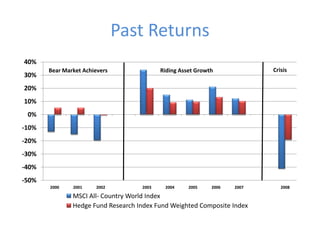
Past Returns
40%
       Bear Market Achievers               Riding Asset Growth             Crisis
30%
20%
10%
 0%
-10%
-20%
-30%
-40%
-50%
       2000    2001    2002         2003    2004     2005    2006   2007      2008

               MSCI All- Country World Index
               Hedge Fund Research Index Fund Weighted Composite Index
Indian Context
• Asian countries are offering many opportunities
• Market in UK and US are facing
   – huge meltdowns
   – investors are finding hard to sustain there
   – money making options are drying
• India is offering various necessary conditions for
  hedge funds to explore with its
   – secondary market liquidity
   – Futures
   – options, etc.
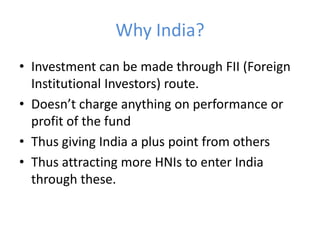
Why India?
• Investment can be made through FII (Foreign
  Institutional Investors) route.
• Doesn’t charge anything on performance or
  profit of the fund
• Thus giving India a plus point from others
• Thus attracting more HNIs to enter India
  through these.
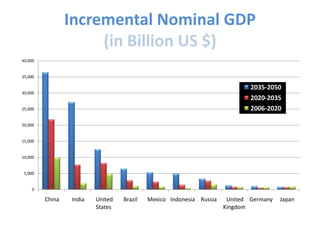
Incremental Nominal GDP
                      (in Billion US $)
40,000


35,000

                                                                             2035-2050
30,000
                                                                             2020-2035
25,000                                                                       2006-2020

20,000


15,000


10,000


 5,000


    0

         China   India   United   Brazil   Mexico Indonesia Russia    United Germany   Japan
                         States                                      Kingdom
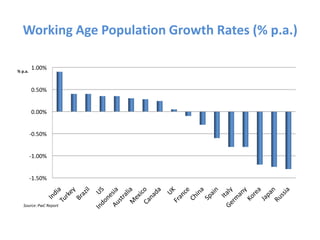
Working Age Population Growth Rates (% p.a.)

% p.a.
         1.00%


         0.50%


         0.00%


         -0.50%


         -1.00%


         -1.50%


   Source: PwC Report
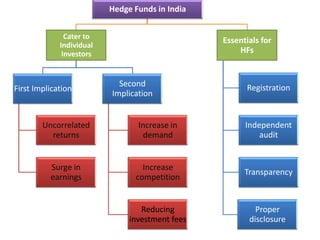
Hedge Funds in India


               Cater to
                                                 Essentials for
             Individual
              Investors                              HFs


                            Second                     Registration
First Implication
                          Implication


        Uncorrelated             Increase in           Independent
          returns                 demand                   audit


          Surge in                Increase
                                                       Transparency
          earnings              competition


                                  Reducing                Proper
                               investment fees          disclosure
Performance of Indian Hedge Funds
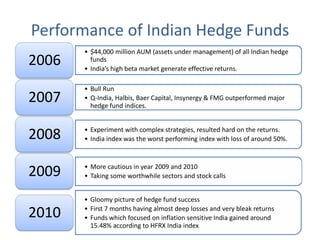
       • $44,000 million AUM (assets under management) of all Indian hedge
2006     funds
       • India’s high beta market generate effective returns.

       • Bull Run
2007   • Q-India, Halbis, Baer Capital, Insynergy & FMG outperformed major
         hedge fund indices.


       • Experiment with complex strategies, resulted hard on the returns.
2008   • India index was the worst performing index with loss of around 50%.


       • More cautious in year 2009 and 2010
2009   • Taking some worthwhile sectors and stock calls


       • Gloomy picture of hedge fund success

2010   • First 7 months having almost deep losses and very bleak returns
       • Funds which focused on inflation sensitive India gained around
         15.48% according to HFRX India index
Various Hedge Fund Strategies
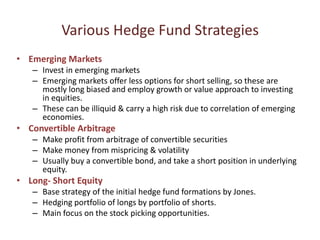
• Emerging Markets
   – Invest in emerging markets
   – Emerging markets offer less options for short selling, so these are
     mostly long biased and employ growth or value approach to investing
     in equities.
   – These can be illiquid & carry a high risk due to correlation of emerging
     economies.
• Convertible Arbitrage
   – Make profit from arbitrage of convertible securities
   – Make money from mispricing & volatility
   – Usually buy a convertible bond, and take a short position in underlying
     equity.
• Long- Short Equity
   – Base strategy of the initial hedge fund formations by Jones.
   – Hedging portfolio of longs by portfolio of shorts.
   – Main focus on the stock picking opportunities.
Various Hedge Fund Strategies
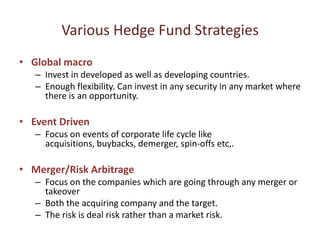
• Global macro
   – Invest in developed as well as developing countries.
   – Enough flexibility. Can invest in any security in any market where
     there is an opportunity.

• Event Driven
   – Focus on events of corporate life cycle like
     acquisitions, buybacks, demerger, spin-offs etc,.

• Merger/Risk Arbitrage
   – Focus on the companies which are going through any merger or
     takeover
   – Both the acquiring company and the target.
   – The risk is deal risk rather than a market risk.
Various Hedge Fund Strategies
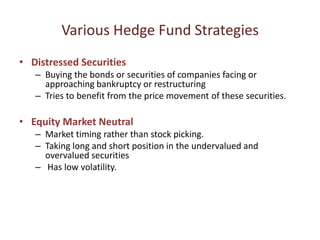
• Distressed Securities
   – Buying the bonds or securities of companies facing or
     approaching bankruptcy or restructuring
   – Tries to benefit from the price movement of these securities.

• Equity Market Neutral
   – Market timing rather than stock picking.
   – Taking long and short position in the undervalued and
     overvalued securities
   – Has low volatility.
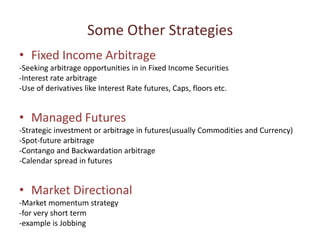
Some Other Strategies
• Fixed Income Arbitrage
-Seeking arbitrage opportunities in in Fixed Income Securities
-Interest rate arbitrage
-Use of derivatives like Interest Rate futures, Caps, floors etc.


• Managed Futures
-Strategic investment or arbitrage in futures(usually Commodities and Currency)
-Spot-future arbitrage
-Contango and Backwardation arbitrage
-Calendar spread in futures


• Market Directional
-Market momentum strategy
-for very short term
-example is Jobbing
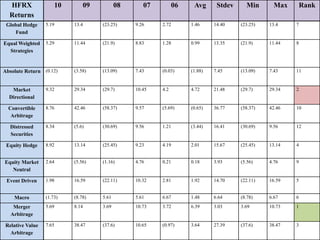
HFRX               10       09          08      07         06    Avg      Stdev     Min       Max   Rank
  Returns
 Global Hedge    5.19     13.4     (23.25)     9.26    2.72       1.46     14.40    (23.25)   13.4    7
    Fund

Equal Weighted   5.29     11.44    (21.9)      8.83    1.28       0.99     13.35    (21.9)    11.44   8
  Strategies


Absolute Return (0.12)    (3.58)   (13.09)     7.43    (0.03)     (1.88)   7.45     (13.09)   7.43    11


   Market        9.32     29.34    (29.7)      10.45   4.2        4.72     21.48    (29.7)    29.34   2
  Directional

  Convertible    8.76     42.46    (58.37)     9.57    (5.69)     (0.65)   36.77    (58.37)   42.46   10
   Arbitrage

  Distressed     8.34     (5.6)    (30.69)     9.56    1.21       (3.44)   16.41    (30.69)   9.56    12
  Securities

 Equity Hedge    8.92     13.14    (25.45)     9.23    4.19       2.01     15.67    (25.45)   13.14   4


Equity Market    2.64     (5.56)   (1.16)      4.76    0.21       0.18     3.93     (5.56)    4.76    9
   Neutral

 Event Driven    1.98     16.59    (22.11)     10.32   2.81       1.92     14.70    (22.11)   16.59   5


    Macro        (1.73)   (8.78)   5.61        5.61    6.67       1.48     6.64     (8.78)    6.67    6
    Merger       5.69     8.14     3.69        10.73   3.72       6.39     3.03     3.69      10.73   1
   Arbitrage

Relative Value   7.65     38.47    (37.6)      10.65   (0.97)     3.64     27.39    (37.6)    38.47   3
  Arbitrage
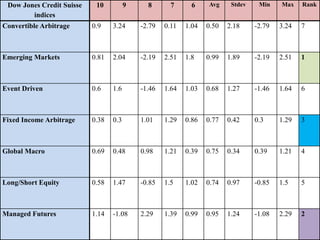
Dow Jones Credit Suisse    10          9     8       7      6    Avg     Stdev    Min    Max    Rank
        indices
Convertible Arbitrage      0.9    3.24      -2.79   0.11   1.04   0.50   2.18     -2.79   3.24   7


Emerging Markets           0.81   2.04      -2.19   2.51   1.8    0.99   1.89     -2.19   2.51   1


Event Driven               0.6    1.6       -1.46   1.64   1.03   0.68   1.27     -1.46   1.64   6


Fixed Income Arbitrage     0.38   0.3       1.01    1.29   0.86   0.77   0.42     0.3     1.29   3


Global Macro               0.69   0.48      0.98    1.21   0.39   0.75   0.34     0.39    1.21   4


Long/Short Equity          0.58   1.47      -0.85   1.5    1.02   0.74   0.97     -0.85   1.5    5


Managed Futures            1.14   -1.08     2.29    1.39   0.99   0.95   1.24     -1.08   2.29   2
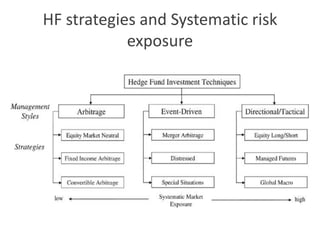
HF strategies and Systematic risk
            exposure
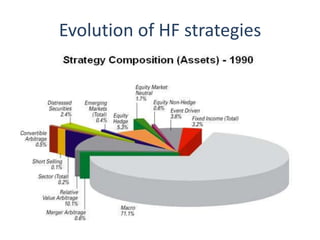
Evolution of HF strategies
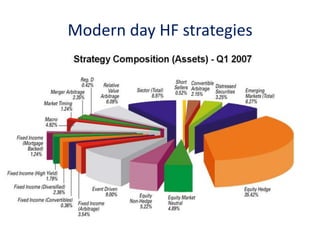
Modern day HF strategies
HFRX
• The “Hedge Fund Research Index”
• Most Widely followed index for Hedge Fund Performance
• It is comprised of all eligible hedge fund strategies. All
  strategies are equally weighted.
• Evaluates the performance of Hedge Funds based on Absolute
  Return and the Relative Risk.
• As a component of the optimization process, the index
  selects constituents which exhibit lower volatilities and lower
  correlations to standard directional benchmarks of equity
  market and hedge fund industry performance.
• “HFRX India” is an index for the Indian Hedge Funds.
Empirical Findings
• Returns are considerably high during a volatile market which
  is mean reverting in nature

• Returns during a trending market in some of the HF strategies
  is low and even negative in some cases

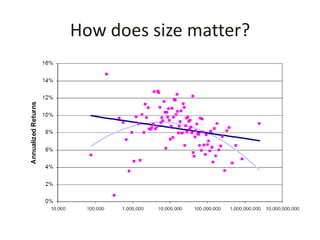
• Well established and High Corpus HFs give a lower returns
  compared to the relatively newer peers who have small
  corpus
How does size matter?
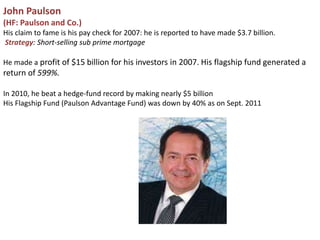
John Paulson
(HF: Paulson and Co.)
His claim to fame is his pay check for 2007: he is reported to have made $3.7 billion.
Strategy: Short-selling sub prime mortgage

He made a profit of $15 billion for his investors in 2007. His flagship fund generated a
return of 599%.

In 2010, he beat a hedge-fund record by making nearly $5 billion
His Flagship Fund (Paulson Advantage Fund) was down by 40% as on Sept. 2011
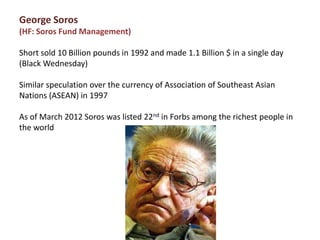
George Soros
(HF: Soros Fund Management)

Short sold 10 Billion pounds in 1992 and made 1.1 Billion $ in a single day
(Black Wednesday)

Similar speculation over the currency of Association of Southeast Asian
Nations (ASEAN) in 1997

As of March 2012 Soros was listed 22nd in Forbs among the richest people in
the world
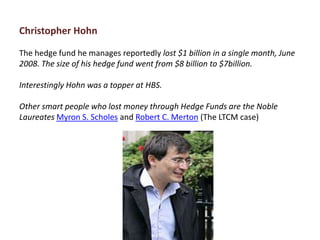
Christopher Hohn

The hedge fund he manages reportedly lost $1 billion in a single month, June
2008. The size of his hedge fund went from $8 billion to $7billion.

Interestingly Hohn was a topper at HBS.

Other smart people who lost money through Hedge Funds are the Noble
Laureates Myron S. Scholes and Robert C. Merton (The LTCM case)
Hedge Fund Regulations In India
• SEBI regulation seeks to cover all types of funds broadly under 3
  categories
• Category I AIF – those AIFs with positive spillover effects on the
  economy
• Category II AIF – those AIFs for which no specific incentives or
  concessions are given by the government or any other Regulator;
  which shall not undertake leverage other than to meet day-to-day
  operational requirements
•    Category III AIF – those AIFs including hedge funds which trade with a
    view to make short term returns; which employs diverse or complex trading
    strategies and may employ leverage including through investment in listed
    or unlisted derivatives.
Regulatory Constraints
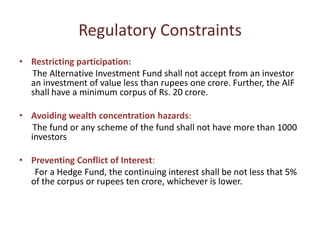
• Restricting participation:
  The Alternative Investment Fund shall not accept from an investor
  an investment of value less than rupees one crore. Further, the AIF
  shall have a minimum corpus of Rs. 20 crore.

• Avoiding wealth concentration hazards:
   The fund or any scheme of the fund shall not have more than 1000
  investors

• Preventing Conflict of Interest:
   For a Hedge Fund, the continuing interest shall be not less that 5%
  of the corpus or rupees ten crore, whichever is lower.
Regulatory Constraints (contd..)
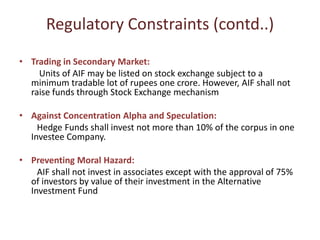
• Trading in Secondary Market:
    Units of AIF may be listed on stock exchange subject to a
  minimum tradable lot of rupees one crore. However, AIF shall not
  raise funds through Stock Exchange mechanism

• Against Concentration Alpha and Speculation:
    Hedge Funds shall invest not more than 10% of the corpus in one
  Investee Company.

• Preventing Moral Hazard:
    AIF shall not invest in associates except with the approval of 75%
  of investors by value of their investment in the Alternative
  Investment Fund
The Category III of AIFs (the Hedge Funds)
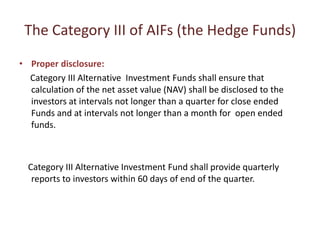
• Proper disclosure:
  Category III Alternative Investment Funds shall ensure that
  calculation of the net asset value (NAV) shall be disclosed to the
  investors at intervals not longer than a quarter for close ended
  Funds and at intervals not longer than a month for open ended
  funds.


  Category III Alternative Investment Fund shall provide quarterly
   reports to investors within 60 days of end of the quarter.
Thank You 

Hedge funds (The Indian Context and the Regulatory Framework)

  • 1.
    Hedge Funds -Avinash and Sham
  • 2.
    Defining Hedge Funds Opinionsdiffer regarding the definition of the phrase “Hedge Fund”. The most commonly accepted definition is that a hedge funds are the funds which: • Have an absolute return performance objective • Allow the manager to be active on both the long and short sides of the markets • Compensate the manager with performance related fees • Allow the manager tremendous flexibility in investment style and approach
  • 3.
    What are HFs? •“To hedge one’s bets” i.e. betting on other side to limit the possibility of loss on a speculation. • Hedge funds – pool of funds of the highly influential investors, – open to limited number of investors – require high investment – include high expertise based investment strategies and Risk management
  • 4.
    Targeted Investments They caninvest in any type of asset class or opportunity luring in the any market, be it • options, • derivatives, • equities, • bonds, • undervalued securities, • currencies, • Commodities • events such as mergers or bankruptcies, • domestic as well as international markets where they can expect to receive attractive returns in all kind of risky situations.
  • 5.
    Motive of HedgeFunds • Protecting capital (i.e. the private pool of funds) • Generating superior returns in all kinds of markets (they are ready to take bearish markets also) • Attempting to minimize the risk i.e. to hedge.
  • 6.
    Past Returns 40% Bear Market Achievers Riding Asset Growth Crisis 30% 20% 10% 0% -10% -20% -30% -40% -50% 2000 2001 2002 2003 2004 2005 2006 2007 2008 MSCI All- Country World Index Hedge Fund Research Index Fund Weighted Composite Index
  • 7.
    Indian Context • Asiancountries are offering many opportunities • Market in UK and US are facing – huge meltdowns – investors are finding hard to sustain there – money making options are drying • India is offering various necessary conditions for hedge funds to explore with its – secondary market liquidity – Futures – options, etc.
  • 8.
    Why India? • Investmentcan be made through FII (Foreign Institutional Investors) route. • Doesn’t charge anything on performance or profit of the fund • Thus giving India a plus point from others • Thus attracting more HNIs to enter India through these.
  • 9.
    Incremental Nominal GDP (in Billion US $) 40,000 35,000 2035-2050 30,000 2020-2035 25,000 2006-2020 20,000 15,000 10,000 5,000 0 China India United Brazil Mexico Indonesia Russia United Germany Japan States Kingdom
  • 10.
    Working Age PopulationGrowth Rates (% p.a.) % p.a. 1.00% 0.50% 0.00% -0.50% -1.00% -1.50% Source: PwC Report
  • 11.
    Hedge Funds inIndia Cater to Essentials for Individual Investors HFs Second Registration First Implication Implication Uncorrelated Increase in Independent returns demand audit Surge in Increase Transparency earnings competition Reducing Proper investment fees disclosure
  • 12.
    Performance of IndianHedge Funds • $44,000 million AUM (assets under management) of all Indian hedge 2006 funds • India’s high beta market generate effective returns. • Bull Run 2007 • Q-India, Halbis, Baer Capital, Insynergy & FMG outperformed major hedge fund indices. • Experiment with complex strategies, resulted hard on the returns. 2008 • India index was the worst performing index with loss of around 50%. • More cautious in year 2009 and 2010 2009 • Taking some worthwhile sectors and stock calls • Gloomy picture of hedge fund success 2010 • First 7 months having almost deep losses and very bleak returns • Funds which focused on inflation sensitive India gained around 15.48% according to HFRX India index
  • 13.
    Various Hedge FundStrategies • Emerging Markets – Invest in emerging markets – Emerging markets offer less options for short selling, so these are mostly long biased and employ growth or value approach to investing in equities. – These can be illiquid & carry a high risk due to correlation of emerging economies. • Convertible Arbitrage – Make profit from arbitrage of convertible securities – Make money from mispricing & volatility – Usually buy a convertible bond, and take a short position in underlying equity. • Long- Short Equity – Base strategy of the initial hedge fund formations by Jones. – Hedging portfolio of longs by portfolio of shorts. – Main focus on the stock picking opportunities.
  • 14.
    Various Hedge FundStrategies • Global macro – Invest in developed as well as developing countries. – Enough flexibility. Can invest in any security in any market where there is an opportunity. • Event Driven – Focus on events of corporate life cycle like acquisitions, buybacks, demerger, spin-offs etc,. • Merger/Risk Arbitrage – Focus on the companies which are going through any merger or takeover – Both the acquiring company and the target. – The risk is deal risk rather than a market risk.
  • 15.
    Various Hedge FundStrategies • Distressed Securities – Buying the bonds or securities of companies facing or approaching bankruptcy or restructuring – Tries to benefit from the price movement of these securities. • Equity Market Neutral – Market timing rather than stock picking. – Taking long and short position in the undervalued and overvalued securities – Has low volatility.
  • 16.
    Some Other Strategies •Fixed Income Arbitrage -Seeking arbitrage opportunities in in Fixed Income Securities -Interest rate arbitrage -Use of derivatives like Interest Rate futures, Caps, floors etc. • Managed Futures -Strategic investment or arbitrage in futures(usually Commodities and Currency) -Spot-future arbitrage -Contango and Backwardation arbitrage -Calendar spread in futures • Market Directional -Market momentum strategy -for very short term -example is Jobbing
  • 17.
    HFRX 10 09 08 07 06 Avg Stdev Min Max Rank Returns Global Hedge 5.19 13.4 (23.25) 9.26 2.72 1.46 14.40 (23.25) 13.4 7 Fund Equal Weighted 5.29 11.44 (21.9) 8.83 1.28 0.99 13.35 (21.9) 11.44 8 Strategies Absolute Return (0.12) (3.58) (13.09) 7.43 (0.03) (1.88) 7.45 (13.09) 7.43 11 Market 9.32 29.34 (29.7) 10.45 4.2 4.72 21.48 (29.7) 29.34 2 Directional Convertible 8.76 42.46 (58.37) 9.57 (5.69) (0.65) 36.77 (58.37) 42.46 10 Arbitrage Distressed 8.34 (5.6) (30.69) 9.56 1.21 (3.44) 16.41 (30.69) 9.56 12 Securities Equity Hedge 8.92 13.14 (25.45) 9.23 4.19 2.01 15.67 (25.45) 13.14 4 Equity Market 2.64 (5.56) (1.16) 4.76 0.21 0.18 3.93 (5.56) 4.76 9 Neutral Event Driven 1.98 16.59 (22.11) 10.32 2.81 1.92 14.70 (22.11) 16.59 5 Macro (1.73) (8.78) 5.61 5.61 6.67 1.48 6.64 (8.78) 6.67 6 Merger 5.69 8.14 3.69 10.73 3.72 6.39 3.03 3.69 10.73 1 Arbitrage Relative Value 7.65 38.47 (37.6) 10.65 (0.97) 3.64 27.39 (37.6) 38.47 3 Arbitrage
  • 18.
    Dow Jones CreditSuisse 10 9 8 7 6 Avg Stdev Min Max Rank indices Convertible Arbitrage 0.9 3.24 -2.79 0.11 1.04 0.50 2.18 -2.79 3.24 7 Emerging Markets 0.81 2.04 -2.19 2.51 1.8 0.99 1.89 -2.19 2.51 1 Event Driven 0.6 1.6 -1.46 1.64 1.03 0.68 1.27 -1.46 1.64 6 Fixed Income Arbitrage 0.38 0.3 1.01 1.29 0.86 0.77 0.42 0.3 1.29 3 Global Macro 0.69 0.48 0.98 1.21 0.39 0.75 0.34 0.39 1.21 4 Long/Short Equity 0.58 1.47 -0.85 1.5 1.02 0.74 0.97 -0.85 1.5 5 Managed Futures 1.14 -1.08 2.29 1.39 0.99 0.95 1.24 -1.08 2.29 2
  • 19.
    HF strategies andSystematic risk exposure
  • 20.
    Evolution of HFstrategies
  • 21.
    Modern day HFstrategies
  • 22.
    HFRX • The “HedgeFund Research Index” • Most Widely followed index for Hedge Fund Performance • It is comprised of all eligible hedge fund strategies. All strategies are equally weighted. • Evaluates the performance of Hedge Funds based on Absolute Return and the Relative Risk. • As a component of the optimization process, the index selects constituents which exhibit lower volatilities and lower correlations to standard directional benchmarks of equity market and hedge fund industry performance. • “HFRX India” is an index for the Indian Hedge Funds.
  • 23.
    Empirical Findings • Returnsare considerably high during a volatile market which is mean reverting in nature • Returns during a trending market in some of the HF strategies is low and even negative in some cases • Well established and High Corpus HFs give a lower returns compared to the relatively newer peers who have small corpus
  • 24.
  • 25.
    John Paulson (HF: Paulsonand Co.) His claim to fame is his pay check for 2007: he is reported to have made $3.7 billion. Strategy: Short-selling sub prime mortgage He made a profit of $15 billion for his investors in 2007. His flagship fund generated a return of 599%. In 2010, he beat a hedge-fund record by making nearly $5 billion His Flagship Fund (Paulson Advantage Fund) was down by 40% as on Sept. 2011
  • 26.
    George Soros (HF: SorosFund Management) Short sold 10 Billion pounds in 1992 and made 1.1 Billion $ in a single day (Black Wednesday) Similar speculation over the currency of Association of Southeast Asian Nations (ASEAN) in 1997 As of March 2012 Soros was listed 22nd in Forbs among the richest people in the world
  • 27.
    Christopher Hohn The hedgefund he manages reportedly lost $1 billion in a single month, June 2008. The size of his hedge fund went from $8 billion to $7billion. Interestingly Hohn was a topper at HBS. Other smart people who lost money through Hedge Funds are the Noble Laureates Myron S. Scholes and Robert C. Merton (The LTCM case)
  • 28.
    Hedge Fund RegulationsIn India • SEBI regulation seeks to cover all types of funds broadly under 3 categories • Category I AIF – those AIFs with positive spillover effects on the economy • Category II AIF – those AIFs for which no specific incentives or concessions are given by the government or any other Regulator; which shall not undertake leverage other than to meet day-to-day operational requirements • Category III AIF – those AIFs including hedge funds which trade with a view to make short term returns; which employs diverse or complex trading strategies and may employ leverage including through investment in listed or unlisted derivatives.
  • 29.
    Regulatory Constraints • Restrictingparticipation: The Alternative Investment Fund shall not accept from an investor an investment of value less than rupees one crore. Further, the AIF shall have a minimum corpus of Rs. 20 crore. • Avoiding wealth concentration hazards: The fund or any scheme of the fund shall not have more than 1000 investors • Preventing Conflict of Interest: For a Hedge Fund, the continuing interest shall be not less that 5% of the corpus or rupees ten crore, whichever is lower.
  • 30.
    Regulatory Constraints (contd..) •Trading in Secondary Market: Units of AIF may be listed on stock exchange subject to a minimum tradable lot of rupees one crore. However, AIF shall not raise funds through Stock Exchange mechanism • Against Concentration Alpha and Speculation: Hedge Funds shall invest not more than 10% of the corpus in one Investee Company. • Preventing Moral Hazard: AIF shall not invest in associates except with the approval of 75% of investors by value of their investment in the Alternative Investment Fund
  • 31.
    The Category IIIof AIFs (the Hedge Funds) • Proper disclosure: Category III Alternative Investment Funds shall ensure that calculation of the net asset value (NAV) shall be disclosed to the investors at intervals not longer than a quarter for close ended Funds and at intervals not longer than a month for open ended funds. Category III Alternative Investment Fund shall provide quarterly reports to investors within 60 days of end of the quarter.
  • 32.