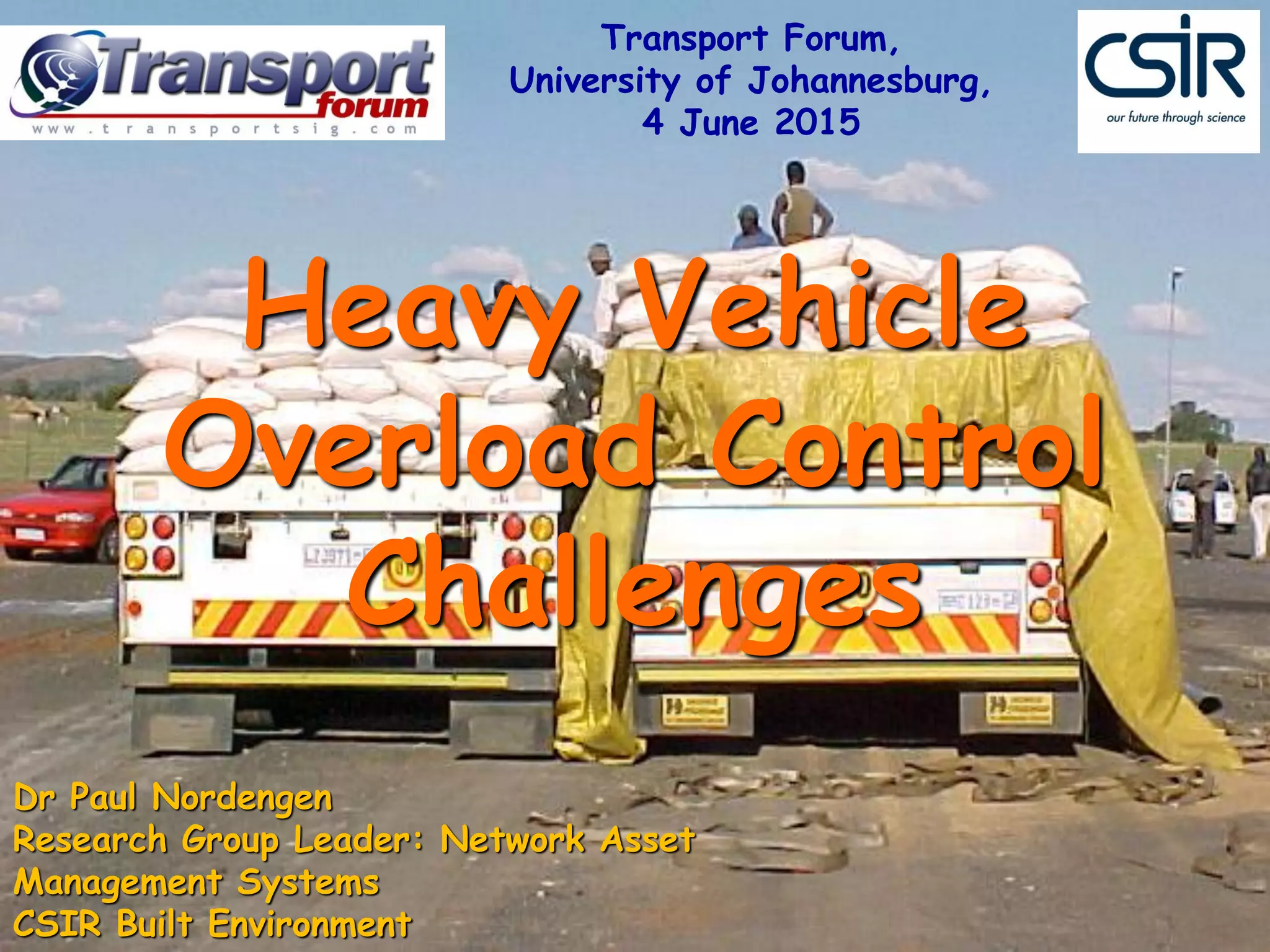
Heavy Vehicle
Overload Control
Challenges
Dr Paul Nordengen
Research Group Leader: Network Asset
Management Systems
CSIR Built Environment
Transport Forum,
University of Johannesburg,
4 June 2015
Contents
 Background and problem statement
 Overload control challenges
 Two more recent solutions
The Culture of Non-compliance
 Overloading
 Speeding
 Vehicle maintenance (brakes, tyres,
lights)
 Driver hours
 Reckless driving
 False licenses (vehicles & drivers)
 Load securement
 Cabotage
 Bribery & corruption
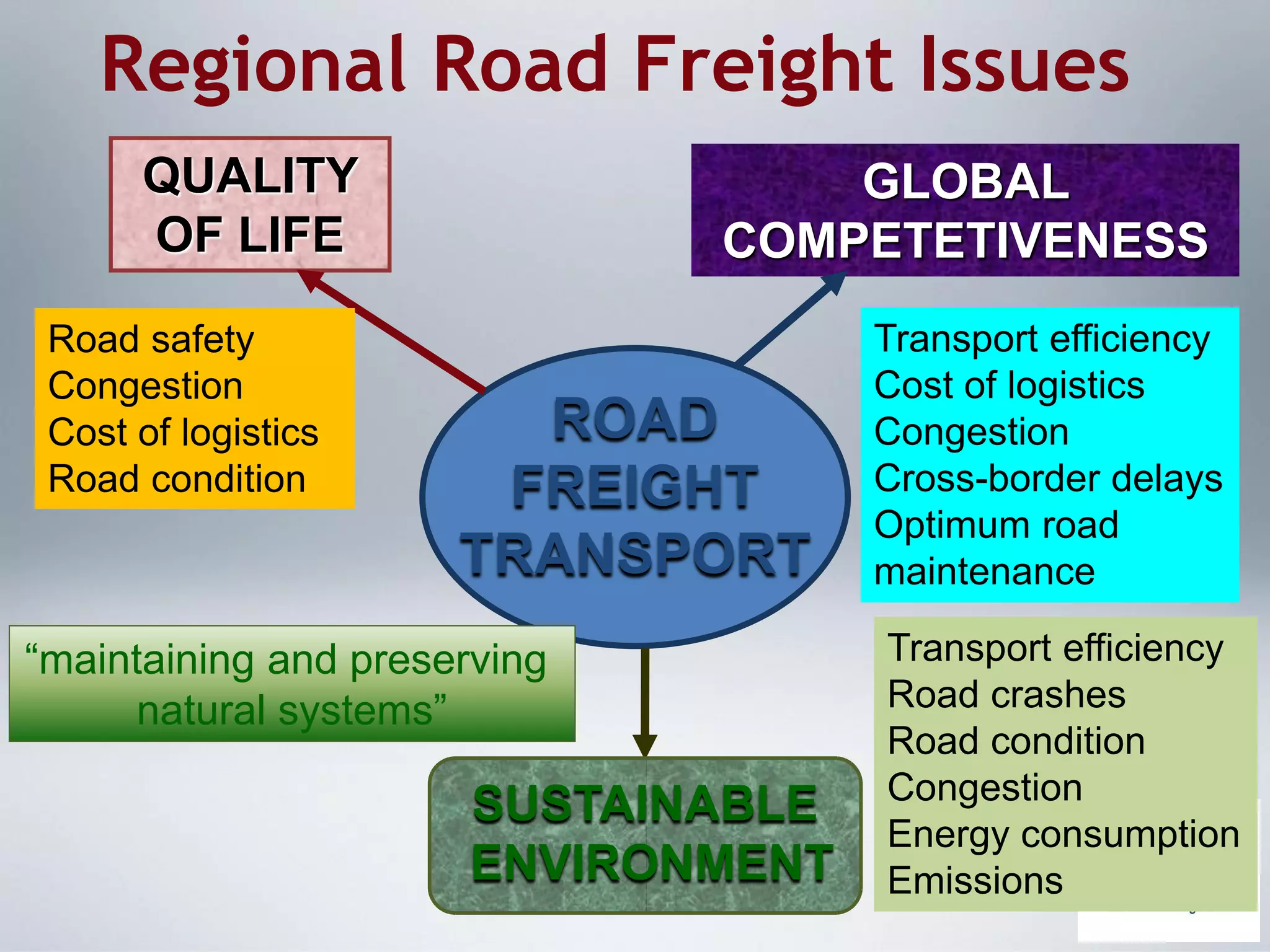
Regional Road Freight Issues
ROAD
FREIGHT
TRANSPORT
GLOBAL
COMPETETIVENESS
QUALITY
OF LIFE
SUSTAINABLE
ENVIRONMENT
Transport efficiency
Cost of logistics
Congestion
Cross-border delays
Optimum road
maintenance
Road safety
Congestion
Cost of logistics
Road condition
Transport efficiency
Road crashes
Road condition
Congestion
Energy consumption
Emissions
“maintaining and preserving
natural systems”
Key Elements in Road
Freight Transport
• Road infrastructure
• Vehicles (design, maintenance
& operation)
• Drivers
Road infrastructure
GOOD ROADS LEAD
TO PROSPERITY
motto of the SA Road
Federation
Better roads,
better world
Slide # 7
Road infrastructure
• South Africa’s road
network has been built to a
high standard (from both
regional and international
perspectives)
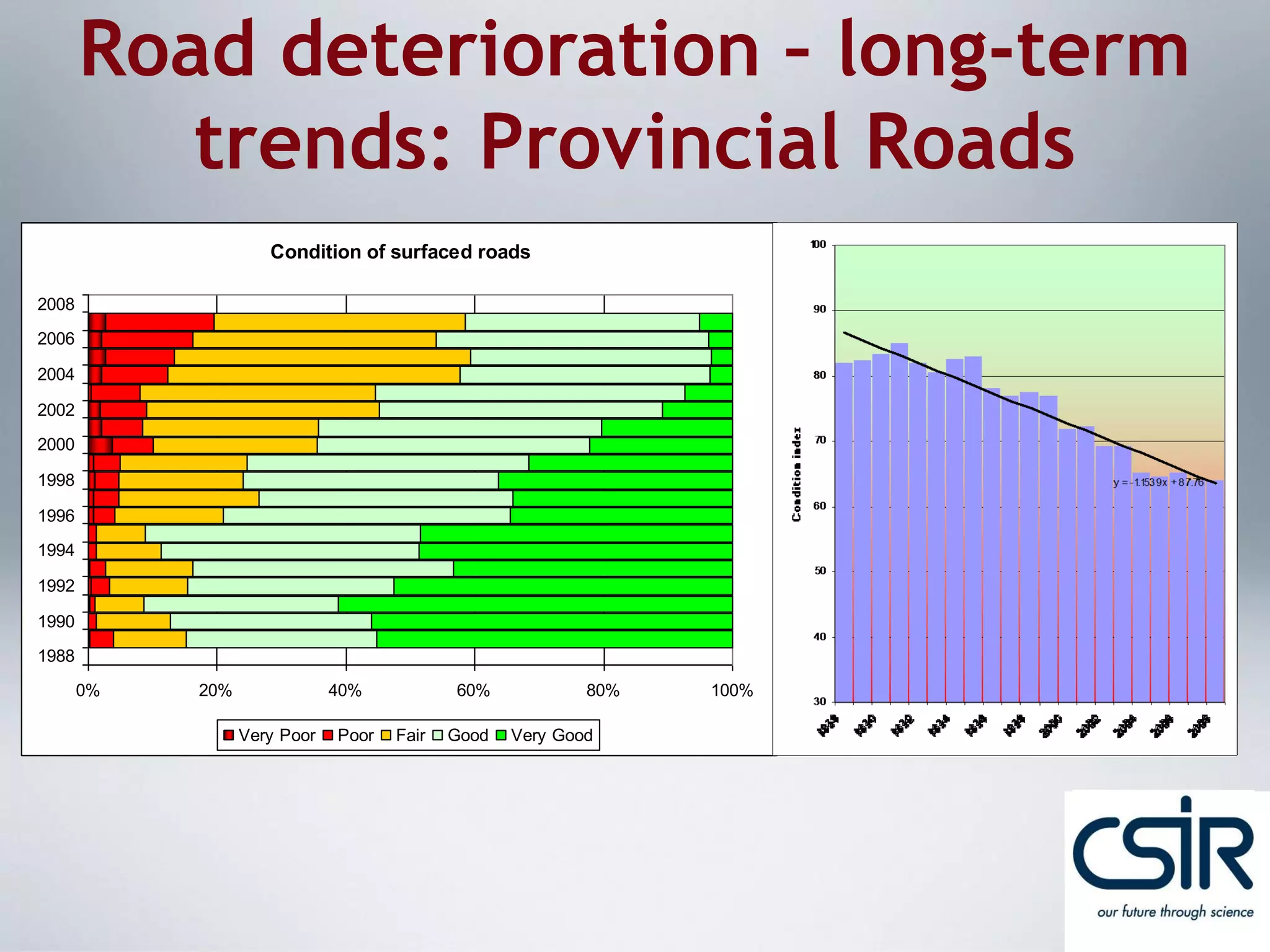
Road deterioration – long-term
trends: Provincial Roads
Condition of surfaced roads
0% 20% 40% 60% 80% 100%
1988
1990
1992
1994
1996
1998
2000
2002
2004
2006
2008
Very Poor Poor Fair Good Very Good
Slide # 15
North West Province, South Africa,
5 Nov 2004, 23h00
Six trucks carrying cobalt concentrate from
DRC to Johannesburg (3 500 km) Overloads
ranged from 30 780kg to 37 640kg (65%)
Slide # 18
0
2
4
6
8
10
12
2001 2002 2003 2004 2005 2006
Year
Fatalcrashrate
Aust
Can
France
Denmark
USA
South Africa
Switzerland
Fatal truck crash per 100 million vehicle
kilometres travelled
Source: OECD report, Moving Freight with Better Trucks, 2010
Heavy Vehicle Fatal Crash Rates
Brake & Tyre Watch Results
Location Inspected Discontinued %
City Deep 24 21 88%
Middelburg 35 24 69%
Centurion 41 17 42%
Midway KZN 26 10 38%
Kroonstad 8 7 92%
Brackenfell, W. Cape 25 25 100%
Pietermaritzburg 12 11 92%
Port Elizabeth 15 6 40%
Rustenburg 7 5 72%
Polokwane 11 10 91%
Midway KZN 24 20 83%
Bloemfontein 24 20 83%
Nelspruit/Komati 13 12 92%
TOTAL (28 events) 594 397 67%
28
B&TW
events
from
Feb.
2006
to date
Slide # 22
Slide # 23
Cost of Logistics
• The cost of logistics as a percentage of GDP in South
Africa is almost double that of the United States and
50% more than Japan and Brazil
0%
2%
4%
6%
8%
10%
12%
14%
16%
United
States
Japan Brazil South Africa
Slide #
25
0%
2%
4%
6%
8%
10%
12%
14%
16%
United
States
Japan Brazil South Africa
Condition of surfaced roads
0% 20% 40% 60% 80% 100%
1988
1990
1992
1994
1996
1998
2000
2002
2004
2006
2008
Very Poor Poor Fair Good Very Good
Overload Control Challenges
• Adequate infrastructure
• Location of weighbridges (alternative routes)
• Efficient weighing procedures (delays –
negative impact on transport productivity
• Maintenance of infrastructure, in particular
advanced technologies
• Data management and reporting
• Consistent application of mass regulations
• Sufficient and adequately trained staff
• Operational hours
• Ineffective court system and low fines
• Bribery & corruption
National Roads
Secondary Roads
Tertiary Roads
Main Road Categories in South Africa
 Status Quo of roads
Weighbridges
Overload Control Challenges
• Adequate infrastructure
• Location of weighbridges (alternative routes)
• Efficient weighing procedures (delays –
negative impact on transport productivity
• Maintenance of infrastructure, in particular
advanced technologies
• Consistent application of mass regulations
• Data management and reporting
• Sufficient and adequately trained staff
• Operational hours
• Ineffective court system and low fines
• Bribery & corruption
Beaufort West Traffic Control Centre
Donkerhoek Traffic Control Centre
Overload Control Challenges
• Adequate infrastructure
• Location of weighbridges (alternative routes)
• Efficient weighing procedures (delays –
negative impact on transport productivity
• Maintenance of infrastructure, in particular
advanced technologies
• Consistent application of mass regulations
• Data management and reporting
• Sufficient and adequately trained staff
• Operational hours
• Ineffective court system and low fines
• Bribery & corruption
Permissible Maximum Mass on a
Steering Axle
• Reg. 240(b)(i) (“Road capacity” limit)
7 700 kg
• Reg. 239(1)(a)(ii) (Vehicle Manufacturer’s Rating)
6 800 kg
• Reg. 238(1) (Tyre Manufacturer’s Rating)
7 200 kg
• Permissible Maximum Mass = 6 800 kg
Overload Control Challenges
• Adequate infrastructure
• Location of weighbridges (alternative routes)
• Efficient weighing procedures (delays –
negative impact on transport productivity
• Maintenance of infrastructure, in particular
advanced technologies
• Consistent application of mass regulations
• Data management and reporting
• Sufficient and adequately trained staff
• Operational hours
• Ineffective court system and low fines
• Bribery & corruption
Overload Control Statistics (2014)
• No. of vehicles weighed: 2 041 000
• No. of vehicles overloaded: 416 364 (20%)
• No. of vehicles chargeable: 53 525 (2.6%)
•
• Mpumalanga (N4 corridor): 669 000
• W. Cape: 540 000
• Limpopo: 413 000
• KwaZulu-Natal : 145 000
• Gauteng: 142 000
• North West: 77 000
• Free State: 44 000
• N. Cape: 10 600
• E. Cape: 65
Overload Control Challenges
• Adequate infrastructure
• Location of weighbridges (alternative routes)
• Efficient weighing procedures (delays –
negative impact on transport productivity
• Maintenance of infrastructure, in particular
advanced technologies
• Consistent application of mass regulations
• Data management and reporting
• Sufficient and adequately trained staff
• Operational hours
• Ineffective court system and low fines
• Bribery & corruption
Overload Control Challenges
• Adequate infrastructure
• Location of weighbridges (alternative routes)
• Efficient weighing procedures (delays –
negative impact on transport productivity
• Maintenance of infrastructure, in particular
advanced technologies
• Consistent application of mass regulations
• Data management and reporting
• Sufficient and adequately trained staff
• Operational hours
• Ineffective court system and low fines
• Bribery & corruption
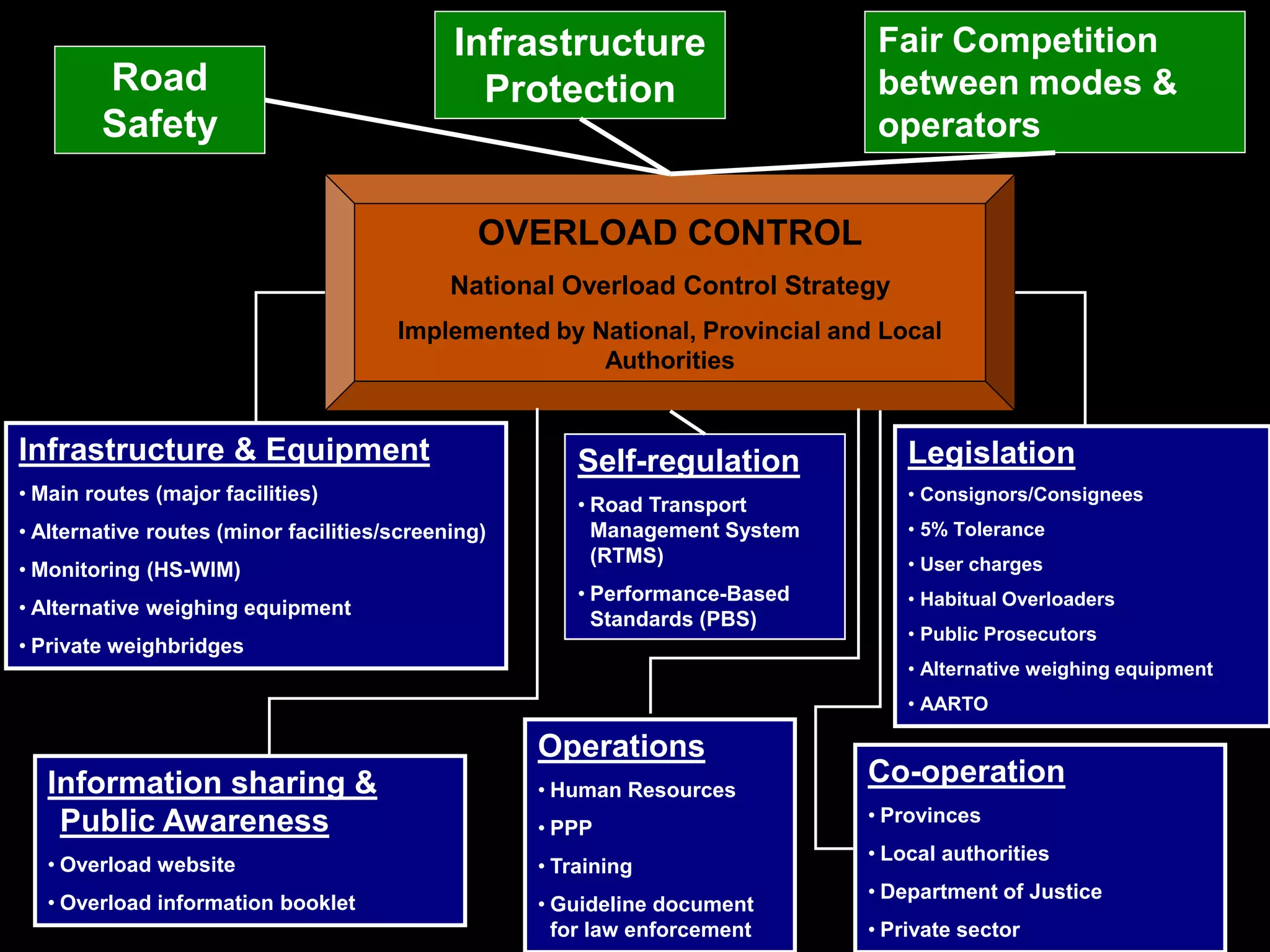
Slide # 44
Road
Safety
Fair Competition
between modes &
operators
Infrastructure
Protection
OVERLOAD CONTROL
National Overload Control Strategy
Implemented by National, Provincial and Local
Authorities
Infrastructure & Equipment
• Main routes (major facilities)
• Alternative routes (minor facilities/screening)
• Monitoring (HS-WIM)
• Alternative weighing equipment
• Private weighbridges
Information sharing &
Public Awareness
• Overload website
• Overload information booklet
Operations
• Human Resources
• PPP
• Training
• Guideline document
for law enforcement
Self-regulation
• Road Transport
Management System
(RTMS)
• Performance-Based
Standards (PBS)
Legislation
• Consignors/Consignees
• 5% Tolerance
• User charges
• Habitual Overloaders
• Public Prosecutors
• Alternative weighing equipment
• AARTO
Co-operation
• Provinces
• Local authorities
• Department of Justice
• Private sector
Consignor/Consignee Legislation
• Legislation signed off in Parliament in Feb 2009
• Regulation promulgated in Oct 2014
• Effective from 31 Jan 2015
The Road Transport Management System
• RTMS is an industry–led, government-
supported, voluntary, self-regulation scheme
that encourages consignees, consignors and
road transport operators to implement a
management systems standard with outcomes
that contribute to preserving road
infrastructure, improving road safety and
increasing productivity.
• Key focus areas are:
- load optimisation (minimise over- and under-loading)
- driver wellness
- vehicle maintenance
- productivity
RTMS Standard Summary
(SANS 1395-1:2014)
Loading
Control
Fleet Inventory
Control of loading
Prevent Overloads
Optimise Payload
Safety/
Compliance
Vehicle Maintenance
Basic Roadworthiness
Minimising
breakdowns
Speeding Controls
Accident Analysis
Traffic violations
Risk Management
Driver
Wellness
Medical Fitness
Chronic illness
Management
Fatigue Management
Driving hours
Wellness Initiatives
(Nutrition etc.)
Support
Providing skills
development to
ensure drivers obtain
and retain
competency to be
safe, compliant and a
minimal risk on
public roads
Procedures, Policies, Documents + Records + Monitoring +
Corrective Actions + Internal Audit = Continual Improvement
Vehicle & Load Safety
52
Management of Driver Wellness
53
Growth of the RTMS in SA
146 fleets
representing
almost 8 000
trucks & buses
(In 2007 their
were 74 certified
vehicles)
24 abnormal load operators:
• 258 vehicles
• Plant hire, construction, engineering, mobile cranes
• 2 commercial A/L operators (108 vehicles)
Three bus
operators:
• Buscor 404
buses
• Intercape
152 coaches
• GABS Over
1000 buses
Reduction in overloading & speeding
0
2
4
6
8
10
12
14
0
2000
4000
6000
8000
10000
12000
14000
16000
18000
20000
22000
24000
26000
28000
30000
11-07
02-08
05-08
08-08
11-08
02-09
05-09
08-09
11-09
02-10
05-10
08-10
11-10
02-11
05-11
08-11
11-11
02-12
05-12
08-12
11-12
02-13
05-13
08-13
11-13
02-14
05-14
08-14
11-14
02-15
Percentage
VehicleVolumes
Month Ending
Percentage Overload
Overloaded ( >2% ) Overloaded ( >5% ) Total Trips Percentage Overload Industry Target Linear (Percentage Overload)
Pre-RTMS Post-RTMS
Average Overloading 23% 2.53%
Vehicle Maintenance
Compliance
62% 95.50%
Compliance with
Speed limits
63% 97.40%
Fatigue Management 54% 94.60%
Medical Fitness 23% 93%
Accidents per million
kilometres
Unknown 7.8
Driver Training 24% 92%
Pre- and Post-RTMS Stats (2014)
Nordengen et al.
RTMS benefits: Crash
reductions
 Barloworld Logistics: 66% reduction in the number of
crashes in 2012 (owner driver fleet);
 Vehicle Delivery Services: 42% reduction in serious
crashes from 2011 to 2012;
 Timber Logistics Services: 50% reduction in crashes
and incidents from 2009 to 2012;
 The City of Cape Town, Electricity Support Services:
44% reduction in the number of crashes;
 Unitrans Amatikulu: cost of crashes reduced from
5.0% of revenue to 1.3% of revenue (reduction in the
frequency and severity of crashes)
STS N°
12
58TRA2014 Paris 14-17 avril 2014
THANK YOU

Heavy vehicle overload challenges

  • 1.
    Heavy Vehicle Overload Control Challenges DrPaul Nordengen Research Group Leader: Network Asset Management Systems CSIR Built Environment Transport Forum, University of Johannesburg, 4 June 2015
  • 2.
    Contents  Background andproblem statement  Overload control challenges  Two more recent solutions
  • 3.
    The Culture ofNon-compliance  Overloading  Speeding  Vehicle maintenance (brakes, tyres, lights)  Driver hours  Reckless driving  False licenses (vehicles & drivers)  Load securement  Cabotage  Bribery & corruption
  • 4.
    Regional Road FreightIssues ROAD FREIGHT TRANSPORT GLOBAL COMPETETIVENESS QUALITY OF LIFE SUSTAINABLE ENVIRONMENT Transport efficiency Cost of logistics Congestion Cross-border delays Optimum road maintenance Road safety Congestion Cost of logistics Road condition Transport efficiency Road crashes Road condition Congestion Energy consumption Emissions “maintaining and preserving natural systems”
  • 5.
    Key Elements inRoad Freight Transport • Road infrastructure • Vehicles (design, maintenance & operation) • Drivers
  • 6.
    Road infrastructure GOOD ROADSLEAD TO PROSPERITY motto of the SA Road Federation Better roads, better world
  • 7.
    Slide # 7 Roadinfrastructure • South Africa’s road network has been built to a high standard (from both regional and international perspectives)
  • 12.
    Road deterioration –long-term trends: Provincial Roads Condition of surfaced roads 0% 20% 40% 60% 80% 100% 1988 1990 1992 1994 1996 1998 2000 2002 2004 2006 2008 Very Poor Poor Fair Good Very Good
  • 15.
    Slide # 15 NorthWest Province, South Africa, 5 Nov 2004, 23h00 Six trucks carrying cobalt concentrate from DRC to Johannesburg (3 500 km) Overloads ranged from 30 780kg to 37 640kg (65%)
  • 18.
    Slide # 18 0 2 4 6 8 10 12 20012002 2003 2004 2005 2006 Year Fatalcrashrate Aust Can France Denmark USA South Africa Switzerland Fatal truck crash per 100 million vehicle kilometres travelled Source: OECD report, Moving Freight with Better Trucks, 2010 Heavy Vehicle Fatal Crash Rates
  • 19.
    Brake & TyreWatch Results Location Inspected Discontinued % City Deep 24 21 88% Middelburg 35 24 69% Centurion 41 17 42% Midway KZN 26 10 38% Kroonstad 8 7 92% Brackenfell, W. Cape 25 25 100% Pietermaritzburg 12 11 92% Port Elizabeth 15 6 40% Rustenburg 7 5 72% Polokwane 11 10 91% Midway KZN 24 20 83% Bloemfontein 24 20 83% Nelspruit/Komati 13 12 92% TOTAL (28 events) 594 397 67% 28 B&TW events from Feb. 2006 to date
  • 22.
  • 23.
  • 24.
    Cost of Logistics •The cost of logistics as a percentage of GDP in South Africa is almost double that of the United States and 50% more than Japan and Brazil 0% 2% 4% 6% 8% 10% 12% 14% 16% United States Japan Brazil South Africa
  • 25.
    Slide # 25 0% 2% 4% 6% 8% 10% 12% 14% 16% United States Japan BrazilSouth Africa Condition of surfaced roads 0% 20% 40% 60% 80% 100% 1988 1990 1992 1994 1996 1998 2000 2002 2004 2006 2008 Very Poor Poor Fair Good Very Good
  • 26.
    Overload Control Challenges •Adequate infrastructure • Location of weighbridges (alternative routes) • Efficient weighing procedures (delays – negative impact on transport productivity • Maintenance of infrastructure, in particular advanced technologies • Data management and reporting • Consistent application of mass regulations • Sufficient and adequately trained staff • Operational hours • Ineffective court system and low fines • Bribery & corruption
  • 27.
    National Roads Secondary Roads TertiaryRoads Main Road Categories in South Africa  Status Quo of roads Weighbridges
  • 29.
    Overload Control Challenges •Adequate infrastructure • Location of weighbridges (alternative routes) • Efficient weighing procedures (delays – negative impact on transport productivity • Maintenance of infrastructure, in particular advanced technologies • Consistent application of mass regulations • Data management and reporting • Sufficient and adequately trained staff • Operational hours • Ineffective court system and low fines • Bribery & corruption
  • 30.
    Beaufort West TrafficControl Centre
  • 31.
  • 32.
    Overload Control Challenges •Adequate infrastructure • Location of weighbridges (alternative routes) • Efficient weighing procedures (delays – negative impact on transport productivity • Maintenance of infrastructure, in particular advanced technologies • Consistent application of mass regulations • Data management and reporting • Sufficient and adequately trained staff • Operational hours • Ineffective court system and low fines • Bribery & corruption
  • 33.
    Permissible Maximum Masson a Steering Axle • Reg. 240(b)(i) (“Road capacity” limit) 7 700 kg • Reg. 239(1)(a)(ii) (Vehicle Manufacturer’s Rating) 6 800 kg • Reg. 238(1) (Tyre Manufacturer’s Rating) 7 200 kg • Permissible Maximum Mass = 6 800 kg
  • 34.
    Overload Control Challenges •Adequate infrastructure • Location of weighbridges (alternative routes) • Efficient weighing procedures (delays – negative impact on transport productivity • Maintenance of infrastructure, in particular advanced technologies • Consistent application of mass regulations • Data management and reporting • Sufficient and adequately trained staff • Operational hours • Ineffective court system and low fines • Bribery & corruption
  • 37.
    Overload Control Statistics(2014) • No. of vehicles weighed: 2 041 000 • No. of vehicles overloaded: 416 364 (20%) • No. of vehicles chargeable: 53 525 (2.6%) • • Mpumalanga (N4 corridor): 669 000 • W. Cape: 540 000 • Limpopo: 413 000 • KwaZulu-Natal : 145 000 • Gauteng: 142 000 • North West: 77 000 • Free State: 44 000 • N. Cape: 10 600 • E. Cape: 65
  • 42.
    Overload Control Challenges •Adequate infrastructure • Location of weighbridges (alternative routes) • Efficient weighing procedures (delays – negative impact on transport productivity • Maintenance of infrastructure, in particular advanced technologies • Consistent application of mass regulations • Data management and reporting • Sufficient and adequately trained staff • Operational hours • Ineffective court system and low fines • Bribery & corruption
  • 43.
    Overload Control Challenges •Adequate infrastructure • Location of weighbridges (alternative routes) • Efficient weighing procedures (delays – negative impact on transport productivity • Maintenance of infrastructure, in particular advanced technologies • Consistent application of mass regulations • Data management and reporting • Sufficient and adequately trained staff • Operational hours • Ineffective court system and low fines • Bribery & corruption
  • 44.
    Slide # 44 Road Safety FairCompetition between modes & operators Infrastructure Protection OVERLOAD CONTROL National Overload Control Strategy Implemented by National, Provincial and Local Authorities Infrastructure & Equipment • Main routes (major facilities) • Alternative routes (minor facilities/screening) • Monitoring (HS-WIM) • Alternative weighing equipment • Private weighbridges Information sharing & Public Awareness • Overload website • Overload information booklet Operations • Human Resources • PPP • Training • Guideline document for law enforcement Self-regulation • Road Transport Management System (RTMS) • Performance-Based Standards (PBS) Legislation • Consignors/Consignees • 5% Tolerance • User charges • Habitual Overloaders • Public Prosecutors • Alternative weighing equipment • AARTO Co-operation • Provinces • Local authorities • Department of Justice • Private sector
  • 45.
    Consignor/Consignee Legislation • Legislationsigned off in Parliament in Feb 2009 • Regulation promulgated in Oct 2014 • Effective from 31 Jan 2015
  • 47.
    The Road TransportManagement System • RTMS is an industry–led, government- supported, voluntary, self-regulation scheme that encourages consignees, consignors and road transport operators to implement a management systems standard with outcomes that contribute to preserving road infrastructure, improving road safety and increasing productivity. • Key focus areas are: - load optimisation (minimise over- and under-loading) - driver wellness - vehicle maintenance - productivity
  • 49.
    RTMS Standard Summary (SANS1395-1:2014) Loading Control Fleet Inventory Control of loading Prevent Overloads Optimise Payload Safety/ Compliance Vehicle Maintenance Basic Roadworthiness Minimising breakdowns Speeding Controls Accident Analysis Traffic violations Risk Management Driver Wellness Medical Fitness Chronic illness Management Fatigue Management Driving hours Wellness Initiatives (Nutrition etc.) Support Providing skills development to ensure drivers obtain and retain competency to be safe, compliant and a minimal risk on public roads Procedures, Policies, Documents + Records + Monitoring + Corrective Actions + Internal Audit = Continual Improvement
  • 52.
    Vehicle & LoadSafety 52
  • 53.
  • 54.
    Growth of theRTMS in SA 146 fleets representing almost 8 000 trucks & buses (In 2007 their were 74 certified vehicles) 24 abnormal load operators: • 258 vehicles • Plant hire, construction, engineering, mobile cranes • 2 commercial A/L operators (108 vehicles) Three bus operators: • Buscor 404 buses • Intercape 152 coaches • GABS Over 1000 buses
  • 55.
  • 56.
  • 57.
    Pre-RTMS Post-RTMS Average Overloading23% 2.53% Vehicle Maintenance Compliance 62% 95.50% Compliance with Speed limits 63% 97.40% Fatigue Management 54% 94.60% Medical Fitness 23% 93% Accidents per million kilometres Unknown 7.8 Driver Training 24% 92% Pre- and Post-RTMS Stats (2014)
  • 58.
    Nordengen et al. RTMSbenefits: Crash reductions  Barloworld Logistics: 66% reduction in the number of crashes in 2012 (owner driver fleet);  Vehicle Delivery Services: 42% reduction in serious crashes from 2011 to 2012;  Timber Logistics Services: 50% reduction in crashes and incidents from 2009 to 2012;  The City of Cape Town, Electricity Support Services: 44% reduction in the number of crashes;  Unitrans Amatikulu: cost of crashes reduced from 5.0% of revenue to 1.3% of revenue (reduction in the frequency and severity of crashes) STS N° 12 58TRA2014 Paris 14-17 avril 2014
  • 59.