Heavy Metals
PRESENTED BY: GROUP-3RD
Introduction
Examples
Properties of Heavy metals
Heavy metals in soil
Mahnoor Shabbir
Introduction:
 any metallic chemical element that has a relatively high density, atomic weight,
or atomic number.
 toxic or poisonous at low concentrations.
 Examples:
Mercury (Hg), cadmium (Cd), arsenic (As), chromium (Cr), thallium (Tl), and
lead (Pb).
Properties of Heavy metals:
 Corrosion resistance
 Density
 Melting point
 Thermal properties:
• Heat capacity
• Thermal conductivity
• Thermal expansion
 Electrical conductivity
 Magnetic properties
Properties of Heavy metals:
Heavy metals in soil:
 Enter the soil agro-ecosystem through natural processes derived from parent
materials, and through anthropogenic activities.
 Heavy metal contamination in agricultural soils may impart functional disorders
of soils such as retarded plant growth.
 Harm the health of humans through contamination of food chain.
 Do not undergo microbial and chemical degradation.
 Persist in the soil for longer duration.
Role of zinc
Role of Nickel
Tehmina Mehtabudin
Role of zinc
 Zinc is micronutrients For plant growth.
 Zinc exits naturalzinc.n rocks. The amount of zinc present in the soil depends on
the parent materials of that soil.
 Zinc is an important component of various enzymes that are responsible for
driving many metabolic reactions in all crops. Growth and development would
stop if specific enzymes were not present in plant tissue. Carbohydrate, protein,
and chlorophyll formation is significantly reduced in zinc-deficient plants.
Therefore, a constant and continuous supply of zinc is needed for optimum growth
.
 Crops vary in Zn required to complete their life cycle.ield.
 Plants fail to develop normally when they are deficient in zinc.
 The normal range for zinc in plant tissue is 15-60 ppm .
 Although uncommon, zinc toxicity can occur when its levels in the tissue exceed
Role of Nickel
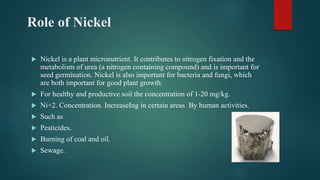
 Nickel is a plant micronutrient. It contributes to nitrogen fixation and the
metabolism of urea (a nitrogen containing compound) and is important for
seed germination. Nickel is also important for bacteria and fungi, which
are both important for good plant growth.
 For healthy and productive soil the concentration of 1-20 mg/kg.
 Ni+2. Concentration. IncreaseIng in certain areas By human activities.
 Such as
 Pesticides.
 Burning of coal and oil.
 Sewage.
Role of mangnese in soil
Role of copper in soil
Habiba Erum
Role of mangnese in soil
 Manganese is used in plants as a major contributor to various biological system.
Including photosynthesis , respiration , and nitrogen assimilation.
 Manganese is also involved in pollen germination pollen tube growth root cell
elongation and resistance to root pathogen.
 Manganese deficiency is a widespread problem most often occuring in sand soil.
 Manganese is an important micronutrients for plant growth and development and
sustains metabolic roles within different plant cell compartment.
 Manganese is used as black brown pigment in paint.
 Mangnese is used in medicine to help support the immune system regulate blood
sugar and maintain in bone red regulation and reproduction.
 Small amount of manganese prsent in food.
 Brown rice
 Sweet potato
Role of copper in soil
 Copper is required for many enzymatic activities in plants and for chlorophyll and seed
production. Deficiency of copper can lead to increased susceptibility to diseases like
ergot, which can cause significant yield loss in small grains. Most Minnesota soils supply
adequate amounts of copper for crop production.
 Copper is an essential micronutrient for plant growth and development. It acts as a
catalyst in photosynthesis and respiration and plays an important role in the formation
of lignin in the cell .

 Copper plays a range of roles in plants. It facilitates respiration and photosynthesis and
is important for plant metabolism. It is a component of a variety of enzymes and plant
cell walls so it is important for plant strength. Copper also affects the flavour, sugar
content and storage life of fruit.
Role of lead in soil
Sources of lead in soil
Chromium
Sources of chromium in soil
Rubina Khan
Role of lead in soil
• Lead is a naturally occurring heavy metal. It is however, toxic to
plants and humans.
• Lead is a metal belonging to group IV and period 6 of the periodic
table with atomic number 82, atomic mass207.2.
• Bluish white in color.
• Lead is released during combustion of fossil fuels and many
manufacturing process produce or release lead.
• It melts at 327 °C and its boiling point is 1750 °C
• Lead is one of the most widespread heavy metal contaminant in soil
• Lead is naturally present in all souls. It generally occurs in the range of 15 to 40
parts lead per million parts of soil (ppm), or 15 to 40 milligrams lead per
kilogram of soil (mg kg).
• Sources of lead in soil
• Higher levels of lead are found in soil:
• Near roadways as a result of air emissions from vehicles that used leaded
gasoline.
• Near the perimeter of buildings that used lead paint that deteriorated as chips and
dusts, or from past renovation activities.
Chromium
 It has atomic number 24, atomic mass 51.996g / mol.
 Its melting point and boiling point of 1907 °C and 2672 °C respectively.
 From Greek word chroma refers to its many colorful compounds.
 Chromium is unstable to oxygen i.e. it react with oxygen to produce a thin oxide layer that is
impermeable to oxygen and thus protects the metal below.
 Chromium is a naturally occurring element in rocks and soil.
 Naturally soil typically contains between 10 and 50 mg of chromium for every kg of soil.
 Chromium affects seed germination, plant growth, photosynthesis and the uptake of a variety of
nutrients.
Sources of chromium in soil
 Found in rocks, plants, soil, in volcanic dust and gases, Cr (0) is used for making steel and alloys, also
found in air as dust, articles, waste streams from electroplating can discharge Ce (VI).
Role of mercury in soil
Role of arsenic in soil
Madiha Akram
ROLE OF MERCURY IN SOIL
 Mercury (Hg) is a potentially harmful trace element in the environment.
 Mercury has toxic effects on plants even st low concentration. And leads to growth retardation .
 The concentration oh Hg in soil from 0.04 to 0.1 with in average value of 0.06 .
 Mercury contaminants in the soil can suppress crops growth or kill plants .
 Highest level found in forest areas.
Role of arsenic in soil
 Arsenic In soil result from human activities including pesticides
 use ,mining and core processing operations,
 operating coal burning power plant
 wastes disposal sites of former tangerines
 Which make leather from animal hides
 have large amount of arsenic in the soil
Advantages and disadvantages of heavy metals
Abida Qasim
Advantages of heavy metal
.high regeneration of materials
. metal selective
.pure metal can be achieved
.most of natal can be removed
.high efficiency (>95%,forl
.less solid waste produced relatively chemical consumption
. Less solid waste produced
. less chemical consumption
. High efficiency 95% for single metal
. Rapid process for toxic pollutants removal
Good removal of wide range of heavy metal
. Flexibility and simplicity design, ease of operation and insensitive to toxic pollutants
. economically feasible
. Rapid process and effective for certain natal ions .
Disadvantages of heavy metals
Heavy metal pollutants of terrestrial ecosystems is of
concern for a number of reasons
. pollutants in the soil may be absorbed through the roots
to gather with soil water in which they are dissolved, and
they are may be either cause injury to the plant or pass
through the food chain when these plans are eaten.
. metal present in atmospheric aerosols, rain water or fog
water maybe deposited into plant surfaces. Unlike organic
pollination, which are broken down to a greater or extent
depending on their reactivity, natal can not be degraded
and
will Ramin in the soil Permanently un less they are
leached out, however, when they are leached out heavy
metal move into surface and ground water and may be
eventually end up in drink water
. cadmium, chromium and, lead among other heavy metal
are known to be dangerous pollutants in our environment.
Inhalation these heavy metal can lead to various health
problems to, particles in ably in children.
.heavy metals can directly influence behaviour by
impairing mental and neurological function, influencing
neurotransmitter processe
1 abdominal pain
2 chronic bronchitis
3 kidney disease
4 pulmonary edam ( accumulation of fluid in lungs )
5 cancer of the lungs
6 nasal sinus ulcers
7 conversations, liver damage and even death
Heavy metal get into the environment water, soil, air ,and
land through activity like intense agriculture, power
generation, industrial discharge etc
Disease

Heavy metals.pptx

  • 1.
  • 2.
    Introduction Examples Properties of Heavymetals Heavy metals in soil Mahnoor Shabbir
  • 3.
    Introduction:  any metallicchemical element that has a relatively high density, atomic weight, or atomic number.  toxic or poisonous at low concentrations.  Examples: Mercury (Hg), cadmium (Cd), arsenic (As), chromium (Cr), thallium (Tl), and lead (Pb).
  • 4.
    Properties of Heavymetals:  Corrosion resistance  Density  Melting point  Thermal properties: • Heat capacity • Thermal conductivity • Thermal expansion  Electrical conductivity  Magnetic properties Properties of Heavy metals:
  • 5.
    Heavy metals insoil:  Enter the soil agro-ecosystem through natural processes derived from parent materials, and through anthropogenic activities.  Heavy metal contamination in agricultural soils may impart functional disorders of soils such as retarded plant growth.  Harm the health of humans through contamination of food chain.  Do not undergo microbial and chemical degradation.  Persist in the soil for longer duration.
  • 6.
    Role of zinc Roleof Nickel Tehmina Mehtabudin
  • 7.
    Role of zinc Zinc is micronutrients For plant growth.  Zinc exits naturalzinc.n rocks. The amount of zinc present in the soil depends on the parent materials of that soil.  Zinc is an important component of various enzymes that are responsible for driving many metabolic reactions in all crops. Growth and development would stop if specific enzymes were not present in plant tissue. Carbohydrate, protein, and chlorophyll formation is significantly reduced in zinc-deficient plants. Therefore, a constant and continuous supply of zinc is needed for optimum growth .  Crops vary in Zn required to complete their life cycle.ield.  Plants fail to develop normally when they are deficient in zinc.  The normal range for zinc in plant tissue is 15-60 ppm .  Although uncommon, zinc toxicity can occur when its levels in the tissue exceed
  • 8.
    Role of Nickel Nickel is a plant micronutrient. It contributes to nitrogen fixation and the metabolism of urea (a nitrogen containing compound) and is important for seed germination. Nickel is also important for bacteria and fungi, which are both important for good plant growth.  For healthy and productive soil the concentration of 1-20 mg/kg.  Ni+2. Concentration. IncreaseIng in certain areas By human activities.  Such as  Pesticides.  Burning of coal and oil.  Sewage.
  • 9.
    Role of mangnesein soil Role of copper in soil Habiba Erum
  • 10.
    Role of mangnesein soil  Manganese is used in plants as a major contributor to various biological system. Including photosynthesis , respiration , and nitrogen assimilation.  Manganese is also involved in pollen germination pollen tube growth root cell elongation and resistance to root pathogen.  Manganese deficiency is a widespread problem most often occuring in sand soil.  Manganese is an important micronutrients for plant growth and development and sustains metabolic roles within different plant cell compartment.
  • 11.
     Manganese isused as black brown pigment in paint.  Mangnese is used in medicine to help support the immune system regulate blood sugar and maintain in bone red regulation and reproduction.  Small amount of manganese prsent in food.  Brown rice  Sweet potato
  • 12.
    Role of copperin soil  Copper is required for many enzymatic activities in plants and for chlorophyll and seed production. Deficiency of copper can lead to increased susceptibility to diseases like ergot, which can cause significant yield loss in small grains. Most Minnesota soils supply adequate amounts of copper for crop production.  Copper is an essential micronutrient for plant growth and development. It acts as a catalyst in photosynthesis and respiration and plays an important role in the formation of lignin in the cell .   Copper plays a range of roles in plants. It facilitates respiration and photosynthesis and is important for plant metabolism. It is a component of a variety of enzymes and plant cell walls so it is important for plant strength. Copper also affects the flavour, sugar content and storage life of fruit.
  • 13.
    Role of leadin soil Sources of lead in soil Chromium Sources of chromium in soil Rubina Khan
  • 14.
    Role of leadin soil • Lead is a naturally occurring heavy metal. It is however, toxic to plants and humans. • Lead is a metal belonging to group IV and period 6 of the periodic table with atomic number 82, atomic mass207.2. • Bluish white in color. • Lead is released during combustion of fossil fuels and many manufacturing process produce or release lead. • It melts at 327 °C and its boiling point is 1750 °C • Lead is one of the most widespread heavy metal contaminant in soil
  • 15.
    • Lead isnaturally present in all souls. It generally occurs in the range of 15 to 40 parts lead per million parts of soil (ppm), or 15 to 40 milligrams lead per kilogram of soil (mg kg). • Sources of lead in soil • Higher levels of lead are found in soil: • Near roadways as a result of air emissions from vehicles that used leaded gasoline. • Near the perimeter of buildings that used lead paint that deteriorated as chips and dusts, or from past renovation activities.
  • 16.
    Chromium  It hasatomic number 24, atomic mass 51.996g / mol.  Its melting point and boiling point of 1907 °C and 2672 °C respectively.  From Greek word chroma refers to its many colorful compounds.  Chromium is unstable to oxygen i.e. it react with oxygen to produce a thin oxide layer that is impermeable to oxygen and thus protects the metal below.  Chromium is a naturally occurring element in rocks and soil.  Naturally soil typically contains between 10 and 50 mg of chromium for every kg of soil.  Chromium affects seed germination, plant growth, photosynthesis and the uptake of a variety of nutrients. Sources of chromium in soil  Found in rocks, plants, soil, in volcanic dust and gases, Cr (0) is used for making steel and alloys, also found in air as dust, articles, waste streams from electroplating can discharge Ce (VI).
  • 17.
    Role of mercuryin soil Role of arsenic in soil Madiha Akram
  • 18.
    ROLE OF MERCURYIN SOIL  Mercury (Hg) is a potentially harmful trace element in the environment.  Mercury has toxic effects on plants even st low concentration. And leads to growth retardation .  The concentration oh Hg in soil from 0.04 to 0.1 with in average value of 0.06 .  Mercury contaminants in the soil can suppress crops growth or kill plants .  Highest level found in forest areas.
  • 20.
    Role of arsenicin soil  Arsenic In soil result from human activities including pesticides  use ,mining and core processing operations,  operating coal burning power plant  wastes disposal sites of former tangerines  Which make leather from animal hides  have large amount of arsenic in the soil
  • 22.
    Advantages and disadvantagesof heavy metals Abida Qasim
  • 23.
    Advantages of heavymetal .high regeneration of materials . metal selective .pure metal can be achieved .most of natal can be removed .high efficiency (>95%,forl .less solid waste produced relatively chemical consumption . Less solid waste produced . less chemical consumption . High efficiency 95% for single metal . Rapid process for toxic pollutants removal Good removal of wide range of heavy metal . Flexibility and simplicity design, ease of operation and insensitive to toxic pollutants . economically feasible . Rapid process and effective for certain natal ions .
  • 24.
    Disadvantages of heavymetals Heavy metal pollutants of terrestrial ecosystems is of concern for a number of reasons . pollutants in the soil may be absorbed through the roots to gather with soil water in which they are dissolved, and they are may be either cause injury to the plant or pass through the food chain when these plans are eaten. . metal present in atmospheric aerosols, rain water or fog water maybe deposited into plant surfaces. Unlike organic pollination, which are broken down to a greater or extent depending on their reactivity, natal can not be degraded and
  • 25.
    will Ramin inthe soil Permanently un less they are leached out, however, when they are leached out heavy metal move into surface and ground water and may be eventually end up in drink water . cadmium, chromium and, lead among other heavy metal are known to be dangerous pollutants in our environment. Inhalation these heavy metal can lead to various health problems to, particles in ably in children. .heavy metals can directly influence behaviour by impairing mental and neurological function, influencing neurotransmitter processe
  • 26.
    1 abdominal pain 2chronic bronchitis 3 kidney disease 4 pulmonary edam ( accumulation of fluid in lungs ) 5 cancer of the lungs 6 nasal sinus ulcers 7 conversations, liver damage and even death Heavy metal get into the environment water, soil, air ,and land through activity like intense agriculture, power generation, industrial discharge etc Disease