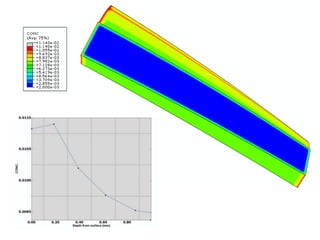
Gas quenching of CARBURIZED PINION GEAR Prediction of Carbon profile
 Determination of Heat Transfer Coefficients
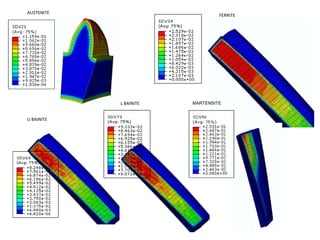
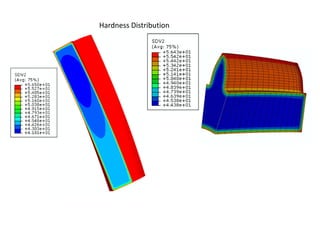
Prediction of Quenched residual Stress State, Metallurgical Phase distribution & Hardness  Profile
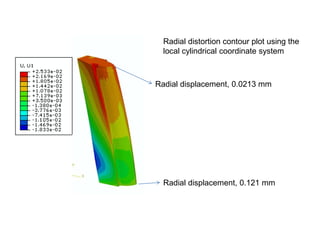
 Prediction of distortionUpwind Technology Inc.6660 Cobb DriveSterling heights, MI 48033586-977-1967
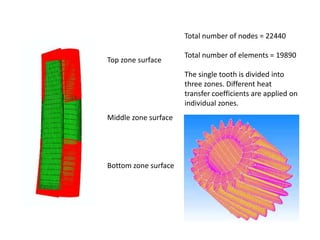
Total number of nodes = 22440Total number of elements = 19890The single tooth is divided into three zones. Different heat transfer coefficients are applied on individual zones. Top zone surfaceMiddle zone surfaceBottom zone surface
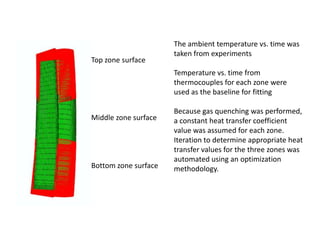
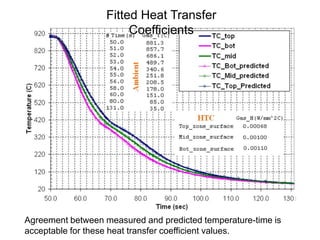
The ambient temperature vs. time was taken from experimentsTemperature vs. time from thermocouples for each zone were used as the baseline for fittingBecause gas quenching was performed, a constant heat transfer coefficient value was assumed for each zone. Iteration to determine appropriate heat transfer values for the three zones was automated using an optimization methodology. Top zone surfaceMiddle zone surfaceBottom zone surface
Fitted Heat Transfer CoefficientsAgreement between measured and predicted temperature-time is acceptable for these heat transfer coefficient values.
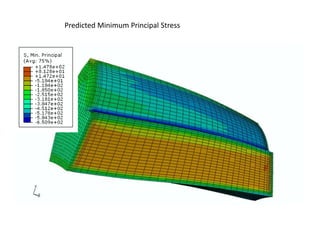
Predicted Minimum Principal StressUnit (mpa)

Heat treatment

  • 1.
    Gas quenching ofCARBURIZED PINION GEAR Prediction of Carbon profile
  • 2.
    Determination ofHeat Transfer Coefficients
  • 3.
    Prediction of Quenchedresidual Stress State, Metallurgical Phase distribution & Hardness Profile
  • 4.
    Prediction ofdistortionUpwind Technology Inc.6660 Cobb DriveSterling heights, MI 48033586-977-1967
  • 6.
    Total number ofnodes = 22440Total number of elements = 19890The single tooth is divided into three zones. Different heat transfer coefficients are applied on individual zones. Top zone surfaceMiddle zone surfaceBottom zone surface
  • 7.
    The ambient temperaturevs. time was taken from experimentsTemperature vs. time from thermocouples for each zone were used as the baseline for fittingBecause gas quenching was performed, a constant heat transfer coefficient value was assumed for each zone. Iteration to determine appropriate heat transfer values for the three zones was automated using an optimization methodology. Top zone surfaceMiddle zone surfaceBottom zone surface
  • 8.
    Fitted Heat TransferCoefficientsAgreement between measured and predicted temperature-time is acceptable for these heat transfer coefficient values.
  • 9.