The Heart and
Circulatory system
BY:KERIM SABIC
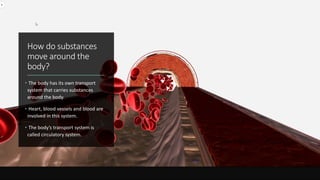
How do substances
move around the
body?
• The body has its own transport
system that carries substances
around the body.
• Heart, blood vessels and blood are
involved in this system.
• The body’s transport system is
called circulatory system.
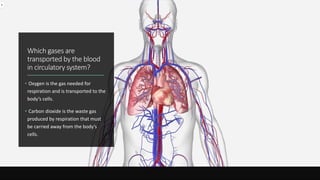
Which gases are
transported by the blood
in circulatory system?
• Oxygen is the gas needed for
respiration and is transported to the
body’s cells.
• Carbon dioxide is the waste gas
produced by respiration that must
be carried away from the body’s
cells.
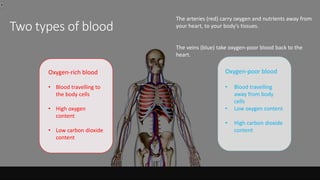
Oxygen-rich blood
• Blood travelling to
the body cells
• High oxygen
content
• Low carbon dioxide
content
Oxygen-poor blood
• Blood travelling
away from body
cells
• Low oxygen content
• High carbon dioxide
content
The arteries (red) carry oxygen and nutrients away from
your heart, to your body's tissues.
The veins (blue) take oxygen-poor blood back to the
heart.
Two types of blood
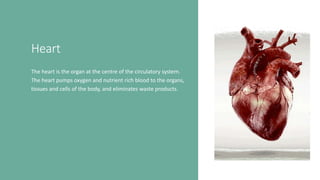
Heart
The heart is the organ at the centre of the circulatory system.
The heart pumps oxygen and nutrient rich blood to the organs,
tissues and cells of the body, and eliminates waste products.
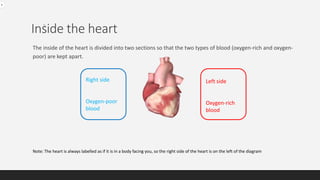
Inside the heart
The inside of the heart is divided into two sections so that the two types of blood (oxygen-rich and oxygen-
poor) are kept apart.
Right side
Oxygen-poor
blood
Left side
Oxygen-rich
blood
Note: The heart is always labelled as if it is in a body facing you, so the right side of the heart is on the left of the diagram
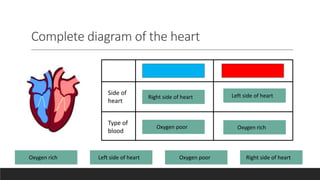
Complete diagram of the heart
Side of
heart
Type of
blood
? ?
??
Oxygen rich Left side of heart Oxygen poor Right side of heart
Oxygen rich
Left side of heart
Oxygen poor
Right side of heart
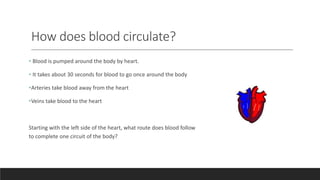
How does blood circulate?
• Blood is pumped around the body by heart.
• It takes about 30 seconds for blood to go once around the body
•Arteries take blood away from the heart
•Veins take blood to the heart
Starting with the left side of the heart, what route does blood follow
to complete one circuit of the body?
How does blood circulate?
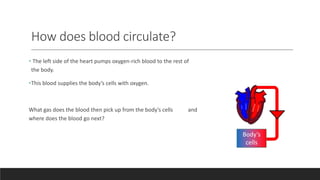
• The left side of the heart pumps oxygen-rich blood to the rest of
the body.
•This blood supplies the body’s cells with oxygen.
What gas does the blood then pick up from the body’s cells and
where does the blood go next?
Body’s
cells
How does blood circulate?
Body’s
cells
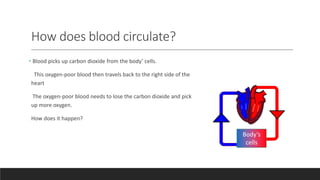
• Blood picks up carbon dioxide from the body’ cells.
This oxygen-poor blood then travels back to the right side of the
heart
The oxygen-poor blood needs to lose the carbon dioxide and pick
up more oxygen.
How does it happen?
How does blood circulate?
Body’s
cells
• Next, the right side of the heart pumps oxygen-poor blood to the
lungs.
•In the lungs the blood gets rid of the waster carbon dioxide and
collects more oxgen.
•Where does this oxygen-rich blood blood then travel too?
Lungs
How does blood circulate?
Body’s
cells
• The oxygen-rich blood then returns to the left side of the heart.
•This completes the blood’s journey around the body.
Why is the journey of blood through the circulatory system is called
double circulation?
Lungs
How does blood circulate?
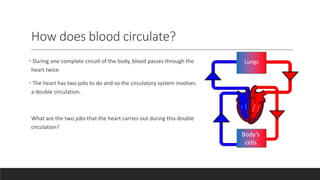
• During one complete circuit of the body, blood passes through the
heart twice
• The heart has two jobs to do and so the circulatory system involves
a double circulation.
What are the two jobs that the heart carries out during this double
circulation?
Body’s
cells
Lungs
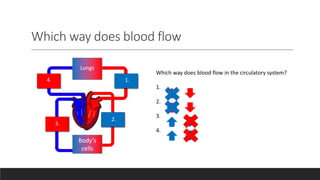
Which way does blood flow
Body’s
cells
Lungs
1.
2.
3.
4.
Which way does blood flow in the circulatory system?
1.
2.
3.
4.
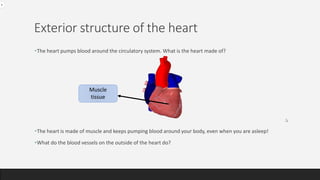
Exterior structure of the heart
•The heart pumps blood around the circulatory system. What is the heart made of?
•The heart is made of muscle and keeps pumping blood around your body, even when you are asleep!
•What do the blood vessels on the outside of the heart do?
Muscle
tissue
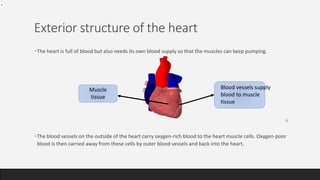
Exterior structure of the heart
•The heart is full of blood but also needs its own blood supply so that the muscles can keep pumping.
•The blood vessels on the outside of the heart carry oxygen-rich blood to the heart muscle cells. Oxygen-poor
blood is then carried away from these cells by outer blood vessels and back into the heart.
Muscle
tissue
Blood vessels supply
blood to muscle
tissue
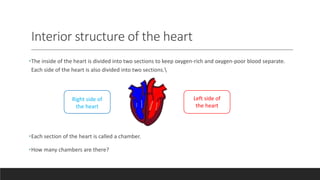
Interior structure of the heart
•The inside of the heart is divided into two sections to keep oxygen-rich and oxygen-poor blood separate.
Each side of the heart is also divided into two sections.
•Each section of the heart is called a chamber.
•How many chambers are there?
Right side of
the heart
Left side of
the heart
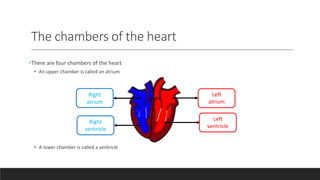
The chambers of the heart
•There are four chambers of the heart
• An upper chamber is called an atrium
• A lower chamber is called a ventricle
Right
ventricle
Left
atrium
Left
ventricle
Right
atrium
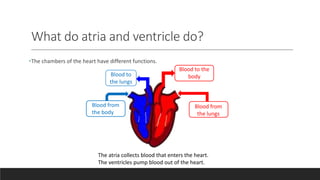
What do atria and ventricle do?
•The chambers of the heart have different functions.
Blood to
the lungs
Blood from
the body
Blood to the
body
Blood from
the lungs
The atria collects blood that enters the heart.
The ventricles pump blood out of the heart.
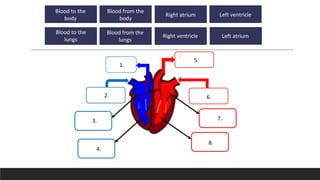
Blood to
the lungs
Blood from
the body
Blood to the
body
Blood from
the lungs
Left
atrium
Left
ventricle
Right
atrium
Right
ventricle
1.
2.
3.
4.
8.
7.
6.
5.
Blood to the
body
Blood from the
body
Right atrium Left ventricle
Blood to the
lungs
Blood from the
lungs
Right ventricle Left atrium
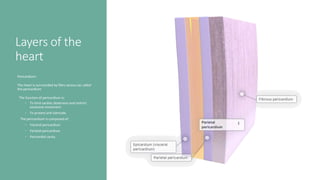
Layers of the
heart
Pericardium:
The heart is surrounded by fibro serous sac called
the pericardium
The function of pericardium is:
◦ To limit cardiac distension and restrict
excessive movement
◦ To protect and lubricate.
The pericardium is composed of:
◦ Visceral pericardium
◦ Parietal pericardium
◦ Pericardial cavity
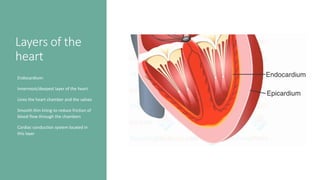
Layers of the
heart
Endocardium:
• Innermost/deepest layer of the heart
• Lines the heart chamber and the valves
• Smooth thin lining to reduce friction of
blood flow through the chambers
• Cardiac conduction system located in
this layer
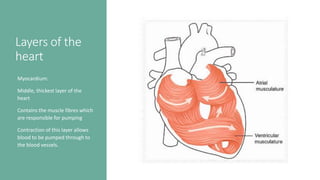
Layers of the
heart
Myocardium:
•Middle, thickest layer of the
heart
•Contains the muscle fibres which
are responsible for pumping
•Contraction of this layer allows
blood to be pumped through to
the blood vessels.
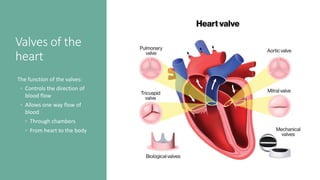
Valves of the
heart
The function of the valves:
◦ Controls the direction of
blood flow
◦ Allows one way flow of
blood
◦ Through chambers
◦ From heart to the body
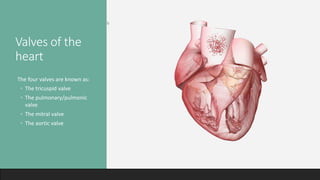
Valves of the
heart
The four valves are known as:
◦ The tricuspid valve
◦ The pulmonary/pulmonic
valve
◦ The mitral valve
◦ The aortic valve
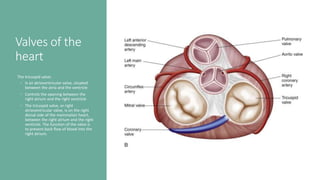
Valves of the
heart
The tricuspid valve:
◦ Is an atrioventricular valve, situated
between the atria and the ventricle
◦ Controls the opening between the
right atrium and the right ventricle
◦ The tricuspid valve, or right
atrioventricular valve, is on the right
dorsal side of the mammalian heart,
between the right atrium and the right
ventricle. The function of the valve is
to prevent back flow of blood into the
right atrium.
Valves of the
heart
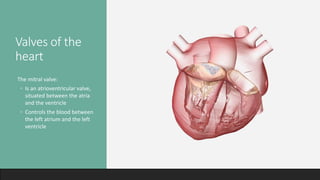
The mitral valve:
◦ Is an atrioventricular valve,
situated between the atria
and the ventricle
◦ Controls the blood between
the left atrium and the left
ventricle
Valves of the
heart
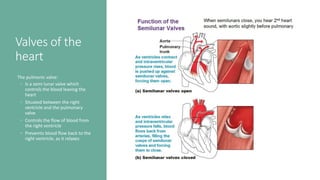
The pulmonic valve:
◦ Is a semi lunar valve which
controls the blood leaving the
heart
◦ Situated between the right
ventricle and the pulmonary
valve
◦ Controls the flow of blood from
the right ventricle
◦ Prevemts blood flow back to the
right ventricle, as it relaxes
Valves of the
heart
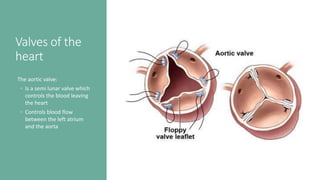
The aortic valve:
◦ Is a semi lunar valve which
controls the blood leaving
the heart
◦ Controls blood flow
between the left atrium
and the aorta
How does the heart pump blood?
Imagine the force needed to squeeze a tennis ball.
That’s how much force the heart uses to pump blood around the
body.
How does the heart produce enough force to keep doing this 24
hours a day?
The heart can pump blood because it is made of muscle. Muscle
tissue works by contracting and relaxing.
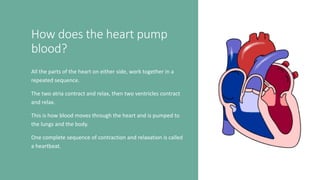
How does the heart pump
blood?
All the parts of the heart on either side, work together in a
repeated sequence.
The two atria contract and relax, then two ventricles contract
and relax.
This is how blood moves through the heart and is pumped to
the lungs and the body.
One complete sequence of contraction and relaxation is called
a heartbeat.
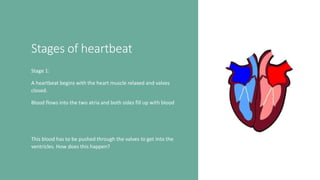
Stages of heartbeat
Stage 1:
A heartbeat begins with the heart muscle relaxed and valves
closed.
Blood flows into the two atria and both sides fill up with blood
This blood has to be pushed through the valves to get into the
ventricles. How does this happen?
Stages of heartbeat
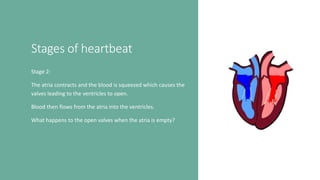
Stage 2:
The atria contracts and the blood is squeezed which causes the
valves leading to the ventricles to open.
Blood then flows from the atria into the ventricles.
What happens to the open valves when the atria is empty?
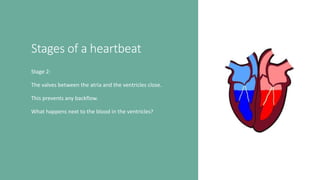
Stages of a heartbeat
Stage 2:
The valves between the atria and the ventricles close.
This prevents any backflow.
What happens next to the blood in the ventricles?
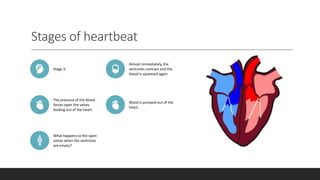
Stages of heartbeat
Stage 3:
Almost immediately, the
ventricles contract and the
blood is squeezed again.
The pressure of the blood
forces open the valves
leading out of the heart.
Blood is pumped out of the
heart.
What happens to the open
valves when the ventricles
are empty?
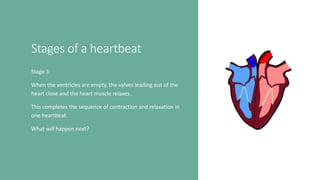
Stages of a heartbeat
Stage 3:
When the ventricles are empty, the valves leading out of the
heart close and the heart muscle relaxes.
This completes the sequence of contraction and relaxation in
one heartbeat.
What will happen next?
Stages of a heartbeat
Stage 1 (again):
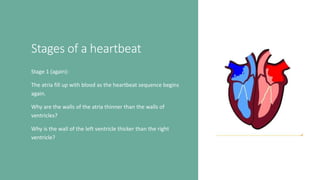
The atria fill up with blood as the heartbeat sequence begins
again.
Why are the walls of the atria thinner than the walls of
ventricles?
Why is the wall of the left ventricle thicker than the right
ventricle?
Breathing
Dynamics with
heart
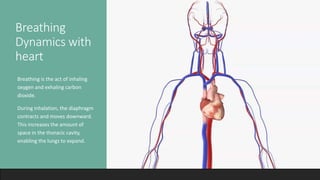
•Breathing is the act of inhaling
oxygen and exhaling carbon
dioxide.
•During inhalation, the diaphragm
contracts and moves downward.
This increases the amount of
space in the thoracic cavity,
enabling the lungs to expand.
Breathing
Dynamics with
heart
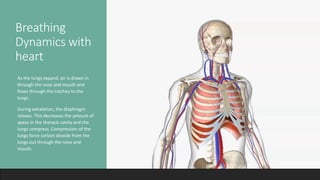
•As the lungs expand, air is drawn in
through the nose and mouth and
flows through the trachea to the
lungs.
•During exhalation, the diaphragm
relaxes. This decreases the amount of
space in the thoracic cavity and the
lungs compress. Compression of the
lungs force carbon dioxide from the
lungs out through the nose and
mouth.
Breathing
Dynamics with
heart
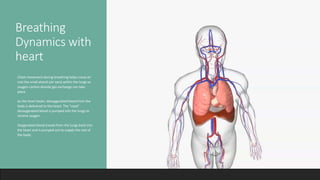
• Chest movement during breathing helps move air
into the small alveoli (air sacs) within the lungs so
oxygen-carbon dioxide gas exchange can take
place.
• As the heart beats, deoxygenated blood from the
body is delivered to the heart. The "used"
deoxygenated blood is pumped into the lungs to
receive oxygen.
• Oxygenated blood travels from the lungs back into
the heart and is pumped out to supply the rest of
the body.

Heart and circulatory system

  • 1.
    The Heart and Circulatorysystem BY:KERIM SABIC
  • 2.
    How do substances movearound the body? • The body has its own transport system that carries substances around the body. • Heart, blood vessels and blood are involved in this system. • The body’s transport system is called circulatory system.
  • 3.
    Which gases are transportedby the blood in circulatory system? • Oxygen is the gas needed for respiration and is transported to the body’s cells. • Carbon dioxide is the waste gas produced by respiration that must be carried away from the body’s cells.
  • 4.
    Oxygen-rich blood • Bloodtravelling to the body cells • High oxygen content • Low carbon dioxide content Oxygen-poor blood • Blood travelling away from body cells • Low oxygen content • High carbon dioxide content The arteries (red) carry oxygen and nutrients away from your heart, to your body's tissues. The veins (blue) take oxygen-poor blood back to the heart. Two types of blood
  • 5.
    Heart The heart isthe organ at the centre of the circulatory system. The heart pumps oxygen and nutrient rich blood to the organs, tissues and cells of the body, and eliminates waste products.
  • 6.
    Inside the heart Theinside of the heart is divided into two sections so that the two types of blood (oxygen-rich and oxygen- poor) are kept apart. Right side Oxygen-poor blood Left side Oxygen-rich blood Note: The heart is always labelled as if it is in a body facing you, so the right side of the heart is on the left of the diagram
  • 7.
    Complete diagram ofthe heart Side of heart Type of blood ? ? ?? Oxygen rich Left side of heart Oxygen poor Right side of heart Oxygen rich Left side of heart Oxygen poor Right side of heart
  • 8.
    How does bloodcirculate? • Blood is pumped around the body by heart. • It takes about 30 seconds for blood to go once around the body •Arteries take blood away from the heart •Veins take blood to the heart Starting with the left side of the heart, what route does blood follow to complete one circuit of the body?
  • 9.
    How does bloodcirculate? • The left side of the heart pumps oxygen-rich blood to the rest of the body. •This blood supplies the body’s cells with oxygen. What gas does the blood then pick up from the body’s cells and where does the blood go next? Body’s cells
  • 10.
    How does bloodcirculate? Body’s cells • Blood picks up carbon dioxide from the body’ cells. This oxygen-poor blood then travels back to the right side of the heart The oxygen-poor blood needs to lose the carbon dioxide and pick up more oxygen. How does it happen?
  • 11.
    How does bloodcirculate? Body’s cells • Next, the right side of the heart pumps oxygen-poor blood to the lungs. •In the lungs the blood gets rid of the waster carbon dioxide and collects more oxgen. •Where does this oxygen-rich blood blood then travel too? Lungs
  • 12.
    How does bloodcirculate? Body’s cells • The oxygen-rich blood then returns to the left side of the heart. •This completes the blood’s journey around the body. Why is the journey of blood through the circulatory system is called double circulation? Lungs
  • 13.
    How does bloodcirculate? • During one complete circuit of the body, blood passes through the heart twice • The heart has two jobs to do and so the circulatory system involves a double circulation. What are the two jobs that the heart carries out during this double circulation? Body’s cells Lungs
  • 14.
    Which way doesblood flow Body’s cells Lungs 1. 2. 3. 4. Which way does blood flow in the circulatory system? 1. 2. 3. 4.
  • 15.
    Exterior structure ofthe heart •The heart pumps blood around the circulatory system. What is the heart made of? •The heart is made of muscle and keeps pumping blood around your body, even when you are asleep! •What do the blood vessels on the outside of the heart do? Muscle tissue
  • 16.
    Exterior structure ofthe heart •The heart is full of blood but also needs its own blood supply so that the muscles can keep pumping. •The blood vessels on the outside of the heart carry oxygen-rich blood to the heart muscle cells. Oxygen-poor blood is then carried away from these cells by outer blood vessels and back into the heart. Muscle tissue Blood vessels supply blood to muscle tissue
  • 17.
    Interior structure ofthe heart •The inside of the heart is divided into two sections to keep oxygen-rich and oxygen-poor blood separate. Each side of the heart is also divided into two sections. •Each section of the heart is called a chamber. •How many chambers are there? Right side of the heart Left side of the heart
  • 18.
    The chambers ofthe heart •There are four chambers of the heart • An upper chamber is called an atrium • A lower chamber is called a ventricle Right ventricle Left atrium Left ventricle Right atrium
  • 19.
    What do atriaand ventricle do? •The chambers of the heart have different functions. Blood to the lungs Blood from the body Blood to the body Blood from the lungs The atria collects blood that enters the heart. The ventricles pump blood out of the heart.
  • 20.
    Blood to the lungs Bloodfrom the body Blood to the body Blood from the lungs Left atrium Left ventricle Right atrium Right ventricle 1. 2. 3. 4. 8. 7. 6. 5. Blood to the body Blood from the body Right atrium Left ventricle Blood to the lungs Blood from the lungs Right ventricle Left atrium
  • 21.
    Layers of the heart Pericardium: Theheart is surrounded by fibro serous sac called the pericardium The function of pericardium is: ◦ To limit cardiac distension and restrict excessive movement ◦ To protect and lubricate. The pericardium is composed of: ◦ Visceral pericardium ◦ Parietal pericardium ◦ Pericardial cavity
  • 22.
    Layers of the heart Endocardium: •Innermost/deepest layer of the heart • Lines the heart chamber and the valves • Smooth thin lining to reduce friction of blood flow through the chambers • Cardiac conduction system located in this layer
  • 23.
    Layers of the heart Myocardium: •Middle,thickest layer of the heart •Contains the muscle fibres which are responsible for pumping •Contraction of this layer allows blood to be pumped through to the blood vessels.
  • 24.
    Valves of the heart Thefunction of the valves: ◦ Controls the direction of blood flow ◦ Allows one way flow of blood ◦ Through chambers ◦ From heart to the body
  • 25.
    Valves of the heart Thefour valves are known as: ◦ The tricuspid valve ◦ The pulmonary/pulmonic valve ◦ The mitral valve ◦ The aortic valve
  • 26.
    Valves of the heart Thetricuspid valve: ◦ Is an atrioventricular valve, situated between the atria and the ventricle ◦ Controls the opening between the right atrium and the right ventricle ◦ The tricuspid valve, or right atrioventricular valve, is on the right dorsal side of the mammalian heart, between the right atrium and the right ventricle. The function of the valve is to prevent back flow of blood into the right atrium.
  • 27.
    Valves of the heart Themitral valve: ◦ Is an atrioventricular valve, situated between the atria and the ventricle ◦ Controls the blood between the left atrium and the left ventricle
  • 28.
    Valves of the heart Thepulmonic valve: ◦ Is a semi lunar valve which controls the blood leaving the heart ◦ Situated between the right ventricle and the pulmonary valve ◦ Controls the flow of blood from the right ventricle ◦ Prevemts blood flow back to the right ventricle, as it relaxes
  • 29.
    Valves of the heart Theaortic valve: ◦ Is a semi lunar valve which controls the blood leaving the heart ◦ Controls blood flow between the left atrium and the aorta
  • 30.
    How does theheart pump blood? Imagine the force needed to squeeze a tennis ball. That’s how much force the heart uses to pump blood around the body. How does the heart produce enough force to keep doing this 24 hours a day? The heart can pump blood because it is made of muscle. Muscle tissue works by contracting and relaxing.
  • 31.
    How does theheart pump blood? All the parts of the heart on either side, work together in a repeated sequence. The two atria contract and relax, then two ventricles contract and relax. This is how blood moves through the heart and is pumped to the lungs and the body. One complete sequence of contraction and relaxation is called a heartbeat.
  • 32.
    Stages of heartbeat Stage1: A heartbeat begins with the heart muscle relaxed and valves closed. Blood flows into the two atria and both sides fill up with blood This blood has to be pushed through the valves to get into the ventricles. How does this happen?
  • 33.
    Stages of heartbeat Stage2: The atria contracts and the blood is squeezed which causes the valves leading to the ventricles to open. Blood then flows from the atria into the ventricles. What happens to the open valves when the atria is empty?
  • 34.
    Stages of aheartbeat Stage 2: The valves between the atria and the ventricles close. This prevents any backflow. What happens next to the blood in the ventricles?
  • 35.
    Stages of heartbeat Stage3: Almost immediately, the ventricles contract and the blood is squeezed again. The pressure of the blood forces open the valves leading out of the heart. Blood is pumped out of the heart. What happens to the open valves when the ventricles are empty?
  • 36.
    Stages of aheartbeat Stage 3: When the ventricles are empty, the valves leading out of the heart close and the heart muscle relaxes. This completes the sequence of contraction and relaxation in one heartbeat. What will happen next?
  • 37.
    Stages of aheartbeat Stage 1 (again): The atria fill up with blood as the heartbeat sequence begins again. Why are the walls of the atria thinner than the walls of ventricles? Why is the wall of the left ventricle thicker than the right ventricle?
  • 38.
    Breathing Dynamics with heart •Breathing isthe act of inhaling oxygen and exhaling carbon dioxide. •During inhalation, the diaphragm contracts and moves downward. This increases the amount of space in the thoracic cavity, enabling the lungs to expand.
  • 39.
    Breathing Dynamics with heart •As thelungs expand, air is drawn in through the nose and mouth and flows through the trachea to the lungs. •During exhalation, the diaphragm relaxes. This decreases the amount of space in the thoracic cavity and the lungs compress. Compression of the lungs force carbon dioxide from the lungs out through the nose and mouth.
  • 40.
    Breathing Dynamics with heart • Chestmovement during breathing helps move air into the small alveoli (air sacs) within the lungs so oxygen-carbon dioxide gas exchange can take place. • As the heart beats, deoxygenated blood from the body is delivered to the heart. The "used" deoxygenated blood is pumped into the lungs to receive oxygen. • Oxygenated blood travels from the lungs back into the heart and is pumped out to supply the rest of the body.