Career Development and Workforce
Preparation for Non-College Bound
High School Students
A Case Study
by
Alton C. Strange
University of Pennsylvania
Graduate School of Education
Rationale
• The career development and workforce preparation needs
of non-college bound (NCB) students have largely been
ignored
• The high school may be the last place where NCB
students can learn career development and workforce
preparation skills
• NCB students are leaving without the skills or
preparation needed to compete for good jobs
• Without these skills these students will likely struggle to
find a good job and become part of the working poor
Context of the Study
– Two Philadelphia urban, comprehensive,
public high schools
• High school 312
• High school 414
– Both prepared their non-college bound (NCB)
high school students with skills and attitudes
to be competitive when applying for a “good
job.”
Definitions
• A good job: a job that offers a reasonable salary,
decent benefits, and the some option for mobility
(McKernan, 1994).
• Non-college bound students: any student who is
not planning to apply to or enroll in a post-
secondary education program for at least one
year.
Research Questions
• What role do teachers and curriculum play in
assisting NCB students to develop their career
plans and learn about workforce demands?
• Are the courses required for graduation providing
workforce skills and attitudes?
• Are there other means by which students learn
these skills? If so, what are they?
Design of the Case Study
• Method: Qualitative Case Study Using
– Participant Observation in:
• HS 312: October 1994-December 1999
• HS 414: January 2000-May 2000
– Individual Student Interviews in HS 414
• Measures: The questions were developed from the
information collected from site observations at HS 312 & HS
414.
• Participants: Fifteen randomly selected Seniors from HS 414
– 6 Male & 9 Female
– Ages 17-19
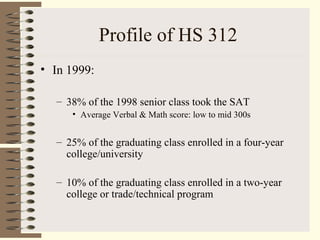
Profile of HS 312
• In 1999:
– 38% of the 1998 senior class took the SAT
• Average Verbal & Math score: low to mid 300s
– 25% of the graduating class enrolled in a four-year
college/university
– 10% of the graduating class enrolled in a two-year
college or trade/technical program
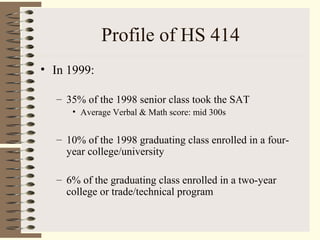
Profile of HS 414
• In 1999:
– 35% of the 1998 senior class took the SAT
• Average Verbal & Math score: mid 300s
– 10% of the 1998 graduating class enrolled in a four-
year college/university
– 6% of the graduating class enrolled in a two-year
college or trade/technical program
Profile Summary
HS 314 & HS 414
• Both have:
– A 95-98% African-American student population
– Principals that have less than three years experience as
a Principal
• Each school is:
– Surrounded by a wealth of resources, universities,
research institutes,and hospitals
– Trying to address the needs of its non-college bound
students by incorporating career development and
workforce preparation skills into the curriculum
Interview Questions
1. If you could have the job you really wanted, how
much schooling would you need in order to obtain
this job?
2. How far do you realistically expect to go in formal
education before you call it quits?
3. What are your plans four to five months after you
graduate?
4. How much formal schooling does the woman who
takes the most care of you have? How much formal
schooling does the man who takes the most care of
you have?
Interview Questions (continued)
5. Are you eligible to receive free lunch from
your school?
6. Before you went to high school, did you
have any out-of school work experiences?
What skills did you learn at these jobs?
During your first year in high school, did
you have any out-of school work
experiences? What skills did you learn at
this job?
Interview Questions (continued)
During your second year in high school, did you have
any out-of-school work experience? What skills did
you learn at this job?
During you third year in high school, did you have
any out-of-work experience? What skills did you
learn at this job?
In your final year of high school, did you have any
out-of-school work experience? What skills did you
learn at this job?
Interview Questions (continued)
7. Is there a specific person(s) who provided you
with career advice? How has this advice been
helpful?
Is there a specific experience when the advice
was not helpful?
8. How has your family’s (immediate and extended)
views of education positively affected your view
of education?
How has your family’s (immediate and extended)
view of education negatively affected your view
of education?
Analysis of Findings
• The teacher and curricula play important roles in
helping NCB students to learn about workforce
demands and plan their future careers
– HS 312 took an “additive” approach
• Worked with public and private partners to create the
Workforce Training Center (WTC)
– HS 414 took an “integrative” approach
• Worked to incorporate career development and workforce
preparation skills into the SLC daily curricula.
Analysis of Findings (continued)
• Participant observation also indicated that many
teachers:
– Were not adequately informed about the demands and
expectations of employers.
– Did not know how to adjust the curriculum to meet the
needs of NCB students
– Did not know the post-graduation plans of NCB
students
Analysis of Findings (continued)
• Student interviews suggested that a majority of NCB
seniors were leaving without career guidance or
advice from teachers or other school staff
– A majority of the seniors said they received their job/career
advice from family members and friends
– Only two of the 15 seniors said they received advice from
their teacher/coordinator
– None of the seniors said they received advice from the
Guidance Counselor or the Career Specialist
– Most of the advice the seniors received was generally
anecdotal
• Example: “don’t quit until you have another job”; “hard work
equals success”
Analysis of Findings (continued)
• The information supports the view that the competitive
occupational chances of these students are at risk because
they are leaving high school with insufficient career
development and workforce preparation skills
– 60% worked during all 4 years of high school
– The jobs the seniors held were:
• Fast food, Restaurant, & Supermarket franchises
• Only 2 seniors had experience working in an office/white-
collar environment
– Some of the skills learned at these jobs were:
• Customer Service/People skills
• Patience/Controlling their temper
• How to use the cash register
Summary
• A majority of the seniors interviewed did not have access
to an informed person who could provide information,
guidance, or advice on getting a good job
• Students were relying on family members and friends for
career and job advice
• The curricula were generalized and did not provide the
skills needed to compete for good jobs
• NCB students were leaving with a false sense of their
skills and competitiveness for good jobs
Educational Implications
• High schools have to do a better job helping non-college
bound students make the connections between education and
work
• High schools have to provide non-college bound students with
a curriculum that supports workforce skills and a strong
academic foundation
• Teachers require more direct education about how to adjust the
curriculum to meet the needs of non-college bound students
• High schools must ensure they are equally valuing students
choosing to enter the workforce and students choosing higher
education
Recommendations for Future
Research & Evaluation
• How to get more teacher involvement in state and
federal school legislation
• Career development and workforce preparation
seminars for all students, but especially for High
School Juniors and Seniors
• The need for a basic uniform standard among
school-to-work programs.
– Employers must have a way to distinguish the skills
and knowledge high school graduates have when
entering the workforce

Hearing SlidesA

  • 1.
    Career Development andWorkforce Preparation for Non-College Bound High School Students A Case Study by Alton C. Strange University of Pennsylvania Graduate School of Education
  • 2.
    Rationale • The careerdevelopment and workforce preparation needs of non-college bound (NCB) students have largely been ignored • The high school may be the last place where NCB students can learn career development and workforce preparation skills • NCB students are leaving without the skills or preparation needed to compete for good jobs • Without these skills these students will likely struggle to find a good job and become part of the working poor
  • 3.
    Context of theStudy – Two Philadelphia urban, comprehensive, public high schools • High school 312 • High school 414 – Both prepared their non-college bound (NCB) high school students with skills and attitudes to be competitive when applying for a “good job.”
  • 4.
    Definitions • A goodjob: a job that offers a reasonable salary, decent benefits, and the some option for mobility (McKernan, 1994). • Non-college bound students: any student who is not planning to apply to or enroll in a post- secondary education program for at least one year.
  • 5.
    Research Questions • Whatrole do teachers and curriculum play in assisting NCB students to develop their career plans and learn about workforce demands? • Are the courses required for graduation providing workforce skills and attitudes? • Are there other means by which students learn these skills? If so, what are they?
  • 6.
    Design of theCase Study • Method: Qualitative Case Study Using – Participant Observation in: • HS 312: October 1994-December 1999 • HS 414: January 2000-May 2000 – Individual Student Interviews in HS 414 • Measures: The questions were developed from the information collected from site observations at HS 312 & HS 414. • Participants: Fifteen randomly selected Seniors from HS 414 – 6 Male & 9 Female – Ages 17-19
  • 7.
    Profile of HS312 • In 1999: – 38% of the 1998 senior class took the SAT • Average Verbal & Math score: low to mid 300s – 25% of the graduating class enrolled in a four-year college/university – 10% of the graduating class enrolled in a two-year college or trade/technical program
  • 8.
    Profile of HS414 • In 1999: – 35% of the 1998 senior class took the SAT • Average Verbal & Math score: mid 300s – 10% of the 1998 graduating class enrolled in a four- year college/university – 6% of the graduating class enrolled in a two-year college or trade/technical program
  • 9.
    Profile Summary HS 314& HS 414 • Both have: – A 95-98% African-American student population – Principals that have less than three years experience as a Principal • Each school is: – Surrounded by a wealth of resources, universities, research institutes,and hospitals – Trying to address the needs of its non-college bound students by incorporating career development and workforce preparation skills into the curriculum
  • 10.
    Interview Questions 1. Ifyou could have the job you really wanted, how much schooling would you need in order to obtain this job? 2. How far do you realistically expect to go in formal education before you call it quits? 3. What are your plans four to five months after you graduate? 4. How much formal schooling does the woman who takes the most care of you have? How much formal schooling does the man who takes the most care of you have?
  • 11.
    Interview Questions (continued) 5.Are you eligible to receive free lunch from your school? 6. Before you went to high school, did you have any out-of school work experiences? What skills did you learn at these jobs? During your first year in high school, did you have any out-of school work experiences? What skills did you learn at this job?
  • 12.
    Interview Questions (continued) Duringyour second year in high school, did you have any out-of-school work experience? What skills did you learn at this job? During you third year in high school, did you have any out-of-work experience? What skills did you learn at this job? In your final year of high school, did you have any out-of-school work experience? What skills did you learn at this job?
  • 13.
    Interview Questions (continued) 7.Is there a specific person(s) who provided you with career advice? How has this advice been helpful? Is there a specific experience when the advice was not helpful? 8. How has your family’s (immediate and extended) views of education positively affected your view of education? How has your family’s (immediate and extended) view of education negatively affected your view of education?
  • 14.
    Analysis of Findings •The teacher and curricula play important roles in helping NCB students to learn about workforce demands and plan their future careers – HS 312 took an “additive” approach • Worked with public and private partners to create the Workforce Training Center (WTC) – HS 414 took an “integrative” approach • Worked to incorporate career development and workforce preparation skills into the SLC daily curricula.
  • 15.
    Analysis of Findings(continued) • Participant observation also indicated that many teachers: – Were not adequately informed about the demands and expectations of employers. – Did not know how to adjust the curriculum to meet the needs of NCB students – Did not know the post-graduation plans of NCB students
  • 16.
    Analysis of Findings(continued) • Student interviews suggested that a majority of NCB seniors were leaving without career guidance or advice from teachers or other school staff – A majority of the seniors said they received their job/career advice from family members and friends – Only two of the 15 seniors said they received advice from their teacher/coordinator – None of the seniors said they received advice from the Guidance Counselor or the Career Specialist – Most of the advice the seniors received was generally anecdotal • Example: “don’t quit until you have another job”; “hard work equals success”
  • 17.
    Analysis of Findings(continued) • The information supports the view that the competitive occupational chances of these students are at risk because they are leaving high school with insufficient career development and workforce preparation skills – 60% worked during all 4 years of high school – The jobs the seniors held were: • Fast food, Restaurant, & Supermarket franchises • Only 2 seniors had experience working in an office/white- collar environment – Some of the skills learned at these jobs were: • Customer Service/People skills • Patience/Controlling their temper • How to use the cash register
  • 18.
    Summary • A majorityof the seniors interviewed did not have access to an informed person who could provide information, guidance, or advice on getting a good job • Students were relying on family members and friends for career and job advice • The curricula were generalized and did not provide the skills needed to compete for good jobs • NCB students were leaving with a false sense of their skills and competitiveness for good jobs
  • 19.
    Educational Implications • Highschools have to do a better job helping non-college bound students make the connections between education and work • High schools have to provide non-college bound students with a curriculum that supports workforce skills and a strong academic foundation • Teachers require more direct education about how to adjust the curriculum to meet the needs of non-college bound students • High schools must ensure they are equally valuing students choosing to enter the workforce and students choosing higher education
  • 20.
    Recommendations for Future Research& Evaluation • How to get more teacher involvement in state and federal school legislation • Career development and workforce preparation seminars for all students, but especially for High School Juniors and Seniors • The need for a basic uniform standard among school-to-work programs. – Employers must have a way to distinguish the skills and knowledge high school graduates have when entering the workforce

Editor's Notes

  • #7 Discuss the transition from HS 312 to 414
  • #8 Discuss Report Card on the Schools
  • #9 Based on the low enrollment percentage of HS 414 graduates into post-secondary education programs, I believed every senior could be considered non-college bound.
  • #11 Free Lunch = Some form of Gov’t Assistance Question 1-3 taken from Slaughter-Defoe & Rubin