Venture Labs
Empathy and Define Phases
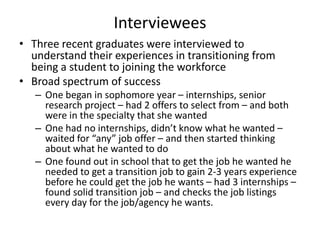
Interviewees
• Three recent graduates were interviewed to
understand their experiences in transitioning from
being a student to joining the workforce
• Broad spectrum of success
– One began in sophomore year – internships, senior
research project – had 2 offers to select from – and both
were in the specialty that she wanted
– One had no internships, didn’t know what he wanted –
waited for “any” job offer – and then started thinking
about what he wanted to do
– One found out in school that to get the job he wanted he
needed to get a transition job to gain 2-3 years experience
before he could get the job he wants – had 3 internships –
found solid transition job – and checks the job listings
every day for the job/agency he wants.
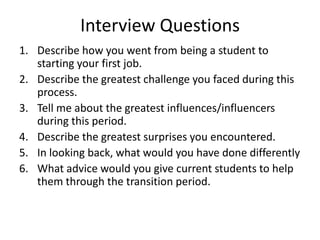
Interview Questions
1. Describe how you went from being a student to
starting your first job.
2. Describe the greatest challenge you faced during this
process.
3. Tell me about the greatest influences/influencers
during this period.
4. Describe the greatest surprises you encountered.
5. In looking back, what would you have done differently
6. What advice would you give current students to help
them through the transition period.
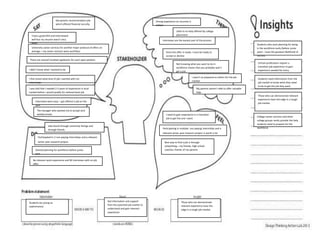
Participated in 2 non-paying internships and a relevant
senior year research project
Started planning for workforce before junior
year
No relevant work experience and 90 interviews with no job
offer.
Strong experience on resumes is
critical
I need to gain experience in a transition
job to get the one I want
Jobs found through university listings and
through friends Participating in multiple non-paying internships and a
relevant senior year research project is worth a lot
Little to no help offered by college
placement
Interviews are the easiest part of the process
I had a good GPA and interviewed
well but my resume wasn’t very
good.
University career services for another major produces 8 offers on
average – my career services were worthless
My parents recommended a job
which offered financial security.
There are several hundred applicants for each open position
I didn’t know what I wanted to do
I fine-tuned what kind of job I wanted with my
internships
I was told that I needed 2-3 years of experience in local
market before I would qualify for national level job
Interviews were easy – got offered a job on the
spot
The manager who wanted me to accept sent
weekly emails
Once the offer is made, I must be ready to
accept or decline
Best way to find a job is through
networking – my friends, high school
coaches, friends of my parents
Not knowing what you want to do in
workforce means that you probably won’t
get a job
Students who start planning for being
in the workforce early (before junior
year) – have the greatest likelihood of
success
College career services and other
college groups rarely provide the help
students need to prepare for the
workforce
Certain professions require a
transition job experience to gain
experience needed for entry
Students need information from the
job market to know what they need
to do to get the job they want.
Students (as young as
sophomores)
Get information and support
from the potential job market to
understand and gain relevant
experience
Those who can demonstrate
relevant experience have the
edge in a tough job market.
Those who can demonstrate relevant
experience have the edge in a tough
job market.
I wasn’t as prepared as others for the job
market
My parents weren’t able to offer valuable
help.
Additional “Say” Quotes
• I can’t understand why my good GPA and interview
skills didn’t work
• I was offered a job on the spot, and given 6 months to
make a decision
• I had to go through physical and psychological test, and
have a Background investigation and a polygraph
• I submitted several resumes (approximately 90) and
didn’t have a single call back
• I researched what was needed to be accepted for the
job I wanted
• My friends helped me find promising jobs
• My university career service only told how to interview

Empathize and define

  • 1.
  • 2.
    Interviewees • Three recentgraduates were interviewed to understand their experiences in transitioning from being a student to joining the workforce • Broad spectrum of success – One began in sophomore year – internships, senior research project – had 2 offers to select from – and both were in the specialty that she wanted – One had no internships, didn’t know what he wanted – waited for “any” job offer – and then started thinking about what he wanted to do – One found out in school that to get the job he wanted he needed to get a transition job to gain 2-3 years experience before he could get the job he wants – had 3 internships – found solid transition job – and checks the job listings every day for the job/agency he wants.
  • 3.
    Interview Questions 1. Describehow you went from being a student to starting your first job. 2. Describe the greatest challenge you faced during this process. 3. Tell me about the greatest influences/influencers during this period. 4. Describe the greatest surprises you encountered. 5. In looking back, what would you have done differently 6. What advice would you give current students to help them through the transition period.
  • 4.
    Participated in 2non-paying internships and a relevant senior year research project Started planning for workforce before junior year No relevant work experience and 90 interviews with no job offer. Strong experience on resumes is critical I need to gain experience in a transition job to get the one I want Jobs found through university listings and through friends Participating in multiple non-paying internships and a relevant senior year research project is worth a lot Little to no help offered by college placement Interviews are the easiest part of the process I had a good GPA and interviewed well but my resume wasn’t very good. University career services for another major produces 8 offers on average – my career services were worthless My parents recommended a job which offered financial security. There are several hundred applicants for each open position I didn’t know what I wanted to do I fine-tuned what kind of job I wanted with my internships I was told that I needed 2-3 years of experience in local market before I would qualify for national level job Interviews were easy – got offered a job on the spot The manager who wanted me to accept sent weekly emails Once the offer is made, I must be ready to accept or decline Best way to find a job is through networking – my friends, high school coaches, friends of my parents Not knowing what you want to do in workforce means that you probably won’t get a job Students who start planning for being in the workforce early (before junior year) – have the greatest likelihood of success College career services and other college groups rarely provide the help students need to prepare for the workforce Certain professions require a transition job experience to gain experience needed for entry Students need information from the job market to know what they need to do to get the job they want. Students (as young as sophomores) Get information and support from the potential job market to understand and gain relevant experience Those who can demonstrate relevant experience have the edge in a tough job market. Those who can demonstrate relevant experience have the edge in a tough job market. I wasn’t as prepared as others for the job market My parents weren’t able to offer valuable help.
  • 5.
    Additional “Say” Quotes •I can’t understand why my good GPA and interview skills didn’t work • I was offered a job on the spot, and given 6 months to make a decision • I had to go through physical and psychological test, and have a Background investigation and a polygraph • I submitted several resumes (approximately 90) and didn’t have a single call back • I researched what was needed to be accepted for the job I wanted • My friends helped me find promising jobs • My university career service only told how to interview