“Factors Affecting Grade-12 student in their Career
Choice S.Y.2021-2022”
Pepito R. Bermudez Jr.
John Jetro Espetero
(RESEARCHERS)
12-HUMSS
Dingalan National High School
Submitted to:
Mrs. Sherlyn Corpuz
(Subject teacher:
Inquiries, Investigation and Immersion)
ABSTRACT
This study may help them to clarify what factors really affect them in their
decision making of their career choice.
According to Kerka (2000), career choice is influenced by multiple factors
including personality, interests, self-concept, cultural identity, globalization,
socialization, role model, social support and available resources such as
information and financial. The researchers use the Likert scale to know the
factors affect the grade 12 students in their decision making of their career
choice. There are total population of 146 students from grade 12. There are 59
total students from HUMSS, 46 total students from GAS and 41 total students
from TVL. From that the researcher got a sample population of 20; 7 students
from HUMSS, 7 students from GAS and 6 students from TVL that will be the
respondents of the study. The respondents are chosen randomly with the margin
of error 10%. The study shows that it is the student by his/herself or personal
factor is still the most influential factor. It was their capability and skill to be on
the career that they want.
Abstract
Acknowledgement
Chapter I
Background of the Study
Statement of the Problem
Scope and Delimitations
Significance of the Study
Chapter II
Review of Related Literature
Chapter III
Methodology
Research Design
Sample
Data Analysis
Instrument of the Study
Statistical Treatment
Research Ethics
TABLE OF CONTENTS
Chapter IV
Presentation Analysis
Interpretation
Chapter V
Conclusion
Recommendation
REFERENCES
List of Tables
Table 1
Table 2
Table 3
Table 4
Table 5
Table 6
Table 7
Table 8
Table 9
ACKNOWLEDGEMENT
In the search of the researchers for knowledge and experience in life, they
are reminded more and more just how lucky they have been. This study
will not be possible if not for the reassurance and help they got in
conducting the study.
To their parents Mr. & Mrs. Bermudez and Mr. Mrs. & Espetero who gave
a financial and moral support to their son in conducting this study. To
all students who helped and participated on this study. To Mrs. Sherlyn
Corpuz, the Inquiries, Investigation and Immersion teacher, who
guided the researchers while conducting the study.
The researchers are very thankful for all the help and kindness that you
gave to the researchers.
BACKGROUND OF THE STUDY
There is a big effect to a student on how is he or she chooses his or her career. There
are many factors that may affect a student to choose the career they want to be
or have in the near future. Factors like Family, Social and Personal. The
students are being influenced by their environment or experiences. The one that
they choose may fulfill their dreams or disappoint them because they did not
have want they want to be. Their decision must be 100% sure and no regrets will
be felt after. Because when you enter to the higher education there must be no
turning back. If so, you only wasted your time because of unsure decisions.
The influence of career choice has a lasting impact on an individual. It serves to be a
predictor and determinant of their prospective level of income, nature of work
and consequently leaves a mark on the personality, demeanor and outlook of an
individual. Thus, one wrong decision can change the fate of an individual. It is
difficult for everyone to make a decision regarding their career. This individual
action is manifested on a larger scale in the economic prosperity of a nation.
Individuals who are misfits in their workplace tend to be less productive and
efficient, and therefore are unable to achieve their goals. (Asma Shahid Kazi &
Abeeda Akhlaq, 2017)
The major part of people life is spent in occupational activities and these pursuits do more than simply
provide income for livelihood (Bandura, 2002:279). There is a widespread agreement that the high
school years are crucial for adolescents to become prepared for transition from school to work or
college (Amoah, Kwofie & Kwofie, 2015:57; Ombaba, Keraro, Sindabi & Asiengo, 2014: 921; Rowland,
2004:1).
Secondary school years present the transition from the cooperatively sheltered life of the primary
school to the freedom and responsibility of either tertiary education or employment (Watts & Kidd,
2000:488; MaluwaBanda, 1998:294). Career guidance is widely accepted as a powerful and effective
method of bridging the gap between education and the world of work (Ibrahim, Wambiya, Olaka &
Raburu, 2014:301; Ajufo, 2013:312).
In 2009, President Obama addressed members of a joint session of Congress where he challenged the
American public to increase their educational investments in themselves (The White House, 2009).
President Obama recommended that Americans increase their knowledge and training beyond a high
school diploma through accessing professional technical training programs, community college courses,
or two- and four-year institutions, for at least one year in order to better their lives. The President’s
challenge came in response the United States continuing to fall behind other nations in the rankings of
percentage of college-educated individuals between ages 25 and 34 (Schneider, 2009).
In 2012, three years after the challenge was given, only 38% of Americans between ages 25 and 34 had
completed a two- or four-year postsecondary degree (Organization for Economic Cooperation and
Developing Countries, 2012).
STATEMENT OF THE PROBLEM
This study uses the descriptive quantitative research of
the student in their career choice. In order to better
understand the factors affecting the decision making
of the grade 12 student in Dingalan National High
School in their career choice. At this part of research,
the factors and how it affects the Grade 12 students
in their decision making will be generally defined as
main objective of the research. This research sought
to answer the following questions:
1. What is the profile of the respondents in terms of:
Age
Strand
Member of the family working
Parent’s marital status
Parent’s Occupation
2. What is the most influential factor that affects the student in their
career choice?
3. How does this factor affect students in choosing their career?
SCOPE DELIMITATION
 This research focused mainly on the factors affecting the Grade 12 students in choosing
their career and how this affects them as a student, daughter/son and member of a
community.
 The respondents of the research will be 20 Grade 12 students of Dingalan National High
School. The researchers will survey 20 Grade 12 students from 3 different strands; 7 for
Humanities and Social Sciences (HUMSS), 7 from General Academic Strand (GAS) and
6 from Technological and Vocational Livelihood (TVL).
 This study was concerned with the decision making of Grade 12 students of DNHS in
their career choice. The students that are included in the research are the Grade 12
students that are studying in the DNHS, Grade 12 students outside the school are not
included. The teachers and other school staff are not involved in the study but they will
get a benefit on the research.
 The research will focus on the factors affecting the Grade 12 students in their
decision making on their career choice. More than that information will not be included.
SIGNIFICANCE OF THE STUDY
To all Grade12 Students,
This study may help them to clarify what factors
really affect them in their decision making of their
career choice.
To all future researchers,
This research may help them to have an advance idea
about the topic that they choose.
REVIEW OF RELATED LITERATURE
It is important for a researcher to find some related literature about the topic so they could
have advance idea and knowledge about it. There are many recent researches about the
factors that affect students on their decision making for their career. Throughout the
1900s and 2000s, researchers have studied students’ decision-making processes for going
to college and selecting careers (Choy, 2002). Due to the increased demand for skilled
workers, it has become vital for students to go on to a post secondary institution to
obtain a professional technical certificate, an associate’s degree, or a bachelor’s degree.
As a result of the complexity of the job market, workers are encouraged to seek
additional training and schooling to have the necessary skills to be competitive in the
workforce (National Governors Association Center, 2010). Among the benefits a society
experiences when students invest in higher education are economic growth to national
income and productivity along with economic growth to the state workforce (Perna,
2006). The community in which the institution resides also experiences economic growth
as does the community where the individual graduate resides (Fatima & Paulsen, 2004)
Other benefits to society are an increase in community service and civic participation, a
reduction in the need for social support programs, and lower crime rates (Baum &
Payea, 2004) Research confirmed that the more education the parent had, the greater
chance there was of their child enrolling in a four-year college (Choy, 2002).
In a study by Perrone et al., (2001) on role model influence on the career decisiveness of
college students, it was found that role model supportiveness, and quality of relationship
contributed to the career choice of students. The same study indicated that majority of the
students selected same gender role models. Research on the role of spirituality and
religion in career development although limited in scope has suggested that such factors
relate positively to desirable career development outcomes such as career decisions. For
many people with spiritual or religious commitment faith plays a critical role in the career
decision making process. (Duffy and Dick 2009). A Study on career choice in Ethiopia by
Stebleton (2007) indicated that the students had an external locus of control and believes
that there are numerous external factors which influence their career choices. These
external factors include; political and economic considerations, previous work experience
and the influence of key individuals in a person’s life. Pummel, Harwood and Lavallee
(2008) reports that external influences that helps to shape an individual’s career choice
are also influenced by significant others through social support from peers. In a study by
Natalie (2006), young adults through interaction with the context of family, school and
community learn about and explore careers which ultimately lead to their career choice.
One consistent finding in research suggests that adolescents’ own aspirations are
influenced by their parent’s aspirations or expectations. Parental support and
encouragement are important factors that have been found to influence career choice.
Children may choose what their parents desire simply to please them (Taylor et al, 2004)
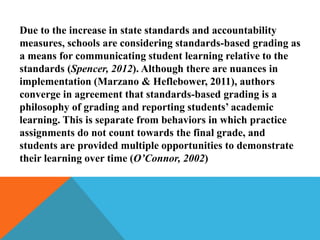
Due to the increase in state standards and accountability
measures, schools are considering standards-based grading as
a means for communicating student learning relative to the
standards (Spencer, 2012). Although there are nuances in
implementation (Marzano & Heflebower, 2011), authors
converge in agreement that standards-based grading is a
philosophy of grading and reporting students’ academic
learning. This is separate from behaviors in which practice
assignments do not count towards the final grade, and
students are provided multiple opportunities to demonstrate
their learning over time (O’Connor, 2002)
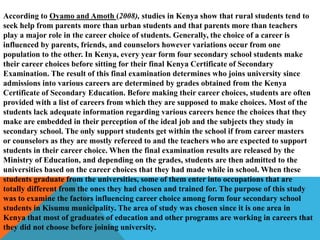
According to Oyamo and Amoth (2008), studies in Kenya show that rural students tend to
seek help from parents more than urban students and that parents more than teachers
play a major role in the career choice of students. Generally, the choice of a career is
influenced by parents, friends, and counselors however variations occur from one
population to the other. In Kenya, every year form four secondary school students make
their career choices before sitting for their final Kenya Certificate of Secondary
Examination. The result of this final examination determines who joins university since
admissions into various careers are determined by grades obtained from the Kenya
Certificate of Secondary Education. Before making their career choices, students are often
provided with a list of careers from which they are supposed to make choices. Most of the
students lack adequate information regarding various careers hence the choices that they
make are embedded in their perception of the ideal job and the subjects they study in
secondary school. The only support students get within the school if from career masters
or counselors as they are mostly refereed to and the teachers who are expected to support
students in their career choice. When the final examination results are released by the
Ministry of Education, and depending on the grades, students are then admitted to the
universities based on the career choices that they had made while in school. When these
students graduate from the universities, some of them enter into occupations that are
totally different from the ones they had chosen and trained for. The purpose of this study
was to examine the factors influencing career choice among form four secondary school
students in Kisumu municipality. The area of study was chosen since it is one area in
Kenya that most of graduates of education and other programs are working in careers that
they did not choose before joining university.
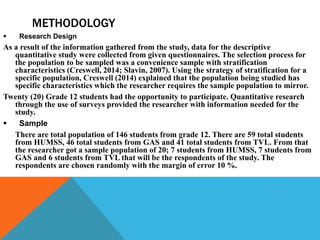
METHODOLOGY
 Research Design
As a result of the information gathered from the study, data for the descriptive
quantitative study were collected from given questionnaires. The selection process for
the population to be sampled was a convenience sample with stratification
characteristics (Creswell, 2014; Slavin, 2007). Using the strategy of stratification for a
specific population, Creswell (2014) explained that the population being studied has
specific characteristics which the researcher requires the sample population to mirror.
Twenty (20) Grade 12 students had the opportunity to participate. Quantitative research
through the use of surveys provided the researcher with information needed for the
study.
 Sample
There are total population of 146 students from grade 12. There are 59 total students
from HUMSS, 46 total students from GAS and 41 total students from TVL. From that
the researcher got a sample population of 20; 7 students from HUMSS, 7 students from
GAS and 6 students from TVL that will be the respondents of the study. The
respondents are chosen randomly with the margin of error 10 %.
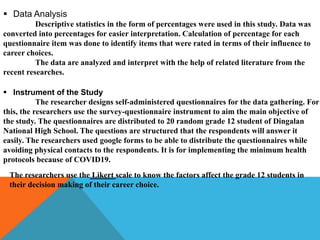
 Data Analysis
Descriptive statistics in the form of percentages were used in this study. Data was
converted into percentages for easier interpretation. Calculation of percentage for each
questionnaire item was done to identify items that were rated in terms of their influence to
career choices.
The data are analyzed and interpret with the help of related literature from the
recent researches.
 Instrument of the Study
The researcher designs self-administered questionnaires for the data gathering. For
this, the researchers use the survey-questionnaire instrument to aim the main objective of
the study. The questionnaires are distributed to 20 random grade 12 student of Dingalan
National High School. The questions are structured that the respondents will answer it
easily. The researchers used google forms to be able to distribute the questionnaires while
avoiding physical contacts to the respondents. It is for implementing the minimum health
protocols because of COVID19.
The researchers use the Likert scale to know the factors affect the grade 12 students in
their decision making of their career choice.
 Statistical Treatment
The researchers count and groups the information gathered using tallying.
The researcher uses the Descriptive Statistics where the data was summarized using
the table and graphs.
 Research Ethics
The researchers make sure that they are prioritizing the five ethics of
research; informed consent, beneficence-do not harm, respects the anonymity and
confidentiality and respect for privacy.
 Data was collected with the permission of respondents and the main goal of study
was well stated by the respondents. In addition, it was ensured to respondents that
the data will not use for any unrelated business.
PRESENTATION, ANALYSIS AND INTERPRETATION
On this part of research will show the presentation, analysis and
interpretation of the data that gathered from the 20 grade 12 students.
It aims to discuss the different factors that affect the grade12 student in
their decision making for their career choice.
 Research Question 1: What is the profile of the respondent in terms of:
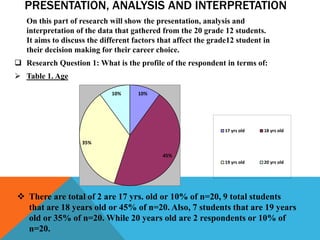
 Table 1. Age
10%
45%
35%
10%
17 yrs old 18 yrs old
19 yrs old 20 yrs old
 There are total of 2 are 17 yrs. old or 10% of n=20, 9 total students
that are 18 years old or 45% of n=20. Also, 7 students that are 19 years
old or 35% of n=20. While 20 years old are 2 respondents or 10% of
n=20.
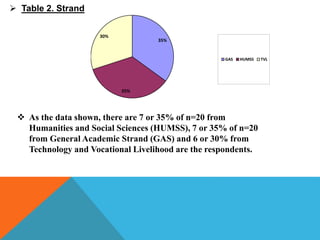
 Table 2. Strand
35%
35%
30%
GAS HUMSS TVL
 As the data shown, there are 7 or 35% of n=20 from
Humanities and Social Sciences (HUMSS), 7 or 35% of n=20
from General Academic Strand (GAS) and 6 or 30% from
Technology and Vocational Livelihood are the respondents.
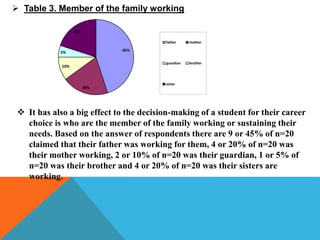
 Table 3. Member of the family working
45%
20%
10%
5%
20%
father mother
guardian brother
sister
 It has also a big effect to the decision-making of a student for their career
choice is who are the member of the family working or sustaining their
needs. Based on the answer of respondents there are 9 or 45% of n=20
claimed that their father was working for them, 4 or 20% of n=20 was
their mother working, 2 or 10% of n=20 was their guardian, 1 or 5% of
n=20 was their brother and 4 or 20% of n=20 was their sisters are
working.
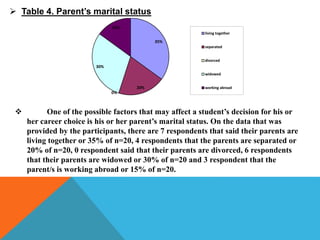
 Table 4. Parent’s marital status
35%
20%
0%
30%
15%
living together
separated
divorced
widowed
working abroad
 One of the possible factors that may affect a student’s decision for his or
her career choice is his or her parent’s marital status. On the data that was
provided by the participants, there are 7 respondents that said their parents are
living together or 35% of n=20, 4 respondents that the parents are separated or
20% of n=20, 0 respondent said that their parents are divorced, 6 respondents
that their parents are widowed or 30% of n=20 and 3 respondent that the
parent/s is working abroad or 15% of n=20.
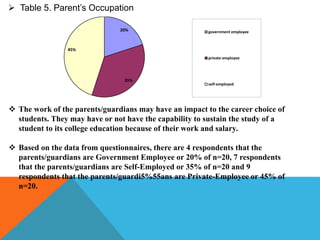
 Table 5. Parent’s Occupation
20%
35%
45%
government employee
private employee
self-employed
 The work of the parents/guardians may have an impact to the career choice of
students. They may have or not have the capability to sustain the study of a
student to its college education because of their work and salary.
 Based on the data from questionnaires, there are 4 respondents that the
parents/guardians are Government Employee or 20% of n=20, 7 respondents
that the parents/guardians are Self-Employed or 35% of n=20 and 9
respondents that the parents/guardi5%55ans are Private-Employee or 45% of
n=20.
 Research Question 2: What is the factor that affects the student the most
in their career choice?
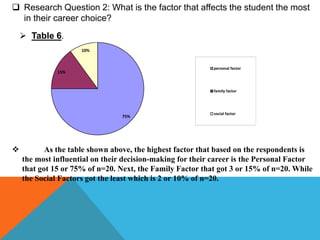
 Table 6.
75%
15%
10%
personal factor
family factor
social factor
 As the table shown above, the highest factor that based on the respondents is
the most influential on their decision-making for their career is the Personal Factor
that got 15 or 75% of n=20. Next, the Family Factor that got 3 or 15% of n=20. While
the Social Factors got the least which is 2 or 10% of n=20.
CONCLUSION
According to Kerka (2000), career choice is influenced by multiple factors
including personality, interests, self-concept, cultural identity,
globalization, socialization, role model, social support and available
resources such as information and financial. The result shown that
personal factors got the most influential factor in decision making of
student to their career. There are still students that prioritized what
they want and what they think right for their future.
Regarding the influence of personal interest on career choice, the study
reported that more than 70% of the students who participated were
influenced by personal interest when making career choice. These
findings are not strange considering those students’ interests are often
shaped by their environment, the people they interact with and more so
their life experiences as they grow. The results on learning experiences
indicate that over 70% of participants agree that learning experiences
influence their choice of career. (Edwards K. & Quinter M, 2011)
There is a reason behind why personal factor is the most
influential factor that affects students in their decision making.
Every person plays different roles in his or her life. He is a
worker at work, a parent, husband or wife at home. And every
person thinks about himself in these different roles and
decides which role will be the most important for him. And
this decision may influence the career choice and the way the
person looks at his work. (Essay for Today, 2014).
 Research Question 3: How does this factor affect students in
choosing their career?
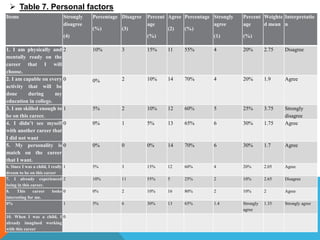
 Table 7. Personal factors
Items Strongly
disagree
(4)
Percentage
(%)
Disagree
(3)
Percent
age
(%)
Agree
(2)
Percentage
(%)
Strongly
agree
(1)
Percent
age
(%)
Weighte
d mean
Interpretatio
n
1. I am physically and
mentally ready on the
career that I will
choose.
2 10% 3 15% 11 55% 4 20% 2.75 Disagree
2. I am capable on every
activity that will be
done during my
education in college.
0 0% 2 10% 14 70% 4 20% 1.9 Agree
3. I am skilled enough to
be on this career.
1 5% 2 10% 12 60% 5 25% 3.75 Strongly
disagree
4. I didn’t see myself
with another career that
I did not want
0 0% 1 5% 13 65% 6 30% 1.75 Agree
5. My personality is
match on the career
that I want.
0 0% 0 0% 14 70% 6 30% 1.7 Agree
6. Since I was a child, I really
dream to be on this career
1 5% 3 15% 12 60% 4 20% 2.05 Agree
7. I already experienced
being in this career.
2 10% 11 55% 5 25% 2 10% 2.65 Disagree
8. This career looks
interesting for me.
0 0% 2 10% 16 80% 2 10% 2 Agree
0% 1 5% 6 30% 13 65% 1.4 Strongly
agree
1.35 Strongly agree
10. When I was a child, I
already imagined working
with this career
0
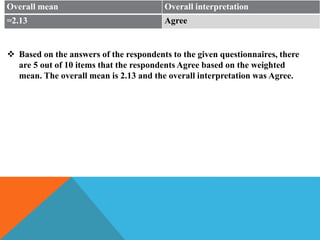
Overall mean Overall interpretation
=2.13 Agree
 Based on the answers of the respondents to the given questionnaires, there
are 5 out of 10 items that the respondents Agree based on the weighted
mean. The overall mean is 2.13 and the overall interpretation was Agree.
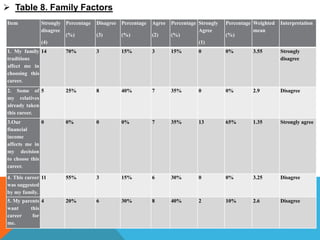
 Table 8. Family Factors
Item Strongly
disagree
(4)
Percentage
(%)
Disagree
(3)
Percentage
(%)
Agree
(2)
Percentage
(%)
Strongly
Agree
(1)
Percentage
(%)
Weighted
mean
Interpretation
1. My family
traditions
affect me in
choosing this
career.
14 70% 3 15% 3 15% 0 0% 3.55 Strongly
disagree
2. Some of
my relatives
already taken
this career.
5 25% 8 40% 7 35% 0 0% 2.9 Disagree
3.Our
financial
income
affects me in
my decision
to choose this
career.
0 0% 0 0% 7 35% 13 65% 1.35 Strongly agree
4. This career
was suggested
by my family.
11 55% 3 15% 6 30% 0 0% 3.25 Disagree
5. My parents
want this
career for
me.
4 20% 6 30% 8 40% 2 10% 2.6 Disagree
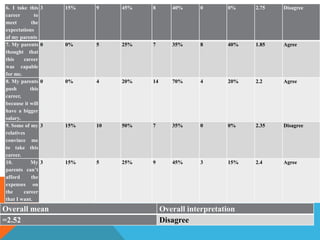
6. I take this
career to
meet the
expectations
of my parents
3 15% 9 45% 8 40% 0 0% 2.75 Disagree
7. My parents
thought that
this career
was capable
for me.
0 0% 5 25% 7 35% 8 40% 1.85 Agree
8. My parents
push this
career,
because it will
have a bigger
salary.
0 0% 4 20% 14 70% 4 20% 2.2 Agree
9. Some of my
relatives
convince me
to take this
career.
3 15% 10 50% 7 35% 0 0% 2.35 Disagree
10. My
parents can’t
afford the
expenses on
the career
that I want.
3 15% 5 25% 9 45% 3 15% 2.4 Agree
Overall mean Overall interpretation
=2.52 Disagree
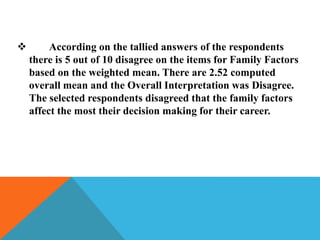
 According on the tallied answers of the respondents
there is 5 out of 10 disagree on the items for Family Factors
based on the weighted mean. There are 2.52 computed
overall mean and the Overall Interpretation was Disagree.
The selected respondents disagreed that the family factors
affect the most their decision making for their career.
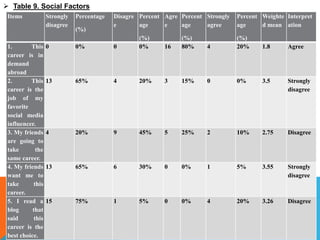
 Table 9. Social Factors
Items Strongly
disagree
Percentage
(%)
Disagre
e
Percent
age
(%)
Agre
e
Percent
age
(%)
Strongly
agree
Percent
age
(%)
Weighte
d mean
Interpret
ation
1. This
career is in
demand
abroad
0 0% 0 0% 16 80% 4 20% 1.8 Agree
2. This
career is the
job of my
favorite
social media
influencer.
13 65% 4 20% 3 15% 0 0% 3.5 Strongly
disagree
3. My friends
are going to
take the
same career.
4 20% 9 45% 5 25% 2 10% 2.75 Disagree
4. My friends
want me to
take this
career.
13 65% 6 30% 0 0% 1 5% 3.55 Strongly
disagree
5. I read a
blog that
said this
career is the
best choice.
15 75% 1 5% 0 0% 4 20% 3.26 Disagree
6. I saw at
social media
that this career
is easy to take.
6 30% 13 65% 1 5% 0 0% 3.25 Disagree
7. My friends
thought that
this career is
suitable for
me.
0 0% 4 20% 3 15% 13 65% 1.55 Agree
8. This career
got a larger
salary abroad.
0 0% 2 10% 16 80% 4 20% 2.1 Agree
9. Social media
help me a lot
to find my
career in the
near future.
2 10% 14 70% 4 20% 0 0% 2.9 Disagree
10. This career
will help the
society to fulfil
the lack of
worker.
0 0% 6 30% 11 55% 3 15% 2.15 Agree
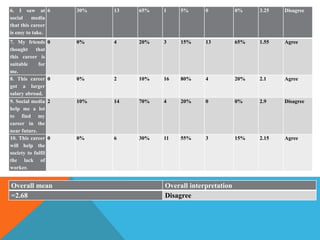
Overall mean Overall interpretation
=2.68 Disagree
 Based on the given data from the participant
there is 4 out of 10 disagree on the weighted mean
for Social Factors. The overall computed mean was
2.68 while the overall interpretation was Disagree.
The respondents, in overall disagree that Social
Factors affect the student the most in their
decision-making for their career.
CONCLUSION AND RECOMMENDATIONS
 Conclusion
In order to be productive citizens in society, students need to be college- and career-
ready by the time they graduate from high school. (Shana Hawkins, 2015).
The study shows that it is the student by his/herself is still the most influential factor.
It was their capability and skill to be on the career that they want. The
participants who had planned to pursue higher education selected the personal
factors as the most influential in their decision-making for their career.
However, parents/guardian and other adults in the community provide guidance
and mentoring to high school students. In addition, it is the highly-trained
school counsellors and other high school personnel who have the enough
knowledge of the requirements needed to assist students choose the right career
for them. The students must be reminded on what will be the things that they
must prioritized when they are choosing the career for themselves but also to the
people around them, especially, their family.
 Recommendation
 To all students,
This study will guide and help the student choose their respective careers and
take it without hesitations, also they enjoy and they are happy to their career
that they choose.
 To school staff's,
They will know how to guide their students in choosing their careers, and this
study will give some help to clarify the confusion to all students that will ask on
them on how they choose their careers that will surely help the community.
 To all parents,
It will help them to choose the career for their children, and also, they can
support them that they will know that the career that chooses by their child is
the best for them.
 To all future researchers,
This study will help the future researchers to get some new ideas and also to
improve their learning in this study. It is therefore recommended that a similar
study be conducted in which many factors affecting career choice decisions can
be explored.
REFERENCES
• Choy, S. P. (2002). Access and persistence: Findings from 10 years of longitudinal research on
students. American Council on Education Center for Policy Analysis. Retrieved from
http://inpathways.net/access.pdf
• Clarke, C. P., Gushue, G. V., Pantzer, K. M., & Scanlan, K. R. L. (2006). The relationship of career
decision-making self-efficacy, vocational identity, and career exploration behavior in African
American high school students. Journal of Career Development, 33(1), 19-28. doi:
10.11777/0894845305283004
• Conklin, A. M., Dahling, J. J., & Garcia, P. A. (2012). Linking affective commitment, career self-
efficacy, and outcome expectations: A test of social cognitive career theory. Journal of Career
Development, 40(1), 68-83. doi: 10.1177/0894845311423534
• Govan, G. V., Patrick, S., & Yen, C. (2006). How high school students construct decisionmaking
strategies for choosing colleges. College and University Journal, 81(3), 19-29.
• Grodsky, E., & Riegle-Crumb, C. (2010). Those who choose and those who don’t: Social background
and college orientation. The Annals of the American Academy of Political and Social Science,
627(1), 1-35. doi: 10.1177/0002716209348732
• Perna, L. W. (2010). Toward a more complete understanding of the role of financial aid in promoting
college enrollment: The importance of context. Higher Education: Handbook of Theory and
Research, 25, 129-179. doi: 10.1007/978-90-481-8598-6
• Perna, L. W., & Titus, M. A. (2005). The relationship between parental involvement as social capital
and college enrollment: An examination of racial/ethnic group differences. The Journal of Higher
Education, 76(5), 485-518.
• McKechnie, J. D. (2012). Factors related to college going self-efficacy among urban African
American high school students. (Doctoral dissertation). Retrieved from PQDT Open.(3543594).
• Boser, U., & Burd, S. (2009). Bridging the gap: How to strengthen the Pk-16 pipeline to improve
college readiness. Education Policy Program, New America Foundation. Retrieved from
http://www.newamerica.net/files/NAF%20Bridging%20the%20Gap.pdf
• National Governors Association Center. (2010). Setting statewide college- and career-ready.
Washington, DC. Retrieved from
http://www.nga.org/files/live/sites/NGA/files/pdf/1008COLLEGECAREERREADYGOALS.PDF
• Leslie, L. L., & Brinkman, P. T. (1988). The economic value of higher education. The Journal of
Higher Education, 60(5), 609-611.
• Fatima, N., & Paulsen, M.B. (2004). Higher education and state workforce
productivity in the 1990s. Thought and Action: NEA Higher Education Journal, 20(1),
75–94.
• Paulsen, M. (1990). College choice: Understanding student enrollment behavior.
ASHE-ERIC Higher Education Report No. 6. Washington, DC:
• Baum, S., & Payea, K. (2004). Education pays 2004: The benefits of higher education
for individuals and society. Retrieved from
http://www.collegeboard.com/prod_downloads/press/cost04/EducationPays2004.pdf
• Perrone, K. M., Sedlacek, E. W. and Alexander, M. C. (2001). Gender and ethnic
differences in career goal attainment.Career Development Quarterly. 50(2), 168-178.
• Duffy, R. D. and Dik, B. J. (2009). Beyond the self: external influences in the career
development process. Career Development Quarterly. 8(1), 29-43.
• Stebleton, M. J. (2007) Career counseling with African immigrant colleges: theoretical
approaches and implications for practice. Career Development Quartely, 55(4), 290-
312.
• Pummel, B., Harwood, C. and Lavallee, D. (2008). Jumping to the next level: A
qualitative examination of within career transition in adolescent’s event riders,
Psychology of Sport and exercise. 9(4), 427-447.
• Natalie, M. F. (2006). Factors influencing career choice of adolescents and young
adults in rural Penn Sylvia. Journal of Extension, 44(3).
• Taylor, J., Harris, M. and Taylor, S. (2004). Parents have their say about their
college aged children’s career decisions. National Association of Colleges ans
Employers Journal, 64 (3).
• Spencer, K. (2012). Standards-based grading. Harvard Education Letter, 28(5).
Retrieved from http://hepg.org/hel-home/issues/28_5/helarticle/standards-based-
grading_545.
• Marzano, R. J., & Heflebower, T. (2011). Grades that show what students know.
Educational Leadership, 69(3), 34-39.
• O’Connor, K. (2002). How to grade for learning: Linking grades to standards
(2nd ed.).Thousand Oaks, CA: Corwin.
• Bandura, A. (1988). Organisational application of social cognitive theory.
Australian Journal of Management, 13(2):275-302.
• Bandura, A. (1989). Social cognitive theory. In Annals of child development: Six
theories of child development (Vol.6). edited by R. Vasta. Greenwich, CT: JAI
Press:1-60.
• Bandura, A. (2002). Social cognitive theory in cultural context. Applied
Psychology: An International Review, 51:269-290.
• Shahid, A. & Akhlaq, K. (2017) Factors Affecting Students’ Career Choice
https://www.researchgate.net/publication/325987918_Factors_Affecting_Studen
ts'_Career_Choice/link/5ba0ab3c299bf13e6038e19d/download
• Bandura, A. Barbaranelli, c., Caprara, G.,& Pastorelli, C. (2001). Self-
efficacy beliefs as aspirations and Carrier trajectories. Child Development,
72 187-206
• The White House. (2009). President Barack Obama address to the joint
session of congress. Retrieved from
http://www.whitehouse.gov/the_press_office/Remarks-of-PresidentBarack-
Obama-Address-to-Joint-Session-of-Congress
• Amoah, S.A., Kwofie, I. & Kwofie, F.A.A. (2015). The school counsellor and
students’ career choice in high schools: The assessor’s perspective in a
Ghanaian case. Journal of Education and Practice, 6(23):57-65
• Watts, A.G. & Kidd, J.M. (2000). Guidance in the United Kingdom: Past,
present and future. British Journal of Guidance and Counselling, 28:485-
502.
• Ibrahim, R., Olaka, P.J.O., Wambiya, P. & Raburu, B.O. (2014). Perceptions on the
role of guidance and counselling programme on Kenyan Secondary School students’
career decision making. Journal of Education and Social Sciences, 4(6):301
• Schneider, M. (2009). Obama’s educational hopes face achievement realities. The
Journal of the American Enterprise Institute. Retrieved from
http://www.american.com/archive/2009/april-2009/obama2019s-education-hopes-
faceachievement-realities/
• Organization for Economic Cooperation and Developing Countries. (2012).
Education at a glance: OECD indicators 2012. Retrieved from
http://www.oecd.org/unitedstates/CN%20-%20United%20States.pdf
• Oyamo, O. R., and Amoth, D (2008). Choice of final year options by undergraduate
students at the Moi School of Information Sciences. East African Journal of
Information Science
• https://essay4today.com/blog/what-influences-your-career-choice
• Kerka, S. (2000). Career development, gender, race and class.Eric Clearing house on
Adult Careed and Vocational Education Columbus. ED 421641.

THESIS PRESENTATION about Factors Affect

  • 1.
    “Factors Affecting Grade-12student in their Career Choice S.Y.2021-2022”
  • 2.
    Pepito R. BermudezJr. John Jetro Espetero (RESEARCHERS) 12-HUMSS Dingalan National High School Submitted to: Mrs. Sherlyn Corpuz (Subject teacher: Inquiries, Investigation and Immersion)
  • 3.
    ABSTRACT This study mayhelp them to clarify what factors really affect them in their decision making of their career choice. According to Kerka (2000), career choice is influenced by multiple factors including personality, interests, self-concept, cultural identity, globalization, socialization, role model, social support and available resources such as information and financial. The researchers use the Likert scale to know the factors affect the grade 12 students in their decision making of their career choice. There are total population of 146 students from grade 12. There are 59 total students from HUMSS, 46 total students from GAS and 41 total students from TVL. From that the researcher got a sample population of 20; 7 students from HUMSS, 7 students from GAS and 6 students from TVL that will be the respondents of the study. The respondents are chosen randomly with the margin of error 10%. The study shows that it is the student by his/herself or personal factor is still the most influential factor. It was their capability and skill to be on the career that they want.
  • 4.
    Abstract Acknowledgement Chapter I Background ofthe Study Statement of the Problem Scope and Delimitations Significance of the Study Chapter II Review of Related Literature Chapter III Methodology Research Design Sample Data Analysis Instrument of the Study Statistical Treatment Research Ethics TABLE OF CONTENTS
  • 5.
    Chapter IV Presentation Analysis Interpretation ChapterV Conclusion Recommendation REFERENCES List of Tables Table 1 Table 2 Table 3 Table 4 Table 5 Table 6 Table 7 Table 8 Table 9
  • 6.
    ACKNOWLEDGEMENT In the searchof the researchers for knowledge and experience in life, they are reminded more and more just how lucky they have been. This study will not be possible if not for the reassurance and help they got in conducting the study. To their parents Mr. & Mrs. Bermudez and Mr. Mrs. & Espetero who gave a financial and moral support to their son in conducting this study. To all students who helped and participated on this study. To Mrs. Sherlyn Corpuz, the Inquiries, Investigation and Immersion teacher, who guided the researchers while conducting the study. The researchers are very thankful for all the help and kindness that you gave to the researchers.
  • 8.
    BACKGROUND OF THESTUDY There is a big effect to a student on how is he or she chooses his or her career. There are many factors that may affect a student to choose the career they want to be or have in the near future. Factors like Family, Social and Personal. The students are being influenced by their environment or experiences. The one that they choose may fulfill their dreams or disappoint them because they did not have want they want to be. Their decision must be 100% sure and no regrets will be felt after. Because when you enter to the higher education there must be no turning back. If so, you only wasted your time because of unsure decisions. The influence of career choice has a lasting impact on an individual. It serves to be a predictor and determinant of their prospective level of income, nature of work and consequently leaves a mark on the personality, demeanor and outlook of an individual. Thus, one wrong decision can change the fate of an individual. It is difficult for everyone to make a decision regarding their career. This individual action is manifested on a larger scale in the economic prosperity of a nation. Individuals who are misfits in their workplace tend to be less productive and efficient, and therefore are unable to achieve their goals. (Asma Shahid Kazi & Abeeda Akhlaq, 2017)
  • 9.
    The major partof people life is spent in occupational activities and these pursuits do more than simply provide income for livelihood (Bandura, 2002:279). There is a widespread agreement that the high school years are crucial for adolescents to become prepared for transition from school to work or college (Amoah, Kwofie & Kwofie, 2015:57; Ombaba, Keraro, Sindabi & Asiengo, 2014: 921; Rowland, 2004:1). Secondary school years present the transition from the cooperatively sheltered life of the primary school to the freedom and responsibility of either tertiary education or employment (Watts & Kidd, 2000:488; MaluwaBanda, 1998:294). Career guidance is widely accepted as a powerful and effective method of bridging the gap between education and the world of work (Ibrahim, Wambiya, Olaka & Raburu, 2014:301; Ajufo, 2013:312). In 2009, President Obama addressed members of a joint session of Congress where he challenged the American public to increase their educational investments in themselves (The White House, 2009). President Obama recommended that Americans increase their knowledge and training beyond a high school diploma through accessing professional technical training programs, community college courses, or two- and four-year institutions, for at least one year in order to better their lives. The President’s challenge came in response the United States continuing to fall behind other nations in the rankings of percentage of college-educated individuals between ages 25 and 34 (Schneider, 2009). In 2012, three years after the challenge was given, only 38% of Americans between ages 25 and 34 had completed a two- or four-year postsecondary degree (Organization for Economic Cooperation and Developing Countries, 2012).
  • 10.
    STATEMENT OF THEPROBLEM This study uses the descriptive quantitative research of the student in their career choice. In order to better understand the factors affecting the decision making of the grade 12 student in Dingalan National High School in their career choice. At this part of research, the factors and how it affects the Grade 12 students in their decision making will be generally defined as main objective of the research. This research sought to answer the following questions:
  • 11.
    1. What isthe profile of the respondents in terms of: Age Strand Member of the family working Parent’s marital status Parent’s Occupation 2. What is the most influential factor that affects the student in their career choice? 3. How does this factor affect students in choosing their career?
  • 12.
    SCOPE DELIMITATION  Thisresearch focused mainly on the factors affecting the Grade 12 students in choosing their career and how this affects them as a student, daughter/son and member of a community.  The respondents of the research will be 20 Grade 12 students of Dingalan National High School. The researchers will survey 20 Grade 12 students from 3 different strands; 7 for Humanities and Social Sciences (HUMSS), 7 from General Academic Strand (GAS) and 6 from Technological and Vocational Livelihood (TVL).  This study was concerned with the decision making of Grade 12 students of DNHS in their career choice. The students that are included in the research are the Grade 12 students that are studying in the DNHS, Grade 12 students outside the school are not included. The teachers and other school staff are not involved in the study but they will get a benefit on the research.  The research will focus on the factors affecting the Grade 12 students in their decision making on their career choice. More than that information will not be included.
  • 13.
    SIGNIFICANCE OF THESTUDY To all Grade12 Students, This study may help them to clarify what factors really affect them in their decision making of their career choice. To all future researchers, This research may help them to have an advance idea about the topic that they choose.
  • 15.
    REVIEW OF RELATEDLITERATURE It is important for a researcher to find some related literature about the topic so they could have advance idea and knowledge about it. There are many recent researches about the factors that affect students on their decision making for their career. Throughout the 1900s and 2000s, researchers have studied students’ decision-making processes for going to college and selecting careers (Choy, 2002). Due to the increased demand for skilled workers, it has become vital for students to go on to a post secondary institution to obtain a professional technical certificate, an associate’s degree, or a bachelor’s degree. As a result of the complexity of the job market, workers are encouraged to seek additional training and schooling to have the necessary skills to be competitive in the workforce (National Governors Association Center, 2010). Among the benefits a society experiences when students invest in higher education are economic growth to national income and productivity along with economic growth to the state workforce (Perna, 2006). The community in which the institution resides also experiences economic growth as does the community where the individual graduate resides (Fatima & Paulsen, 2004) Other benefits to society are an increase in community service and civic participation, a reduction in the need for social support programs, and lower crime rates (Baum & Payea, 2004) Research confirmed that the more education the parent had, the greater chance there was of their child enrolling in a four-year college (Choy, 2002).
  • 16.
    In a studyby Perrone et al., (2001) on role model influence on the career decisiveness of college students, it was found that role model supportiveness, and quality of relationship contributed to the career choice of students. The same study indicated that majority of the students selected same gender role models. Research on the role of spirituality and religion in career development although limited in scope has suggested that such factors relate positively to desirable career development outcomes such as career decisions. For many people with spiritual or religious commitment faith plays a critical role in the career decision making process. (Duffy and Dick 2009). A Study on career choice in Ethiopia by Stebleton (2007) indicated that the students had an external locus of control and believes that there are numerous external factors which influence their career choices. These external factors include; political and economic considerations, previous work experience and the influence of key individuals in a person’s life. Pummel, Harwood and Lavallee (2008) reports that external influences that helps to shape an individual’s career choice are also influenced by significant others through social support from peers. In a study by Natalie (2006), young adults through interaction with the context of family, school and community learn about and explore careers which ultimately lead to their career choice. One consistent finding in research suggests that adolescents’ own aspirations are influenced by their parent’s aspirations or expectations. Parental support and encouragement are important factors that have been found to influence career choice. Children may choose what their parents desire simply to please them (Taylor et al, 2004)
  • 17.
    Due to theincrease in state standards and accountability measures, schools are considering standards-based grading as a means for communicating student learning relative to the standards (Spencer, 2012). Although there are nuances in implementation (Marzano & Heflebower, 2011), authors converge in agreement that standards-based grading is a philosophy of grading and reporting students’ academic learning. This is separate from behaviors in which practice assignments do not count towards the final grade, and students are provided multiple opportunities to demonstrate their learning over time (O’Connor, 2002)
  • 18.
    According to Oyamoand Amoth (2008), studies in Kenya show that rural students tend to seek help from parents more than urban students and that parents more than teachers play a major role in the career choice of students. Generally, the choice of a career is influenced by parents, friends, and counselors however variations occur from one population to the other. In Kenya, every year form four secondary school students make their career choices before sitting for their final Kenya Certificate of Secondary Examination. The result of this final examination determines who joins university since admissions into various careers are determined by grades obtained from the Kenya Certificate of Secondary Education. Before making their career choices, students are often provided with a list of careers from which they are supposed to make choices. Most of the students lack adequate information regarding various careers hence the choices that they make are embedded in their perception of the ideal job and the subjects they study in secondary school. The only support students get within the school if from career masters or counselors as they are mostly refereed to and the teachers who are expected to support students in their career choice. When the final examination results are released by the Ministry of Education, and depending on the grades, students are then admitted to the universities based on the career choices that they had made while in school. When these students graduate from the universities, some of them enter into occupations that are totally different from the ones they had chosen and trained for. The purpose of this study was to examine the factors influencing career choice among form four secondary school students in Kisumu municipality. The area of study was chosen since it is one area in Kenya that most of graduates of education and other programs are working in careers that they did not choose before joining university.
  • 20.
    METHODOLOGY  Research Design Asa result of the information gathered from the study, data for the descriptive quantitative study were collected from given questionnaires. The selection process for the population to be sampled was a convenience sample with stratification characteristics (Creswell, 2014; Slavin, 2007). Using the strategy of stratification for a specific population, Creswell (2014) explained that the population being studied has specific characteristics which the researcher requires the sample population to mirror. Twenty (20) Grade 12 students had the opportunity to participate. Quantitative research through the use of surveys provided the researcher with information needed for the study.  Sample There are total population of 146 students from grade 12. There are 59 total students from HUMSS, 46 total students from GAS and 41 total students from TVL. From that the researcher got a sample population of 20; 7 students from HUMSS, 7 students from GAS and 6 students from TVL that will be the respondents of the study. The respondents are chosen randomly with the margin of error 10 %.
  • 21.
     Data Analysis Descriptivestatistics in the form of percentages were used in this study. Data was converted into percentages for easier interpretation. Calculation of percentage for each questionnaire item was done to identify items that were rated in terms of their influence to career choices. The data are analyzed and interpret with the help of related literature from the recent researches.  Instrument of the Study The researcher designs self-administered questionnaires for the data gathering. For this, the researchers use the survey-questionnaire instrument to aim the main objective of the study. The questionnaires are distributed to 20 random grade 12 student of Dingalan National High School. The questions are structured that the respondents will answer it easily. The researchers used google forms to be able to distribute the questionnaires while avoiding physical contacts to the respondents. It is for implementing the minimum health protocols because of COVID19. The researchers use the Likert scale to know the factors affect the grade 12 students in their decision making of their career choice.
  • 22.
     Statistical Treatment Theresearchers count and groups the information gathered using tallying. The researcher uses the Descriptive Statistics where the data was summarized using the table and graphs.  Research Ethics The researchers make sure that they are prioritizing the five ethics of research; informed consent, beneficence-do not harm, respects the anonymity and confidentiality and respect for privacy.  Data was collected with the permission of respondents and the main goal of study was well stated by the respondents. In addition, it was ensured to respondents that the data will not use for any unrelated business.
  • 24.
    PRESENTATION, ANALYSIS ANDINTERPRETATION On this part of research will show the presentation, analysis and interpretation of the data that gathered from the 20 grade 12 students. It aims to discuss the different factors that affect the grade12 student in their decision making for their career choice.  Research Question 1: What is the profile of the respondent in terms of:  Table 1. Age 10% 45% 35% 10% 17 yrs old 18 yrs old 19 yrs old 20 yrs old  There are total of 2 are 17 yrs. old or 10% of n=20, 9 total students that are 18 years old or 45% of n=20. Also, 7 students that are 19 years old or 35% of n=20. While 20 years old are 2 respondents or 10% of n=20.
  • 25.
     Table 2.Strand 35% 35% 30% GAS HUMSS TVL  As the data shown, there are 7 or 35% of n=20 from Humanities and Social Sciences (HUMSS), 7 or 35% of n=20 from General Academic Strand (GAS) and 6 or 30% from Technology and Vocational Livelihood are the respondents.
  • 26.
     Table 3.Member of the family working 45% 20% 10% 5% 20% father mother guardian brother sister  It has also a big effect to the decision-making of a student for their career choice is who are the member of the family working or sustaining their needs. Based on the answer of respondents there are 9 or 45% of n=20 claimed that their father was working for them, 4 or 20% of n=20 was their mother working, 2 or 10% of n=20 was their guardian, 1 or 5% of n=20 was their brother and 4 or 20% of n=20 was their sisters are working.
  • 27.
     Table 4.Parent’s marital status 35% 20% 0% 30% 15% living together separated divorced widowed working abroad  One of the possible factors that may affect a student’s decision for his or her career choice is his or her parent’s marital status. On the data that was provided by the participants, there are 7 respondents that said their parents are living together or 35% of n=20, 4 respondents that the parents are separated or 20% of n=20, 0 respondent said that their parents are divorced, 6 respondents that their parents are widowed or 30% of n=20 and 3 respondent that the parent/s is working abroad or 15% of n=20.
  • 28.
     Table 5.Parent’s Occupation 20% 35% 45% government employee private employee self-employed  The work of the parents/guardians may have an impact to the career choice of students. They may have or not have the capability to sustain the study of a student to its college education because of their work and salary.  Based on the data from questionnaires, there are 4 respondents that the parents/guardians are Government Employee or 20% of n=20, 7 respondents that the parents/guardians are Self-Employed or 35% of n=20 and 9 respondents that the parents/guardi5%55ans are Private-Employee or 45% of n=20.
  • 29.
     Research Question2: What is the factor that affects the student the most in their career choice?  Table 6. 75% 15% 10% personal factor family factor social factor  As the table shown above, the highest factor that based on the respondents is the most influential on their decision-making for their career is the Personal Factor that got 15 or 75% of n=20. Next, the Family Factor that got 3 or 15% of n=20. While the Social Factors got the least which is 2 or 10% of n=20.
  • 30.
    CONCLUSION According to Kerka(2000), career choice is influenced by multiple factors including personality, interests, self-concept, cultural identity, globalization, socialization, role model, social support and available resources such as information and financial. The result shown that personal factors got the most influential factor in decision making of student to their career. There are still students that prioritized what they want and what they think right for their future. Regarding the influence of personal interest on career choice, the study reported that more than 70% of the students who participated were influenced by personal interest when making career choice. These findings are not strange considering those students’ interests are often shaped by their environment, the people they interact with and more so their life experiences as they grow. The results on learning experiences indicate that over 70% of participants agree that learning experiences influence their choice of career. (Edwards K. & Quinter M, 2011)
  • 31.
    There is areason behind why personal factor is the most influential factor that affects students in their decision making. Every person plays different roles in his or her life. He is a worker at work, a parent, husband or wife at home. And every person thinks about himself in these different roles and decides which role will be the most important for him. And this decision may influence the career choice and the way the person looks at his work. (Essay for Today, 2014).  Research Question 3: How does this factor affect students in choosing their career?
  • 32.
     Table 7.Personal factors Items Strongly disagree (4) Percentage (%) Disagree (3) Percent age (%) Agree (2) Percentage (%) Strongly agree (1) Percent age (%) Weighte d mean Interpretatio n 1. I am physically and mentally ready on the career that I will choose. 2 10% 3 15% 11 55% 4 20% 2.75 Disagree 2. I am capable on every activity that will be done during my education in college. 0 0% 2 10% 14 70% 4 20% 1.9 Agree 3. I am skilled enough to be on this career. 1 5% 2 10% 12 60% 5 25% 3.75 Strongly disagree 4. I didn’t see myself with another career that I did not want 0 0% 1 5% 13 65% 6 30% 1.75 Agree 5. My personality is match on the career that I want. 0 0% 0 0% 14 70% 6 30% 1.7 Agree 6. Since I was a child, I really dream to be on this career 1 5% 3 15% 12 60% 4 20% 2.05 Agree 7. I already experienced being in this career. 2 10% 11 55% 5 25% 2 10% 2.65 Disagree 8. This career looks interesting for me. 0 0% 2 10% 16 80% 2 10% 2 Agree 0% 1 5% 6 30% 13 65% 1.4 Strongly agree 1.35 Strongly agree 10. When I was a child, I already imagined working with this career 0
  • 33.
    Overall mean Overallinterpretation =2.13 Agree  Based on the answers of the respondents to the given questionnaires, there are 5 out of 10 items that the respondents Agree based on the weighted mean. The overall mean is 2.13 and the overall interpretation was Agree.
  • 34.
     Table 8.Family Factors Item Strongly disagree (4) Percentage (%) Disagree (3) Percentage (%) Agree (2) Percentage (%) Strongly Agree (1) Percentage (%) Weighted mean Interpretation 1. My family traditions affect me in choosing this career. 14 70% 3 15% 3 15% 0 0% 3.55 Strongly disagree 2. Some of my relatives already taken this career. 5 25% 8 40% 7 35% 0 0% 2.9 Disagree 3.Our financial income affects me in my decision to choose this career. 0 0% 0 0% 7 35% 13 65% 1.35 Strongly agree 4. This career was suggested by my family. 11 55% 3 15% 6 30% 0 0% 3.25 Disagree 5. My parents want this career for me. 4 20% 6 30% 8 40% 2 10% 2.6 Disagree
  • 35.
    6. I takethis career to meet the expectations of my parents 3 15% 9 45% 8 40% 0 0% 2.75 Disagree 7. My parents thought that this career was capable for me. 0 0% 5 25% 7 35% 8 40% 1.85 Agree 8. My parents push this career, because it will have a bigger salary. 0 0% 4 20% 14 70% 4 20% 2.2 Agree 9. Some of my relatives convince me to take this career. 3 15% 10 50% 7 35% 0 0% 2.35 Disagree 10. My parents can’t afford the expenses on the career that I want. 3 15% 5 25% 9 45% 3 15% 2.4 Agree Overall mean Overall interpretation =2.52 Disagree
  • 36.
     According onthe tallied answers of the respondents there is 5 out of 10 disagree on the items for Family Factors based on the weighted mean. There are 2.52 computed overall mean and the Overall Interpretation was Disagree. The selected respondents disagreed that the family factors affect the most their decision making for their career.
  • 37.
     Table 9.Social Factors Items Strongly disagree Percentage (%) Disagre e Percent age (%) Agre e Percent age (%) Strongly agree Percent age (%) Weighte d mean Interpret ation 1. This career is in demand abroad 0 0% 0 0% 16 80% 4 20% 1.8 Agree 2. This career is the job of my favorite social media influencer. 13 65% 4 20% 3 15% 0 0% 3.5 Strongly disagree 3. My friends are going to take the same career. 4 20% 9 45% 5 25% 2 10% 2.75 Disagree 4. My friends want me to take this career. 13 65% 6 30% 0 0% 1 5% 3.55 Strongly disagree 5. I read a blog that said this career is the best choice. 15 75% 1 5% 0 0% 4 20% 3.26 Disagree
  • 38.
    6. I sawat social media that this career is easy to take. 6 30% 13 65% 1 5% 0 0% 3.25 Disagree 7. My friends thought that this career is suitable for me. 0 0% 4 20% 3 15% 13 65% 1.55 Agree 8. This career got a larger salary abroad. 0 0% 2 10% 16 80% 4 20% 2.1 Agree 9. Social media help me a lot to find my career in the near future. 2 10% 14 70% 4 20% 0 0% 2.9 Disagree 10. This career will help the society to fulfil the lack of worker. 0 0% 6 30% 11 55% 3 15% 2.15 Agree Overall mean Overall interpretation =2.68 Disagree
  • 39.
     Based onthe given data from the participant there is 4 out of 10 disagree on the weighted mean for Social Factors. The overall computed mean was 2.68 while the overall interpretation was Disagree. The respondents, in overall disagree that Social Factors affect the student the most in their decision-making for their career.
  • 41.
    CONCLUSION AND RECOMMENDATIONS Conclusion In order to be productive citizens in society, students need to be college- and career- ready by the time they graduate from high school. (Shana Hawkins, 2015). The study shows that it is the student by his/herself is still the most influential factor. It was their capability and skill to be on the career that they want. The participants who had planned to pursue higher education selected the personal factors as the most influential in their decision-making for their career. However, parents/guardian and other adults in the community provide guidance and mentoring to high school students. In addition, it is the highly-trained school counsellors and other high school personnel who have the enough knowledge of the requirements needed to assist students choose the right career for them. The students must be reminded on what will be the things that they must prioritized when they are choosing the career for themselves but also to the people around them, especially, their family.
  • 42.
     Recommendation  Toall students, This study will guide and help the student choose their respective careers and take it without hesitations, also they enjoy and they are happy to their career that they choose.  To school staff's, They will know how to guide their students in choosing their careers, and this study will give some help to clarify the confusion to all students that will ask on them on how they choose their careers that will surely help the community.  To all parents, It will help them to choose the career for their children, and also, they can support them that they will know that the career that chooses by their child is the best for them.  To all future researchers, This study will help the future researchers to get some new ideas and also to improve their learning in this study. It is therefore recommended that a similar study be conducted in which many factors affecting career choice decisions can be explored.
  • 43.
    REFERENCES • Choy, S.P. (2002). Access and persistence: Findings from 10 years of longitudinal research on students. American Council on Education Center for Policy Analysis. Retrieved from http://inpathways.net/access.pdf • Clarke, C. P., Gushue, G. V., Pantzer, K. M., & Scanlan, K. R. L. (2006). The relationship of career decision-making self-efficacy, vocational identity, and career exploration behavior in African American high school students. Journal of Career Development, 33(1), 19-28. doi: 10.11777/0894845305283004 • Conklin, A. M., Dahling, J. J., & Garcia, P. A. (2012). Linking affective commitment, career self- efficacy, and outcome expectations: A test of social cognitive career theory. Journal of Career Development, 40(1), 68-83. doi: 10.1177/0894845311423534 • Govan, G. V., Patrick, S., & Yen, C. (2006). How high school students construct decisionmaking strategies for choosing colleges. College and University Journal, 81(3), 19-29. • Grodsky, E., & Riegle-Crumb, C. (2010). Those who choose and those who don’t: Social background and college orientation. The Annals of the American Academy of Political and Social Science, 627(1), 1-35. doi: 10.1177/0002716209348732 • Perna, L. W. (2010). Toward a more complete understanding of the role of financial aid in promoting college enrollment: The importance of context. Higher Education: Handbook of Theory and Research, 25, 129-179. doi: 10.1007/978-90-481-8598-6 • Perna, L. W., & Titus, M. A. (2005). The relationship between parental involvement as social capital and college enrollment: An examination of racial/ethnic group differences. The Journal of Higher Education, 76(5), 485-518. • McKechnie, J. D. (2012). Factors related to college going self-efficacy among urban African American high school students. (Doctoral dissertation). Retrieved from PQDT Open.(3543594). • Boser, U., & Burd, S. (2009). Bridging the gap: How to strengthen the Pk-16 pipeline to improve college readiness. Education Policy Program, New America Foundation. Retrieved from http://www.newamerica.net/files/NAF%20Bridging%20the%20Gap.pdf • National Governors Association Center. (2010). Setting statewide college- and career-ready. Washington, DC. Retrieved from http://www.nga.org/files/live/sites/NGA/files/pdf/1008COLLEGECAREERREADYGOALS.PDF • Leslie, L. L., & Brinkman, P. T. (1988). The economic value of higher education. The Journal of Higher Education, 60(5), 609-611.
  • 44.
    • Fatima, N.,& Paulsen, M.B. (2004). Higher education and state workforce productivity in the 1990s. Thought and Action: NEA Higher Education Journal, 20(1), 75–94. • Paulsen, M. (1990). College choice: Understanding student enrollment behavior. ASHE-ERIC Higher Education Report No. 6. Washington, DC: • Baum, S., & Payea, K. (2004). Education pays 2004: The benefits of higher education for individuals and society. Retrieved from http://www.collegeboard.com/prod_downloads/press/cost04/EducationPays2004.pdf • Perrone, K. M., Sedlacek, E. W. and Alexander, M. C. (2001). Gender and ethnic differences in career goal attainment.Career Development Quarterly. 50(2), 168-178. • Duffy, R. D. and Dik, B. J. (2009). Beyond the self: external influences in the career development process. Career Development Quarterly. 8(1), 29-43. • Stebleton, M. J. (2007) Career counseling with African immigrant colleges: theoretical approaches and implications for practice. Career Development Quartely, 55(4), 290- 312. • Pummel, B., Harwood, C. and Lavallee, D. (2008). Jumping to the next level: A qualitative examination of within career transition in adolescent’s event riders, Psychology of Sport and exercise. 9(4), 427-447.
  • 45.
    • Natalie, M.F. (2006). Factors influencing career choice of adolescents and young adults in rural Penn Sylvia. Journal of Extension, 44(3). • Taylor, J., Harris, M. and Taylor, S. (2004). Parents have their say about their college aged children’s career decisions. National Association of Colleges ans Employers Journal, 64 (3). • Spencer, K. (2012). Standards-based grading. Harvard Education Letter, 28(5). Retrieved from http://hepg.org/hel-home/issues/28_5/helarticle/standards-based- grading_545. • Marzano, R. J., & Heflebower, T. (2011). Grades that show what students know. Educational Leadership, 69(3), 34-39. • O’Connor, K. (2002). How to grade for learning: Linking grades to standards (2nd ed.).Thousand Oaks, CA: Corwin. • Bandura, A. (1988). Organisational application of social cognitive theory. Australian Journal of Management, 13(2):275-302. • Bandura, A. (1989). Social cognitive theory. In Annals of child development: Six theories of child development (Vol.6). edited by R. Vasta. Greenwich, CT: JAI Press:1-60. • Bandura, A. (2002). Social cognitive theory in cultural context. Applied Psychology: An International Review, 51:269-290.
  • 46.
    • Shahid, A.& Akhlaq, K. (2017) Factors Affecting Students’ Career Choice https://www.researchgate.net/publication/325987918_Factors_Affecting_Studen ts'_Career_Choice/link/5ba0ab3c299bf13e6038e19d/download • Bandura, A. Barbaranelli, c., Caprara, G.,& Pastorelli, C. (2001). Self- efficacy beliefs as aspirations and Carrier trajectories. Child Development, 72 187-206 • The White House. (2009). President Barack Obama address to the joint session of congress. Retrieved from http://www.whitehouse.gov/the_press_office/Remarks-of-PresidentBarack- Obama-Address-to-Joint-Session-of-Congress • Amoah, S.A., Kwofie, I. & Kwofie, F.A.A. (2015). The school counsellor and students’ career choice in high schools: The assessor’s perspective in a Ghanaian case. Journal of Education and Practice, 6(23):57-65 • Watts, A.G. & Kidd, J.M. (2000). Guidance in the United Kingdom: Past, present and future. British Journal of Guidance and Counselling, 28:485- 502.
  • 47.
    • Ibrahim, R.,Olaka, P.J.O., Wambiya, P. & Raburu, B.O. (2014). Perceptions on the role of guidance and counselling programme on Kenyan Secondary School students’ career decision making. Journal of Education and Social Sciences, 4(6):301 • Schneider, M. (2009). Obama’s educational hopes face achievement realities. The Journal of the American Enterprise Institute. Retrieved from http://www.american.com/archive/2009/april-2009/obama2019s-education-hopes- faceachievement-realities/ • Organization for Economic Cooperation and Developing Countries. (2012). Education at a glance: OECD indicators 2012. Retrieved from http://www.oecd.org/unitedstates/CN%20-%20United%20States.pdf • Oyamo, O. R., and Amoth, D (2008). Choice of final year options by undergraduate students at the Moi School of Information Sciences. East African Journal of Information Science • https://essay4today.com/blog/what-influences-your-career-choice • Kerka, S. (2000). Career development, gender, race and class.Eric Clearing house on Adult Careed and Vocational Education Columbus. ED 421641.