Aryn Brown
Adi Smith
Cricket Collinsworth
LaKeta Mayfield
Tyra
LeBlanc
• Hearing Health can be
summed up into three basic
roles:
Detection
Prevention
Management
• How do I know when
something is wrong?
• What can I do to reduce
my chances of having
early in life hearing loss?
• Do I have options once I
have passed the
prevention stage?
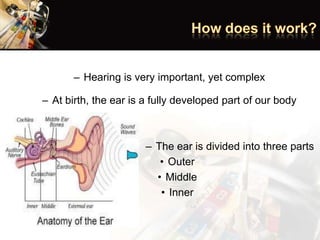
– Hearing is very important, yet complex
– At birth, the ear is a fully developed part of our body
– The ear is divided into three parts
• Outer
• Middle
• Inner
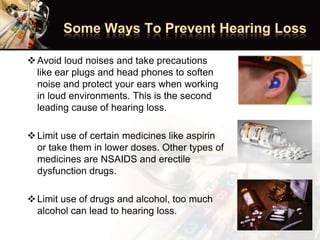
Avoid loud noises and take precautions
like ear plugs and head phones to soften
noise and protect your ears when working
in loud environments. This is the second
leading cause of hearing loss.
Limit use of certain medicines like aspirin
or take them in lower doses. Other types of
medicines are NSAIDS and erectile
dysfunction drugs.
Limit use of drugs and alcohol, too much
alcohol can lead to hearing loss.
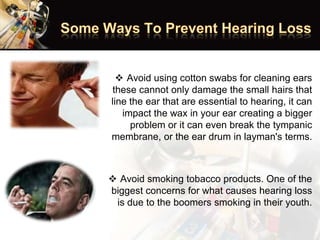
 Avoid using cotton swabs for cleaning ears
these cannot only damage the small hairs that
line the ear that are essential to hearing, it can
impact the wax in your ear creating a bigger
problem or it can even break the tympanic
membrane, or the ear drum in layman's terms.
 Avoid smoking tobacco products. One of the
biggest concerns for what causes hearing loss
is due to the boomers smoking in their youth.
 See an audiologist on a regular basis.
They can be found in doctors offices and
hospitals. There are also many found
with their own private clinics. It is important
to be tested on a regular basis.
 Don't wait! Get checked now and then get
rechecked every year.
 17%, 36 million American
adults report some degree of
hearing loss
 47%, 75 and older have
hearing loss
 Men have a higher chance of
developing a hearing
impairment
 Tinnitus(ringing in the ears) is
a symptom of hearing loss
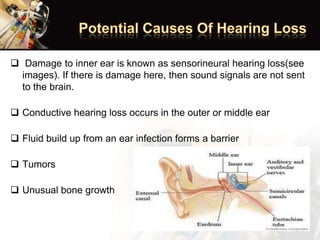
 Damage to inner ear is known as sensorineural hearing loss(see
images). If there is damage here, then sound signals are not sent
to the brain.
 Conductive hearing loss occurs in the outer or middle ear
 Fluid build up from an ear infection forms a barrier
 Tumors
 Unusual bone growth
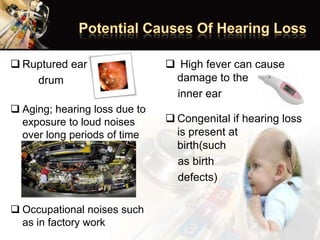
 Ruptured ear
drum
 Aging; hearing loss due to
exposure to loud noises
over long periods of time
 Occupational noises such
as in factory work
 High fever can cause
damage to the
inner ear
 Congenital if hearing loss
is present at
birth(such
as birth
defects)
• While hearing loss is preventable it still happens and often times
people do not seek out the treatment they need. For people who do
seek out treatment one of the options is hearing aids.
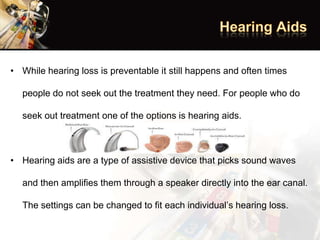
• Hearing aids are a type of assistive device that picks sound waves
and then amplifies them through a speaker directly into the ear canal.
The settings can be changed to fit each individual’s hearing loss.
• A correctly fitting hearing aid is essential to them functioning properly.
If they do not fit there may be loud feedback and high pitched
whistling to not only the person with the hearing aid but also to those
around them.
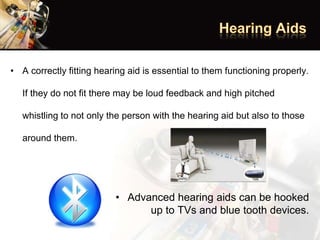
• Advanced hearing aids can be hooked
up to TVs and blue tooth devices.
• Hearing aids must be maintained throughout the entire time that they
are owned. They first must be set to a lower volume setting and then
gradually raised so that the listener can adapt and get used to the
sound before it is raised.
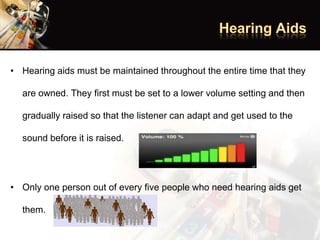
• Only one person out of every five people who need hearing aids get
them.
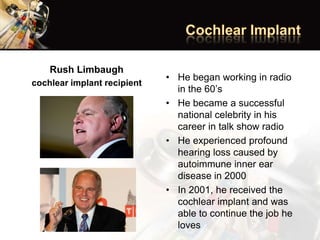
Rush Limbaugh
cochlear implant recipient
• He began working in radio
in the 60’s
• He became a successful
national celebrity in his
career in talk show radio
• He experienced profound
hearing loss caused by
autoimmune inner ear
disease in 2000
• In 2001, he received the
cochlear implant and was
able to continue the job he
loves
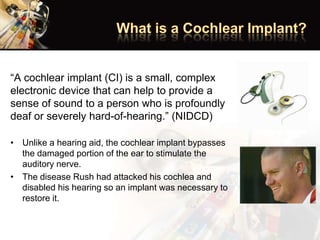
“A cochlear implant (CI) is a small, complex
electronic device that can help to provide a
sense of sound to a person who is profoundly
deaf or severely hard-of-hearing.” (NIDCD)
• Unlike a hearing aid, the cochlear implant bypasses
the damaged portion of the ear to stimulate the
auditory nerve.
• The disease Rush had attacked his cochlea and
disabled his hearing so an implant was necessary to
restore it.
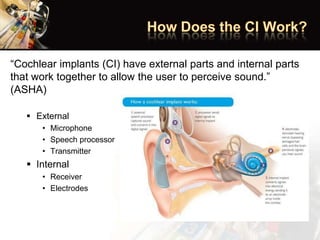
“Cochlear implants (CI) have external parts and internal parts
that work together to allow the user to perceive sound.”
(ASHA)
 External
• Microphone
• Speech processor
• Transmitter
 Internal
• Receiver
• Electrodes
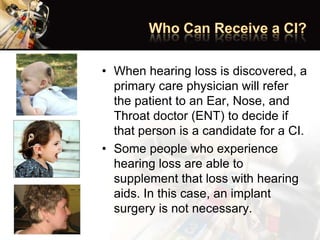
• When hearing loss is discovered, a
primary care physician will refer
the patient to an Ear, Nose, and
Throat doctor (ENT) to decide if
that person is a candidate for a CI.
• Some people who experience
hearing loss are able to
supplement that loss with hearing
aids. In this case, an implant
surgery is not necessary.
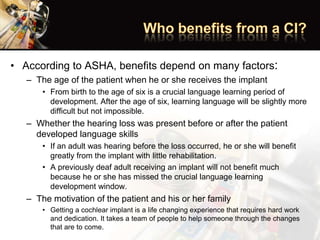
• According to ASHA, benefits depend on many factors:
– The age of the patient when he or she receives the implant
• From birth to the age of six is a crucial language learning period of
development. After the age of six, learning language will be slightly more
difficult but not impossible.
– Whether the hearing loss was present before or after the patient
developed language skills
• If an adult was hearing before the loss occurred, he or she will benefit
greatly from the implant with little rehabilitation.
• A previously deaf adult receiving an implant will not benefit much
because he or she has missed the crucial language learning
development window.
– The motivation of the patient and his or her family
• Getting a cochlear implant is a life changing experience that requires hard work
and dedication. It takes a team of people to help someone through the changes
that are to come.
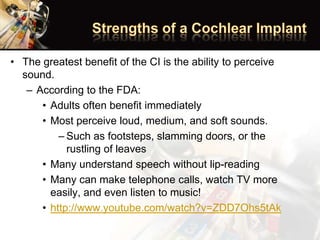
• The greatest benefit of the CI is the ability to perceive
sound.
– According to the FDA:
• Adults often benefit immediately
• Most perceive loud, medium, and soft sounds.
– Such as footsteps, slamming doors, or the
rustling of leaves
• Many understand speech without lip-reading
• Many can make telephone calls, watch TV more
easily, and even listen to music!
• http://www.youtube.com/watch?v=ZDD7Ohs5tAk
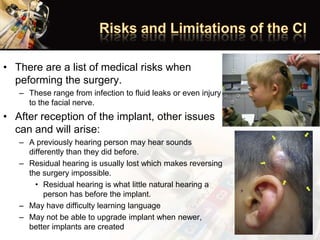
• There are a list of medical risks when
peforming the surgery.
– These range from infection to fluid leaks or even injury
to the facial nerve.
• After reception of the implant, other issues
can and will arise:
– A previously hearing person may hear sounds
differently than they did before.
– Residual hearing is usually lost which makes reversing
the surgery impossible.
• Residual hearing is what little natural hearing a
person has before the implant.
– May have difficulty learning language
– May not be able to upgrade implant when newer,
better implants are created
• Limitations of the Cochlear Implant continued:
– May not be able to have certain medical examinations such as an MRI
– The implant depends on batteries that will need to be changed out and
replacing damaged parts can be expensive
After receiving the CI, rehabilitation is required.
o Tedious rehabilitation is required to teach previously deaf people how
to use the new sounds that they are hearing.
o After the age of six, the crucial window of language developement has
closed and will make learning language more difficult but not
impossible.
o Previously deaf adults may not ever be able to fully understand or use
language like previously deaf children
• The Cochlear Implant technology is not available to all
providers. There are specialists who can determine the
need for a CI and sub-specialists who actually perform
the surgery.
• A primary care physician will refer a person to an
otolaryngologist if hearing impairment is suspected. If the
otolaryngologist believes the person is a candidate for the
CI, he or she will be referred to an Otologist for the
implant surgery.
– “An otologist/neurotologist is a board-certified otolaryngologist who
provides medical and surgical care of patients, both adult and
pediatric, with diseases that affect the ears, balance system,
temporal bone, skull base, and related structures of the head and
neck.” (UMMC)
• Speech-Language Pathologists work with patients after
the reception of the implant to habilitate or rehabilitate
them into the hearing world.
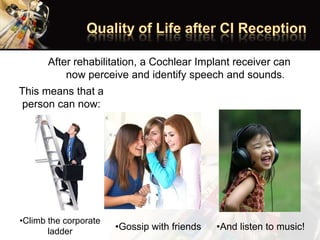
After rehabilitation, a Cochlear Implant receiver can
now perceive and identify speech and sounds.
This means that a
person can now:
•Climb the corporate
ladder
•Gossip with friends •And listen to music!
• Boswell, S. (n.d.). Cochlear Implants. American Speech-Language-Hearing
Association | ASHA. Retrieved May 4, 2012, from
http://www.asha.org/public/hearing/Cochlear-Implant/
• Burke, L., & Weill, B. (2008). Information technology for the health professions (3.
ed.). Upper Saddle River, N.J.: Pearson Prentice Hall.
• Cochlear Implant - YouTube . (n.d.). YouTube - Broadcast Yourself. . Retrieved May
4, 2012, from
http://www.youtube.com/watch?v=SmNpP2fr57A
• Cochlear Implants. (n.d.). U S Food and Drug Administration Home Page. Retrieved
May 4, 2012, from
http://www.fda.gov/MedicalDevices/ProductsandMedicalProcedures/Impla
ntsandProsthetics/CochlearImplants/default.htm
• Cochlear Implants . (n.d.). National Institute on Deafness and Other
Communication Disorders [NIDCD] . Retrieved May 4, 2012, from
http://www.nidcd.nih.gov/health/hearing/pages/coch.aspx
• What is an Otologist / Neurotologist?. (n.d.). University of Maryland Medical
Center | Home. Retrieved May 6, 2012, from
http://www.umm.edu/otolaryngology/otolo_neuro.htm
• Spyridakou, C. (2012). HEARING LOSS: A HEALTH PROBLEM FOR ALL AGES. Primary
Health Care, 22(4), 16-20.
• Noonan, D., Ulick, J., Springen, K., & Scelfo, J. (2005). A Little Bit Louder, Please.
(Cover story). Newsweek, 145(23), 42-49
• Unknown(2011). Prevention. Retrieved from:http://www.webmd.com/healthy-
aging/guide/hearing-loss-prevention
• Unknown(2011). 10 Ways to Prevent Hearing Loss. Retrieved
from:http://www.reviewjournal.com/news/10-ways-prevent-hearing-loss

Hearing health

  • 1.
    Aryn Brown Adi Smith CricketCollinsworth LaKeta Mayfield Tyra LeBlanc
  • 2.
    • Hearing Healthcan be summed up into three basic roles: Detection Prevention Management • How do I know when something is wrong? • What can I do to reduce my chances of having early in life hearing loss? • Do I have options once I have passed the prevention stage?
  • 3.
    – Hearing isvery important, yet complex – At birth, the ear is a fully developed part of our body – The ear is divided into three parts • Outer • Middle • Inner
  • 4.
    Avoid loud noisesand take precautions like ear plugs and head phones to soften noise and protect your ears when working in loud environments. This is the second leading cause of hearing loss. Limit use of certain medicines like aspirin or take them in lower doses. Other types of medicines are NSAIDS and erectile dysfunction drugs. Limit use of drugs and alcohol, too much alcohol can lead to hearing loss.
  • 5.
     Avoid usingcotton swabs for cleaning ears these cannot only damage the small hairs that line the ear that are essential to hearing, it can impact the wax in your ear creating a bigger problem or it can even break the tympanic membrane, or the ear drum in layman's terms.  Avoid smoking tobacco products. One of the biggest concerns for what causes hearing loss is due to the boomers smoking in their youth.
  • 6.
     See anaudiologist on a regular basis. They can be found in doctors offices and hospitals. There are also many found with their own private clinics. It is important to be tested on a regular basis.  Don't wait! Get checked now and then get rechecked every year.
  • 7.
     17%, 36million American adults report some degree of hearing loss  47%, 75 and older have hearing loss  Men have a higher chance of developing a hearing impairment  Tinnitus(ringing in the ears) is a symptom of hearing loss
  • 8.
     Damage toinner ear is known as sensorineural hearing loss(see images). If there is damage here, then sound signals are not sent to the brain.  Conductive hearing loss occurs in the outer or middle ear  Fluid build up from an ear infection forms a barrier  Tumors  Unusual bone growth
  • 9.
     Ruptured ear drum Aging; hearing loss due to exposure to loud noises over long periods of time  Occupational noises such as in factory work  High fever can cause damage to the inner ear  Congenital if hearing loss is present at birth(such as birth defects)
  • 10.
    • While hearingloss is preventable it still happens and often times people do not seek out the treatment they need. For people who do seek out treatment one of the options is hearing aids. • Hearing aids are a type of assistive device that picks sound waves and then amplifies them through a speaker directly into the ear canal. The settings can be changed to fit each individual’s hearing loss.
  • 11.
    • A correctlyfitting hearing aid is essential to them functioning properly. If they do not fit there may be loud feedback and high pitched whistling to not only the person with the hearing aid but also to those around them. • Advanced hearing aids can be hooked up to TVs and blue tooth devices.
  • 12.
    • Hearing aidsmust be maintained throughout the entire time that they are owned. They first must be set to a lower volume setting and then gradually raised so that the listener can adapt and get used to the sound before it is raised. • Only one person out of every five people who need hearing aids get them.
  • 13.
    Rush Limbaugh cochlear implantrecipient • He began working in radio in the 60’s • He became a successful national celebrity in his career in talk show radio • He experienced profound hearing loss caused by autoimmune inner ear disease in 2000 • In 2001, he received the cochlear implant and was able to continue the job he loves
  • 14.
    “A cochlear implant(CI) is a small, complex electronic device that can help to provide a sense of sound to a person who is profoundly deaf or severely hard-of-hearing.” (NIDCD) • Unlike a hearing aid, the cochlear implant bypasses the damaged portion of the ear to stimulate the auditory nerve. • The disease Rush had attacked his cochlea and disabled his hearing so an implant was necessary to restore it.
  • 15.
    “Cochlear implants (CI)have external parts and internal parts that work together to allow the user to perceive sound.” (ASHA)  External • Microphone • Speech processor • Transmitter  Internal • Receiver • Electrodes
  • 16.
    • When hearingloss is discovered, a primary care physician will refer the patient to an Ear, Nose, and Throat doctor (ENT) to decide if that person is a candidate for a CI. • Some people who experience hearing loss are able to supplement that loss with hearing aids. In this case, an implant surgery is not necessary.
  • 17.
    • According toASHA, benefits depend on many factors: – The age of the patient when he or she receives the implant • From birth to the age of six is a crucial language learning period of development. After the age of six, learning language will be slightly more difficult but not impossible. – Whether the hearing loss was present before or after the patient developed language skills • If an adult was hearing before the loss occurred, he or she will benefit greatly from the implant with little rehabilitation. • A previously deaf adult receiving an implant will not benefit much because he or she has missed the crucial language learning development window. – The motivation of the patient and his or her family • Getting a cochlear implant is a life changing experience that requires hard work and dedication. It takes a team of people to help someone through the changes that are to come.
  • 18.
    • The greatestbenefit of the CI is the ability to perceive sound. – According to the FDA: • Adults often benefit immediately • Most perceive loud, medium, and soft sounds. – Such as footsteps, slamming doors, or the rustling of leaves • Many understand speech without lip-reading • Many can make telephone calls, watch TV more easily, and even listen to music! • http://www.youtube.com/watch?v=ZDD7Ohs5tAk
  • 19.
    • There area list of medical risks when peforming the surgery. – These range from infection to fluid leaks or even injury to the facial nerve. • After reception of the implant, other issues can and will arise: – A previously hearing person may hear sounds differently than they did before. – Residual hearing is usually lost which makes reversing the surgery impossible. • Residual hearing is what little natural hearing a person has before the implant. – May have difficulty learning language – May not be able to upgrade implant when newer, better implants are created
  • 20.
    • Limitations ofthe Cochlear Implant continued: – May not be able to have certain medical examinations such as an MRI – The implant depends on batteries that will need to be changed out and replacing damaged parts can be expensive After receiving the CI, rehabilitation is required. o Tedious rehabilitation is required to teach previously deaf people how to use the new sounds that they are hearing. o After the age of six, the crucial window of language developement has closed and will make learning language more difficult but not impossible. o Previously deaf adults may not ever be able to fully understand or use language like previously deaf children
  • 21.
    • The CochlearImplant technology is not available to all providers. There are specialists who can determine the need for a CI and sub-specialists who actually perform the surgery. • A primary care physician will refer a person to an otolaryngologist if hearing impairment is suspected. If the otolaryngologist believes the person is a candidate for the CI, he or she will be referred to an Otologist for the implant surgery. – “An otologist/neurotologist is a board-certified otolaryngologist who provides medical and surgical care of patients, both adult and pediatric, with diseases that affect the ears, balance system, temporal bone, skull base, and related structures of the head and neck.” (UMMC) • Speech-Language Pathologists work with patients after the reception of the implant to habilitate or rehabilitate them into the hearing world.
  • 22.
    After rehabilitation, aCochlear Implant receiver can now perceive and identify speech and sounds. This means that a person can now: •Climb the corporate ladder •Gossip with friends •And listen to music!
  • 23.
    • Boswell, S.(n.d.). Cochlear Implants. American Speech-Language-Hearing Association | ASHA. Retrieved May 4, 2012, from http://www.asha.org/public/hearing/Cochlear-Implant/ • Burke, L., & Weill, B. (2008). Information technology for the health professions (3. ed.). Upper Saddle River, N.J.: Pearson Prentice Hall. • Cochlear Implant - YouTube . (n.d.). YouTube - Broadcast Yourself. . Retrieved May 4, 2012, from http://www.youtube.com/watch?v=SmNpP2fr57A • Cochlear Implants. (n.d.). U S Food and Drug Administration Home Page. Retrieved May 4, 2012, from http://www.fda.gov/MedicalDevices/ProductsandMedicalProcedures/Impla ntsandProsthetics/CochlearImplants/default.htm • Cochlear Implants . (n.d.). National Institute on Deafness and Other Communication Disorders [NIDCD] . Retrieved May 4, 2012, from http://www.nidcd.nih.gov/health/hearing/pages/coch.aspx • What is an Otologist / Neurotologist?. (n.d.). University of Maryland Medical Center | Home. Retrieved May 6, 2012, from http://www.umm.edu/otolaryngology/otolo_neuro.htm
  • 24.
    • Spyridakou, C.(2012). HEARING LOSS: A HEALTH PROBLEM FOR ALL AGES. Primary Health Care, 22(4), 16-20. • Noonan, D., Ulick, J., Springen, K., & Scelfo, J. (2005). A Little Bit Louder, Please. (Cover story). Newsweek, 145(23), 42-49 • Unknown(2011). Prevention. Retrieved from:http://www.webmd.com/healthy- aging/guide/hearing-loss-prevention • Unknown(2011). 10 Ways to Prevent Hearing Loss. Retrieved from:http://www.reviewjournal.com/news/10-ways-prevent-hearing-loss

Editor's Notes

  • #2 IntroductionThe health of your hearing affects you from before you are born until your very last day. In utero you can detect which voice is your mothers and distinguish it from all other voices. At four days old you can recognize your mother tongue. Hearing Health affects people of all ages and is something that people should not take for granted.