HEALTH
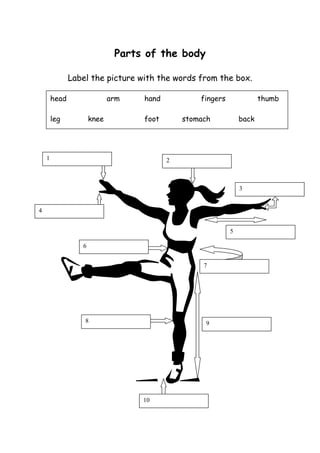
Parts of the body
Label the picture with the words from the box.
head arm hand fingers thumb
leg knee foot stomach back
5
1 2
8
6
10
3
4
9
7
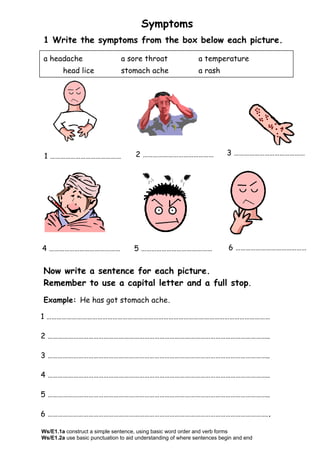
Symptoms
1 Write the symptoms from the box below each picture.
Now write a sentence for each picture.
Remember to use a capital letter and a full stop.
Example: He has got stomach ache.
1 ……………………………………………………………………………………………………………………
2 …………………………………………………………………………………………………………………..
3 …………………………………………………………………………………………………………………..
4 …………………………………………………………………………………………………………………..
5 …………………………………………………………………………………………………………………..
6 …………………………………………………………………………………………………………………..
a headache a sore throat a temperature
head lice stomach ache a rash
1 …………………………………… 2 …………………………………… 3 ……………………………………
4 …………………………………… 5 …………………………………… 6 ……………………………………
Ws/E1.1a construct a simple sentence, using basic word order and verb forms
Ws/E1.2a use basic punctuation to aid understanding of where sentences begin and end
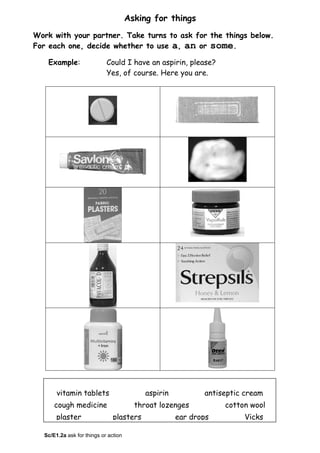
Asking for things
Work with your partner. Take turns to ask for the things below.
For each one, decide whether to use a, an or some.
Example: Could I have an aspirin, please?
Yes, of course. Here you are.
vitamin tablets aspirin antiseptic cream
cough medicine throat lozenges cotton wool
plaster plasters ear drops Vicks
Sc/E1.2a ask for things or action
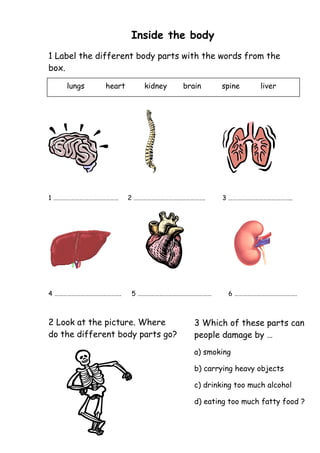
Inside the body
1 Label the different body parts with the words from the
box.
1 ……………………………………… 2 …………………………………………. 3 ……………………………………..
4 ………………………………………. 5 …………………………………………… 6 …………………………………….
2 Look at the picture. Where
do the different body parts go?
lungs heart kidney brain spine liver
3 Which of these parts can
people damage by …
a) smoking
b) carrying heavy objects
c) drinking too much alcohol
d) eating too much fatty food ?
Health Checks
Write the correct words from the box below the pictures.
Where do you go for the different health checks? Complete the
chart.
Hospital Doctor's surgery Optician
blood test x-ray scan
examination operation eye test
2 ……………………………………….1 ……………………………… ………… 3 ………………………………………
4 ………………………………………. 5 ……………………………………… 6 ………………………………………
Healthy living
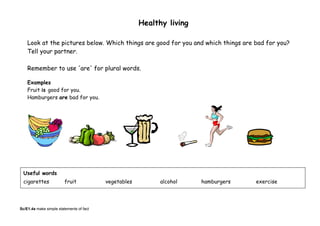
Look at the pictures below. Which things are good for you and which things are bad for you?
Tell your partner.
Remember to use 'are' for plural words.
Examples
Fruit is good for you.
Hamburgers are bad for you.
Useful words
cigarettes fruit vegetables alcohol hamburgers exercise
Sc/E1.4a make simple statements of fact
A letter from the hospital
Read the letter and then answer the questions.
1 What is the appointment for? ………………………………………………………………………
2 What date is the appointment? ……………………………………………………………………
3 What time? ………………………………………………………………………………………………………
4 What is the name of the doctor? ……………………………………………………………….
5 What must Hawa bring? ……………………………………………………………………………….
6 What must Hawa do if she can't go? …………………………………………………………
Tower Hamlets Hospital NHS
Outpatient Department
Stepney Road
London
E2 6SF
Ms Hawa Ahmed
20 Cromwell House
Canter Road
London
E1 4BX
30th June
Dear Ms Ahmed,
You have an appointment for a scan.
Clinic: Antenatal (baby clinic)
Doctor: Dr Riley
Date: Tuesday 14th July
Time: 10:30 am
Please bring any medicines you are taking.
If you cannot attend, please telephone the Outpatients Department on 020 6700
5211 to make another appointment.
Yours sincerely,
Mary Carr
Clinic Administrator
Rt/E1.1b obtaining information from texts
Leaving a message at the school office
Your child is ill and cannot go to school. Practise phoning the
school office to leave a message for your child's teacher.
Good morning. Mowlem School. How can I help you?
Yes, of course. What's the message?
What's your child's name?
Could you spell that, please?
Thank you very much for letting us know.
Could I just check your telephone number, please?
That's 020 ……………………………………….. ?
Thank you very much. I hope ……………………………………. feels better soon.
Goodbye.
Sc/E1.4a make statements of fact clearly
Lr/E1.4a listen and respond to requests for personal information
Understanding labels
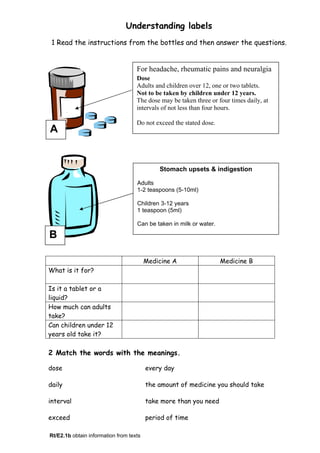
1 Read the instructions from the bottles and then answer the questions.
Medicine A Medicine B
What is it for?
Is it a tablet or a
liquid?
How much can adults
take?
Can children under 12
years old take it?
2 Match the words with the meanings.
dose every day
daily the amount of medicine you should take
interval take more than you need
exceed period of time
For headache, rheumatic pains and neuralgia
Dose
Adults and children over 12, one or two tablets.
Not to be taken by children under 12 years.
The dose may be taken three or four times daily, at
intervals of not less than four hours.
Do not exceed the stated dose.
Stomach upsets & indigestion
Adults
1-2 teaspoons (5-10ml)
Children 3-12 years
1 teaspoon (5ml)
Can be taken in milk or water.
A
B
Rt/E2.1b obtain information from texts
Symptoms and illness
1 Here are some symptoms. Try to find out what they mean. You can
write the meaning in English or your first language.
1 Diarrhoea ____________________________________
2 Constipated ____________________________________
3 Period pains ____________________________________
4 Morning sickness ____________________________________
5 Vomiting a lot ____________________________________
6 Depressed ____________________________________
2 Have got, has got, am or is?
Write a sentence for each word:
1. Diarrhoea
I_______________________________
2. Constipated
He______________________________
3. Period pains
She_____________________________
4. Morning sickness
I _______________________________
5. Vomiting a lot
He______________________________
6. Depressed
She_____________________________
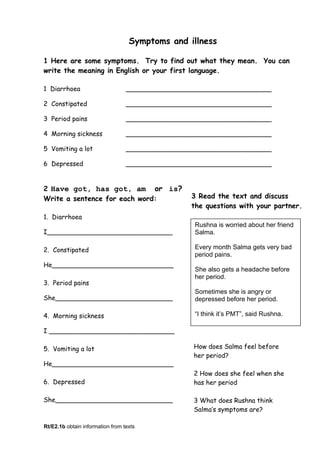
Rushna is worried about her friend
Salma.
Every month Salma gets very bad
period pains.
She also gets a headache before
her period.
Sometimes she is angry or
depressed before her period.
“I think it’s PMT”, said Rushna.
3 Read the text and discuss
the questions with your partner.
Rt/E2.1b obtain information from texts
How does Salma feel before
her period?
2 How does she feel when she
has her period
3 What does Rushna think
Salma’s symptoms are?
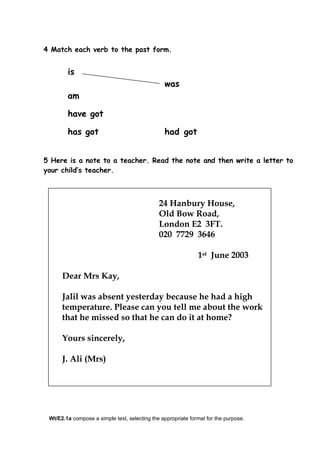
4 Match each verb to the past form.
is
was
am
have got
has got had got
5 Here is a note to a teacher. Read the note and then write a letter to
your child’s teacher.
24 Hanbury House,
Old Bow Road,
London E2 3FT.
020 7729 3646
1st June 2003
Dear Mrs Kay,
Jalil was absent yesterday because he had a high
temperature. Please can you tell me about the work
that he missed so that he can do it at home?
Yours sincerely,
J. Ali (Mrs)
Wt/E2.1a compose a simple text, selecting the appropriate format for the purpose.
Healthy eating during pregnancy
Folic acid
It's very important to have enough folic acid in your diet when you are pregnant.
This helps the baby’s spine and brain to develop properly. The food groups below
contain folic acid:
• dark green vegetables
• cereals, especially wholegrain (e.g. Shredded Wheat, Shreddies)
• bananas, grapefruit and oranges
• beans and pulses
• milk and yogurt
• yeast or malt extract (e.g. Marmite)
1 Look at the pictures different types of food below. Which ones
contain folic acid?
2 Think of the food you have in your kitchen at home. Write a list of
the things that contain folic acid.
………………………………………………………………………………………………………………
………………………………………………………………………………………………………………
……………………………………………………………………………………………………………..
Making a doctor’s appointment
Momtaz is making an appointment to see her doctor.
Listen to the conversation.
- Hello, Poplar Health Centre.
- Hello. I’d like to make an appointment to see a doctor this
week, please.
- We’ve got something on Wednesday morning with Dr Walker.
- What time?
- Ten o’clock
- That’s fine.
- What’s your name?
- Momtaz Begum
- How do you spell that?
- M-O-M-T-A-Z
- And what’s your date of birth?
- 1st March 1970
- O.K. See you on Wednesday at ten o’clock.
Lr/E1.2d listen for phonological detail
You are making an appointment to see the doctor.
Complete the conversation with your own details and
practise with your partner.
- Hello, Poplar Health Centre.
- Hello. I’d like to make an appointment to see a doctor this
week, please.
- We’ve got something on Wednesday morning with Dr Walker.
- What time?
- Ten o’clock
- That’s fine.
- What’s your name?
- How do you spell that?
- And what’s your date of birth?
- O.K. See you on Wednesday at ten o’clock.
Sc/E1.3a ask for personal details
Sc/E1.4a make simple statements of fact

Health worksheets

  • 1.
  • 2.
    Parts of thebody Label the picture with the words from the box. head arm hand fingers thumb leg knee foot stomach back 5 1 2 8 6 10 3 4 9 7
  • 3.
    Symptoms 1 Write thesymptoms from the box below each picture. Now write a sentence for each picture. Remember to use a capital letter and a full stop. Example: He has got stomach ache. 1 …………………………………………………………………………………………………………………… 2 ………………………………………………………………………………………………………………….. 3 ………………………………………………………………………………………………………………….. 4 ………………………………………………………………………………………………………………….. 5 ………………………………………………………………………………………………………………….. 6 ………………………………………………………………………………………………………………….. a headache a sore throat a temperature head lice stomach ache a rash 1 …………………………………… 2 …………………………………… 3 …………………………………… 4 …………………………………… 5 …………………………………… 6 …………………………………… Ws/E1.1a construct a simple sentence, using basic word order and verb forms Ws/E1.2a use basic punctuation to aid understanding of where sentences begin and end
  • 4.
    Asking for things Workwith your partner. Take turns to ask for the things below. For each one, decide whether to use a, an or some. Example: Could I have an aspirin, please? Yes, of course. Here you are. vitamin tablets aspirin antiseptic cream cough medicine throat lozenges cotton wool plaster plasters ear drops Vicks Sc/E1.2a ask for things or action
  • 5.
    Inside the body 1Label the different body parts with the words from the box. 1 ……………………………………… 2 …………………………………………. 3 …………………………………….. 4 ………………………………………. 5 …………………………………………… 6 ……………………………………. 2 Look at the picture. Where do the different body parts go? lungs heart kidney brain spine liver 3 Which of these parts can people damage by … a) smoking b) carrying heavy objects c) drinking too much alcohol d) eating too much fatty food ?
  • 6.
    Health Checks Write thecorrect words from the box below the pictures. Where do you go for the different health checks? Complete the chart. Hospital Doctor's surgery Optician blood test x-ray scan examination operation eye test 2 ……………………………………….1 ……………………………… ………… 3 ……………………………………… 4 ………………………………………. 5 ……………………………………… 6 ………………………………………
  • 7.
    Healthy living Look atthe pictures below. Which things are good for you and which things are bad for you? Tell your partner. Remember to use 'are' for plural words. Examples Fruit is good for you. Hamburgers are bad for you. Useful words cigarettes fruit vegetables alcohol hamburgers exercise Sc/E1.4a make simple statements of fact
  • 8.
    A letter fromthe hospital Read the letter and then answer the questions. 1 What is the appointment for? ……………………………………………………………………… 2 What date is the appointment? …………………………………………………………………… 3 What time? ……………………………………………………………………………………………………… 4 What is the name of the doctor? ………………………………………………………………. 5 What must Hawa bring? ………………………………………………………………………………. 6 What must Hawa do if she can't go? ………………………………………………………… Tower Hamlets Hospital NHS Outpatient Department Stepney Road London E2 6SF Ms Hawa Ahmed 20 Cromwell House Canter Road London E1 4BX 30th June Dear Ms Ahmed, You have an appointment for a scan. Clinic: Antenatal (baby clinic) Doctor: Dr Riley Date: Tuesday 14th July Time: 10:30 am Please bring any medicines you are taking. If you cannot attend, please telephone the Outpatients Department on 020 6700 5211 to make another appointment. Yours sincerely, Mary Carr Clinic Administrator Rt/E1.1b obtaining information from texts
  • 9.
    Leaving a messageat the school office Your child is ill and cannot go to school. Practise phoning the school office to leave a message for your child's teacher. Good morning. Mowlem School. How can I help you? Yes, of course. What's the message? What's your child's name? Could you spell that, please? Thank you very much for letting us know. Could I just check your telephone number, please? That's 020 ……………………………………….. ? Thank you very much. I hope ……………………………………. feels better soon. Goodbye. Sc/E1.4a make statements of fact clearly Lr/E1.4a listen and respond to requests for personal information
  • 10.
    Understanding labels 1 Readthe instructions from the bottles and then answer the questions. Medicine A Medicine B What is it for? Is it a tablet or a liquid? How much can adults take? Can children under 12 years old take it? 2 Match the words with the meanings. dose every day daily the amount of medicine you should take interval take more than you need exceed period of time For headache, rheumatic pains and neuralgia Dose Adults and children over 12, one or two tablets. Not to be taken by children under 12 years. The dose may be taken three or four times daily, at intervals of not less than four hours. Do not exceed the stated dose. Stomach upsets & indigestion Adults 1-2 teaspoons (5-10ml) Children 3-12 years 1 teaspoon (5ml) Can be taken in milk or water. A B Rt/E2.1b obtain information from texts
  • 11.
    Symptoms and illness 1Here are some symptoms. Try to find out what they mean. You can write the meaning in English or your first language. 1 Diarrhoea ____________________________________ 2 Constipated ____________________________________ 3 Period pains ____________________________________ 4 Morning sickness ____________________________________ 5 Vomiting a lot ____________________________________ 6 Depressed ____________________________________ 2 Have got, has got, am or is? Write a sentence for each word: 1. Diarrhoea I_______________________________ 2. Constipated He______________________________ 3. Period pains She_____________________________ 4. Morning sickness I _______________________________ 5. Vomiting a lot He______________________________ 6. Depressed She_____________________________ Rushna is worried about her friend Salma. Every month Salma gets very bad period pains. She also gets a headache before her period. Sometimes she is angry or depressed before her period. “I think it’s PMT”, said Rushna. 3 Read the text and discuss the questions with your partner. Rt/E2.1b obtain information from texts How does Salma feel before her period? 2 How does she feel when she has her period 3 What does Rushna think Salma’s symptoms are?
  • 12.
    4 Match eachverb to the past form. is was am have got has got had got 5 Here is a note to a teacher. Read the note and then write a letter to your child’s teacher. 24 Hanbury House, Old Bow Road, London E2 3FT. 020 7729 3646 1st June 2003 Dear Mrs Kay, Jalil was absent yesterday because he had a high temperature. Please can you tell me about the work that he missed so that he can do it at home? Yours sincerely, J. Ali (Mrs) Wt/E2.1a compose a simple text, selecting the appropriate format for the purpose.
  • 13.
    Healthy eating duringpregnancy Folic acid It's very important to have enough folic acid in your diet when you are pregnant. This helps the baby’s spine and brain to develop properly. The food groups below contain folic acid: • dark green vegetables • cereals, especially wholegrain (e.g. Shredded Wheat, Shreddies) • bananas, grapefruit and oranges • beans and pulses • milk and yogurt • yeast or malt extract (e.g. Marmite) 1 Look at the pictures different types of food below. Which ones contain folic acid? 2 Think of the food you have in your kitchen at home. Write a list of the things that contain folic acid. ……………………………………………………………………………………………………………… ……………………………………………………………………………………………………………… ……………………………………………………………………………………………………………..
  • 14.
    Making a doctor’sappointment Momtaz is making an appointment to see her doctor. Listen to the conversation. - Hello, Poplar Health Centre. - Hello. I’d like to make an appointment to see a doctor this week, please. - We’ve got something on Wednesday morning with Dr Walker. - What time? - Ten o’clock - That’s fine. - What’s your name? - Momtaz Begum - How do you spell that? - M-O-M-T-A-Z - And what’s your date of birth? - 1st March 1970 - O.K. See you on Wednesday at ten o’clock. Lr/E1.2d listen for phonological detail
  • 15.
    You are makingan appointment to see the doctor. Complete the conversation with your own details and practise with your partner. - Hello, Poplar Health Centre. - Hello. I’d like to make an appointment to see a doctor this week, please. - We’ve got something on Wednesday morning with Dr Walker. - What time? - Ten o’clock - That’s fine. - What’s your name? - How do you spell that? - And what’s your date of birth? - O.K. See you on Wednesday at ten o’clock. Sc/E1.3a ask for personal details Sc/E1.4a make simple statements of fact