
THE STOCK MARKET
               &
         INVESTMENT BANKING

A Presentation By:
Elaine Lopez
Janivey Porch
Yvonne Lopez
Marc Miller


                     Supervisor: Joey V. Price
STOCK -

   A type of security that represents ownership
    in a corporation, a large business
    organization, and also represents a claim on
    part of the organization's assets and
    earnings.
SHARE -

   A unit of ownership interest in a corporation
    or financial asset. Being a shareholder
    entitles the possessor to an equal distribution
    in any profits, if any are declared in the form
    of dividends.
STOCK TICKER -

   arrangement of characters (usually letters)
    representing a particular security listed on an
    exchange or otherwise traded publicly.
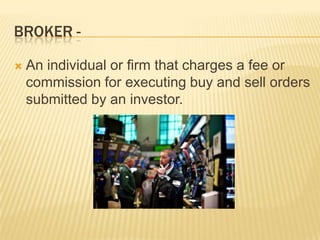
BROKER -

   An individual or firm that charges a fee or
    commission for executing buy and sell orders
    submitted by an investor.
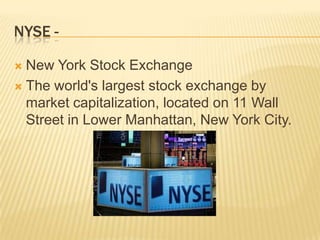
NYSE -

 New York Stock Exchange
 The world's largest stock exchange by
  market capitalization, located on 11 Wall
  Street in Lower Manhattan, New York City.
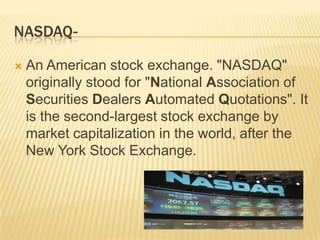
NASDAQ-

   An American stock exchange. "NASDAQ"
    originally stood for "National Association of
    Securities Dealers Automated Quotations". It
    is the second-largest stock exchange by
    market capitalization in the world, after the
    New York Stock Exchange.
IRA -

   Investment Retirement Arrangement

   An investing tool used by individuals to earn
    and save funds for retirement savings.
ROTH IRA -

   A special type of retirement plan under US
    law that is generally not taxed, provided
    certain conditions are met. The tax break is
    granted on the money withdrawn from the
    plan during retirement.
401K PLAN -

   traditional retirement account for
    most Americans it is named after the
    corresponding section of the internal revenue
    code: 401K. You contribute money from your
    check every month. You receive the
    proceeds when you retire.
PENSION -

   A fund established by an employer to
    facilitate and organize the investment of
    employee’s retirement funds contributed by
    the employer and employees. It is meant to
    have a stable growth over a long term.
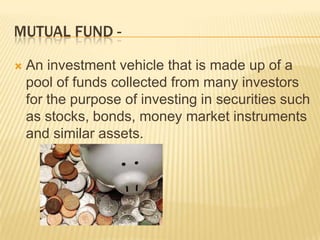
MUTUAL FUND -

   An investment vehicle that is made up of a
    pool of funds collected from many investors
    for the purpose of investing in securities such
    as stocks, bonds, money market instruments
    and similar assets.
HEDGE FUND -

   An aggressively managed portfolio of
    investments that uses advanced investment
    strategies
SEC -

   Securities Exchange Commission

   A government commission created by
    Congress to regulate the securities markets
    and protect investors. In addition to
    regulation and protection, it also monitors the
    corporate takeovers in the U.S.
ETF & “BULLISH”

 Exchange Traded Fund: a security that
  tracks an index, a commodity or a basket of
  assets like an index fund, but trades like a
  stock on an exchange. An ETF’s price
  changes throughout the day as they are
  bought and sold.
 Bull/Bullish: defines an upward-moving
  stock
BEAR/ BEARISH -

   An investor who believes that a particular
    security or market is headed
    downward. Bears attempt to profit from a
    decline in prices. Bears are
    generally pessimistic about the state of a
    given market.
STOP - LOSS

 also known as a “stop order” or “stop-market
  order”
 an order placed with a broker to sell a
  security when it reaches a certain price. It is
  designed to limit an investor’s loss on a
  security position.
COMMODITY -

   A raw material or primary agricultural product
    that can be bought and sold, such as copper
    or coffee.
DIVIDEND -

   A portion of a company's earnings which is
    paid to the shareholders/stockholders on a
    quarterly or annual basis.
OPTIONS -

   One options contract represents one
    hundred shares in the underlying stock. The
    quoted price of an option is per share.
FREQUENTLY ASKED QUESTIONS:
   1. What is investing?
-   Investing is using your money to make more money. Investing also
    can include the amount of time you put into the study of a prospective
    company, especially since time is money. Investing is another way of
    making money without actually doing manual labor.

   2. What are some ways that I begin investing?
    Putting your money into stock, bonds, mutual funds, and many other
    things, are ways to invest your money.

   3. Who receives your investment? (where does your money go?)
    In order to buy shares of stock , you need a stockbroker to help you
    with the transaction. In the same way that your local electronics
    retailer is the “middleman” between you and computer manufacturers,
    the broker (also known as a stockbroker) is the link between you and
    the stock exchange .
4. Are there any limits to investments? What are the maximum and
   minimum amounts?
   There are no regulatory limitations for investors regarding the
   dollar amount, number of securities, or the number of issuers for stocks
   and bonds.

5. What is the difference between a stock and a bond market?
   The stock market has central places, stock exchanges, where stocks are
   bought and sold. However, the bond market does not have a central
   trading place for bonds. Also, investing in a bond market is usually less
   risky than investing in a stock market because the bond market is not
   as changeable as the stock market is.

6. When you invest in a stock and make a profit, where do you
   collect?
   Stock brokers handle the investments. It is their job to decide whether to
   buy stock or sell. All profits you would collect from a stock broker.
7. Do all stocks costs the same?
All stocks do not cost the same. Their price depends upon the company.

              8. What are the symbols on a stock ticker?
  The symbols on an a stock ticker are an arrangement of characters
(usually letters) representing a particular security listed on an exchange
                       or otherwise traded publicly.

  9. What are the differences between good risks and silly risks?
  A good risk would be investing money in a stock that is doing well in
 high hopes that the money will increase over a period of time. On the
  contrary, a silly risk would be investing money in a company that is
    obviously doing bad. This bad decision will then cause money to
                                 decrease.
10. How does stop-loss work?
-   Setting a stop-loss order for 10% below the price you paid for the stock
    will limit your loss to 10%. This strategy allows investors to determine
    their loss limit in advance, preventing emotional decision-making.

11. What is pension? How much time does it take to receive pension?
-  a fund established by an employer to facilitate and organize the
   investment of employee’s retirement funds contributed by the employer
   and employees. A pension is received after you are retired.

12. How/Why does shares decrease/increase in value?
- Shares increase and decrease based on the supply and demand of the
   economy.
THANK YOU !!
       Thank you for viewing our presentation. We
all learned so much during this internship and
will use the skills learned during our future
endeavors !

HCZ Stock Market FAQ Presentation

  • 1.
    THE STOCK MARKET & INVESTMENT BANKING A Presentation By: Elaine Lopez Janivey Porch Yvonne Lopez Marc Miller Supervisor: Joey V. Price
  • 2.
    STOCK -  A type of security that represents ownership in a corporation, a large business organization, and also represents a claim on part of the organization's assets and earnings.
  • 3.
    SHARE -  A unit of ownership interest in a corporation or financial asset. Being a shareholder entitles the possessor to an equal distribution in any profits, if any are declared in the form of dividends.
  • 4.
    STOCK TICKER -  arrangement of characters (usually letters) representing a particular security listed on an exchange or otherwise traded publicly.
  • 5.
    BROKER -  An individual or firm that charges a fee or commission for executing buy and sell orders submitted by an investor.
  • 6.
    NYSE -  NewYork Stock Exchange  The world's largest stock exchange by market capitalization, located on 11 Wall Street in Lower Manhattan, New York City.
  • 7.
    NASDAQ-  An American stock exchange. "NASDAQ" originally stood for "National Association of Securities Dealers Automated Quotations". It is the second-largest stock exchange by market capitalization in the world, after the New York Stock Exchange.
  • 8.
    IRA -  Investment Retirement Arrangement  An investing tool used by individuals to earn and save funds for retirement savings.
  • 9.
    ROTH IRA -  A special type of retirement plan under US law that is generally not taxed, provided certain conditions are met. The tax break is granted on the money withdrawn from the plan during retirement.
  • 10.
    401K PLAN -  traditional retirement account for most Americans it is named after the corresponding section of the internal revenue code: 401K. You contribute money from your check every month. You receive the proceeds when you retire.
  • 11.
    PENSION -  A fund established by an employer to facilitate and organize the investment of employee’s retirement funds contributed by the employer and employees. It is meant to have a stable growth over a long term.
  • 12.
    MUTUAL FUND -  An investment vehicle that is made up of a pool of funds collected from many investors for the purpose of investing in securities such as stocks, bonds, money market instruments and similar assets.
  • 13.
    HEDGE FUND -  An aggressively managed portfolio of investments that uses advanced investment strategies
  • 14.
    SEC -  Securities Exchange Commission  A government commission created by Congress to regulate the securities markets and protect investors. In addition to regulation and protection, it also monitors the corporate takeovers in the U.S.
  • 15.
    ETF & “BULLISH” Exchange Traded Fund: a security that tracks an index, a commodity or a basket of assets like an index fund, but trades like a stock on an exchange. An ETF’s price changes throughout the day as they are bought and sold.  Bull/Bullish: defines an upward-moving stock
  • 16.
    BEAR/ BEARISH -  An investor who believes that a particular security or market is headed downward. Bears attempt to profit from a decline in prices. Bears are generally pessimistic about the state of a given market.
  • 17.
    STOP - LOSS also known as a “stop order” or “stop-market order”  an order placed with a broker to sell a security when it reaches a certain price. It is designed to limit an investor’s loss on a security position.
  • 18.
    COMMODITY -  A raw material or primary agricultural product that can be bought and sold, such as copper or coffee.
  • 19.
    DIVIDEND -  A portion of a company's earnings which is paid to the shareholders/stockholders on a quarterly or annual basis.
  • 20.
    OPTIONS -  One options contract represents one hundred shares in the underlying stock. The quoted price of an option is per share.
  • 21.
    FREQUENTLY ASKED QUESTIONS:  1. What is investing? - Investing is using your money to make more money. Investing also can include the amount of time you put into the study of a prospective company, especially since time is money. Investing is another way of making money without actually doing manual labor.  2. What are some ways that I begin investing? Putting your money into stock, bonds, mutual funds, and many other things, are ways to invest your money.  3. Who receives your investment? (where does your money go?) In order to buy shares of stock , you need a stockbroker to help you with the transaction. In the same way that your local electronics retailer is the “middleman” between you and computer manufacturers, the broker (also known as a stockbroker) is the link between you and the stock exchange .
  • 22.
    4. Are thereany limits to investments? What are the maximum and minimum amounts? There are no regulatory limitations for investors regarding the dollar amount, number of securities, or the number of issuers for stocks and bonds. 5. What is the difference between a stock and a bond market? The stock market has central places, stock exchanges, where stocks are bought and sold. However, the bond market does not have a central trading place for bonds. Also, investing in a bond market is usually less risky than investing in a stock market because the bond market is not as changeable as the stock market is. 6. When you invest in a stock and make a profit, where do you collect? Stock brokers handle the investments. It is their job to decide whether to buy stock or sell. All profits you would collect from a stock broker.
  • 23.
    7. Do allstocks costs the same? All stocks do not cost the same. Their price depends upon the company. 8. What are the symbols on a stock ticker? The symbols on an a stock ticker are an arrangement of characters (usually letters) representing a particular security listed on an exchange or otherwise traded publicly. 9. What are the differences between good risks and silly risks? A good risk would be investing money in a stock that is doing well in high hopes that the money will increase over a period of time. On the contrary, a silly risk would be investing money in a company that is obviously doing bad. This bad decision will then cause money to decrease.
  • 24.
    10. How doesstop-loss work? - Setting a stop-loss order for 10% below the price you paid for the stock will limit your loss to 10%. This strategy allows investors to determine their loss limit in advance, preventing emotional decision-making. 11. What is pension? How much time does it take to receive pension? - a fund established by an employer to facilitate and organize the investment of employee’s retirement funds contributed by the employer and employees. A pension is received after you are retired. 12. How/Why does shares decrease/increase in value? - Shares increase and decrease based on the supply and demand of the economy.
  • 25.
    THANK YOU !! Thank you for viewing our presentation. We all learned so much during this internship and will use the skills learned during our future endeavors !