Adopting HCI
Approaches In
Employee Software
Training
Individual Study 2
Cezara Hulber
The presentation will start by stablishing the research context and why
this topic is important.
Introduction01
The field of Human-Computer Interaction is innovative and endlessly
creative – this allows HCI approaches to be applied in nearly every
discipline.
HCI as a multidisciplinary field02
Experts have been researching ways to improve software training for
decades. This section will present some of the known obstacles to skill
acquisition and retention.
Training obstacles03
Solutions for better training frameworks have been developed that
employ various perspective: gamification, e-learning, and more.
Existing approaches04
What are some ways HCI can further improve training models?
Proposals for future work05
Introduction
Establishing research context and objectives
1. Worland, Justin (2016). What Will the Retirement Age Be In 2050? TIME Magazine. Available at: https://time.com/4217033/what-will-the-retirement-age-be-in-2050/ and accessed on 12/01/2020.
2. Friedberg, L. (2003) The Impact of Technological Change on Older Workers: Evidence from Data on Computer Use. Industrial and Labor Relations Review, 56 (3)
3. Brougham, D. and Haar, J. (2018) Smart Technology, Artificial Intelligence, Robotics, and Algorithms (STARA): Employees’ perceptions of our future workplace. Journal of Management & Organization, 24 (2)
The current situation
• Pension age increasing in first world countries
• By 2050, experts predict the pension age to
reach 70 1
• The continuing employability of older adults
requires them to engage in training programs
to maintain their skill set up-to-date 2
Aging population
• Smart Technology, Artificial Intelligence, Robotics
and Algorithms
• Emergent technologies that are expected to
replace 1/3 of existing jobs by 2025 3
• Employees are not concerned about the possibility
of STARA technologies taking their job
• Lack of STARA awareness may lead to a lower
share in technology related employee training
STARA
• Alter skill requirements
• Are restructuring training programs
• Their use is increasing in all industries
• Computer proficiency is a valuable skill in many
workplaces
Technological advancements
Research objectives
and research questions
In order to advocate for the application of an HCI
perspective in improving training frameworks, HCI must
be presented as a field that can bring improvements in a
wide range of disciplines, not just the technological ones.
HCI as multidisciplinary field
Developing a successful training framework can be
difficult. What factors influence the success or failure rate
of a training program?
Identify obstacles in employee software training
Researches have used different methods of improving
software training. How can current efforts be used in
combination with HCI theory principles?
Study existing approaches for improving training models
HCI
as a multidisciplinary field
Human-Computer Interaction
• innovative space that encourages developers to build for the user
• encourages empathetic and critical thinking
• solidifies the importance of iteration
• brings a breath of fresh air to technological developments
Technologies have changed and evolved from professional to domestic and leisure environments,
and as such, disciplines responsible for the design and use of technologies have also gone through
changes themselves. 4
• Factory machines
• Banking devices
• Cloud servers
Professional
• Home appliances
• Smart-home devices
• Security systems
Domestic • Smartphones
• TV, speakers, game
console
• Apps, music & video
streaming, social media
Leisure
4. Sengers, P., McCarthy, J., and Dourish, P. (2006) Reflective HCI: articulating an agenda for critical practice. In CHI ’06 Extended Abstracts on Human Factors in Computing Systems (CHI EA ’06). Association for Computing
Machinery, New York, NY, USA, 1683–1686.
The researchers’ motivation stemmed from a desire to assist
organizational, social and political activities in a professional
environment.
Desire to assist employees
By putting in a considerable amount of care in creating
technical solutions appropriate for employees’ professional
needs and activities, the workshop raised the question of
applying HCI approaches to contextualised activities and
involving HCI within other disciplines.
Incorporates HCI philosophy
By enhancing the employees’ technical knowledge,
computerised solutions for work-related activities (e-mail,
networking, etc) would be much more intuitive and easy to use.
Enhance the technical environment
The workshop is believed to have ended HCI as a discipline
mainly concerned with user-intuitive interfaces, and launch the
adoption of multidisciplinary characteristics.
Launching point
an interdisciplinary workshop organised by
researchers Irene Greif and Paul Cashman in 1984
The workshop is concerned with
supporting employees in their work
place with the use of technology. 5, 6
Computer Supported
Cooperative Work (CSCW)
5. Schmidt, K. and Bannon, L. (1992) Taking CSCW seriously. Computer Supported Cooperative Work (CSCW), 1 (1–2): 7–40.
6. Greif, I. (1998) “Everyone is talking about knowledge management (panel).” In Proceedings of the 1998 ACM conference on Computer supported cooperative work - CSCW ’98. New York, New York, USA, 1998. ACM Press. pp. 405–406.
doi:10.1145/289444.289516.
HCI philosophy
Innovative, empathetic and intuitive solutions
To be designed and created with the user in mind.
All types of users
Users should be able to interact with the design
intuitively, no matter what their technological,
physiological, or psychological capabilities are.
Symphony of Sciences
Social sciences, psychology, arts, computer science,
biology, environmental sciences, etc.
All types of activities
HCI can be applied in all kind of activities, from
performing arts to mobile banking.
All types of contexts
Whether the context is professional, leisure, or
domestic, the design should mold appropriately.
To summarise…
Reasons HCI philosophy should be applied in the
development of software training frameworks
HCI is a trading zone where disciplines can be directly
involved in other disciplines’ priorities. 7
HCI is not a field concerned with user interfaces, but an
essential model that can be employed to preserve
computer science knowledge if it is assembled in
educational and professional activities. 8
The HCI perspective can be applied within an
organisation on environmental issues (organisational,
social and global) and job-related issues (task goals and
task characteristics). 9
Technology can be used to bring people together and
help them learn from each other- in other words,
technological involvement can facilitate skill acquisition
and employee training.
7. Kim, S. (1995) Interdisciplinary Cooperation. Readings in Human–Computer Interaction, pp. 304–311.
8. Blackwell, A.F. (2015) HCI as an inter-discipline. Conference on Human Factors in Computing Systems - Proceedings, 18: 503–512.
9. Galletta, D. and Zhang, P. (2006) Applications of Human-Computer Interaction in Management Information Systems. ME Sharpe Inc.
Training obstacles
Factors that impact employee training
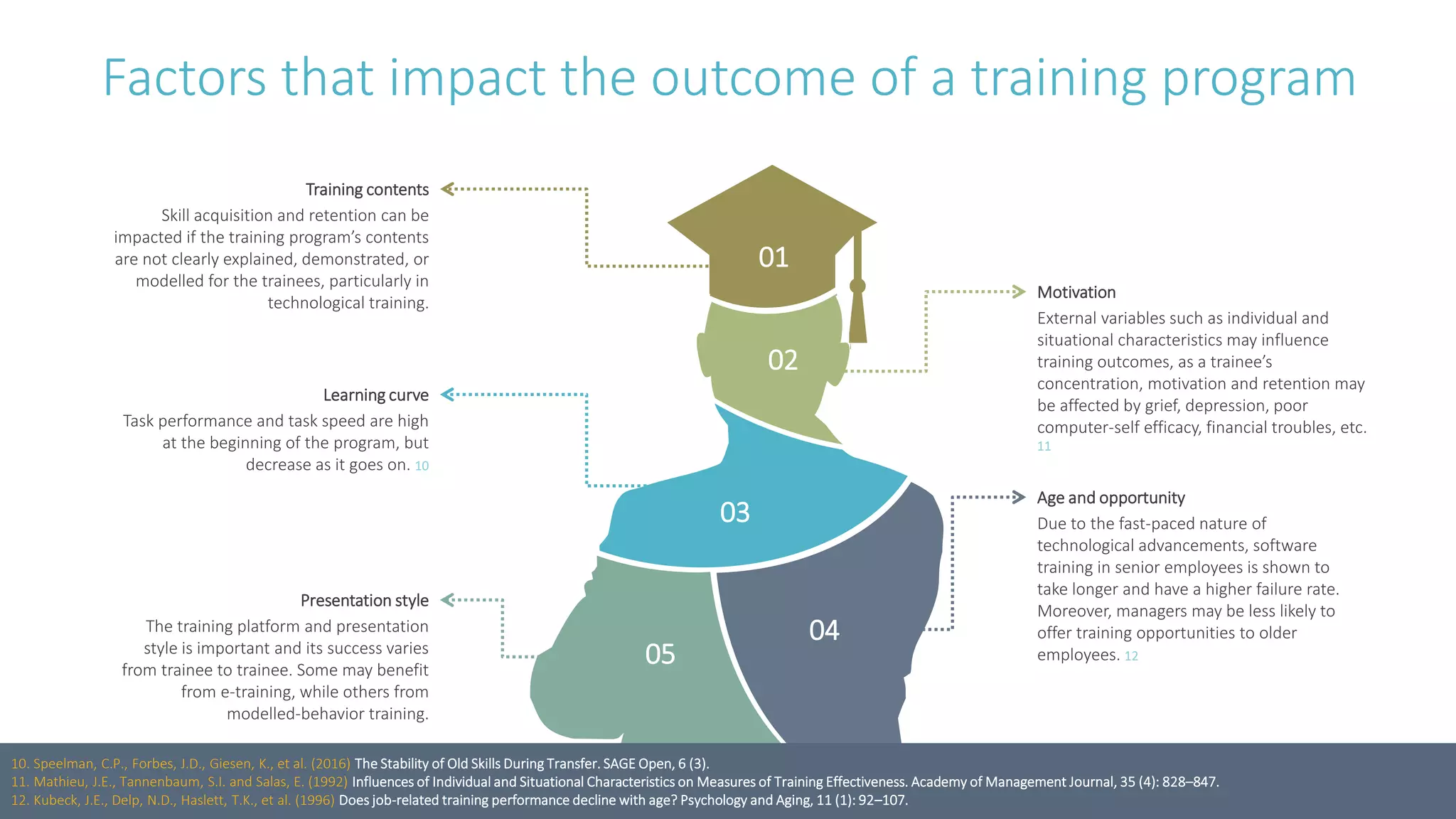
Factors that impact the outcome of a training program
The training platform and presentation
style is important and its success varies
from trainee to trainee. Some may benefit
from e-training, while others from
modelled-behavior training.
Presentation style
Skill acquisition and retention can be
impacted if the training program’s contents
are not clearly explained, demonstrated, or
modelled for the trainees, particularly in
technological training.
Training contents
External variables such as individual and
situational characteristics may influence
training outcomes, as a trainee’s
concentration, motivation and retention may
be affected by grief, depression, poor
computer-self efficacy, financial troubles, etc.
11
Motivation
Due to the fast-paced nature of
technological advancements, software
training in senior employees is shown to
take longer and have a higher failure rate.
Moreover, managers may be less likely to
offer training opportunities to older
employees. 12
Age and opportunity
Task performance and task speed are high
at the beginning of the program, but
decrease as it goes on. 10
Learning curve
01
02
03
05
04
10. Speelman, C.P., Forbes, J.D., Giesen, K., et al. (2016) The Stability of Old Skills During Transfer. SAGE Open, 6 (3).
11. Mathieu, J.E., Tannenbaum, S.I. and Salas, E. (1992) Influences of Individual and Situational Characteristics on Measures of Training Effectiveness. Academy of Management Journal, 35 (4): 828–847.
12. Kubeck, J.E., Delp, N.D., Haslett, T.K., et al. (1996) Does job-related training performance decline with age? Psychology and Aging, 11 (1): 92–107.
Existing approaches
Methodologies for improving training frameworks
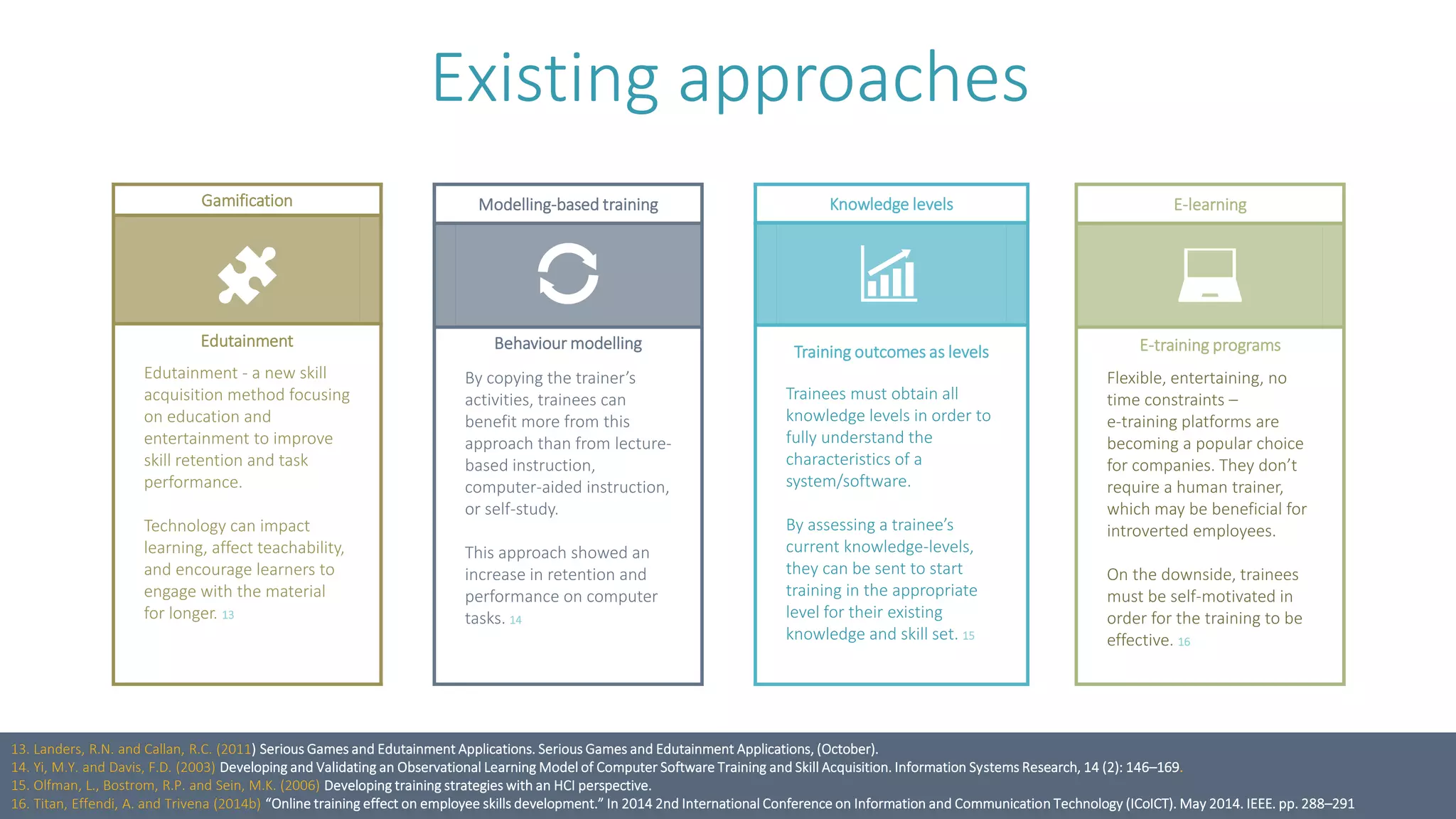
Existing approaches
Gamification
Edutainment
Edutainment - a new skill
acquisition method focusing
on education and
entertainment to improve
skill retention and task
performance.
Technology can impact
learning, affect teachability,
and encourage learners to
engage with the material
for longer. 13
Modelling-based training
Behaviour modelling
By copying the trainer’s
activities, trainees can
benefit more from this
approach than from lecture-
based instruction,
computer-aided instruction,
or self-study.
This approach showed an
increase in retention and
performance on computer
tasks. 14
Knowledge levels
Training outcomes as levels
Trainees must obtain all
knowledge levels in order to
fully understand the
characteristics of a
system/software.
By assessing a trainee’s
current knowledge-levels,
they can be sent to start
training in the appropriate
level for their existing
knowledge and skill set. 15
E-learning
E-training programs
Flexible, entertaining, no
time constraints –
e-training platforms are
becoming a popular choice
for companies. They don’t
require a human trainer,
which may be beneficial for
introverted employees.
On the downside, trainees
must be self-motivated in
order for the training to be
effective. 16
13. Landers, R.N. and Callan, R.C. (2011) Serious Games and Edutainment Applications. Serious Games and Edutainment Applications, (October).
14. Yi, M.Y. and Davis, F.D. (2003) Developing and Validating an Observational Learning Model of Computer Software Training and Skill Acquisition. Information Systems Research, 14 (2): 146–169.
15. Olfman, L., Bostrom, R.P. and Sein, M.K. (2006) Developing training strategies with an HCI perspective.
16. Titan, Effendi, A. and Trivena (2014b) “Online training effect on employee skills development.” In 2014 2nd International Conference on Information and Communication Technology (ICoICT). May 2014. IEEE. pp. 288–291
Proposals for future work
Formulating ideas based on research
When discussing computer or software training, one must take into consideration the trainee’s level
of confidence in computer use. Research suggests the following: 17 18
1. Increasing trainees’ computer self-efficacy
Poor computer self-efficacy,
or computer anxiety:
• negatively impacts skill
acquisition and task
performance
•makes trainees unwilling to
learn technical skills or ask
for vital computer training
•may lead to the wrong
performance of
organizational operations
that rely on computer use
Improving trainees’
computer confidence prior
to training:
• Improves skill acquisition
and skill retention
•Improves task performance
and speed
•Encourages employees to
seek further computer
training
17. Torkzadeh, R., Pflughoeft, K. and Hall, L. (1999) Computer self-efficacy, training effectiveness and user attitudes: An empirical study. Behaviour and Information Technology, 18 (4): 299–309.
18. Coffin, R.J. and MacIntyre, P.D. (1999) Motivational influences on computer-related affective states. Computers in Human Behaviour, 15 (5): 549–569.
E-training interfaces are the most appropriate platform for adopting HCI approaches in software
training, as the HCI usability guidelines and design philosophy can be best applied in a system
that is ultimately created to be intuitive, comprehensible, and friendly for users.
Moreover, in the digital age, their usage is bound to increase. 16
2. E-training as a platform, but only if it meets usability requirements
16. Titan, Effendi, A. and Trivena (2014b) “Online training effect on employee skills development.” In 2014 2nd International Conference on Information and Communication Technology (ICoICT). May 2014. IEEE. pp. 288–291
D
DDDD
Successful E-training
programs should
• Have a user-friendly interface
• Meet HCI guidelines of
usability
• Present clear, well-structured
content
• Not cause the trainee
computer anxiety
Even with a comprehensive training framework that adopts HCI approaches, in order for the
training outcomes to be successful:
• skill-sharing and skill acquisition should be encouraged on an organisational level
• work culture should be changed to promote a training-focused culture of organisational
learning
• employees should be encouraged to apply to training programs
In the ideal work ecosystem, employees’ computer use confidence is high and their productivity
is increased. Moreover, employees benefit from training opportunities while companies benefit
from a competent, efficient workforce. 9, 13, 16
3. Work culture must encourage skill acquisition/sharing
9. Galletta, D. and Zhang, P. (2006) Applications of Human-Computer Interaction in Management Information Systems. ME Sharpe Inc.
13. Landers, R.N. and Callan, R.C. (2011) Serious Games and Edutainment Applications. Serious Games and Edutainment Applications, (October).
16. Titan, Effendi, A. and Trivena (2014b) “Online training effect on employee skills development.” In 2014 2nd International Conference on Information and Communication Technology (ICoICT). May 2014. IEEE. pp. 288–291
Thank you!
Do you have any
questions?

HCI approach to employee training

  • 1.
    Adopting HCI Approaches In EmployeeSoftware Training Individual Study 2 Cezara Hulber
  • 2.
    The presentation willstart by stablishing the research context and why this topic is important. Introduction01 The field of Human-Computer Interaction is innovative and endlessly creative – this allows HCI approaches to be applied in nearly every discipline. HCI as a multidisciplinary field02 Experts have been researching ways to improve software training for decades. This section will present some of the known obstacles to skill acquisition and retention. Training obstacles03 Solutions for better training frameworks have been developed that employ various perspective: gamification, e-learning, and more. Existing approaches04 What are some ways HCI can further improve training models? Proposals for future work05
  • 3.
  • 4.
    1. Worland, Justin(2016). What Will the Retirement Age Be In 2050? TIME Magazine. Available at: https://time.com/4217033/what-will-the-retirement-age-be-in-2050/ and accessed on 12/01/2020. 2. Friedberg, L. (2003) The Impact of Technological Change on Older Workers: Evidence from Data on Computer Use. Industrial and Labor Relations Review, 56 (3) 3. Brougham, D. and Haar, J. (2018) Smart Technology, Artificial Intelligence, Robotics, and Algorithms (STARA): Employees’ perceptions of our future workplace. Journal of Management & Organization, 24 (2) The current situation • Pension age increasing in first world countries • By 2050, experts predict the pension age to reach 70 1 • The continuing employability of older adults requires them to engage in training programs to maintain their skill set up-to-date 2 Aging population • Smart Technology, Artificial Intelligence, Robotics and Algorithms • Emergent technologies that are expected to replace 1/3 of existing jobs by 2025 3 • Employees are not concerned about the possibility of STARA technologies taking their job • Lack of STARA awareness may lead to a lower share in technology related employee training STARA • Alter skill requirements • Are restructuring training programs • Their use is increasing in all industries • Computer proficiency is a valuable skill in many workplaces Technological advancements
  • 5.
    Research objectives and researchquestions In order to advocate for the application of an HCI perspective in improving training frameworks, HCI must be presented as a field that can bring improvements in a wide range of disciplines, not just the technological ones. HCI as multidisciplinary field Developing a successful training framework can be difficult. What factors influence the success or failure rate of a training program? Identify obstacles in employee software training Researches have used different methods of improving software training. How can current efforts be used in combination with HCI theory principles? Study existing approaches for improving training models
  • 6.
  • 7.
    Human-Computer Interaction • innovativespace that encourages developers to build for the user • encourages empathetic and critical thinking • solidifies the importance of iteration • brings a breath of fresh air to technological developments Technologies have changed and evolved from professional to domestic and leisure environments, and as such, disciplines responsible for the design and use of technologies have also gone through changes themselves. 4 • Factory machines • Banking devices • Cloud servers Professional • Home appliances • Smart-home devices • Security systems Domestic • Smartphones • TV, speakers, game console • Apps, music & video streaming, social media Leisure 4. Sengers, P., McCarthy, J., and Dourish, P. (2006) Reflective HCI: articulating an agenda for critical practice. In CHI ’06 Extended Abstracts on Human Factors in Computing Systems (CHI EA ’06). Association for Computing Machinery, New York, NY, USA, 1683–1686.
  • 8.
    The researchers’ motivationstemmed from a desire to assist organizational, social and political activities in a professional environment. Desire to assist employees By putting in a considerable amount of care in creating technical solutions appropriate for employees’ professional needs and activities, the workshop raised the question of applying HCI approaches to contextualised activities and involving HCI within other disciplines. Incorporates HCI philosophy By enhancing the employees’ technical knowledge, computerised solutions for work-related activities (e-mail, networking, etc) would be much more intuitive and easy to use. Enhance the technical environment The workshop is believed to have ended HCI as a discipline mainly concerned with user-intuitive interfaces, and launch the adoption of multidisciplinary characteristics. Launching point an interdisciplinary workshop organised by researchers Irene Greif and Paul Cashman in 1984 The workshop is concerned with supporting employees in their work place with the use of technology. 5, 6 Computer Supported Cooperative Work (CSCW) 5. Schmidt, K. and Bannon, L. (1992) Taking CSCW seriously. Computer Supported Cooperative Work (CSCW), 1 (1–2): 7–40. 6. Greif, I. (1998) “Everyone is talking about knowledge management (panel).” In Proceedings of the 1998 ACM conference on Computer supported cooperative work - CSCW ’98. New York, New York, USA, 1998. ACM Press. pp. 405–406. doi:10.1145/289444.289516.
  • 9.
    HCI philosophy Innovative, empatheticand intuitive solutions To be designed and created with the user in mind. All types of users Users should be able to interact with the design intuitively, no matter what their technological, physiological, or psychological capabilities are. Symphony of Sciences Social sciences, psychology, arts, computer science, biology, environmental sciences, etc. All types of activities HCI can be applied in all kind of activities, from performing arts to mobile banking. All types of contexts Whether the context is professional, leisure, or domestic, the design should mold appropriately.
  • 10.
    To summarise… Reasons HCIphilosophy should be applied in the development of software training frameworks HCI is a trading zone where disciplines can be directly involved in other disciplines’ priorities. 7 HCI is not a field concerned with user interfaces, but an essential model that can be employed to preserve computer science knowledge if it is assembled in educational and professional activities. 8 The HCI perspective can be applied within an organisation on environmental issues (organisational, social and global) and job-related issues (task goals and task characteristics). 9 Technology can be used to bring people together and help them learn from each other- in other words, technological involvement can facilitate skill acquisition and employee training. 7. Kim, S. (1995) Interdisciplinary Cooperation. Readings in Human–Computer Interaction, pp. 304–311. 8. Blackwell, A.F. (2015) HCI as an inter-discipline. Conference on Human Factors in Computing Systems - Proceedings, 18: 503–512. 9. Galletta, D. and Zhang, P. (2006) Applications of Human-Computer Interaction in Management Information Systems. ME Sharpe Inc.
  • 11.
    Training obstacles Factors thatimpact employee training
  • 12.
    Factors that impactthe outcome of a training program The training platform and presentation style is important and its success varies from trainee to trainee. Some may benefit from e-training, while others from modelled-behavior training. Presentation style Skill acquisition and retention can be impacted if the training program’s contents are not clearly explained, demonstrated, or modelled for the trainees, particularly in technological training. Training contents External variables such as individual and situational characteristics may influence training outcomes, as a trainee’s concentration, motivation and retention may be affected by grief, depression, poor computer-self efficacy, financial troubles, etc. 11 Motivation Due to the fast-paced nature of technological advancements, software training in senior employees is shown to take longer and have a higher failure rate. Moreover, managers may be less likely to offer training opportunities to older employees. 12 Age and opportunity Task performance and task speed are high at the beginning of the program, but decrease as it goes on. 10 Learning curve 01 02 03 05 04 10. Speelman, C.P., Forbes, J.D., Giesen, K., et al. (2016) The Stability of Old Skills During Transfer. SAGE Open, 6 (3). 11. Mathieu, J.E., Tannenbaum, S.I. and Salas, E. (1992) Influences of Individual and Situational Characteristics on Measures of Training Effectiveness. Academy of Management Journal, 35 (4): 828–847. 12. Kubeck, J.E., Delp, N.D., Haslett, T.K., et al. (1996) Does job-related training performance decline with age? Psychology and Aging, 11 (1): 92–107.
  • 13.
    Existing approaches Methodologies forimproving training frameworks
  • 14.
    Existing approaches Gamification Edutainment Edutainment -a new skill acquisition method focusing on education and entertainment to improve skill retention and task performance. Technology can impact learning, affect teachability, and encourage learners to engage with the material for longer. 13 Modelling-based training Behaviour modelling By copying the trainer’s activities, trainees can benefit more from this approach than from lecture- based instruction, computer-aided instruction, or self-study. This approach showed an increase in retention and performance on computer tasks. 14 Knowledge levels Training outcomes as levels Trainees must obtain all knowledge levels in order to fully understand the characteristics of a system/software. By assessing a trainee’s current knowledge-levels, they can be sent to start training in the appropriate level for their existing knowledge and skill set. 15 E-learning E-training programs Flexible, entertaining, no time constraints – e-training platforms are becoming a popular choice for companies. They don’t require a human trainer, which may be beneficial for introverted employees. On the downside, trainees must be self-motivated in order for the training to be effective. 16 13. Landers, R.N. and Callan, R.C. (2011) Serious Games and Edutainment Applications. Serious Games and Edutainment Applications, (October). 14. Yi, M.Y. and Davis, F.D. (2003) Developing and Validating an Observational Learning Model of Computer Software Training and Skill Acquisition. Information Systems Research, 14 (2): 146–169. 15. Olfman, L., Bostrom, R.P. and Sein, M.K. (2006) Developing training strategies with an HCI perspective. 16. Titan, Effendi, A. and Trivena (2014b) “Online training effect on employee skills development.” In 2014 2nd International Conference on Information and Communication Technology (ICoICT). May 2014. IEEE. pp. 288–291
  • 15.
    Proposals for futurework Formulating ideas based on research
  • 16.
    When discussing computeror software training, one must take into consideration the trainee’s level of confidence in computer use. Research suggests the following: 17 18 1. Increasing trainees’ computer self-efficacy Poor computer self-efficacy, or computer anxiety: • negatively impacts skill acquisition and task performance •makes trainees unwilling to learn technical skills or ask for vital computer training •may lead to the wrong performance of organizational operations that rely on computer use Improving trainees’ computer confidence prior to training: • Improves skill acquisition and skill retention •Improves task performance and speed •Encourages employees to seek further computer training 17. Torkzadeh, R., Pflughoeft, K. and Hall, L. (1999) Computer self-efficacy, training effectiveness and user attitudes: An empirical study. Behaviour and Information Technology, 18 (4): 299–309. 18. Coffin, R.J. and MacIntyre, P.D. (1999) Motivational influences on computer-related affective states. Computers in Human Behaviour, 15 (5): 549–569.
  • 17.
    E-training interfaces arethe most appropriate platform for adopting HCI approaches in software training, as the HCI usability guidelines and design philosophy can be best applied in a system that is ultimately created to be intuitive, comprehensible, and friendly for users. Moreover, in the digital age, their usage is bound to increase. 16 2. E-training as a platform, but only if it meets usability requirements 16. Titan, Effendi, A. and Trivena (2014b) “Online training effect on employee skills development.” In 2014 2nd International Conference on Information and Communication Technology (ICoICT). May 2014. IEEE. pp. 288–291 D DDDD Successful E-training programs should • Have a user-friendly interface • Meet HCI guidelines of usability • Present clear, well-structured content • Not cause the trainee computer anxiety
  • 18.
    Even with acomprehensive training framework that adopts HCI approaches, in order for the training outcomes to be successful: • skill-sharing and skill acquisition should be encouraged on an organisational level • work culture should be changed to promote a training-focused culture of organisational learning • employees should be encouraged to apply to training programs In the ideal work ecosystem, employees’ computer use confidence is high and their productivity is increased. Moreover, employees benefit from training opportunities while companies benefit from a competent, efficient workforce. 9, 13, 16 3. Work culture must encourage skill acquisition/sharing 9. Galletta, D. and Zhang, P. (2006) Applications of Human-Computer Interaction in Management Information Systems. ME Sharpe Inc. 13. Landers, R.N. and Callan, R.C. (2011) Serious Games and Edutainment Applications. Serious Games and Edutainment Applications, (October). 16. Titan, Effendi, A. and Trivena (2014b) “Online training effect on employee skills development.” In 2014 2nd International Conference on Information and Communication Technology (ICoICT). May 2014. IEEE. pp. 288–291
  • 19.
    Thank you! Do youhave any questions?