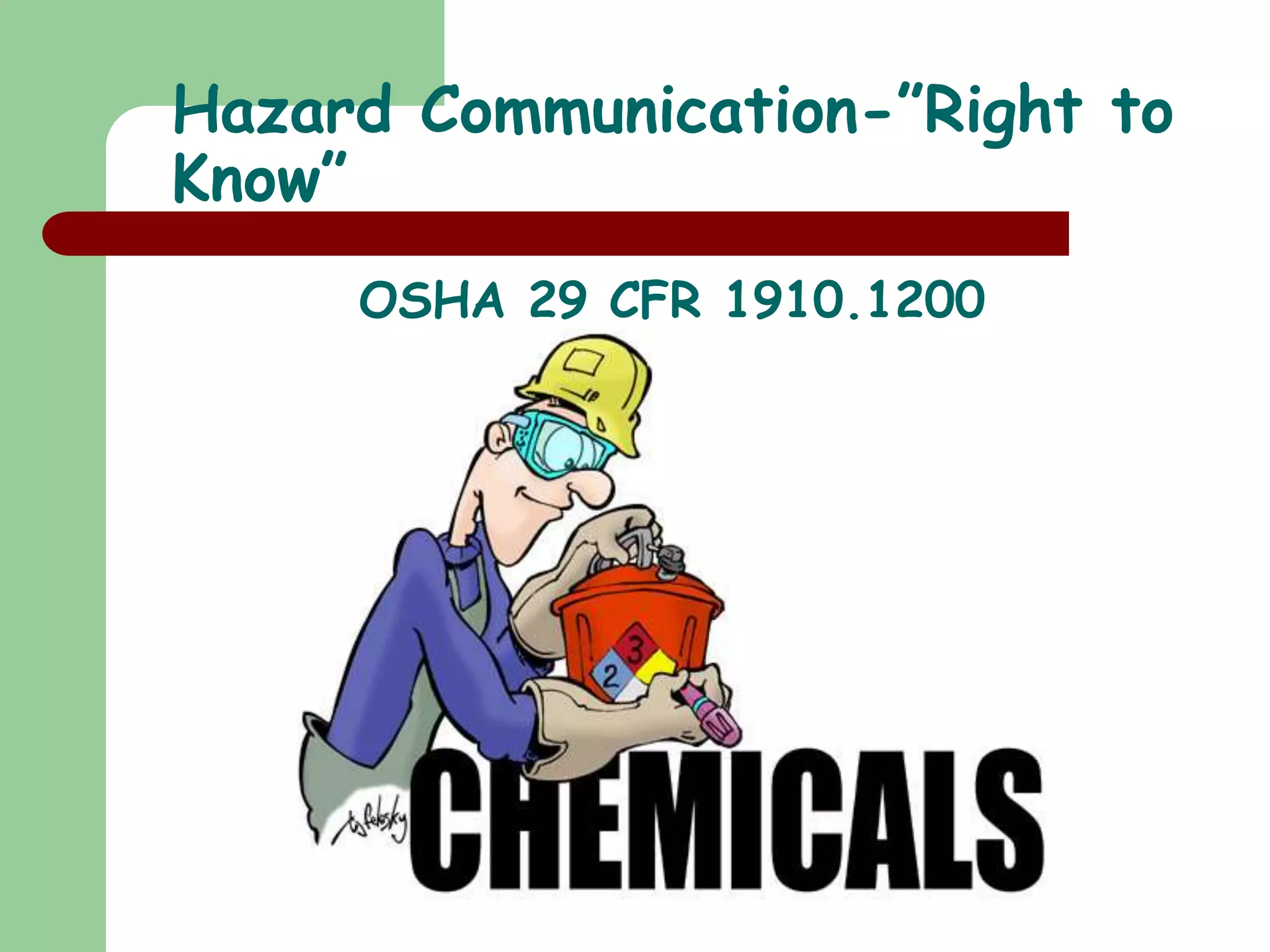
Hazard Communication-”Right to
Know”
OSHA 29 CFR 1910.1200
Hazard Communication “Goals”
 Right to Know chemical hazards
 PPE
 First aid
 Labels
 Material Safety Data Sheets (MSDS)
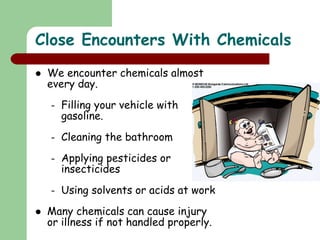
Close Encounters With Chemicals
 We encounter chemicals almost
every day.
– Filling your vehicle with
gasoline.
– Cleaning the bathroom
– Applying pesticides or
insecticides
– Using solvents or acids at work
 Many chemicals can cause injury
or illness if not handled properly.
Right to Know
 OSHA created the Hazard
Communication Standard to help
ensure your safety when working with
hazardous chemicals.
 You have a RIGHT TO KNOW about
the hazardous chemicals you use on
the job and how to work safely with
those chemicals.
Hazard Communication Standard
 Chemical Manufacturers must:
– Determine a chemical’s hazards
– Provide labels and MSDSs
 Employers must:
– Provide a Hazard Communication Program
– Maintain MSDSs
– Train on hazardous materials
 Employees must:
– Read labels and MSDSs
– Follow employer instructions and warnings
– Identify hazards before starting a job
– Participate in training
HazCom Standard (cont.)
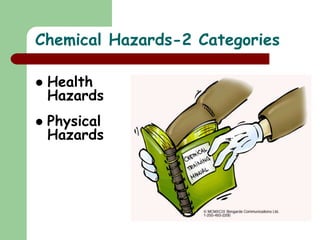
Chemical Hazards-2 Categories
 Health
Hazards
 Physical
Hazards
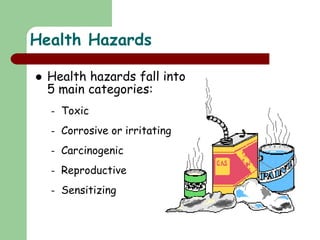
Health Hazards
 Health hazards fall into
5 main categories:
– Toxic
– Corrosive or irritating
– Carcinogenic
– Reproductive
– Sensitizing
Toxic-Toxic Chemicals
 Have an effect on one or more
body organ or system.
 This effect may be varied.
 It may damage the lungs,
stimulate or depress the nervous
system, or damage other
systems, such as the kidneys or
liver.
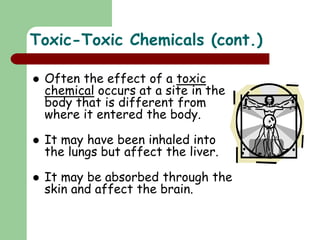
Toxic-Toxic Chemicals (cont.)
 Often the effect of a toxic
chemical occurs at a site in the
body that is different from
where it entered the body.
 It may have been inhaled into
the lungs but affect the liver.
 It may be absorbed through the
skin and affect the brain.
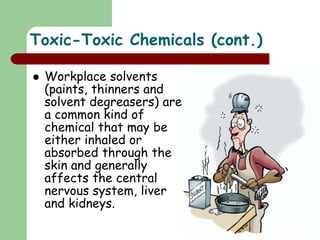
Toxic-Toxic Chemicals (cont.)
 Workplace solvents
(paints, thinners and
solvent degreasers) are
a common kind of
chemical that may be
either inhaled or
absorbed through the
skin and generally
affects the central
nervous system, liver
and kidneys.
Toxic-Toxic Chemicals (cont.)
 The effect of a toxic chemical
may develop immediately or may
take months to years to develop.
 Toxic effects are dependent on
the dose – how much exposure
you have over what period of
time.
 Often you can safely be exposed
to low levels over a long time
period.
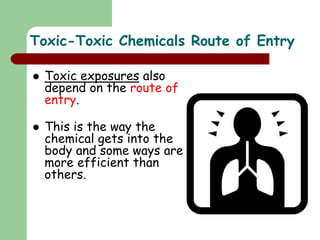
Toxic-Toxic Chemicals Route of Entry
 Toxic exposures also
depend on the route of
entry.
 This is the way the
chemical gets into the
body and some ways are
more efficient than
others.
In comparing the different routes of entry:
 INHALATION of a chemical via the lungs, can
take a chemical directly to the blood stream,
as can an open cut or rash.
 ABSORPTION & INGESTION through the
skin and gastrointestinal system are generally
slower and less effective routes of entry.
 The eyes aren’t a very effective route of
entry, but are very sensitive to many
chemicals. PROTECT YOUR EYES!
Toxic-Toxic Chemicals Route of Entry
Irritating or Corrosive
 Irritating or corrosive chemicals are
very different than toxic chemicals.
 And in many ways much simpler.
 They have essentially one effect,
which is to irritate body tissues that
they come into contact with.
 Irritating or corrosive chemicals
affect the tissues at the site
they contact and are not
transported through the body to
cause effects at other sites.
 And the effect is generally
immediate, or very nearly.
Irritating or Corrosive (cont.)
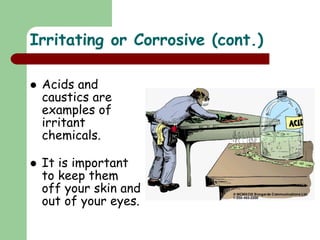
 Acids and
caustics are
examples of
irritant
chemicals.
 It is important
to keep them
off your skin and
out of your eyes.
Irritating or Corrosive (cont.)
Carcinogens
 Carcinogens are chemicals that
cause cancer.
 In many ways they act like toxic
chemicals, exerting their effect
on various body organs and
systems and having an effect
that is often long-term
(occurring over a period of
years).
 Carcinogens are different than toxic
chemicals in that their effect is less
dependent on dose.
 Even a one-time exposure to some
carcinogens can cause cancer years later.
 So preventing contact and exposure is
especially important.
 Asbestos and lead are examples of
carcinogens found in many workplaces and
homes.
Carcinogens (cont.)
Reproductive
 Reproductive hazards affect the
reproductive system directly
(both male and female),
depending on the chemical and
its effect.
 They also, in some cases, affect
the unborn child, particularly
during the first 3 months of
pregnancy.
 Reproductive hazards act in
some ways like carcinogens,
requiring a relatively limited
exposure for the effect to
occur.
 Again, preventing exposure,
especially during pregnancy, is
the key.
Reproductive (cont.)
Sensitizing
 Sensitizers cause an allergic-
type reaction.
 Often this reaction takes the
form of a skin reaction, such as
hives, or a respiratory reaction
similar to asthma.
 The reaction can be severe and
tends to get worse over time.
 With sensitizers, the reaction
won’t be initially present. It
requires initial exposure to
trigger it, after which a very
small exposure may trigger the
reaction.
 Again, controlling exposure
initially is key.
Sensitizing (cont.)
Controlling Chemical Health Hazards
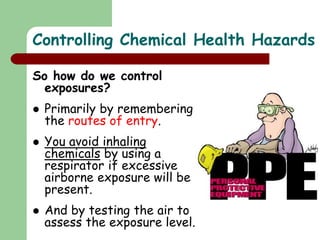
So how do we control
exposures?
 Primarily by remembering
the routes of entry.
 You avoid inhaling
chemicals by using a
respirator if excessive
airborne exposure will be
present.
 And by testing the air to
assess the exposure level.
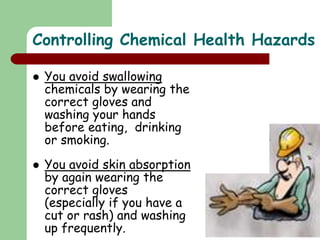
 You avoid swallowing
chemicals by wearing the
correct gloves and
washing your hands
before eating, drinking
or smoking.
 You avoid skin absorption
by again wearing the
correct gloves
(especially if you have a
cut or rash) and washing
up frequently.
Controlling Chemical Health Hazards
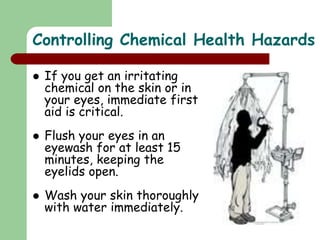
 If you get an irritating
chemical on the skin or in
your eyes, immediate first
aid is critical.
 Flush your eyes in an
eyewash for at least 15
minutes, keeping the
eyelids open.
 Wash your skin thoroughly
with water immediately.
Controlling Chemical Health Hazards
 Combustibles and
flammables
 Explosive and reactive
chemicals
 Compressed gases
Physical Hazards of Workplace
Chemicals
Physical hazards of chemicals
include:
Combustibles and Flammables
 Combustibles and flammables catch
fire and burn, sometimes explosively.
 They can be handled safely by
remembering a few simple principles.
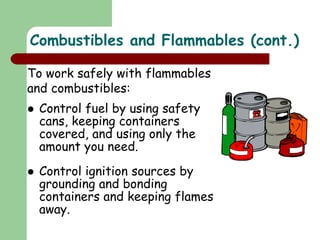
 Control fuel by using safety
cans, keeping containers
covered, and using only the
amount you need.
 Control ignition sources by
grounding and bonding
containers and keeping flames
away.
Combustibles and Flammables (cont.)
To work safely with flammables
and combustibles:
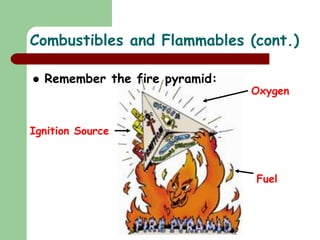
Fuel
Oxygen
Ignition Source
 Remember the fire pyramid:
Combustibles and Flammables (cont.)
Explosives and Reactives
 Explosives and reactives present very
specialized hazards.
 Explosive: Compressed gas cylinders;
aerosol cans
 Reactive: Mixture of bleach and
ammonia; mixture of acid and solvents.
 The key with any chemical is to read
the Material Safety Data Sheet (more
in a minute) and know its safe handling.
Combustible Gases
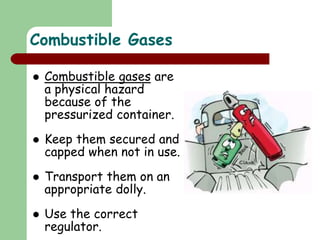
 Combustible gases are
a physical hazard
because of the
pressurized container.
 Keep them secured and
capped when not in use.
 Transport them on an
appropriate dolly.
 Use the correct
regulator.
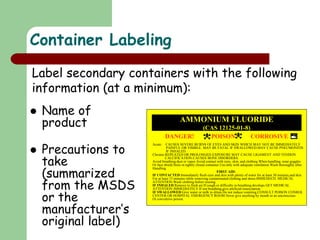
Container Labeling
 Name of
product
 Precautions to
take
(summarized
from the MSDS
or the
manufacturer’s
original label)
Label secondary containers with the following
information (at a minimum):
AMMONIUM FLUORIDE
(CAS 12125-01-8)
DANGER! POISON CORROSIVE
Acute: CAUSES SEVERE BURNS OF EYES AND SKIN WHICH MAY NOT BE IMMEDIATELY
PAINFUL OR VISIBLE. MAY BE FATAL IF SWALLOWED.MAY CAUSE PNEUMONITIS
IF INHALED.
Chronic:REPEATED OR PROLONGED EXPOSURE MAY CAUSE LIGAMENT AND TENDON
CALCIFICATION.CAUSES BONE DISORDERS.
Avoid breathing dust or vapor.Avoid contact with eyes, skin, and clothing.When handling, wear goggles
Or face shield.Store in tightly closed container.Use only with adequate ventilation.Wash thoroughly after
Handling.
FIRST AID:
IF CONTACTED:Immediately flush eyes and skin with plenty of water for at least 30 minutes,and skin
For at least 15 minutes while removing contaminated clothing and shoes.IMMEDIATE MEDICAL
ATTENTION.Wash clothing before reusing.
IF INHALED.Remove to fresh air.If cough or difficulty in breathing develops GET MEDICAL
ATTENTION IMMEDIATELY.If not breathing,give artificial resuscitation.
IF SWALLOWED:Give water or milk to dilute.Do not induce vomiting.CONSULT POISON CONROL
CENTER OR HOSPITAL EMERGENCY ROOM.Never give anything by mouth to an unconscious
Or convulsive person.
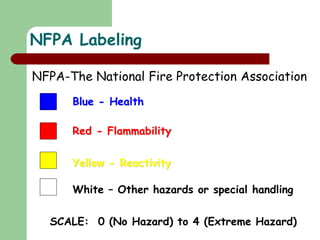
NFPA Labeling
NFPA-The National Fire Protection Association
Blue - Health
Red - Flammability
Yellow - Reactivity
White – Other hazards or special handling
SCALE: 0 (No Hazard) to 4 (Extreme Hazard)
MSDS Book
 The Material Safety
Data Sheet (MSDS) is
a document that is
provided by the
manufacturer of a
chemical to describe
the hazards of that
chemical and the
precautions to take in
order to work with it
safely.
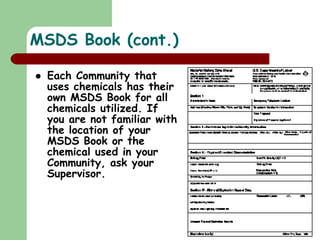
 Each Community that
uses chemicals has their
own MSDS Book for all
chemicals utilized. If
you are not familiar with
the location of your
MSDS Book or the
chemical used in your
Community, ask your
Supervisor.
MSDS Book (cont.)
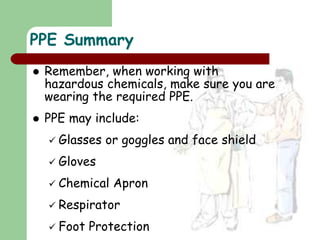
 Remember, when working with
hazardous chemicals, make sure you are
wearing the required PPE.
 PPE may include:
 Glasses or goggles and face shield
 Gloves
 Chemical Apron
 Respirator
 Foot Protection
PPE Summary
 Eyes: Flush with water for at least 15-20
minutes.
 Skin:
 Flush with water for at least 15-20 minutes
(corrosive or solvent contact)
 wash with soap and water (lead or inorganic
arsenic contact).
 Inhalation: Move to fresh air
 Ingestion: Get emergency medical assistance.
First Aid Summary

HazCom_1.ppt

  • 1.
  • 2.
    Hazard Communication “Goals” Right to Know chemical hazards  PPE  First aid  Labels  Material Safety Data Sheets (MSDS)
  • 3.
    Close Encounters WithChemicals  We encounter chemicals almost every day. – Filling your vehicle with gasoline. – Cleaning the bathroom – Applying pesticides or insecticides – Using solvents or acids at work  Many chemicals can cause injury or illness if not handled properly.
  • 4.
    Right to Know OSHA created the Hazard Communication Standard to help ensure your safety when working with hazardous chemicals.  You have a RIGHT TO KNOW about the hazardous chemicals you use on the job and how to work safely with those chemicals.
  • 5.
    Hazard Communication Standard Chemical Manufacturers must: – Determine a chemical’s hazards – Provide labels and MSDSs  Employers must: – Provide a Hazard Communication Program – Maintain MSDSs – Train on hazardous materials
  • 6.
     Employees must: –Read labels and MSDSs – Follow employer instructions and warnings – Identify hazards before starting a job – Participate in training HazCom Standard (cont.)
  • 7.
    Chemical Hazards-2 Categories Health Hazards  Physical Hazards
  • 8.
    Health Hazards  Healthhazards fall into 5 main categories: – Toxic – Corrosive or irritating – Carcinogenic – Reproductive – Sensitizing
  • 9.
    Toxic-Toxic Chemicals  Havean effect on one or more body organ or system.  This effect may be varied.  It may damage the lungs, stimulate or depress the nervous system, or damage other systems, such as the kidneys or liver.
  • 10.
    Toxic-Toxic Chemicals (cont.) Often the effect of a toxic chemical occurs at a site in the body that is different from where it entered the body.  It may have been inhaled into the lungs but affect the liver.  It may be absorbed through the skin and affect the brain.
  • 11.
    Toxic-Toxic Chemicals (cont.) Workplace solvents (paints, thinners and solvent degreasers) are a common kind of chemical that may be either inhaled or absorbed through the skin and generally affects the central nervous system, liver and kidneys.
  • 12.
    Toxic-Toxic Chemicals (cont.) The effect of a toxic chemical may develop immediately or may take months to years to develop.  Toxic effects are dependent on the dose – how much exposure you have over what period of time.  Often you can safely be exposed to low levels over a long time period.
  • 13.
    Toxic-Toxic Chemicals Routeof Entry  Toxic exposures also depend on the route of entry.  This is the way the chemical gets into the body and some ways are more efficient than others.
  • 14.
    In comparing thedifferent routes of entry:  INHALATION of a chemical via the lungs, can take a chemical directly to the blood stream, as can an open cut or rash.  ABSORPTION & INGESTION through the skin and gastrointestinal system are generally slower and less effective routes of entry.  The eyes aren’t a very effective route of entry, but are very sensitive to many chemicals. PROTECT YOUR EYES! Toxic-Toxic Chemicals Route of Entry
  • 15.
    Irritating or Corrosive Irritating or corrosive chemicals are very different than toxic chemicals.  And in many ways much simpler.  They have essentially one effect, which is to irritate body tissues that they come into contact with.
  • 16.
     Irritating orcorrosive chemicals affect the tissues at the site they contact and are not transported through the body to cause effects at other sites.  And the effect is generally immediate, or very nearly. Irritating or Corrosive (cont.)
  • 17.
     Acids and causticsare examples of irritant chemicals.  It is important to keep them off your skin and out of your eyes. Irritating or Corrosive (cont.)
  • 18.
    Carcinogens  Carcinogens arechemicals that cause cancer.  In many ways they act like toxic chemicals, exerting their effect on various body organs and systems and having an effect that is often long-term (occurring over a period of years).
  • 19.
     Carcinogens aredifferent than toxic chemicals in that their effect is less dependent on dose.  Even a one-time exposure to some carcinogens can cause cancer years later.  So preventing contact and exposure is especially important.  Asbestos and lead are examples of carcinogens found in many workplaces and homes. Carcinogens (cont.)
  • 20.
    Reproductive  Reproductive hazardsaffect the reproductive system directly (both male and female), depending on the chemical and its effect.  They also, in some cases, affect the unborn child, particularly during the first 3 months of pregnancy.
  • 21.
     Reproductive hazardsact in some ways like carcinogens, requiring a relatively limited exposure for the effect to occur.  Again, preventing exposure, especially during pregnancy, is the key. Reproductive (cont.)
  • 22.
    Sensitizing  Sensitizers causean allergic- type reaction.  Often this reaction takes the form of a skin reaction, such as hives, or a respiratory reaction similar to asthma.  The reaction can be severe and tends to get worse over time.
  • 23.
     With sensitizers,the reaction won’t be initially present. It requires initial exposure to trigger it, after which a very small exposure may trigger the reaction.  Again, controlling exposure initially is key. Sensitizing (cont.)
  • 24.
    Controlling Chemical HealthHazards So how do we control exposures?  Primarily by remembering the routes of entry.  You avoid inhaling chemicals by using a respirator if excessive airborne exposure will be present.  And by testing the air to assess the exposure level.
  • 25.
     You avoidswallowing chemicals by wearing the correct gloves and washing your hands before eating, drinking or smoking.  You avoid skin absorption by again wearing the correct gloves (especially if you have a cut or rash) and washing up frequently. Controlling Chemical Health Hazards
  • 26.
     If youget an irritating chemical on the skin or in your eyes, immediate first aid is critical.  Flush your eyes in an eyewash for at least 15 minutes, keeping the eyelids open.  Wash your skin thoroughly with water immediately. Controlling Chemical Health Hazards
  • 27.
     Combustibles and flammables Explosive and reactive chemicals  Compressed gases Physical Hazards of Workplace Chemicals Physical hazards of chemicals include:
  • 28.
    Combustibles and Flammables Combustibles and flammables catch fire and burn, sometimes explosively.  They can be handled safely by remembering a few simple principles.
  • 29.
     Control fuelby using safety cans, keeping containers covered, and using only the amount you need.  Control ignition sources by grounding and bonding containers and keeping flames away. Combustibles and Flammables (cont.) To work safely with flammables and combustibles:
  • 30.
    Fuel Oxygen Ignition Source  Rememberthe fire pyramid: Combustibles and Flammables (cont.)
  • 31.
    Explosives and Reactives Explosives and reactives present very specialized hazards.  Explosive: Compressed gas cylinders; aerosol cans  Reactive: Mixture of bleach and ammonia; mixture of acid and solvents.  The key with any chemical is to read the Material Safety Data Sheet (more in a minute) and know its safe handling.
  • 32.
    Combustible Gases  Combustiblegases are a physical hazard because of the pressurized container.  Keep them secured and capped when not in use.  Transport them on an appropriate dolly.  Use the correct regulator.
  • 33.
    Container Labeling  Nameof product  Precautions to take (summarized from the MSDS or the manufacturer’s original label) Label secondary containers with the following information (at a minimum): AMMONIUM FLUORIDE (CAS 12125-01-8) DANGER! POISON CORROSIVE Acute: CAUSES SEVERE BURNS OF EYES AND SKIN WHICH MAY NOT BE IMMEDIATELY PAINFUL OR VISIBLE. MAY BE FATAL IF SWALLOWED.MAY CAUSE PNEUMONITIS IF INHALED. Chronic:REPEATED OR PROLONGED EXPOSURE MAY CAUSE LIGAMENT AND TENDON CALCIFICATION.CAUSES BONE DISORDERS. Avoid breathing dust or vapor.Avoid contact with eyes, skin, and clothing.When handling, wear goggles Or face shield.Store in tightly closed container.Use only with adequate ventilation.Wash thoroughly after Handling. FIRST AID: IF CONTACTED:Immediately flush eyes and skin with plenty of water for at least 30 minutes,and skin For at least 15 minutes while removing contaminated clothing and shoes.IMMEDIATE MEDICAL ATTENTION.Wash clothing before reusing. IF INHALED.Remove to fresh air.If cough or difficulty in breathing develops GET MEDICAL ATTENTION IMMEDIATELY.If not breathing,give artificial resuscitation. IF SWALLOWED:Give water or milk to dilute.Do not induce vomiting.CONSULT POISON CONROL CENTER OR HOSPITAL EMERGENCY ROOM.Never give anything by mouth to an unconscious Or convulsive person.
  • 34.
    NFPA Labeling NFPA-The NationalFire Protection Association Blue - Health Red - Flammability Yellow - Reactivity White – Other hazards or special handling SCALE: 0 (No Hazard) to 4 (Extreme Hazard)
  • 35.
    MSDS Book  TheMaterial Safety Data Sheet (MSDS) is a document that is provided by the manufacturer of a chemical to describe the hazards of that chemical and the precautions to take in order to work with it safely.
  • 36.
     Each Communitythat uses chemicals has their own MSDS Book for all chemicals utilized. If you are not familiar with the location of your MSDS Book or the chemical used in your Community, ask your Supervisor. MSDS Book (cont.)
  • 37.
     Remember, whenworking with hazardous chemicals, make sure you are wearing the required PPE.  PPE may include:  Glasses or goggles and face shield  Gloves  Chemical Apron  Respirator  Foot Protection PPE Summary
  • 38.
     Eyes: Flushwith water for at least 15-20 minutes.  Skin:  Flush with water for at least 15-20 minutes (corrosive or solvent contact)  wash with soap and water (lead or inorganic arsenic contact).  Inhalation: Move to fresh air  Ingestion: Get emergency medical assistance. First Aid Summary