Bitterroot as a metaphor for
   decolonizing education
             Starleigh Grass
           October 25th, 2012
University of British Columbia Okanagan
Recognition of territory
• We are on unceded Okanagan territory
• Thank you to the Okanagan Nation for their
  ongoing hospitality
• Limlempt to Carmella Alexis, Dr. Jeanette
  Armstrong, Dr. Bill Cohen, Marlow Sam, Dr.
  Brent Peacock for their ongoing leadership in
  academia and for being inspirations in my own
  life
Properly introducing myself
•   Tsilhqot’in – gold
•   Tletinqox-t’in, Yunesit’in, Tsi Del Del
•   E-li Jeff – knowledge and land justice
•   Nita Grass – education as empowerment
•   Mother/aunt – education as an obligation to
    the future
Resistance as an inheritance
• Hardline         • Insolence
• Unreasonable     • Menaces
• Religious        • Troublesome and
  fundamentalist     disorderly
  extremist
                   •   Glavin, T. (1992). Nemiah: The Unconquered Country.
                       Vancouver, BC: New Star Books.
Professionally introducing myself
•   Aboriginal Strategic Plan Implementation Committee
•   FNESC – EFP10/11, EFP12
•   Educational Advisor for McGraw Hill
•   Professional development facilitator
•   K-12 humanities teacher in communities with high
    percentage of Aboriginal students
•   Literacy coach – Lillooet Tribal Council
•   Curriculum development
•   TA Leyton Schnellert
•   BCTELA – journal co-editor Pamela Richardson
•   GAA Jeanette Armstrong, Bill Cohen
•   Twinkle’s Happy Place
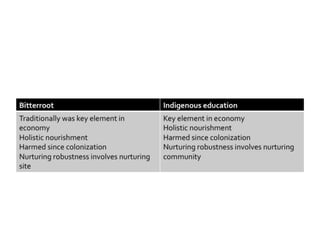
Why bitterroot?
What are we doing here?
5 stages of decolonization
Laenui, P. (2000). Process of decolonization. In M. Baptiste (Ed.) Reclaiming Indigenous Voice and Vision. Vancouver, BC: UBC Press. Pp. 150-
                                                                      160


1)      Rediscovery and recovery
2)      Mourning
3)      Dreaming
4)      Commitment
5)      Action
Medicine wheel
           Baptiste, M. (2000). Reclaiming Indigenous Voice and Vision. Vancouver, BC: UBC Press.


•   Mapping colonialism (West)
•   Diagnosing colonialism (North)
•   Healing colonized indigenous peoples (East)
•   Indigenous renaissance (South)
25 Indigenous Projects
 Smith, L. T. (1999). Decolonizing Methodologies: Research and Indigenous Peoples. New York, New York: Zen Publications.


• Reframing
• Envisioning
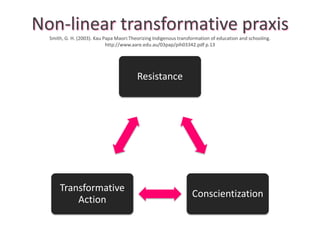
Non-linear transformative praxis
  Smith, G. H. (2003). Kau Papa Maori:Theorizing Indigenous transformation of education and schooling.
                            http://www.aare.edu.au/03pap/pih03342.pdf p.13


                                         Resistance


      Transformative
                                                                  Conscientization
          Action
Awareness is not enough
• In anti-racist education, being aware of racism
  and different perspectives is not enough. One
  can be aware, and yet continue to perpetuate
  oppression.

•   Gorski, P. C. (2009). Good intentions are not enough: A decolonizing intercultural education. Intercultural Education 19(6).
    P515-525. Retrieved fromhttp://www.everettcc.edu/uploadedFiles/Faculty_Staff/TLC/Diversity_Teaching_Lab/intercultural-
    education.pdf
What are we doing here?
Reframing the roots of inequity
        in education
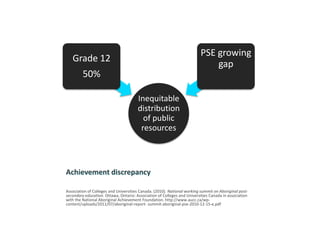
PSE growing
   Grade 12
                                                                             gap
         50%

                                       Inequitable
                                       distribution
                                         of public
                                        resources


Achievement discrepancy

Association of Colleges and Universities Canada. (2010). National working summit on Aboriginal post-
secondary education. Ottawa, Ontario: Association of Colleges and Universities Canada in association
with the National Aboriginal Achievement Foundation. http://www.aucc.ca/wp-
content/uploads/2011/07/aboriginal-report- summit-aboriginal-pse-2010-12-15-e.pdf
Locating responsibility
Kuokkanen, R. (2007). Reshaping the University: Responsibility, Indigenous Epistemes, and the Logic of Gift. Vancouver, BC: UBC Press.


             Student
        Community                                                                               Institution
   Outside factors
Invisibility
• Academia presents Indigenous thought as
  inferior to Eurocentric thought
• Strips Aboriginal students of their heritage
  and identity
• Succumb to eurocentric thought,
•   Youngblood Henderson, J. (2000b). Postcolonial ghost dancing: Diagnosing European colonialism. In M. Battiste (Ed.), Reclaiming
    Indigenous Voice and Vision (57-76). Vancouver, BC: UBC Press.


• or else?
Teaching population
Wilful ignorance
Kuokkanen, R. (2007). Reshaping the University: Responsibility, Indigenous Epistemes, and the Logic of Gift. Vancouver, BC: UBC Press.


Sanctioned ignorance
Regan, P. (2010). Unsettling the Settler Within. Vancouver, BC: UBC Press.
Liberal individual ideology
• Power blind tolerance discourses which do not
  explicitly address racism only serve to blame
  Aboriginal students when it is the institutions
  that are failing
• There is room in the curriculum for
  decolonization, but teachers aren’t making it
  happen
•   Orlowski, P. (2008). "That would certainly be spoiling them": Liberal discourses of Social Studies teachers and concerns
    about Aboriginal students. Canadian Journal of Native Education 31 (2). p110-129.
Culture as a means of assimilation?
• Integration of culture into the classroom for
  the sole purpose of increasing literacy and
  numeracy achievement in order to better
  integrate indigenous peoples into the
  neoliberal market is a neocolonial version of
  education for assimilation
•   Kostogriz, A. (2011). Interrogating the ethics of literacy intervention in indigenous schools. English
    Teaching: Practice and Critique 10 (2). P24-38.
If these are the roots of inequity,
     what are the solutions?
   And what role do I play in solutions?
IK

               Self
          determination
               and
          decolonization

Culture
Indigenous knowledges are inherently
                 disruptive
• Requires epistemological and pedagogical
  shift that inherently undermines the
  privileging of Eurocentric thought
• Experiential, student centered, place based
•    Mason, R. (2008). Conflicts and Lessons in First Nations Secondary Education: An Analysis of BC First Nations Studies. Canadian Journal of
     Native Education 31 (2). pp 130-153.
Cultural integration
• Indigenous knowledge base increases high
  school completion
•   Nazeem, M., Puchala, C., Janus, M. (2011). Does the EDI Equivalently Measure Facets of School Readiness for Aboriginal and Non-Aboriginal children?
    Social Indicators Research, 103, 299-314.


• Being culturally connected increases post
  secondary completion
•   Drywater-Whitekiller, V. (2010). Cultural resilience: Voices of Native American students in college retention. The Canadian Journal of Native
    Studies 30 (1). p1-19.


• Communities with a cultural continuity have
  lower suicide rates
•   Chandler, M. J., & Lalonde, C. (1998). Cultural continuity as a hedge against suicide in Canada's First Nations.Transcultural Psychiatry
    35 (2). 191-219.
Community connections
• Make connections to Aboriginal communities
• Learn about the histories of Aboriginal
  communities
•   Orlowski, P. (2008). "That would certainly be spoiling them": Liberal discourses of Social Studies teachers and concerns about Aboriginal
    students. Canadian Journal of Native Education 31 (2). p110-129.
Self determination and decolonization
• University classroom climate is a strong
  indicator of drop out rates in post-secondary
•    Lindsay, W. G. (2010). Redman in the ivory tower: First Nations students and negative classroom environments in the university setting. The
     Canadian Journal of Native Studies 30 (1). p 143-154.


• Shifting the purpose of education as a means
  to explicitly to address ongoing injustices
  shifts classroom climate and teaching
  attitudes
It is being done
• Self governed Aboriginal post-secondary
  institutions, developed with the purpose of
  building capacity to meet the needs of
  decolonization, have a higher success rate
  than mainstream institutions
•   Stonechild, B. (2006). The New Buffalo: The Struggle for Aboriginal Post-secondary Education in Canada. Winnipeg, Manitoba: University of
    Manitoba Press.
It is mandated in this institution
• "UBC has an obligation to assure that an
  accurate and developed understanding of
  Aboriginal histories, cultures, and perspectives
  is integrated into its existing curricula," (2008
  UBC Aboriginal Strategic Plan).
How do we hold this institution
accountable for these changes?
    And what role do I have in this
         process of change?
Bitterroot as a metaphor for decolonizing education

Bitterroot as a metaphor for decolonizing education

  • 1.
    Bitterroot as ametaphor for decolonizing education Starleigh Grass October 25th, 2012 University of British Columbia Okanagan
  • 2.
    Recognition of territory •We are on unceded Okanagan territory • Thank you to the Okanagan Nation for their ongoing hospitality • Limlempt to Carmella Alexis, Dr. Jeanette Armstrong, Dr. Bill Cohen, Marlow Sam, Dr. Brent Peacock for their ongoing leadership in academia and for being inspirations in my own life
  • 3.
    Properly introducing myself • Tsilhqot’in – gold • Tletinqox-t’in, Yunesit’in, Tsi Del Del • E-li Jeff – knowledge and land justice • Nita Grass – education as empowerment • Mother/aunt – education as an obligation to the future
  • 4.
    Resistance as aninheritance • Hardline • Insolence • Unreasonable • Menaces • Religious • Troublesome and fundamentalist disorderly extremist • Glavin, T. (1992). Nemiah: The Unconquered Country. Vancouver, BC: New Star Books.
  • 5.
    Professionally introducing myself • Aboriginal Strategic Plan Implementation Committee • FNESC – EFP10/11, EFP12 • Educational Advisor for McGraw Hill • Professional development facilitator • K-12 humanities teacher in communities with high percentage of Aboriginal students • Literacy coach – Lillooet Tribal Council • Curriculum development • TA Leyton Schnellert • BCTELA – journal co-editor Pamela Richardson • GAA Jeanette Armstrong, Bill Cohen • Twinkle’s Happy Place
  • 6.
  • 7.
    What are wedoing here?
  • 8.
    5 stages ofdecolonization Laenui, P. (2000). Process of decolonization. In M. Baptiste (Ed.) Reclaiming Indigenous Voice and Vision. Vancouver, BC: UBC Press. Pp. 150- 160 1) Rediscovery and recovery 2) Mourning 3) Dreaming 4) Commitment 5) Action
  • 9.
    Medicine wheel Baptiste, M. (2000). Reclaiming Indigenous Voice and Vision. Vancouver, BC: UBC Press. • Mapping colonialism (West) • Diagnosing colonialism (North) • Healing colonized indigenous peoples (East) • Indigenous renaissance (South)
  • 10.
    25 Indigenous Projects Smith, L. T. (1999). Decolonizing Methodologies: Research and Indigenous Peoples. New York, New York: Zen Publications. • Reframing • Envisioning
  • 11.
    Non-linear transformative praxis Smith, G. H. (2003). Kau Papa Maori:Theorizing Indigenous transformation of education and schooling. http://www.aare.edu.au/03pap/pih03342.pdf p.13 Resistance Transformative Conscientization Action
  • 12.
    Awareness is notenough • In anti-racist education, being aware of racism and different perspectives is not enough. One can be aware, and yet continue to perpetuate oppression. • Gorski, P. C. (2009). Good intentions are not enough: A decolonizing intercultural education. Intercultural Education 19(6). P515-525. Retrieved fromhttp://www.everettcc.edu/uploadedFiles/Faculty_Staff/TLC/Diversity_Teaching_Lab/intercultural- education.pdf
  • 13.
    What are wedoing here?
  • 14.
    Reframing the rootsof inequity in education
  • 15.
    PSE growing Grade 12 gap 50% Inequitable distribution of public resources Achievement discrepancy Association of Colleges and Universities Canada. (2010). National working summit on Aboriginal post- secondary education. Ottawa, Ontario: Association of Colleges and Universities Canada in association with the National Aboriginal Achievement Foundation. http://www.aucc.ca/wp- content/uploads/2011/07/aboriginal-report- summit-aboriginal-pse-2010-12-15-e.pdf
  • 16.
    Locating responsibility Kuokkanen, R.(2007). Reshaping the University: Responsibility, Indigenous Epistemes, and the Logic of Gift. Vancouver, BC: UBC Press. Student Community Institution Outside factors
  • 17.
    Invisibility • Academia presentsIndigenous thought as inferior to Eurocentric thought • Strips Aboriginal students of their heritage and identity • Succumb to eurocentric thought, • Youngblood Henderson, J. (2000b). Postcolonial ghost dancing: Diagnosing European colonialism. In M. Battiste (Ed.), Reclaiming Indigenous Voice and Vision (57-76). Vancouver, BC: UBC Press. • or else?
  • 18.
    Teaching population Wilful ignorance Kuokkanen,R. (2007). Reshaping the University: Responsibility, Indigenous Epistemes, and the Logic of Gift. Vancouver, BC: UBC Press. Sanctioned ignorance Regan, P. (2010). Unsettling the Settler Within. Vancouver, BC: UBC Press.
  • 19.
    Liberal individual ideology •Power blind tolerance discourses which do not explicitly address racism only serve to blame Aboriginal students when it is the institutions that are failing • There is room in the curriculum for decolonization, but teachers aren’t making it happen • Orlowski, P. (2008). "That would certainly be spoiling them": Liberal discourses of Social Studies teachers and concerns about Aboriginal students. Canadian Journal of Native Education 31 (2). p110-129.
  • 20.
    Culture as ameans of assimilation? • Integration of culture into the classroom for the sole purpose of increasing literacy and numeracy achievement in order to better integrate indigenous peoples into the neoliberal market is a neocolonial version of education for assimilation • Kostogriz, A. (2011). Interrogating the ethics of literacy intervention in indigenous schools. English Teaching: Practice and Critique 10 (2). P24-38.
  • 21.
    If these arethe roots of inequity, what are the solutions? And what role do I play in solutions?
  • 22.
    IK Self determination and decolonization Culture
  • 23.
    Indigenous knowledges areinherently disruptive • Requires epistemological and pedagogical shift that inherently undermines the privileging of Eurocentric thought • Experiential, student centered, place based • Mason, R. (2008). Conflicts and Lessons in First Nations Secondary Education: An Analysis of BC First Nations Studies. Canadian Journal of Native Education 31 (2). pp 130-153.
  • 24.
    Cultural integration • Indigenousknowledge base increases high school completion • Nazeem, M., Puchala, C., Janus, M. (2011). Does the EDI Equivalently Measure Facets of School Readiness for Aboriginal and Non-Aboriginal children? Social Indicators Research, 103, 299-314. • Being culturally connected increases post secondary completion • Drywater-Whitekiller, V. (2010). Cultural resilience: Voices of Native American students in college retention. The Canadian Journal of Native Studies 30 (1). p1-19. • Communities with a cultural continuity have lower suicide rates • Chandler, M. J., & Lalonde, C. (1998). Cultural continuity as a hedge against suicide in Canada's First Nations.Transcultural Psychiatry 35 (2). 191-219.
  • 25.
    Community connections • Makeconnections to Aboriginal communities • Learn about the histories of Aboriginal communities • Orlowski, P. (2008). "That would certainly be spoiling them": Liberal discourses of Social Studies teachers and concerns about Aboriginal students. Canadian Journal of Native Education 31 (2). p110-129.
  • 26.
    Self determination anddecolonization • University classroom climate is a strong indicator of drop out rates in post-secondary • Lindsay, W. G. (2010). Redman in the ivory tower: First Nations students and negative classroom environments in the university setting. The Canadian Journal of Native Studies 30 (1). p 143-154. • Shifting the purpose of education as a means to explicitly to address ongoing injustices shifts classroom climate and teaching attitudes
  • 27.
    It is beingdone • Self governed Aboriginal post-secondary institutions, developed with the purpose of building capacity to meet the needs of decolonization, have a higher success rate than mainstream institutions • Stonechild, B. (2006). The New Buffalo: The Struggle for Aboriginal Post-secondary Education in Canada. Winnipeg, Manitoba: University of Manitoba Press.
  • 28.
    It is mandatedin this institution • "UBC has an obligation to assure that an accurate and developed understanding of Aboriginal histories, cultures, and perspectives is integrated into its existing curricula," (2008 UBC Aboriginal Strategic Plan).
  • 29.
    How do wehold this institution accountable for these changes? And what role do I have in this process of change?