WELCOME
DRUG & ALCOHOL AWARENESS
CORPORATE
SAFETY TRAINING
 Discuss the Components of an Effective Program.
 Introduce Ideas to Help Develop an Effective Program.
 Discuss the Drug-Free Workplace Policy.
 Clarification of the Expected Roles of Employers.
 Clarification of the Expected Roles of Employees.
 Explanation of the Effects of Drug Use.
 Overview of Rehabilitative Services.
 Overview of Drug Testing Methods.
COURSE OBJECTIVES
REGULATORY STANDARD
THE GENERAL DUTY CLAUSE
FEDERAL - 29 CFR 1903.1
EMPLOYERS MUST: Furnish a place of employment
free of recognized hazards that are causing or are likely
to cause death or serious physical harm to employees.
Employers must comply with occupational safety and
health standards promulgated under the Williams-
Steiger Occupational Safety and Health Act of 1970.
OSHA ACT OF 1970
THE DRUG-FREE WORKPLACE ACT OF 1988:
APPLICABLE REGULATIONS
 1986 - Signed by the President.
 1988 - Congress Passed the Drug-Free Workplace Act.
 Affects Federal Grantees Receiving $25,000 or More.
 Affects Federal Contracts Receiving $25,000 or More.
 Requires a Written Policy.
 Requires that Employees Read and Consent to the Policy.
 Requires that an Awareness Program be Instituted.
 Employees Must Disclose Any Drug Related Conviction in
the Workplace to the Employer Within 5 Days of the
Conviction.
FEDERAL REQUIREMENTS
Continued
THE DRUG-FREE WORKPLACE ACT OF 1988:
APPLICABLE REGULATIONS
 Employers must Disclose Any Drug Related Conviction in
the Workplace to the Federal Agency with Which the
Employer has a Grant or Contract Within 10 Days of the
Conviction.
 Employers Must Make an Ongoing Effort to Maintain a
Workplace Free of Drugs.
FEDERAL REQUIREMENTS
Continued
Continued
REQUIREMENTS VARY FROM STATE TO STATE:
APPLICABLE REGULATIONS
 Some States, CA, AL, FL, WA and Others Have Programs.
 Many States Offer Workers’ Compensation Discounts.
 Criteria are Similar but No Standard Model Exists.
 Employers Must Meet Certification Criteria in Each State.
 Employers Must Maintain Certifications to Participate.
 Certain Fees May be Required of the Employer.
 De-certification Can Occur for Various Reasons.
STATE REQUIREMENTS
Continued
TYPICAL STATE REQUIREMENTS:
APPLICABLE REGULATIONS
 A Corporate Policy Statement.
 Employee Notification of the Policy.
 Employee Notification of Substance Abuse Testing.
 Substance Abuse Testing Program.
 Employee Assistance Program.
 Supervisor Training.
 Employee Training.
 Agreements to Confidentiality.
STATE REQUIREMENTS
Continued
APPLICABLE REGULATIONS
STATE REQUIREMENTS
SPECIFIC
REQUIREMENTS
OF THIS STATE INCLUDE:
Continued
APPLICABLE REGULATIONS
FOR SPECIFIC STATE REQUIREMENTS
Contact the State Attorney General
or
GUIDE TO STATE DRUG TESTING LAWS
Published by: Institute for a Drug-Free Workplace
1225 I Street, N.W.
Washington, DC 20005-3914
(202) 842-7400 Fax (202) 842-0022
Price (may change): $115 Single Copy
$75 ea, 2 or More
Continued
TRAINING REQUIREMENTS
 Two Hour Training Course.
 The Relationship Between Work & Personal Problems.
 Recognition of Employee Substance Abuse.
 Documenting Signs of Employee Substance Abuse.
 Corroborating Signs of Employee Substance Abuse.
 How to Refer Employees to the Employee Assistance Program.
 Circumstances and Procedures for Post-Injury Testing.
 Supervisor Responsibilities in a “Last Chance Agreement”.
 Employee Confidentiality.
TYPICAL SUPERVISOR TRAINING REQUIREMENTS:
TRAINING REQUIREMENTS
 One Hour Course Conducted Annually.
 The Disease Model of Addiction for Alcohol and Drugs.
 Effects & Dangers of Commonly Abused Workplace Substances.
 The Employer’s Policies/Procedures Regarding Substance Abuse.
 How to Access the Employee Assistance Program.
 Provided in a Non-English Language if Required.
TYPICAL EMPLOYEE TRAINING REQUIREMENTS:
Continued
MAY BE REQUIRED:
 Annually for Some States.
 For a Program Related Injury.
RETRAINING REQUIREMENTS
TRAINING IS IMPORTANT
 Reduce injury and illness rates.
 Help Individuals with personal problems.
 Increase performance and productivity.
 Increase profits.
 Workers feel better about their work.
 Reduce workers’ compensation costs.
 Elevate safety compliance to a higher level.
A GOOD PROGRAM WILL HELP:
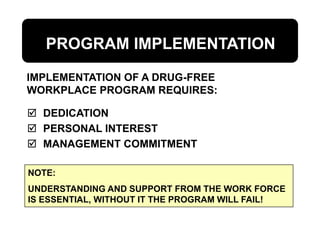
PROGRAM IMPLEMENTATION
 DEDICATION
 PERSONAL INTEREST
 MANAGEMENT COMMITMENT
IMPLEMENTATION OF A DRUG-FREE
WORKPLACE PROGRAM REQUIRES:
NOTE:
UNDERSTANDING AND SUPPORT FROM THE WORK FORCE
IS ESSENTIAL, WITHOUT IT THE PROGRAM WILL FAIL!
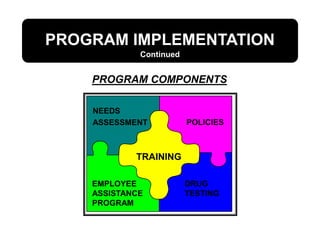
PROGRAM IMPLEMENTATION
Continued
PROGRAM COMPONENTS
NEEDS
ASSESSMENT POLICIES
TRAINING
EMPLOYEE
ASSISTANCE
PROGRAM
DRUG
TESTING
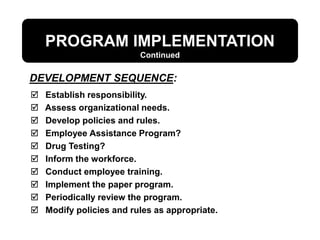
PROGRAM IMPLEMENTATION
 Establish responsibility.
 Assess organizational needs.
 Develop policies and rules.
 Employee Assistance Program?
 Drug Testing?
 Inform the workforce.
 Conduct employee training.
 Implement the paper program.
 Periodically review the program.
 Modify policies and rules as appropriate.
DEVELOPMENT SEQUENCE:
Continued
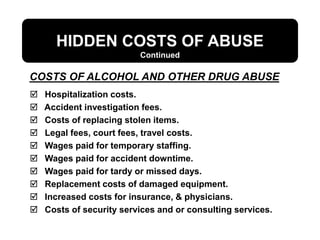
HIDDEN COSTS OF ABUSE
 Hospitalization costs.
 Accident investigation fees.
 Costs of replacing stolen items.
 Legal fees, court fees, travel costs.
 Wages paid for temporary staffing.
 Wages paid for accident downtime.
 Wages paid for tardy or missed days.
 Replacement costs of damaged equipment.
 Increased costs for insurance, & physicians.
 Costs of security services and or consulting services.
COSTS OF ALCOHOL AND OTHER DRUG ABUSE
Continued
HIDDEN COSTS OF ABUSE
COSTS OF ALCOHOL AND OTHER DRUG ABUSE
Continued
Annual Costs for Business
$60 - 150 Billion
HIDDEN COSTS OF ABUSE
 75% had used drugs on the job.
 64% admitted that drugs adversely affected job performance.
 44% said they had sold drugs to other employees
 18% said they had stolen from co-workers.
STATISTICS FROM A “COCAINE HOTLINE”:
Continued
HIDDEN COSTS OF ABUSE
Continued
THOSE WHO ILLICITLY USE DRUGS ARE:
 2.5 times more likely to have absences of 8 days or more.
 3.6 times more likely to injure themselves or others on the job.
 5.0 times more likely to be injured off the job.
 5.0 times more likely to file a workers’ compensation claim.
 1/3 less productive than their co-workers who didn’t.
 Incurred 300 percent higher medical costs.
PROGRAM BENEFITS
 Fewer accidents.
 Fewer disciplinary actions.
 Cost savings and incentive programs:
- Medical & health insurance carriers
- Workers' Compensation insurance carriers.
- Property, casualty, and liability insurance carriers.
 Reduced losses due to absenteeism, theft, and fraud.
 Less chance that a user/abuser will apply and be hired.
 Ability to respond quickly to program related problems.
SHORT-TERM BENEFITS:
PROGRAM BENEFITS
 Reduced costs of insurance claims.
 Lower costs due to losses and errors.
 Improved employee morale and productivity.
 Earlier identification and resolution of problems.
 Greater employee awareness about the problem.
 Decreased legal costs and costs of hiring and training.
LONG-TERM BENEFITS:
Continued
THE SUPERVISOR’S ROLE
 CONSIDER THE FOLLOWING:
1. GET AS MUCH TRAINING AS POSSIBLE.
2. GET TO KNOW YOUR PEOPLE!
3. GET INVOLVED IN, AND UNDERSTAND THE PROGRAM.
4. EXPLAIN THE PROGRAM TO EMPLOYEES.
5. OBTAIN ASSISTANCE FROM EXPERTS IN THE FIELD.
6. UNDERSTAND THE IMPORTANCE OF SUPERVISION.
7. ACCEPT YOUR RESPONSIBILITY.
8. KNOW WHERE YOUR AUTHORITY STOPS.
9. FOLLOW-UP ON THE ACTIONS YOU TOOK.
THE SUPERVISOR’S ROLE
 GUIDELINES FOR EFFECTIVE SUPERVISION:
1. BE ATTENTIVE: Be ready to recognize employee problems
(e.g., accidents, frequent lateness, mood swings) that may or
may not be related to alcohol or other drug abuse.
2. BE OBSERVANT: Focus on specifics aspects of job
performance.
3. DOCUMENT: Keep an ongoing record of the employee's
performance.
4. FOCUS ON JOB PERFORMANCE: Avoid judging, diagnosing,
or counseling the employee.
Continued
THE SUPERVISOR’S ROLE
 GUIDELINES FOR EFFECTIVE SUPERVISION:
5. BE THOUGHTFUL: Stay nonjudgmental and recognize the
employee's point of view.
6. BE STRAIGHTFORWARD: Stick to the facts of job
performance; don't get sidetracked.
7. BE CONSISTENT: Follow the same procedures for all
employees.
8. MAINTAIN CONFIDENTIALITY. Discuss employee problems in
private and keep the discussion between the two of you.
Continued
THE SUPERVISOR’S ROLE
 GUIDELINES FOR EFFECTIVE SUPERVISION:
9. REFER: Encourage troubled employees to seek help from the
resources available in the workplace or the community.
10. FOLLOW-UP: Continue to assess employee job performance
over a period of time.
Continued
THE SUPERVISOR’S ROLE
 SIGNS OF SUBSTANCE ABUSE:
1. Absenteeism: Two to three times more than other employees.
2. Staff Turnover: Many quit rather than face detection.
3. Lower Productivity: Perform at 2/3 of their work potential.
4. Equipment Breakdown: May use this as a stopwork excuse.
5. Poor Work Quality: Mental and physical agility deteriorates.
6. Poor Morale: Abuse creates wide mood swings, anxiety,
depression and anger.
7. Increased Accidents. Abusers are 3.6 times more likely to
have or cause an accident.
8. Near Misses: Even small quantities of drugs can cause a near
miss. Always treat a near miss just like an actual accident.
Continued
COUNSELING SCENARIOS
 DENIAL: The employee denies that problems exist
and insists that everyone is out to get them.
 RESPONSE: Stay calm. Have at hand
documentation of the job performance and/or
conduct and keep the conversation focused on
performance issues.
 THREATS: "If you push me, I'll go to an attorney . . .
make a scene - - - quit here and now . . . "
 RESPONSE: Remind them that they are free to do
what ever they choose. Remind them of your
responsibility. If you lose objectivity seek the help of
another supervisor or manager.
Continued
COUNSELING SCENARIOS
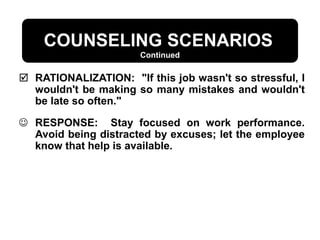
 RATIONALIZATION: "If this job wasn't so stressful, I
wouldn't be making so many mistakes and wouldn't
be late so often."
 RESPONSE: Stay focused on work performance.
Avoid being distracted by excuses; let the employee
know that help is available.
Continued
COUNSELING SCENARIOS
 ANGRY OUTBURST: The employee becomes angry.
He or she may cry, yell, or scream. This emotional
outburst is intended to scare off the supervisor and
cause him or her to drop the whole affair.
 RESPONSE: Do not react! Wait until the employee
has run out of steam and then continue where you
left off; keep the focus on performance issues. If the
employee continues to carry on, reschedule the
meeting.
Continued
COUNSELING SCENARIOS
THE LAST CHANCE AGREEMENT
 Says we want you if you invest in yourself.
 Lets you decide what is most important.
 Comes with conditions:
- Periodic drug testing.
- Rehabilitation.
- No relapses.
- Measured work performance.
 Confidentiality will be maintained.
 Keeps a good worker working.
LAST CHANCE AGREEMENT:
THE STAGES OF ABUSE
Continued
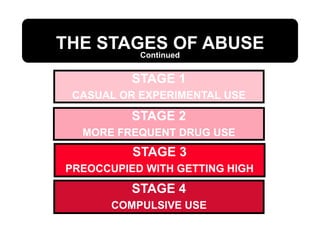
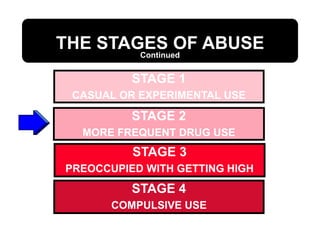
STAGE 1
CASUAL OR EXPERIMENTAL USE
STAGE 2
MORE FREQUENT DRUG USE
STAGE 3
PREOCCUPIED WITH GETTING HIGH
STAGE 4
COMPULSIVE USE
THE STAGES OF ABUSE
Continued
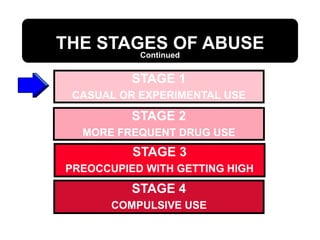
STAGE 1
CASUAL OR EXPERIMENTAL USE
STAGE 2
MORE FREQUENT DRUG USE
STAGE 3
PREOCCUPIED WITH GETTING HIGH
STAGE 4
COMPULSIVE USE
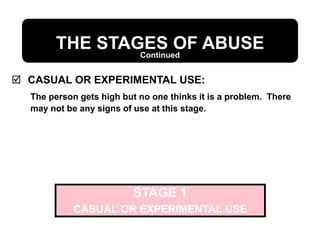
 CASUAL OR EXPERIMENTAL USE:
The person gets high but no one thinks it is a problem. There
may not be any signs of use at this stage.
THE STAGES OF ABUSE
Continued
STAGE 1
CASUAL OR EXPERIMENTAL USE
THE STAGES OF ABUSE
Continued
STAGE 1
CASUAL OR EXPERIMENTAL USE
STAGE 2
MORE FREQUENT DRUG USE
STAGE 3
PREOCCUPIED WITH GETTING HIGH
STAGE 4
COMPULSIVE USE
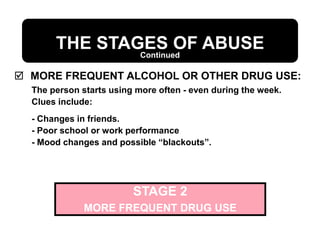
 MORE FREQUENT ALCOHOL OR OTHER DRUG USE:
The person starts using more often - even during the week.
Clues include:
- Changes in friends.
- Poor school or work performance
- Mood changes and possible “blackouts”.
THE STAGES OF ABUSE
Continued
STAGE 2
MORE FREQUENT DRUG USE
THE STAGES OF ABUSE
Continued
STAGE 1
CASUAL OR EXPERIMENTAL USE
STAGE 2
MORE FREQUENT DRUG USE
STAGE 3
PREOCCUPIED WITH GETTING HIGH
STAGE 4
COMPULSIVE USE
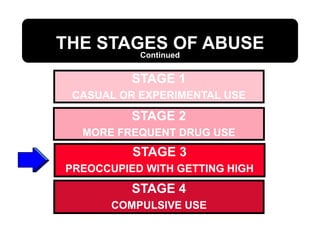
 PREOCCUPIED WITH GETTING HIGH:
- Daily use is common, others may binge once a week or so.
- The user is ill more often
- Family and job problems get worse.
- The user may begin to have trouble with the law.
- Family and friends become concerned.
THE STAGES OF ABUSE
Continued
STAGE 3
PREOCCUPIED WITH GETTING HIGH
THE STAGES OF ABUSE
Continued
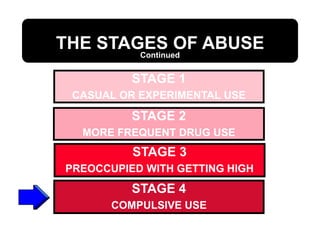
STAGE 1
CASUAL OR EXPERIMENTAL USE
STAGE 2
MORE FREQUENT DRUG USE
STAGE 3
PREOCCUPIED WITH GETTING HIGH
STAGE 4
COMPULSIVE USE
 COMPULSIVE USE:
- Without the drug the user may go into withdrawal.
- Blackouts and overdosing are more common.
- The family feels torn apart.
- Getting money to buy drugs becomes an obsession,
- The user is about to lose his or her job.
- The user is isolated from friends.
- Without treatment, insanity and or death may follow.
THE STAGES OF ABUSE
Continued
STAGE 4
COMPULSIVE USE
DRUGS & THEIR AFFECTS
 Marijuana.
 Cocaine.
 Alcohol.
 Depressants (valium, librium, xanax, serax etc.).
 Amphetamines (dexedrine, ritalin, methedrine).
 Heroin and Other Opiates (heroin, morphine, codeine).
 Inhalants (plastic cement, lighter fluid, ether etc.).
 Hallucinogens (PCP, LSD, Designer Drugs).
COMMONLY ABUSED DRUGS:
MARIJUANA
DRUGS & THEIR AFFECTS
Continued
The most commonly abused illicit drug
-- used by more than nine million
Americans. In the workplace, almost 10
percent of U.S. workers report that they
are current users of marijuana.
DRUGS & THEIR AFFECTS
 THC or delta-9-tetra-hydrocannabinol
- Grass, pot, weed, ganja, doobie, reefer, Mary Jane.
Type of Drug
 Derived from the hemp plant Cannabis Sativa.
How Taken
 Smoked or sometimes used in food (brownies).
Effects
 Euphoric feeling; increased sense of well-being.
 Lack of motivation, lowered inhibitions, talkativeness.
 Dry mouth and throat.
MARIJUANA:
Continued
Continued
DRUGS & THEIR AFFECTS
 Increased appetite - “munchies”.
 Impaired coordination, concentration, and memory
 Increased heart rate.
Dangers
 Deteriorating performance at work or at school.
 “Burn out” involving muddled thinking.
 Acute frustration, depression, and isolation.
 Impaired sexual development and fertility.
 Production of abnormal sperm.
 Menstrual irregularities.
 Damage to the lungs and pulmonary system
Continued
Continued
MARIJUANA:
DRUGS & THEIR AFFECTS
 One joint equal to 25 commercial cigarettes in this regard.
 Impaired ability to operate machinery and vehicles.
 Hallucinations and paranoia in high doses.
 Increased risk to safety and health at work.
 Increased accident rates at work.
 Prolonged use can lead to psychological dependance.
 Can be a “gateway” to more serious drugs.
Continued
Continued
MARIJUANA:
COCAINE
DRUGS & THEIR AFFECTS
Continued
A commonly abused illicit drug -- used by
1.3 million Americans. More than 66 percent
are employed by American businesses.
Because it is so costly ($100.00 per gram), it
is often associated with criminal behavior.
DRUGS & THEIR AFFECTS
 Cocaine hydrochloride
- Coke, blow, snow, toot, flake.
Type of Drug
 A highly potent organic stimulant derived from the coca plant.
 A white crystalline powder sometimes cut/diluted with sugar.
Other Forms
 Crack, an expensive purified form of cocaine.
- Known to show signs of clinical addiction after one use.
 Freebase, is formed by heating pure cocaine, mixing it with
ether and sodium bicarbonate and smoking it.
COCAINE:
Continued
DRUGS & THEIR AFFECTS
How Taken
 Sniffed or snorted through the nose (cocaine)
 Smoked (crack)
Effects
 Brief but intense feelings of euphoria and competence.
 Stimulates the central nervous system.
 Increases pulse, blood pressure, body temperature.
 Increases respiratory rate.
 Sleeplessness and chronic fatigue.
Continued
Continued
COCAINE:
DRUGS & THEIR AFFECTS
Dangers
 Bleeding and other damage to nasal passages.
 Paranoid psychosis, hallucinations, mental abnormalities.
 Impaired ability to operate machinery and vehicles.
 Death caused by heart or respiratory failure.
 Injury or death caused by freebasing (volatile when heated).
Continued
Continued
COCAINE:
ALCOHOL
DRUGS & THEIR AFFECTS
Continued
The most commonly abused substance
in the United States -- used by almost
fifty percent of Americans. Estimated
to have cost the nation almost $99
billion in 1990.
DRUGS & THEIR AFFECTS
ALCOHOL:
Continued
 Ethyl alcohol (liquor, cocktails, spirits, booze).
Type of Drug
 Acts as a depressant on the central nervous system.
 A psychoactive ingredient in beer, wine, and distilled liquor.
How Taken
 Consumed in drinks but can be used in cooking as well.
Effects
 Initially acts as a stimulant, invigorates thought and activity.
 Eventually acts as a depressant.
 In higher doses causes aggressive tendencies.
DRUGS & THEIR AFFECTS
ALCOHOL:
Continued
Continued
 In higher doses causes aggressive tendencies.
 In extremely high doses causes sedation and coma.
 Causes reddening of the eyes.
 Impairs the ability to use self-control.
 Impairs memory, coordination and driving ability.
Dangers
 Safe if used in moderation by otherwise healthy people.
 Impaired ability to operate machinery and vehicles.
 Blackouts or memory loss from minutes to days.
 Can damage the liver, heart, pancreas, gastrointestinal tract.
 Can increase susceptibility to disease.
DEPRESSANTS
DRUGS & THEIR AFFECTS
Continued
The largest and most commonly
abused category of controlled
substances -- The impact of
depressants abuse on the workplace is
substantial in highly stressful or
demanding positions.
DRUGS & THEIR AFFECTS
DEPRESSANTS:
Continued
 Three groups; Benzodiazepines, Barbiturates, Methaqualone.
 Benzodiazepines: Valium, Librium, Xanax, Tranxene etc.
- Tranquilizers, sleeping pills.
 Barbiturates: Seconal, Nembutal Amytal, Butisol, Tuinol etc.
- Downers, barbs, goofballs, blues, yellows, reds, etc.
 Methaqualone: Quaalude, Hymnal, Mandrax, Parest, Ect.
- Ludes, sopors, 714s
Type of Drug
 Synthetically produced legal drugs often prescribed.
 Distribution is controlled by the FDA.
How Taken
 Consumed orally, can be injected into the bloodstream.
Continued
DRUGS & THEIR AFFECTS
Continued
Continued
Effects
 Produces sedation and/or sleep
 Lessens tension, anxiety, and irritability.
 Can cause confusion, slurred speech, depression.
 Can cause lack of coordination, loss of motor control.
 Can cause disorientation, and suicidal behavior.
Dangers
 Safe if properly prescribed to otherwise healthy people.
 Impaired ability to operate machinery and vehicles.
 In extremely high doses causes sedation, coma and death.
DEPRESSANTS:
AMPHETAMINES
DRUGS & THEIR AFFECTS
Continued
A commonly abused category of
controlled substances -- Some workers
believe (inaccurately) that amphetamines
will enhance performance and creativity.
They ignore the physical and mental
dangers.
DRUGS & THEIR AFFECTS
AMPHETAMINES:
Continued
 Dexedrine, Biphetamine, Ritalin, Preludin Methedrine.
 Benzodiazepines: Valium, Librium, Xanax, Tranxene etc.
 Barbiturates: Seconal, Nembutal Amytal, Butisol, Tuinol etc.
 Methaqualone: Quaalude, Hymnal, Mandrax, Parest, Ect.
- Speed, uppers, bennies, dexies, black beauties, pep pills etc.
Type of Drug
 Chemically manufactured drugs.
 Stimulants of the central nervous system.
How Taken
 Consumed orally, injected, or inhaled into the nose.
Continued
DRUGS & THEIR AFFECTS
Continued
Continued
Effects
 Produces feelings of alertness and euphoria.
 Increases heart rate and blood pressure.
 Dilates the pupils of the eyes.
 Decreases appetite.
 Causes distorted thinking.
 Enables sleeplessness for relatively long periods of time.
Dangers
 Dizziness, headaches, blurred vision, and sweating.
 Loss of coordination, tremors, convulsions, and collapse.
 Anorexia and malnutrition resulting from decreased appetite.
AMPHETAMINES:
DRUGS & THEIR AFFECTS
Continued
Continued
Dangers
 Nervousness, irritability, and drastic mood swings.
 Hallucinations, paranoia, physical collapse.
 Brain deterioration.
 Sudden blood pressure increases from injections resulting in:
- Fever.
- Stroke.
- Heart failure.
 Continued heavy use can be fatal.
AMPHETAMINES:
HEROIN & OTHER OPIATES
DRUGS & THEIR AFFECTS
Continued
1.8 million Americans have used heroin
in their lifetime. Heroin accounts for
more than 90% of the opiate abuse in
the United States. Because of AIDS,
snorting or smoking heroin has
increased dramatically in recent years.
DRUGS & THEIR AFFECTS
HEROIN & OTHER OPIATES:
Continued
 Heroin (smack, junk, brown sugar, dope, horse, skunk etc.).
 Morphine (mud, M, dope, morpho).
 Codeine (schoolboy, coties).
Type of Drug
 Derived from the resin of the poppy plant.
 Acts as a depressant on the central nervous system.
How Taken
 Heroin - Injected, snorted, or smoked.
 Codeine and morphine are usually injected or taken orally.
Continued
DRUGS & THEIR AFFECTS
Continued
HEROIN & OTHER OPIATES:
Other Forms
 Opioids, synthetic substitutes, have similar effects.
- Darvon, demerol, meperidine and methodone.
- Methodone is legally prescribed for heroin treatment.
- Methodone can also be addictive.
Effects (general)
 Short-lived state of euphoria, followed by drowsiness.
 Slowed heart rate, breathing, and brain activity.
 Depressed appetite, thirst, reflexes, and sexual desire.
 Increased tolerance for pain.
 Impairs memory, coordination and driving ability.
Continued
Dangers
 Extreme addiction and withdrawal.
 AIDS, blood poisoning, and hepatitis from shared needles.
 Impaired ability to operate machinery and vehicles.
 Death resulting from injection of impure heroin.
 Death resulting from injection of high purity heroin.
 Convulsions, coma, or death from overdose.
DRUGS & THEIR AFFECTS
Continued
HEROIN & OTHER OPIATES: Continued
INHALANTS
DRUGS & THEIR AFFECTS
Continued
The percentage of high school students
who reported using inhalants at least
once climbed to 19.4 percent in 1993
making inhalants the most widely
abused substances after alcohol and
tobacco among this age group.
DRUGS & THEIR AFFECTS
INHALANTS:
Continued
 Street Names: Plastic cement, fingernail polish remover,
lighter fluid, nitrous oxide, ether, hairspray, insecticides, and
cleaning fluid.
Type of Drug
 Breathable substances that produce psychoactive effects.
How Taken
 Inhaled into the nose or mouth.
Effects
 Short-term
- Short-lived high resulting in dizziness & lightheadedness.
Continued
DRUGS & THEIR AFFECTS
Continued
Effects
 Short-term (continued)
- Can cause sneezing, coughing, runny nose, nose bleeds.
- Can cause nausea, abnormal heart rhythm and chest pain.
- Can causes impaired coordination, balance and judgment.
 Long-term
- Liver, nerve, and brain damage.
- Heart failure, respiratory arrest, suffocation, coma and death.
INHALANTS: Continued
Dangers
 Death can result when high concentration replace oxygen
in the lungs suppressing the CNS causing breathing to
stop.
 Brain damage from prolonged use.
DRUGS & THEIR AFFECTS
Continued
Continued
INHALANTS:
HALLUCINOGENS
DRUGS & THEIR AFFECTS
Continued
Unlike the downward trends in use of
most other illicit drugs, statistics indicate
that the use of, and experimentation with,
hallucinogens, (PCP & LSD), has
increased significantly in recent years.
DRUGS & THEIR AFFECTS
HALLUCINOGENS:
Continued
 PCP or Phyencyclidine is a synthetic drug.
- Called: Angel dust, rocket fuel, zombie, krystal joints etc.
 LSD or Lysergic Acid Diethylamide is made from lysergic acid.
- Called: Acid, fry, microdot, white lightening etc.
 Ecstasy or Methylenedioxy Methamphetamine.
- Called: X, XTC, disco biscuits, scoobie snacks.
 Psilocybin is the active ingredient in the psilocybe mushroom.
- Called: Magic mushrooms, shrooms etc.
 Peyote and Mescaline are active ingredients in peyote cactus.
- Called: Mesc, buttons etc.
Continued
DRUGS & THEIR AFFECTS
Continued
Type of Drug
 Hallucinogens distort a person’s sensation, thinking emotions
and perceptions.
How Taken
 Consumed orally, injected, or inhaled into the nose.
 Cigarettes also can be dipped into liquid PCP and smoked.
Effects
 Distortion of reality, may report “seeing sounds”.
- May report “hearing colors”.
HALLUCINOGENS: Continued
DRUGS & THEIR AFFECTS
Continued
Dangers
 Flashbacks - a recurrence of psychedelic effects after use of
of the drug ceases.
 Severe mood swings and paranoia.
 Impaired thinking and judgment leading to irrational behavior.
 Unexpected and unexplained outbursts of violence.
 Genetic changes.
 Depression, sometimes coupled with suicidal tendencies.
HALLUCINOGENS: Continued
DRUG TESTING
Continued
 Federal regulations may require it.
 State regulations may require it.
 Safety concerns.
 The high costs of alcohol and other drug abuse.
 Crime reduction.
 Concerns over employee well-being.
 Employment screening.
 Reductions in Workers’ Compensation Premiums.
THE PURPOSE OF DRUG TESTING:
DRUG TESTING
Continued
 Pre-employment tests.
 Reasonable suspicion and “for cause” tests.
 Random tests.
 Post-accident tests.
 Post-treatment tests.
 Promotion.
TESTING SITUATIONS:
DRUG TESTING
Continued
 Urine screens - measures leftover traces of drugs in urine.
 Blood tests - measures actual amount of drug in the blood.
 Breath alcohol tests - measure amount of alcohol in blood.
 Saliva tests - still mostly experimental.
 Hair tests - still mostly experimental.
TYPES OF DRUG TESTS:
ARE DRUG TESTS ACCURATE?
DRUG TESTING
 Chain of Custody: Used to document handling and storage.
 Initial Screen: The first may not be accurate.
 Confirmation Testing (92-98% accurate):
- A second test (GC/MS) is very accurate and will rule out any
false positives from the initial screen.
- GC/MS is 100% accurate from a scientific standpoint.
- For a test result to be reported as positive, both test results
must agree.
 Medical Review Officer:
- The MRO is a licensed medical doctor who has special
training in the area of substance abuse.
Continued
ARE DRUG TESTS ACCURATE?
DRUG TESTING
 Medical Review Officer:
- If the test is positive the MRO reviews the results.
- Ensures the chain of custody procedures were followed.
- Contacts the testee to make sure there are no medical or
other reasons a positive result.
 Confidentiality is very important.
 Drug test results will be kept private.
 Only persons with a “need to know” will know the result.
Continued
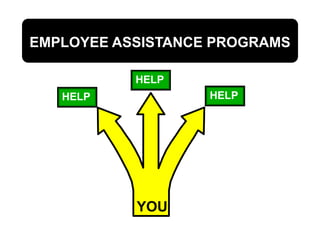
EMPLOYEE ASSISTANCE PROGRAMS
HELP
HELP
HELP
YOU
EMPLOYEE ASSISTANCE PROGRAMS
 Internal/In-House Programs:
- Most often found in large companies.
- EAP staff is employed by the company and works on-site.
 Fixed-Fee Contracts:
- Employers contract directly with an EAP provider.
- Fees are usually based on the number of employees.
 Fee-for Service Contracts:
- Employers contract directly with an EAP provider.
- Fees are based on individual referrals by the employer.
TYPES OF EAPS:
Continued
EMPLOYEE ASSISTANCE PROGRAMS
 Consortia:
- Multi-employers with a contract with an EAP provider.
- Generally cheaper with quality EAP services.
 Peer-based Programs:
- Assistance is provided by co-workers and peers.
- Requires considerable education and training.
TYPES OF EAPS:
Continued
Continued
EMPLOYEE ASSISTANCE PROGRAMS
 Assistance with policy development.
 Assistance with employee training and education.
 They take the pressure off of supervisors and managers.
 They offer an alternative to firing, saving recruiting costs.
 They offer employees access to treatment.
 They have been linked to decreases in Workers’ Comp. costs.
 They assist employers in complying with drug-free workplace
laws.
BENEFITS OF EAPS:
Continued
Continued
EMPLOYEE ASSISTANCE PROGRAMS
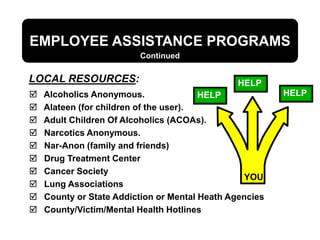
 Alcoholics Anonymous.
 Alateen (for children of the user).
 Adult Children Of Alcoholics (ACOAs).
 Narcotics Anonymous.
 Nar-Anon (family and friends)
 Drug Treatment Center
 Cancer Society
 Lung Associations
 County or State Addiction or Mental Heath Agencies
 County/Victim/Mental Health Hotlines
LOCAL RESOURCES:
Continued
HELP
HELP
HELP
YOU

2.Substance_Abuse_1.ppt

  • 1.
    WELCOME DRUG & ALCOHOLAWARENESS CORPORATE SAFETY TRAINING
  • 2.
     Discuss theComponents of an Effective Program.  Introduce Ideas to Help Develop an Effective Program.  Discuss the Drug-Free Workplace Policy.  Clarification of the Expected Roles of Employers.  Clarification of the Expected Roles of Employees.  Explanation of the Effects of Drug Use.  Overview of Rehabilitative Services.  Overview of Drug Testing Methods. COURSE OBJECTIVES
  • 3.
    REGULATORY STANDARD THE GENERALDUTY CLAUSE FEDERAL - 29 CFR 1903.1 EMPLOYERS MUST: Furnish a place of employment free of recognized hazards that are causing or are likely to cause death or serious physical harm to employees. Employers must comply with occupational safety and health standards promulgated under the Williams- Steiger Occupational Safety and Health Act of 1970. OSHA ACT OF 1970
  • 4.
    THE DRUG-FREE WORKPLACEACT OF 1988: APPLICABLE REGULATIONS  1986 - Signed by the President.  1988 - Congress Passed the Drug-Free Workplace Act.  Affects Federal Grantees Receiving $25,000 or More.  Affects Federal Contracts Receiving $25,000 or More.  Requires a Written Policy.  Requires that Employees Read and Consent to the Policy.  Requires that an Awareness Program be Instituted.  Employees Must Disclose Any Drug Related Conviction in the Workplace to the Employer Within 5 Days of the Conviction. FEDERAL REQUIREMENTS Continued
  • 5.
    THE DRUG-FREE WORKPLACEACT OF 1988: APPLICABLE REGULATIONS  Employers must Disclose Any Drug Related Conviction in the Workplace to the Federal Agency with Which the Employer has a Grant or Contract Within 10 Days of the Conviction.  Employers Must Make an Ongoing Effort to Maintain a Workplace Free of Drugs. FEDERAL REQUIREMENTS Continued Continued
  • 6.
    REQUIREMENTS VARY FROMSTATE TO STATE: APPLICABLE REGULATIONS  Some States, CA, AL, FL, WA and Others Have Programs.  Many States Offer Workers’ Compensation Discounts.  Criteria are Similar but No Standard Model Exists.  Employers Must Meet Certification Criteria in Each State.  Employers Must Maintain Certifications to Participate.  Certain Fees May be Required of the Employer.  De-certification Can Occur for Various Reasons. STATE REQUIREMENTS Continued
  • 7.
    TYPICAL STATE REQUIREMENTS: APPLICABLEREGULATIONS  A Corporate Policy Statement.  Employee Notification of the Policy.  Employee Notification of Substance Abuse Testing.  Substance Abuse Testing Program.  Employee Assistance Program.  Supervisor Training.  Employee Training.  Agreements to Confidentiality. STATE REQUIREMENTS Continued
  • 8.
  • 9.
    APPLICABLE REGULATIONS FOR SPECIFICSTATE REQUIREMENTS Contact the State Attorney General or GUIDE TO STATE DRUG TESTING LAWS Published by: Institute for a Drug-Free Workplace 1225 I Street, N.W. Washington, DC 20005-3914 (202) 842-7400 Fax (202) 842-0022 Price (may change): $115 Single Copy $75 ea, 2 or More Continued
  • 10.
    TRAINING REQUIREMENTS  TwoHour Training Course.  The Relationship Between Work & Personal Problems.  Recognition of Employee Substance Abuse.  Documenting Signs of Employee Substance Abuse.  Corroborating Signs of Employee Substance Abuse.  How to Refer Employees to the Employee Assistance Program.  Circumstances and Procedures for Post-Injury Testing.  Supervisor Responsibilities in a “Last Chance Agreement”.  Employee Confidentiality. TYPICAL SUPERVISOR TRAINING REQUIREMENTS:
  • 11.
    TRAINING REQUIREMENTS  OneHour Course Conducted Annually.  The Disease Model of Addiction for Alcohol and Drugs.  Effects & Dangers of Commonly Abused Workplace Substances.  The Employer’s Policies/Procedures Regarding Substance Abuse.  How to Access the Employee Assistance Program.  Provided in a Non-English Language if Required. TYPICAL EMPLOYEE TRAINING REQUIREMENTS: Continued
  • 12.
    MAY BE REQUIRED: Annually for Some States.  For a Program Related Injury. RETRAINING REQUIREMENTS
  • 13.
    TRAINING IS IMPORTANT Reduce injury and illness rates.  Help Individuals with personal problems.  Increase performance and productivity.  Increase profits.  Workers feel better about their work.  Reduce workers’ compensation costs.  Elevate safety compliance to a higher level. A GOOD PROGRAM WILL HELP:
  • 14.
    PROGRAM IMPLEMENTATION  DEDICATION PERSONAL INTEREST  MANAGEMENT COMMITMENT IMPLEMENTATION OF A DRUG-FREE WORKPLACE PROGRAM REQUIRES: NOTE: UNDERSTANDING AND SUPPORT FROM THE WORK FORCE IS ESSENTIAL, WITHOUT IT THE PROGRAM WILL FAIL!
  • 15.
    PROGRAM IMPLEMENTATION Continued PROGRAM COMPONENTS NEEDS ASSESSMENTPOLICIES TRAINING EMPLOYEE ASSISTANCE PROGRAM DRUG TESTING
  • 16.
    PROGRAM IMPLEMENTATION  Establishresponsibility.  Assess organizational needs.  Develop policies and rules.  Employee Assistance Program?  Drug Testing?  Inform the workforce.  Conduct employee training.  Implement the paper program.  Periodically review the program.  Modify policies and rules as appropriate. DEVELOPMENT SEQUENCE: Continued
  • 17.
    HIDDEN COSTS OFABUSE  Hospitalization costs.  Accident investigation fees.  Costs of replacing stolen items.  Legal fees, court fees, travel costs.  Wages paid for temporary staffing.  Wages paid for accident downtime.  Wages paid for tardy or missed days.  Replacement costs of damaged equipment.  Increased costs for insurance, & physicians.  Costs of security services and or consulting services. COSTS OF ALCOHOL AND OTHER DRUG ABUSE Continued
  • 18.
    HIDDEN COSTS OFABUSE COSTS OF ALCOHOL AND OTHER DRUG ABUSE Continued Annual Costs for Business $60 - 150 Billion
  • 19.
    HIDDEN COSTS OFABUSE  75% had used drugs on the job.  64% admitted that drugs adversely affected job performance.  44% said they had sold drugs to other employees  18% said they had stolen from co-workers. STATISTICS FROM A “COCAINE HOTLINE”: Continued
  • 20.
    HIDDEN COSTS OFABUSE Continued THOSE WHO ILLICITLY USE DRUGS ARE:  2.5 times more likely to have absences of 8 days or more.  3.6 times more likely to injure themselves or others on the job.  5.0 times more likely to be injured off the job.  5.0 times more likely to file a workers’ compensation claim.  1/3 less productive than their co-workers who didn’t.  Incurred 300 percent higher medical costs.
  • 21.
    PROGRAM BENEFITS  Feweraccidents.  Fewer disciplinary actions.  Cost savings and incentive programs: - Medical & health insurance carriers - Workers' Compensation insurance carriers. - Property, casualty, and liability insurance carriers.  Reduced losses due to absenteeism, theft, and fraud.  Less chance that a user/abuser will apply and be hired.  Ability to respond quickly to program related problems. SHORT-TERM BENEFITS:
  • 22.
    PROGRAM BENEFITS  Reducedcosts of insurance claims.  Lower costs due to losses and errors.  Improved employee morale and productivity.  Earlier identification and resolution of problems.  Greater employee awareness about the problem.  Decreased legal costs and costs of hiring and training. LONG-TERM BENEFITS: Continued
  • 23.
    THE SUPERVISOR’S ROLE CONSIDER THE FOLLOWING: 1. GET AS MUCH TRAINING AS POSSIBLE. 2. GET TO KNOW YOUR PEOPLE! 3. GET INVOLVED IN, AND UNDERSTAND THE PROGRAM. 4. EXPLAIN THE PROGRAM TO EMPLOYEES. 5. OBTAIN ASSISTANCE FROM EXPERTS IN THE FIELD. 6. UNDERSTAND THE IMPORTANCE OF SUPERVISION. 7. ACCEPT YOUR RESPONSIBILITY. 8. KNOW WHERE YOUR AUTHORITY STOPS. 9. FOLLOW-UP ON THE ACTIONS YOU TOOK.
  • 24.
    THE SUPERVISOR’S ROLE GUIDELINES FOR EFFECTIVE SUPERVISION: 1. BE ATTENTIVE: Be ready to recognize employee problems (e.g., accidents, frequent lateness, mood swings) that may or may not be related to alcohol or other drug abuse. 2. BE OBSERVANT: Focus on specifics aspects of job performance. 3. DOCUMENT: Keep an ongoing record of the employee's performance. 4. FOCUS ON JOB PERFORMANCE: Avoid judging, diagnosing, or counseling the employee. Continued
  • 25.
    THE SUPERVISOR’S ROLE GUIDELINES FOR EFFECTIVE SUPERVISION: 5. BE THOUGHTFUL: Stay nonjudgmental and recognize the employee's point of view. 6. BE STRAIGHTFORWARD: Stick to the facts of job performance; don't get sidetracked. 7. BE CONSISTENT: Follow the same procedures for all employees. 8. MAINTAIN CONFIDENTIALITY. Discuss employee problems in private and keep the discussion between the two of you. Continued
  • 26.
    THE SUPERVISOR’S ROLE GUIDELINES FOR EFFECTIVE SUPERVISION: 9. REFER: Encourage troubled employees to seek help from the resources available in the workplace or the community. 10. FOLLOW-UP: Continue to assess employee job performance over a period of time. Continued
  • 27.
    THE SUPERVISOR’S ROLE SIGNS OF SUBSTANCE ABUSE: 1. Absenteeism: Two to three times more than other employees. 2. Staff Turnover: Many quit rather than face detection. 3. Lower Productivity: Perform at 2/3 of their work potential. 4. Equipment Breakdown: May use this as a stopwork excuse. 5. Poor Work Quality: Mental and physical agility deteriorates. 6. Poor Morale: Abuse creates wide mood swings, anxiety, depression and anger. 7. Increased Accidents. Abusers are 3.6 times more likely to have or cause an accident. 8. Near Misses: Even small quantities of drugs can cause a near miss. Always treat a near miss just like an actual accident. Continued
  • 28.
    COUNSELING SCENARIOS  DENIAL:The employee denies that problems exist and insists that everyone is out to get them.  RESPONSE: Stay calm. Have at hand documentation of the job performance and/or conduct and keep the conversation focused on performance issues.
  • 29.
     THREATS: "Ifyou push me, I'll go to an attorney . . . make a scene - - - quit here and now . . . "  RESPONSE: Remind them that they are free to do what ever they choose. Remind them of your responsibility. If you lose objectivity seek the help of another supervisor or manager. Continued COUNSELING SCENARIOS
  • 30.
     RATIONALIZATION: "Ifthis job wasn't so stressful, I wouldn't be making so many mistakes and wouldn't be late so often."  RESPONSE: Stay focused on work performance. Avoid being distracted by excuses; let the employee know that help is available. Continued COUNSELING SCENARIOS
  • 31.
     ANGRY OUTBURST:The employee becomes angry. He or she may cry, yell, or scream. This emotional outburst is intended to scare off the supervisor and cause him or her to drop the whole affair.  RESPONSE: Do not react! Wait until the employee has run out of steam and then continue where you left off; keep the focus on performance issues. If the employee continues to carry on, reschedule the meeting. Continued COUNSELING SCENARIOS
  • 32.
    THE LAST CHANCEAGREEMENT  Says we want you if you invest in yourself.  Lets you decide what is most important.  Comes with conditions: - Periodic drug testing. - Rehabilitation. - No relapses. - Measured work performance.  Confidentiality will be maintained.  Keeps a good worker working. LAST CHANCE AGREEMENT:
  • 33.
    THE STAGES OFABUSE Continued STAGE 1 CASUAL OR EXPERIMENTAL USE STAGE 2 MORE FREQUENT DRUG USE STAGE 3 PREOCCUPIED WITH GETTING HIGH STAGE 4 COMPULSIVE USE
  • 34.
    THE STAGES OFABUSE Continued STAGE 1 CASUAL OR EXPERIMENTAL USE STAGE 2 MORE FREQUENT DRUG USE STAGE 3 PREOCCUPIED WITH GETTING HIGH STAGE 4 COMPULSIVE USE
  • 35.
     CASUAL OREXPERIMENTAL USE: The person gets high but no one thinks it is a problem. There may not be any signs of use at this stage. THE STAGES OF ABUSE Continued STAGE 1 CASUAL OR EXPERIMENTAL USE
  • 36.
    THE STAGES OFABUSE Continued STAGE 1 CASUAL OR EXPERIMENTAL USE STAGE 2 MORE FREQUENT DRUG USE STAGE 3 PREOCCUPIED WITH GETTING HIGH STAGE 4 COMPULSIVE USE
  • 37.
     MORE FREQUENTALCOHOL OR OTHER DRUG USE: The person starts using more often - even during the week. Clues include: - Changes in friends. - Poor school or work performance - Mood changes and possible “blackouts”. THE STAGES OF ABUSE Continued STAGE 2 MORE FREQUENT DRUG USE
  • 38.
    THE STAGES OFABUSE Continued STAGE 1 CASUAL OR EXPERIMENTAL USE STAGE 2 MORE FREQUENT DRUG USE STAGE 3 PREOCCUPIED WITH GETTING HIGH STAGE 4 COMPULSIVE USE
  • 39.
     PREOCCUPIED WITHGETTING HIGH: - Daily use is common, others may binge once a week or so. - The user is ill more often - Family and job problems get worse. - The user may begin to have trouble with the law. - Family and friends become concerned. THE STAGES OF ABUSE Continued STAGE 3 PREOCCUPIED WITH GETTING HIGH
  • 40.
    THE STAGES OFABUSE Continued STAGE 1 CASUAL OR EXPERIMENTAL USE STAGE 2 MORE FREQUENT DRUG USE STAGE 3 PREOCCUPIED WITH GETTING HIGH STAGE 4 COMPULSIVE USE
  • 41.
     COMPULSIVE USE: -Without the drug the user may go into withdrawal. - Blackouts and overdosing are more common. - The family feels torn apart. - Getting money to buy drugs becomes an obsession, - The user is about to lose his or her job. - The user is isolated from friends. - Without treatment, insanity and or death may follow. THE STAGES OF ABUSE Continued STAGE 4 COMPULSIVE USE
  • 42.
    DRUGS & THEIRAFFECTS  Marijuana.  Cocaine.  Alcohol.  Depressants (valium, librium, xanax, serax etc.).  Amphetamines (dexedrine, ritalin, methedrine).  Heroin and Other Opiates (heroin, morphine, codeine).  Inhalants (plastic cement, lighter fluid, ether etc.).  Hallucinogens (PCP, LSD, Designer Drugs). COMMONLY ABUSED DRUGS:
  • 43.
    MARIJUANA DRUGS & THEIRAFFECTS Continued The most commonly abused illicit drug -- used by more than nine million Americans. In the workplace, almost 10 percent of U.S. workers report that they are current users of marijuana.
  • 44.
    DRUGS & THEIRAFFECTS  THC or delta-9-tetra-hydrocannabinol - Grass, pot, weed, ganja, doobie, reefer, Mary Jane. Type of Drug  Derived from the hemp plant Cannabis Sativa. How Taken  Smoked or sometimes used in food (brownies). Effects  Euphoric feeling; increased sense of well-being.  Lack of motivation, lowered inhibitions, talkativeness.  Dry mouth and throat. MARIJUANA: Continued Continued
  • 45.
    DRUGS & THEIRAFFECTS  Increased appetite - “munchies”.  Impaired coordination, concentration, and memory  Increased heart rate. Dangers  Deteriorating performance at work or at school.  “Burn out” involving muddled thinking.  Acute frustration, depression, and isolation.  Impaired sexual development and fertility.  Production of abnormal sperm.  Menstrual irregularities.  Damage to the lungs and pulmonary system Continued Continued MARIJUANA:
  • 46.
    DRUGS & THEIRAFFECTS  One joint equal to 25 commercial cigarettes in this regard.  Impaired ability to operate machinery and vehicles.  Hallucinations and paranoia in high doses.  Increased risk to safety and health at work.  Increased accident rates at work.  Prolonged use can lead to psychological dependance.  Can be a “gateway” to more serious drugs. Continued Continued MARIJUANA:
  • 47.
    COCAINE DRUGS & THEIRAFFECTS Continued A commonly abused illicit drug -- used by 1.3 million Americans. More than 66 percent are employed by American businesses. Because it is so costly ($100.00 per gram), it is often associated with criminal behavior.
  • 48.
    DRUGS & THEIRAFFECTS  Cocaine hydrochloride - Coke, blow, snow, toot, flake. Type of Drug  A highly potent organic stimulant derived from the coca plant.  A white crystalline powder sometimes cut/diluted with sugar. Other Forms  Crack, an expensive purified form of cocaine. - Known to show signs of clinical addiction after one use.  Freebase, is formed by heating pure cocaine, mixing it with ether and sodium bicarbonate and smoking it. COCAINE: Continued
  • 49.
    DRUGS & THEIRAFFECTS How Taken  Sniffed or snorted through the nose (cocaine)  Smoked (crack) Effects  Brief but intense feelings of euphoria and competence.  Stimulates the central nervous system.  Increases pulse, blood pressure, body temperature.  Increases respiratory rate.  Sleeplessness and chronic fatigue. Continued Continued COCAINE:
  • 50.
    DRUGS & THEIRAFFECTS Dangers  Bleeding and other damage to nasal passages.  Paranoid psychosis, hallucinations, mental abnormalities.  Impaired ability to operate machinery and vehicles.  Death caused by heart or respiratory failure.  Injury or death caused by freebasing (volatile when heated). Continued Continued COCAINE:
  • 51.
    ALCOHOL DRUGS & THEIRAFFECTS Continued The most commonly abused substance in the United States -- used by almost fifty percent of Americans. Estimated to have cost the nation almost $99 billion in 1990.
  • 52.
    DRUGS & THEIRAFFECTS ALCOHOL: Continued  Ethyl alcohol (liquor, cocktails, spirits, booze). Type of Drug  Acts as a depressant on the central nervous system.  A psychoactive ingredient in beer, wine, and distilled liquor. How Taken  Consumed in drinks but can be used in cooking as well. Effects  Initially acts as a stimulant, invigorates thought and activity.  Eventually acts as a depressant.  In higher doses causes aggressive tendencies.
  • 53.
    DRUGS & THEIRAFFECTS ALCOHOL: Continued Continued  In higher doses causes aggressive tendencies.  In extremely high doses causes sedation and coma.  Causes reddening of the eyes.  Impairs the ability to use self-control.  Impairs memory, coordination and driving ability. Dangers  Safe if used in moderation by otherwise healthy people.  Impaired ability to operate machinery and vehicles.  Blackouts or memory loss from minutes to days.  Can damage the liver, heart, pancreas, gastrointestinal tract.  Can increase susceptibility to disease.
  • 54.
    DEPRESSANTS DRUGS & THEIRAFFECTS Continued The largest and most commonly abused category of controlled substances -- The impact of depressants abuse on the workplace is substantial in highly stressful or demanding positions.
  • 55.
    DRUGS & THEIRAFFECTS DEPRESSANTS: Continued  Three groups; Benzodiazepines, Barbiturates, Methaqualone.  Benzodiazepines: Valium, Librium, Xanax, Tranxene etc. - Tranquilizers, sleeping pills.  Barbiturates: Seconal, Nembutal Amytal, Butisol, Tuinol etc. - Downers, barbs, goofballs, blues, yellows, reds, etc.  Methaqualone: Quaalude, Hymnal, Mandrax, Parest, Ect. - Ludes, sopors, 714s Type of Drug  Synthetically produced legal drugs often prescribed.  Distribution is controlled by the FDA. How Taken  Consumed orally, can be injected into the bloodstream. Continued
  • 56.
    DRUGS & THEIRAFFECTS Continued Continued Effects  Produces sedation and/or sleep  Lessens tension, anxiety, and irritability.  Can cause confusion, slurred speech, depression.  Can cause lack of coordination, loss of motor control.  Can cause disorientation, and suicidal behavior. Dangers  Safe if properly prescribed to otherwise healthy people.  Impaired ability to operate machinery and vehicles.  In extremely high doses causes sedation, coma and death. DEPRESSANTS:
  • 57.
    AMPHETAMINES DRUGS & THEIRAFFECTS Continued A commonly abused category of controlled substances -- Some workers believe (inaccurately) that amphetamines will enhance performance and creativity. They ignore the physical and mental dangers.
  • 58.
    DRUGS & THEIRAFFECTS AMPHETAMINES: Continued  Dexedrine, Biphetamine, Ritalin, Preludin Methedrine.  Benzodiazepines: Valium, Librium, Xanax, Tranxene etc.  Barbiturates: Seconal, Nembutal Amytal, Butisol, Tuinol etc.  Methaqualone: Quaalude, Hymnal, Mandrax, Parest, Ect. - Speed, uppers, bennies, dexies, black beauties, pep pills etc. Type of Drug  Chemically manufactured drugs.  Stimulants of the central nervous system. How Taken  Consumed orally, injected, or inhaled into the nose. Continued
  • 59.
    DRUGS & THEIRAFFECTS Continued Continued Effects  Produces feelings of alertness and euphoria.  Increases heart rate and blood pressure.  Dilates the pupils of the eyes.  Decreases appetite.  Causes distorted thinking.  Enables sleeplessness for relatively long periods of time. Dangers  Dizziness, headaches, blurred vision, and sweating.  Loss of coordination, tremors, convulsions, and collapse.  Anorexia and malnutrition resulting from decreased appetite. AMPHETAMINES:
  • 60.
    DRUGS & THEIRAFFECTS Continued Continued Dangers  Nervousness, irritability, and drastic mood swings.  Hallucinations, paranoia, physical collapse.  Brain deterioration.  Sudden blood pressure increases from injections resulting in: - Fever. - Stroke. - Heart failure.  Continued heavy use can be fatal. AMPHETAMINES:
  • 61.
    HEROIN & OTHEROPIATES DRUGS & THEIR AFFECTS Continued 1.8 million Americans have used heroin in their lifetime. Heroin accounts for more than 90% of the opiate abuse in the United States. Because of AIDS, snorting or smoking heroin has increased dramatically in recent years.
  • 62.
    DRUGS & THEIRAFFECTS HEROIN & OTHER OPIATES: Continued  Heroin (smack, junk, brown sugar, dope, horse, skunk etc.).  Morphine (mud, M, dope, morpho).  Codeine (schoolboy, coties). Type of Drug  Derived from the resin of the poppy plant.  Acts as a depressant on the central nervous system. How Taken  Heroin - Injected, snorted, or smoked.  Codeine and morphine are usually injected or taken orally. Continued
  • 63.
    DRUGS & THEIRAFFECTS Continued HEROIN & OTHER OPIATES: Other Forms  Opioids, synthetic substitutes, have similar effects. - Darvon, demerol, meperidine and methodone. - Methodone is legally prescribed for heroin treatment. - Methodone can also be addictive. Effects (general)  Short-lived state of euphoria, followed by drowsiness.  Slowed heart rate, breathing, and brain activity.  Depressed appetite, thirst, reflexes, and sexual desire.  Increased tolerance for pain.  Impairs memory, coordination and driving ability. Continued
  • 64.
    Dangers  Extreme addictionand withdrawal.  AIDS, blood poisoning, and hepatitis from shared needles.  Impaired ability to operate machinery and vehicles.  Death resulting from injection of impure heroin.  Death resulting from injection of high purity heroin.  Convulsions, coma, or death from overdose. DRUGS & THEIR AFFECTS Continued HEROIN & OTHER OPIATES: Continued
  • 65.
    INHALANTS DRUGS & THEIRAFFECTS Continued The percentage of high school students who reported using inhalants at least once climbed to 19.4 percent in 1993 making inhalants the most widely abused substances after alcohol and tobacco among this age group.
  • 66.
    DRUGS & THEIRAFFECTS INHALANTS: Continued  Street Names: Plastic cement, fingernail polish remover, lighter fluid, nitrous oxide, ether, hairspray, insecticides, and cleaning fluid. Type of Drug  Breathable substances that produce psychoactive effects. How Taken  Inhaled into the nose or mouth. Effects  Short-term - Short-lived high resulting in dizziness & lightheadedness. Continued
  • 67.
    DRUGS & THEIRAFFECTS Continued Effects  Short-term (continued) - Can cause sneezing, coughing, runny nose, nose bleeds. - Can cause nausea, abnormal heart rhythm and chest pain. - Can causes impaired coordination, balance and judgment.  Long-term - Liver, nerve, and brain damage. - Heart failure, respiratory arrest, suffocation, coma and death. INHALANTS: Continued
  • 68.
    Dangers  Death canresult when high concentration replace oxygen in the lungs suppressing the CNS causing breathing to stop.  Brain damage from prolonged use. DRUGS & THEIR AFFECTS Continued Continued INHALANTS:
  • 69.
    HALLUCINOGENS DRUGS & THEIRAFFECTS Continued Unlike the downward trends in use of most other illicit drugs, statistics indicate that the use of, and experimentation with, hallucinogens, (PCP & LSD), has increased significantly in recent years.
  • 70.
    DRUGS & THEIRAFFECTS HALLUCINOGENS: Continued  PCP or Phyencyclidine is a synthetic drug. - Called: Angel dust, rocket fuel, zombie, krystal joints etc.  LSD or Lysergic Acid Diethylamide is made from lysergic acid. - Called: Acid, fry, microdot, white lightening etc.  Ecstasy or Methylenedioxy Methamphetamine. - Called: X, XTC, disco biscuits, scoobie snacks.  Psilocybin is the active ingredient in the psilocybe mushroom. - Called: Magic mushrooms, shrooms etc.  Peyote and Mescaline are active ingredients in peyote cactus. - Called: Mesc, buttons etc. Continued
  • 71.
    DRUGS & THEIRAFFECTS Continued Type of Drug  Hallucinogens distort a person’s sensation, thinking emotions and perceptions. How Taken  Consumed orally, injected, or inhaled into the nose.  Cigarettes also can be dipped into liquid PCP and smoked. Effects  Distortion of reality, may report “seeing sounds”. - May report “hearing colors”. HALLUCINOGENS: Continued
  • 72.
    DRUGS & THEIRAFFECTS Continued Dangers  Flashbacks - a recurrence of psychedelic effects after use of of the drug ceases.  Severe mood swings and paranoia.  Impaired thinking and judgment leading to irrational behavior.  Unexpected and unexplained outbursts of violence.  Genetic changes.  Depression, sometimes coupled with suicidal tendencies. HALLUCINOGENS: Continued
  • 73.
    DRUG TESTING Continued  Federalregulations may require it.  State regulations may require it.  Safety concerns.  The high costs of alcohol and other drug abuse.  Crime reduction.  Concerns over employee well-being.  Employment screening.  Reductions in Workers’ Compensation Premiums. THE PURPOSE OF DRUG TESTING:
  • 74.
    DRUG TESTING Continued  Pre-employmenttests.  Reasonable suspicion and “for cause” tests.  Random tests.  Post-accident tests.  Post-treatment tests.  Promotion. TESTING SITUATIONS:
  • 75.
    DRUG TESTING Continued  Urinescreens - measures leftover traces of drugs in urine.  Blood tests - measures actual amount of drug in the blood.  Breath alcohol tests - measure amount of alcohol in blood.  Saliva tests - still mostly experimental.  Hair tests - still mostly experimental. TYPES OF DRUG TESTS:
  • 76.
    ARE DRUG TESTSACCURATE? DRUG TESTING  Chain of Custody: Used to document handling and storage.  Initial Screen: The first may not be accurate.  Confirmation Testing (92-98% accurate): - A second test (GC/MS) is very accurate and will rule out any false positives from the initial screen. - GC/MS is 100% accurate from a scientific standpoint. - For a test result to be reported as positive, both test results must agree.  Medical Review Officer: - The MRO is a licensed medical doctor who has special training in the area of substance abuse. Continued
  • 77.
    ARE DRUG TESTSACCURATE? DRUG TESTING  Medical Review Officer: - If the test is positive the MRO reviews the results. - Ensures the chain of custody procedures were followed. - Contacts the testee to make sure there are no medical or other reasons a positive result.  Confidentiality is very important.  Drug test results will be kept private.  Only persons with a “need to know” will know the result. Continued
  • 78.
  • 79.
    EMPLOYEE ASSISTANCE PROGRAMS Internal/In-House Programs: - Most often found in large companies. - EAP staff is employed by the company and works on-site.  Fixed-Fee Contracts: - Employers contract directly with an EAP provider. - Fees are usually based on the number of employees.  Fee-for Service Contracts: - Employers contract directly with an EAP provider. - Fees are based on individual referrals by the employer. TYPES OF EAPS: Continued
  • 80.
    EMPLOYEE ASSISTANCE PROGRAMS Consortia: - Multi-employers with a contract with an EAP provider. - Generally cheaper with quality EAP services.  Peer-based Programs: - Assistance is provided by co-workers and peers. - Requires considerable education and training. TYPES OF EAPS: Continued Continued
  • 81.
    EMPLOYEE ASSISTANCE PROGRAMS Assistance with policy development.  Assistance with employee training and education.  They take the pressure off of supervisors and managers.  They offer an alternative to firing, saving recruiting costs.  They offer employees access to treatment.  They have been linked to decreases in Workers’ Comp. costs.  They assist employers in complying with drug-free workplace laws. BENEFITS OF EAPS: Continued Continued
  • 82.
    EMPLOYEE ASSISTANCE PROGRAMS Alcoholics Anonymous.  Alateen (for children of the user).  Adult Children Of Alcoholics (ACOAs).  Narcotics Anonymous.  Nar-Anon (family and friends)  Drug Treatment Center  Cancer Society  Lung Associations  County or State Addiction or Mental Heath Agencies  County/Victim/Mental Health Hotlines LOCAL RESOURCES: Continued HELP HELP HELP YOU