
EVICTION UNDER TAMILNADU RENT CONTROL ACTPresented By,       Dhanya N. Menon
WHAT IS RENT CONTROL?imposing a legal maximum (rent ceiling)Upon the rentParticular housing market
ORIGINFirst time in US, in 1900sto check uninhibited rent increases and tenant eviction Need for rented house increased after World War II and with industrialization and corresponding urbanization Rent Control Acts, under various names were introduced.India’s 1st Rent Control Act: in Bombay in 1918: First World War
THE LEGAL ASPECTS OF RENT CONTROL Indian Constitution: “Housing” – State Subject Enactment: responsibility of each StateObjects are similarTo protect the tenant from eviction from the house where he is living except for defined reasons and on defined conditions; and To protect him from having to pay more than a fair/standard rent. Landlord has the right to evict the tenant, ifHe is guilty of certain specified acts landlord requires the house for his own personal occupation.
Grounds: Landlord can evict the tenant:The law relating to the landlord’s rights to evict the tenant can be found in the Transfer of Property Act, 1882. While a landlord can immediately start an action for eviction of a tenant on expiry of the notice of eviction under Section 106 of the Transfer of Property Act, 1882,He cannot start such an action where the rent control act applies, unless he can prove the existence of one of the grounds of eviction under the Rent Act.
EXEMPTIONProperties belonging to the government •  Any tenancy created by a grant from the Government in respect of the premises taken on lease or requisitioned, by the Government •   Newly constructed properties for a period of ten years (in Delhi) from the date of construction. This period may vary from state to state. •   Any premises, residential or other, whose monthly rent exceeds three thousand and five hundred rupees (in Delhi). The amount may vary from state to state. religious and ethnic institutions
TAMIL NADU RENT CONTROL LAWSThe necessity for imposing control of rents and prevention of unreasonable eviction of tenants arose during the war periodRent Control Orders in the year 1941 Renewed until Legislature enacted the Madras Act XV of 1946.Act of 1946 was replaced by Madras Act XXV of 1949In 1960, The Tamilnadu Buildings (Lease and Rent Control) Act,1960(XVIII of 1960) was passed
FAIR RENTResidential: 9 % of total cost of such building Non Residential: 12% of total cost of such building Total cost: market value of the site in which the building is constructedthe cost of construction of the buildingthe cost of provision of anyone or more of the amenities specified in the ActFixed by the Controller on application made by the tenant or the landlord Cond…
Cannot be increased, but decreasedLandlord shall not claim, receive or stipulate for the payment in addition to such fair rent – advance can be asked	If not fixed: Agreed rentLandlord liable to give receipt for rent or advance
EVICTIONSection 10 of the ActThe right of eviction: Only on the reasons specified in the Act.Tenancies where the Act has no Application: Notice of atleast 6 monthsREASONS:Willful omission of payment of rent for more than 15 days after the rent fell dueSubletting of the premisesUnauthorized use of the buildingHas materially impaired the building or its value or utilityUsing of building of unlawful purposeContd…
Nuisance Non occupancy for a period in excess of four monthsUnlawful denial of landlord's title to the building Landlord’s own useEffecting repairs of the buildingCreation of a new buildingLandlord is religious or educational institutionMember of armed force
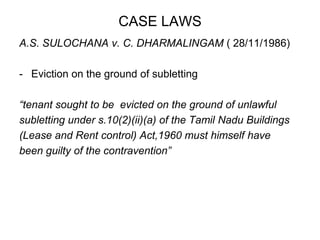
CASE LAWSA.S. SULOCHANA v. C. DHARMALINGAM ( 28/11/1986)Eviction on the ground of subletting“tenant sought to be  evicted on the ground of unlawfulsubletting under s.10(2)(ii)(a) of the Tamil Nadu Buildings(Lease and Rent control) Act,1960 must himself havebeen guilty of the contravention”
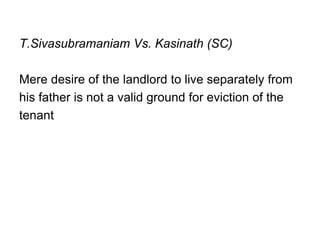
T.Sivasubramaniam Vs. Kasinath (SC)Mere desire of the landlord to live separately fromhis father is not a valid ground for eviction of thetenant
Eviction under tamilnadu rent control act

Eviction under tamilnadu rent control act

  • 1.
    EVICTION UNDER TAMILNADURENT CONTROL ACTPresented By, Dhanya N. Menon
  • 2.
    WHAT IS RENTCONTROL?imposing a legal maximum (rent ceiling)Upon the rentParticular housing market
  • 3.
    ORIGINFirst time inUS, in 1900sto check uninhibited rent increases and tenant eviction Need for rented house increased after World War II and with industrialization and corresponding urbanization Rent Control Acts, under various names were introduced.India’s 1st Rent Control Act: in Bombay in 1918: First World War
  • 4.
    THE LEGAL ASPECTSOF RENT CONTROL Indian Constitution: “Housing” – State Subject Enactment: responsibility of each StateObjects are similarTo protect the tenant from eviction from the house where he is living except for defined reasons and on defined conditions; and To protect him from having to pay more than a fair/standard rent. Landlord has the right to evict the tenant, ifHe is guilty of certain specified acts landlord requires the house for his own personal occupation.
  • 5.
    Grounds: Landlord canevict the tenant:The law relating to the landlord’s rights to evict the tenant can be found in the Transfer of Property Act, 1882. While a landlord can immediately start an action for eviction of a tenant on expiry of the notice of eviction under Section 106 of the Transfer of Property Act, 1882,He cannot start such an action where the rent control act applies, unless he can prove the existence of one of the grounds of eviction under the Rent Act.
  • 6.
    EXEMPTIONProperties belonging tothe government • Any tenancy created by a grant from the Government in respect of the premises taken on lease or requisitioned, by the Government • Newly constructed properties for a period of ten years (in Delhi) from the date of construction. This period may vary from state to state. • Any premises, residential or other, whose monthly rent exceeds three thousand and five hundred rupees (in Delhi). The amount may vary from state to state. religious and ethnic institutions
  • 7.
    TAMIL NADU RENTCONTROL LAWSThe necessity for imposing control of rents and prevention of unreasonable eviction of tenants arose during the war periodRent Control Orders in the year 1941 Renewed until Legislature enacted the Madras Act XV of 1946.Act of 1946 was replaced by Madras Act XXV of 1949In 1960, The Tamilnadu Buildings (Lease and Rent Control) Act,1960(XVIII of 1960) was passed
  • 8.
    FAIR RENTResidential: 9% of total cost of such building Non Residential: 12% of total cost of such building Total cost: market value of the site in which the building is constructedthe cost of construction of the buildingthe cost of provision of anyone or more of the amenities specified in the ActFixed by the Controller on application made by the tenant or the landlord Cond…
  • 9.
    Cannot be increased,but decreasedLandlord shall not claim, receive or stipulate for the payment in addition to such fair rent – advance can be asked If not fixed: Agreed rentLandlord liable to give receipt for rent or advance
  • 10.
    EVICTIONSection 10 ofthe ActThe right of eviction: Only on the reasons specified in the Act.Tenancies where the Act has no Application: Notice of atleast 6 monthsREASONS:Willful omission of payment of rent for more than 15 days after the rent fell dueSubletting of the premisesUnauthorized use of the buildingHas materially impaired the building or its value or utilityUsing of building of unlawful purposeContd…
  • 11.
    Nuisance Non occupancyfor a period in excess of four monthsUnlawful denial of landlord's title to the building Landlord’s own useEffecting repairs of the buildingCreation of a new buildingLandlord is religious or educational institutionMember of armed force
  • 12.
    CASE LAWSA.S. SULOCHANAv. C. DHARMALINGAM ( 28/11/1986)Eviction on the ground of subletting“tenant sought to be  evicted on the ground of unlawfulsubletting under s.10(2)(ii)(a) of the Tamil Nadu Buildings(Lease and Rent control) Act,1960 must himself havebeen guilty of the contravention”
  • 13.
    T.Sivasubramaniam Vs. Kasinath(SC)Mere desire of the landlord to live separately fromhis father is not a valid ground for eviction of thetenant