Heather Harton
Clemson University
Research funded in part by NSF grants CCF-0811748 and DMS-0701187
Thesis Statement
Related Work
Details of the Verification System
Research Evaluation
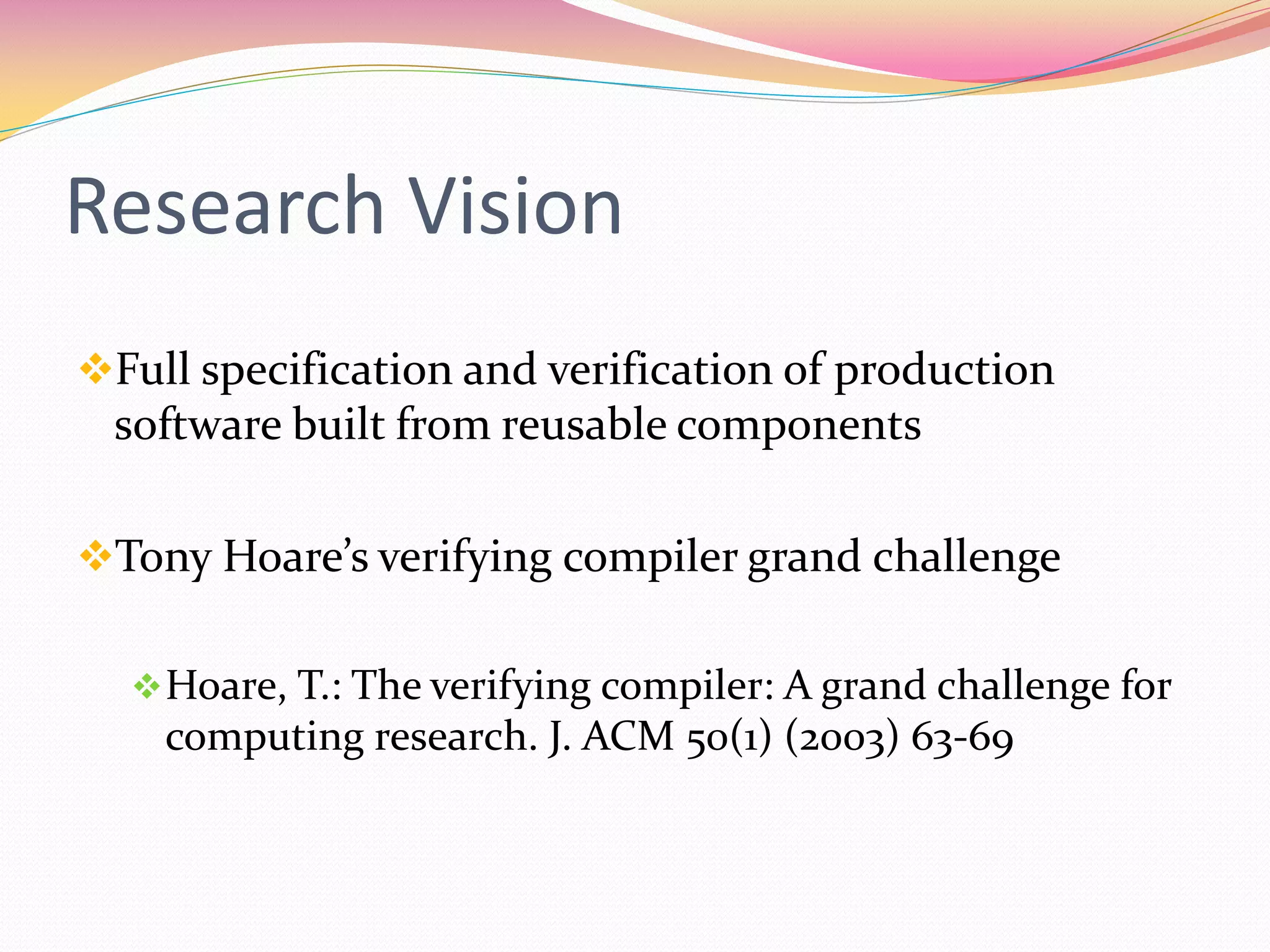
Research Vision
Full specification and verification of production
software built from reusable components
Tony Hoare’s verifying compiler grand challenge
Hoare, T.: The verifying compiler: A grand challenge for
computing research. J. ACM 50(1) (2003) 63-69
Thesis Statement
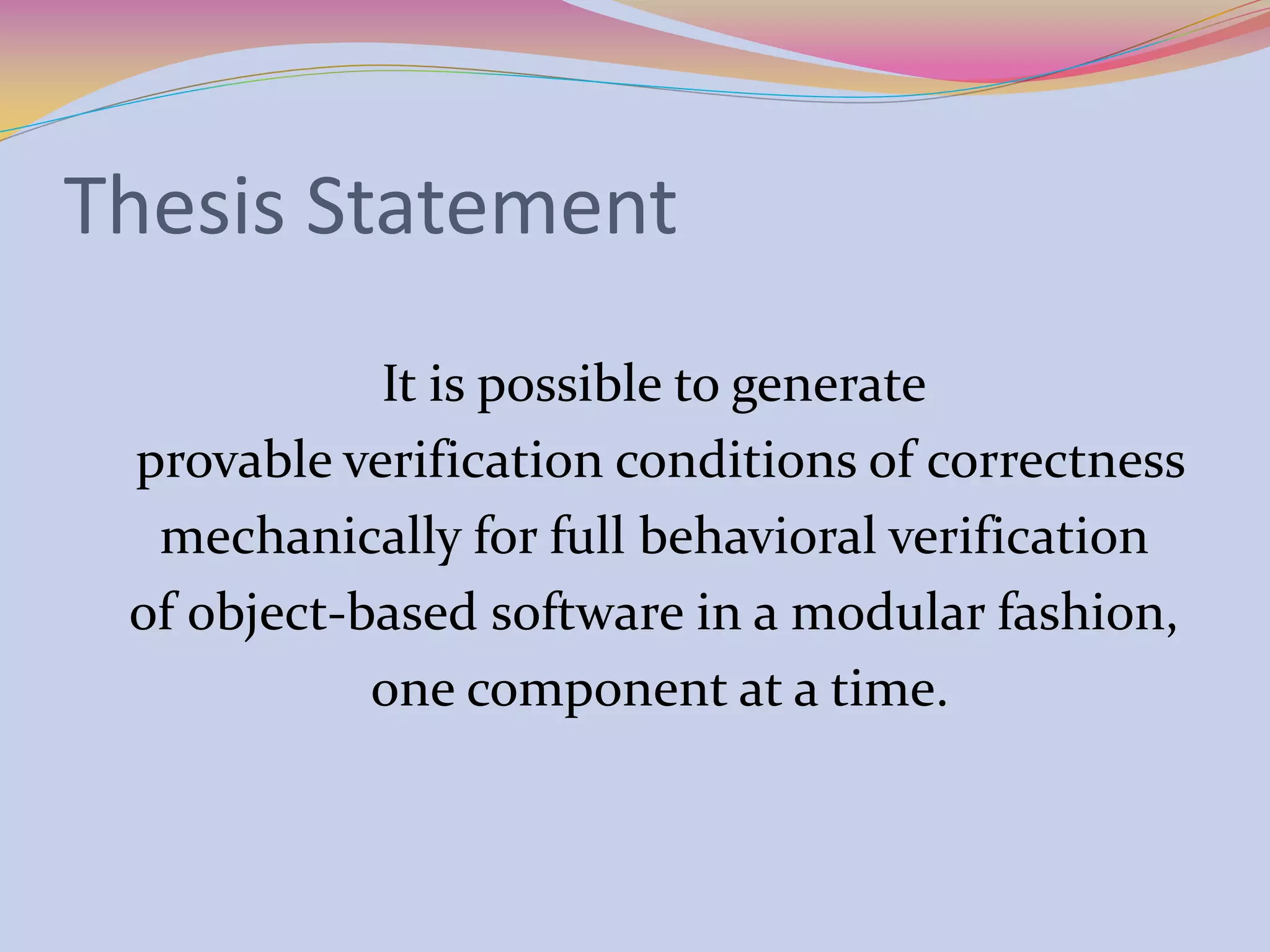
It is possible to generate
provable verification conditions of correctness
mechanically for full behavioral verification
of object-based software in a modular fashion,
one component at a time.
Thesis Statement
It is possible to generate
provable verification conditions of correctness
mechanically for full behavioral verification
of object-based software in a modular fashion,
one component at a time.
Full Behavioral Specification and
Verification
Some systems only verify properties (e.g., no null
reference access)
Some systems only allow specs that define partial
behavior
Example: Eiffel
Other systems have the ability to verify more complex
properties and may provide full verification
Thesis Statement
It is possible to generate
provable verification conditions of correctness
mechanically for full behavioral verification
of object-based software in a modular
fashion, one component at a time.
Modular Verification
Ability to verify one component at a time using only
specifications of reused components
Component
A
Spec
Component
B
Spec
New
Component
Realization
External
Component
Realization
Component
C
Spec
New
Component
Spec
=Component
Realization
Component
Realization
Component
Realization
Scalability of Proof Rules
Limited Number of Proof Rules
Should work for any data type
Should work on Built-In or User-Created Data Types
 Integers
 Arrays
 Pointers
 Generic Objects
Thesis Statement
It is possible to generate
provable verification conditions of correctness
mechanically for full behavioral verification
of object-based software in a modular fashion,
one component at a time.
Mechanical Verification
Huge gap between principle and practice
Example: Hoare’s proof rule for loops from 1969 can’t be
mechanized for practical use without several changes
Undecidability is less of a concern
Both VC generation process and proofs of correctness
should be automatic
Programmers will need to provide annotated code
 Invariants
 Progress Metrics
Mathematicians will need to provide proofs of the more
complicated theorems used by the prover
Object-Based Verification
Mechanizable proof rules are needed for all modern
language constructs
 Module-Level Verification
 Generics
 Object Specifications
 Enhancement Specifications
 Concept Implementations
 Operation-Level Verification
 Local and External Operations
 Control Constructs
 Object Declarations
 Auxiliary Variables and Code
 Context Enrichment
 Iterative and Recursive Procedures
 Enhancement Implementations
 Facility Declarations
 Simple
 Detailed
 Operation Calls
 Operation Declarations
 Functional
 Relational
Thesis Statement
It is possible to generate
provable verification conditions of correctness
mechanically for full behavioral verification
of object-based software in a modular fashion,
one component at a time.
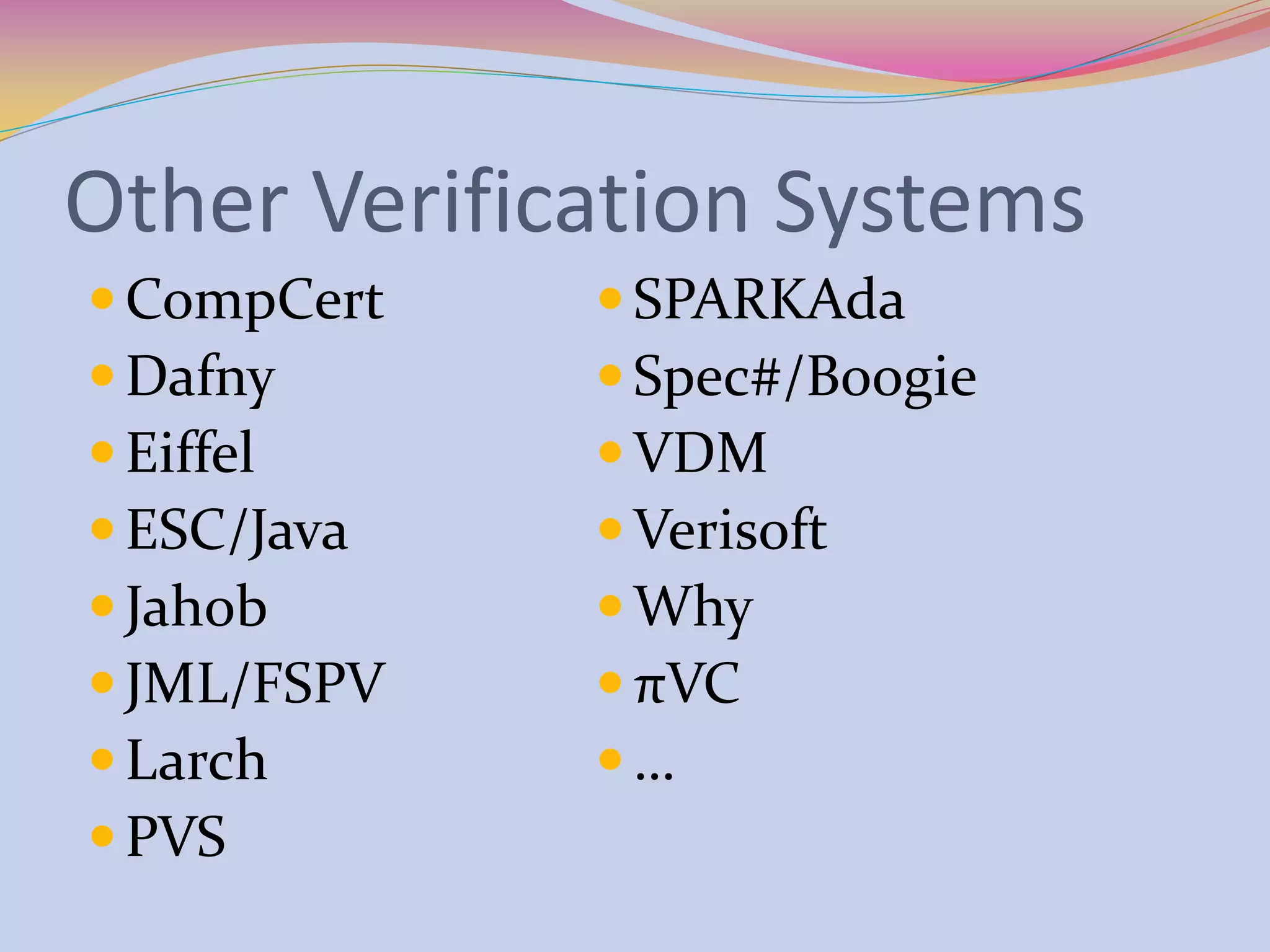
Other Verification Systems
SPARKAda
Spec#/Boogie
VDM
Verisoft
Why
πVC
…
CompCert
Dafny
Eiffel
ESC/Java
Jahob
JML/FSPV
Larch
PVS
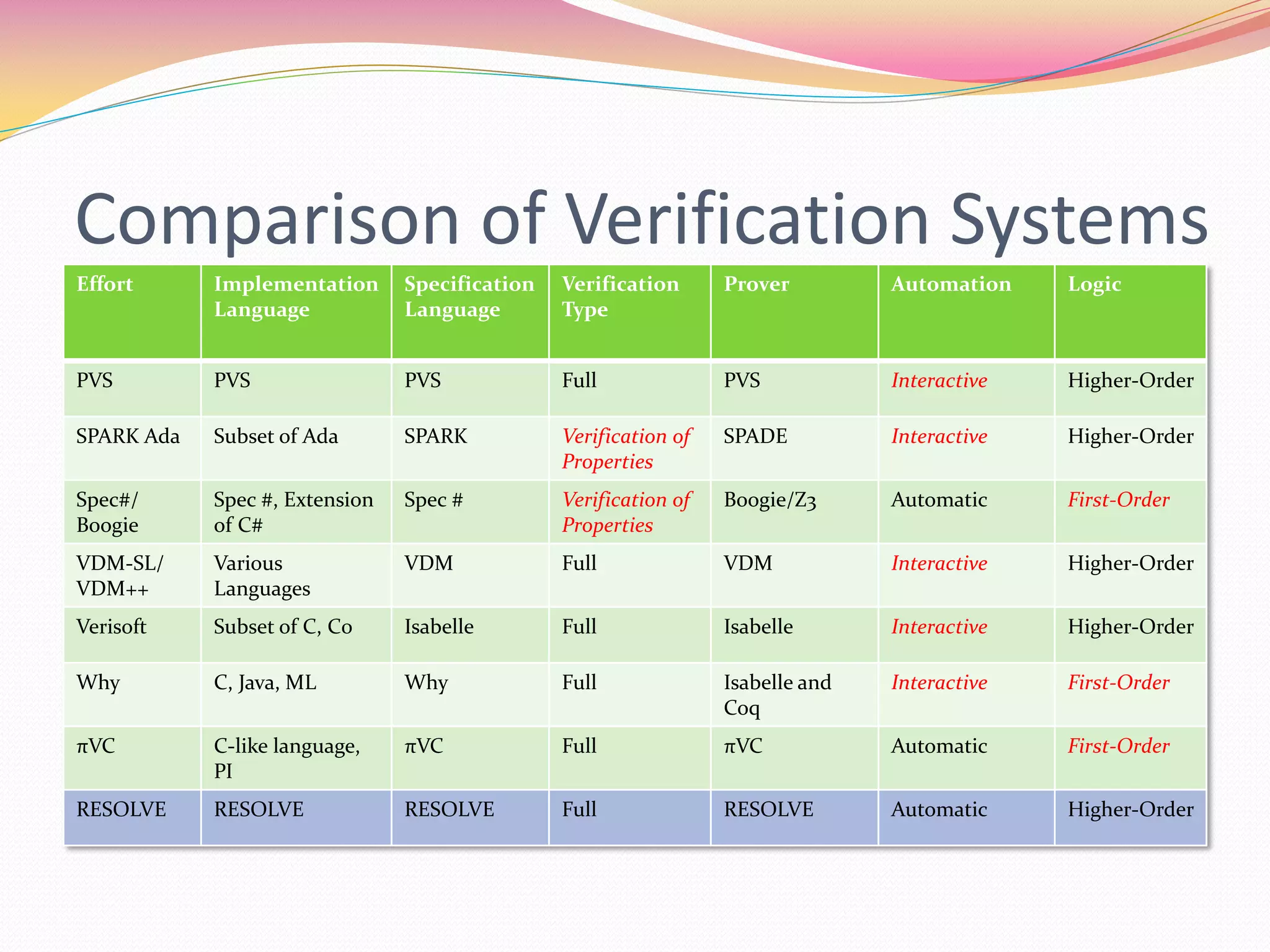
Comparison of Verification Systems
Effort Implementation
Language
Specification
Language
Verification
Type
Prover Automation Logic
Compcert Clight, subset of
C
Coq Full Coq Interactive Higher-Order
Dafny Dafny (Research
Language)
Dafny Full Boogie/Z3 Automatic First-Order
Eiffel Eiffel Eiffel Verification of
Properties
(Currently only
runtime checks)
Automatic First-Order
ESC/Java Java JML Verification of
Properties
Simplify Automatic Higher-Order
Jahob Subset of Java Subset of
Isabelle
Full Isabelle, Others Interactive Higher-Order
JML/FSPV Java JML Full Isabelle/Simpl Interactive Higher-Order
Larch Various
Languages
Larch Full Larch Prover Interactive First-Order
RESOLVE RESOLVE RESOLVE Full RESOLVE Automatic Higher-Order
Comparison of Verification Systems
Effort Implementation
Language
Specification
Language
Verification
Type
Prover Automation Logic
PVS PVS PVS Full PVS Interactive Higher-Order
SPARK Ada Subset of Ada SPARK Verification of
Properties
SPADE Interactive Higher-Order
Spec#/
Boogie
Spec #, Extension
of C#
Spec # Verification of
Properties
Boogie/Z3 Automatic First-Order
VDM-SL/
VDM++
Various
Languages
VDM Full VDM Interactive Higher-Order
Verisoft Subset of C, C0 Isabelle Full Isabelle Interactive Higher-Order
Why C, Java, ML Why Full Isabelle and
Coq
Interactive First-Order
πVC C-like language,
PI
πVC Full πVC Automatic First-Order
RESOLVE RESOLVE RESOLVE Full RESOLVE Automatic Higher-Order
Current Verification System
Uses RESOLVE
RESOLVE Semantics
Research into Mechanization of Proof Rules
Provides Modular Verification
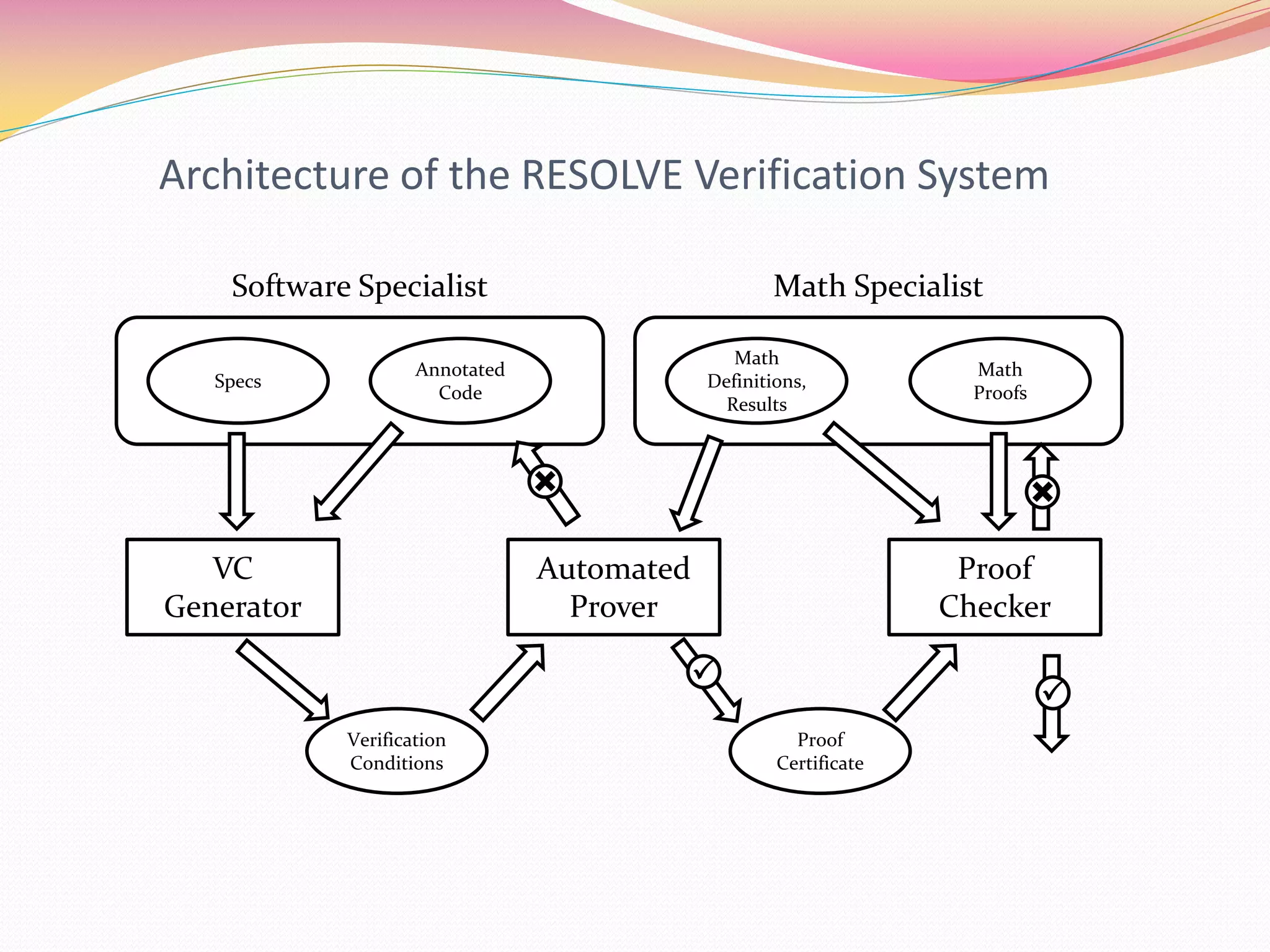
Architecture of the RESOLVE Verification System
Math SpecialistSoftware Specialist
VC
Generator
Specs
Proof
Checker
Automated
Prover
Annotated
Code
Verification
Conditions
Math
Definitions,
Results
Math
Proofs
Proof
Certificate
 


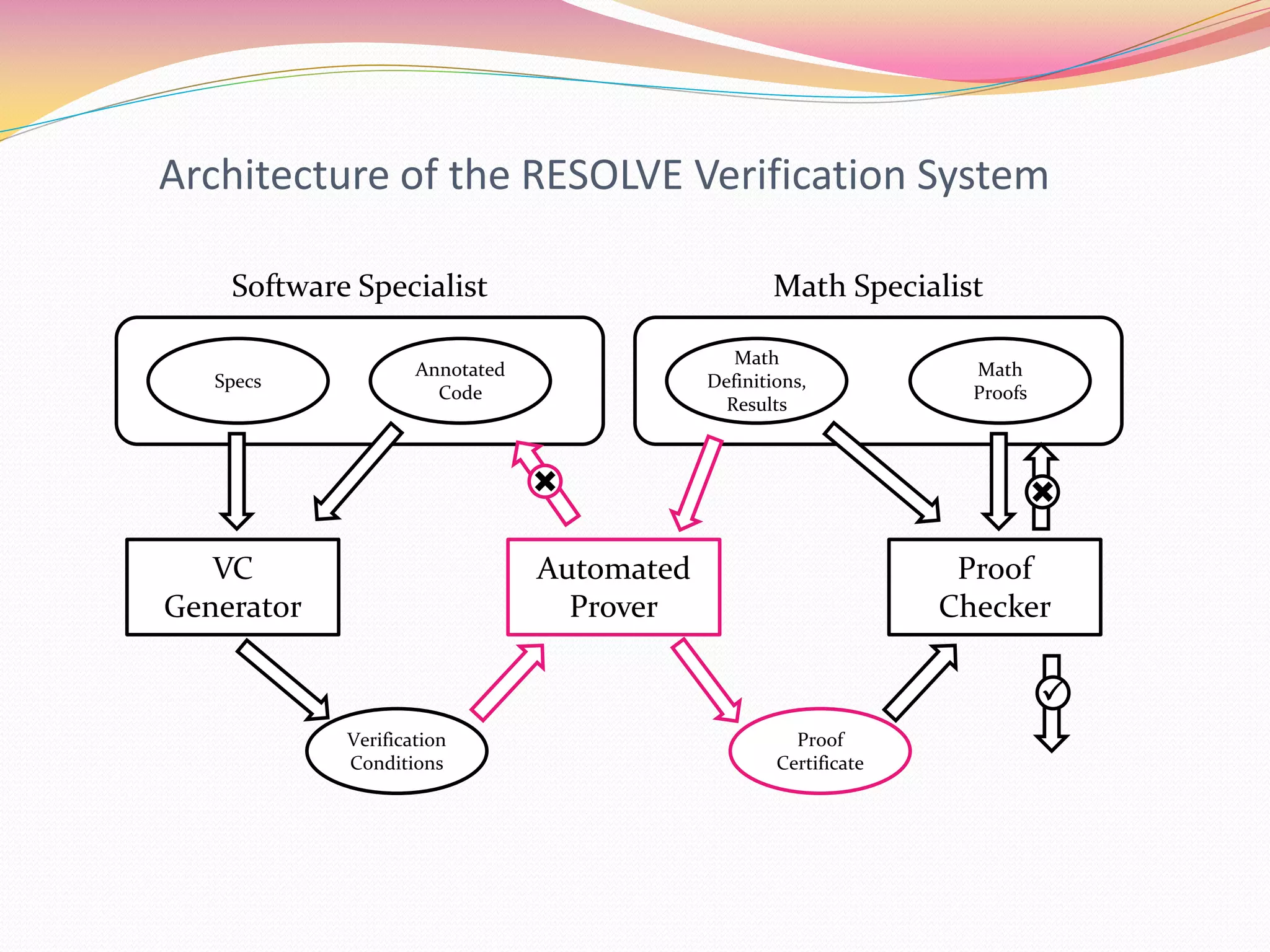
Architecture of the RESOLVE Verification System
Math SpecialistSoftware Specialist
VC
Generator
Specs
Proof
Checker
Automated
Prover
Annotated
Code
Verification
Conditions
Math
Definitions,
Results
Math
Proofs
Proof
Certificate
 


Architecture of the RESOLVE Verification System
Math SpecialistSoftware Specialist
VC
Generator
Specs
Proof
Checker
Automated
Prover
Annotated
Code
Verification
Conditions
Math
Definitions,
Results
Math
Proofs
Proof
Certificate
 


Architecture of the RESOLVE Verification System
Math SpecialistSoftware Specialist
VC
Generator
Specs
Proof
Checker
Automated
Prover
Annotated
Code
Verification
Conditions
Math
Definitions,
Results
Math
Proofs
Proof
Certificate
 

RESOLVE
Specification and implementation language
Object-based
Includes parametric polymorphism
Does not include dynamic typing
Clean language (Kulczycki 2004)
No references when passing parameters
Provides the swap operator
Relies on a developed math library for proofs
Language elements
Concepts and enhancements
Realizations
Facilities
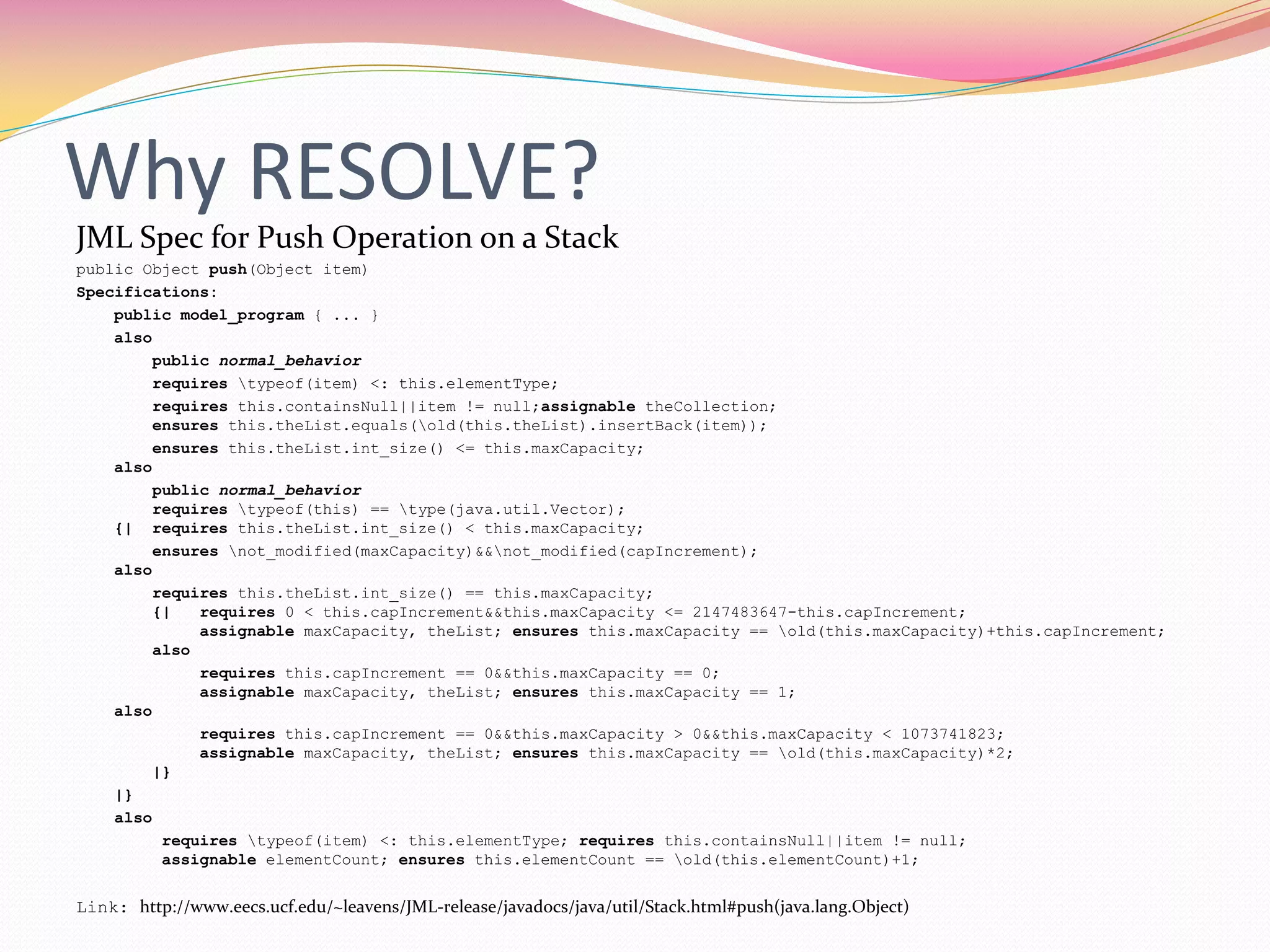
Why RESOLVE?
JML Spec for Push Operation on a Stack
public Object push(Object item)
Specifications:
public model_program { ... }
also
public normal_behavior
requires typeof(item) <: this.elementType;
requires this.containsNull||item != null;assignable theCollection;
ensures this.theList.equals(old(this.theList).insertBack(item));
ensures this.theList.int_size() <= this.maxCapacity;
also
public normal_behavior
requires typeof(this) == type(java.util.Vector);
{| requires this.theList.int_size() < this.maxCapacity;
ensures not_modified(maxCapacity)&&not_modified(capIncrement);
also
requires this.theList.int_size() == this.maxCapacity;
{| requires 0 < this.capIncrement&&this.maxCapacity <= 2147483647-this.capIncrement;
assignable maxCapacity, theList; ensures this.maxCapacity == old(this.maxCapacity)+this.capIncrement;
also
requires this.capIncrement == 0&&this.maxCapacity == 0;
assignable maxCapacity, theList; ensures this.maxCapacity == 1;
also
requires this.capIncrement == 0&&this.maxCapacity > 0&&this.maxCapacity < 1073741823;
assignable maxCapacity, theList; ensures this.maxCapacity == old(this.maxCapacity)*2;
|}
|}
also
requires typeof(item) <: this.elementType; requires this.containsNull||item != null;
assignable elementCount; ensures this.elementCount == old(this.elementCount)+1;
Link: http://www.eecs.ucf.edu/~leavens/JML-release/javadocs/java/util/Stack.html#push(java.lang.Object)
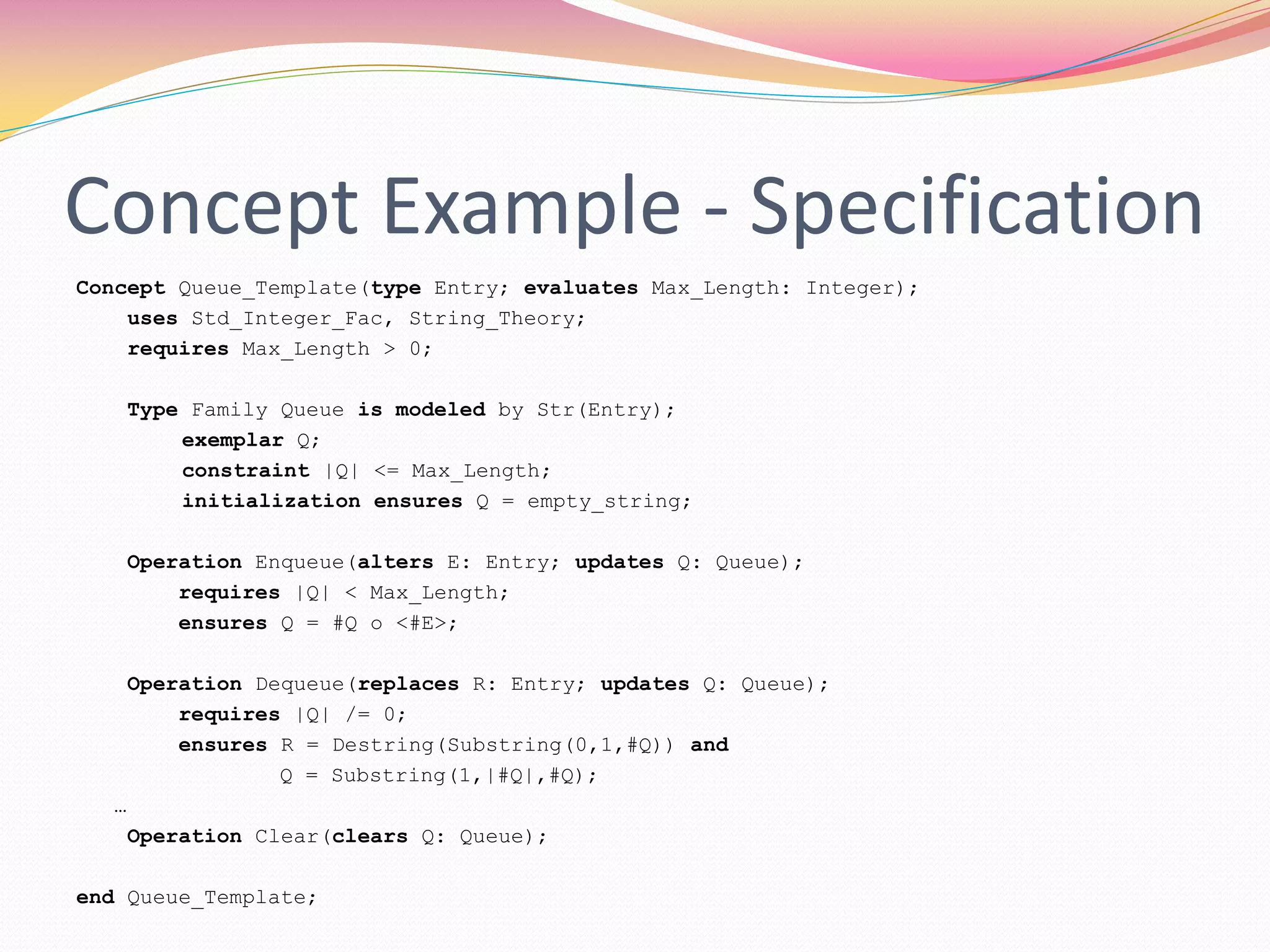
Concept Example - Specification
Concept Queue_Template(type Entry; evaluates Max_Length: Integer);
uses Std_Integer_Fac, String_Theory;
requires Max_Length > 0;
Type Family Queue is modeled by Str(Entry);
exemplar Q;
constraint |Q| <= Max_Length;
initialization ensures Q = empty_string;
Operation Enqueue(alters E: Entry; updates Q: Queue);
requires |Q| < Max_Length;
ensures Q = #Q o <#E>;
Operation Dequeue(replaces R: Entry; updates Q: Queue);
requires |Q| /= 0;
ensures R = Destring(Substring(0,1,#Q)) and
Q = Substring(1,|#Q|,#Q);
…
Operation Clear(clears Q: Queue);
end Queue_Template;
Enhancement Example
Enhancement Rotating_Capability for Queue_Template;
Operation Rotate(updates Q: Queue);
requires |Q| /= 0;
ensures Q = Substring(1,|#Q|,#Q) o Substring(0,1,#Q);
end Rotating_Capability;
Realization Obvious_Rotate_Realiz
for Rotating_Capability of Queue_Template;
Procedure Rotate(updates Q: Queue);
Var TE: Entry;
Dequeue(TE, Q);
Enqueue(TE, Q);
end Rotate;
end Obvious_Rotate_Realiz;
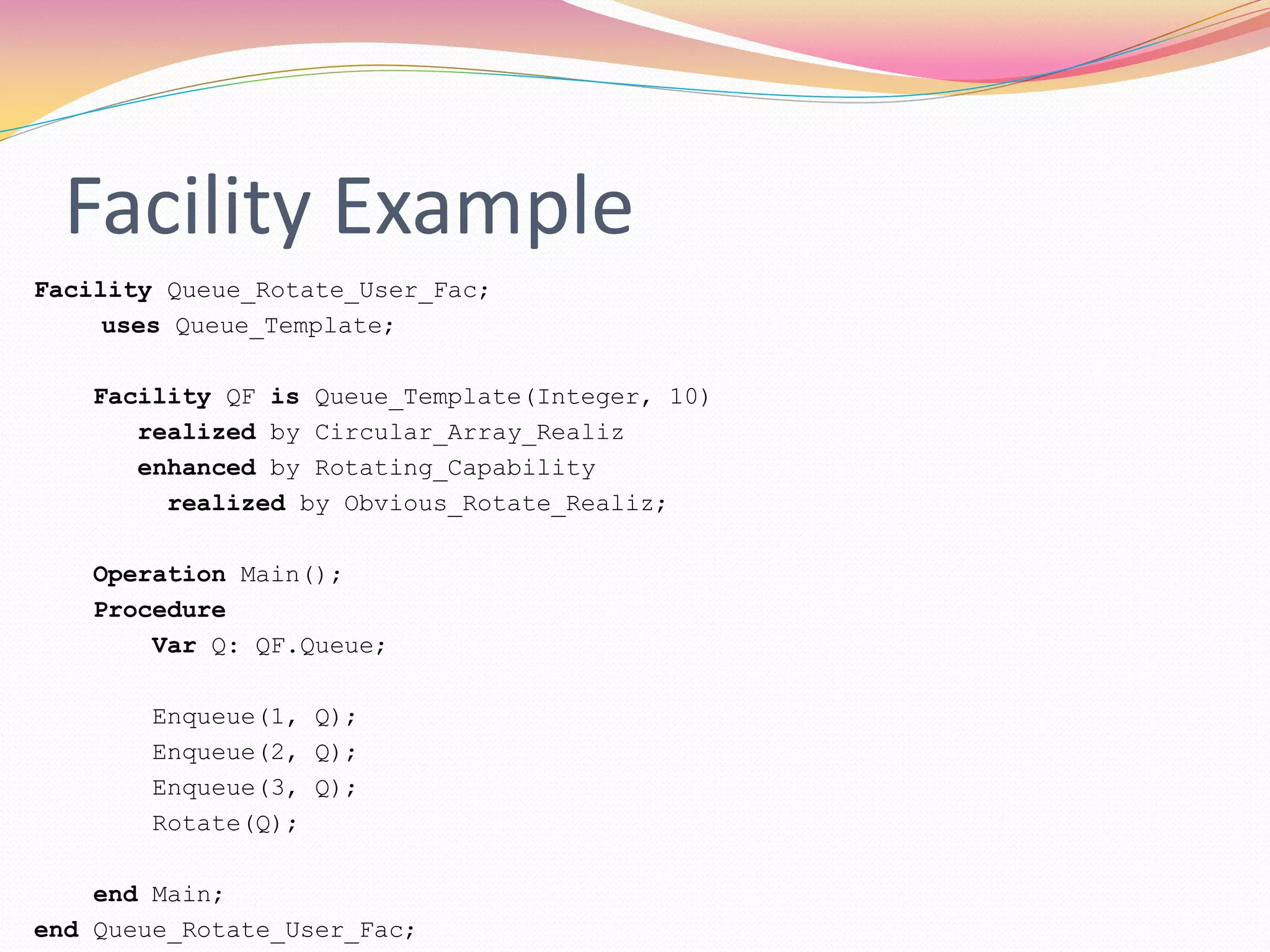
Facility Example
Facility Queue_Rotate_User_Fac;
uses Queue_Template;
Facility QF is Queue_Template(Integer, 10)
realized by Circular_Array_Realiz
enhanced by Rotating_Capability
realized by Obvious_Rotate_Realiz;
Operation Main();
Procedure
Var Q: QF.Queue;
Enqueue(1, Q);
Enqueue(2, Q);
Enqueue(3, Q);
Rotate(Q);
end Main;
end Queue_Rotate_User_Fac;
Current Verification System
Uses RESOLVE
RESOLVE Semantics
Research into Mechanization of Proof Rules
Provides Modular Verification
Semantic Foundations
 Why do we need semantics?
 Need to define the meaning of programs beyond what
implementations do when they are executed
 Semantics capture state to state transformations
 Semantics help establish that the proof system for
verification is sound and (relatively) complete
RESOLVE Semantics
 Modularity (using only specifications)
 Specifications of Operations and Objects
 Operations with Relational Specifications
Modularity
 States may be “Stuck” States or “Normal” States
 Stuck States
 MW – Manifestly Wrong
 For example, this can be reached by violating the precondition of a
call
 VC – Vacuously Correct
 For example, this can be reached when a called operation ends in a
state that doesn't satisfy the ensures clause of the called operation,
i.e., the called op. is wrong.
 ‘Bottom’ – Non termination
 For example, this can be reached with a non-terminating loop
 Normal States
 A function from variable names to their values.
Relational Semantics
MW MW
MW
Relational Semantics
MW
While Loop Semantics
 If the programmer-supplied invariant is false, then the
code will be invalid (MW).
 If invariant is omitted, it is assumed to be true.
 If the decreasing clause is wrong, then the code will be
invalid (MW).
 If the decreasing clause is omitted and the procedure is
expected to terminate with an ensures clause, then the
code is invalid (MW).
Current Verification System
Uses RESOLVE
RESOLVE Semantics
Research into Mechanization of Proof Rules
Provides Modular Verification
Goal-Oriented Vs. Tabular VC
Generation
 Dr. Krone’s dissertation explains the principles behind the
goal-oriented approach for VC Generation
 J. Krone, “The Role of Verification in Software Reusability,”
The Ohio State University, PhD. Thesis 1988.
 Dr. Heym’s dissertation explains the principles behind the
tabular approach for VC Generation
 W. Heym, “Computer Program Verification: Improvements
for Human Reasoning,” The Ohio State University, PhD.
Thesis 1995.
 There are many issues to move from principles of VC
generation to a practical, automated system.
So how are the Proof Rules
developed?
 Proof rules should be sound and (relatively) complete
 Proof rules need to be mechanizable
 Proof rules need to include the context
 Proof rules need to be generic
 Should work for any data type
 Should be composable
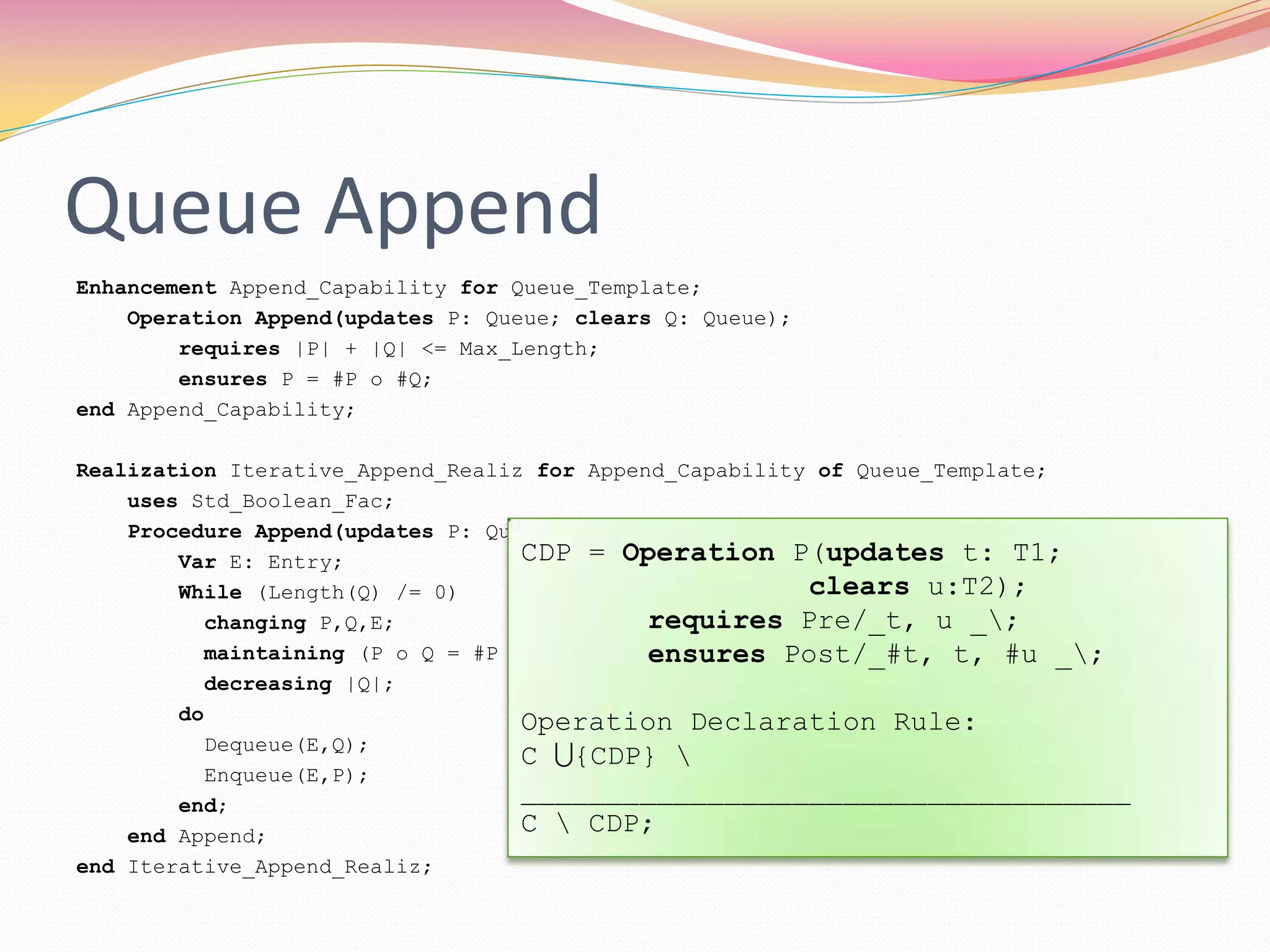
Queue Append
Enhancement Append_Capability for Queue_Template;
Operation Append(updates P: Queue; clears Q: Queue);
requires |P| + |Q| <= Max_Length;
ensures P = #P o #Q;
end Append_Capability;
Realization Iterative_Append_Realiz for Append_Capability of Queue_Template;
uses Std_Boolean_Fac;
Procedure Append(updates P: Queue; clears Q: Queue);
Var E: Entry;
While (Length(Q) /= 0)
changing P,Q,E;
maintaining (P o Q = #P o #Q) and (|P| + |Q| <= Max_Length);
decreasing |Q|;
do
Dequeue(E,Q);
Enqueue(E,P);
end;
end Append;
end Iterative_Append_Realiz;
Queue Append
Enhancement Append_Capability for Queue_Template;
Operation Append(updates P: Queue; clears Q: Queue);
requires |P| + |Q| <= Max_Length;
ensures P = #P o #Q;
end Append_Capability;
Realization Iterative_Append_Realiz for Append_Capability of Queue_Template;
uses Std_Boolean_Fac;
Procedure Append(updates P: Queue; clears Q: Queue);
Var E: Entry;
While (Length(Q) /= 0)
changing P,Q,E;
maintaining (P o Q = #P o #Q) and (|P| + |Q| <= Max_Length);
decreasing |Q|;
do
Dequeue(E,Q);
Enqueue(E,P);
end;
end Append;
end Iterative_Append_Realiz;
CDP = Operation P(updates t: T1;
clears u:T2);
requires Pre/_t, u _;
ensures Post/_#t, t, #u _;
Operation Declaration Rule:
C {CDP} 
____________________________________
C  CDP;
Queue Append
Enhancement Append_Capability for Queue_Template;
Operation Append(updates P: Queue; clears Q: Queue);
requires |P| + |Q| <= Max_Length;
ensures P = #P o #Q;
end Append_Capability;
Realization Iterative_Append_Realiz for Append_Capability of Queue_Template;
uses Std_Boolean_Fac;
Procedure Append(updates P: Queue; clears Q: Queue);
Var E: Entry;
While (Length(Q) /= 0)
changing P,Q,E;
maintaining (P o Q = #P o #Q) and (|P| + |Q| <= Max_Length);
decreasing |Q|;
do
Dequeue(E,Q);
Enqueue(E,P);
end;
end Append;
end Iterative_Append_Realiz;
CDP = Operation P(updates t: T1;
clears u:T2);
requires Pre/_t, u _;
ensures Post/_#t, t, #u _;
Operation Realization Rule:
C {CDP}
Assume Pre  T1.Constraint(t) ^
T2.Constraint(u);
Remember;
body;
Confirm Post;
__________________________________
C {CDP} Proc P(… ); body; end P;
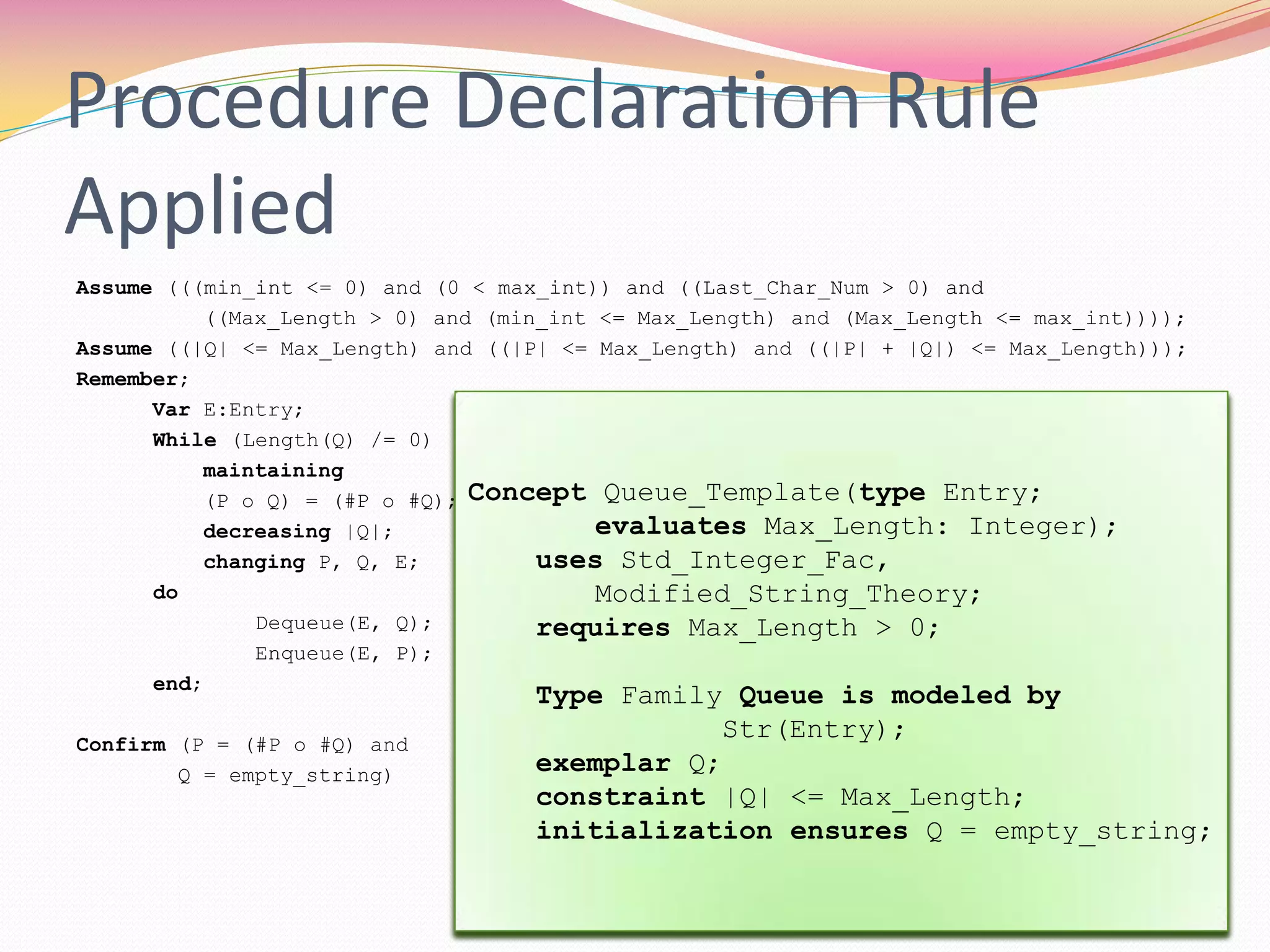
Assume (((min_int <= 0) and (0 < max_int)) and ((Last_Char_Num > 0) and
((Max_Length > 0) and (min_int <= Max_Length) and (Max_Length <= max_int))));
Assume ((|Q| <= Max_Length) and ((|P| <= Max_Length) and ((|P| + |Q|) <= Max_Length)));
Remember;
Var E:Entry;
While (Length(Q) /= 0)
maintaining
(P o Q) = (#P o #Q);
decreasing |Q|;
changing P, Q, E;
do
Dequeue(E, Q);
Enqueue(E, P);
end;
Confirm (P = (#P o #Q) and
Q = empty_string)
Concept Integer_Template;
uses Integer_Theory, Std_Boolean_Fac;
Definition min_int: Z;
Definition max_int: Z;
Constraint min_int <= 0 and 0 < max_int;
Type Family Integer is modeled by Z;
exemplar i;
constraint min_int <= i <= max_int;
initialization ensures i = 0;
Enhancement Append_Capability for
Queue_Template;
Operation Append(updates P: Queue;
clears Q: Queue);
requires |P| + |Q| <= Max_Length;
ensures P = #P o #Q;
end Append_Capability;
Procedure Declaration Rule
Applied
Concept Character_Template;
uses Std_Boolean_Fac, Std_Integer_Fac;
Definition Last_Char_Num: N;
Constraint Last_Char_Num > 0;
Concept Queue_Template(type Entry;
evaluates Max_Length: Integer);
uses Std_Integer_Fac,
Modified_String_Theory;
requires Max_Length > 0;
Type Family Queue is modeled by
Str(Entry);
exemplar Q;
constraint |Q| <= Max_Length;
initialization ensures Q = empty_string;
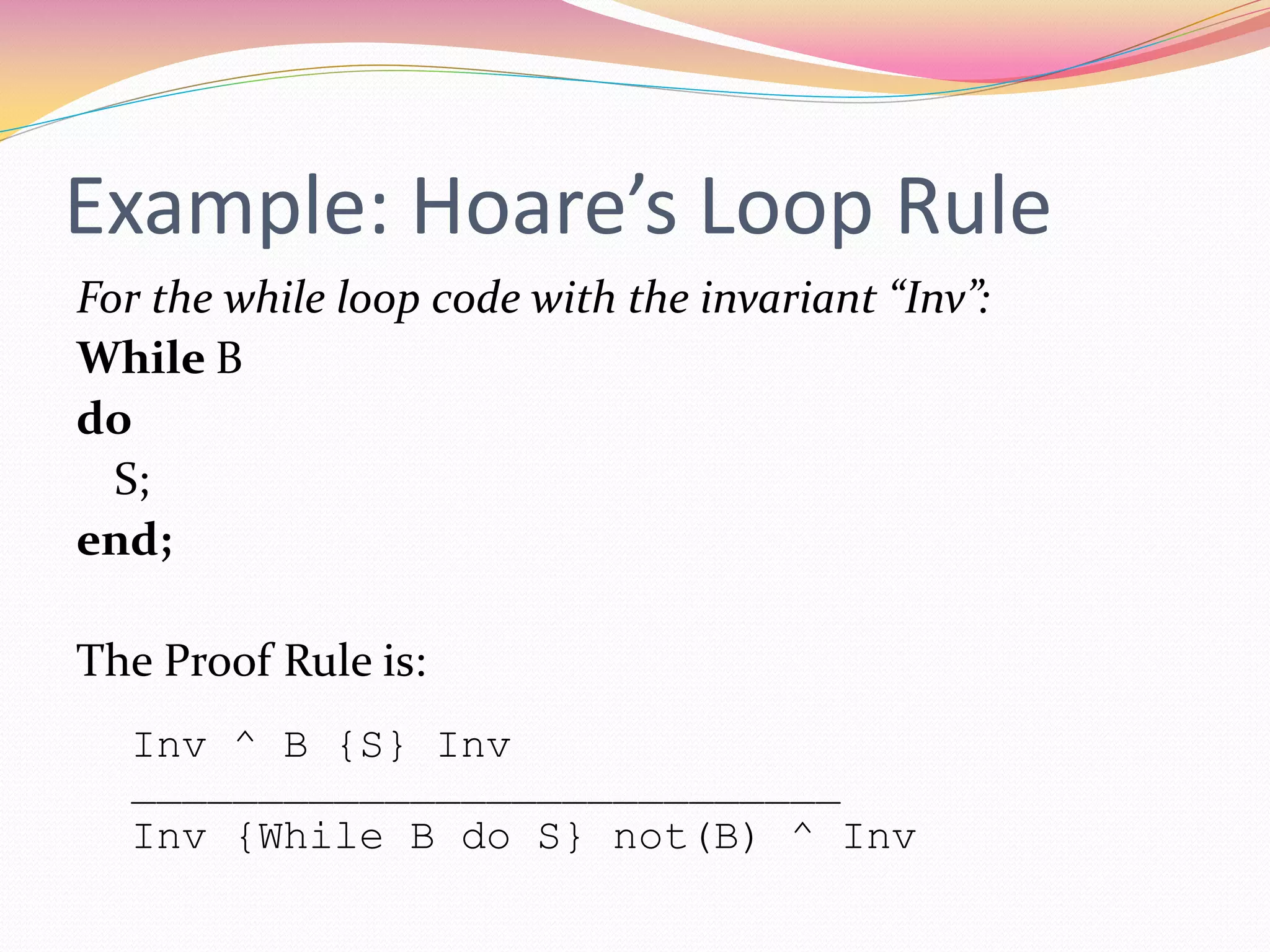
Example: Hoare’s Loop Rule
For the while loop code with the invariant “Inv”:
While B
do
S;
end;
The Proof Rule is:
Inv ^ B {S} Inv
____________________________
Inv {While B do S} not(B) ^ Inv
Mechanized Proof Rule
Hoare’s Proof Rule:
Inv ^ B {S} Inv
_________________
Inv
{While B do S}
not(B) ^ Inv
RESOLVE While Loop Rule:
Context/ code;
Confirm Inv; Change Vlist;
Assume Inv and
NQV(RP, P_Val)= P_Exp;
If B then body;
Confirm Inv and
NQV(RP, P_Val)< P_Exp;
else Confirm RP end_if;
Confirm True;
________________________________
C/ code;
While B
maintaining Inv;
decreasing P_Exp;
changing Vlist;
do body end;
Confirm RP;
Development of Proof Rule –
Version 2
 Need to be able to prove generic assertions (not just the invariant)
 Need a syntactic slot for the Invariant
code; Confirm Inv;
Assume Inv and B; body; Confirm Inv;
Assume Inv and not(B); Confirm RP;
_________________________________
code;
While B
maintaining Inv;
do
body
end;
Confirm RP;
Development of Proof Rule –
Version 3
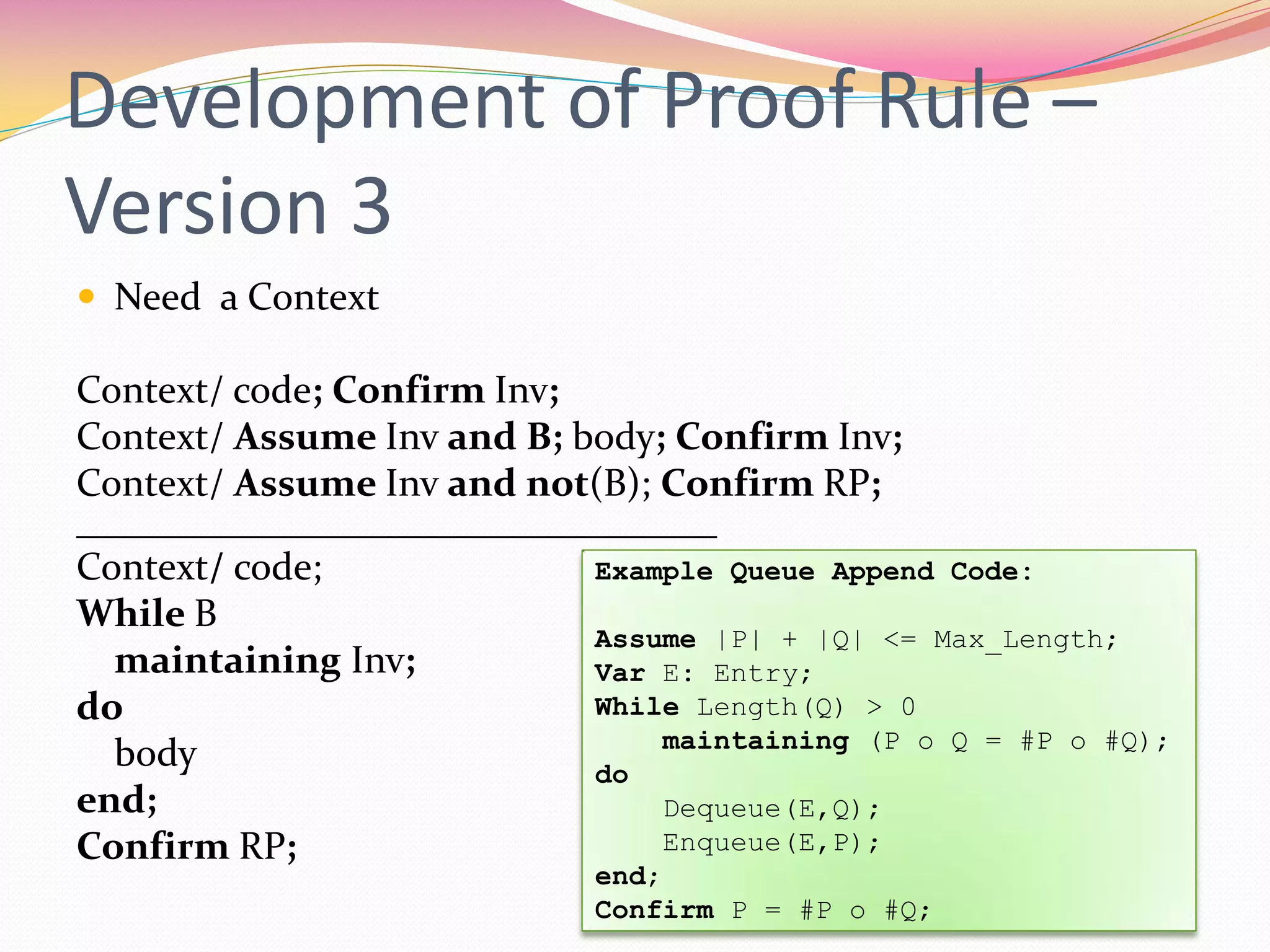
 Need a Context
Context/ code; Confirm Inv;
Context/ Assume Inv and B; body; Confirm Inv;
Context/ Assume Inv and not(B); Confirm RP;
_________________________________
Context/ code;
While B
maintaining Inv;
do
body
end;
Confirm RP;
Example Queue Append Code:
Assume |P| + |Q| <= Max_Length;
Var E: Entry;
While Length(Q) > 0
maintaining (P o Q = #P o #Q);
do
Dequeue(E,Q);
Enqueue(E,P);
end;
Confirm P = #P o #Q;
Proof Rule –
Version 3
 Need a Context
Context/ code; Confirm Inv;
Context/ Assume Inv and B; body;
Confirm Inv;
Context/ Assume Inv and not(B);
Confirm RP;
_________________________________
Context/ code;
While B
maintaining Inv;
do
body
end;
Confirm RP;
Context/
Assume |P| + |Q| <= Max_Length;
Var E: Entry;
Confirm P o Q = #P o #Q;
Context/
Assume P o Q = #P o #Q and
not(Length(Q) > 0);
Confirm P = #P o #Q;
Context/
Assume P o Q = #P o #Q and
Length(Q) > 0;
Dequeue(E,Q);
Enqueue(E,P);
Confirm P o Q = #P o #Q;
Proof Rule –
Version 4
 Need to convert condition statements
to Mathematical Form
Context/ code; Confirm Inv;
Context/ Assume Inv and Math(B);
body; Confirm Inv;
Context/ Assume Inv and not(Math(B));
Confirm RP;
_________________________________
Context/ code;
While B
maintaining Inv;
do
body
end;
Confirm RP;
Context/
Assume |P| + |Q| <= Max_Length;
Var E: Entry;
Confirm P o Q = #P o #Q;
Context/
Assume P o Q = #P o #Q and
|Q| > 0;
Dequeue(E,Q);
Enqueue(E,P);
Confirm P o Q = #P o #Q;
Context/
Assume P o Q = #P o #Q and
not(|Q| > 0);
Confirm P = #P o #Q;
Proof Rule –
Version 5
 Need to assume constraints
for variables
C/ code; Confirm Inv;
C/ Assume Inv and Math(B) and
Are_Constraints_Compliant(P, T);
body; Confirm Inv;
C/ Assume Inv and not(Math(B));
Confirm RP;
_________________________________
C Var P:Type1, Var T:Type2/ code;
While B
maintaining Inv;
do
body
end;
Confirm RP;
Context/
Assume |P| + |Q| <= Max_Length;
Var E: Entry;
Confirm P o Q = #P o #Q;
Context/
Assume P o Q = #P o #Q and
|P| <= Max_Length and
|Q| <= Max_Length and
|Q| > 0;
Dequeue(E,Q);
Enqueue(E,P);
Confirm P o Q = #P o #Q;
Context/
Assume P o Q = #P o #Q and
not(|Q| > 0);
Confirm P = #P o #Q;
Development of Proof Rule –
Version 6
 Need to show termination
C/ code; Confirm Inv;
C/ Assume Inv and Math(B) and Are_Constraints_Compliant(P, T) and P_Val=P_Exp;
body;
Confirm P_Val<P_Exp and Inv;
C/ Assume Inv and not(Math(B));
Confirm RP;
_________________________________
C Var P:Type1, Var T:Type2/ code;
While B
maintaining Inv;
decreasing P_Exp;
do
body
end;
Confirm RP;
Example Queue Append Code:
Assume |P| + |Q| <= Max_Length;
Var E: Entry;
While Length(Q) > 0
maintaining (P o Q = #P o #Q);
decreasing |Q|;
do
Dequeue(E,Q);
Enqueue(E,P);
end;
Confirm P = #P o #Q;
Development of Proof Rule –
Version 6
 Need to show termination
C/ code; Confirm Inv;
C/ Assume Inv and Math(B) and
Are_Constraints_Compliant(P, T) and
P_Val=P_Exp; body;
Confirm P_Val > P_Exp and Inv;
C/ Assume Inv and not(Math(B));
Confirm RP;
_________________________________
C Var P:Type1, Var T:Type2/ code;
While B
maintaining Inv;
decreasing P_Exp;
do
body
end;
Confirm RP;
Context/
Assume |P| + |Q| <= Max_Length;
Var E: Entry;
Confirm P o Q = #P o #Q;
Confirm Inv;
Context/
Assume P o Q = #P o #Q and
|P| <= Max_Length and
|Q| <= Max_Length and
|Q| > 0 and
P_Val=|Q|;
Dequeue(E,Q);
Enqueue(E,P);
Confirm P_Val > |Q| and
P o Q = #P o #Q;
Context/
Assume P o Q = #P o #Q and
not(|Q| > 0);
Confirm P = #P o #Q;
Development of Proof Rule –
Version 7
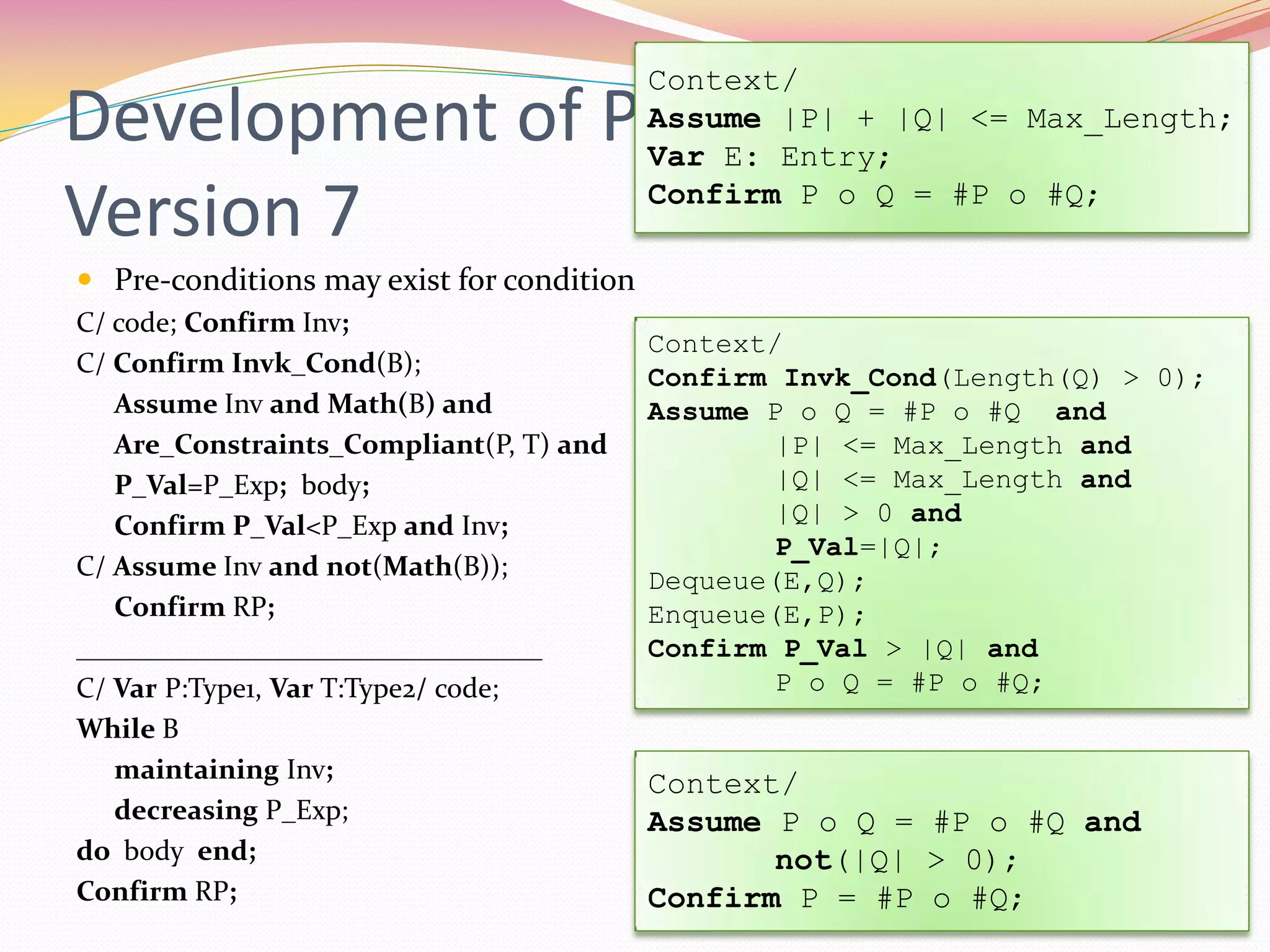
 Pre-conditions may exist for condition
C/ code; Confirm Inv;
C/ Confirm Invk_Cond(B);
Assume Inv and Math(B) and
Are_Constraints_Compliant(P, T) and
P_Val=P_Exp; body;
Confirm P_Val<P_Exp and Inv;
C/ Assume Inv and not(Math(B));
Confirm RP;
_________________________________
C/ Var P:Type1, Var T:Type2/ code;
While B
maintaining Inv;
decreasing P_Exp;
do body end;
Confirm RP;
Context/
Assume |P| + |Q| <= Max_Length;
Var E: Entry;
Confirm P o Q = #P o #Q;
Context/
Confirm Invk_Cond(Length(Q) > 0);
Assume P o Q = #P o #Q and
|P| <= Max_Length and
|Q| <= Max_Length and
|Q| > 0 and
P_Val=|Q|;
Dequeue(E,Q);
Enqueue(E,P);
Confirm P_Val > |Q| and
P o Q = #P o #Q;
Context/
Assume P o Q = #P o #Q and
not(|Q| > 0);
Confirm P = #P o #Q;
Development of Proof Rule –
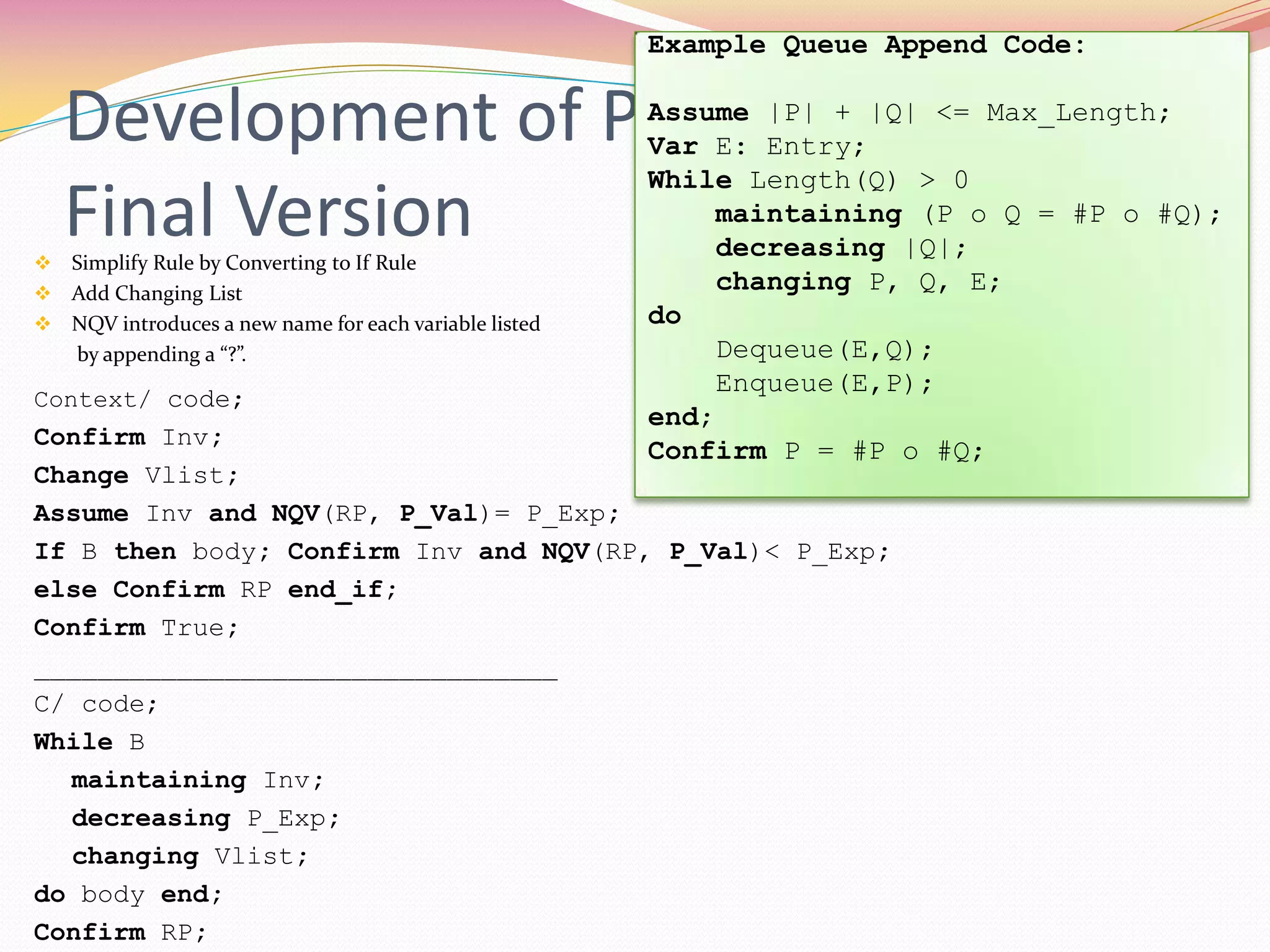
Final Version Simplify Rule by Converting to If Rule
 Add Changing List
 NQV introduces a new name for each variable listed
by appending a “?”.
Context/ code;
Confirm Inv;
Change Vlist;
Assume Inv and NQV(RP, P_Val)= P_Exp;
If B then body; Confirm Inv and NQV(RP, P_Val)< P_Exp;
else Confirm RP end_if;
Confirm True;
_________________________________
C/ code;
While B
maintaining Inv;
decreasing P_Exp;
changing Vlist;
do body end;
Confirm RP;
Example Queue Append Code:
Assume |P| + |Q| <= Max_Length;
Var E: Entry;
While Length(Q) > 0
maintaining (P o Q = #P o #Q);
decreasing |Q|;
changing P, Q, E;
do
Dequeue(E,Q);
Enqueue(E,P);
end;
Confirm P = #P o #Q;
Development of Proof Rule –
Final Version
Context/ code;
Confirm Inv; Change Vlist;
Assume Inv and
NQV(RP, P_Val)= P_Exp;
If B then body;
Confirm Inv and
NQV(RP, P_Val)< P_Exp;
else Confirm RP end_if;
Confirm True;
_________________________________
C/ code;
While B
maintaining Inv;
decreasing P_Exp;
changing Vlist;
do body end;
Confirm RP;
Context/
Assume |P| + |Q| <= Max_Length;
Var E: Entry;
Confirm P o Q = #P o #Q;
Assume P o Q = #P o #Q and
P_Val=|Q|;
If (Length(Q) > 0) then
Dequeue(E,Q);
Enqueue(E,P);
Confirm P_Val<|Q| and
P o Q = #P o #Q;
Else Confirm P = #P o #Q;
end_if;
Confirm True;
Mechanized Proof Rule
Hoare’s Proof Rule:
Inv ^ B {S} Inv
_________________
Inv
{While B do S}
not(B) ^ Inv
RESOLVE While Loop Rule:
Context/ code;
Confirm Inv; Change Vlist;
Assume Inv and
NQV(RP, P_Val)= P_Exp;
If B then body;
Confirm Inv and
NQV(RP, P_Val)< P_Exp;
else Confirm RP end_if;
Confirm True;
________________________________
C/ code;
While B
maintaining Inv;
decreasing P_Exp;
changing Vlist;
do body end;
Confirm RP;
Assertive Code
Assume (((min_int <= 0) and (0 < max_int)) and ((Last_Char_Num > 0) and
((Max_Length > 0) and (min_int <= Max_Length) and (Max_Length <= max_int))));
Assume ((|Q| <= Max_Length) and ((|P| <= Max_Length) and ((|P| + |Q|) <= Max_Length)));
Remember;
Var E:Entry;
While (Length(Q) /= 0)
maintaining
(P o Q) = (#P o #Q);
decreasing |Q|;
changing P, Q, E;
do
Dequeue(E, Q);
Enqueue(E, P);
end;
Confirm (P = (#P o #Q) and
Q = empty_string)
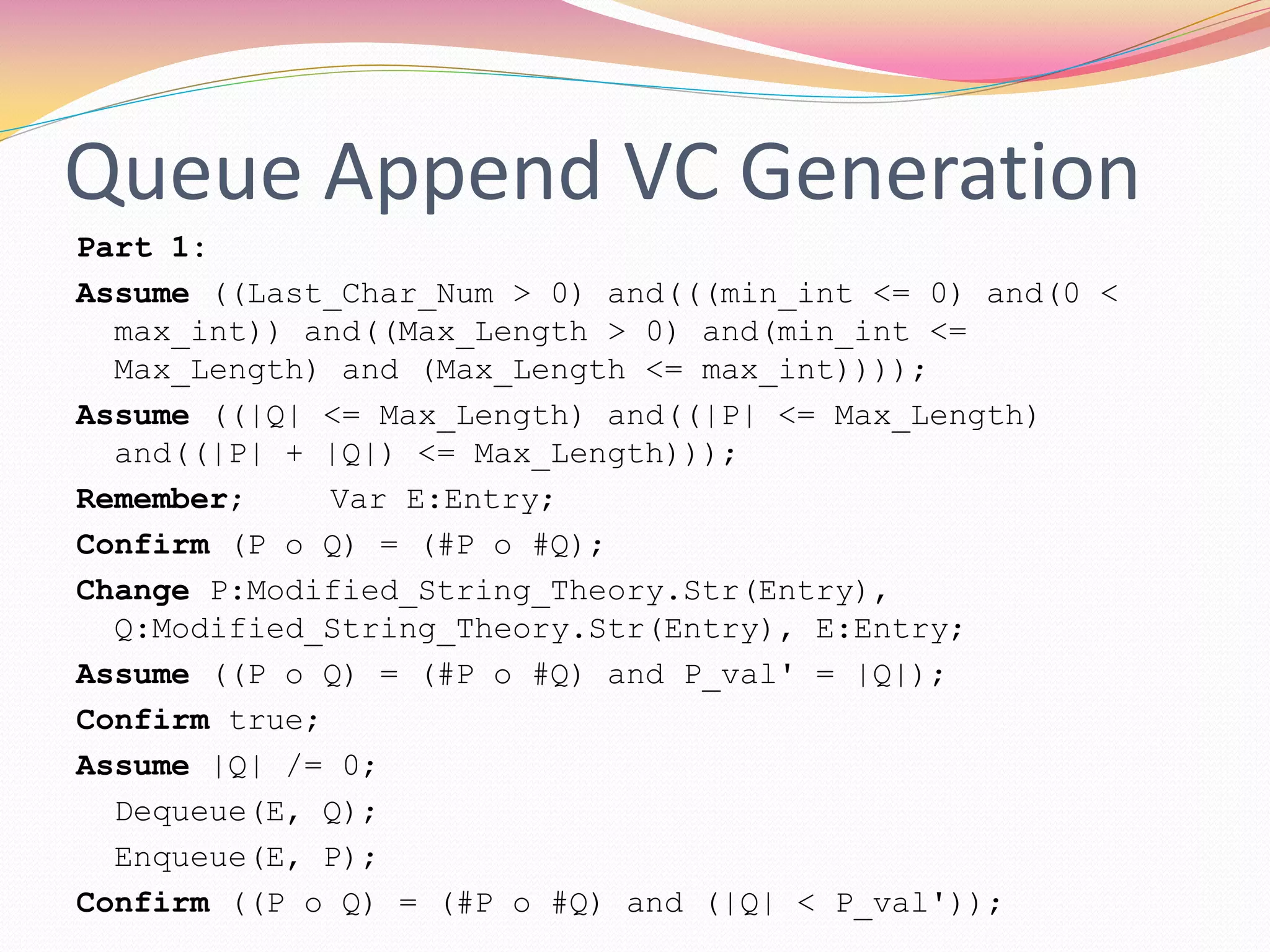
Queue Append VC Generation
Part 1:
Assume ((Last_Char_Num > 0) and(((min_int <= 0) and(0 <
max_int)) and((Max_Length > 0) and(min_int <=
Max_Length) and (Max_Length <= max_int))));
Assume ((|Q| <= Max_Length) and((|P| <= Max_Length)
and((|P| + |Q|) <= Max_Length)));
Remember; Var E:Entry;
Confirm (P o Q) = (#P o #Q);
Change P:Modified_String_Theory.Str(Entry),
Q:Modified_String_Theory.Str(Entry), E:Entry;
Assume ((P o Q) = (#P o #Q) and P_val' = |Q|);
Confirm true;
Assume |Q| /= 0;
Dequeue(E, Q);
Enqueue(E, P);
Confirm ((P o Q) = (#P o #Q) and (|Q| < P_val'));
Queue Append VC Generation
Part 1:
Assume ((Last_Char_Num > 0) and(((min_int <= 0) and(0 <
max_int)) and((Max_Length > 0) and(min_int <=
Max_Length) and (Max_Length <= max_int))));
Assume ((|Q| <= Max_Length) and((|P| <= Max_Length)
and((|P| + |Q|) <= Max_Length)));
Remember; Var E:Entry;
Confirm (P o Q) = (#P o #Q);
Change P:Modified_String_Theory.Str(Entry),
Q:Modified_String_Theory.Str(Entry), E:Entry, E:Entry;
Assume ((P o Q) = (#P o #Q) and P_val' = |Q|);
Confirm true;
Assume |Q| /= 0;
Dequeue(E, Q);
Enqueue(E, P);
Confirm ((P o Q) = (#P o #Q) and(|Q| < P_val'));
CDP = Operation P( updates t: T1; alters u: T2);
requires Pre/_t, u _;
ensures Post/_ #t, #u, t _;
Operation Call Rule:
C {CDP} code; Confirm Invk_Cond(P(a,b));
Assume Post[t⇝NQV(result, a), #t⇝a, #u⇝b];
Confirm result[a⇝NQV(result, a)];
____________________________________________
C {CDP} code; P( a, b); Confirm result/_ a, b _ ;
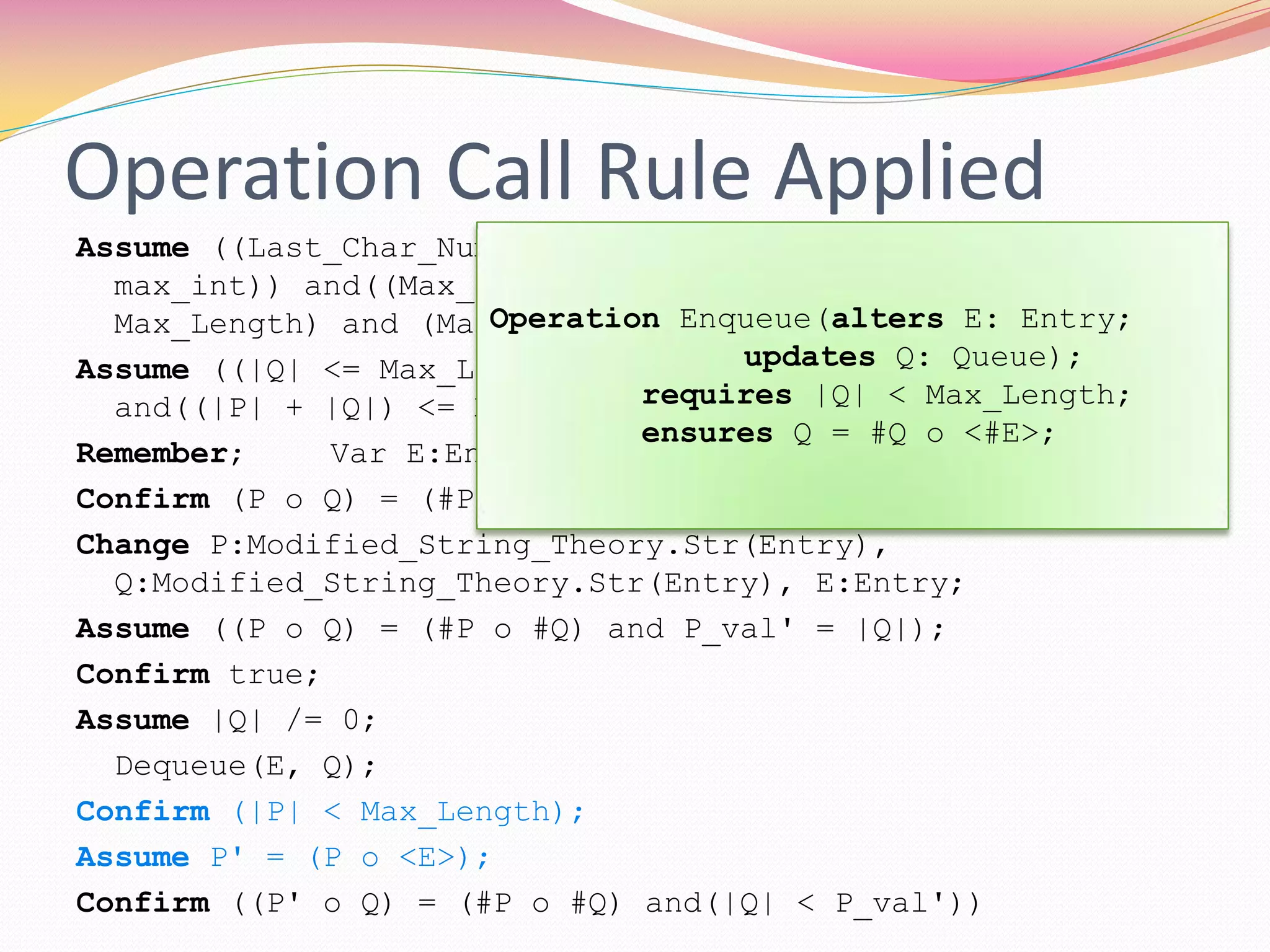
Operation Call Rule Applied
Assume ((Last_Char_Num > 0) and(((min_int <= 0) and(0 <
max_int)) and((Max_Length > 0) and(min_int <=
Max_Length) and (Max_Length <= max_int))));
Assume ((|Q| <= Max_Length) and((|P| <= Max_Length)
and((|P| + |Q|) <= Max_Length)));
Remember; Var E:Entry;
Confirm (P o Q) = (#P o #Q);
Change P:Modified_String_Theory.Str(Entry),
Q:Modified_String_Theory.Str(Entry), E:Entry;
Assume ((P o Q) = (#P o #Q) and P_val' = |Q|);
Confirm true;
Assume |Q| /= 0;
Dequeue(E, Q);
Confirm (|P| < Max_Length);
Assume P' = (P o <E>);
Confirm ((P' o Q) = (#P o #Q) and(|Q| < P_val'))
Operation Enqueue(alters E: Entry;
updates Q: Queue);
requires |Q| < Max_Length;
ensures Q = #Q o <#E>;
Assume Rule Applied
Assume ((Last_Char_Num > 0) and(((min_int <= 0) and(0 <
max_int)) and((Max_Length > 0) and(min_int <=
Max_Length) and (Max_Length <= max_int))));
Assume ((|Q| <= Max_Length) and((|P| <= Max_Length)
and((|P| + |Q|) <= Max_Length)));
Remember; Var E:Entry;
Confirm (P o Q) = (#P o #Q);
Change P:Modified_String_Theory.Str(Entry),
Q:Modified_String_Theory.Str(Entry), E:Entry;
Assume ((P o Q) = (#P o #Q) and P_val' = |Q|);
Confirm true;
Assume |Q| /= 0;
Dequeue(E, Q);
Confirm (|P| < Max_Length);
Confirm (((P o <E>) o Q) = (#P o #Q) and(|Q| < P_val'))
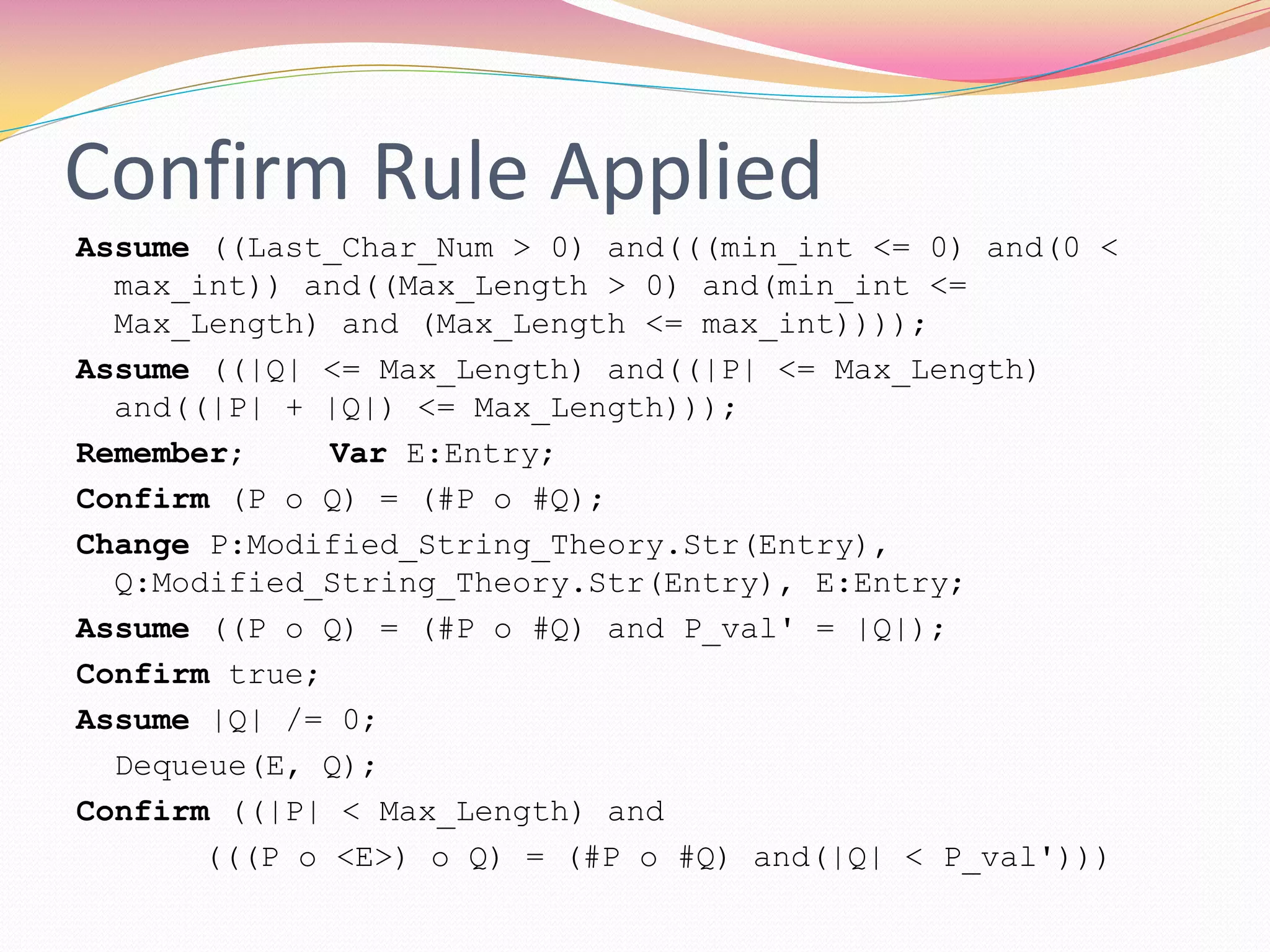
Confirm Rule Applied
Assume ((Last_Char_Num > 0) and(((min_int <= 0) and(0 <
max_int)) and((Max_Length > 0) and(min_int <=
Max_Length) and (Max_Length <= max_int))));
Assume ((|Q| <= Max_Length) and((|P| <= Max_Length)
and((|P| + |Q|) <= Max_Length)));
Remember; Var E:Entry;
Confirm (P o Q) = (#P o #Q);
Change P:Modified_String_Theory.Str(Entry),
Q:Modified_String_Theory.Str(Entry), E:Entry;
Assume ((P o Q) = (#P o #Q) and P_val' = |Q|);
Confirm true;
Assume |Q| /= 0;
Dequeue(E, Q);
Confirm ((|P| < Max_Length) and
(((P o <E>) o Q) = (#P o #Q) and(|Q| < P_val')))
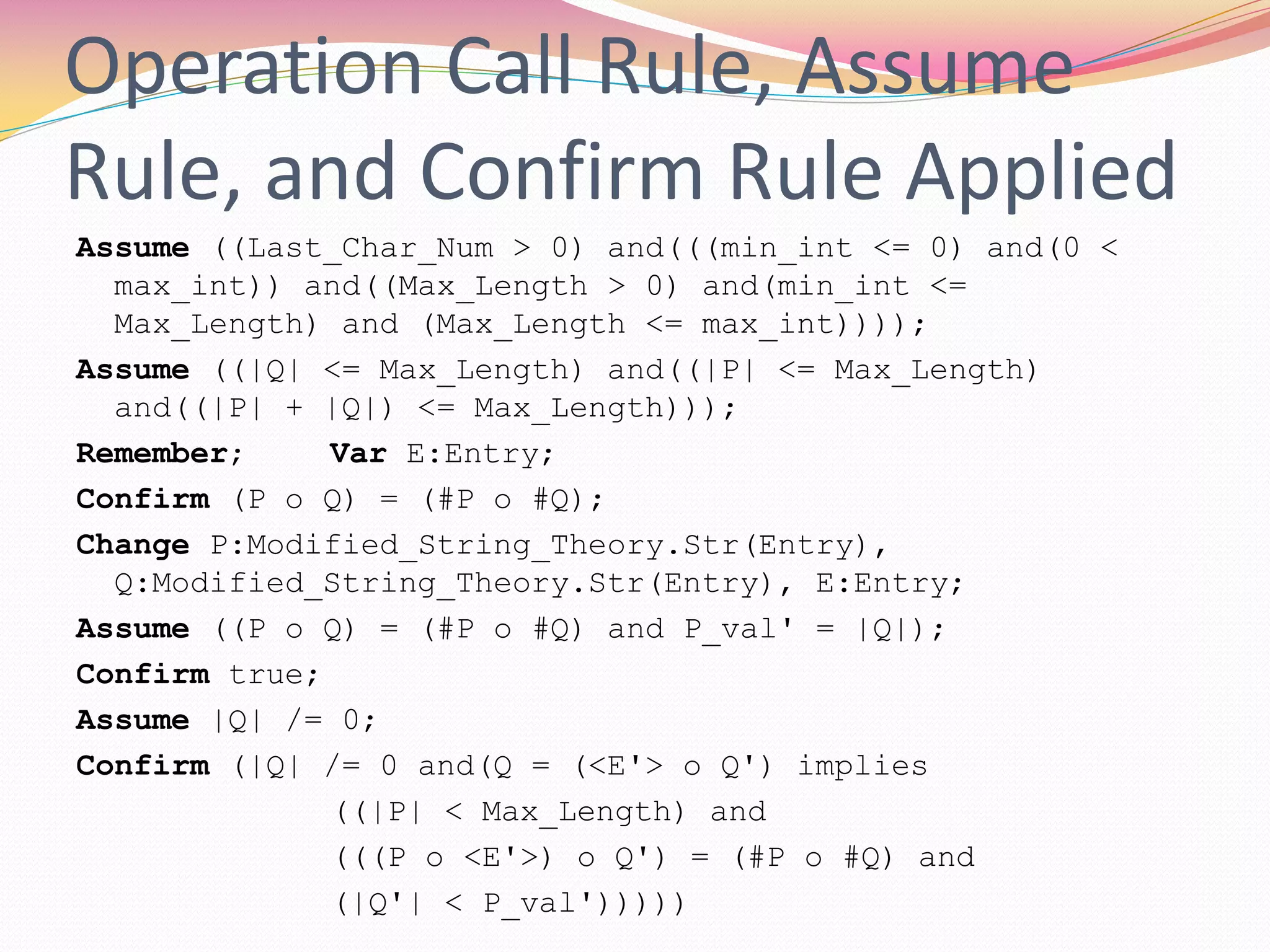
Operation Call Rule, Assume
Rule, and Confirm Rule Applied
Assume ((Last_Char_Num > 0) and(((min_int <= 0) and(0 <
max_int)) and((Max_Length > 0) and(min_int <=
Max_Length) and (Max_Length <= max_int))));
Assume ((|Q| <= Max_Length) and((|P| <= Max_Length)
and((|P| + |Q|) <= Max_Length)));
Remember; Var E:Entry;
Confirm (P o Q) = (#P o #Q);
Change P:Modified_String_Theory.Str(Entry),
Q:Modified_String_Theory.Str(Entry), E:Entry;
Assume ((P o Q) = (#P o #Q) and P_val' = |Q|);
Confirm true;
Assume |Q| /= 0;
Confirm (|Q| /= 0 and(Q = (<E'> o Q') implies
((|P| < Max_Length) and
(((P o <E'>) o Q') = (#P o #Q) and
(|Q'| < P_val')))))
Assume Rule and Confirm Rule
Assume ((Last_Char_Num > 0) and(((min_int <= 0) and(0 <
max_int)) and((Max_Length > 0) and(min_int <=
Max_Length) and (Max_Length <= max_int))));
Assume ((|Q| <= Max_Length) and((|P| <= Max_Length)
and((|P| + |Q|) <= Max_Length)));
Remember;
Var E:Entry;
Confirm (P o Q) = (#P o #Q);
Change P:Modified_String_Theory.Str(Entry),
Q:Modified_String_Theory.Str(Entry), E:Entry;
Confirm ((P o Q) = (#P o #Q) implies
(|Q| /= 0 implies
(|Q| /= 0 and (Q = (<E'> o Q') implies
((|P| < Max_Length) and
(((P o <E'>) o Q') = (#P o #Q) and
(|Q'| < |Q|)))))))
Change Rule Applied
Assume ((Last_Char_Num > 0) and(((min_int <= 0) and(0 <
max_int)) and((Max_Length > 0) and(min_int <=
Max_Length) and (Max_Length <= max_int))));
Assume ((|Q| <= Max_Length) and((|P| <= Max_Length)
and((|P| + |Q|) <= Max_Length)));
Remember;
Var E:Entry;
Confirm (P o Q) = (#P o #Q);
Confirm ((P' o Q'') = (#P o #Q) implies
(|Q''| /= 0 implies
(|Q''| /= 0 and (Q'' = (<E'> o Q') implies
((|P'| < Max_Length) and
(((P' o <E'>) o Q') = (#P o #Q) and
(|Q'| < |Q''|)))))))
Change Rule:
C code;
Confirm result[x⇝NQV(result, x)];
_____________________________________________
C code; Change x; Confirm result;
Confirm Rule Applied
Assume ((Last_Char_Num > 0) and(((min_int <= 0) and(0 <
max_int)) and((Max_Length > 0) and(min_int <=
Max_Length) and (Max_Length <= max_int))));
Assume ((|Q| <= Max_Length) and((|P| <= Max_Length)
and((|P| + |Q|) <= Max_Length)));
Remember;
Var E:Entry;
Confirm ((P o Q) = (#P o #Q) and
((P' o Q'') = (#P o #Q) implies
(|Q''| /= 0 implies
(|Q''| /= 0 and (Q'' = (<E'> o Q') implies
((|P'| < Max_Length) and
(((P' o <E'>) o Q') = (#P o #Q) and
(|Q'| < |Q''|))))))))
Variable Declaration Rule
Assume ((Last_Char_Num > 0) and(((min_int <= 0) and(0 <
max_int)) and((Max_Length > 0) and(min_int <=
Max_Length) and (Max_Length <= max_int))));
Assume ((|Q| <= Max_Length) and((|P| <= Max_Length)
and((|P| + |Q|) <= Max_Length)));
Remember;
Confirm ((P o Q) = (#P o #Q) and
((P' o Q'') = (#P o #Q) implies
(|Q''| /= 0 implies
(|Q''| /= 0 and (Q'' = (<E'> o Q') implies
((|P'| < Max_Length) and
(((P' o <E'>) o Q') = (#P o #Q) and
(|Q'| < |Q''|))))))))
Variable Declaration Rule:
C code; Assume T.Is_Initial(v); Confirm result;
_____________________________________________
C code; code; Var v: T; Confirm result;
Remember Rule
Assume ((Last_Char_Num > 0) and(((min_int <= 0) and(0 <
max_int)) and((Max_Length > 0) and(min_int <=
Max_Length) and (Max_Length <= max_int))));
Assume ((|Q| <= Max_Length) and((|P| <= Max_Length)
and((|P| + |Q|) <= Max_Length)));
Confirm ((P o Q) = (P o Q) and
((P' o Q'') = (P o Q) implies
(|Q''| /= 0 implies
(|Q''| /= 0 and (Q'' = (<E'> o Q') implies
((|P'| < Max_Length) and
(((P' o <E'>) o Q') = (P o Q) and
(|Q'| < |Q''|))))))))
Remember Rule:
C code; Confirm result[#s⇝s, #t⇝t];
_____________________________________________
C code; Remember;
Confirm result/_ s, #s, t, #t, u, v, ⋯ _;
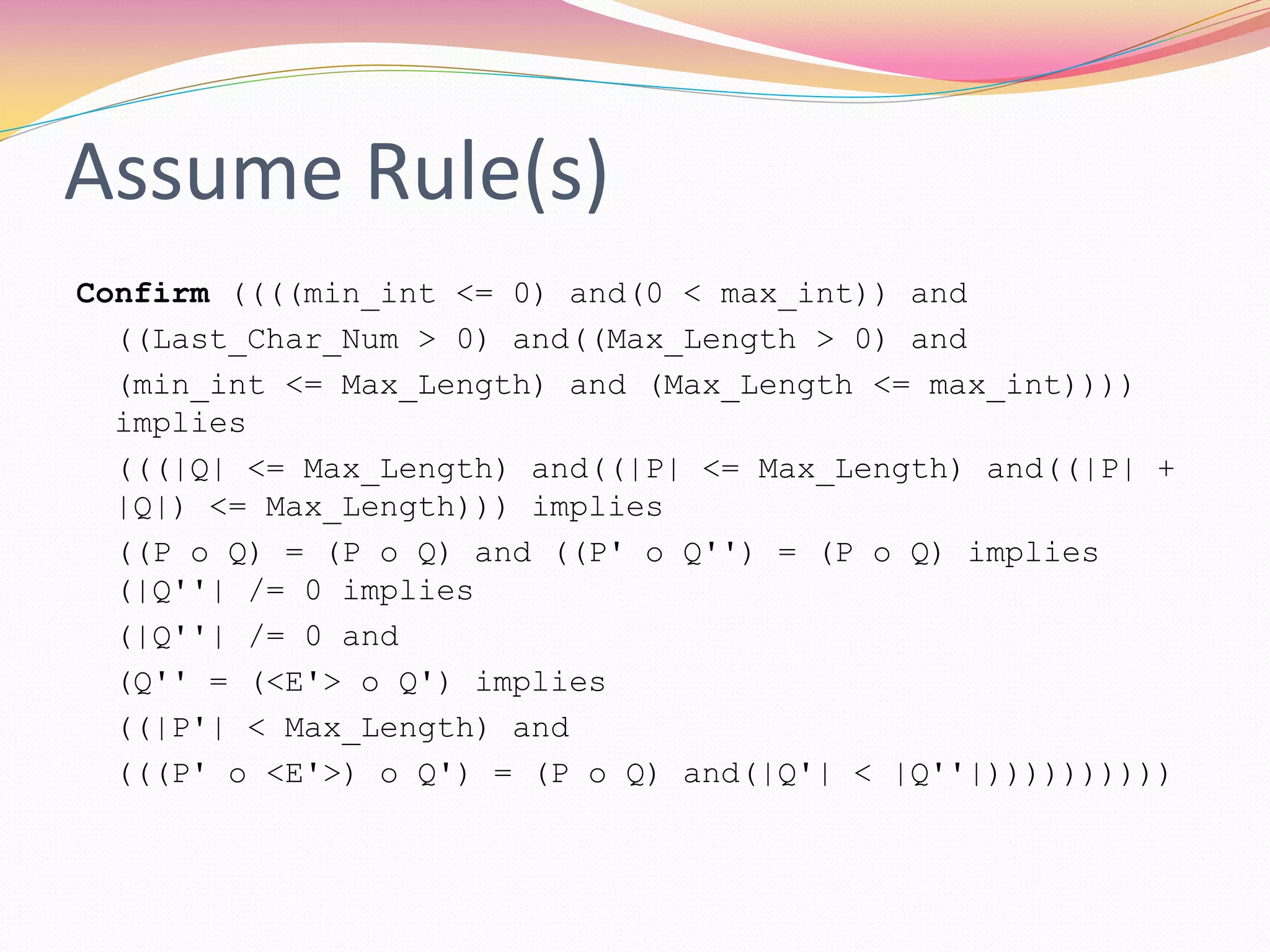
Assume Rule(s)
Confirm ((((min_int <= 0) and(0 < max_int)) and
((Last_Char_Num > 0) and((Max_Length > 0) and
(min_int <= Max_Length) and (Max_Length <= max_int))))
implies
(((|Q| <= Max_Length) and((|P| <= Max_Length) and((|P| +
|Q|) <= Max_Length))) implies
((P o Q) = (P o Q) and ((P' o Q'') = (P o Q) implies
(|Q''| /= 0 implies
(|Q''| /= 0 and
(Q'' = (<E'> o Q') implies
((|P'| < Max_Length) and
(((P' o <E'>) o Q') = (P o Q) and(|Q'| < |Q''|))))))))))
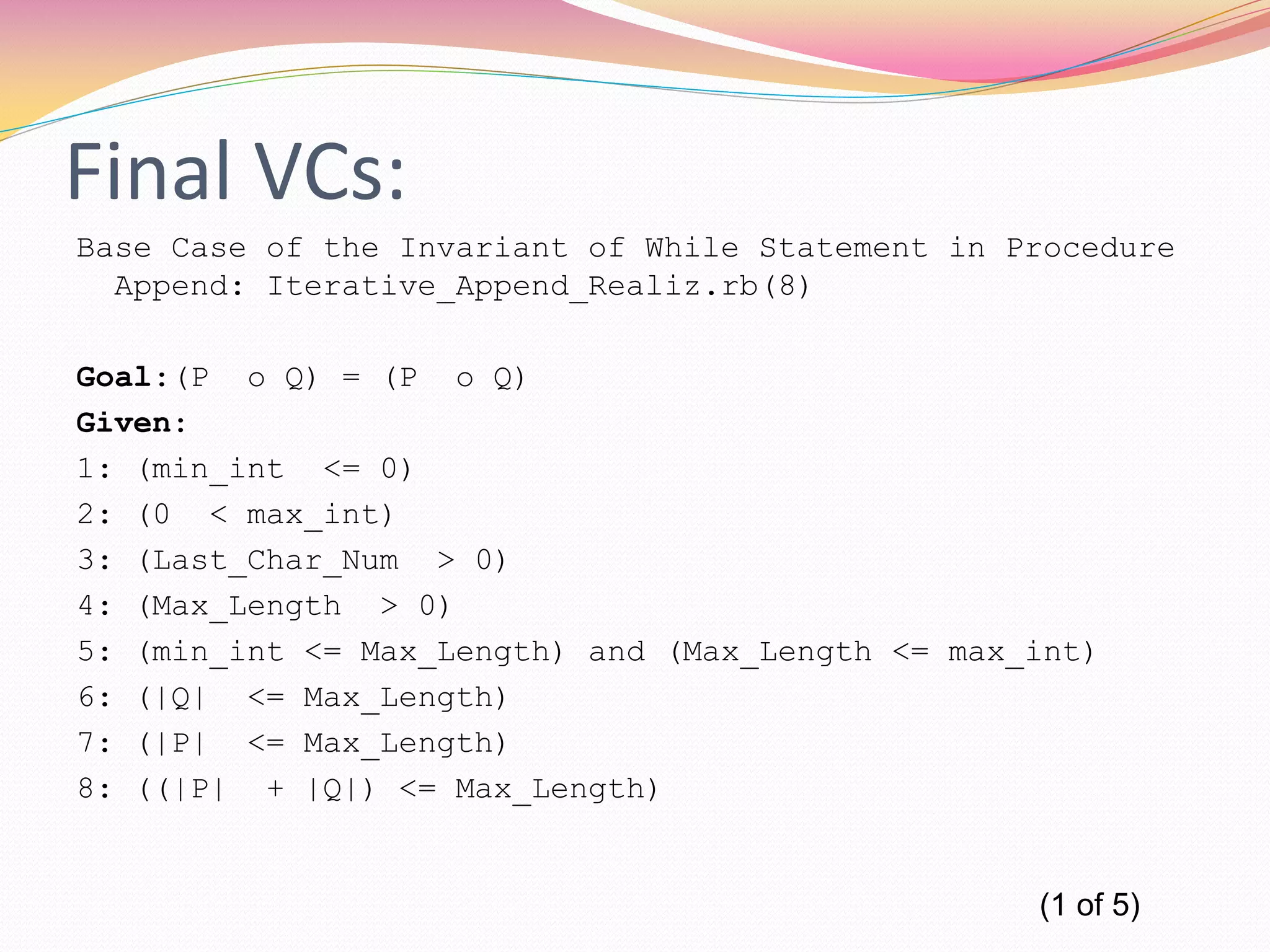
Final VCs:
Base Case of the Invariant of While Statement in Procedure
Append: Iterative_Append_Realiz.rb(8)
Goal:(P o Q) = (P o Q)
Given:
1: (min_int <= 0)
2: (0 < max_int)
3: (Last_Char_Num > 0)
4: (Max_Length > 0)
5: (min_int <= Max_Length) and (Max_Length <= max_int)
6: (|Q| <= Max_Length)
7: (|P| <= Max_Length)
8: ((|P| + |Q|) <= Max_Length)
(1 of 5)
Final VCs:
Requires Clause of Dequeue in Procedure Append:
Iterative_Append_Realiz.rb(11)
Goal:|Q''| /= 0
Given:
1: (min_int <= 0)
2: (0 < max_int)
3: (Last_Char_Num > 0)
4: (Max_Length > 0)
5: (min_int <= Max_Length) and (Max_Length <= max_int)
6: (|Q| <= Max_Length)
7: (|P| <= Max_Length)
8: ((|P| + |Q|) <= Max_Length)
9: (P' o Q'') = (P o Q)
10: |Q''| /= 0
(2 of 5)
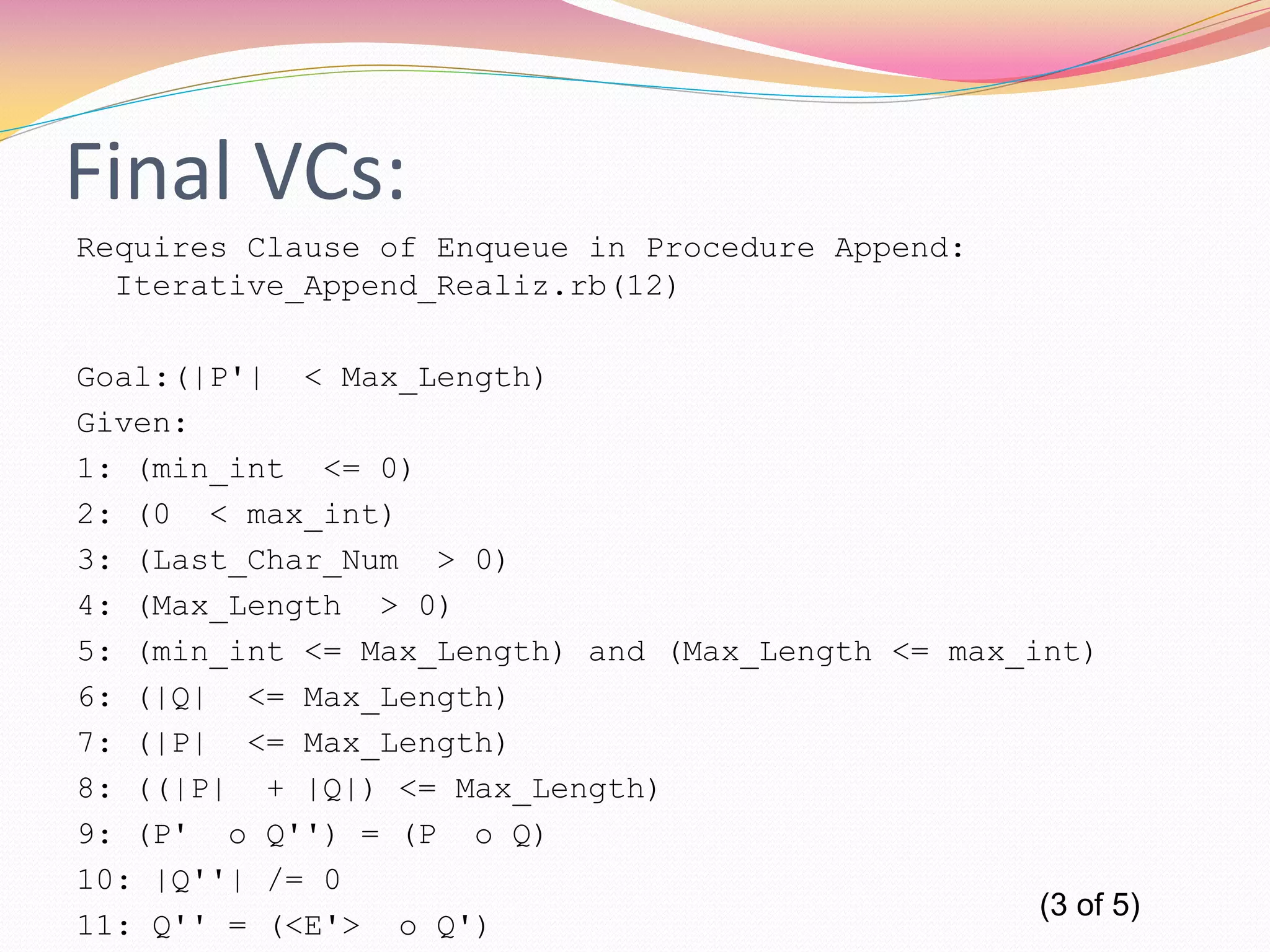
Final VCs:
Requires Clause of Enqueue in Procedure Append:
Iterative_Append_Realiz.rb(12)
Goal:(|P'| < Max_Length)
Given:
1: (min_int <= 0)
2: (0 < max_int)
3: (Last_Char_Num > 0)
4: (Max_Length > 0)
5: (min_int <= Max_Length) and (Max_Length <= max_int)
6: (|Q| <= Max_Length)
7: (|P| <= Max_Length)
8: ((|P| + |Q|) <= Max_Length)
9: (P' o Q'') = (P o Q)
10: |Q''| /= 0
11: Q'' = (<E'> o Q')
(3 of 5)
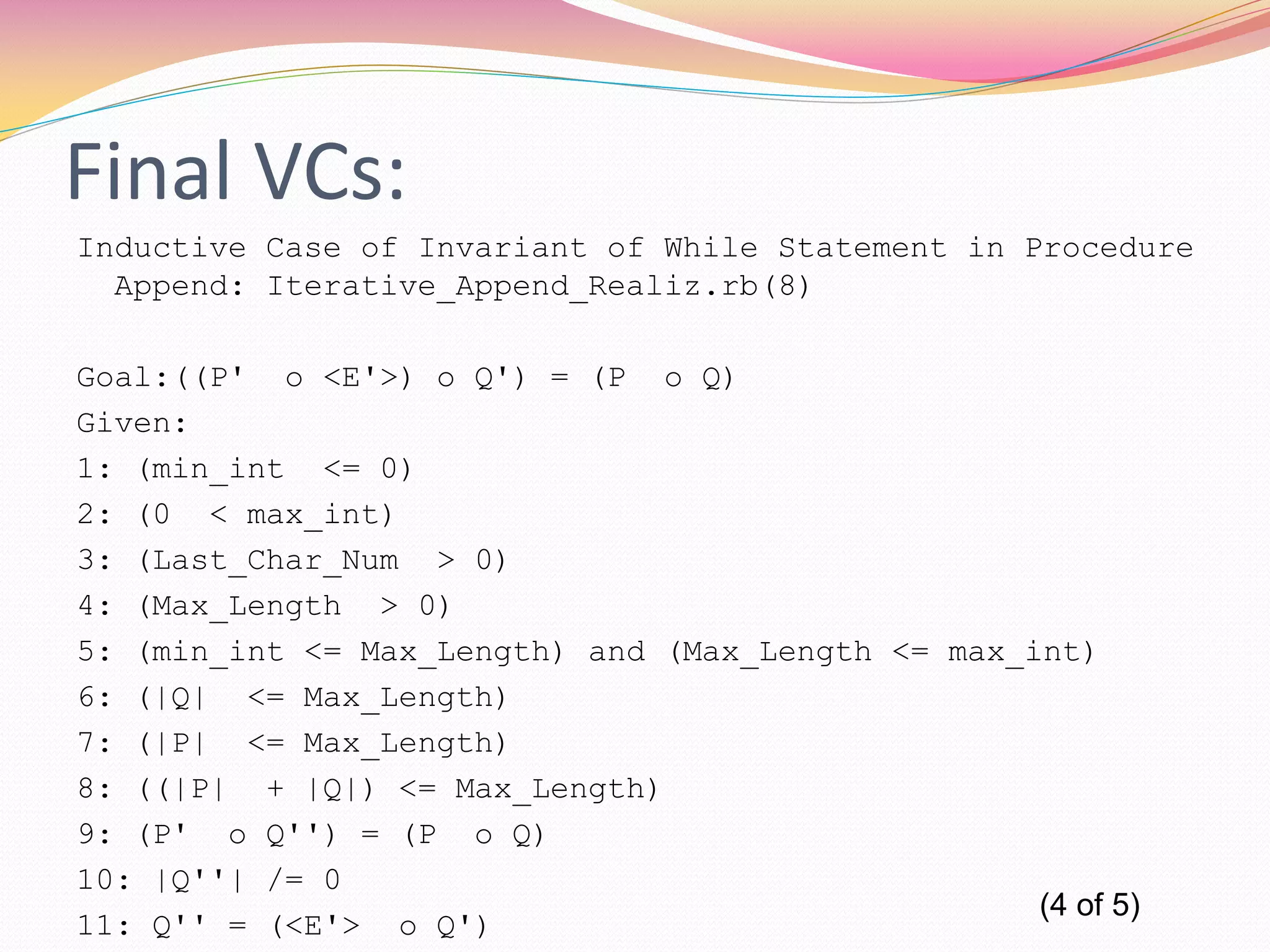
Final VCs:
Inductive Case of Invariant of While Statement in Procedure
Append: Iterative_Append_Realiz.rb(8)
Goal:((P' o <E'>) o Q') = (P o Q)
Given:
1: (min_int <= 0)
2: (0 < max_int)
3: (Last_Char_Num > 0)
4: (Max_Length > 0)
5: (min_int <= Max_Length) and (Max_Length <= max_int)
6: (|Q| <= Max_Length)
7: (|P| <= Max_Length)
8: ((|P| + |Q|) <= Max_Length)
9: (P' o Q'') = (P o Q)
10: |Q''| /= 0
11: Q'' = (<E'> o Q')
(4 of 5)
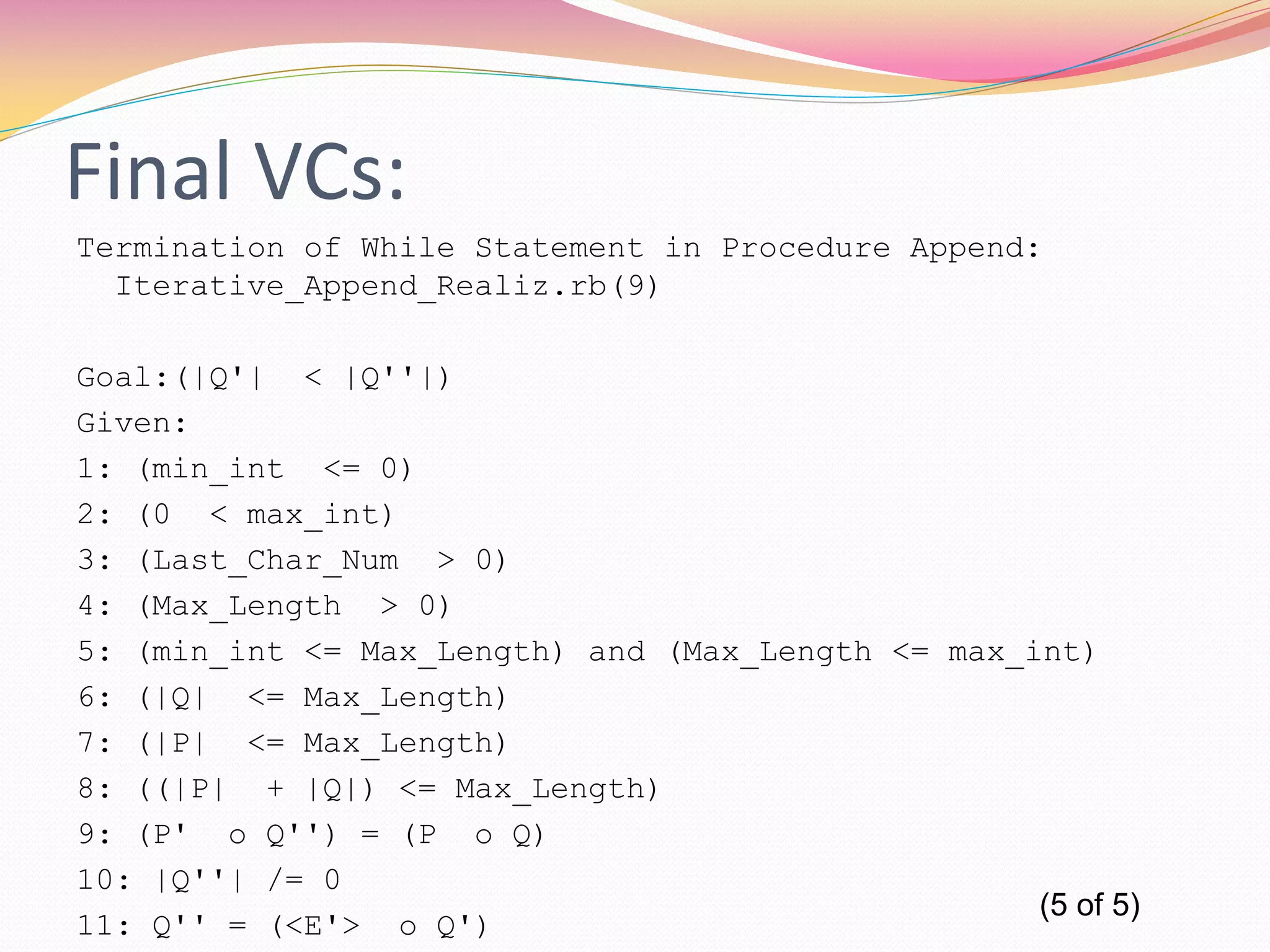
Final VCs:
Termination of While Statement in Procedure Append:
Iterative_Append_Realiz.rb(9)
Goal:(|Q'| < |Q''|)
Given:
1: (min_int <= 0)
2: (0 < max_int)
3: (Last_Char_Num > 0)
4: (Max_Length > 0)
5: (min_int <= Max_Length) and (Max_Length <= max_int)
6: (|Q| <= Max_Length)
7: (|P| <= Max_Length)
8: ((|P| + |Q|) <= Max_Length)
9: (P' o Q'') = (P o Q)
10: |Q''| /= 0
11: Q'' = (<E'> o Q')
(5 of 5)
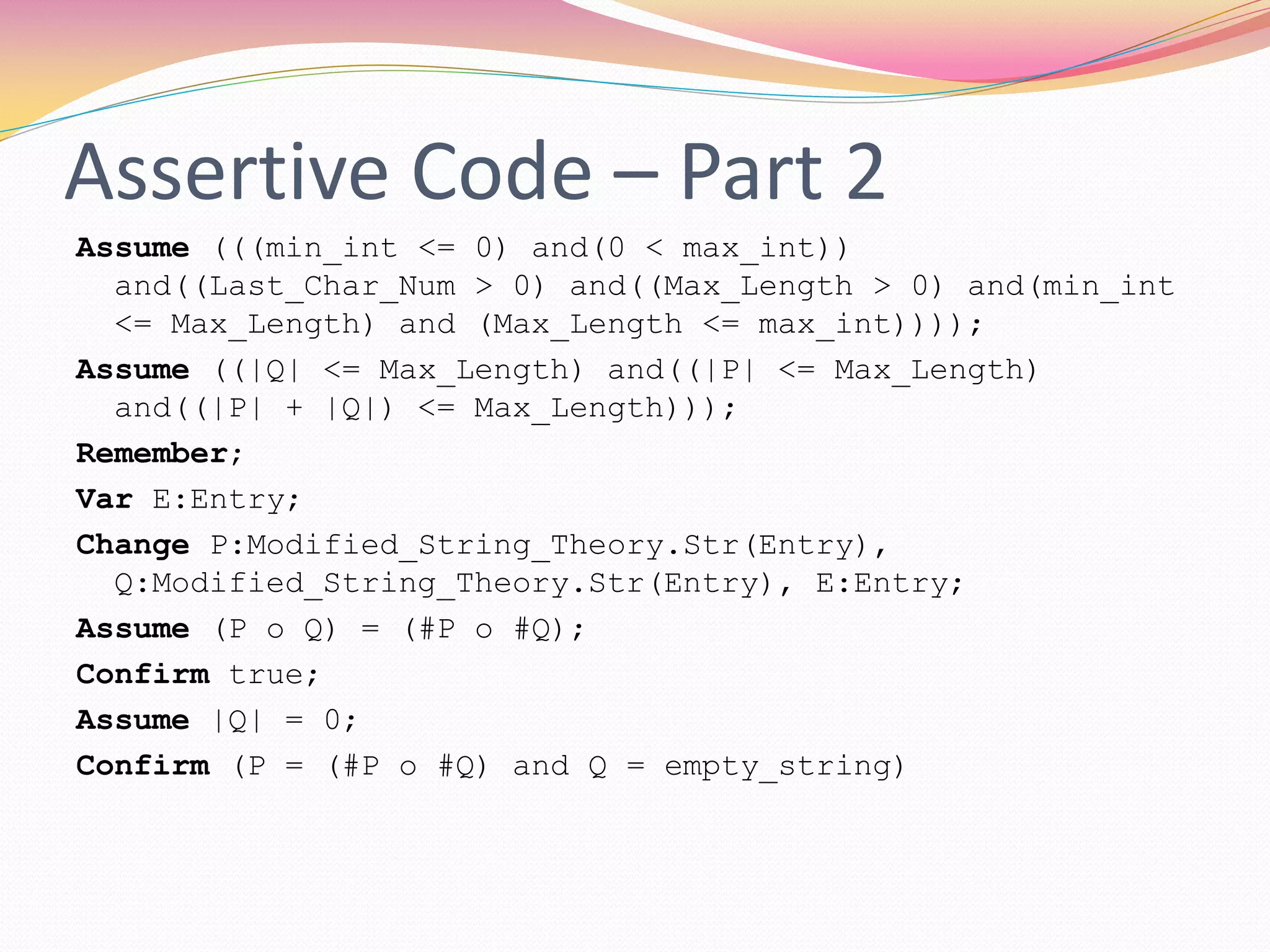
Assertive Code – Part 2
Assume (((min_int <= 0) and(0 < max_int))
and((Last_Char_Num > 0) and((Max_Length > 0) and(min_int
<= Max_Length) and (Max_Length <= max_int))));
Assume ((|Q| <= Max_Length) and((|P| <= Max_Length)
and((|P| + |Q|) <= Max_Length)));
Remember;
Var E:Entry;
Change P:Modified_String_Theory.Str(Entry),
Q:Modified_String_Theory.Str(Entry), E:Entry;
Assume (P o Q) = (#P o #Q);
Confirm true;
Assume |Q| = 0;
Confirm (P = (#P o #Q) and Q = empty_string)
Additional VCs (from Part 2):
Ensures Clause of Append: Iterative_Append_Realiz.rb(13)
Goal: P' = (P o Q)
Given:
1: (min_int <= 0)
2: (0 < max_int)
3: (Last_Char_Num > 0)
4: (Max_Length > 0)
5: (min_int <= Max_Length) and (Max_Length <= max_int)
6: (|Q| <= Max_Length)
7: (|P| <= Max_Length)
8: ((|P| + |Q|) <= Max_Length)
9: (P' o Q') = (P o Q)
10: |Q'| = 0
(1 of 2)
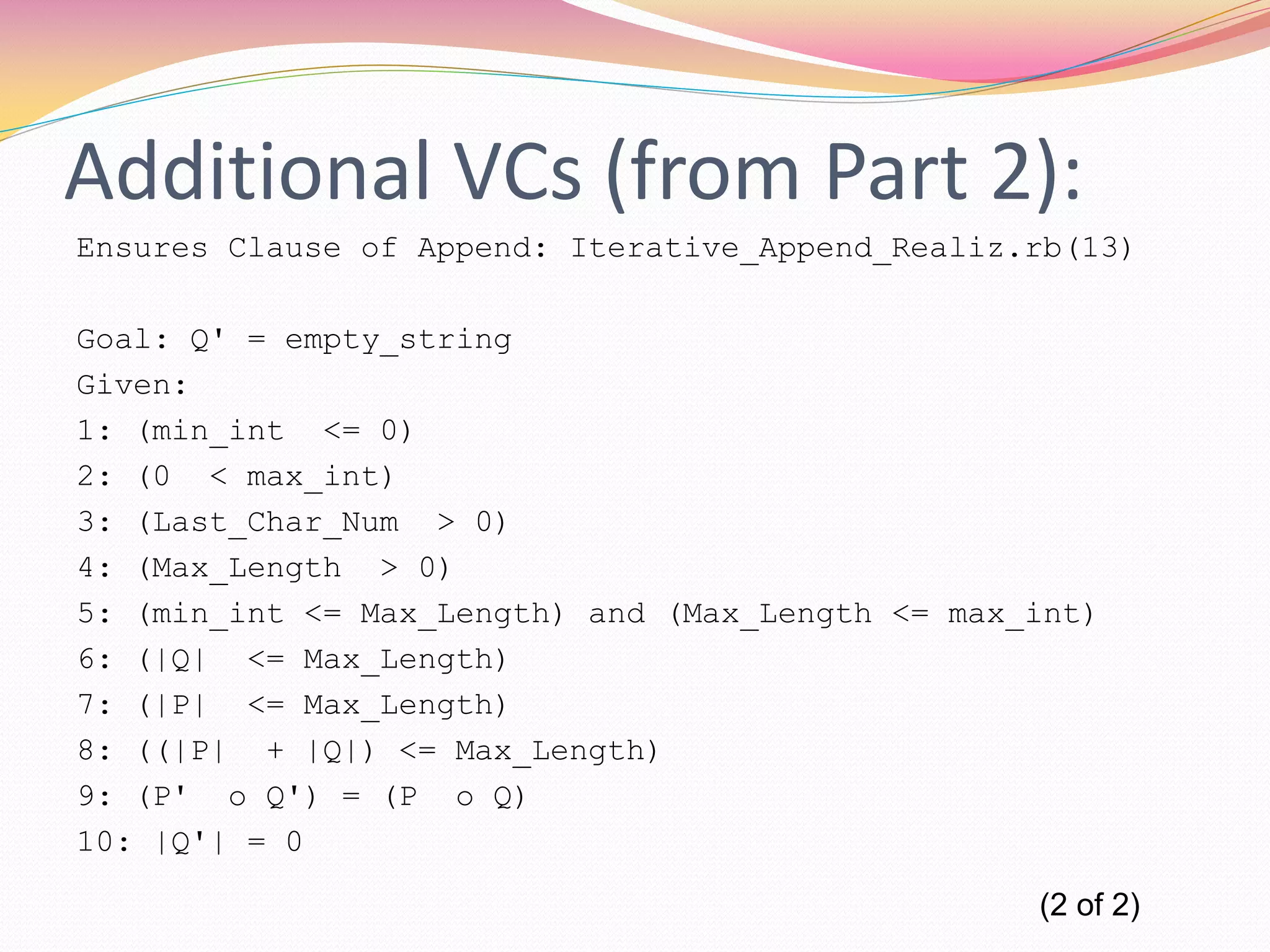
Additional VCs (from Part 2):
Ensures Clause of Append: Iterative_Append_Realiz.rb(13)
Goal: Q' = empty_string
Given:
1: (min_int <= 0)
2: (0 < max_int)
3: (Last_Char_Num > 0)
4: (Max_Length > 0)
5: (min_int <= Max_Length) and (Max_Length <= max_int)
6: (|Q| <= Max_Length)
7: (|P| <= Max_Length)
8: ((|P| + |Q|) <= Max_Length)
9: (P' o Q') = (P o Q)
10: |Q'| = 0
(2 of 2)
Current Verification System
Uses RESOLVE
RESOLVE Semantics
Research into Mechanization of Proof Rules
Provides Modular Verification
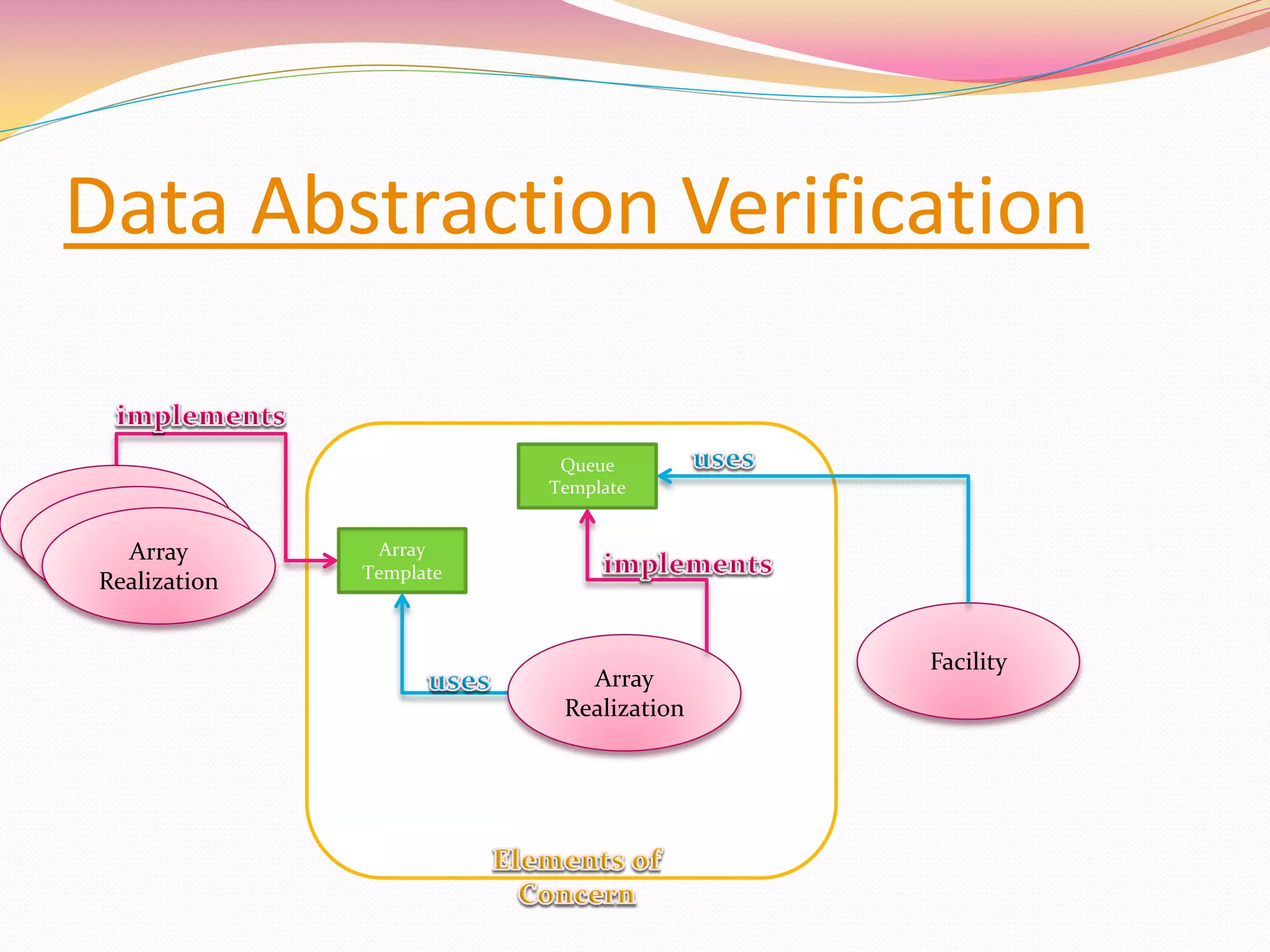
Data Abstraction Verification
Array
Template
Array
Realization
Facility
Queue
Template
=Array
Realization
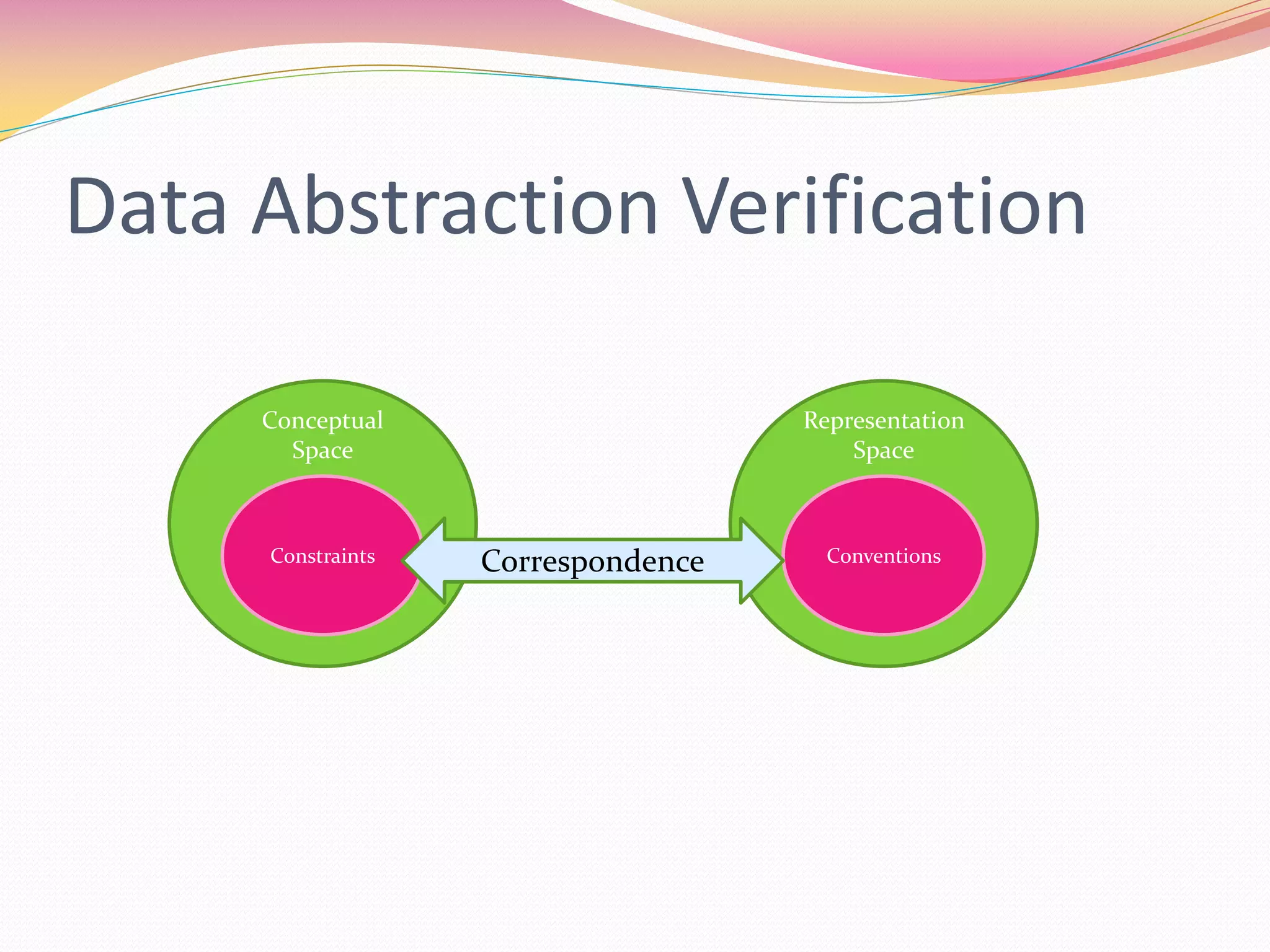
Data Abstraction Verification
Conceptual
Space
Representation
Space
Constraints ConventionsCorrespondence
Modular Verification
Queue
Template
Sort
Realization
Queue_Sort
FacilitySort
Specification
=Array
Realization
Evaluation
Experimental Evaluation
Benchmarks
Educational Evaluation
“What If” Example
Benchmark #1:
 Adding and Multiplying Numbers
 Problem Requirements:
Verify an operation that adds two numbers by
repeated incrementing. Verify an operation that
multiplies two numbers by repeated addition,
using the first operation to do the addition.
Make one algorithm iterative, the other
recursive.
Benchmark #2:
 Binary Search in an Array
 Problem Requirements:
Verify an operation that uses binary search to
find a given entry in an array of entries that are
in sorted order
Benchmark #3:
 Sorting a Queue
 Problem Requirements:
Specify a user-defined FIFO ADT that is generic
(i.e., parameterized by the type of entries in a
queue). Verify an operation that uses this
component to sort the entries in a queue into
some client-defined order.
Benchmark #4:
 Layered Implementation of a Map ADT
 Problem Requirements:
Verify an implementation of a generic map
ADT, where the data representation is layered
on other built-in types and/or ADTs.
Benchmark #5:
 Linked-List Implementation of a Queue ADT
 Problem Requirements:
Verify an implementation of the queue type
specified in benchmark #3, using a linked data
structure for the representation.
Evaluation
Experimental Evaluation
Benchmarks
Educational Evaluation
“What If” Example
Educational Evaluation
 In use in Classrooms
 Students write RESOLVE code and generate VCs
 Used to evaluate students understanding of VC
Generation
 Used to evaluate their ability to do proofs of VCs
 Used by students at various institutions:
 Clemson University
 Denison University
 Western Carolina University
 University of Alabama
 Depauw University
 …
Conclusions and Contributions
 A Mechanical, Scalable, and Full Verification System is
attainable
 Mechanization of proof rules for the RESOLVE language
 VCs can be generated for the RESOLVE language
 Educational Uses
 Experimentation with Benchmarks
Future Directions
 Complete Semantics
 Additional Experimentation
 VCs should be automatically proved
 Minimalist Prover for RESOLVE
 Verified Verifier
 Performance Profiles
 Educational Tool
Harton-Presentation

Harton-Presentation

  • 1.
    Heather Harton Clemson University Researchfunded in part by NSF grants CCF-0811748 and DMS-0701187
  • 2.
    Thesis Statement Related Work Detailsof the Verification System Research Evaluation
  • 3.
    Research Vision Full specificationand verification of production software built from reusable components Tony Hoare’s verifying compiler grand challenge Hoare, T.: The verifying compiler: A grand challenge for computing research. J. ACM 50(1) (2003) 63-69
  • 4.
    Thesis Statement It ispossible to generate provable verification conditions of correctness mechanically for full behavioral verification of object-based software in a modular fashion, one component at a time.
  • 5.
    Thesis Statement It ispossible to generate provable verification conditions of correctness mechanically for full behavioral verification of object-based software in a modular fashion, one component at a time.
  • 6.
    Full Behavioral Specificationand Verification Some systems only verify properties (e.g., no null reference access) Some systems only allow specs that define partial behavior Example: Eiffel Other systems have the ability to verify more complex properties and may provide full verification
  • 7.
    Thesis Statement It ispossible to generate provable verification conditions of correctness mechanically for full behavioral verification of object-based software in a modular fashion, one component at a time.
  • 8.
    Modular Verification Ability toverify one component at a time using only specifications of reused components Component A Spec Component B Spec New Component Realization External Component Realization Component C Spec New Component Spec =Component Realization Component Realization Component Realization
  • 9.
    Scalability of ProofRules Limited Number of Proof Rules Should work for any data type Should work on Built-In or User-Created Data Types  Integers  Arrays  Pointers  Generic Objects
  • 10.
    Thesis Statement It ispossible to generate provable verification conditions of correctness mechanically for full behavioral verification of object-based software in a modular fashion, one component at a time.
  • 11.
    Mechanical Verification Huge gapbetween principle and practice Example: Hoare’s proof rule for loops from 1969 can’t be mechanized for practical use without several changes Undecidability is less of a concern Both VC generation process and proofs of correctness should be automatic Programmers will need to provide annotated code  Invariants  Progress Metrics Mathematicians will need to provide proofs of the more complicated theorems used by the prover
  • 12.
    Object-Based Verification Mechanizable proofrules are needed for all modern language constructs  Module-Level Verification  Generics  Object Specifications  Enhancement Specifications  Concept Implementations  Operation-Level Verification  Local and External Operations  Control Constructs  Object Declarations  Auxiliary Variables and Code  Context Enrichment  Iterative and Recursive Procedures  Enhancement Implementations  Facility Declarations  Simple  Detailed  Operation Calls  Operation Declarations  Functional  Relational
  • 13.
    Thesis Statement It ispossible to generate provable verification conditions of correctness mechanically for full behavioral verification of object-based software in a modular fashion, one component at a time.
  • 14.
  • 15.
    Comparison of VerificationSystems Effort Implementation Language Specification Language Verification Type Prover Automation Logic Compcert Clight, subset of C Coq Full Coq Interactive Higher-Order Dafny Dafny (Research Language) Dafny Full Boogie/Z3 Automatic First-Order Eiffel Eiffel Eiffel Verification of Properties (Currently only runtime checks) Automatic First-Order ESC/Java Java JML Verification of Properties Simplify Automatic Higher-Order Jahob Subset of Java Subset of Isabelle Full Isabelle, Others Interactive Higher-Order JML/FSPV Java JML Full Isabelle/Simpl Interactive Higher-Order Larch Various Languages Larch Full Larch Prover Interactive First-Order RESOLVE RESOLVE RESOLVE Full RESOLVE Automatic Higher-Order
  • 16.
    Comparison of VerificationSystems Effort Implementation Language Specification Language Verification Type Prover Automation Logic PVS PVS PVS Full PVS Interactive Higher-Order SPARK Ada Subset of Ada SPARK Verification of Properties SPADE Interactive Higher-Order Spec#/ Boogie Spec #, Extension of C# Spec # Verification of Properties Boogie/Z3 Automatic First-Order VDM-SL/ VDM++ Various Languages VDM Full VDM Interactive Higher-Order Verisoft Subset of C, C0 Isabelle Full Isabelle Interactive Higher-Order Why C, Java, ML Why Full Isabelle and Coq Interactive First-Order πVC C-like language, PI πVC Full πVC Automatic First-Order RESOLVE RESOLVE RESOLVE Full RESOLVE Automatic Higher-Order
  • 17.
    Current Verification System UsesRESOLVE RESOLVE Semantics Research into Mechanization of Proof Rules Provides Modular Verification
  • 18.
    Architecture of theRESOLVE Verification System Math SpecialistSoftware Specialist VC Generator Specs Proof Checker Automated Prover Annotated Code Verification Conditions Math Definitions, Results Math Proofs Proof Certificate    
  • 19.
    Architecture of theRESOLVE Verification System Math SpecialistSoftware Specialist VC Generator Specs Proof Checker Automated Prover Annotated Code Verification Conditions Math Definitions, Results Math Proofs Proof Certificate    
  • 20.
    Architecture of theRESOLVE Verification System Math SpecialistSoftware Specialist VC Generator Specs Proof Checker Automated Prover Annotated Code Verification Conditions Math Definitions, Results Math Proofs Proof Certificate    
  • 21.
    Architecture of theRESOLVE Verification System Math SpecialistSoftware Specialist VC Generator Specs Proof Checker Automated Prover Annotated Code Verification Conditions Math Definitions, Results Math Proofs Proof Certificate   
  • 22.
    RESOLVE Specification and implementationlanguage Object-based Includes parametric polymorphism Does not include dynamic typing Clean language (Kulczycki 2004) No references when passing parameters Provides the swap operator Relies on a developed math library for proofs Language elements Concepts and enhancements Realizations Facilities
  • 23.
    Why RESOLVE? JML Specfor Push Operation on a Stack public Object push(Object item) Specifications: public model_program { ... } also public normal_behavior requires typeof(item) <: this.elementType; requires this.containsNull||item != null;assignable theCollection; ensures this.theList.equals(old(this.theList).insertBack(item)); ensures this.theList.int_size() <= this.maxCapacity; also public normal_behavior requires typeof(this) == type(java.util.Vector); {| requires this.theList.int_size() < this.maxCapacity; ensures not_modified(maxCapacity)&&not_modified(capIncrement); also requires this.theList.int_size() == this.maxCapacity; {| requires 0 < this.capIncrement&&this.maxCapacity <= 2147483647-this.capIncrement; assignable maxCapacity, theList; ensures this.maxCapacity == old(this.maxCapacity)+this.capIncrement; also requires this.capIncrement == 0&&this.maxCapacity == 0; assignable maxCapacity, theList; ensures this.maxCapacity == 1; also requires this.capIncrement == 0&&this.maxCapacity > 0&&this.maxCapacity < 1073741823; assignable maxCapacity, theList; ensures this.maxCapacity == old(this.maxCapacity)*2; |} |} also requires typeof(item) <: this.elementType; requires this.containsNull||item != null; assignable elementCount; ensures this.elementCount == old(this.elementCount)+1; Link: http://www.eecs.ucf.edu/~leavens/JML-release/javadocs/java/util/Stack.html#push(java.lang.Object)
  • 24.
    Concept Example -Specification Concept Queue_Template(type Entry; evaluates Max_Length: Integer); uses Std_Integer_Fac, String_Theory; requires Max_Length > 0; Type Family Queue is modeled by Str(Entry); exemplar Q; constraint |Q| <= Max_Length; initialization ensures Q = empty_string; Operation Enqueue(alters E: Entry; updates Q: Queue); requires |Q| < Max_Length; ensures Q = #Q o <#E>; Operation Dequeue(replaces R: Entry; updates Q: Queue); requires |Q| /= 0; ensures R = Destring(Substring(0,1,#Q)) and Q = Substring(1,|#Q|,#Q); … Operation Clear(clears Q: Queue); end Queue_Template;
  • 25.
    Enhancement Example Enhancement Rotating_Capabilityfor Queue_Template; Operation Rotate(updates Q: Queue); requires |Q| /= 0; ensures Q = Substring(1,|#Q|,#Q) o Substring(0,1,#Q); end Rotating_Capability; Realization Obvious_Rotate_Realiz for Rotating_Capability of Queue_Template; Procedure Rotate(updates Q: Queue); Var TE: Entry; Dequeue(TE, Q); Enqueue(TE, Q); end Rotate; end Obvious_Rotate_Realiz;
  • 26.
    Facility Example Facility Queue_Rotate_User_Fac; usesQueue_Template; Facility QF is Queue_Template(Integer, 10) realized by Circular_Array_Realiz enhanced by Rotating_Capability realized by Obvious_Rotate_Realiz; Operation Main(); Procedure Var Q: QF.Queue; Enqueue(1, Q); Enqueue(2, Q); Enqueue(3, Q); Rotate(Q); end Main; end Queue_Rotate_User_Fac;
  • 27.
    Current Verification System UsesRESOLVE RESOLVE Semantics Research into Mechanization of Proof Rules Provides Modular Verification
  • 28.
    Semantic Foundations  Whydo we need semantics?  Need to define the meaning of programs beyond what implementations do when they are executed  Semantics capture state to state transformations  Semantics help establish that the proof system for verification is sound and (relatively) complete
  • 29.
    RESOLVE Semantics  Modularity(using only specifications)  Specifications of Operations and Objects  Operations with Relational Specifications
  • 30.
    Modularity  States maybe “Stuck” States or “Normal” States  Stuck States  MW – Manifestly Wrong  For example, this can be reached by violating the precondition of a call  VC – Vacuously Correct  For example, this can be reached when a called operation ends in a state that doesn't satisfy the ensures clause of the called operation, i.e., the called op. is wrong.  ‘Bottom’ – Non termination  For example, this can be reached with a non-terminating loop  Normal States  A function from variable names to their values.
  • 31.
  • 32.
  • 33.
    While Loop Semantics If the programmer-supplied invariant is false, then the code will be invalid (MW).  If invariant is omitted, it is assumed to be true.  If the decreasing clause is wrong, then the code will be invalid (MW).  If the decreasing clause is omitted and the procedure is expected to terminate with an ensures clause, then the code is invalid (MW).
  • 34.
    Current Verification System UsesRESOLVE RESOLVE Semantics Research into Mechanization of Proof Rules Provides Modular Verification
  • 35.
    Goal-Oriented Vs. TabularVC Generation  Dr. Krone’s dissertation explains the principles behind the goal-oriented approach for VC Generation  J. Krone, “The Role of Verification in Software Reusability,” The Ohio State University, PhD. Thesis 1988.  Dr. Heym’s dissertation explains the principles behind the tabular approach for VC Generation  W. Heym, “Computer Program Verification: Improvements for Human Reasoning,” The Ohio State University, PhD. Thesis 1995.  There are many issues to move from principles of VC generation to a practical, automated system.
  • 36.
    So how arethe Proof Rules developed?  Proof rules should be sound and (relatively) complete  Proof rules need to be mechanizable  Proof rules need to include the context  Proof rules need to be generic  Should work for any data type  Should be composable
  • 37.
    Queue Append Enhancement Append_Capabilityfor Queue_Template; Operation Append(updates P: Queue; clears Q: Queue); requires |P| + |Q| <= Max_Length; ensures P = #P o #Q; end Append_Capability; Realization Iterative_Append_Realiz for Append_Capability of Queue_Template; uses Std_Boolean_Fac; Procedure Append(updates P: Queue; clears Q: Queue); Var E: Entry; While (Length(Q) /= 0) changing P,Q,E; maintaining (P o Q = #P o #Q) and (|P| + |Q| <= Max_Length); decreasing |Q|; do Dequeue(E,Q); Enqueue(E,P); end; end Append; end Iterative_Append_Realiz;
  • 38.
    Queue Append Enhancement Append_Capabilityfor Queue_Template; Operation Append(updates P: Queue; clears Q: Queue); requires |P| + |Q| <= Max_Length; ensures P = #P o #Q; end Append_Capability; Realization Iterative_Append_Realiz for Append_Capability of Queue_Template; uses Std_Boolean_Fac; Procedure Append(updates P: Queue; clears Q: Queue); Var E: Entry; While (Length(Q) /= 0) changing P,Q,E; maintaining (P o Q = #P o #Q) and (|P| + |Q| <= Max_Length); decreasing |Q|; do Dequeue(E,Q); Enqueue(E,P); end; end Append; end Iterative_Append_Realiz; CDP = Operation P(updates t: T1; clears u:T2); requires Pre/_t, u _; ensures Post/_#t, t, #u _; Operation Declaration Rule: C {CDP} ____________________________________ C CDP;
  • 39.
    Queue Append Enhancement Append_Capabilityfor Queue_Template; Operation Append(updates P: Queue; clears Q: Queue); requires |P| + |Q| <= Max_Length; ensures P = #P o #Q; end Append_Capability; Realization Iterative_Append_Realiz for Append_Capability of Queue_Template; uses Std_Boolean_Fac; Procedure Append(updates P: Queue; clears Q: Queue); Var E: Entry; While (Length(Q) /= 0) changing P,Q,E; maintaining (P o Q = #P o #Q) and (|P| + |Q| <= Max_Length); decreasing |Q|; do Dequeue(E,Q); Enqueue(E,P); end; end Append; end Iterative_Append_Realiz; CDP = Operation P(updates t: T1; clears u:T2); requires Pre/_t, u _; ensures Post/_#t, t, #u _; Operation Realization Rule: C {CDP} Assume Pre  T1.Constraint(t) ^ T2.Constraint(u); Remember; body; Confirm Post; __________________________________ C {CDP} Proc P(… ); body; end P;
  • 40.
    Assume (((min_int <=0) and (0 < max_int)) and ((Last_Char_Num > 0) and ((Max_Length > 0) and (min_int <= Max_Length) and (Max_Length <= max_int)))); Assume ((|Q| <= Max_Length) and ((|P| <= Max_Length) and ((|P| + |Q|) <= Max_Length))); Remember; Var E:Entry; While (Length(Q) /= 0) maintaining (P o Q) = (#P o #Q); decreasing |Q|; changing P, Q, E; do Dequeue(E, Q); Enqueue(E, P); end; Confirm (P = (#P o #Q) and Q = empty_string) Concept Integer_Template; uses Integer_Theory, Std_Boolean_Fac; Definition min_int: Z; Definition max_int: Z; Constraint min_int <= 0 and 0 < max_int; Type Family Integer is modeled by Z; exemplar i; constraint min_int <= i <= max_int; initialization ensures i = 0; Enhancement Append_Capability for Queue_Template; Operation Append(updates P: Queue; clears Q: Queue); requires |P| + |Q| <= Max_Length; ensures P = #P o #Q; end Append_Capability; Procedure Declaration Rule Applied Concept Character_Template; uses Std_Boolean_Fac, Std_Integer_Fac; Definition Last_Char_Num: N; Constraint Last_Char_Num > 0; Concept Queue_Template(type Entry; evaluates Max_Length: Integer); uses Std_Integer_Fac, Modified_String_Theory; requires Max_Length > 0; Type Family Queue is modeled by Str(Entry); exemplar Q; constraint |Q| <= Max_Length; initialization ensures Q = empty_string;
  • 41.
    Example: Hoare’s LoopRule For the while loop code with the invariant “Inv”: While B do S; end; The Proof Rule is: Inv ^ B {S} Inv ____________________________ Inv {While B do S} not(B) ^ Inv
  • 42.
    Mechanized Proof Rule Hoare’sProof Rule: Inv ^ B {S} Inv _________________ Inv {While B do S} not(B) ^ Inv RESOLVE While Loop Rule: Context/ code; Confirm Inv; Change Vlist; Assume Inv and NQV(RP, P_Val)= P_Exp; If B then body; Confirm Inv and NQV(RP, P_Val)< P_Exp; else Confirm RP end_if; Confirm True; ________________________________ C/ code; While B maintaining Inv; decreasing P_Exp; changing Vlist; do body end; Confirm RP;
  • 43.
    Development of ProofRule – Version 2  Need to be able to prove generic assertions (not just the invariant)  Need a syntactic slot for the Invariant code; Confirm Inv; Assume Inv and B; body; Confirm Inv; Assume Inv and not(B); Confirm RP; _________________________________ code; While B maintaining Inv; do body end; Confirm RP;
  • 44.
    Development of ProofRule – Version 3  Need a Context Context/ code; Confirm Inv; Context/ Assume Inv and B; body; Confirm Inv; Context/ Assume Inv and not(B); Confirm RP; _________________________________ Context/ code; While B maintaining Inv; do body end; Confirm RP; Example Queue Append Code: Assume |P| + |Q| <= Max_Length; Var E: Entry; While Length(Q) > 0 maintaining (P o Q = #P o #Q); do Dequeue(E,Q); Enqueue(E,P); end; Confirm P = #P o #Q;
  • 45.
    Proof Rule – Version3  Need a Context Context/ code; Confirm Inv; Context/ Assume Inv and B; body; Confirm Inv; Context/ Assume Inv and not(B); Confirm RP; _________________________________ Context/ code; While B maintaining Inv; do body end; Confirm RP; Context/ Assume |P| + |Q| <= Max_Length; Var E: Entry; Confirm P o Q = #P o #Q; Context/ Assume P o Q = #P o #Q and not(Length(Q) > 0); Confirm P = #P o #Q; Context/ Assume P o Q = #P o #Q and Length(Q) > 0; Dequeue(E,Q); Enqueue(E,P); Confirm P o Q = #P o #Q;
  • 46.
    Proof Rule – Version4  Need to convert condition statements to Mathematical Form Context/ code; Confirm Inv; Context/ Assume Inv and Math(B); body; Confirm Inv; Context/ Assume Inv and not(Math(B)); Confirm RP; _________________________________ Context/ code; While B maintaining Inv; do body end; Confirm RP; Context/ Assume |P| + |Q| <= Max_Length; Var E: Entry; Confirm P o Q = #P o #Q; Context/ Assume P o Q = #P o #Q and |Q| > 0; Dequeue(E,Q); Enqueue(E,P); Confirm P o Q = #P o #Q; Context/ Assume P o Q = #P o #Q and not(|Q| > 0); Confirm P = #P o #Q;
  • 47.
    Proof Rule – Version5  Need to assume constraints for variables C/ code; Confirm Inv; C/ Assume Inv and Math(B) and Are_Constraints_Compliant(P, T); body; Confirm Inv; C/ Assume Inv and not(Math(B)); Confirm RP; _________________________________ C Var P:Type1, Var T:Type2/ code; While B maintaining Inv; do body end; Confirm RP; Context/ Assume |P| + |Q| <= Max_Length; Var E: Entry; Confirm P o Q = #P o #Q; Context/ Assume P o Q = #P o #Q and |P| <= Max_Length and |Q| <= Max_Length and |Q| > 0; Dequeue(E,Q); Enqueue(E,P); Confirm P o Q = #P o #Q; Context/ Assume P o Q = #P o #Q and not(|Q| > 0); Confirm P = #P o #Q;
  • 48.
    Development of ProofRule – Version 6  Need to show termination C/ code; Confirm Inv; C/ Assume Inv and Math(B) and Are_Constraints_Compliant(P, T) and P_Val=P_Exp; body; Confirm P_Val<P_Exp and Inv; C/ Assume Inv and not(Math(B)); Confirm RP; _________________________________ C Var P:Type1, Var T:Type2/ code; While B maintaining Inv; decreasing P_Exp; do body end; Confirm RP; Example Queue Append Code: Assume |P| + |Q| <= Max_Length; Var E: Entry; While Length(Q) > 0 maintaining (P o Q = #P o #Q); decreasing |Q|; do Dequeue(E,Q); Enqueue(E,P); end; Confirm P = #P o #Q;
  • 49.
    Development of ProofRule – Version 6  Need to show termination C/ code; Confirm Inv; C/ Assume Inv and Math(B) and Are_Constraints_Compliant(P, T) and P_Val=P_Exp; body; Confirm P_Val > P_Exp and Inv; C/ Assume Inv and not(Math(B)); Confirm RP; _________________________________ C Var P:Type1, Var T:Type2/ code; While B maintaining Inv; decreasing P_Exp; do body end; Confirm RP; Context/ Assume |P| + |Q| <= Max_Length; Var E: Entry; Confirm P o Q = #P o #Q; Confirm Inv; Context/ Assume P o Q = #P o #Q and |P| <= Max_Length and |Q| <= Max_Length and |Q| > 0 and P_Val=|Q|; Dequeue(E,Q); Enqueue(E,P); Confirm P_Val > |Q| and P o Q = #P o #Q; Context/ Assume P o Q = #P o #Q and not(|Q| > 0); Confirm P = #P o #Q;
  • 50.
    Development of ProofRule – Version 7  Pre-conditions may exist for condition C/ code; Confirm Inv; C/ Confirm Invk_Cond(B); Assume Inv and Math(B) and Are_Constraints_Compliant(P, T) and P_Val=P_Exp; body; Confirm P_Val<P_Exp and Inv; C/ Assume Inv and not(Math(B)); Confirm RP; _________________________________ C/ Var P:Type1, Var T:Type2/ code; While B maintaining Inv; decreasing P_Exp; do body end; Confirm RP; Context/ Assume |P| + |Q| <= Max_Length; Var E: Entry; Confirm P o Q = #P o #Q; Context/ Confirm Invk_Cond(Length(Q) > 0); Assume P o Q = #P o #Q and |P| <= Max_Length and |Q| <= Max_Length and |Q| > 0 and P_Val=|Q|; Dequeue(E,Q); Enqueue(E,P); Confirm P_Val > |Q| and P o Q = #P o #Q; Context/ Assume P o Q = #P o #Q and not(|Q| > 0); Confirm P = #P o #Q;
  • 51.
    Development of ProofRule – Final Version Simplify Rule by Converting to If Rule  Add Changing List  NQV introduces a new name for each variable listed by appending a “?”. Context/ code; Confirm Inv; Change Vlist; Assume Inv and NQV(RP, P_Val)= P_Exp; If B then body; Confirm Inv and NQV(RP, P_Val)< P_Exp; else Confirm RP end_if; Confirm True; _________________________________ C/ code; While B maintaining Inv; decreasing P_Exp; changing Vlist; do body end; Confirm RP; Example Queue Append Code: Assume |P| + |Q| <= Max_Length; Var E: Entry; While Length(Q) > 0 maintaining (P o Q = #P o #Q); decreasing |Q|; changing P, Q, E; do Dequeue(E,Q); Enqueue(E,P); end; Confirm P = #P o #Q;
  • 52.
    Development of ProofRule – Final Version Context/ code; Confirm Inv; Change Vlist; Assume Inv and NQV(RP, P_Val)= P_Exp; If B then body; Confirm Inv and NQV(RP, P_Val)< P_Exp; else Confirm RP end_if; Confirm True; _________________________________ C/ code; While B maintaining Inv; decreasing P_Exp; changing Vlist; do body end; Confirm RP; Context/ Assume |P| + |Q| <= Max_Length; Var E: Entry; Confirm P o Q = #P o #Q; Assume P o Q = #P o #Q and P_Val=|Q|; If (Length(Q) > 0) then Dequeue(E,Q); Enqueue(E,P); Confirm P_Val<|Q| and P o Q = #P o #Q; Else Confirm P = #P o #Q; end_if; Confirm True;
  • 53.
    Mechanized Proof Rule Hoare’sProof Rule: Inv ^ B {S} Inv _________________ Inv {While B do S} not(B) ^ Inv RESOLVE While Loop Rule: Context/ code; Confirm Inv; Change Vlist; Assume Inv and NQV(RP, P_Val)= P_Exp; If B then body; Confirm Inv and NQV(RP, P_Val)< P_Exp; else Confirm RP end_if; Confirm True; ________________________________ C/ code; While B maintaining Inv; decreasing P_Exp; changing Vlist; do body end; Confirm RP;
  • 54.
    Assertive Code Assume (((min_int<= 0) and (0 < max_int)) and ((Last_Char_Num > 0) and ((Max_Length > 0) and (min_int <= Max_Length) and (Max_Length <= max_int)))); Assume ((|Q| <= Max_Length) and ((|P| <= Max_Length) and ((|P| + |Q|) <= Max_Length))); Remember; Var E:Entry; While (Length(Q) /= 0) maintaining (P o Q) = (#P o #Q); decreasing |Q|; changing P, Q, E; do Dequeue(E, Q); Enqueue(E, P); end; Confirm (P = (#P o #Q) and Q = empty_string)
  • 55.
    Queue Append VCGeneration Part 1: Assume ((Last_Char_Num > 0) and(((min_int <= 0) and(0 < max_int)) and((Max_Length > 0) and(min_int <= Max_Length) and (Max_Length <= max_int)))); Assume ((|Q| <= Max_Length) and((|P| <= Max_Length) and((|P| + |Q|) <= Max_Length))); Remember; Var E:Entry; Confirm (P o Q) = (#P o #Q); Change P:Modified_String_Theory.Str(Entry), Q:Modified_String_Theory.Str(Entry), E:Entry; Assume ((P o Q) = (#P o #Q) and P_val' = |Q|); Confirm true; Assume |Q| /= 0; Dequeue(E, Q); Enqueue(E, P); Confirm ((P o Q) = (#P o #Q) and (|Q| < P_val'));
  • 56.
    Queue Append VCGeneration Part 1: Assume ((Last_Char_Num > 0) and(((min_int <= 0) and(0 < max_int)) and((Max_Length > 0) and(min_int <= Max_Length) and (Max_Length <= max_int)))); Assume ((|Q| <= Max_Length) and((|P| <= Max_Length) and((|P| + |Q|) <= Max_Length))); Remember; Var E:Entry; Confirm (P o Q) = (#P o #Q); Change P:Modified_String_Theory.Str(Entry), Q:Modified_String_Theory.Str(Entry), E:Entry, E:Entry; Assume ((P o Q) = (#P o #Q) and P_val' = |Q|); Confirm true; Assume |Q| /= 0; Dequeue(E, Q); Enqueue(E, P); Confirm ((P o Q) = (#P o #Q) and(|Q| < P_val')); CDP = Operation P( updates t: T1; alters u: T2); requires Pre/_t, u _; ensures Post/_ #t, #u, t _; Operation Call Rule: C {CDP} code; Confirm Invk_Cond(P(a,b)); Assume Post[t⇝NQV(result, a), #t⇝a, #u⇝b]; Confirm result[a⇝NQV(result, a)]; ____________________________________________ C {CDP} code; P( a, b); Confirm result/_ a, b _ ;
  • 57.
    Operation Call RuleApplied Assume ((Last_Char_Num > 0) and(((min_int <= 0) and(0 < max_int)) and((Max_Length > 0) and(min_int <= Max_Length) and (Max_Length <= max_int)))); Assume ((|Q| <= Max_Length) and((|P| <= Max_Length) and((|P| + |Q|) <= Max_Length))); Remember; Var E:Entry; Confirm (P o Q) = (#P o #Q); Change P:Modified_String_Theory.Str(Entry), Q:Modified_String_Theory.Str(Entry), E:Entry; Assume ((P o Q) = (#P o #Q) and P_val' = |Q|); Confirm true; Assume |Q| /= 0; Dequeue(E, Q); Confirm (|P| < Max_Length); Assume P' = (P o <E>); Confirm ((P' o Q) = (#P o #Q) and(|Q| < P_val')) Operation Enqueue(alters E: Entry; updates Q: Queue); requires |Q| < Max_Length; ensures Q = #Q o <#E>;
  • 58.
    Assume Rule Applied Assume((Last_Char_Num > 0) and(((min_int <= 0) and(0 < max_int)) and((Max_Length > 0) and(min_int <= Max_Length) and (Max_Length <= max_int)))); Assume ((|Q| <= Max_Length) and((|P| <= Max_Length) and((|P| + |Q|) <= Max_Length))); Remember; Var E:Entry; Confirm (P o Q) = (#P o #Q); Change P:Modified_String_Theory.Str(Entry), Q:Modified_String_Theory.Str(Entry), E:Entry; Assume ((P o Q) = (#P o #Q) and P_val' = |Q|); Confirm true; Assume |Q| /= 0; Dequeue(E, Q); Confirm (|P| < Max_Length); Confirm (((P o <E>) o Q) = (#P o #Q) and(|Q| < P_val'))
  • 59.
    Confirm Rule Applied Assume((Last_Char_Num > 0) and(((min_int <= 0) and(0 < max_int)) and((Max_Length > 0) and(min_int <= Max_Length) and (Max_Length <= max_int)))); Assume ((|Q| <= Max_Length) and((|P| <= Max_Length) and((|P| + |Q|) <= Max_Length))); Remember; Var E:Entry; Confirm (P o Q) = (#P o #Q); Change P:Modified_String_Theory.Str(Entry), Q:Modified_String_Theory.Str(Entry), E:Entry; Assume ((P o Q) = (#P o #Q) and P_val' = |Q|); Confirm true; Assume |Q| /= 0; Dequeue(E, Q); Confirm ((|P| < Max_Length) and (((P o <E>) o Q) = (#P o #Q) and(|Q| < P_val')))
  • 60.
    Operation Call Rule,Assume Rule, and Confirm Rule Applied Assume ((Last_Char_Num > 0) and(((min_int <= 0) and(0 < max_int)) and((Max_Length > 0) and(min_int <= Max_Length) and (Max_Length <= max_int)))); Assume ((|Q| <= Max_Length) and((|P| <= Max_Length) and((|P| + |Q|) <= Max_Length))); Remember; Var E:Entry; Confirm (P o Q) = (#P o #Q); Change P:Modified_String_Theory.Str(Entry), Q:Modified_String_Theory.Str(Entry), E:Entry; Assume ((P o Q) = (#P o #Q) and P_val' = |Q|); Confirm true; Assume |Q| /= 0; Confirm (|Q| /= 0 and(Q = (<E'> o Q') implies ((|P| < Max_Length) and (((P o <E'>) o Q') = (#P o #Q) and (|Q'| < P_val')))))
  • 61.
    Assume Rule andConfirm Rule Assume ((Last_Char_Num > 0) and(((min_int <= 0) and(0 < max_int)) and((Max_Length > 0) and(min_int <= Max_Length) and (Max_Length <= max_int)))); Assume ((|Q| <= Max_Length) and((|P| <= Max_Length) and((|P| + |Q|) <= Max_Length))); Remember; Var E:Entry; Confirm (P o Q) = (#P o #Q); Change P:Modified_String_Theory.Str(Entry), Q:Modified_String_Theory.Str(Entry), E:Entry; Confirm ((P o Q) = (#P o #Q) implies (|Q| /= 0 implies (|Q| /= 0 and (Q = (<E'> o Q') implies ((|P| < Max_Length) and (((P o <E'>) o Q') = (#P o #Q) and (|Q'| < |Q|)))))))
  • 62.
    Change Rule Applied Assume((Last_Char_Num > 0) and(((min_int <= 0) and(0 < max_int)) and((Max_Length > 0) and(min_int <= Max_Length) and (Max_Length <= max_int)))); Assume ((|Q| <= Max_Length) and((|P| <= Max_Length) and((|P| + |Q|) <= Max_Length))); Remember; Var E:Entry; Confirm (P o Q) = (#P o #Q); Confirm ((P' o Q'') = (#P o #Q) implies (|Q''| /= 0 implies (|Q''| /= 0 and (Q'' = (<E'> o Q') implies ((|P'| < Max_Length) and (((P' o <E'>) o Q') = (#P o #Q) and (|Q'| < |Q''|))))))) Change Rule: C code; Confirm result[x⇝NQV(result, x)]; _____________________________________________ C code; Change x; Confirm result;
  • 63.
    Confirm Rule Applied Assume((Last_Char_Num > 0) and(((min_int <= 0) and(0 < max_int)) and((Max_Length > 0) and(min_int <= Max_Length) and (Max_Length <= max_int)))); Assume ((|Q| <= Max_Length) and((|P| <= Max_Length) and((|P| + |Q|) <= Max_Length))); Remember; Var E:Entry; Confirm ((P o Q) = (#P o #Q) and ((P' o Q'') = (#P o #Q) implies (|Q''| /= 0 implies (|Q''| /= 0 and (Q'' = (<E'> o Q') implies ((|P'| < Max_Length) and (((P' o <E'>) o Q') = (#P o #Q) and (|Q'| < |Q''|))))))))
  • 64.
    Variable Declaration Rule Assume((Last_Char_Num > 0) and(((min_int <= 0) and(0 < max_int)) and((Max_Length > 0) and(min_int <= Max_Length) and (Max_Length <= max_int)))); Assume ((|Q| <= Max_Length) and((|P| <= Max_Length) and((|P| + |Q|) <= Max_Length))); Remember; Confirm ((P o Q) = (#P o #Q) and ((P' o Q'') = (#P o #Q) implies (|Q''| /= 0 implies (|Q''| /= 0 and (Q'' = (<E'> o Q') implies ((|P'| < Max_Length) and (((P' o <E'>) o Q') = (#P o #Q) and (|Q'| < |Q''|)))))))) Variable Declaration Rule: C code; Assume T.Is_Initial(v); Confirm result; _____________________________________________ C code; code; Var v: T; Confirm result;
  • 65.
    Remember Rule Assume ((Last_Char_Num> 0) and(((min_int <= 0) and(0 < max_int)) and((Max_Length > 0) and(min_int <= Max_Length) and (Max_Length <= max_int)))); Assume ((|Q| <= Max_Length) and((|P| <= Max_Length) and((|P| + |Q|) <= Max_Length))); Confirm ((P o Q) = (P o Q) and ((P' o Q'') = (P o Q) implies (|Q''| /= 0 implies (|Q''| /= 0 and (Q'' = (<E'> o Q') implies ((|P'| < Max_Length) and (((P' o <E'>) o Q') = (P o Q) and (|Q'| < |Q''|)))))))) Remember Rule: C code; Confirm result[#s⇝s, #t⇝t]; _____________________________________________ C code; Remember; Confirm result/_ s, #s, t, #t, u, v, ⋯ _;
  • 66.
    Assume Rule(s) Confirm ((((min_int<= 0) and(0 < max_int)) and ((Last_Char_Num > 0) and((Max_Length > 0) and (min_int <= Max_Length) and (Max_Length <= max_int)))) implies (((|Q| <= Max_Length) and((|P| <= Max_Length) and((|P| + |Q|) <= Max_Length))) implies ((P o Q) = (P o Q) and ((P' o Q'') = (P o Q) implies (|Q''| /= 0 implies (|Q''| /= 0 and (Q'' = (<E'> o Q') implies ((|P'| < Max_Length) and (((P' o <E'>) o Q') = (P o Q) and(|Q'| < |Q''|))))))))))
  • 67.
    Final VCs: Base Caseof the Invariant of While Statement in Procedure Append: Iterative_Append_Realiz.rb(8) Goal:(P o Q) = (P o Q) Given: 1: (min_int <= 0) 2: (0 < max_int) 3: (Last_Char_Num > 0) 4: (Max_Length > 0) 5: (min_int <= Max_Length) and (Max_Length <= max_int) 6: (|Q| <= Max_Length) 7: (|P| <= Max_Length) 8: ((|P| + |Q|) <= Max_Length) (1 of 5)
  • 68.
    Final VCs: Requires Clauseof Dequeue in Procedure Append: Iterative_Append_Realiz.rb(11) Goal:|Q''| /= 0 Given: 1: (min_int <= 0) 2: (0 < max_int) 3: (Last_Char_Num > 0) 4: (Max_Length > 0) 5: (min_int <= Max_Length) and (Max_Length <= max_int) 6: (|Q| <= Max_Length) 7: (|P| <= Max_Length) 8: ((|P| + |Q|) <= Max_Length) 9: (P' o Q'') = (P o Q) 10: |Q''| /= 0 (2 of 5)
  • 69.
    Final VCs: Requires Clauseof Enqueue in Procedure Append: Iterative_Append_Realiz.rb(12) Goal:(|P'| < Max_Length) Given: 1: (min_int <= 0) 2: (0 < max_int) 3: (Last_Char_Num > 0) 4: (Max_Length > 0) 5: (min_int <= Max_Length) and (Max_Length <= max_int) 6: (|Q| <= Max_Length) 7: (|P| <= Max_Length) 8: ((|P| + |Q|) <= Max_Length) 9: (P' o Q'') = (P o Q) 10: |Q''| /= 0 11: Q'' = (<E'> o Q') (3 of 5)
  • 70.
    Final VCs: Inductive Caseof Invariant of While Statement in Procedure Append: Iterative_Append_Realiz.rb(8) Goal:((P' o <E'>) o Q') = (P o Q) Given: 1: (min_int <= 0) 2: (0 < max_int) 3: (Last_Char_Num > 0) 4: (Max_Length > 0) 5: (min_int <= Max_Length) and (Max_Length <= max_int) 6: (|Q| <= Max_Length) 7: (|P| <= Max_Length) 8: ((|P| + |Q|) <= Max_Length) 9: (P' o Q'') = (P o Q) 10: |Q''| /= 0 11: Q'' = (<E'> o Q') (4 of 5)
  • 71.
    Final VCs: Termination ofWhile Statement in Procedure Append: Iterative_Append_Realiz.rb(9) Goal:(|Q'| < |Q''|) Given: 1: (min_int <= 0) 2: (0 < max_int) 3: (Last_Char_Num > 0) 4: (Max_Length > 0) 5: (min_int <= Max_Length) and (Max_Length <= max_int) 6: (|Q| <= Max_Length) 7: (|P| <= Max_Length) 8: ((|P| + |Q|) <= Max_Length) 9: (P' o Q'') = (P o Q) 10: |Q''| /= 0 11: Q'' = (<E'> o Q') (5 of 5)
  • 72.
    Assertive Code –Part 2 Assume (((min_int <= 0) and(0 < max_int)) and((Last_Char_Num > 0) and((Max_Length > 0) and(min_int <= Max_Length) and (Max_Length <= max_int)))); Assume ((|Q| <= Max_Length) and((|P| <= Max_Length) and((|P| + |Q|) <= Max_Length))); Remember; Var E:Entry; Change P:Modified_String_Theory.Str(Entry), Q:Modified_String_Theory.Str(Entry), E:Entry; Assume (P o Q) = (#P o #Q); Confirm true; Assume |Q| = 0; Confirm (P = (#P o #Q) and Q = empty_string)
  • 73.
    Additional VCs (fromPart 2): Ensures Clause of Append: Iterative_Append_Realiz.rb(13) Goal: P' = (P o Q) Given: 1: (min_int <= 0) 2: (0 < max_int) 3: (Last_Char_Num > 0) 4: (Max_Length > 0) 5: (min_int <= Max_Length) and (Max_Length <= max_int) 6: (|Q| <= Max_Length) 7: (|P| <= Max_Length) 8: ((|P| + |Q|) <= Max_Length) 9: (P' o Q') = (P o Q) 10: |Q'| = 0 (1 of 2)
  • 74.
    Additional VCs (fromPart 2): Ensures Clause of Append: Iterative_Append_Realiz.rb(13) Goal: Q' = empty_string Given: 1: (min_int <= 0) 2: (0 < max_int) 3: (Last_Char_Num > 0) 4: (Max_Length > 0) 5: (min_int <= Max_Length) and (Max_Length <= max_int) 6: (|Q| <= Max_Length) 7: (|P| <= Max_Length) 8: ((|P| + |Q|) <= Max_Length) 9: (P' o Q') = (P o Q) 10: |Q'| = 0 (2 of 2)
  • 75.
    Current Verification System UsesRESOLVE RESOLVE Semantics Research into Mechanization of Proof Rules Provides Modular Verification
  • 76.
  • 77.
  • 78.
  • 79.
  • 80.
    Benchmark #1:  Addingand Multiplying Numbers  Problem Requirements: Verify an operation that adds two numbers by repeated incrementing. Verify an operation that multiplies two numbers by repeated addition, using the first operation to do the addition. Make one algorithm iterative, the other recursive.
  • 81.
    Benchmark #2:  BinarySearch in an Array  Problem Requirements: Verify an operation that uses binary search to find a given entry in an array of entries that are in sorted order
  • 82.
    Benchmark #3:  Sortinga Queue  Problem Requirements: Specify a user-defined FIFO ADT that is generic (i.e., parameterized by the type of entries in a queue). Verify an operation that uses this component to sort the entries in a queue into some client-defined order.
  • 83.
    Benchmark #4:  LayeredImplementation of a Map ADT  Problem Requirements: Verify an implementation of a generic map ADT, where the data representation is layered on other built-in types and/or ADTs.
  • 84.
    Benchmark #5:  Linked-ListImplementation of a Queue ADT  Problem Requirements: Verify an implementation of the queue type specified in benchmark #3, using a linked data structure for the representation.
  • 85.
  • 86.
    Educational Evaluation  Inuse in Classrooms  Students write RESOLVE code and generate VCs  Used to evaluate students understanding of VC Generation  Used to evaluate their ability to do proofs of VCs  Used by students at various institutions:  Clemson University  Denison University  Western Carolina University  University of Alabama  Depauw University  …
  • 87.
    Conclusions and Contributions A Mechanical, Scalable, and Full Verification System is attainable  Mechanization of proof rules for the RESOLVE language  VCs can be generated for the RESOLVE language  Educational Uses  Experimentation with Benchmarks
  • 88.
    Future Directions  CompleteSemantics  Additional Experimentation  VCs should be automatically proved  Minimalist Prover for RESOLVE  Verified Verifier  Performance Profiles  Educational Tool