Cortical spreading depolarizations are a novel mechanism independently associated with unfavorable clinical outcome in TBI Jed Hartings, PhD Department of Neurosurgery University of Cincinnati [email_address] 513-558-3567 COSBID
Introduction Developing new therapies is a challenge in TBI due to heterogeneity of the disease, in cause, severity, pathology, and outcome. Imaging is the only tool to assess heterogeneous intracranial disease processes.  Neuromonitoring captures ICP and P ti O 2 , which are usually global measures of cerebral status. Medical management is mainly supportive, aimed at maintaining adequate cerebral blood flow and oxygenation.  To advance treatment, a goal of translational research is to identify pathomechanisms that can be monitored and targeted for therapeutic intervention.  This would enable application of  therapies tailored to individual patients and their specific pathomechanisms , and optimize chances to detect significant treatment effects when they exist in clinical trials.
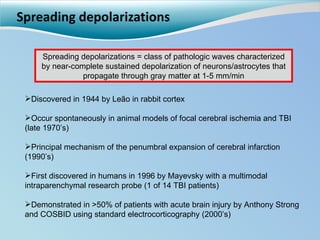
Spreading depolarizations Spreading depolarizations = class of pathologic waves characterized by near-complete sustained depolarization of neurons/astrocytes that propagate through gray matter at 1-5 mm/min Discovered in 1944 by Leão in rabbit cortex Occur spontaneously in animal models of focal cerebral ischemia and TBI (late 1970’s) Principal mechanism of the penumbral expansion of cerebral infarction (1990’s) First discovered in humans in 1996 by Mayevsky with a multimodal intraparenchymal research probe (1 of 14 TBI patients) Demonstrated in >50% of patients with acute brain injury by Anthony Strong and COSBID using standard electrocorticography (2000’s)
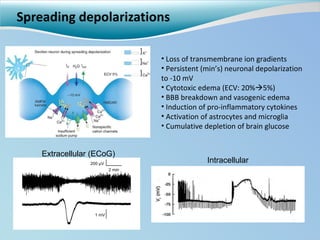
Spreading depolarizations Loss of transmembrane ion gradients Persistent (min’s) neuronal depolarization to -10 mV Cytotoxic edema (ECV: 20%  5%) BBB breakdown and vasogenic edema Induction of pro-inflammatory cytokines Activation of astrocytes and microglia Cumulative depletion of brain glucose Intracellular Extracellular (ECoG)
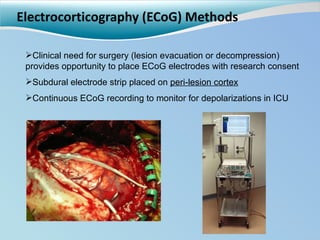
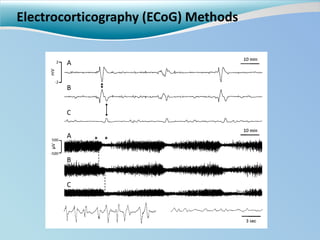
Electrocorticography (ECoG) Methods Clinical need for surgery (lesion evacuation or decompression) provides opportunity to place ECoG electrodes with research consent Subdural electrode strip placed on  peri-lesion cortex Continuous ECoG recording to monitor for depolarizations in ICU
Electrocorticography (ECoG) Methods
Objective Study Aim To test the null hypothesis that  depolarizations have no  independent  association with 6-month outcomes after TBI , after controlling for established prognostic factors in multivariate analysis We previously reported that occurrence of depolarizations is significantly associated with 6-month outcomes after TBI (Hartings et al.,  Brain  134:1529-40, 2011) Depolarizations may be a marker of injury severity, with no causal influence on recovery; known prognostic factors may account for this association
Study Design Prospective, observational, multi-center clinical study 109 patients enrolled from 2004-2010 at seven centers of Co-Operative Study on Brain Injury Depolarizations ( www.cosbid.org ) 75 patients enrolled in pilot phase; 34 enrolled in study funded by U.S. Army and registered at ClinicalTrials.gov (NCT00803036) Statistical Plan Power analysis was not possible at study inception Analyze core hypothesis after enrollment of first 100 patients Fit a multivariate proportional odds model to determine association of depolarizations with outcome, using covariates defined in IMPACT* study *Marmarou et al. J Neurotrauma 2007 24(2):239-50. Hukkelhoven et al. J Neurotrauma 2005 22(10):1025-39.
Study Design Outcome measure extended Glasgow Outcome Scale (eGOS) at 6 months Variables Age GCS motor score at ADM Pupillary reactivity at ADM Early hypoxia Early hypotension tSAH Marshall CT category Depolarizations Inclusion criteria Clinical decision for craniotomy  Surgery < 7 days after trauma Age ≥ 18 years Exclusions Fixed, dilated pupils Pregnancy Prognostic Score* Depolarizations *Hukkelhoven et al. J Neurotrauma 2005 22(10):1025-39 Variables
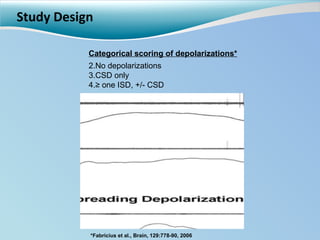
Study Design Categorical scoring of depolarizations* No depolarizations CSD only ≥  one ISD, +/- CSD *Fabricius et al., Brain, 129:778-90, 2006
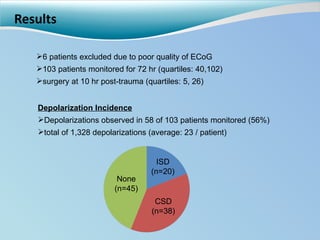
Results 6 patients excluded due to poor quality of ECoG 103 patients monitored for 72 hr (quartiles: 40,102)  surgery at 10 hr post-trauma (quartiles: 5, 26)  Depolarization Incidence Depolarizations observed in 58 of 103 patients monitored (56%) total of 1,328 depolarizations (average: 23 / patient) ISD (n=20) CSD (n=38) None (n=45)
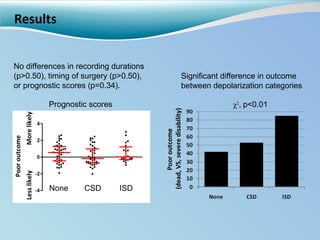
Results No differences in recording durations (p>0.50), timing of surgery (p>0.50), or prognostic scores (p=0.34). Significant difference in outcome between depolarization categories χ 2 ,  p<0.01 Poor outcome  (dead, VS, severe disability) ISD CSD None Poor outcome More likely Less likely Prognostic scores
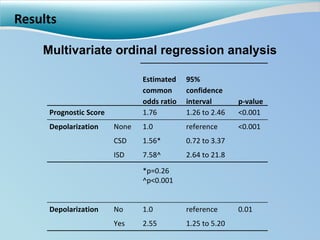
Results *p=0.26 ^p<0.001 Multivariate ordinal regression analysis Estimated common odds ratio 95% confidence interval p-value Prognostic Score 1.76 1.26 to 2.46 <0.001 Depolarization None 1.0 reference <0.001 CSD 1.56* 0.72 to 3.37 ISD 7.58^ 2.64 to 21.8 Depolarization No 1.0 reference 0.01 Yes 2.55 1.25 to 5.20
Conclusions Spreading depolarizations are robustly associated with worse outcomes, independent of baseline outcome predictors including age, GCS, and pupillary reactivity. Depolarizations account for 13% of outcome variance beyond that explained by established prognostic factors.  Results suggest that depolarizations are a causal pathomechanism, with adverse effects on traumatically injured brain.  The first pathomechanism, with demonstrated clinical relevance, that can be monitored in real-time and targeted in treatment of TBI.
Considerations Late, in-hospital secondary insults may be confounding variables; they may co-vary with spreading depolarizations and mediate some of the association of depolarizations with outcome. Depolarizations were scored into 2 simple categories, whereas patterns are complex and exist on a continuum.  Prognostic value of ECoG may be increased with more refined quantification of depolarization ‘burden’. Study subjects limited to those who undergo surgery.  Do the same relationships exist in non-surgical patients?  Variable placement of electrode strip may impact detection of ISDs/CSDs.  However, the effect would be to bias data toward a negative result.
Acknowledgments Ross Bullock – Miami, FL David Okonkwo – Pittsburgh, PA Lilian Murray – Glasgow, Scotland Gordon Murray – Glasgow, Scotland Martin Fabricius – Copenhagen, Denmark Andrew Maas – Edegem, Belgium Johannes Woitzik – Berlin, Germany Oliver Sakowitz – Heidelberg, Germany Bruce Mathern – Richmond, VA Bob Roozenbeek – Rotterdam, Netherlands Hester Lingsma – Rotterdam, Netherlands Jens Dreier – Berlin, Germany Ava Puccio – Pittsburgh, PA Lori Shutter – Cincinnati, OH Clemens Pahl – London, UK Anthony Strong – London, UK COSBID U.S. Army CDMRP PH/TBI Research Program, Contract  No. W81XWH-08-2-0016

Hartings, Jed - Outcome

  • 1.
    Cortical spreading depolarizationsare a novel mechanism independently associated with unfavorable clinical outcome in TBI Jed Hartings, PhD Department of Neurosurgery University of Cincinnati [email_address] 513-558-3567 COSBID
  • 2.
    Introduction Developing newtherapies is a challenge in TBI due to heterogeneity of the disease, in cause, severity, pathology, and outcome. Imaging is the only tool to assess heterogeneous intracranial disease processes. Neuromonitoring captures ICP and P ti O 2 , which are usually global measures of cerebral status. Medical management is mainly supportive, aimed at maintaining adequate cerebral blood flow and oxygenation. To advance treatment, a goal of translational research is to identify pathomechanisms that can be monitored and targeted for therapeutic intervention. This would enable application of therapies tailored to individual patients and their specific pathomechanisms , and optimize chances to detect significant treatment effects when they exist in clinical trials.
  • 3.
    Spreading depolarizations Spreadingdepolarizations = class of pathologic waves characterized by near-complete sustained depolarization of neurons/astrocytes that propagate through gray matter at 1-5 mm/min Discovered in 1944 by Leão in rabbit cortex Occur spontaneously in animal models of focal cerebral ischemia and TBI (late 1970’s) Principal mechanism of the penumbral expansion of cerebral infarction (1990’s) First discovered in humans in 1996 by Mayevsky with a multimodal intraparenchymal research probe (1 of 14 TBI patients) Demonstrated in >50% of patients with acute brain injury by Anthony Strong and COSBID using standard electrocorticography (2000’s)
  • 4.
    Spreading depolarizations Lossof transmembrane ion gradients Persistent (min’s) neuronal depolarization to -10 mV Cytotoxic edema (ECV: 20%  5%) BBB breakdown and vasogenic edema Induction of pro-inflammatory cytokines Activation of astrocytes and microglia Cumulative depletion of brain glucose Intracellular Extracellular (ECoG)
  • 5.
    Electrocorticography (ECoG) MethodsClinical need for surgery (lesion evacuation or decompression) provides opportunity to place ECoG electrodes with research consent Subdural electrode strip placed on peri-lesion cortex Continuous ECoG recording to monitor for depolarizations in ICU
  • 6.
  • 7.
    Objective Study AimTo test the null hypothesis that depolarizations have no independent association with 6-month outcomes after TBI , after controlling for established prognostic factors in multivariate analysis We previously reported that occurrence of depolarizations is significantly associated with 6-month outcomes after TBI (Hartings et al., Brain 134:1529-40, 2011) Depolarizations may be a marker of injury severity, with no causal influence on recovery; known prognostic factors may account for this association
  • 8.
    Study Design Prospective,observational, multi-center clinical study 109 patients enrolled from 2004-2010 at seven centers of Co-Operative Study on Brain Injury Depolarizations ( www.cosbid.org ) 75 patients enrolled in pilot phase; 34 enrolled in study funded by U.S. Army and registered at ClinicalTrials.gov (NCT00803036) Statistical Plan Power analysis was not possible at study inception Analyze core hypothesis after enrollment of first 100 patients Fit a multivariate proportional odds model to determine association of depolarizations with outcome, using covariates defined in IMPACT* study *Marmarou et al. J Neurotrauma 2007 24(2):239-50. Hukkelhoven et al. J Neurotrauma 2005 22(10):1025-39.
  • 9.
    Study Design Outcomemeasure extended Glasgow Outcome Scale (eGOS) at 6 months Variables Age GCS motor score at ADM Pupillary reactivity at ADM Early hypoxia Early hypotension tSAH Marshall CT category Depolarizations Inclusion criteria Clinical decision for craniotomy Surgery < 7 days after trauma Age ≥ 18 years Exclusions Fixed, dilated pupils Pregnancy Prognostic Score* Depolarizations *Hukkelhoven et al. J Neurotrauma 2005 22(10):1025-39 Variables
  • 10.
    Study Design Categoricalscoring of depolarizations* No depolarizations CSD only ≥ one ISD, +/- CSD *Fabricius et al., Brain, 129:778-90, 2006
  • 11.
    Results 6 patientsexcluded due to poor quality of ECoG 103 patients monitored for 72 hr (quartiles: 40,102) surgery at 10 hr post-trauma (quartiles: 5, 26) Depolarization Incidence Depolarizations observed in 58 of 103 patients monitored (56%) total of 1,328 depolarizations (average: 23 / patient) ISD (n=20) CSD (n=38) None (n=45)
  • 12.
    Results No differencesin recording durations (p>0.50), timing of surgery (p>0.50), or prognostic scores (p=0.34). Significant difference in outcome between depolarization categories χ 2 , p<0.01 Poor outcome (dead, VS, severe disability) ISD CSD None Poor outcome More likely Less likely Prognostic scores
  • 13.
    Results *p=0.26 ^p<0.001Multivariate ordinal regression analysis Estimated common odds ratio 95% confidence interval p-value Prognostic Score 1.76 1.26 to 2.46 <0.001 Depolarization None 1.0 reference <0.001 CSD 1.56* 0.72 to 3.37 ISD 7.58^ 2.64 to 21.8 Depolarization No 1.0 reference 0.01 Yes 2.55 1.25 to 5.20
  • 14.
    Conclusions Spreading depolarizationsare robustly associated with worse outcomes, independent of baseline outcome predictors including age, GCS, and pupillary reactivity. Depolarizations account for 13% of outcome variance beyond that explained by established prognostic factors. Results suggest that depolarizations are a causal pathomechanism, with adverse effects on traumatically injured brain. The first pathomechanism, with demonstrated clinical relevance, that can be monitored in real-time and targeted in treatment of TBI.
  • 15.
    Considerations Late, in-hospitalsecondary insults may be confounding variables; they may co-vary with spreading depolarizations and mediate some of the association of depolarizations with outcome. Depolarizations were scored into 2 simple categories, whereas patterns are complex and exist on a continuum. Prognostic value of ECoG may be increased with more refined quantification of depolarization ‘burden’. Study subjects limited to those who undergo surgery. Do the same relationships exist in non-surgical patients? Variable placement of electrode strip may impact detection of ISDs/CSDs. However, the effect would be to bias data toward a negative result.
  • 16.
    Acknowledgments Ross Bullock– Miami, FL David Okonkwo – Pittsburgh, PA Lilian Murray – Glasgow, Scotland Gordon Murray – Glasgow, Scotland Martin Fabricius – Copenhagen, Denmark Andrew Maas – Edegem, Belgium Johannes Woitzik – Berlin, Germany Oliver Sakowitz – Heidelberg, Germany Bruce Mathern – Richmond, VA Bob Roozenbeek – Rotterdam, Netherlands Hester Lingsma – Rotterdam, Netherlands Jens Dreier – Berlin, Germany Ava Puccio – Pittsburgh, PA Lori Shutter – Cincinnati, OH Clemens Pahl – London, UK Anthony Strong – London, UK COSBID U.S. Army CDMRP PH/TBI Research Program, Contract No. W81XWH-08-2-0016