Act II
Act II Scene 1
 A terrible storm has struck Cyprus, just as the Turks
  were about to approach.
                            
 This might mean that the Turkish attack will not
  happen; but it also bodes badly for Othello's ship.
 A messenger enters, and confirms that the Turkish fleet
  was broken apart by the storm, and that Cassio has
  arrived, though Othello is still at sea.
 They spot a ship coming forth; but Iago, Desdemona,
  and Emilia are on it, not Othello.
 Cassio greets them all, especially praising Desdemona;
  somehow, Iago and Desdemona enter into an argument
  about what women are
 Iago shows how little praise he believes women deserve.
 Othello arrives at last, and is very glad to see his wife
  arrived
Act II Scene 1
                 
 Othello and Desdemona make public signs of
  their love, and then depart.
 Iago speaks to Roderigo, convincing him that
  Desdemona will stray from Othello, as she
  has already done with Cassio.
 He convinces Roderigo to attack Cassio that
  night, as he plans to visit mischief on both
  Othello and Cassio.
Analysis: Storms
               
 Storms are always of greater significance in
  Shakespeare:
   the storm is a symbol of unrest
   The storm marks the end of the peaceful part of the
    play, and is an act of fate
   it is a signal that Iago's mischief is about to begin.
 Shakespeare's characters that comment on the
  storm are mariners, alluding to Ursa Minor and
  stars used for navigation
 This is a testament to Shakespeare's incredible
  ability to form credible language for a great
  diversity and range of characters.
Analysis: Cassio
 Just as every character has their own manner of speech
  and expression, Cassio has a very polished, courtly way
                            
  of speaking, especially of ladies.
 He describes Desdemona as one who "excels the quirks
  of blazoning pens"; he calls her "divine Desdemona"
 As Iago finds out later, he has no love for her, though
  much respect; so it is with much irony that Cassio is
  charged as being Desdemona's lover
 Othello sees Cassio as a model Venetian, all poise and
  polish, which is something Othello wants to be, but
  thinks he is not.
 Othello's insecurities mean that Cassio is promoted over
  Iago, but also lead Othello to hold Cassio at a distance.
Analysis: Women
               
 Though Iago is married, he does not have as
  favorable an impression of women as Cassio does.
 Women are "wildcats in your kitchens, saints in your
  injuries, devils being offended“
 He even declares that they "rise to play, and go to
  bed to work“
 Iago's perception of women as deceptive,
  dominating, and lusty colors the way he portrays
  both Emilia and Desdemona; both are good women
 Desdemona exceedingly so, yet he is able to convince
  other men that they are anything but what they are.
Analysis: Misrepresentation
 Misrepresentation is a theme that surfaces often
  through Iago's villainy
 He makes Desdemona seem like a fickle, lusty
                        
  woman, which he will soon try to convince
  Othello of as well.
 Iago's speech plays on Othello's insecurities
  perfectly
 He speaks of Othello's age, race, and manners as
  reasons why Desdemona will grow tired of him,
  which are also reaons why Othello fears he
  might lose her.
 Iago is also a master of temptation, another
  theme in the story
 He is able to figure out exactly what people
  want, and then drive them to it.
Analysis: Motives
               
 Though Iago seems grieved by Cassio's promotion
  over him, this does not seem to be his main motive.
 Iago also cites his suspicions that Emilia and Othello
  have had an affair as another reason for his enmity.
 Iago is not a man to be consumed with sexual
  jealousy; though rumors about his wife may hurt his
  pride, they seem but an excuse for the misery he is
  about to cause.
 Shakespeare leaves the root of Iago's malignancy
  unexplained, while showing the fruits of his evil in
  full.
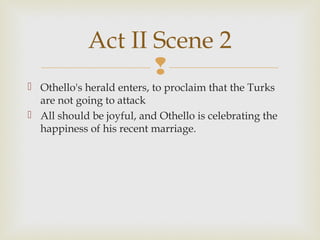
Act II Scene 2
                    
 Othello's herald enters, to proclaim that the Turks
  are not going to attack
 All should be joyful, and Othello is celebrating the
  happiness of his recent marriage.
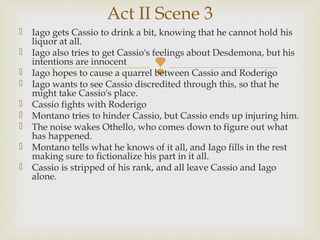
Act II Scene 3
   Iago gets Cassio to drink a bit, knowing that he cannot hold his
    liquor at all.
   Iago also tries to get Cassio's feelings about Desdemona, but his


    intentions are innocent
                                 
    Iago hopes to cause a quarrel between Cassio and Roderigo
   Iago wants to see Cassio discredited through this, so that he
    might take Cassio's place.
   Cassio fights with Roderigo
   Montano tries to hinder Cassio, but Cassio ends up injuring him.
   The noise wakes Othello, who comes down to figure out what
    has happened.
   Montano tells what he knows of it all, and Iago fills in the rest
    making sure to fictionalize his part in it all.
   Cassio is stripped of his rank, and all leave Cassio and Iago
    alone.
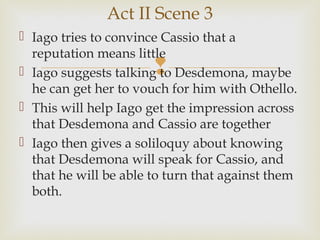
Act II Scene 3
 Iago tries to convince Cassio that a
  reputation means little
                       
 Iago suggests talking to Desdemona, maybe
  he can get her to vouch for him with Othello.
 This will help Iago get the impression across
  that Desdemona and Cassio are together
 Iago then gives a soliloquy about knowing
  that Desdemona will speak for Cassio, and
  that he will be able to turn that against them
  both.
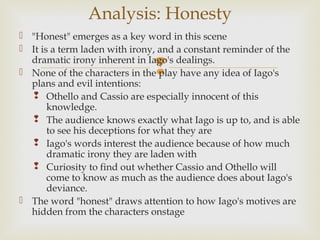
Analysis: Honesty
 "Honest" emerges as a key word in this scene
 It is a term laden with irony, and a constant reminder of the
  dramatic irony inherent in Iago's dealings.
                              
 None of the characters in the play have any idea of Iago's
  plans and evil intentions:
   Othello and Cassio are especially innocent of this
       knowledge.
   The audience knows exactly what Iago is up to, and is able
       to see his deceptions for what they are
   Iago's words interest the audience because of how much
       dramatic irony they are laden with
   Curiosity to find out whether Cassio and Othello will
       come to know as much as the audience does about Iago's
       deviance.
 The word "honest" draws attention to how Iago's motives are
  hidden from the characters onstage
Analysis: Juxtaposition
 Iago and Cassio are juxtaposed in this scene to bring out
  Cassio's flawed honor and courtliness and Iago's
  manipulativeness and deceptiveness.
                             
 Cassio stands in especially sharp contrast to Iago when
  Iago speaks lustfully of Desdemona
 Cassio is full of honor when it comes to women, and the
  ideals of a courtier as well.
 "He's a soldier fit to stand by Caesar," Iago says, the
  allusion to Caesar stating the fact that he knows Cassio's
  true quality.
 Iago strikes gold when he figures out Cassio's weakness
  for drink
 "He'll be as full of quarrel and offense as my young
  mistress' dog,"
 Iago’ metaphor shows that he knows how liquor can
  separate even the best man from himself
 Iago's metaphor reinforces his perceptiveness, and the
  light/dark imagery
Analysis: Know the Audience
 Iago's homage to "sweet England" in his song of this act:
    though this play does not take place in England
                             
    features no English characters
    Shakespeare throws this in to amuse his audience.
 He does the same in plays like Hamlet, in which a little
  nod to England is thrown in for comic effect, and as an
  audience pleaser.
Analysis: Reputation
 Reputation is a theme in the book that obviously
  holds some resonance for Cassio
                            
 Iago also knows the importance of reputation,
  which is why he makes sure that people see him
  as "honest" before anything.
 "Reputation is a most idle and false imposition,"
  Iago says:
   this statement is meant as false consolation to Cassio,
    and is filled with great irony.
 Reputation is always of concern when
  individuals are involved
Analysis: Devil
 Cassio is so grieved that his reputation has been
  hurt that he sees fit to find a villain in all that
  has happened            
 Ironically, Cassio misses the identity of the real
  devil in this situation, Iago.
 "Devil" becomes a key word in this play, as
  people try to seek out what is poisoning
  everyone
 Good vs. evil is a major theme in the play
 There is a great deal of gray area:
   Iago is the villain
   Everyone else has some blemish of their natures
   No one entirely deserving of the label "good".

 Adapted from:
 https://hhs-english-iv.wikispaces.com

Othello Act II Notes

  • 1.
  • 2.
    Act II Scene1  A terrible storm has struck Cyprus, just as the Turks were about to approach.   This might mean that the Turkish attack will not happen; but it also bodes badly for Othello's ship.  A messenger enters, and confirms that the Turkish fleet was broken apart by the storm, and that Cassio has arrived, though Othello is still at sea.  They spot a ship coming forth; but Iago, Desdemona, and Emilia are on it, not Othello.  Cassio greets them all, especially praising Desdemona; somehow, Iago and Desdemona enter into an argument about what women are  Iago shows how little praise he believes women deserve.  Othello arrives at last, and is very glad to see his wife arrived
  • 3.
    Act II Scene1   Othello and Desdemona make public signs of their love, and then depart.  Iago speaks to Roderigo, convincing him that Desdemona will stray from Othello, as she has already done with Cassio.  He convinces Roderigo to attack Cassio that night, as he plans to visit mischief on both Othello and Cassio.
  • 4.
    Analysis: Storms   Storms are always of greater significance in Shakespeare:  the storm is a symbol of unrest  The storm marks the end of the peaceful part of the play, and is an act of fate  it is a signal that Iago's mischief is about to begin.  Shakespeare's characters that comment on the storm are mariners, alluding to Ursa Minor and stars used for navigation  This is a testament to Shakespeare's incredible ability to form credible language for a great diversity and range of characters.
  • 5.
    Analysis: Cassio  Justas every character has their own manner of speech and expression, Cassio has a very polished, courtly way  of speaking, especially of ladies.  He describes Desdemona as one who "excels the quirks of blazoning pens"; he calls her "divine Desdemona"  As Iago finds out later, he has no love for her, though much respect; so it is with much irony that Cassio is charged as being Desdemona's lover  Othello sees Cassio as a model Venetian, all poise and polish, which is something Othello wants to be, but thinks he is not.  Othello's insecurities mean that Cassio is promoted over Iago, but also lead Othello to hold Cassio at a distance.
  • 6.
    Analysis: Women   Though Iago is married, he does not have as favorable an impression of women as Cassio does.  Women are "wildcats in your kitchens, saints in your injuries, devils being offended“  He even declares that they "rise to play, and go to bed to work“  Iago's perception of women as deceptive, dominating, and lusty colors the way he portrays both Emilia and Desdemona; both are good women  Desdemona exceedingly so, yet he is able to convince other men that they are anything but what they are.
  • 7.
    Analysis: Misrepresentation  Misrepresentationis a theme that surfaces often through Iago's villainy  He makes Desdemona seem like a fickle, lusty  woman, which he will soon try to convince Othello of as well.  Iago's speech plays on Othello's insecurities perfectly  He speaks of Othello's age, race, and manners as reasons why Desdemona will grow tired of him, which are also reaons why Othello fears he might lose her.  Iago is also a master of temptation, another theme in the story  He is able to figure out exactly what people want, and then drive them to it.
  • 8.
    Analysis: Motives   Though Iago seems grieved by Cassio's promotion over him, this does not seem to be his main motive.  Iago also cites his suspicions that Emilia and Othello have had an affair as another reason for his enmity.  Iago is not a man to be consumed with sexual jealousy; though rumors about his wife may hurt his pride, they seem but an excuse for the misery he is about to cause.  Shakespeare leaves the root of Iago's malignancy unexplained, while showing the fruits of his evil in full.
  • 9.
    Act II Scene2   Othello's herald enters, to proclaim that the Turks are not going to attack  All should be joyful, and Othello is celebrating the happiness of his recent marriage.
  • 10.
    Act II Scene3  Iago gets Cassio to drink a bit, knowing that he cannot hold his liquor at all.  Iago also tries to get Cassio's feelings about Desdemona, but his  intentions are innocent  Iago hopes to cause a quarrel between Cassio and Roderigo  Iago wants to see Cassio discredited through this, so that he might take Cassio's place.  Cassio fights with Roderigo  Montano tries to hinder Cassio, but Cassio ends up injuring him.  The noise wakes Othello, who comes down to figure out what has happened.  Montano tells what he knows of it all, and Iago fills in the rest making sure to fictionalize his part in it all.  Cassio is stripped of his rank, and all leave Cassio and Iago alone.
  • 11.
    Act II Scene3  Iago tries to convince Cassio that a reputation means little   Iago suggests talking to Desdemona, maybe he can get her to vouch for him with Othello.  This will help Iago get the impression across that Desdemona and Cassio are together  Iago then gives a soliloquy about knowing that Desdemona will speak for Cassio, and that he will be able to turn that against them both.
  • 12.
    Analysis: Honesty  "Honest"emerges as a key word in this scene  It is a term laden with irony, and a constant reminder of the dramatic irony inherent in Iago's dealings.   None of the characters in the play have any idea of Iago's plans and evil intentions:  Othello and Cassio are especially innocent of this knowledge.  The audience knows exactly what Iago is up to, and is able to see his deceptions for what they are  Iago's words interest the audience because of how much dramatic irony they are laden with  Curiosity to find out whether Cassio and Othello will come to know as much as the audience does about Iago's deviance.  The word "honest" draws attention to how Iago's motives are hidden from the characters onstage
  • 13.
    Analysis: Juxtaposition  Iagoand Cassio are juxtaposed in this scene to bring out Cassio's flawed honor and courtliness and Iago's manipulativeness and deceptiveness.   Cassio stands in especially sharp contrast to Iago when Iago speaks lustfully of Desdemona  Cassio is full of honor when it comes to women, and the ideals of a courtier as well.  "He's a soldier fit to stand by Caesar," Iago says, the allusion to Caesar stating the fact that he knows Cassio's true quality.  Iago strikes gold when he figures out Cassio's weakness for drink  "He'll be as full of quarrel and offense as my young mistress' dog,"  Iago’ metaphor shows that he knows how liquor can separate even the best man from himself  Iago's metaphor reinforces his perceptiveness, and the light/dark imagery
  • 14.
    Analysis: Know theAudience  Iago's homage to "sweet England" in his song of this act:  though this play does not take place in England   features no English characters  Shakespeare throws this in to amuse his audience.  He does the same in plays like Hamlet, in which a little nod to England is thrown in for comic effect, and as an audience pleaser.
  • 15.
    Analysis: Reputation  Reputationis a theme in the book that obviously holds some resonance for Cassio   Iago also knows the importance of reputation, which is why he makes sure that people see him as "honest" before anything.  "Reputation is a most idle and false imposition," Iago says:  this statement is meant as false consolation to Cassio, and is filled with great irony.  Reputation is always of concern when individuals are involved
  • 16.
    Analysis: Devil  Cassiois so grieved that his reputation has been hurt that he sees fit to find a villain in all that has happened   Ironically, Cassio misses the identity of the real devil in this situation, Iago.  "Devil" becomes a key word in this play, as people try to seek out what is poisoning everyone  Good vs. evil is a major theme in the play  There is a great deal of gray area:  Iago is the villain  Everyone else has some blemish of their natures  No one entirely deserving of the label "good".
  • 17.
      Adapted from: https://hhs-english-iv.wikispaces.com