PAAVAI COLLEGE OF EDUCATION
   Paavai Nagar, Nh-7,pachal, Namakkal - 637018


 POWER POINT PRESENTATION

                2011-2012
PAAVAI COLLEGE OF EDUCATION
           Paavai Nagar, Nh-7,pachal, Namakkal - 637018


     POWER POINT PRESENTATION

NAME             : S.MANIKANDAN
OPTIONAL         : COMPUTER SCIENCE AND MATHS
ROLL NO          : 038
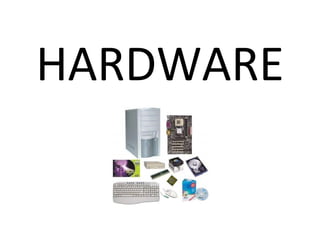
HARDWARE
Unofficial ICT Hardware Categories

 •   Input
 •   Output
 •   Processing
 •   Storage
 •   Communication
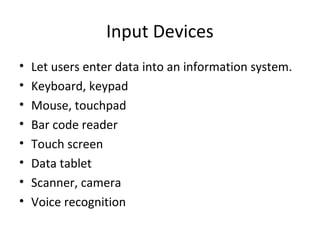
Input Devices
•   Let users enter data into an information system.
•   Keyboard, keypad
•   Mouse, touchpad
•   Bar code reader
•   Touch screen
•   Data tablet
•   Scanner, camera
•   Voice recognition
Input Devices
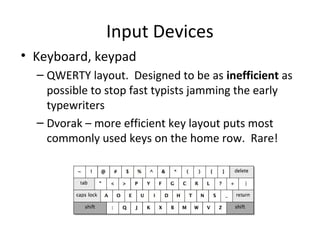
• Keyboard, keypad
  – QWERTY layout. Designed to be as inefficient as
    possible to stop fast typists jamming the early
    typewriters
  – Dvorak – more efficient key layout puts most
    commonly used keys on the home row. Rare!
Input Devices
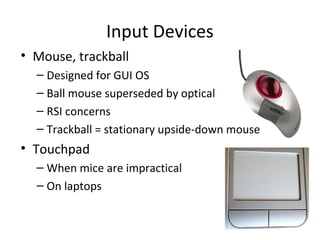
• Mouse, trackball
  – Designed for GUI OS
  – Ball mouse superseded by optical
  – RSI concerns
  – Trackball = stationary upside-down mouse
• Touchpad
  – When mice are impractical
  – On laptops
Input Devices
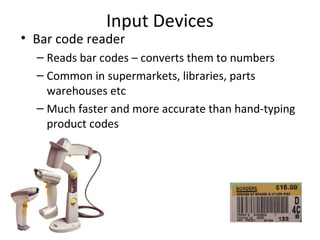
• Bar code reader
  – Reads bar codes – converts them to numbers
  – Common in supermarkets, libraries, parts
    warehouses etc
  – Much faster and more accurate than hand-typing
    product codes
Input Devices
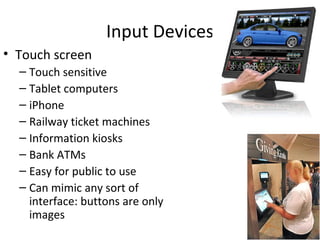
• Touch screen
  – Touch sensitive
  – Tablet computers
  – iPhone
  – Railway ticket machines
  – Information kiosks
  – Bank ATMs
  – Easy for public to use
  – Can mimic any sort of
    interface: buttons are only
    images
Input Devices
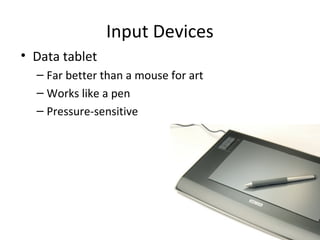
• Data tablet
  – Far better than a mouse for art
  – Works like a pen
  – Pressure-sensitive
Input Devices
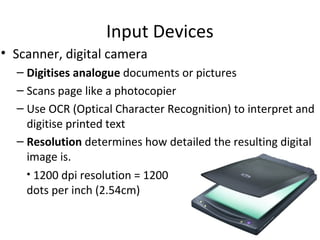
• Scanner, digital camera
  – Digitises analogue documents or pictures
  – Scans page like a photocopier
  – Use OCR (Optical Character Recognition) to interpret and
    digitise printed text
  – Resolution determines how detailed the resulting digital
    image is.
    • 1200 dpi resolution = 1200
    dots per inch (2.54cm)
Output devices 1
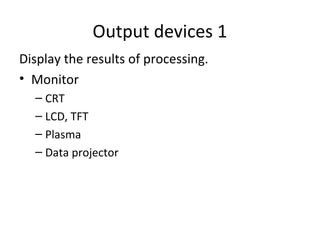
Display the results of processing.
• Monitor
  – CRT
  – LCD, TFT
  – Plasma
  – Data projector
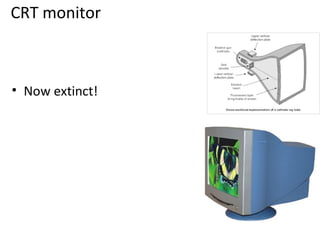
CRT monitor


• Now extinct!
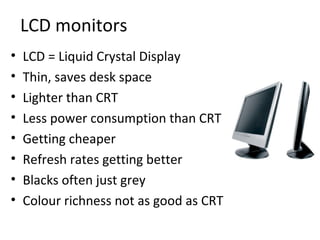
LCD monitors
•   LCD = Liquid Crystal Display
•   Thin, saves desk space
•   Lighter than CRT
•   Less power consumption than CRT
•   Getting cheaper
•   Refresh rates getting better
•   Blacks often just grey
•   Colour richness not as good as CRT
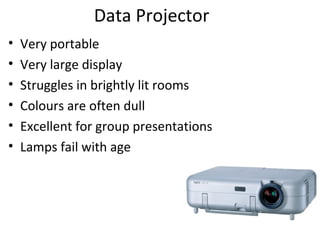
Data Projector
•   Very portable
•   Very large display
•   Struggles in brightly lit rooms
•   Colours are often dull
•   Excellent for group presentations
•   Lamps fail with age
Output devices 2
• Printer
  – Laser
  – Inkjet
  – Thermal
  – Dot matrix, Impact
• Speakers
• Indicators, LEDs
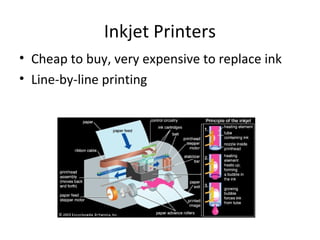
Inkjet Printers
• Cheap to buy, very expensive to replace ink
• Line-by-line printing
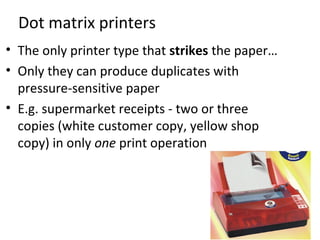
Dot matrix printers
• The only printer type that strikes the paper…
• Only they can produce duplicates with
  pressure-sensitive paper
• E.g. supermarket receipts - two or three
  copies (white customer copy, yellow shop
  copy) in only one print operation
Storage hardware
Stores & retrieves data and software.
• Hard disk
• Solid state disk
• Flash RAM, RAM, ROM
• CD, DVD
• Tape, floppy disk
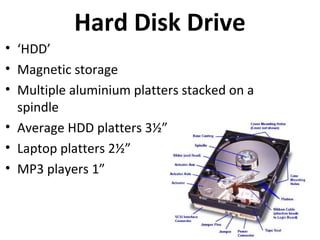
Hard Disk Drive
• ‘HDD’
• Magnetic storage
• Multiple aluminium platters stacked on a
  spindle
• Average HDD platters 3½” (inches)
• Laptop platters 2½”
• MP3 players 1”
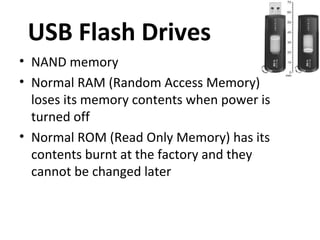
USB Flash Drives
• NAND memory
• Normal RAM (Random Access Memory)
  loses its memory contents when power is
  turned off
• Normal ROM (Read Only Memory) has its
  contents burnt at the factory and they
  cannot be changed later
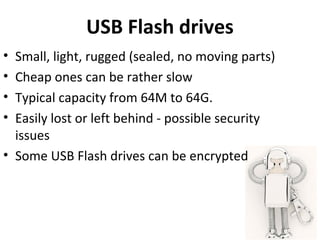
USB Flash drives
• Small, light, rugged (sealed, no moving parts)
• Cheap ones can be rather slow
• Typical capacity from 64M to 64G.
• Easily lost or left behind - possible security
  issues
• Some USB Flash drives can be encrypted
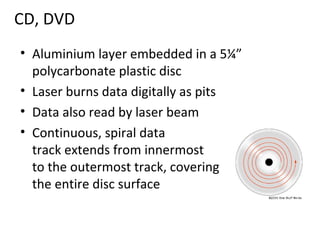
CD, DVD
• Aluminium layer embedded in a 5¼”
  polycarbonate plastic disc
• Laser burns data digitally as pits
• Data also read by laser beam
• Continuous, spiral data
  track extends from innermost
  to the outermost track, covering
  the entire disc surface
CD, DVD
• Sensitive to scratches, heat
• Immune to magnetic effects
• Not “perpetual storage” as originally believed.
  – Disks degrade over time, become unreadable
  – Gold disks seem to last longer


   The laser lens in
     a CD drive
THANK YOU
          BY
S.MANIKANDAN

Hardware software

  • 1.
    PAAVAI COLLEGE OFEDUCATION Paavai Nagar, Nh-7,pachal, Namakkal - 637018 POWER POINT PRESENTATION 2011-2012
  • 2.
    PAAVAI COLLEGE OFEDUCATION Paavai Nagar, Nh-7,pachal, Namakkal - 637018 POWER POINT PRESENTATION NAME : S.MANIKANDAN OPTIONAL : COMPUTER SCIENCE AND MATHS ROLL NO : 038
  • 3.
  • 4.
    Unofficial ICT HardwareCategories • Input • Output • Processing • Storage • Communication
  • 5.
    Input Devices • Let users enter data into an information system. • Keyboard, keypad • Mouse, touchpad • Bar code reader • Touch screen • Data tablet • Scanner, camera • Voice recognition
  • 6.
    Input Devices • Keyboard,keypad – QWERTY layout. Designed to be as inefficient as possible to stop fast typists jamming the early typewriters – Dvorak – more efficient key layout puts most commonly used keys on the home row. Rare!
  • 7.
    Input Devices • Mouse,trackball – Designed for GUI OS – Ball mouse superseded by optical – RSI concerns – Trackball = stationary upside-down mouse • Touchpad – When mice are impractical – On laptops
  • 8.
    Input Devices • Barcode reader – Reads bar codes – converts them to numbers – Common in supermarkets, libraries, parts warehouses etc – Much faster and more accurate than hand-typing product codes
  • 9.
    Input Devices • Touchscreen – Touch sensitive – Tablet computers – iPhone – Railway ticket machines – Information kiosks – Bank ATMs – Easy for public to use – Can mimic any sort of interface: buttons are only images
  • 10.
    Input Devices • Datatablet – Far better than a mouse for art – Works like a pen – Pressure-sensitive
  • 11.
    Input Devices • Scanner,digital camera – Digitises analogue documents or pictures – Scans page like a photocopier – Use OCR (Optical Character Recognition) to interpret and digitise printed text – Resolution determines how detailed the resulting digital image is. • 1200 dpi resolution = 1200 dots per inch (2.54cm)
  • 12.
    Output devices 1 Displaythe results of processing. • Monitor – CRT – LCD, TFT – Plasma – Data projector
  • 13.
  • 14.
    LCD monitors • LCD = Liquid Crystal Display • Thin, saves desk space • Lighter than CRT • Less power consumption than CRT • Getting cheaper • Refresh rates getting better • Blacks often just grey • Colour richness not as good as CRT
  • 15.
    Data Projector • Very portable • Very large display • Struggles in brightly lit rooms • Colours are often dull • Excellent for group presentations • Lamps fail with age
  • 16.
    Output devices 2 •Printer – Laser – Inkjet – Thermal – Dot matrix, Impact • Speakers • Indicators, LEDs
  • 17.
    Inkjet Printers • Cheapto buy, very expensive to replace ink • Line-by-line printing
  • 18.
    Dot matrix printers •The only printer type that strikes the paper… • Only they can produce duplicates with pressure-sensitive paper • E.g. supermarket receipts - two or three copies (white customer copy, yellow shop copy) in only one print operation
  • 19.
    Storage hardware Stores &retrieves data and software. • Hard disk • Solid state disk • Flash RAM, RAM, ROM • CD, DVD • Tape, floppy disk
  • 20.
    Hard Disk Drive •‘HDD’ • Magnetic storage • Multiple aluminium platters stacked on a spindle • Average HDD platters 3½” (inches) • Laptop platters 2½” • MP3 players 1”
  • 21.
    USB Flash Drives •NAND memory • Normal RAM (Random Access Memory) loses its memory contents when power is turned off • Normal ROM (Read Only Memory) has its contents burnt at the factory and they cannot be changed later
  • 22.
    USB Flash drives •Small, light, rugged (sealed, no moving parts) • Cheap ones can be rather slow • Typical capacity from 64M to 64G. • Easily lost or left behind - possible security issues • Some USB Flash drives can be encrypted
  • 23.
    CD, DVD • Aluminiumlayer embedded in a 5¼” polycarbonate plastic disc • Laser burns data digitally as pits • Data also read by laser beam • Continuous, spiral data track extends from innermost to the outermost track, covering the entire disc surface
  • 24.
    CD, DVD • Sensitiveto scratches, heat • Immune to magnetic effects • Not “perpetual storage” as originally believed. – Disks degrade over time, become unreadable – Gold disks seem to last longer The laser lens in a CD drive
  • 25.
    THANK YOU BY S.MANIKANDAN