Carlo Lombardi,  June  2008 Theoretical  Computer  Science Hardness   of   Approximation A brief survey of  Inapproximability theory  for NP optimization problems
Carlo Lombardi,  June  2008 Theoretical  Computer  Science Overview Optimization problem: Definition NP Optimization Approximability and Inapproximability  Approximation-Preserving Reduction Gap Problems, Karp reduction, PCP Theorem Probabilistic Verification
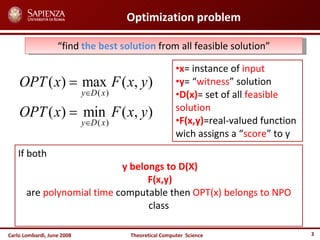
Carlo Lombardi,  June  2008 Theoretical  Computer  Science Optimization problem “ find  the best solution   from all feasible solution” x = instance of  input y = “ witness ” solution D(x) =   set of all  feasible solution F(x,y) = real-valued function  wich assigns a “ score ” to y If both  y belongs to D(X) F(x,y) are  polynomial time  computable then  OPT(x) belongs to NPO  class
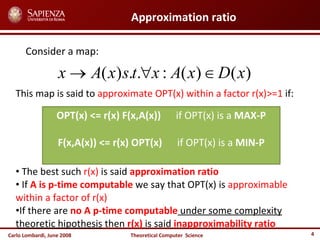
Carlo Lombardi,  June  2008 Theoretical  Computer  Science Approximation ratio Consider a map: This map is said to  approximate OPT(x) within a factor r(x)>=1  if: The best such  r(x)  is said  approximation ratio If  A is p-time computable  we say that OPT(x) is  approximable within a factor of r(x) If there are  no A p-time computable   under some complexity theoretic hipothesis  then  r(x)  is said  inapproximability ratio OPT(x) <= r(x) F(x,A(x))  if OPT(x) is a  MAX-P F(x,A(x)) <= r(x) OPT(x)   if OPT(x) is a  MIN-P
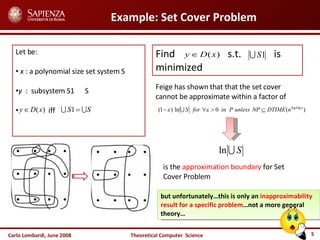
Carlo Lombardi,  June  2008 Theoretical  Computer  Science Example: Set Cover Problem Let be: x  : a polynomial size set system S y   :  subsystem S1  S iff  Find  s.t.  is minimized  Feige has shown that that the set cover cannot be approximate within a factor of is the  approximation boundary  for Set Cover Problem but unfortunately…this is only an  inapproximability result for a specific problem …not a more general theory…
Carlo Lombardi,  June  2008 Theoretical  Computer  Science Question In which way we  can obtain inapproximability results   for optimization problems? Roughly speaking, how we can find  a lower bound for approximation ratio   of optimization problems?
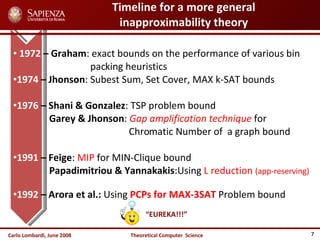
Carlo Lombardi,  June  2008 Theoretical  Computer  Science Timeline for a more general inapproximability theory 1972  – Graham : exact bounds on the performance of various bin   packing heuristics 1974  – Jhonson : Subest Sum, Set Cover, MAX k-SAT bounds 1976  – Shani & Gonzalez : TSP problem bound Garey & Jhonson :  Gap amplification technique   for   Chromatic Number of  a graph bound 1991  – Feige :  MIP  for MIN-Clique bound Papadimitriou & Yannakakis :Using  L reduction  (app-reserving) 1992  – Arora et al.:  Using  PCPs for MAX-3SAT  Problem bound “ EUREKA!!!”
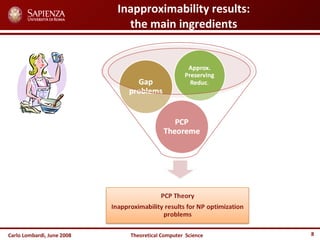
Carlo Lombardi,  June  2008 Theoretical  Computer  Science Inapproximability results: the main ingredients
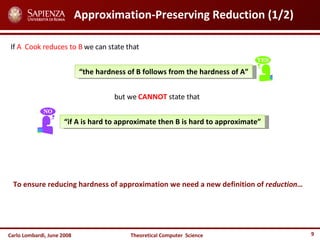
Carlo Lombardi,  June  2008 Theoretical  Computer  Science Approximation-Preserving Reduction (1/2) If  A   Cook reduces to B  we can state that “ the hardness of B follows from the hardness of A” but we  CANNOT  state that  “ if A is hard to approximate then B is hard to approximate” To ensure reducing hardness of approximation we need a new definition of  reduction…
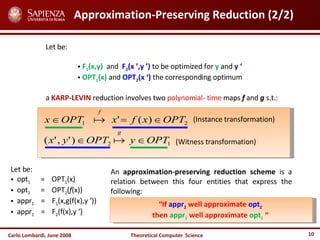
Carlo Lombardi,  June  2008 Theoretical  Computer  Science Approximation-Preserving Reduction (2/2) Let be: F 1 (x,y)   and  F 2 (x ’,y ’)   to be optimized for  y  and  y ‘   OPT 1 (x)   and  OPT 2 (x ‘)   the corresponding optimum a  KARP-LEVIN  reduction involves two  polynomial- time  maps  f   and  g   s.t.: (Instance transformation) (Witness transformation) Let be: opt 1   =  OPT 1 (x) opt 2   =  OPT 2 ( f (x)) appr 1   =  F 1 (x,g(f(x),y ’)) appr 1   =  F 2 (f(x),y ‘) An  approximation-preserving reduction scheme  is a relation between this four entities that express the following: “ If  appr 2  well approximate  opt 2   then  appr 1  well approximate  opt 1  “
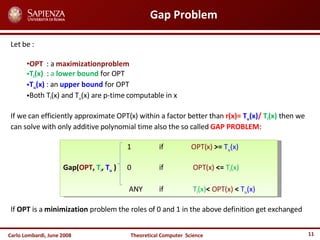
Carlo Lombardi,  June  2008 Theoretical  Computer  Science Gap Problem Let be : OPT   : a  maximizationproblem T l (x)   :  a  lower bound  for OPT T u (x)  : an  upper bound  for OPT Both T l (x) and T u (x) are p-time computable in x If we can efficiently approximate OPT(x) within a factor better than  r(x)=  T u (x) /  T l (x)   then we can solve with only additive polynomial time also the so called  GAP PROBLEM : 1 if  OPT(x)   >=   T u (x) Gap( OPT ,  T l ,  T u  )  0 if   OPT(x)  <=  T l (x)   ANY if   T l (x) <   OPT(x)   <   T u (x) If  OPT  is a  minimization  problem the roles of 0 and 1 in the above definition get exchanged
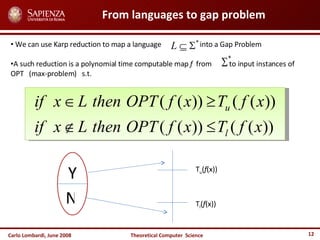
Carlo Lombardi,  June  2008 Theoretical  Computer  Science From languages to gap problem We can use Karp reduction to map a language  into a Gap Problem A such reduction is a polynomial time computable map  f  from  to input instances of  OPT  (max-problem)  s.t. Y N T u ( f (x)) T l ( f (x))
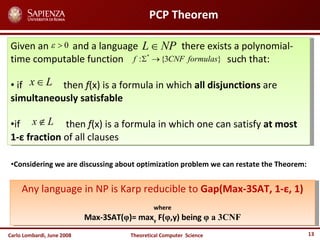
Carlo Lombardi,  June  2008 Theoretical  Computer  Science PCP Theorem Given an  and a language  there exists a polynomial-time computable function  such that: if  then  f (x) is a formula in which  all disjunctions  are  simultaneously satisfable if  then  f (x) is a formula in which one can satisfy  at most  1- ε  fraction  of all clauses Considering we are discussing about optimization problem we can restate the Theorem: Any language in NP is Karp reducible to  Gap(Max-3SAT, 1- ε , 1) where Max-3SAT( φ )= max y  F( φ ,y) being  φ  a 3CNF
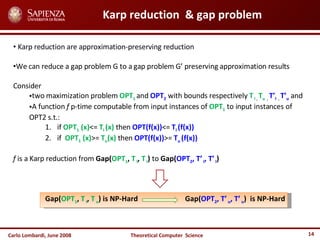
Carlo Lombardi,  June  2008 Theoretical  Computer  Science Karp reduction  & gap problem  Karp reduction are approximation-preserving reduction We can reduce a gap problem G to a gap problem G’ preserving approximation results Consider  two maximization problem  OPT 1  and  OPT 2   with bounds respectively  T   l  ,  T u   ,  T’ l   ,  T’ u  and  A function  f  p-time computable from input instances of  OPT 1  to input instances of OPT2 s.t.: if  OPT 1  (x) <=  T l  (x)  then  OPT(f(x)) <=   T l  (f(x)) if  OPT 1  (x) >=  T u (x)  then  OPT(f(x)) >=  T u  (f(x)) f  is a Karp reduction from  Gap( OPT 1 ,  T   l ,  T   l )  to  Gap( OPT 2 , T’  l , T’  l )  Gap( OPT 1 ,  T   l ,  T   u ) is NP-Hard  Gap( OPT 2 , T’  u , T’  u )  is NP-Hard
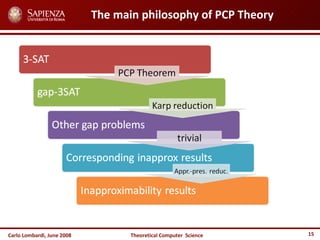
Carlo Lombardi,  June  2008 Theoretical  Computer  Science The main philosophy of PCP Theory
Carlo Lombardi,  June  2008 Theoretical  Computer  Science Question How it’s possible to compute efficiently gap problems?
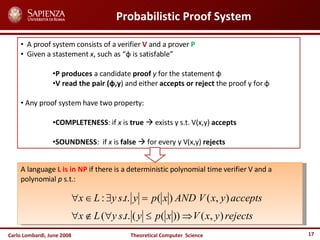
Carlo Lombardi,  June  2008 Theoretical  Computer  Science Probabilistic Proof System A proof system consists of a verifier  V  and a prover  P Given a stastement  x , such as “ φ  is satisfable” P produces  a candidate  proof   y  for the statement  φ V read the pair ( φ ,y ) and either  accepts or reject  the proof y for  φ Any proof system have two property: COMPLETENESS : if  x  is  true     exists y s.t. V(x,y)  accepts SOUNDNESS :  if  x  is  false     for every y V(x,y)  rejects A language  L is in NP  if there is a deterministic polynomial time verifier V and a polynomial  p  s.t.:
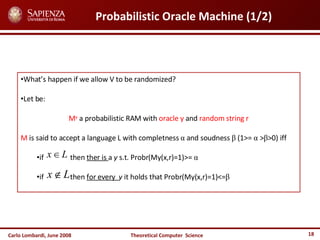
Carlo Lombardi,  June  2008 Theoretical  Computer  Science Probabilistic Oracle Machine (1/2) What’s happen if we allow V to be randomized? Let be: M y  a probabilistic RAM with  oracle y  and  random string r M  is said to accept a language L with completness  α  and soudness  β  (1>=  α  > β >0) iff if  then  ther is  a  y  s.t. Probr(My(x,r)=1)>=  α if  then  for every  y  it holds that Probr(My(x,r)=1)<= β
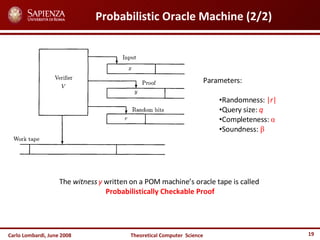
Carlo Lombardi,  June  2008 Theoretical  Computer  Science Parameters: Randomness:  | r | Query size:  q Completeness:  α Soundness:   β Probabilistic Oracle Machine (2/2) The  witness  y   written on a POM machine’s oracle tape is called  Probabilistically Checkable Proof
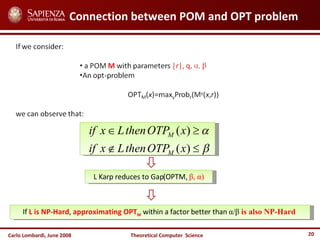
Carlo Lombardi,  June  2008 Theoretical  Computer  Science Connection between POM and OPT problem L Karp reduces to Gap(OPTM,  β ,  α ) If  L is NP-Hard ,  approximating OPT M   within a factor better than  α / β   is also NP-Hard

Hardness of approximation

  • 1.
    Carlo Lombardi, June 2008 Theoretical Computer Science Hardness of Approximation A brief survey of Inapproximability theory for NP optimization problems
  • 2.
    Carlo Lombardi, June 2008 Theoretical Computer Science Overview Optimization problem: Definition NP Optimization Approximability and Inapproximability Approximation-Preserving Reduction Gap Problems, Karp reduction, PCP Theorem Probabilistic Verification
  • 3.
    Carlo Lombardi, June 2008 Theoretical Computer Science Optimization problem “ find the best solution from all feasible solution” x = instance of input y = “ witness ” solution D(x) = set of all feasible solution F(x,y) = real-valued function wich assigns a “ score ” to y If both y belongs to D(X) F(x,y) are polynomial time computable then OPT(x) belongs to NPO class
  • 4.
    Carlo Lombardi, June 2008 Theoretical Computer Science Approximation ratio Consider a map: This map is said to approximate OPT(x) within a factor r(x)>=1 if: The best such r(x) is said approximation ratio If A is p-time computable we say that OPT(x) is approximable within a factor of r(x) If there are no A p-time computable under some complexity theoretic hipothesis then r(x) is said inapproximability ratio OPT(x) <= r(x) F(x,A(x)) if OPT(x) is a MAX-P F(x,A(x)) <= r(x) OPT(x) if OPT(x) is a MIN-P
  • 5.
    Carlo Lombardi, June 2008 Theoretical Computer Science Example: Set Cover Problem Let be: x : a polynomial size set system S y : subsystem S1 S iff Find s.t. is minimized Feige has shown that that the set cover cannot be approximate within a factor of is the approximation boundary for Set Cover Problem but unfortunately…this is only an inapproximability result for a specific problem …not a more general theory…
  • 6.
    Carlo Lombardi, June 2008 Theoretical Computer Science Question In which way we can obtain inapproximability results for optimization problems? Roughly speaking, how we can find a lower bound for approximation ratio of optimization problems?
  • 7.
    Carlo Lombardi, June 2008 Theoretical Computer Science Timeline for a more general inapproximability theory 1972 – Graham : exact bounds on the performance of various bin packing heuristics 1974 – Jhonson : Subest Sum, Set Cover, MAX k-SAT bounds 1976 – Shani & Gonzalez : TSP problem bound Garey & Jhonson : Gap amplification technique for Chromatic Number of a graph bound 1991 – Feige : MIP for MIN-Clique bound Papadimitriou & Yannakakis :Using L reduction (app-reserving) 1992 – Arora et al.: Using PCPs for MAX-3SAT Problem bound “ EUREKA!!!”
  • 8.
    Carlo Lombardi, June 2008 Theoretical Computer Science Inapproximability results: the main ingredients
  • 9.
    Carlo Lombardi, June 2008 Theoretical Computer Science Approximation-Preserving Reduction (1/2) If A Cook reduces to B we can state that “ the hardness of B follows from the hardness of A” but we CANNOT state that “ if A is hard to approximate then B is hard to approximate” To ensure reducing hardness of approximation we need a new definition of reduction…
  • 10.
    Carlo Lombardi, June 2008 Theoretical Computer Science Approximation-Preserving Reduction (2/2) Let be: F 1 (x,y) and F 2 (x ’,y ’) to be optimized for y and y ‘ OPT 1 (x) and OPT 2 (x ‘) the corresponding optimum a KARP-LEVIN reduction involves two polynomial- time maps f and g s.t.: (Instance transformation) (Witness transformation) Let be: opt 1 = OPT 1 (x) opt 2 = OPT 2 ( f (x)) appr 1 = F 1 (x,g(f(x),y ’)) appr 1 = F 2 (f(x),y ‘) An approximation-preserving reduction scheme is a relation between this four entities that express the following: “ If appr 2 well approximate opt 2 then appr 1 well approximate opt 1 “
  • 11.
    Carlo Lombardi, June 2008 Theoretical Computer Science Gap Problem Let be : OPT : a maximizationproblem T l (x) : a lower bound for OPT T u (x) : an upper bound for OPT Both T l (x) and T u (x) are p-time computable in x If we can efficiently approximate OPT(x) within a factor better than r(x)= T u (x) / T l (x) then we can solve with only additive polynomial time also the so called GAP PROBLEM : 1 if OPT(x) >= T u (x) Gap( OPT , T l , T u ) 0 if OPT(x) <= T l (x) ANY if T l (x) < OPT(x) < T u (x) If OPT is a minimization problem the roles of 0 and 1 in the above definition get exchanged
  • 12.
    Carlo Lombardi, June 2008 Theoretical Computer Science From languages to gap problem We can use Karp reduction to map a language into a Gap Problem A such reduction is a polynomial time computable map f from to input instances of OPT (max-problem) s.t. Y N T u ( f (x)) T l ( f (x))
  • 13.
    Carlo Lombardi, June 2008 Theoretical Computer Science PCP Theorem Given an and a language there exists a polynomial-time computable function such that: if then f (x) is a formula in which all disjunctions are simultaneously satisfable if then f (x) is a formula in which one can satisfy at most 1- ε fraction of all clauses Considering we are discussing about optimization problem we can restate the Theorem: Any language in NP is Karp reducible to Gap(Max-3SAT, 1- ε , 1) where Max-3SAT( φ )= max y F( φ ,y) being φ a 3CNF
  • 14.
    Carlo Lombardi, June 2008 Theoretical Computer Science Karp reduction & gap problem Karp reduction are approximation-preserving reduction We can reduce a gap problem G to a gap problem G’ preserving approximation results Consider two maximization problem OPT 1 and OPT 2 with bounds respectively T l , T u , T’ l , T’ u and A function f p-time computable from input instances of OPT 1 to input instances of OPT2 s.t.: if OPT 1 (x) <= T l (x) then OPT(f(x)) <= T l (f(x)) if OPT 1 (x) >= T u (x) then OPT(f(x)) >= T u (f(x)) f is a Karp reduction from Gap( OPT 1 , T l , T l ) to Gap( OPT 2 , T’ l , T’ l ) Gap( OPT 1 , T l , T u ) is NP-Hard Gap( OPT 2 , T’ u , T’ u ) is NP-Hard
  • 15.
    Carlo Lombardi, June 2008 Theoretical Computer Science The main philosophy of PCP Theory
  • 16.
    Carlo Lombardi, June 2008 Theoretical Computer Science Question How it’s possible to compute efficiently gap problems?
  • 17.
    Carlo Lombardi, June 2008 Theoretical Computer Science Probabilistic Proof System A proof system consists of a verifier V and a prover P Given a stastement x , such as “ φ is satisfable” P produces a candidate proof y for the statement φ V read the pair ( φ ,y ) and either accepts or reject the proof y for φ Any proof system have two property: COMPLETENESS : if x is true  exists y s.t. V(x,y) accepts SOUNDNESS : if x is false  for every y V(x,y) rejects A language L is in NP if there is a deterministic polynomial time verifier V and a polynomial p s.t.:
  • 18.
    Carlo Lombardi, June 2008 Theoretical Computer Science Probabilistic Oracle Machine (1/2) What’s happen if we allow V to be randomized? Let be: M y a probabilistic RAM with oracle y and random string r M is said to accept a language L with completness α and soudness β (1>= α > β >0) iff if then ther is a y s.t. Probr(My(x,r)=1)>= α if then for every y it holds that Probr(My(x,r)=1)<= β
  • 19.
    Carlo Lombardi, June 2008 Theoretical Computer Science Parameters: Randomness: | r | Query size: q Completeness: α Soundness: β Probabilistic Oracle Machine (2/2) The witness y written on a POM machine’s oracle tape is called Probabilistically Checkable Proof
  • 20.
    Carlo Lombardi, June 2008 Theoretical Computer Science Connection between POM and OPT problem L Karp reduces to Gap(OPTM, β , α ) If L is NP-Hard , approximating OPT M within a factor better than α / β is also NP-Hard