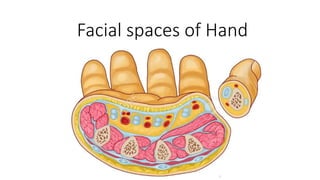
Facial spaces of Hand
Spaces Of Hand
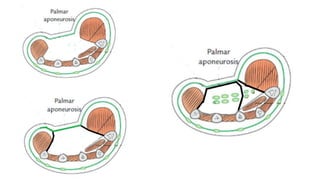
• Palmar spaces
• Thenar space
• Midpalmar space
• Web space
• Pulp space of fingers
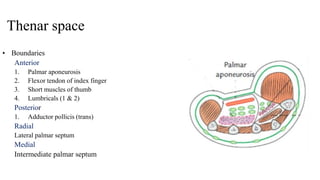
Thenar space
• Boundaries
Anterior
1. Palmar aponeurosis
2. Flexor tendon of index finger
3. Short muscles of thumb
4. Lumbricals (1 & 2)
Posterior
1. Adductor pollicis (trans)
Radial
Lateral palmar septum
Medial
Intermediate palmar septum
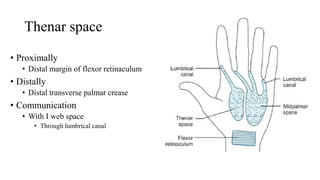
Thenar space
• Proximally
• Distal margin of flexor retinaculum
• Distally
• Distal transverse palmar crease
• Communication
• With I web space
• Through lumbrical canal
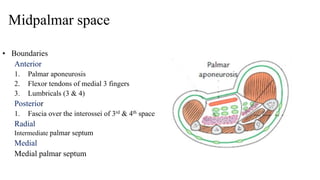
Midpalmar space
• Boundaries
Anterior
1. Palmar aponeurosis
2. Flexor tendons of medial 3 fingers
3. Lumbricals (3 & 4)
Posterior
1. Fascia over the interossei of 3rd & 4th space
Radial
Intermediate palmar septum
Medial
Medial palmar septum
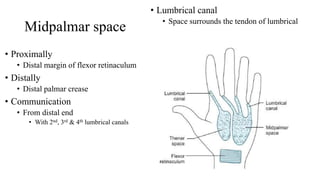
Midpalmar space
• Proximally
• Distal margin of flexor retinaculum
• Distally
• Distal palmar crease
• Communication
• From distal end
• With 2nd, 3rd & 4th lumbrical canals
• Lumbrical canal
• Space surrounds the tendon of lumbrical
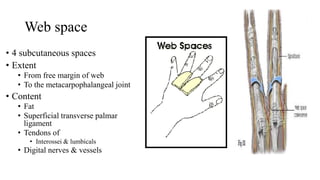
Web space
• 4 subcutaneous spaces
• Extent
• From free margin of web
• To the metacarpophalangeal joint
• Content
• Fat
• Superficial transverse palmar
ligament
• Tendons of
• Interossei & lumbicals
• Digital nerves & vessels
Fibrous flexor sheath
• Fibrous sheath covering the digits
• On anterior surface of the fingers and
attached to the sides of the phalanges
• Forms an Osteofibrous blind Tunnel
• To retain the tendons in position
• Covering the long flexor tendons
• Thumb
• Flexor pollicis longus
• Medial 4 fingers
• Flexor digitorum profundus
• Flexor digitorum superficialis
Fibrous flexor sheath - Extent
• From
• Head of Metacarpal
• Proximal end is opened
• To
• Base of Distal phalanx
• Distal end is closed
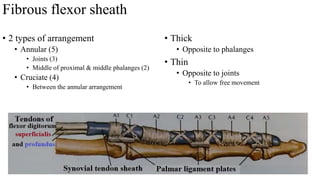
Fibrous flexor sheath
• 2 types of arrangement
• Annular (5)
• Joints (3)
• Middle of proximal & middle phalanges (2)
• Cruciate (4)
• Between the annular arrangement
• Thick
• Opposite to phalanges
• Thin
• Opposite to joints
• To allow free movement
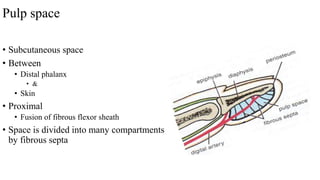
Pulp space
• Subcutaneous space
• Between
• Distal phalanx
• &
• Skin
• Proximal
• Fusion of fibrous flexor sheath
• Space is divided into many compartments
by fibrous septa
Applied anatomy
• Infection of this region
• Known as whitlow or felon
• Distension of any compartment by
pus
• Presses on nerve endings
• Necrosis of distal 4/5th of distal phalanx
may happen
• If whitlow is not treated
• Why
• Blood supply is from the branches arising within
this space
• Proximal 1/5th part of distal phalanx is getting
supply from the branch which does not traverse
the pulp space
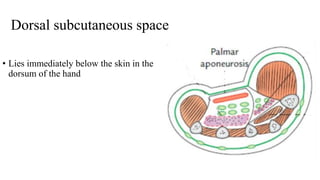
Dorsal subcutaneous space
• Lies immediately below the skin in the
dorsum of the hand
Arterial supply to hand
• Hand has rich arterial supply
• Many anastomoses
• Allows the hand get blood supply
• Grasping or applying pressure
• Supplied by
• Ulnar and radial arteries
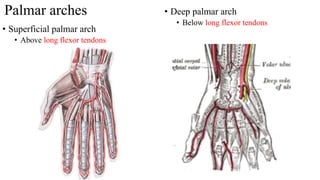
Palmar arches
• Superficial palmar arch
• Above long flexor tendons
• Deep palmar arch
• Below long flexor tendons
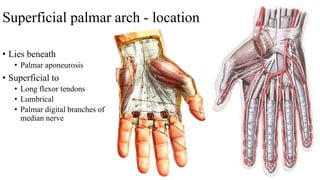
Superficial palmar arch - location
• Lies beneath
• Palmar aponeurosis
• Superficial to
• Long flexor tendons
• Lumbrical
• Palmar digital branches of
median nerve
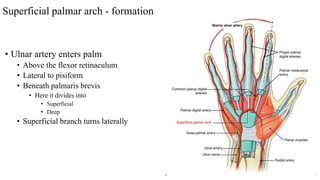
Superficial palmar arch - formation
• Ulnar artery enters palm
• Above the flexor retinaculum
• Lateral to pisiform
• Beneath palmaris brevis
• Here it divides into
• Superficial
• Deep
• Superficial branch turns laterally
• Ulnar artery is main contribution
• Superficial branch of ulnar artery
• Continues as superficial palmar arch
• Mode of completion
• By one of the following branches of radial
artery
• Superficial palmar branch
• Arteria princeps pollicis
• Arteria radialis indicis
Superficial palmar arch - formation
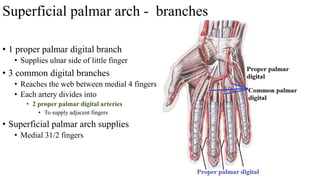
Superficial palmar arch - branches
• 1 proper palmar digital branch
• Supplies ulnar side of little finger
• 3 common digital branches
• Reaches the web between medial 4 fingers
• Each artery divides into
• 2 proper palmar digital arteries
• To supply adjacent fingers
• Superficial palmar arch supplies
• Medial 31/2 fingers
• At web
• Common palmar digital
• Branch from superficial palmar arch
• Palmar metacarpal
• Branch from deep palmar arch
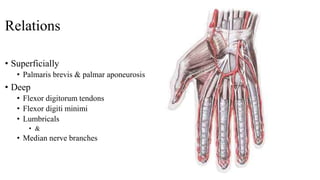
Relations
• Superficially
• Palmaris brevis & palmar aponeurosis
• Deep
• Flexor digitorum tendons
• Flexor digiti minimi
• Lumbricals
• &
• Median nerve branches
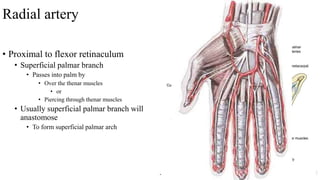
Radial artery
• Proximal to flexor retinaculum
• Superficial palmar branch
• Passes into palm by
• Over the thenar muscles
• or
• Piercing through thenar muscles
• Usually superficial palmar branch will
anastomose
• To form superficial palmar arch
Radial artery
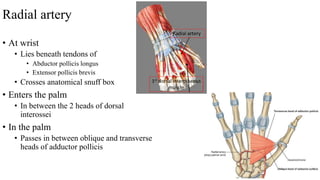
• At wrist
• Lies beneath tendons of
• Abductor pollicis longus
• Extensor pollicis brevis
• Crosses anatomical snuff box
• Enters the palm
• In between the 2 heads of dorsal
interossei
• In the palm
• Passes in between oblique and transverse
heads of adductor pollicis
Radial artery
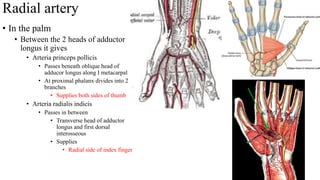
• In the palm
• Between the 2 heads of adductor
longus it gives
• Arteria princeps pollicis
• Passes beneath oblique head of
adducor longus along I metacarpal
• At proximal phalanx divides into 2
branches
• Supplies both sides of thumb
• Arteria radialis indicis
• Passes in between
• Transverse head of adductor
longus and first dorsal
interosseous
• Supplies
• Radial side of index finger
Deep palmar arch
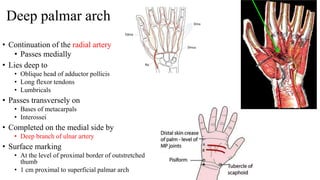
• Continuation of the radial artery
• Passes medially
• Lies deep to
• Oblique head of adductor pollicis
• Long flexor tendons
• Lumbricals
• Passes transversely on
• Bases of metacarpals
• Interossei
• Completed on the medial side by
• Deep branch of ulnar artery
• Surface marking
• At the level of proximal border of outstretched
thumb
• 1 cm proximal to superficial palmar arch
Deep palmar arch
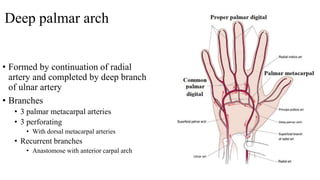
• Formed by continuation of radial
artery and completed by deep branch
of ulnar artery
• Branches
• 3 palmar metacarpal arteries
• 3 perforating
• With dorsal metacarpal arteries
• Recurrent branches
• Anastomose with anterior carpal arch
Dorsal metacarpal arteries
• 1st dorsal metacarpal
• From radial
• 2nd , 3rd, & 4th dorsal metacarpal
• From dorsal carpal arch
Allen's test
• To test for adequate
anastomoses between the radial
and ulnar arteries
• Compress both the radial and
ulnar arteries at the wrist
• Then release pressure from one
or the other
• and
• Determine the filling pattern of
the hand
How to control bleeding in hand
• Compression of brachial artery
• Against humerus
• Why not at wrist by arresting
ulnar & radial arteries
• There is communication between
palmar & dorsal carpal arches
with arterial arches of palm
Hand-spaces and arterial arches.pptx

Hand-spaces and arterial arches.pptx

  • 1.
  • 2.
    Spaces Of Hand •Palmar spaces • Thenar space • Midpalmar space • Web space • Pulp space of fingers
  • 6.
    Thenar space • Boundaries Anterior 1.Palmar aponeurosis 2. Flexor tendon of index finger 3. Short muscles of thumb 4. Lumbricals (1 & 2) Posterior 1. Adductor pollicis (trans) Radial Lateral palmar septum Medial Intermediate palmar septum
  • 7.
    Thenar space • Proximally •Distal margin of flexor retinaculum • Distally • Distal transverse palmar crease • Communication • With I web space • Through lumbrical canal
  • 8.
    Midpalmar space • Boundaries Anterior 1.Palmar aponeurosis 2. Flexor tendons of medial 3 fingers 3. Lumbricals (3 & 4) Posterior 1. Fascia over the interossei of 3rd & 4th space Radial Intermediate palmar septum Medial Medial palmar septum
  • 9.
    Midpalmar space • Proximally •Distal margin of flexor retinaculum • Distally • Distal palmar crease • Communication • From distal end • With 2nd, 3rd & 4th lumbrical canals • Lumbrical canal • Space surrounds the tendon of lumbrical
  • 10.
    Web space • 4subcutaneous spaces • Extent • From free margin of web • To the metacarpophalangeal joint • Content • Fat • Superficial transverse palmar ligament • Tendons of • Interossei & lumbicals • Digital nerves & vessels
  • 11.
    Fibrous flexor sheath •Fibrous sheath covering the digits • On anterior surface of the fingers and attached to the sides of the phalanges • Forms an Osteofibrous blind Tunnel • To retain the tendons in position • Covering the long flexor tendons • Thumb • Flexor pollicis longus • Medial 4 fingers • Flexor digitorum profundus • Flexor digitorum superficialis
  • 12.
    Fibrous flexor sheath- Extent • From • Head of Metacarpal • Proximal end is opened • To • Base of Distal phalanx • Distal end is closed
  • 13.
    Fibrous flexor sheath •2 types of arrangement • Annular (5) • Joints (3) • Middle of proximal & middle phalanges (2) • Cruciate (4) • Between the annular arrangement • Thick • Opposite to phalanges • Thin • Opposite to joints • To allow free movement
  • 14.
    Pulp space • Subcutaneousspace • Between • Distal phalanx • & • Skin • Proximal • Fusion of fibrous flexor sheath • Space is divided into many compartments by fibrous septa
  • 15.
    Applied anatomy • Infectionof this region • Known as whitlow or felon • Distension of any compartment by pus • Presses on nerve endings • Necrosis of distal 4/5th of distal phalanx may happen • If whitlow is not treated • Why • Blood supply is from the branches arising within this space • Proximal 1/5th part of distal phalanx is getting supply from the branch which does not traverse the pulp space
  • 16.
    Dorsal subcutaneous space •Lies immediately below the skin in the dorsum of the hand
  • 17.
    Arterial supply tohand • Hand has rich arterial supply • Many anastomoses • Allows the hand get blood supply • Grasping or applying pressure • Supplied by • Ulnar and radial arteries
  • 18.
    Palmar arches • Superficialpalmar arch • Above long flexor tendons • Deep palmar arch • Below long flexor tendons
  • 19.
    Superficial palmar arch- location • Lies beneath • Palmar aponeurosis • Superficial to • Long flexor tendons • Lumbrical • Palmar digital branches of median nerve
  • 20.
    Superficial palmar arch- formation • Ulnar artery enters palm • Above the flexor retinaculum • Lateral to pisiform • Beneath palmaris brevis • Here it divides into • Superficial • Deep • Superficial branch turns laterally
  • 21.
    • Ulnar arteryis main contribution • Superficial branch of ulnar artery • Continues as superficial palmar arch • Mode of completion • By one of the following branches of radial artery • Superficial palmar branch • Arteria princeps pollicis • Arteria radialis indicis Superficial palmar arch - formation
  • 22.
    Superficial palmar arch- branches • 1 proper palmar digital branch • Supplies ulnar side of little finger • 3 common digital branches • Reaches the web between medial 4 fingers • Each artery divides into • 2 proper palmar digital arteries • To supply adjacent fingers • Superficial palmar arch supplies • Medial 31/2 fingers
  • 23.
    • At web •Common palmar digital • Branch from superficial palmar arch • Palmar metacarpal • Branch from deep palmar arch
  • 24.
    Relations • Superficially • Palmarisbrevis & palmar aponeurosis • Deep • Flexor digitorum tendons • Flexor digiti minimi • Lumbricals • & • Median nerve branches
  • 25.
    Radial artery • Proximalto flexor retinaculum • Superficial palmar branch • Passes into palm by • Over the thenar muscles • or • Piercing through thenar muscles • Usually superficial palmar branch will anastomose • To form superficial palmar arch
  • 26.
    Radial artery • Atwrist • Lies beneath tendons of • Abductor pollicis longus • Extensor pollicis brevis • Crosses anatomical snuff box • Enters the palm • In between the 2 heads of dorsal interossei • In the palm • Passes in between oblique and transverse heads of adductor pollicis
  • 27.
    Radial artery • Inthe palm • Between the 2 heads of adductor longus it gives • Arteria princeps pollicis • Passes beneath oblique head of adducor longus along I metacarpal • At proximal phalanx divides into 2 branches • Supplies both sides of thumb • Arteria radialis indicis • Passes in between • Transverse head of adductor longus and first dorsal interosseous • Supplies • Radial side of index finger
  • 28.
    Deep palmar arch •Continuation of the radial artery • Passes medially • Lies deep to • Oblique head of adductor pollicis • Long flexor tendons • Lumbricals • Passes transversely on • Bases of metacarpals • Interossei • Completed on the medial side by • Deep branch of ulnar artery • Surface marking • At the level of proximal border of outstretched thumb • 1 cm proximal to superficial palmar arch
  • 29.
    Deep palmar arch •Formed by continuation of radial artery and completed by deep branch of ulnar artery • Branches • 3 palmar metacarpal arteries • 3 perforating • With dorsal metacarpal arteries • Recurrent branches • Anastomose with anterior carpal arch
  • 30.
    Dorsal metacarpal arteries •1st dorsal metacarpal • From radial • 2nd , 3rd, & 4th dorsal metacarpal • From dorsal carpal arch
  • 31.
    Allen's test • Totest for adequate anastomoses between the radial and ulnar arteries • Compress both the radial and ulnar arteries at the wrist • Then release pressure from one or the other • and • Determine the filling pattern of the hand
  • 32.
    How to controlbleeding in hand • Compression of brachial artery • Against humerus • Why not at wrist by arresting ulnar & radial arteries • There is communication between palmar & dorsal carpal arches with arterial arches of palm