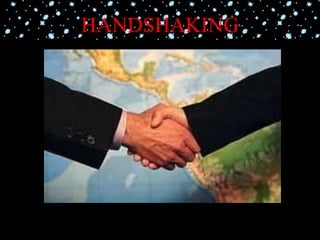
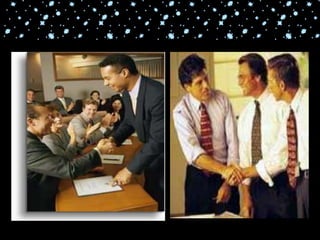
HANDSHAKING
Outline
A. General Points
B. Steps
C. Typical types & Interpretation
D. Factors affecting handshaking interpretation
A. General Points
1. Definition
2. Purposes
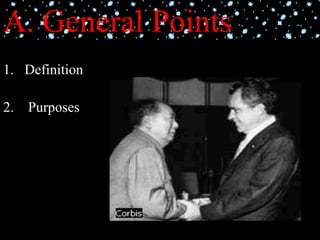
1. DEFINITION
HANDSHAKING: is
* a kind of nonverbal language used as a gesture of greeting or congratulation.
*If you give someone a handshake, you take their
right hand with your own right hand and hold it
firmly or move it up and down, as a sign of greeting
or to show that you have agreed about something
such as a business deal.
2. Purposes
Why do people shake hands? – To…
- Introduce themselves
- Congratulate someone
- Agree to do something together
ON…
- Initial meeting
- Departure
B. STEPS
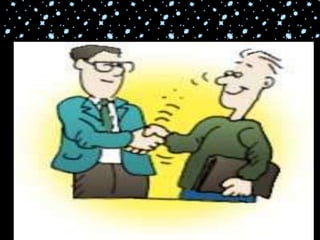
1. Extend your right hand to meet the other person's right
hand.
2. Point your thumb upward toward the other person's arm
and extend your arm at a slight downward angle.
3. Wrap your hand around the other person's hand when your
thumb joints come together.
4. Grasp the hand firmly and squeeze gently once.
Remember that limp handshakes are a big turnoff,
as are bone-crushing grasps.
5. Hold the handshake for 2 to 3 seconds.
6. Pump your hand up and down (2/3 times).
“You cannot shake hands with a clenched fist.”
Indira Gandhi (1917 - 1984)Indian prime minister.
C. TYPES AND INTERPRETATION
12 types
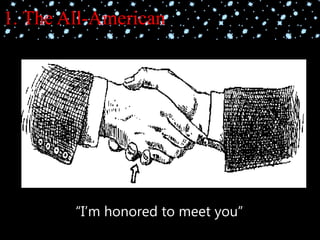
1. The All-American
“I’m honored to meet you”
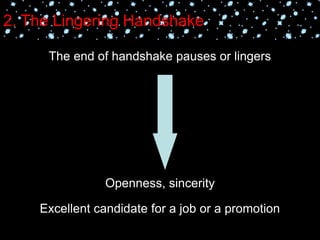
2. The Lingering Handshake
The end of handshake pauses or lingers
Openness, sincerity
Excellent candidate for a job or a promotion
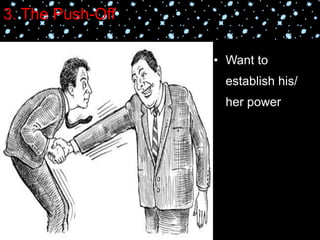
3. The Push-Off
• Want to
establish his/
her power
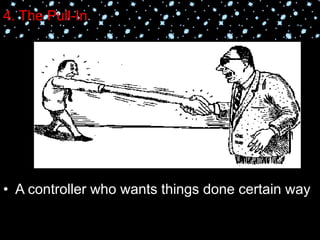
4. The Pull-In
• A controller who wants things done certain way
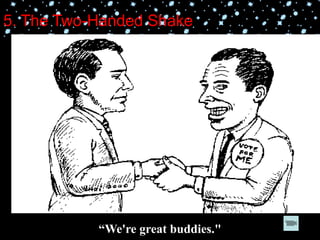
5. The Two-Handed Shake
“We're great buddies."
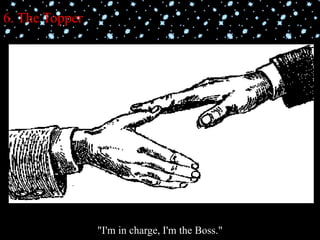
6. The Topper
"I'm in charge, I'm the Boss."
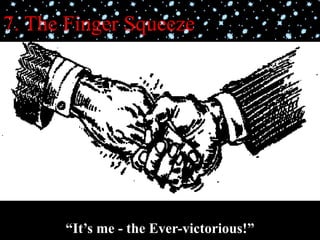
7. The Finger Squeeze
“It’s me - the Ever-victorious!”
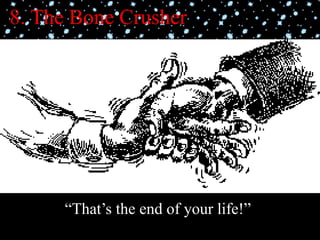
8. The Bone Crusher
“That’s the end of your life!”
9. The Palm Pinch
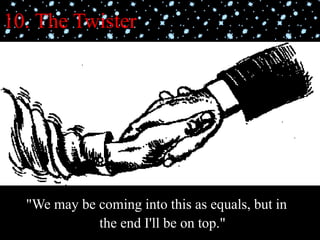
10. The Twister
"We may be coming into this as equals, but in
the end I'll be on top."
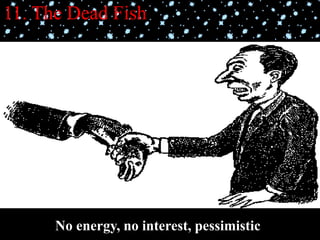
11. The Dead Fish
No energy, no interest, pessimistic
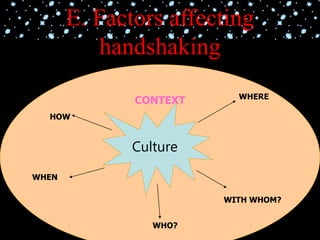
CONTEXT
E. Factors affecting
handshaking
Culture
WHEN
WHERE
WITH WHOM?
HOW
WHO?
1.When…?
• As you know people shake hand when they
first meet and they say goodbye. Besides these
we can see:
a. In business – meeting each other to carrying out activity of
making, buying, selling or supplying goods or services for
money.
b. In intimate meeting – having and showing a close and
friendly relationship
c. At the negotiating table - making an agreement
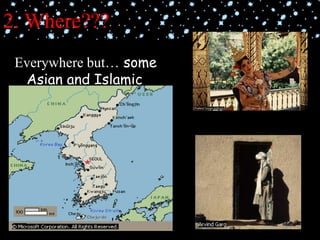
2. Where???
Everywhere but… some
Asian and Islamic
countries, women
don't like shaking
hands
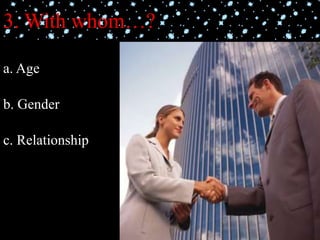
3. With whom…?
a. Age
b. Gender
c. Relationship
HOW – handshaking vs. other
gestures
a. Facial expression – smile at your partner & have
eye contact that make you hospitable or cordial
and your partner is happy to take your hand. Your
hand should be most opened, don't that tells your
partner your sincerity.
b. Posture – standing or sitting you should have an
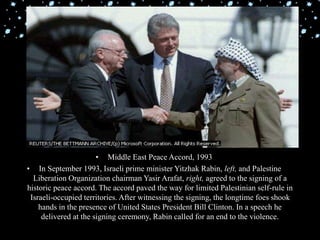
• Middle East Peace Accord, 1993
• In September 1993, Israeli prime minister Yitzhak Rabin, left, and Palestine
Liberation Organization chairman Yasir Arafat, right, agreed to the signing of a
historic peace accord. The accord paved the way for limited Palestinian self-rule in
Israeli-occupied territories. After witnessing the signing, the longtime foes shook
hands in the presence of United States President Bill Clinton. In a speech he
delivered at the signing ceremony, Rabin called for an end to the violence.

hand-shaking.ppt

  • 1.
  • 3.
    Outline A. General Points B.Steps C. Typical types & Interpretation D. Factors affecting handshaking interpretation
  • 4.
    A. General Points 1.Definition 2. Purposes
  • 5.
    1. DEFINITION HANDSHAKING: is *a kind of nonverbal language used as a gesture of greeting or congratulation. *If you give someone a handshake, you take their right hand with your own right hand and hold it firmly or move it up and down, as a sign of greeting or to show that you have agreed about something such as a business deal.
  • 6.
    2. Purposes Why dopeople shake hands? – To… - Introduce themselves - Congratulate someone - Agree to do something together ON… - Initial meeting - Departure
  • 7.
    B. STEPS 1. Extendyour right hand to meet the other person's right hand. 2. Point your thumb upward toward the other person's arm and extend your arm at a slight downward angle. 3. Wrap your hand around the other person's hand when your thumb joints come together.
  • 8.
    4. Grasp thehand firmly and squeeze gently once. Remember that limp handshakes are a big turnoff, as are bone-crushing grasps. 5. Hold the handshake for 2 to 3 seconds. 6. Pump your hand up and down (2/3 times). “You cannot shake hands with a clenched fist.” Indira Gandhi (1917 - 1984)Indian prime minister.
  • 9.
    C. TYPES ANDINTERPRETATION 12 types
  • 10.
    1. The All-American “I’mhonored to meet you”
  • 11.
    2. The LingeringHandshake The end of handshake pauses or lingers Openness, sincerity Excellent candidate for a job or a promotion
  • 12.
    3. The Push-Off •Want to establish his/ her power
  • 13.
    4. The Pull-In •A controller who wants things done certain way
  • 14.
    5. The Two-HandedShake “We're great buddies."
  • 15.
    6. The Topper "I'min charge, I'm the Boss."
  • 16.
    7. The FingerSqueeze “It’s me - the Ever-victorious!”
  • 17.
    8. The BoneCrusher “That’s the end of your life!”
  • 18.
  • 19.
    10. The Twister "Wemay be coming into this as equals, but in the end I'll be on top."
  • 20.
    11. The DeadFish No energy, no interest, pessimistic
  • 21.
  • 22.
    1.When…? • As youknow people shake hand when they first meet and they say goodbye. Besides these we can see: a. In business – meeting each other to carrying out activity of making, buying, selling or supplying goods or services for money. b. In intimate meeting – having and showing a close and friendly relationship c. At the negotiating table - making an agreement
  • 23.
    2. Where??? Everywhere but…some Asian and Islamic countries, women don't like shaking hands
  • 24.
    3. With whom…? a.Age b. Gender c. Relationship
  • 25.
    HOW – handshakingvs. other gestures a. Facial expression – smile at your partner & have eye contact that make you hospitable or cordial and your partner is happy to take your hand. Your hand should be most opened, don't that tells your partner your sincerity. b. Posture – standing or sitting you should have an
  • 29.
    • Middle EastPeace Accord, 1993 • In September 1993, Israeli prime minister Yitzhak Rabin, left, and Palestine Liberation Organization chairman Yasir Arafat, right, agreed to the signing of a historic peace accord. The accord paved the way for limited Palestinian self-rule in Israeli-occupied territories. After witnessing the signing, the longtime foes shook hands in the presence of United States President Bill Clinton. In a speech he delivered at the signing ceremony, Rabin called for an end to the violence.