DEFINITIONFO
HALITOSIS
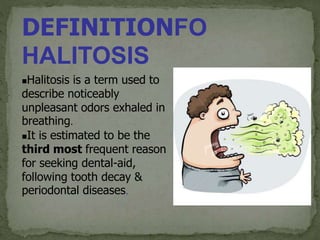
Halitosis is a term used to
describe noticeably
unpleasant odors exhaled in
breathing.
It is estimated to be the
third most frequent reason
for seeking dental-aid,
following tooth decay &
periodontal diseases.
Epidemiology
Extremely common.
Majority of adult population have had it at
some point in time.
Unpleasant condition which creates huge
embarrassment with potentially grave
consequences.
 Formed by bacterial putrefaction of food
debris, cells, saliva and blood.
 Proteolysis of proteins,peptides,amino
acids,free thiol groups & volatile sulphides.
 Results from any form of sepsis : increased
anaerobic activity of pathogens.
 Despite rigorous hygiene, good dentition,
posterior dorsum of tongue is often a source.
Pathophysiology
Anaerobic Sulphur Producing Bacteria which normally
live BELOW the surface of the tongue and in the
throat(Fusobacterium,Actinomyces ,and Bacteriods
forsythus) They assist humans in digestion by
breaking down proteins found in specific foods,mucus
or blood, and in diseased or “broken-down ”oral
tissue. Under certain conditions, these bacteria start
to break down proteins at a very high rate .
Proteins are made up of Amino Acids.Two of
Amino Acids in the mouth (Cysteine &
methionine) are dense with sulphur.
When “beneficial ”bacteria break down these
compounds, the odorous and “lousy-tasting ”
Volatile sulphur compounds (VSCs) are
released ,Hydrogen sulphide, Dimethyl sulphide
& methyl mercaptan) with other bad tasting
compounds .
Compounds commonly produced by mouth
bacteria and their odours :
Hydrogen sulfide- Rotten eggs
Methyl mercaptan- Faeces
Skatole - Faeces
Cadaverine - Corpses
Putrescine - Decaying meat
Isovaleric acid - Sweaty feet
Pathophysiology of
Halitosis
Etiology of Halitosis
1. Oral & Throat Causes
2. Nasal/ Nasopharyngeal problems
3. Systemic disease
4. Physiologic considerations
5. Drugs
6. Food
7. Psychologic disorders
Oral & Throat Causes
1 .Poor dental hygiene & food impaction
2 .Dental & Gum diseases
3 .Bacteria accumulation on the posterior dorsum of
tongue & tonsils
4 .Post nasal drip
5 .Chronic tonsillitis &Tonsilloliths(Tonsil Stones)
6 .Dry mouth
7 .Oral sepsis
8 .Oral Ulcerative lesions
9 .Oral malignancy
Dental & Gum
Disease
 Periodontal disease
 Dental caries
 Faulty restoration
 Denture
 Impacted or abscessed
tooth
 Infected extraction sites
 Residual post-operative
blood
 Debris under bridges or
appliances kept in mouth at
night or not cleaned properly.
Oral & Throat Causes
The real reason for the bad breath is
bacteria that accumulate on back of
tongue,in pockets of gum or in the throat.
Anaerobic bacteria produce volatile
sulphur compounds (VSC) such as methyl
mercaptan & hydrogen sulphide.
These VSC’s are source of malodor
Oral & Throat Causes
Tonsil Stones(tonsilloliths) are caused by
an accumulation of sulfur-producing bacteria,
post nasal drip, and debris that become
lodged in the tonsil crypts
When this debris combines with the Volatile
Sulfur Compounds produced by the anaerobic
bacteria beneath the surface of the tongue, it
can also create chronic Halitosis
Oral & Throat Causes
Tonsillolith
Oral & Throat Causes
Breaking open one of
these white tonsilloliths,
causes an absolutely
terrible smell! which is
actually a combination of
volatile sulfur
compounds,post nasal
drip, and bacteria.
Oral & Throat
Causes
Dry Mouth is a Leading Cause of Bad Breath
 Dry mouth is naturally occurring in elderly, most
cases are caused by medications, adult beverages
and mouthwashes with alcohol
 Saliva contains Oxygen, which helps oxygenate the
mouth keep it healthy and fresh
 Dry mouth with less saliva and less oxygen, makes
bad breath gets worse by creating an anaerobic
environment, perfect for the bacteria to produce more
of these odorous compounds.
Oral & Throat Causes
Excess Mucus (Post-Nasal Drip) is actually a
Food Source For Anaerobic Bacteria
 When a person has post-nasal drip, mucus coats the
back of the tongue and throat. Since mucus is made
up of interlinked strands of protein, the bacteria,
break down these proteins into odorous and sour
tasting sulfur type compounds .
 Strong antihistamines don’t help, because the
drying effect of the antihistamines also creates a
problem (by reducing the amount of germ-controlling
saliva)
Oral & Throat Causes
Gingivitis
Acute necrotizing ulcerative gingivitis (ANUG)
or Trench mouth
Chronic Tonsillitis
Black
Hairy
Tongue
Oral & Throat Causes
Patients with fissured tongue dorsum
may have elongated filiform papillae
along the fissure walls
Black Hairy Tongue
Oral & Throat Causes
Low-magnification
photo-micrograph,the
elongation of filiform
papillae is clearly
evident. The debris
between papillae
consists of
desquamated
epithelial cells and
microbial colonies
Black Hairy Tongue
Oral & Throat Causes
Peritonsillar Abscess
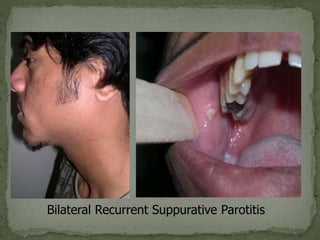
Bilateral Recurrent Suppurative Parotitis
Nasal/Nasopharyngeal
problems
1 .Sinusitis & Nasopharyngitis
2 .Chronic nasal airway obstruction
3 .Adenoid hypertrophy
4 .Rhinolithiasis & Nasopharyngeal
lithiasis
5 .Nasal & Sinus granulomas
6 . Nasal & Sinus tumors.
7 .Nasopharyngeal Carcinoma
Systemic diseases
 Diabetes mellitus, Diabetic ketoacidosis,
 Renal failure, Bowel obstruction, etc.
 Liver failure
 Lung abscess, Bronchiectasis
 Severe GERD with H. Pylori
 Pharyngeal pouch
 Gastric & Esophageal carcinoma
 Carcinoma of the Larynx & Tracheobronchial
Tree
 Granuloma of the Larynx & Tracheobronchial
Tree
 Sjogren syndrome & Post irradiation therapy
 Trimethylaminuria
Physiologic considerations
1. Reduction of
salivation
2. Dehydration
3. Vitamin deficiency
4. Hunger
5. Morning breath
6. Aging
7. Gastroesophageal
reflux
8. Menstruation
Physiologic considerations
It must be kept in mind that bad breath under the following circumstances
is normal :
Morning breath because the function of salivary glands slows down over
night and saliva thickens, which stops it from bathing mouth tissues
properly, therefore mouth breathers face the problem more often, but it
disappears when you eat or drink .
Hunger breath accompanies morning breath and arises from putrefaction
of pancreatic juice, which pours into the stomach when nothing is eaten or
drunk. Hunger breath is more apparent even after brushing, if morning
meals are omitted .
Menstrual breath is caused because of hormonal disturbances, which
trigger sloughing of the body’s lining tissues and oral tissues and creates
more ridges for bacteria, leading to halitosis
Drugs
1. Antihistamines
2. Anticholinergics
3. Antihypertensives
4. Anorectics
5. Antidepressants
6. Antiparkinson
7. Diuretics
8. Sulfa drugs
9. Long term use of antibiotics
Foods
1 .Food eaten (onions,
garlic, cabbage, etc)
2 .High protein diet like
Fish,red meat
3 .Dairy food
4 .Acidic food
5 .Sugars
6 .Coffee
7 .Tobacco
8 .Alcohol
Dense Protein Foods:
 A high protein diet is always ideal for
anaerobic bacteria,e.g. Fish, eggs,red
meat
 The end result is a buildup of amino
acids, which are easily converted into
volatile sulfur compounds by the
anaerobic bacteria found within the
surface of your tongue and throat.
Sugars:
 Sugar, which are fuel for the bacteria to
reproduce and create more sulfur compounds.
 In addition, other bacteria can take the
sugars and produce glycan strands, which in
turn end up causing thick layers of plaque on
enamel and around gums. This leads to tooth
decay and gum disease - and of course, worse
breath
Acidic Foods :
 Coffee - both decaf and regular
contains high levels of acids.
 Tea is a much better alternative.
 Tomato Juice
 All Citrus Juices - Orange Juice,
Pineapple Juice, Grapefruit Juice
Acidic Foods :
 The reason why acidic foods are a
concern has to do with the way the
bacteria react to an acidic environment .
The oral cavity has a normal pH of 6.5
which is in the acidic range.
Acids make the bacteria reproduce much
faster.
 Onions and garlic already contain powerful
volatile sulphur compounds, called mercaptans-
eating them simply adds more odor-which can
sometimes enter the lungs and bloodstream.
 Milk and other dairy products may cause
problems for most people (The fat content
does not matter, so low fat milk is just as
problematic as butter)
 In lactose intolerance, the system cannot digest
these dairy products properly,so they are available
to the bacteria for an extended period of time.
Trimethylaminuria-TMA“ Fish Odour
Syndrome”
 A rare problem occurs in people who have an
inability to breakdown certain proteins found in
beans.The odour produced is similar to
decaying fish .
The odor consists of sulfur compounds &
nitrogen compounds (amines)
 People with this condition must abstain from
beans and other dense protein foods.
Smoking (nicotine)
 Smoking has a drying effect on
oral tissues
 Destroys ascorbic acid (vitamin C)
which is essential for immunity
 Odor associated with smoking
depends on a number of factors,
directly related to the tar, nicotine,
and other foul smelling substances
that accumulates on teeth and soft
oral tissues (tongue, cheeks,
gums)There is no effective way to
totally eliminate smoker's breath,
although oral hygiene can help to
minimize it .
DIAGNOSIS
1. Oral examination
2. History taking
3. Smelling
4. Sampling by spoon, gauze, cotton
5. Information from family, friend
6. Self examination
7. Use of the halimeter
EXAMINATION
 Some of the characteristic
smells accompanied by
various diseases include
acetone (a fruity smell)
caused by diabetic
ketoacidosis.
 Sweaty smell caused by
liver dysfunction and
extremely foul smell caused
by diphtheria.
INVESTIGATIONS
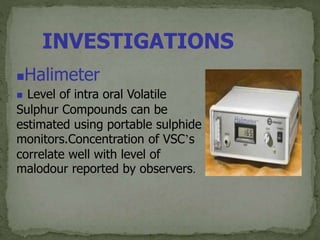
Halimeter
 Level of intra oral Volatile
Sulphur Compounds can be
estimated using portable sulphide
monitors.Concentration of VSC’s
correlate well with level of
malodour reported by observers.
Management
 Identify & eliminate obvious causes
 Dental & Oral hygiene
 Dietary advice
 Neti pot is an instrument used for
irrigation of nasal passages
 Laser Tonsillectomy or tonsillectomy
 Adenoidectomy
Neti pot
Management
Dental & Oral hygiene
Regular Dental Consultation
Regular proper tooth brushing
Interdental flossing
Tongue cleaning, brushing, scraping
Tongue cleansing by tongue scrapper ,
gauze, tooth brush without paste
Mouth rinses
Baking soda etsaphtoot or mouthwash. This changes the
acidity of the mouth
Denture care & soaking in antiseptic solution over night
Management
 The only effective method of treating
Halitosis is by attacking the bacteria’s ability to
produce VSC’s and by converting the VSC’s
into non-odorous and non-tasting organic salts.
 Nearly all cases of “real ”bad breath and/or
taste disorders (or Halitosis) involve good
bacteria and should never be treated with
antibiotics.
Dietary advice
Avoid odiferous foods: Onion, Garlic,
Spices
Avoid habits: Smoking, Alcohol, Coffee
Take regular meals, fresh fruits
Eat fresh, fibrous vegetables such as
carrots
Drink tea regularly: aet ni slonehpyloP
htworg lairetcab tibihni
Do not drink too much coffee
Management
Dietary advice
Don't miss breakfast. Hunger lead to killing-breath .
Drink plenty of liquids/ 8 glasses of water a day .
Eat parsley or wintergreen with your main meals.
These herbs release pleasant oils as they chew them
which linger for hours .
Avoid fats - cheese, butter, milk, fat meats - in your
diet if indigestion is the source of your bad breath
Avoid beans &high protein diet in Trimethylaminuria
Management
Dietary advice
Stay away from candies, mints, and chewing gum if they
contain sugar.
Chew sugar-free gum for a minute or two at a time, especially
if your mouth feels dry, chewing parsley, mint, cloves or fennel
seeds may also help.
In Xerostamia, increase your fluid intake( at least 18-20
glasses per day ), suck on sugarless lozenges.
Citrus fruits, Vitamin C makes you resistant to coughs and
colds
Name – Amanjot Singh
BDS Intern

Halitosis

  • 2.
    DEFINITIONFO HALITOSIS Halitosis is aterm used to describe noticeably unpleasant odors exhaled in breathing. It is estimated to be the third most frequent reason for seeking dental-aid, following tooth decay & periodontal diseases.
  • 3.
    Epidemiology Extremely common. Majority ofadult population have had it at some point in time. Unpleasant condition which creates huge embarrassment with potentially grave consequences.
  • 4.
     Formed bybacterial putrefaction of food debris, cells, saliva and blood.  Proteolysis of proteins,peptides,amino acids,free thiol groups & volatile sulphides.  Results from any form of sepsis : increased anaerobic activity of pathogens.  Despite rigorous hygiene, good dentition, posterior dorsum of tongue is often a source. Pathophysiology
  • 5.
    Anaerobic Sulphur ProducingBacteria which normally live BELOW the surface of the tongue and in the throat(Fusobacterium,Actinomyces ,and Bacteriods forsythus) They assist humans in digestion by breaking down proteins found in specific foods,mucus or blood, and in diseased or “broken-down ”oral tissue. Under certain conditions, these bacteria start to break down proteins at a very high rate .
  • 6.
    Proteins are madeup of Amino Acids.Two of Amino Acids in the mouth (Cysteine & methionine) are dense with sulphur. When “beneficial ”bacteria break down these compounds, the odorous and “lousy-tasting ” Volatile sulphur compounds (VSCs) are released ,Hydrogen sulphide, Dimethyl sulphide & methyl mercaptan) with other bad tasting compounds .
  • 7.
    Compounds commonly producedby mouth bacteria and their odours : Hydrogen sulfide- Rotten eggs Methyl mercaptan- Faeces Skatole - Faeces Cadaverine - Corpses Putrescine - Decaying meat Isovaleric acid - Sweaty feet Pathophysiology of Halitosis
  • 8.
    Etiology of Halitosis 1.Oral & Throat Causes 2. Nasal/ Nasopharyngeal problems 3. Systemic disease 4. Physiologic considerations 5. Drugs 6. Food 7. Psychologic disorders
  • 9.
    Oral & ThroatCauses 1 .Poor dental hygiene & food impaction 2 .Dental & Gum diseases 3 .Bacteria accumulation on the posterior dorsum of tongue & tonsils 4 .Post nasal drip 5 .Chronic tonsillitis &Tonsilloliths(Tonsil Stones) 6 .Dry mouth 7 .Oral sepsis 8 .Oral Ulcerative lesions 9 .Oral malignancy
  • 10.
    Dental & Gum Disease Periodontal disease  Dental caries  Faulty restoration  Denture  Impacted or abscessed tooth  Infected extraction sites  Residual post-operative blood  Debris under bridges or appliances kept in mouth at night or not cleaned properly. Oral & Throat Causes
  • 11.
    The real reasonfor the bad breath is bacteria that accumulate on back of tongue,in pockets of gum or in the throat. Anaerobic bacteria produce volatile sulphur compounds (VSC) such as methyl mercaptan & hydrogen sulphide. These VSC’s are source of malodor Oral & Throat Causes
  • 12.
    Tonsil Stones(tonsilloliths) arecaused by an accumulation of sulfur-producing bacteria, post nasal drip, and debris that become lodged in the tonsil crypts When this debris combines with the Volatile Sulfur Compounds produced by the anaerobic bacteria beneath the surface of the tongue, it can also create chronic Halitosis Oral & Throat Causes
  • 13.
  • 14.
    Breaking open oneof these white tonsilloliths, causes an absolutely terrible smell! which is actually a combination of volatile sulfur compounds,post nasal drip, and bacteria. Oral & Throat Causes
  • 15.
    Dry Mouth isa Leading Cause of Bad Breath  Dry mouth is naturally occurring in elderly, most cases are caused by medications, adult beverages and mouthwashes with alcohol  Saliva contains Oxygen, which helps oxygenate the mouth keep it healthy and fresh  Dry mouth with less saliva and less oxygen, makes bad breath gets worse by creating an anaerobic environment, perfect for the bacteria to produce more of these odorous compounds. Oral & Throat Causes
  • 16.
    Excess Mucus (Post-NasalDrip) is actually a Food Source For Anaerobic Bacteria  When a person has post-nasal drip, mucus coats the back of the tongue and throat. Since mucus is made up of interlinked strands of protein, the bacteria, break down these proteins into odorous and sour tasting sulfur type compounds .  Strong antihistamines don’t help, because the drying effect of the antihistamines also creates a problem (by reducing the amount of germ-controlling saliva) Oral & Throat Causes
  • 17.
    Gingivitis Acute necrotizing ulcerativegingivitis (ANUG) or Trench mouth
  • 18.
  • 19.
  • 20.
    Patients with fissuredtongue dorsum may have elongated filiform papillae along the fissure walls Black Hairy Tongue Oral & Throat Causes
  • 21.
    Low-magnification photo-micrograph,the elongation of filiform papillaeis clearly evident. The debris between papillae consists of desquamated epithelial cells and microbial colonies Black Hairy Tongue Oral & Throat Causes
  • 22.
  • 23.
  • 24.
    Nasal/Nasopharyngeal problems 1 .Sinusitis &Nasopharyngitis 2 .Chronic nasal airway obstruction 3 .Adenoid hypertrophy 4 .Rhinolithiasis & Nasopharyngeal lithiasis 5 .Nasal & Sinus granulomas 6 . Nasal & Sinus tumors. 7 .Nasopharyngeal Carcinoma
  • 25.
    Systemic diseases  Diabetesmellitus, Diabetic ketoacidosis,  Renal failure, Bowel obstruction, etc.  Liver failure  Lung abscess, Bronchiectasis  Severe GERD with H. Pylori  Pharyngeal pouch  Gastric & Esophageal carcinoma  Carcinoma of the Larynx & Tracheobronchial Tree  Granuloma of the Larynx & Tracheobronchial Tree  Sjogren syndrome & Post irradiation therapy  Trimethylaminuria
  • 26.
    Physiologic considerations 1. Reductionof salivation 2. Dehydration 3. Vitamin deficiency 4. Hunger 5. Morning breath 6. Aging 7. Gastroesophageal reflux 8. Menstruation
  • 27.
    Physiologic considerations It mustbe kept in mind that bad breath under the following circumstances is normal : Morning breath because the function of salivary glands slows down over night and saliva thickens, which stops it from bathing mouth tissues properly, therefore mouth breathers face the problem more often, but it disappears when you eat or drink . Hunger breath accompanies morning breath and arises from putrefaction of pancreatic juice, which pours into the stomach when nothing is eaten or drunk. Hunger breath is more apparent even after brushing, if morning meals are omitted . Menstrual breath is caused because of hormonal disturbances, which trigger sloughing of the body’s lining tissues and oral tissues and creates more ridges for bacteria, leading to halitosis
  • 28.
    Drugs 1. Antihistamines 2. Anticholinergics 3.Antihypertensives 4. Anorectics 5. Antidepressants 6. Antiparkinson 7. Diuretics 8. Sulfa drugs 9. Long term use of antibiotics
  • 29.
    Foods 1 .Food eaten(onions, garlic, cabbage, etc) 2 .High protein diet like Fish,red meat 3 .Dairy food 4 .Acidic food 5 .Sugars 6 .Coffee 7 .Tobacco 8 .Alcohol
  • 30.
    Dense Protein Foods: A high protein diet is always ideal for anaerobic bacteria,e.g. Fish, eggs,red meat  The end result is a buildup of amino acids, which are easily converted into volatile sulfur compounds by the anaerobic bacteria found within the surface of your tongue and throat.
  • 31.
    Sugars:  Sugar, whichare fuel for the bacteria to reproduce and create more sulfur compounds.  In addition, other bacteria can take the sugars and produce glycan strands, which in turn end up causing thick layers of plaque on enamel and around gums. This leads to tooth decay and gum disease - and of course, worse breath
  • 32.
    Acidic Foods : Coffee - both decaf and regular contains high levels of acids.  Tea is a much better alternative.  Tomato Juice  All Citrus Juices - Orange Juice, Pineapple Juice, Grapefruit Juice
  • 33.
    Acidic Foods : The reason why acidic foods are a concern has to do with the way the bacteria react to an acidic environment . The oral cavity has a normal pH of 6.5 which is in the acidic range. Acids make the bacteria reproduce much faster.
  • 34.
     Onions andgarlic already contain powerful volatile sulphur compounds, called mercaptans- eating them simply adds more odor-which can sometimes enter the lungs and bloodstream.  Milk and other dairy products may cause problems for most people (The fat content does not matter, so low fat milk is just as problematic as butter)  In lactose intolerance, the system cannot digest these dairy products properly,so they are available to the bacteria for an extended period of time.
  • 35.
    Trimethylaminuria-TMA“ Fish Odour Syndrome” A rare problem occurs in people who have an inability to breakdown certain proteins found in beans.The odour produced is similar to decaying fish . The odor consists of sulfur compounds & nitrogen compounds (amines)  People with this condition must abstain from beans and other dense protein foods.
  • 36.
    Smoking (nicotine)  Smokinghas a drying effect on oral tissues  Destroys ascorbic acid (vitamin C) which is essential for immunity  Odor associated with smoking depends on a number of factors, directly related to the tar, nicotine, and other foul smelling substances that accumulates on teeth and soft oral tissues (tongue, cheeks, gums)There is no effective way to totally eliminate smoker's breath, although oral hygiene can help to minimize it .
  • 37.
    DIAGNOSIS 1. Oral examination 2.History taking 3. Smelling 4. Sampling by spoon, gauze, cotton 5. Information from family, friend 6. Self examination 7. Use of the halimeter
  • 38.
    EXAMINATION  Some ofthe characteristic smells accompanied by various diseases include acetone (a fruity smell) caused by diabetic ketoacidosis.  Sweaty smell caused by liver dysfunction and extremely foul smell caused by diphtheria.
  • 39.
    INVESTIGATIONS Halimeter  Level ofintra oral Volatile Sulphur Compounds can be estimated using portable sulphide monitors.Concentration of VSC’s correlate well with level of malodour reported by observers.
  • 40.
    Management  Identify &eliminate obvious causes  Dental & Oral hygiene  Dietary advice  Neti pot is an instrument used for irrigation of nasal passages  Laser Tonsillectomy or tonsillectomy  Adenoidectomy Neti pot
  • 41.
    Management Dental & Oralhygiene Regular Dental Consultation Regular proper tooth brushing Interdental flossing Tongue cleaning, brushing, scraping Tongue cleansing by tongue scrapper , gauze, tooth brush without paste Mouth rinses Baking soda etsaphtoot or mouthwash. This changes the acidity of the mouth Denture care & soaking in antiseptic solution over night
  • 42.
    Management  The onlyeffective method of treating Halitosis is by attacking the bacteria’s ability to produce VSC’s and by converting the VSC’s into non-odorous and non-tasting organic salts.  Nearly all cases of “real ”bad breath and/or taste disorders (or Halitosis) involve good bacteria and should never be treated with antibiotics.
  • 43.
    Dietary advice Avoid odiferousfoods: Onion, Garlic, Spices Avoid habits: Smoking, Alcohol, Coffee Take regular meals, fresh fruits Eat fresh, fibrous vegetables such as carrots Drink tea regularly: aet ni slonehpyloP htworg lairetcab tibihni Do not drink too much coffee
  • 44.
    Management Dietary advice Don't missbreakfast. Hunger lead to killing-breath . Drink plenty of liquids/ 8 glasses of water a day . Eat parsley or wintergreen with your main meals. These herbs release pleasant oils as they chew them which linger for hours . Avoid fats - cheese, butter, milk, fat meats - in your diet if indigestion is the source of your bad breath Avoid beans &high protein diet in Trimethylaminuria
  • 45.
    Management Dietary advice Stay awayfrom candies, mints, and chewing gum if they contain sugar. Chew sugar-free gum for a minute or two at a time, especially if your mouth feels dry, chewing parsley, mint, cloves or fennel seeds may also help. In Xerostamia, increase your fluid intake( at least 18-20 glasses per day ), suck on sugarless lozenges. Citrus fruits, Vitamin C makes you resistant to coughs and colds
  • 46.
    Name – AmanjotSingh BDS Intern