E3a Knowledge Questions and Answers Unit H6 (012) Cut hair using basic techniques
1. State your salons requirements for client preparation Answer: Candidates answer should reflect salon policy but include reference to gowning the client
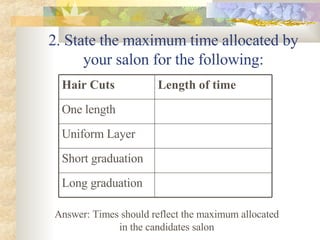
2. State the maximum time allocated by your salon for the following: Answer: Times should reflect the maximum allocated in the candidates salon Long graduation Short graduation Uniform Layer One length Length of time Hair Cuts
3. State your salons and legal requirements for the disposal of waste materials Answer: Make reference to disposal of hair and sharps
4. List at least two items from the range of protective clothing and materials that should be available for clients  Answer: Responses should include two of the following – gowns, cutting collar, cape, neck strips, towels
5. Describe why it is important to protect clients from hair clippings Answer: To maintain client comfort throughout and following the service To protect the clients clothing
6. Describe how the position of your client and yourself can affect the desired outcome and minimise fatigue and the risk of injury Answer: Client – seat the client comfortably with back against the chair. Try to prevent the client from slouching. This minimises discomfort to the client and helps the stylist to complete the haircut correctly. Yourself – stand with feet slightly apart to maintain balance and even distribution of weight. Avoid stretching or bending. This helps to prevent long term injury
7. State two safety considerations that have to be taken into account when cutting hair Answer: Disposal of sharps in accordance with legal requirements and salon procedures Client position and comfort Avoid harm to self and others Prompt removal of hair cuttings from the floor Care when handling cutting tools
8. Briefly describe why it is important to avoid cross infection and infestation Answer: To ensure the image and reputation of the salon is maintained To minimise the risk of spreading infection and infestation
9. State two reasons why work areas should be kept clean and tidy Answer: To minimise the risk of cross infection To maintain a professional image To reduce hazards
10. Briefly describe why it is important to position your cutting tools for ease of use. Answer: To ensure that all tools are readily available and to provide an efficient method throughout the service.
11. State three methods that can be used in the salon for sterilising tools and equipment Answer: Moist heat  Chemical Ultra violet rays
12. Identify the appropriate method of sterilisation for the tools listed  Answer: UV Rays Chemicals Sectioning Clips UV Rays Chemicals Combs UV Rays Moist Heat Razors UV Rays Moist Heat Scissors  Appropriate method of sterilisation Cutting Tools
13. Outline at least four methods for working safely and hygienically when cutting hair Answer: The candidate should make reference to at least four of the following: Use clean protective materials Sterilise all tools Use tools with care Remove hair cuttings from floor at end of service Remove hair cuttings from client throughout the service Keep work area clean and tidy throughout service
14. State at least three ways of correctly using and maintaining cutting tools Answer: The candidates response should include at least three of the following: Ensure that all tools are fit for purpose Use only for intended purpose Carry in a safe manner Clean and sterilise after use Oil cutting tools are required
15. State the importance of personal hygiene  Answer: To minimise offence to clients and colleagues To reduce the risk of cross infection To reduce the risk of cross infestation
16. Describe briefly why each of the following factors must be taken into consideration  prior and during  cutting Suspected infections Suspected infestations Hair density Hair texture Hair type Head and face shape Hair elasticity  Hair growth patterns Piercings Scalp disorders
16. Answer: Suspected infections: to minimise the risk of spreading the infection Suspected infestation: to minimise the risk of spreading the infestation Hair density – the hair may be too abundant or too sparse for the expected result Hair texture – the texture of the clients hair may be unsuitable for the expected result Hair type – the hair may be too curly, wavy or straight for the expected result  Head and face shape – the choice of haircut or style may be unflattering for the clients head or face shape Hair elasticity – the degree of tension applied to the hair will vary according to the amount of elasticity Hair growth patterns – the client may have a hair growth pattern that will influence the choice of the hair cut Piercings – to minimise the risk of injury or discomfort to the client if cutting tools or combs come into contact with piercing To ensure that the haircut can be completed to the satisfaction of the client Scalp disorders – the client may have a scalp disorder that will influence the choice of the haircut
17. List the factors which should be considered when cutting wet hair and dry hair Answer: Hair elasticity  Hair growth pattern Hair type Hair style
18. State the average rate of hair growth Answer: 1.25cm (or ½ inch) per month
19. State why it is important to check the hair before and after shampooing prior to cutting Answer: Before shampooing – to enable the stylist to identify the natural hair growth patterns, hair density, texture, elasticity, degree of curl and preferred direction of hair After shampooing – to enable the stylist to identify the natural lie of hair, the degree of curl and elasticity
20. State the importance of consulting with clients throughout the cutting process. Answer: To accurately establish the clients wishes, to provide accurate information to the client, to confirm the progress of the haircut in meeting the clients expectations.
21. State the importance of applying the correct degree of tension to the hair when cutting  Answer: To avoid stretching the hair and thereby cutting it too short To avoid using different tensions that would create an uneven result
22. State a.) when and b.) how to use club, freehand and scissor over comb cutting techniques Answer a.) Club – to reduce length, to retain bulk of hair Freehand – when tension is to be avoided or is not required Scissor over comb – to achieve graduation in a hair cut, to achieve a shorter, closer look b.) Club – hair is held between fingers and cut straight across Freehand – hair is combed into position and cut without being held  Scissor over comb – hair is lifted by and held in the comb whilst being cut with the scissors
23. State the reasons for establishing and following cutting guidelines Answer: To determine the finished length and shape of the required haircut To ensure methodical progression of the haircut To enable an accurate cut to be achieved
24. State the importance of cross checking the cut Answer: To ensure the accuracy of the hair cut
25. State the importance of working with the natural fall of the hair when considering weight distribution within a hair cut Answer: To ensure that the expected shape of the hair cut can be achieved

H6 Revision

  • 1.
    E3a Knowledge Questionsand Answers Unit H6 (012) Cut hair using basic techniques
  • 2.
    1. State yoursalons requirements for client preparation Answer: Candidates answer should reflect salon policy but include reference to gowning the client
  • 3.
    2. State themaximum time allocated by your salon for the following: Answer: Times should reflect the maximum allocated in the candidates salon Long graduation Short graduation Uniform Layer One length Length of time Hair Cuts
  • 4.
    3. State yoursalons and legal requirements for the disposal of waste materials Answer: Make reference to disposal of hair and sharps
  • 5.
    4. List atleast two items from the range of protective clothing and materials that should be available for clients Answer: Responses should include two of the following – gowns, cutting collar, cape, neck strips, towels
  • 6.
    5. Describe whyit is important to protect clients from hair clippings Answer: To maintain client comfort throughout and following the service To protect the clients clothing
  • 7.
    6. Describe howthe position of your client and yourself can affect the desired outcome and minimise fatigue and the risk of injury Answer: Client – seat the client comfortably with back against the chair. Try to prevent the client from slouching. This minimises discomfort to the client and helps the stylist to complete the haircut correctly. Yourself – stand with feet slightly apart to maintain balance and even distribution of weight. Avoid stretching or bending. This helps to prevent long term injury
  • 8.
    7. State twosafety considerations that have to be taken into account when cutting hair Answer: Disposal of sharps in accordance with legal requirements and salon procedures Client position and comfort Avoid harm to self and others Prompt removal of hair cuttings from the floor Care when handling cutting tools
  • 9.
    8. Briefly describewhy it is important to avoid cross infection and infestation Answer: To ensure the image and reputation of the salon is maintained To minimise the risk of spreading infection and infestation
  • 10.
    9. State tworeasons why work areas should be kept clean and tidy Answer: To minimise the risk of cross infection To maintain a professional image To reduce hazards
  • 11.
    10. Briefly describewhy it is important to position your cutting tools for ease of use. Answer: To ensure that all tools are readily available and to provide an efficient method throughout the service.
  • 12.
    11. State threemethods that can be used in the salon for sterilising tools and equipment Answer: Moist heat Chemical Ultra violet rays
  • 13.
    12. Identify theappropriate method of sterilisation for the tools listed Answer: UV Rays Chemicals Sectioning Clips UV Rays Chemicals Combs UV Rays Moist Heat Razors UV Rays Moist Heat Scissors Appropriate method of sterilisation Cutting Tools
  • 14.
    13. Outline atleast four methods for working safely and hygienically when cutting hair Answer: The candidate should make reference to at least four of the following: Use clean protective materials Sterilise all tools Use tools with care Remove hair cuttings from floor at end of service Remove hair cuttings from client throughout the service Keep work area clean and tidy throughout service
  • 15.
    14. State atleast three ways of correctly using and maintaining cutting tools Answer: The candidates response should include at least three of the following: Ensure that all tools are fit for purpose Use only for intended purpose Carry in a safe manner Clean and sterilise after use Oil cutting tools are required
  • 16.
    15. State theimportance of personal hygiene Answer: To minimise offence to clients and colleagues To reduce the risk of cross infection To reduce the risk of cross infestation
  • 17.
    16. Describe brieflywhy each of the following factors must be taken into consideration prior and during cutting Suspected infections Suspected infestations Hair density Hair texture Hair type Head and face shape Hair elasticity Hair growth patterns Piercings Scalp disorders
  • 18.
    16. Answer: Suspectedinfections: to minimise the risk of spreading the infection Suspected infestation: to minimise the risk of spreading the infestation Hair density – the hair may be too abundant or too sparse for the expected result Hair texture – the texture of the clients hair may be unsuitable for the expected result Hair type – the hair may be too curly, wavy or straight for the expected result Head and face shape – the choice of haircut or style may be unflattering for the clients head or face shape Hair elasticity – the degree of tension applied to the hair will vary according to the amount of elasticity Hair growth patterns – the client may have a hair growth pattern that will influence the choice of the hair cut Piercings – to minimise the risk of injury or discomfort to the client if cutting tools or combs come into contact with piercing To ensure that the haircut can be completed to the satisfaction of the client Scalp disorders – the client may have a scalp disorder that will influence the choice of the haircut
  • 19.
    17. List thefactors which should be considered when cutting wet hair and dry hair Answer: Hair elasticity Hair growth pattern Hair type Hair style
  • 20.
    18. State theaverage rate of hair growth Answer: 1.25cm (or ½ inch) per month
  • 21.
    19. State whyit is important to check the hair before and after shampooing prior to cutting Answer: Before shampooing – to enable the stylist to identify the natural hair growth patterns, hair density, texture, elasticity, degree of curl and preferred direction of hair After shampooing – to enable the stylist to identify the natural lie of hair, the degree of curl and elasticity
  • 22.
    20. State theimportance of consulting with clients throughout the cutting process. Answer: To accurately establish the clients wishes, to provide accurate information to the client, to confirm the progress of the haircut in meeting the clients expectations.
  • 23.
    21. State theimportance of applying the correct degree of tension to the hair when cutting Answer: To avoid stretching the hair and thereby cutting it too short To avoid using different tensions that would create an uneven result
  • 24.
    22. State a.)when and b.) how to use club, freehand and scissor over comb cutting techniques Answer a.) Club – to reduce length, to retain bulk of hair Freehand – when tension is to be avoided or is not required Scissor over comb – to achieve graduation in a hair cut, to achieve a shorter, closer look b.) Club – hair is held between fingers and cut straight across Freehand – hair is combed into position and cut without being held Scissor over comb – hair is lifted by and held in the comb whilst being cut with the scissors
  • 25.
    23. State thereasons for establishing and following cutting guidelines Answer: To determine the finished length and shape of the required haircut To ensure methodical progression of the haircut To enable an accurate cut to be achieved
  • 26.
    24. State theimportance of cross checking the cut Answer: To ensure the accuracy of the hair cut
  • 27.
    25. State theimportance of working with the natural fall of the hair when considering weight distribution within a hair cut Answer: To ensure that the expected shape of the hair cut can be achieved