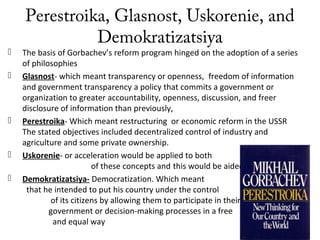
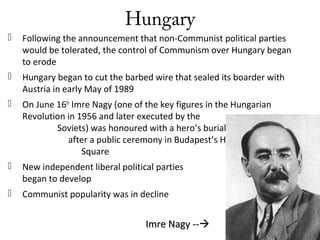
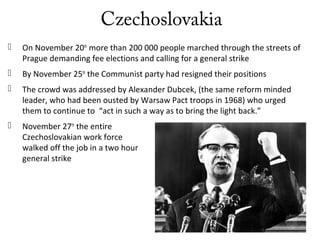
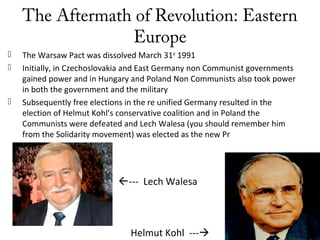
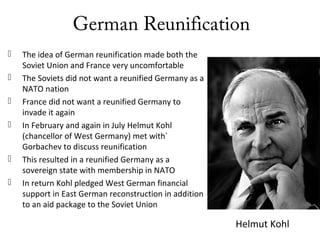
Mikhail Gorbachev became the leader of the Soviet Union in 1985 and sought to reform the Soviet system through his policies of perestroika, glasnost, uskorenie, and demokratizatsiya. This involved restructuring the political and economic system, increasing transparency, accelerating reforms, and democratizing. He faced opposition from conservatives and Boris Yeltsin. Glasnost allowed for greater freedom of expression and criticism, but also increased unrest in Soviet republics and satellite states. Reforms began to spread through Eastern Europe in 1989, with Solidarity gaining power in Poland and Hungary liberalizing under Soviet non-intervention.